> ## Documentation Index
> Fetch the complete documentation index at: https://promptwatch.com/docs/llms.txt
> Use this file to discover all available pages before exploring further.
# Identifying Your Competitors
> How to build and maintain your competitor list in Promptwatch, and how that list shapes Share of Voice, the heatmap, and mention detection.
### Why the competitor list matters
Competitors in Promptwatch are the brands you're measured against. The list is set once at the project level and applies to every monitor, and it feeds three things directly:
* **Share of Voice**: every competitor's mentions join the denominator, so adding one changes your share even if nothing else moved. See [Share of Voice](/docs/academy/share-of-voice).
* **The competitor heatmap**: a brand-by-model matrix. By default it shows the top detected brands; switch the filter to "My brands" to show your own brand plus your direct competitors as the rows. See [competitors and the heatmap](/docs/academy/competitors-and-heatmap).
* **Detection accuracy**: direct competitors' names and aliases are passed into the analysis of every response, the same way your own brand is, so their mentions are tracked as reliably as yours.
Because of the first point, the list is part of the metric. Keep it to brands you actually compete with: a padded list dilutes your share with a market you're not in, and a thin list flatters you.
### Where competitors live
Open **Competitors** in the sidebar. The page has three tabs:
* **Direct Competitors**: the brands in your comparison set.
* **Ignored**: brands you've excluded, like publishers, marketplaces, or irrelevant names the models keep bringing up.
* **Suggestions**: brands Promptwatch detected in your responses over the last 90 days that you haven't classified yet. This is where new rivals surface on their own.
Your own brand is managed in the [Brand Book](/docs/academy/brand-profile), not in these tabs.
### Suggested vs. manual competitors
Your first competitor set is suggested during setup from your website analysis. After that, the Suggestions tab does the ongoing work: every brand that shows up in your responses lands there until you decide what it is. This is worth checking regularly, because the brands AI models recommend instead of you are, by definition, your competitors in this channel, whether or not you think of them that way.
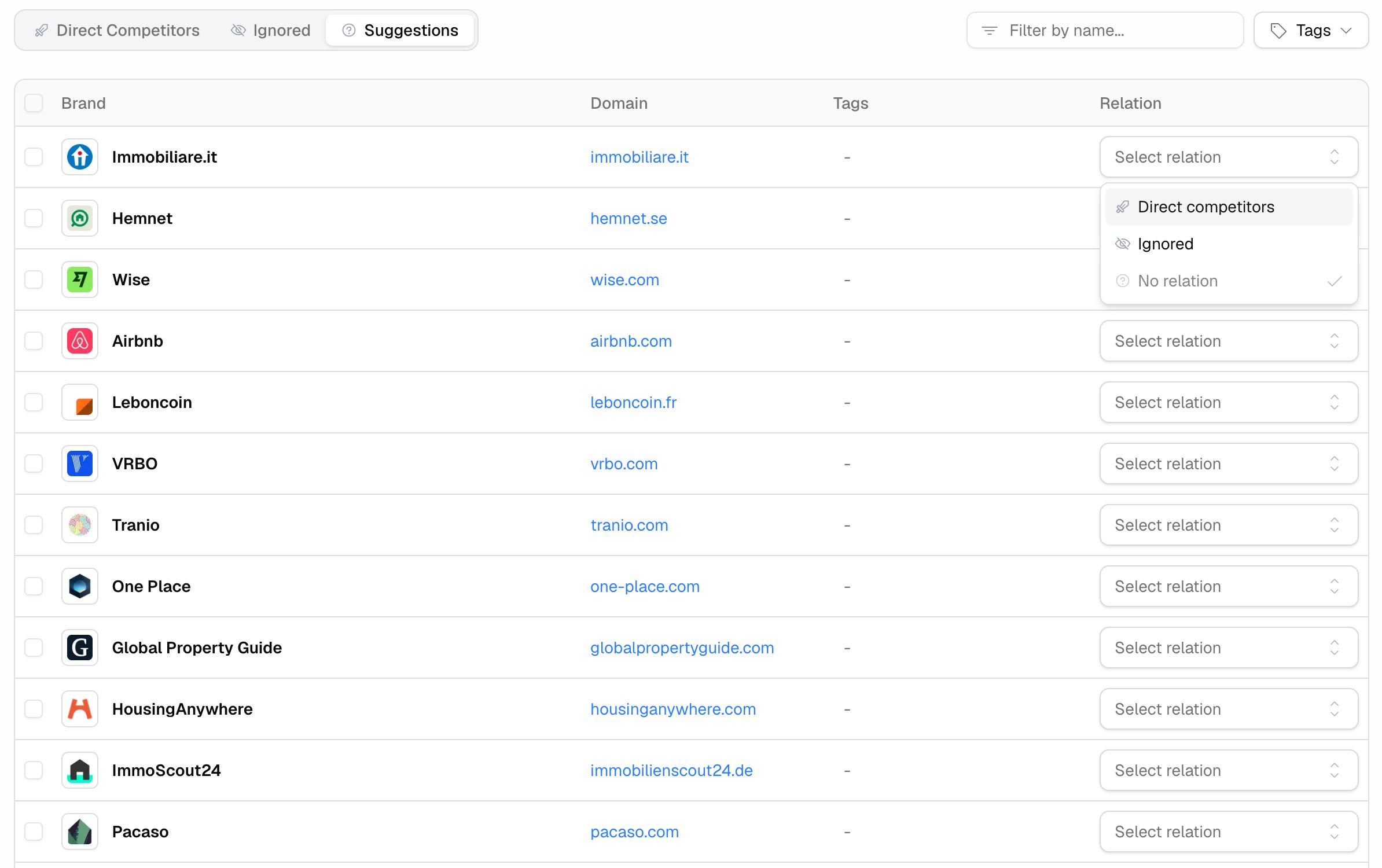 * **Promote a suggestion**: open the relation dropdown on its row and pick "Direct competitors". It joins your comparison set from that point on.
* **Dismiss noise**: select rows and use "Ignore selected", or set the row to "Ignored". Ignored brands stay out of your charts.
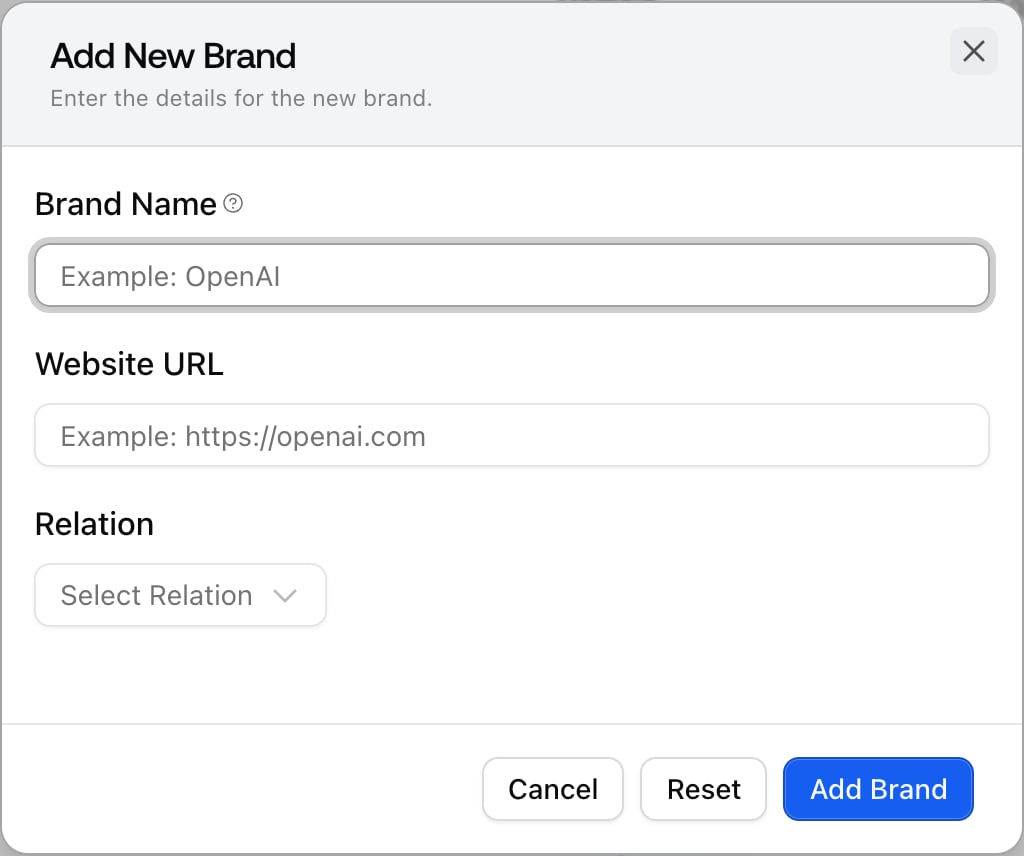
* **Add one manually**: click **Add Competitor** and enter the brand name, website URL, and relation (Direct Competitor or Ignore). Use this for competitors that haven't appeared in your responses yet, which is itself a signal worth tracking: if they start getting mentioned, you'll see it.
* **Promote a suggestion**: open the relation dropdown on its row and pick "Direct competitors". It joins your comparison set from that point on.
* **Dismiss noise**: select rows and use "Ignore selected", or set the row to "Ignored". Ignored brands stay out of your charts.
* **Add one manually**: click **Add Competitor** and enter the brand name, website URL, and relation (Direct Competitor or Ignore). Use this for competitors that haven't appeared in your responses yet, which is itself a signal worth tracking: if they start getting mentioned, you'll see it.
 ### Managing competitors: status and removal
There is no delete button for competitors, and that's deliberate: a brand you remove can start showing up in your responses again tomorrow, and its mention history stays useful. Instead of deleting, you change a brand's relation, which controls whether it counts in your metrics.
#### Changing a single brand's status
1. Open **Competitors** in the sidebar and find the brand on any of the three tabs.
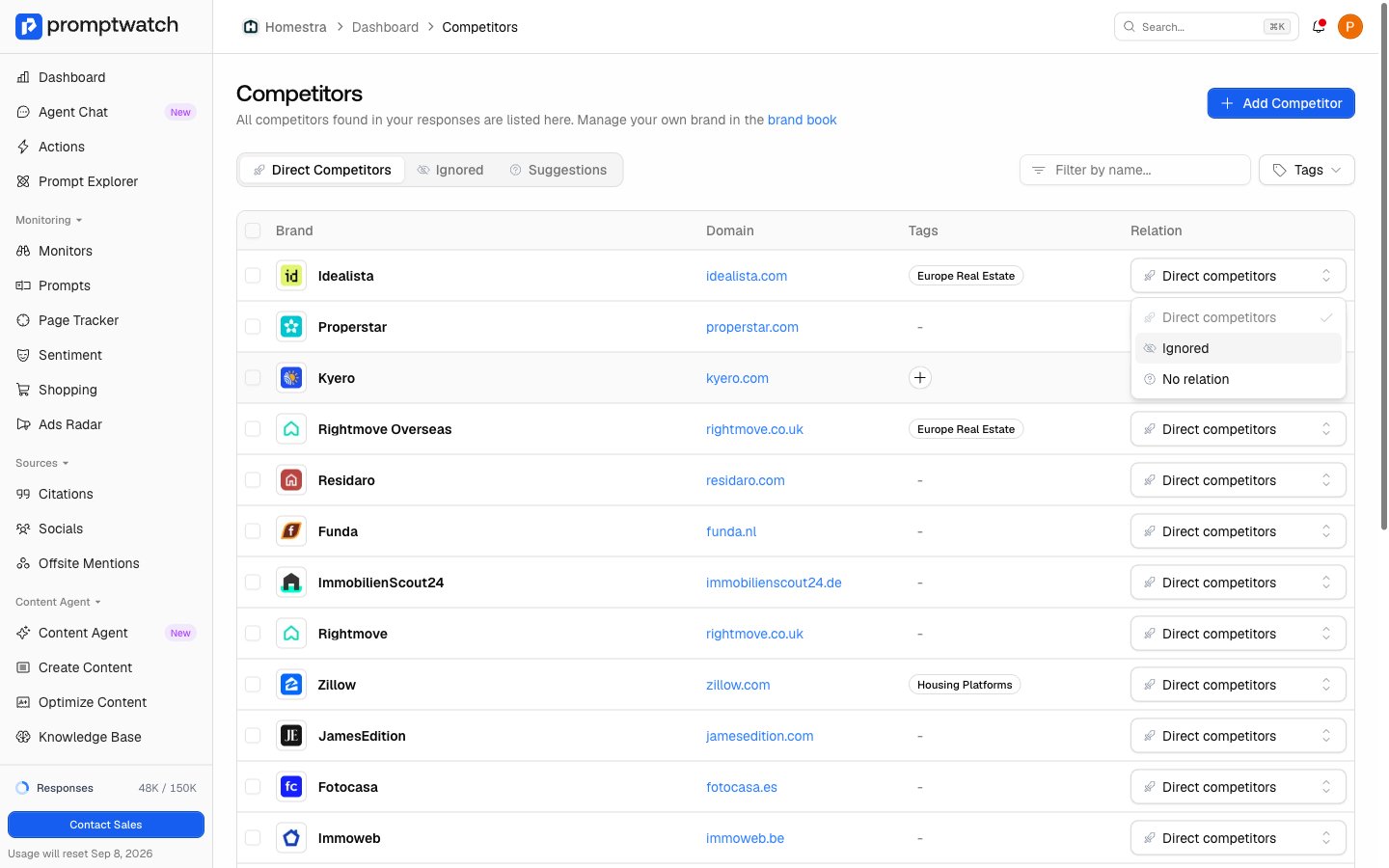
2. Click the dropdown in the **Relation** column of its row.
3. Pick **Direct competitors**, **Ignored**, or **No relation**.
### Managing competitors: status and removal
There is no delete button for competitors, and that's deliberate: a brand you remove can start showing up in your responses again tomorrow, and its mention history stays useful. Instead of deleting, you change a brand's relation, which controls whether it counts in your metrics.
#### Changing a single brand's status
1. Open **Competitors** in the sidebar and find the brand on any of the three tabs.
2. Click the dropdown in the **Relation** column of its row.
3. Pick **Direct competitors**, **Ignored**, or **No relation**.
 The change applies immediately: charts re-query with the new relation rather than re-analyzing past responses, so history is preserved under the new label (some charts, like the heatmap, can take a few minutes to reflect it). What each status means:
* **Direct competitors**: the brand joins your comparison set. It counts in Share of Voice and appears in your competitive charts.
* **Ignored**: the brand is excluded from your charts and competitive analysis. This is the closest thing to deleting, and the right choice for publishers, marketplaces, and irrelevant names.
* **No relation**: the brand returns to the Suggestions tab, unclassified. It drops out of the default Share of Voice comparison (your brand plus direct competitors) but can still appear on the heatmap when the heatmap filter is set to All brands.
Ignored and No relation both take the brand out of your comparison set, but they aren't identical: Ignored is excluded everywhere, while No relation stays visible on the heatmap under All brands and keeps resurfacing in Suggestions as long as models mention it. Ignored records a decision; No relation puts the brand back in the review queue.
#### Removing several suggestions at once
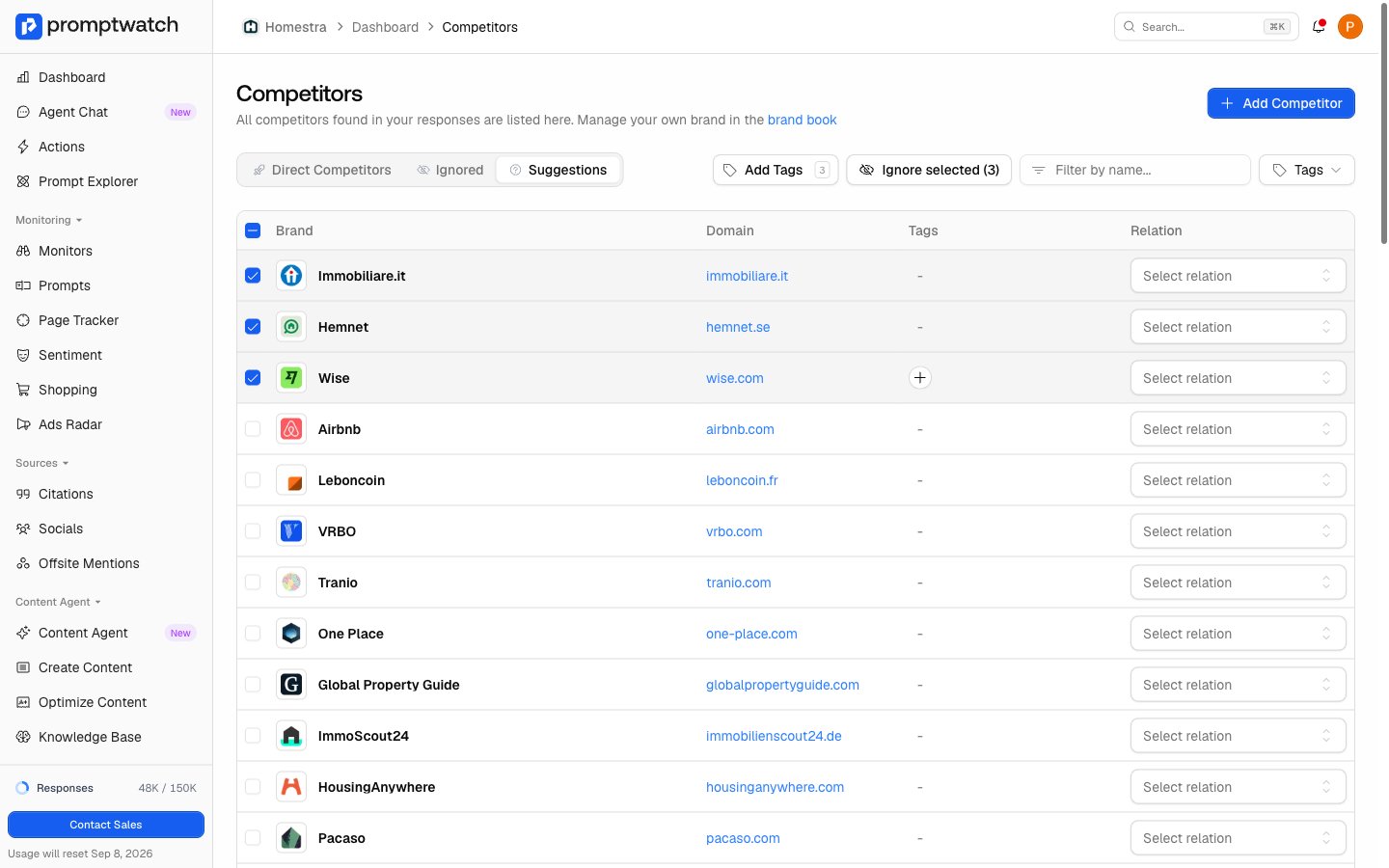
On the **Suggestions** tab, select rows with the checkboxes and click **Ignore selected (N)**. A confirmation dialog lists the brands about to be marked as ignored; confirm to move them all out of Suggestions in one step. This is the fast way to clear a backlog of publishers and noise after your first weeks of data.
The change applies immediately: charts re-query with the new relation rather than re-analyzing past responses, so history is preserved under the new label (some charts, like the heatmap, can take a few minutes to reflect it). What each status means:
* **Direct competitors**: the brand joins your comparison set. It counts in Share of Voice and appears in your competitive charts.
* **Ignored**: the brand is excluded from your charts and competitive analysis. This is the closest thing to deleting, and the right choice for publishers, marketplaces, and irrelevant names.
* **No relation**: the brand returns to the Suggestions tab, unclassified. It drops out of the default Share of Voice comparison (your brand plus direct competitors) but can still appear on the heatmap when the heatmap filter is set to All brands.
Ignored and No relation both take the brand out of your comparison set, but they aren't identical: Ignored is excluded everywhere, while No relation stays visible on the heatmap under All brands and keeps resurfacing in Suggestions as long as models mention it. Ignored records a decision; No relation puts the brand back in the review queue.
#### Removing several suggestions at once
On the **Suggestions** tab, select rows with the checkboxes and click **Ignore selected (N)**. A confirmation dialog lists the brands about to be marked as ignored; confirm to move them all out of Suggestions in one step. This is the fast way to clear a backlog of publishers and noise after your first weeks of data.
 ### Organizing a longer list
You can tag competitor brands, for example "enterprise", "budget", or "regional", and filter the competitors page by tag. Brand tags organize this page; they don't filter the project dashboard, which slices by topic.
### What happens next
Once your Direct Competitors tab reflects your real market, the comparison metrics start meaning something: Share of Voice measures a race you're actually in, and the heatmap shows the matchups that matter. From here, make reviewing the Suggestions tab a habit, and read [competitors and the heatmap](/docs/academy/competitors-and-heatmap) to put the list to work.
### Organizing a longer list
You can tag competitor brands, for example "enterprise", "budget", or "regional", and filter the competitors page by tag. Brand tags organize this page; they don't filter the project dashboard, which slices by topic.
### What happens next
Once your Direct Competitors tab reflects your real market, the comparison metrics start meaning something: Share of Voice measures a race you're actually in, and the heatmap shows the matchups that matter. From here, make reviewing the Suggestions tab a habit, and read [competitors and the heatmap](/docs/academy/competitors-and-heatmap) to put the list to work.