Definition
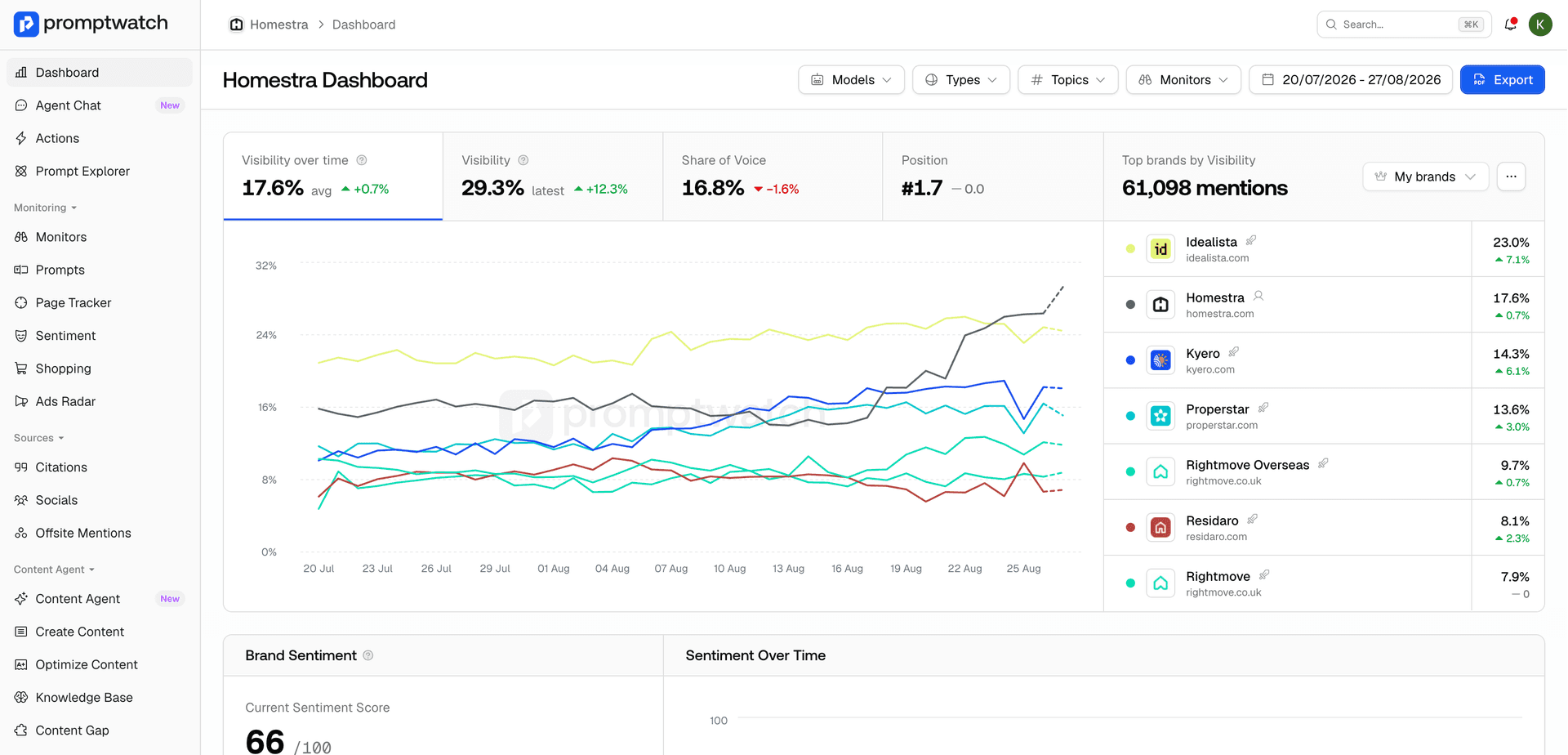
AI Share of Voice (AI SOV) measures the percentage of AI-generated responses that mention your brand versus competitors for relevant industry queries. It is the AI-era evolution of traditional share of voice, quantifying competitive positioning across ChatGPT, Claude, Perplexity, Google AI Overviews, and other AI platforms where many adults now regularly seek information.
The calculation is inherently comparative. If you test 200 relevant queries and your brand appears in 50 responses while your top competitor appears in 80, your AI SOV is 25% versus their 40%. This competitive framing makes AI SOV especially valuable for executive reporting—it immediately communicates market position in the AI discovery layer.
AI SOV is most actionable when segmented across multiple dimensions:
Platform SOV: Your share on specific AI systems. A brand might hold 35% SOV on Perplexity but only 10% on ChatGPT, since only 11% of cited domains appear on both platforms. This reveals platform-specific gaps requiring targeted optimization.
Category SOV: Your share within specific topic areas. A SaaS company might dominate 'project management for agencies' (50% SOV) but be absent from 'enterprise project management' (3% SOV).
Query Type SOV: How your share varies between recommendation queries ('best X for Y'), comparison queries ('X vs Y'), and informational queries ('how does X work'). Different query types surface different competitive dynamics.
Temporal SOV: How competitive position shifts over time, especially around content updates, competitor campaigns, and AI model refreshes.
The factors driving AI SOV mirror those driving individual citation rates but with competitive dynamics layered on top. Entity authority correlates substantially more with AI citations than technical optimization, meaning brands with stronger web-wide recognition capture disproportionate SOV. Brand web mentions show a 0.334 correlation with citations, and 85% of citation-driving mentions come from third-party sources.
Content freshness creates a particularly dynamic SOV battleground. Since pages updated within 30 days capture a large share of ChatGPT citations in industry studies for commercial queries, competitors who maintain rigorous update schedules can rapidly capture SOV from those who let content age. This makes freshness both an offensive and defensive SOV lever.
Cross-platform presence also drives SOV: sites appearing on 4+ platforms are 2.8x more likely to appear in ChatGPT responses. A multi-channel authority strategy compounds SOV gains across the AI ecosystem.
AI SOV carries strategic implications beyond marketing metrics. High SOV means your brand shapes the narrative when AI systems advise millions of users daily. Low SOV means competitors define the conversation. In markets where AI-mediated discovery is growing toward 28% of search volume by 2027, SOV gaps increasingly translate into real market share shifts.
Monitoring AI SOV requires systematic automated testing across platforms—manual testing cannot achieve the query volume, platform coverage, or update frequency needed for reliable competitive intelligence. Weekly tracking is standard, with real-time alerts for significant SOV shifts that require immediate response. Our explainer on what AI share of voice is covers the measurement setup.
Examples of AI Share of Voice
- A CRM company discovers they hold 45% AI SOV on Perplexity but only 12% on ChatGPT. Investigation reveals Perplexity heavily cites their comparison content, while ChatGPT relies on review platforms where competitors have stronger profiles. They target ChatGPT-specific optimization, increasing overall SOV from 28% to 41% across platforms
- A cybersecurity firm tracks AI SOV monthly and notices a competitor's SOV increasing 15 points after they publish original threat intelligence reports. The firm responds by launching their own research program with proprietary threat data, gradually reclaiming SOV from 30% to 52% in their niche
- A fintech startup measures AI SOV across three categories: 'business banking,' 'startup finance,' and 'SMB accounting.' Dominant SOV in startup finance (55%) but minimal presence in the other categories guides their content expansion strategy toward specific category gaps
- A law firm monitors AI SOV for 'immigration lawyer' queries and discovers their SOV varies by platform—high on Google AI Overviews due to strong local SEO signals, but low on ChatGPT where third-party review presence matters more. They launch a review generation strategy to close the platform gap
- A GEO team tests ai share of voice by comparing ChatGPT, Perplexity, Google AI Mode, and Microsoft Copilot answers for the same buying prompts, then updates content where the brand is missing or misrepresented.