


TL;DR
- Tracking brand mentions is the starting point, not the finish line. A mention count alone doesn't tell you why AI includes or excludes a brand, and closing that loop requires seeing prompts, citations, crawler activity, and content gaps together.
- Mention, citation, and visibility score measure three different things: a mention is any appearance, a citation is a sourced reference with a link, and a visibility score weighs position, tone, and competitor presence into one number, counting unmentioned responses as zero.
- Content cited in AI answers holds its relevance for roughly 8 to 14 weeks before a refresh helps, since models re-crawl and re-index on their own schedule, independent of any ranking signal.
As the way people find brands is shifting, whoever answers the question "was my brand mentioned in ChatGPT or Gemini this week?" is behind the curve. AI-driven platforms decide, per prompt, whether to name a brand at all, and that decision resets every time the model re-crawls, re-indexes, or updates its training and retrieval behavior. A brand mentioned favorably in a March response can quietly disappear from the same prompt's answer in June, with no ranking drop, no site error, and no alert unless something is watching continuously.
Promptwatch has observed more than 4.52 billion citations, clicks, and prompts across AI Search platforms, and collects over 100 million AI data points every day, so the patterns in this guide come from that dataset rather than a single test run. Before trusting any visibility score, it's worth understanding how it's actually produced, which is where the tracking method comes in.
The Blind Spot Most Brand Mention Trackers Won't Tell You About
Why an API response isn't what your customer actually sees
How a tool actually collects mention data changes what you see. Many monitoring platforms query AI models through their APIs, which is faster to build but doesn't reflect what a real person using the consumer interface sees. API responses can differ from the shipped consumer experience in ordering, localization, and which citations get surfaced.
What real UI scraping catches that an API call misses
Promptwatch scrapes the real UI interfaces of each LLM instead of relying only on API calls, running through geo-located, locale-matched sessions so the engine returns the same localized answer a genuine user in that market would get. It's a deliberate architectural choice, not a workaround: measuring what an API returns measures something most users never actually see. For a deeper look at why this distinction affects the numbers a tool reports, see how UI scraping compares to API-based tracking.
Framed as a decision rather than a fixed technical detail, teams actually choose between three ways to do this, and each one has a different failure mode depending on what you need to prove.
| Method | What it catches | Where it breaks |
|---|---|---|
| Manual checking | Fine for a one-off spot check on a handful of prompts | Doesn't scale to a daily program, and can't cover multiple markets, languages, or models at once |
| API monitoring | Cheap, programmatic, easy to automate | Blind to what the rendered consumer interface actually shows, since ordering, localization, and citation display can differ from the API response |
| Real-UI monitoring (scraped, geo-located sessions) | Reflects what an actual user in a given market sees, across multiple models at once | Requires infrastructure to maintain geo-located, locale-matched sessions at scale, which is why most tools default to the API instead |
Mention vs. Citation vs. Visibility Score: The Distinction Most Tools Skip
Reps spend the first several minutes of nearly every sales call defining these three terms, because the category still has no shared vocabulary it's one of the most common friction points in the entire sales process.
- A mention is any AI response that includes your brand, whether the tone is glowing or dismissive. Appearing three times in one answer still counts as one mention.
- A citation goes further: the model explicitly points to a page or source as evidence, usually with a link. Citations matter more than raw mentions because they show which of your pages an AI system trusts enough to reference, and citation rank matters too. A source cited as [1] gets clicked more than one cited as [5].
- A visibility score goes further still, combining position, tone, and competitor presence into a single number:
Position + Context − Competitors = Visibility Score. The lead recommendation in an answer scores highest; a brand buried in passing scores low even with positive sentiment. Critically, unmentioned responses count as zero, which is why a brand with a healthy mention count can still carry a low visibility score if it's rarely the recommendation being led with.
One related metric worth distinguishing from all three: AI share of voice measures what portion of the total conversation in your category is yours versus competitors', which is a different question from how well-positioned you are when you do appear. A brand can carry a strong share of voice and a mediocre visibility score at the same time if it's mentioned constantly but consistently hedged or buried.
Sentiment sits alongside these metrics rather than replacing any of them, since a brand can be mentioned frequently but negatively, or cited rarely but favorably. Promptwatch's AI brand sentiment analysis tracks that dimension separately, model by model.
This distinction explains a common objection: two tools can report meaningfully different scores for the same brand, and prospects report seeing gaps of 5 to 15% between competing platforms. That's not usually a bug. It reflects different methodologies (API sampling versus scraping the live interface, raw mention counts versus a weighted formula). The fix isn't picking whichever number looks better; it's asking any vendor to publish the formula and be specific about what counts as a mention, a citation, and a zero.
Direct mentions vs. off-site mentions
Not every mention an AI model draws on happens inside the answer you're reading. Off-site mentions, brand references in Reddit threads, review sites, LinkedIn posts, and news coverage, feed into what a model says even when they never appear as a citation on your own domain, since models weigh third-party sentiment alongside owned content when forming a response. That's why a share-of-voice reading built only from your own site's citation data tells half the story at best.
What "Real Time" Actually Means for AI Model Tracking
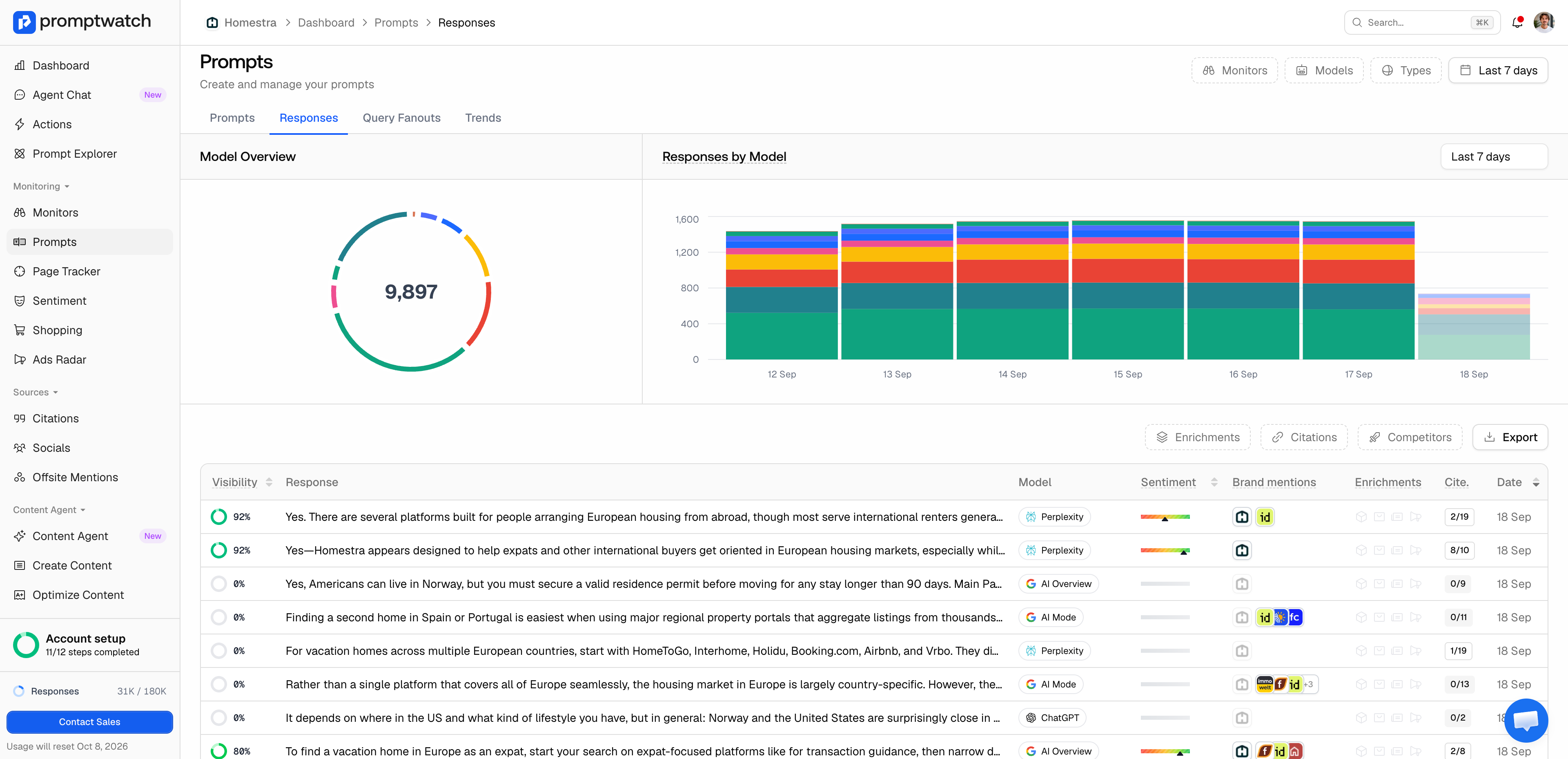
"Real-time" gets used loosely across this category, so it's worth being precise about the mechanism. In practice, tracking a brand across AI models means running a monitor: a panel of prompts executed on a repeating schedule, daily by default, across a chosen set of models, scoped to one country, one language, and optionally a US state or city. If you sell in several markets, see which AI visibility tools track brand mentions across multiple countries and languages.
"Since implementing Promptwatch, we've seen a measurable increase in our LLM visibility. Its clear insights into share of voice, content gaps, and AI crawler activity have made it a core part of our marketing reporting stack." Sam Franklin, VP Marketing at Landytech
That geo-scoping matters more than it sounds. AI answers to the same question genuinely differ by location and language; "best project management software" surfaces a different set of brands in the US than in Germany. A single blended, national-language score averages away exactly the markets where a brand is winning or losing. Multiple markets mean multiple monitors, not one monitor with more prompts crammed into it.
Monitoring Competitor Mentions and Share of Voice
A single blended visibility number hides exactly the detail that matters: which competitor is winning a given prompt, and on which platform. A competitor heatmap, mentions broken out by competitor and by platform, shows that comparison directly instead of forcing it out of one flattened score.
What a heatmap tells you that one blended score can't
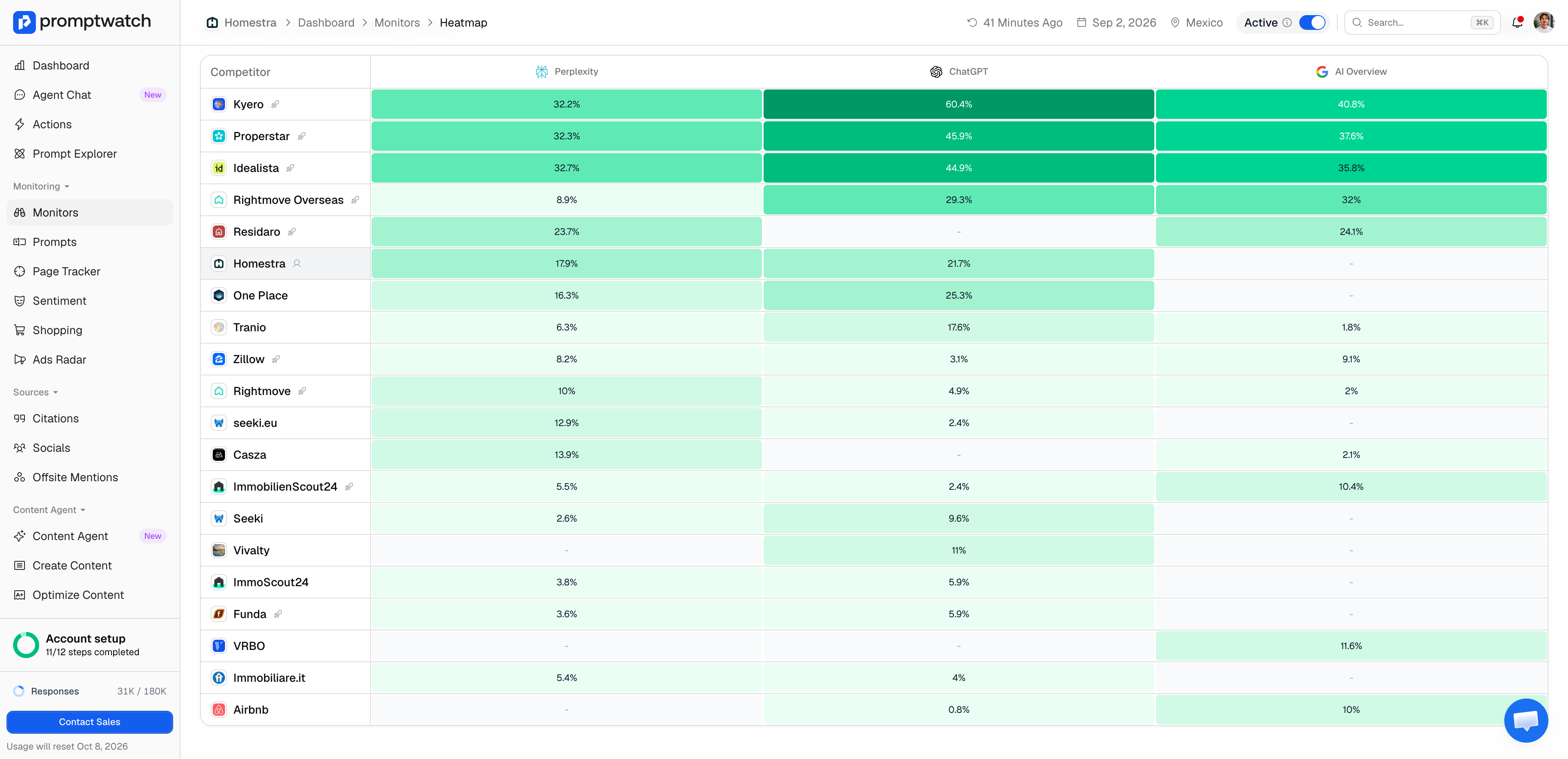
AI share of voice is a related but distinct metric from a visibility score: it measures what percentage of a conversation your brand occupies against named competitors, while a visibility score measures the quality of your own positioning within that. Tracking both together shows not just whether you're mentioned, but whether you're gaining or losing ground against the brands actually competing for the same prompts.
Crawler Logs: What AI Can See vs. What AI Says
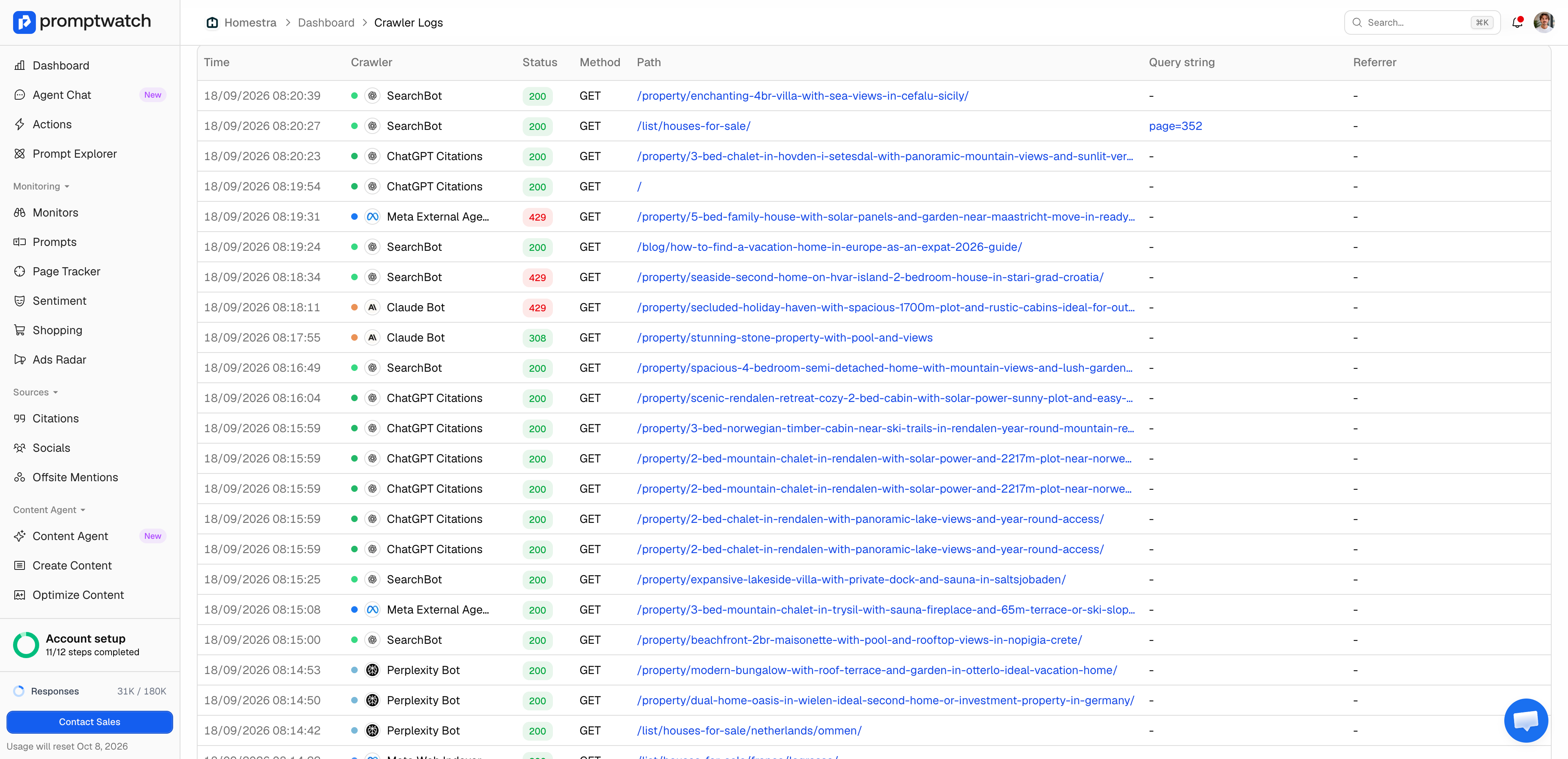
Mention tracking answers what an AI model said about a brand. It says nothing about whether that model's crawler could actually reach the pages behind the answer, which is a separate and often-overlooked failure point. A page can be well-written and still get zero citations because GPTBot or ClaudeBot hit a 403, a rate limit, or a broken redirect trying to reach it.
"In Promptwatch we are able to see how active the ChatGPT bot is on our client websites and exactly how often our content is being used in responses of LLMs." Marijn ten Bulte, Head of Organic Channels at Advise
AI crawler logs close that gap by logging every crawler hit in real time: which bot (GPTBot, ClaudeBot, PerplexityBot, and others), which page, the status code returned, and the timestamp. Lining that up against citation data shows the crawl-to-citation path directly, not just that visibility changed, but why. It's also worth being able to check which AI bots can access your website independently of any citation data, since a crawl-blocking issue often shows up in logs well before it shows up as a visibility drop.
Why "Low Clicks" From AI Search Isn't the Red Flag It Looks Like
Crawler activity and human visitor traffic need to stay separate in any dashboard you're reading. Crawler hits show what AI can see; visitor traffic (a human clicking through from an AI answer) shows what's actually converting. Blurring the two produces a dashboard that looks busy and tells you nothing about ROI, especially since AI-referred click-through rates routinely run under 0.1%, far below traditional search. That's not a channel failure so much as a reflection of where the value sits: most of it happens inside the answer itself, in being the brand a model names and recommends, not in the click.
What to measure instead of clicks
That reframing changes which numbers to report first: lead with presence, prominence, and share of voice, and treat click-through rate as one input among several rather than the metric the whole channel gets judged on.
From Mentions to Action: Closing the Content Gap
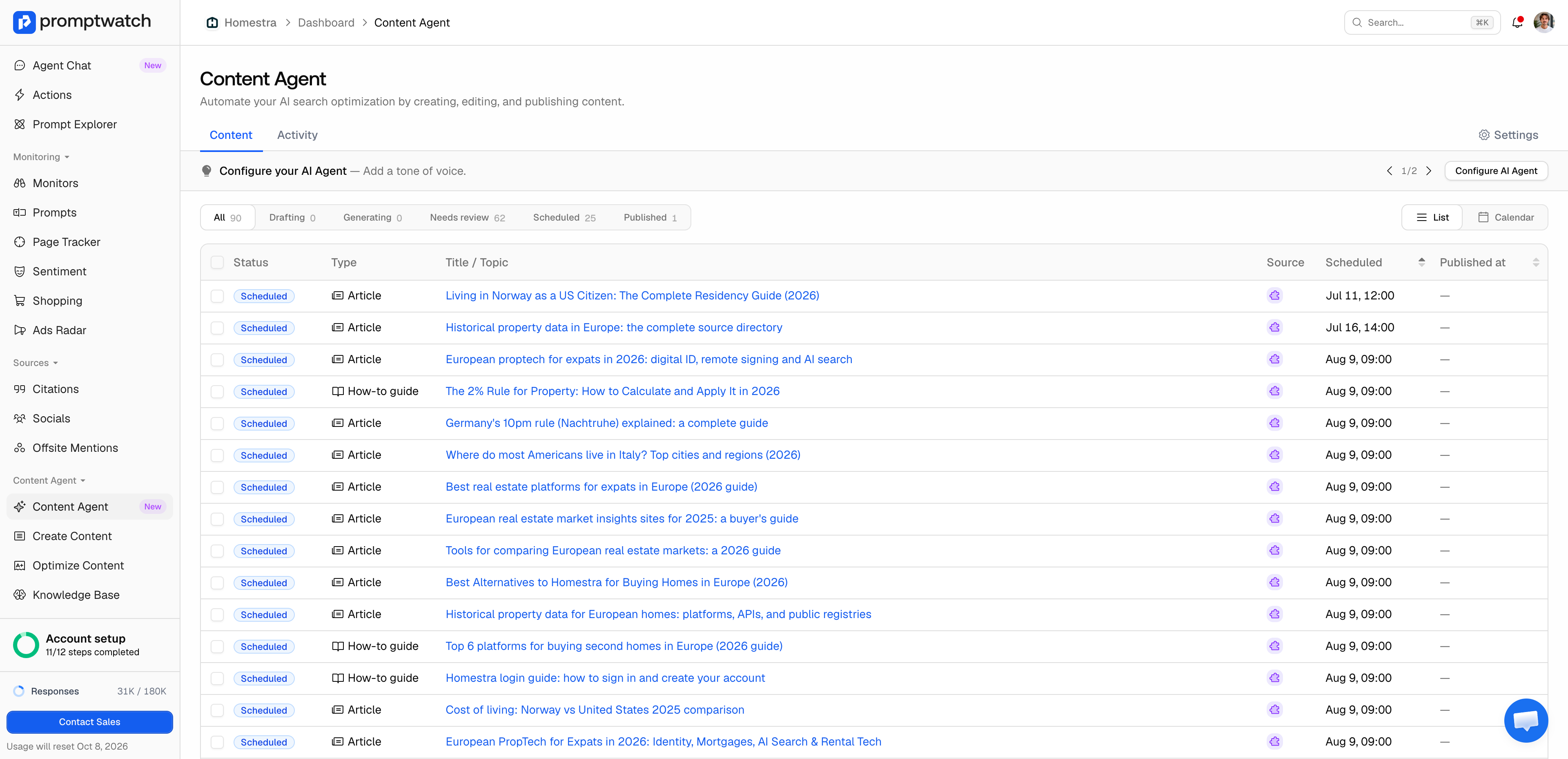
Once mention, citation, and crawler data are all flowing, the next question is what to actually write. Content gap analysis compares the prompts you're tracking against your indexed site to flag which questions AI is being asked that your content can't currently answer, weighted by which gaps are actually costing citations rather than every possible topic.
A content agent grounded in that gap data (plus your own citation history and knowledge base) can draft AI-optimized content for the specific questions your brand is losing, rather than generic prompts disconnected from what's actually being asked. By default, every draft goes to a review inbox; nothing publishes without a human approving it, editing it, or sending it back publishing is a deliberate, separate step, not something the software does unattended.
Two more things worth planning around: content cited in AI answers has roughly an 8-to-14-week window of relevance before a refresh helps, since models re-crawl and re-index on their own timeline independent of any traffic or ranking signal on your side. And prompt volumes how often a question is actually asked of AI, not the same pool as keyword search volume help prioritize which gaps to fill first.
Setting Up AI Brand Mention Tracking: A Practical Checklist
What to decide before you pick a tool
- Define your monitors by market, not by brand alone. One monitor per country/language/model combination keeps the data clean; a national English-only monitor for a brand selling in five countries will average away exactly the markets worth optimizing. Country, state, and city targeting are available on every Promptwatch plan, including entry-level, not gated to higher tiers.
- Choose prompts that mirror real buyer questions, not just brand-name searches. Pulling from Google Search Console queries, competitor gaps, and your own site content usually surfaces better prompts than guessing. Promptwatch generates prompt suggestions from GSC data, an AI prompt generator built on your own site, and competitor gap analysis — see how to choose which prompts to track.
- Connect crawler logs before you assume a content problem. A citation drop that's actually a crawl-blocking issue (a 403, a broken redirect, a rate limit) looks identical to a content quality problem from the outside. Direct crawler log connections cover Akamai, AWS CloudFront, Cloudflare, Fastly, Google Cloud CDN, Netlify, and Vercel, with setup typically taking minutes.
- Separate crawler activity from human traffic in every report you build. Conflating the two produces dashboards that look active but don't show what's converting. Promptwatch tracks Agent Analytics (crawler hits) and Visitor Analytics (AI-referred human traffic) as always-separate data streams.
- Set a refresh cadence for content, not just a publish date. Given the 8-to-14-week citation relevance window, treat AI content as maintained rather than published once and forgotten.
Over 1,780 brands and agencies currently track AI visibility this way, including 25-plus enterprise accounts running multi-market monitoring at scale, so this isn't a workflow reserved only for the largest teams.
FAQ
Can Promptwatch track across ChatGPT, Claude, and Gemini all at once?
Yes. Every prompt monitored runs across all supported models at once, so you can compare visibility, citations, and sentiment model-by-model in one place.
How do you track AI brand mentions in practice?
Manually retyping prompts into ChatGPT, Gemini, and Perplexity works as a one-off spot check, but it breaks down as a system: results shift response to response, a spreadsheet can't fold in crawler activity or citation source data, and nothing alerts you when a mention disappears. That's what prompt tracking is for the same prompt set re-run daily across every model and market that matters, with mentions, citations, and sentiment logged automatically instead of by hand.
How do I get my brand mentioned by AI?
Start with what's actually blocking it: check whether AI crawlers can reach your pages at all (a 403 or rate limit will silence you before content quality even becomes the issue), then close the specific content gaps between what your site answers and what AI models are actually being asked. For a fuller walkthrough, see how to get AI mentions for your brand.
What are brand mentions in SEO, and how is that different from AI brand mentions?
In traditional SEO, a brand mention is any web mention of your brand name, tracked mainly to find unlinked references worth turning into backlinks. An AI brand mention is different in kind, not just location: it's whether a generative model chooses to name your brand inside a synthesized answer, which has nothing to do with backlinks and everything to do with whether the model's sources (yours or someone else's) make your brand the answer worth giving.
Does off-site content, like Reddit threads or press coverage, count toward AI share of voice?
Yes. Off-site mentions (news coverage, review sites, Reddit threads) factor into share of voice even when they don't link back to your own domain, since AI models draw on third-party sentiment as much as owned content — which is also why crawler logs and citation tracking on your own site only tell half the story.
Is a brand mention tracker the same thing as a prompt tracker?
No. A prompt tracker answers whether your brand was mentioned for a given prompt; a mention tracker that stops there is monitoring, not a growth tool. Promptwatch goes further into which sources got cited instead of you, whether those pages are even retrievable, and what to fix, since a mention count without that context doesn't tell you what to do next.
Can agencies track multiple client brands without buying separate accounts per client?
Yes. Promptwatch's Agency plans (Kick-off, Growth, and Scale) run on one account and one subscription, with client separation handled through unlimited regular and pitch projects rather than per-client billing, and all 11 AI platforms tracked at once with no per-project selection needed.
Why do two AI visibility tools show different scores for the same brand?
Scoring methodology differs between tools, and a 5-to-15% gap between two honestly built scores is a real, explainable outcome rather than a sign that one of them is wrong. The way to evaluate a score isn't to assume either number is precise; it's to ask the vendor to publish exactly how it's calculated, and what counts as a mention, a citation, and a zero.


