

TL;DR
- To prepare for agentic commerce, start with work that pays off under every protocol: complete, machine-readable product data, a written policy for agent purchases that go wrong, and measurement for sales your analytics can't see.
- Then pick the one protocol integration (ACP, UCP, AP2 or MCP) that matches where your buyers shop, and treat it as reversible.
- The 90-day plan below turns this into nine steps with an owner for each.
- Promptwatch's AI crawler logs show whether shopping agents can reach your product pages, and its prompt tracking and ChatGPT Shopping tracking show whether your products appear in AI shopping answers, before and after each fix.
Your 90-day agentic commerce readiness plan
This plan turns the guide into three 30-day phases, with an owner and a clear finish line for each task. Each step is explained in the section of this guide that covers it. Before you start, name one person who owns the whole plan, since the work spans product data, payments, legal and marketing.
Days 1 to 30: see your store the way an agent does
| Step | Task | Owner | Done when |
|---|---|---|---|
| 1 | Check that AI crawlers and shopping agents can reach your product pages | SEO or web team | Key product pages return a 200 status to GPTBot, OAI-SearchBot, Amazon's product-discovery bot and other shopping agents in your crawler logs |
| 2 | Audit product data on your best-selling products | E-commerce or product data team | Price, availability, shipping speed and return policy are present as JSON-LD and match across your feed, product page and marketplace listings |
| 3 | Record a visibility baseline | Marketing | You have 20 to 50 buyer-intent prompts and a record of which of your products ChatGPT, Google AI Mode and Perplexity show for each one |
Days 31 to 60: fix the data and make your first protocol choice
| Step | Task | Owner | Done when |
|---|---|---|---|
| 4 | Encode shipping and return policies as structured data | Product data and development | shippingDetails and hasMerchantReturnPolicy validate on every product page, and your feed refreshes price and stock at least daily |
| 5 | Start your first protocol integration | E-commerce lead | One integration is underway that matches where your buyers shop: UCP for Shopify stores (their catalog and cart tools now run at each store's UCP endpoint), UCP checkout early access for Merchant Center retailers in the US, Canada or Australia, or ACP for brands with strong ChatGPT referral traffic |
| 6 | Write your agent purchase policy | Payments and legal | Spending cap, revocation flow, authorization logging, billing descriptor and return window are documented and approved |
Days 61 to 90: measure, then repeat
| Step | Task | Owner | Done when |
|---|---|---|---|
| 7 | Close the measurement gap | Analytics | Your analytics or CDP vendor has a plan for server-side purchase events, transaction-ID logging and agent user-agent segmentation |
| 8 | Re-run your visibility baseline | Marketing | Product appearances are compared against day 1, and each gap is traced to a data, access or content cause |
| 9 | Set a refresh cycle | Plan owner | Product content and feeds are reviewed every 8 to 14 weeks, the window Promptwatch's citation data shows relevance in AI answers holds before a refresh helps |
After day 90, repeat steps 1 to 3 and 8 every quarter. Step 5 is the one to revisit whenever a protocol's adoption or rules change. Promptwatch covers steps 1, 3 and 8 in one place: AI crawler logs show bot access, and prompt tracking with ChatGPT Shopping tracking records the baseline and each re-check.
What AI shopping agents need from your store
A page written to rank in Google and a product record an agent can act on solve different problems, and most e-commerce teams still optimize for the first one. Strong on-page copy, backlinks and solid agentic search visibility tell a human, or a citation-focused AI Overview, that a page is relevant. A shopping agent needs three other answers: whether the item is in stock, what it costs after tax and whether it ships in time.
What AI shopping agents actually read
An agent evaluating a product skips your headline and hero copy and queries structured fields:
- Price
- Availability
- Shipping speed
- Return policy
These fields usually come from JSON-LD product schema, a merchant feed or a protocol-specific catalog endpoint such as UCP's catalog capability, which Shopify stores now expose over MCP. When the data is missing, ambiguous or only implied by page layout (“free shipping on orders over $50” in a banner instead of encoded as shippingDetails), the agent treats it as a disqualifier and moves to the next listing. For field-level specifics, required schema, feed freshness and how to test whether a catalog is machine-readable, see the guide on how to optimize product listings to be selected by AI shopping agents.
Where your existing SEO/GEO work still matters, and where it stops
Content work keeps its value in a narrower scope than most teams assume. Informational content (buying guides, comparison pages, category explainers) still gets cited in AI Overviews and ChatGPT answers, and citation is often what puts a brand on an agent's shortlist in the first place. SEO and GEO work stops at the transaction step itself: there, an agent needs a hasMerchantReturnPolicy field it can parse, and well-written prose can't stand in for it. Promptwatch's ChatGPT monitoring for product pages shows which of your product pages ChatGPT recommends or skips in shopping answers, so you can see where citations turn into product placements.
Crawlers and shopping agents are also often different bots visiting for different reasons. Promptwatch's bot directory classifies commerce agents such as Amazon's product-discovery bot and Henry, a shopping agent, separately from AI crawlers such as GPTBot, because a page can be reachable for one and invisible to the other.
What agentic commerce is and how much volume it has right now
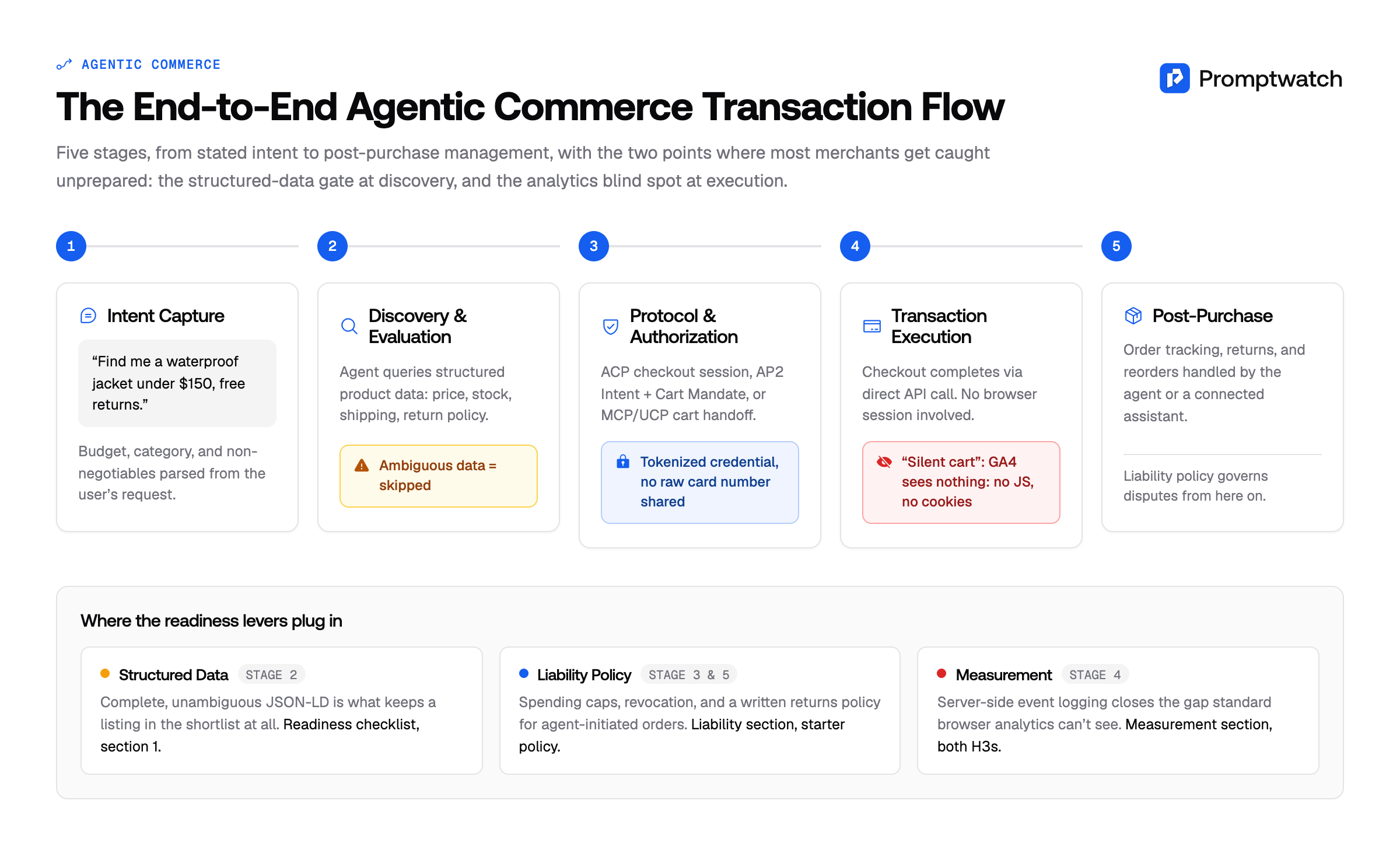
Agentic commerce is AI agents finding, comparing and, with permission, completing purchases on a user's behalf, using structured product data and standardized payment protocols. It runs on the same catalogs, payment processors and fulfillment systems that already power e-commerce. What changes is who, or what, does the browsing and clicking.
Volume is still small, and it is growing fast. In Q1 2026, according to Adobe Analytics:
- AI-referred traffic to U.S. retail sites grew 393% year over year
- That traffic converted 42% better than non-AI traffic by March 2026, a full reversal from March 2025, when it converted 38% worse
- Visitors arriving from AI sources spent 48% longer per visit and viewed 13% more pages than other visitors
Those numbers measure referral traffic: a person following an AI recommendation to a site. For agent-initiated transactions specifically, Checkout.com's 2026 survey of UK and US merchants and consumers shows:
- Current adoption sits at roughly 3% of transactions
- 89% of merchants surveyed report they're already preparing
- 72% expect consumer adoption to outpace merchant readiness
Low transaction share today combined with high expected adoption is the case for budgeting now, before the number looks urgent.
Agent-assisted browsing vs. fully agentic checkout
These two behaviors need different readiness work. Agent-assisted browsing is a person using ChatGPT, Perplexity or a similar assistant to research and compare, then clicking through to buy, which shows up as AI-referred traffic in ordinary analytics. Fully agentic checkout is the agent completing the purchase itself through a delegated payment flow such as ACP's Checkout API or UCP checkout in Google AI Mode, and current web analytics is largely blind to it (see the measurement section below). Most of the growth Adobe reports is likely the first kind. The second kind is smaller, and it is what the liability and protocol questions in this guide are about.
The four protocols you need to know: AP2, ACP, MCP and UCP
Four specifications do most of the work of standardizing how an agent transacts with a merchant. Each one covers a different part of the transaction, and UCP builds on two of the others.
| Agent Payments Protocol (AP2) | Agentic Commerce Protocol (ACP) | Model Context Protocol (MCP), commerce use | Universal Commerce Protocol (UCP) | |
|---|---|---|---|---|
| Backed by | Google, with 60+ partner organizations including Mastercard, PayPal, American Express, Coinbase, Adobe and Salesforce | OpenAI and Stripe as joint maintainers, moving toward neutral foundation governance | Anthropic (protocol creator); Shopify now serves its catalog, cart and checkout tools as UCP capabilities over MCP | Google, co-developed with Shopify, Etsy, Wayfair, Target and Walmart; 20+ endorsers including Adyen, Mastercard, Stripe and Visa |
| What it standardizes | Cryptographically signed Mandates (Intent Mandate, Cart Mandate) that prove an agent had real authorization to pay | A Checkout API and Delegate Payment API that make a business purchasable inside a chat surface, with tokenized payment credentials | How an agent connects to external tools; in commerce, it carries catalog, cart and checkout tool calls | Discovery, cart, checkout and order management in one spec, with a business profile at /.well-known/ucp; runs over REST, MCP or A2A |
| Maturity / adoption signal | Launched September 2025; open-source spec with a broad named partner list | Launched with ChatGPT's Instant Checkout in late 2025; in March 2026 OpenAI moved checkout from the chat to merchants' connected apps; the protocol is still used elsewhere | Widely used as a general standard for connecting agents to tools; Shopify removed its standalone Storefront MCP catalog and cart tools (deadline August 31, 2026) and moved them to UCP | Launched January 11, 2026; spec version 2026-04-08; checkout live in Google AI Mode and Gemini in early access (US, Canada, Australia) |
| Gaps | Leaves catalog discovery and product data format to other protocols | Built around chat-surface checkout; catalog discovery sits outside it | Payment authorization sits outside it; checkout runs at the application layer | Google's implementation currently accepts only cards stored in Google Wallet, in three countries; authorization proof comes through the AP2 extension |
For the full comparison of backers, payment rails, integration effort and adoption, see AP2 vs ACP vs MCP vs UCP.
Who's backing which protocol
Alliances matter more than any “best protocol” ranking, and they have already shifted once:
- AP2: has the deepest bench of payments and enterprise partners (see Google Cloud's AP2 announcement and the protocol's GitHub specification). It leaves catalog discovery to other protocols.
- ACP: defined the fastest path to being purchasable inside ChatGPT when it launched. In March 2026, OpenAI refocused ChatGPT on product discovery and moved checkout to merchants' connected apps. The specification and checkout flow are still published in the ACP GitHub repository and Stripe's documentation.
- MCP: its commerce role on Shopify now runs through UCP. Shopify removed its standalone Storefront MCP catalog and cart tools (deadline August 31, 2026) and moved them to a UCP endpoint, as its migration guide explains.
- UCP: has the most retailers behind it. Google published it on January 11, 2026, with Shopify, Etsy, Wayfair, Target and Walmart as co-developers, and more than 20 companies endorsed it, including Adyen, Mastercard, Stripe and Visa, according to the Google Developers Blog.
What protocol-agnostic readiness looks like in practice
The practical move is readiness work that pays off whichever protocol, or combination, ends up mattering for your buyers. That splits into two layers:
- Protocol-agnostic groundwork (structured product data, machine-readable policies, a written liability position) serves ACP, AP2, MCP and UCP alike, since all four read the same underlying product and policy data.
- Protocol integration is the reversible layer. Match it to where your buyers already shop:
- Shopify merchants have the most direct path through UCP, since Shopify co-developed it and now serves each store's catalog and cart tools from a UCP endpoint over MCP.
- Retailers in the US, Canada or Australia with a complete Google Merchant Center feed can apply for UCP checkout in AI Mode and Gemini, which is still in early access.
- Brands with strong ChatGPT referral traffic have reason to watch ACP, even after OpenAI moved checkout to merchants' connected apps in March 2026.
Treat that choice as revisable. ACP's trajectory this year shows how quickly an early leader can change course.
The liability question nobody answers: who pays for a wrong agent purchase
Every merchant preparing for agentic commerce eventually asks this, and it has no clean answer yet. When an agent buys the wrong size, orders the wrong quantity or gets talked into a fraudulent transaction, dispute frameworks built for a cardholder and a merchant now face a user, an agent and a merchant.
What the protocols currently leave to merchant policy
Industry reporting is consistent that no settled standard exists yet, and in practice merchants carry the burden because they respond to the dispute. Traditional chargeback evidence (device fingerprints, IP history, on-site navigation paths) often doesn't exist when an agent completes a purchase through a direct API call. That makes it harder to link a customer to a transaction the way card issuers expect.
AP2's Mandates partly solve the evidence problem: a signed Intent Mandate and Cart Mandate create an audit trail of what the user authorized, and UCP can carry the same Mandates as a checkout extension. That proves authorization happened. It leaves open who pays when authorization was real and the outcome was still wrong (the agent picked the wrong item, misread a size chart or missed a discontinued-product flag).
American Express has made the most concrete public commitment so far: it covers erroneous purchases made by registered AI agents on its network. That commitment covers agent error and hallucination. Fraud where a bad actor defeats authentication remains an open question, even in Amex's own framing.
A starter returns and liability policy for agent-initiated orders
A written policy in place before the first dispute beats a reaction after it. A reasonable starting point, built from where the current gaps are:
- Set a default spending cap on agent-authorized purchases, with a step-up confirmation above it. Consumer research found buyers are comfortable letting an agent spend a moderate amount (roughly the mid-hundreds in local currency) without extra approval, which makes a cap in that range, adjustable per customer, a defensible default.
- Build real-time revocation and cancellation into the purchase flow itself. The same research found instant revocation and easy cancellation are two of the top three safeguards buyers want before trusting an agent with a purchase. Missing them shows up later as chargebacks.
- Record delegation and authorization evidence at the point of purchase. Timestamped logs of when and how a customer set up agent purchasing authority are the closest current substitute for the device fingerprints and navigation history that traditional fraud tooling relies on.
- Use billing descriptors that make agent-initiated charges recognizable to the cardholder. An unrecognized charge on a statement is a common trigger for an unnecessary dispute, agent-initiated or otherwise.
- Set a return window for agent-initiated orders at least as generous as your standard policy, and encode it as structured data (hasMerchantReturnPolicy). An agent struggles to parse a return policy held in a PDF or FAQ paragraph, and an undiscoverable return policy is itself a reason an agent skips a listing.
How to measure agent traffic your analytics stack can't see yet
A retailer can get structured data and liability policy right and still have no view of whether it works. The most direct form of agentic traffic, an agent completing checkout through an API call, produces none of the signals standard web analytics depends on.
Why GA4 and Shopify Analytics miss agent sessions
The gap is architectural. GA4 measures browser behavior: it depends on client-side JavaScript, a DOM, a Google tag firing and referrer headers arriving with a page request. An agent completing a purchase through ACP's Checkout API, UCP checkout or another server-to-server call produces none of that. With no browser involved, no JavaScript runs, no cookies get set and no referrer header arrives. That transaction is a “silent cart”: revenue moved, and the analytics stack that explains where revenue comes from has no record of it.
AI-referral traffic of the kind Adobe measures does show up in GA4, because a human still clicks through a browser. The case that goes dark is the agent completing the purchase itself, which is the case ACP, UCP and AP2 are built for.
What to ask your analytics or CDP vendor
Closing this gap means measuring at the API layer. Three concrete asks for an analytics or CDP vendor:
- Server-side Measurement Protocol integration, so a checkout API sends purchase events directly to GA4
- API request logging that ties agent calls to conversions through a persistent transaction ID, independent of any browser session
- User-agent or request-header rules that segment known agent traffic, so it stops landing in “Direct/None” with everything else that has no referrer
The crawl side is easier to solve today than the transaction side, so handle it separately. Promptwatch's AI crawler logs record which bot requested which page and the status code it received. Promptwatch's bot directory classifies commerce agents such as Amazon's product-discovery agent and Henry separately from GPTBot and ClaudeBot. Together they show whether shopping agents can reach and read your catalog, the precondition for any agent-initiated purchase. Reconstructing the API-level checkout event itself is the harder half, and it sits with your own checkout and analytics stack.
“In Promptwatch we are able to see how active the ChatGPT bot is on our client websites and exactly how often our content is being used in responses of LLMs.”
FAQ
Do we need to pick one protocol now, or wait?
Do the protocol-agnostic groundwork now (structured product data, machine-readable policies, a written liability position) and treat protocol integration as a reversible choice driven by where your buyers shop. ACP shows why: it had the earliest, most visible checkout integration in ChatGPT, and within months OpenAI moved checkout from the chat to merchants' connected apps. With AP2 backed by a broad payments coalition, Shopify serving catalog and cart tools through UCP over MCP, and UCP running checkout in Google AI Mode and Gemini, betting on a single winner this early is a guess.
Who inside our company should own agentic commerce readiness?
There is no standard org chart answer yet. In practice the work splits across existing functions: e-commerce or product-data teams own structured data and feed accuracy, payments and legal own the liability and returns policy, and marketing or analytics owns attribution and measurement. What most teams need is a single named owner who pulls those three threads into one readiness effort.
Is agentic commerce readiness worth budget in 2026, or is it too early?
It's worth budget now, and the reason has little to do with predicting when agent-initiated transactions will scale. The structured-data, crawlability and content-freshness work in this guide carries its own SEO and GEO value, so it keeps paying off even if agentic checkout takes longer to reach meaningful volume. No protocol dominates yet, and agent-initiated purchases are still about 3% of transactions according to Checkout.com's 2026 survey, so treat any confident forecast of which standard wins with caution.


