TL;DR:
- An AI agent is a single, task-bound system. Agentic AI is what you get when several such agents (or one agent with a planning loop) are orchestrated to plan, execute, and adapt across multiple steps toward a larger goal.
- Agentic behavior is typically built on a reasoning loop, often called ReAct (reason, act, observe). A single AI agent runs one pass of it; an agentic AI system runs it across multiple coordinated agents.
- The real technical marker of "agentic" behavior is dynamic re-planning. A fixed, predefined sequence is an agentic workflow; a true agentic AI system adjusts its plan when a step fails or returns something unexpected.
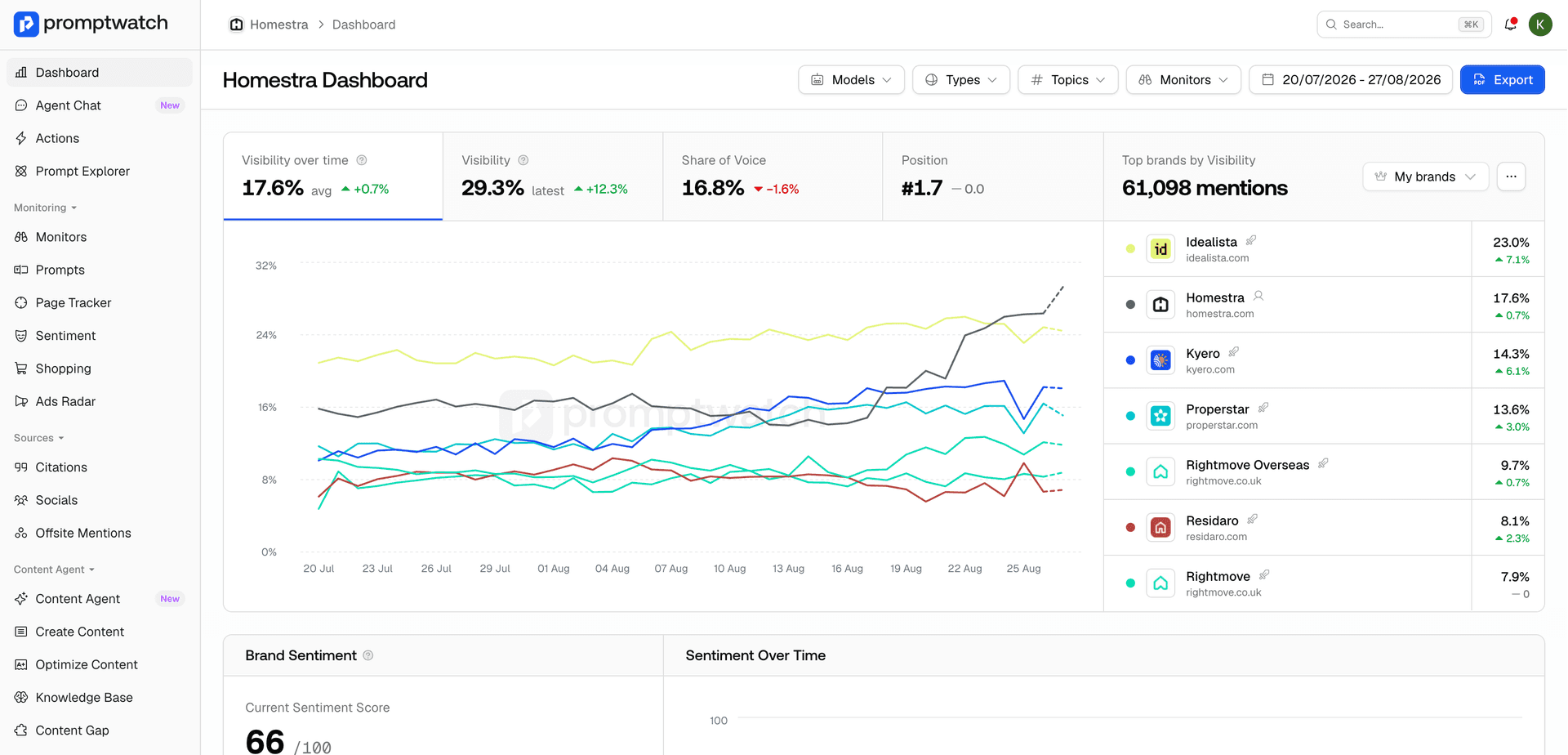
- Promptwatch's own Action Items agent is a live example of agentic AI in production: it re-prioritizes and dismisses recommendations daily as new evidence comes in, rather than running the same fixed checklist every day regardless of what's changed.
AI agent and agentic AI get used interchangeably online, but they describe different things: one is a single, task-bound system, and the other is what happens when several of those systems (or one system with a planning loop) get orchestrated to plan and adapt across multiple steps. This article draws the line clearly, with input from Promptwatch's own engineering team, so it's possible to tell the difference between an AI agent and agentic AI, and see exactly how that distinction shows up in a real product today.
Agentic AI vs AI Agent: The Actual Definitions
Ask the people actually building this technology, and the definition holds up cleanly:
“An AI agent is just part of agentic AI orchestration. So an AI agent is an agent itself. And agentic AI is using multiple agents to orchestrate a process.“ - Jon, Senior Software Engineer at Promptwatch
That's the core distinction, and it's worth sitting with: an AI agent is a unit. Agentic AI is what happens when those units get composed into a system that can plan and execute across multiple steps on its own.
What is an AI agent?
An AI agent is a single system, usually built on a large language model, that performs a task, often with access to tools, memory, or the ability to take actions rather than just generate text. A customer-support bot, a scheduling assistant, or an SEO agent built to flag one specific class of technical issue are all AI agents in this sense: focused, single-purpose specialists rather than general problem-solvers. Jon's analogy is a useful one for picturing it:
“Let's imagine an AI agent as something maybe you've used before, like ChatGPT or another large language model. So imagine that instead of having lots of different tasks for this one agent... we give it one thing to do, we make it an expert in one thing.” Jon, Senior Software Engineer at Promptwatch
That's an AI agent: a focused, single-purpose expert.
What is agentic AI?
Agentic AI is the paradigm, or the system, built by orchestrating multiple such agents (or a single agent with a planning loop) to accomplish something larger than any one agent could do alone, with a meaningful degree of autonomy over how it gets there.
Is an AI agent a type of agentic AI, or the other way around?
Neither is a "type" of the other; they sit at different levels. An AI agent is the component. Agentic AI is the property of a system built from components like that, operating with autonomy over a multi-step process. A single chatbot answering questions is an AI agent without any agentic AI around it. Agentic AI, on the other hand, generally can't exist without at least one AI agent doing the underlying work.
| AI agent | Agentic AI | |
|---|---|---|
| Autonomy level | Executes one task per trigger | Plans and adapts across a sequence of tasks |
| Decision scope | Bounded to a single defined job | Spans a goal broken into several sub-tasks |
| Human oversight | Usually reviews the single output | Usually reviews checkpoints or the final outcome, not every step |
| Example | A single chatbot answering one category of question | A system that plans several searches, retrieves from each, and synthesizes an answer |
Where the Line Actually Is: Compositional Autonomy, Not the Model
The distinction isn't about which model is being used; it's about how much autonomy the system has over its own multi-step plan. This is where most explainer content gets vague, so it's worth going one level deeper into the mechanics.
The reasoning loop: how "agentic" behavior actually works
"Agentic" behavior is typically built on a reasoning loop, often described in the research literature as ReAct (Reason, Act, Observe): the system reasons about what to do next, takes an action, observes the result, and decides whether to continue, retry, or change course. A single AI agent might run one pass of this loop. An agentic AI system runs it across multiple agents, each contributing a piece, coordinated by an orchestrator.
Agentic workflow vs. agentic AI: the nuance vendors skip
Not every multi-step AI process is agentic AI:
- Agentic workflow (automated, but deterministic): a predefined sequence where step 1 always runs, then step 2, then step 3, regardless of what happens along the way.
- Agentic AI (dynamic, re-planning): if step 2 fails or returns something unexpected, the system adjusts its approach rather than simply erroring out.
That capacity to replan, not just execute a fixed script, is the real technical marker of "agentic."
Reasons to split work across multiple orchestrated agents instead of relying on one large model go beyond technical elegance. Jon lays out the practical case:
“AI orchestration is when we have these smaller agents which are trained or taught to do one thing and one thing well, and we orchestrate them to do a much larger project or activity.” - Jon, Senior Software Engineer at Promptwatch
On the non-technical reasons for doing this:
“First of all, your main orchestrator doesn't get bogged down with context. We have the concept of context rot, which is where your main agent will get too much information and start forgetting things. Having sub agents to sort of curate that data really lowers the main information in that main orchestration agent and allows it to see what's important at the time.” - Jon, Senior Software Engineer at Promptwatch
He also points to validation as a reason to orchestrate multiple agents: one agent can check another agent's output, allowing the system to "validate your output or reiterate or loop a certain process until it's complete in a satisfactory manner."
On the cost side:
“Usually as the sub-agent's tasks are simpler, you can run it on a cheaper model. And you're also moving less context back and forth between your AI orchestrator, which may be your more expensive or more powerful model, meaning you have cost savings and token savings there.” - Jon, Senior Software Engineer at Promptwatch
That's the practical case for agentic AI in one paragraph: smaller, specialized agents keep the expensive orchestrating model focused, cut token costs, and let a system validate its own work in a loop instead of trusting a single pass.
Where Each One Actually Gets Used in Business
The clearest way to see the difference is a real example. Promptwatch's own product uses exactly this pattern: single-purpose AI agents handling one job each, with a layer above them deciding what gets prioritized.
- The single-agent version: a support chatbot that answers customer questions using a knowledge base. One agent, one job, no orchestration.
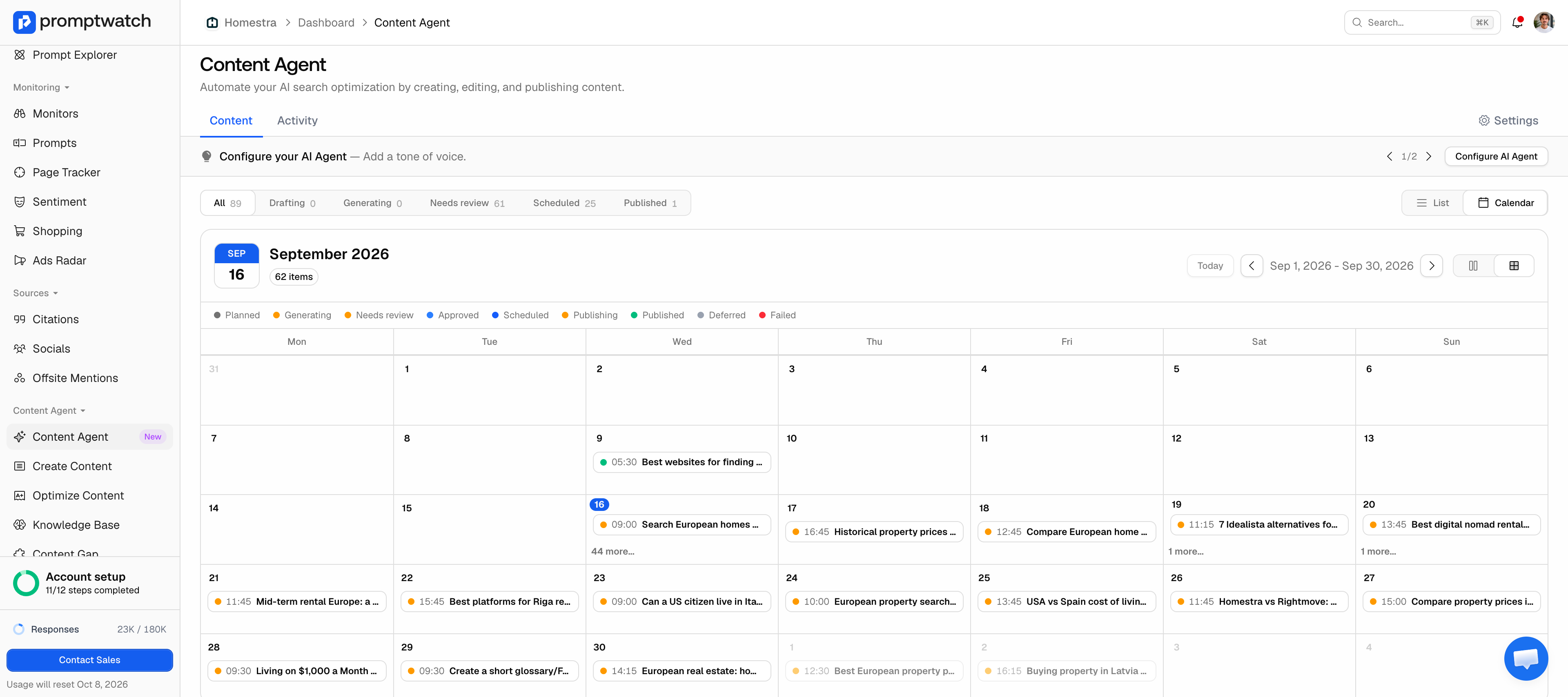
- The agentic AI version, in production at Promptwatch: an Action Items agent that runs daily per project, rotating its focus by weekday across content, performance, signals, Reddit, offsite mentions, and sentiment. It refreshes stale recommendations, re-prioritizes severity as new evidence comes in, and auto-dismisses items evidence no longer supports, rather than running the same fixed checklist every day regardless of what's actually changed. That re-planning behavior, not just a scheduled task list, is what makes it agentic rather than a static workflow.
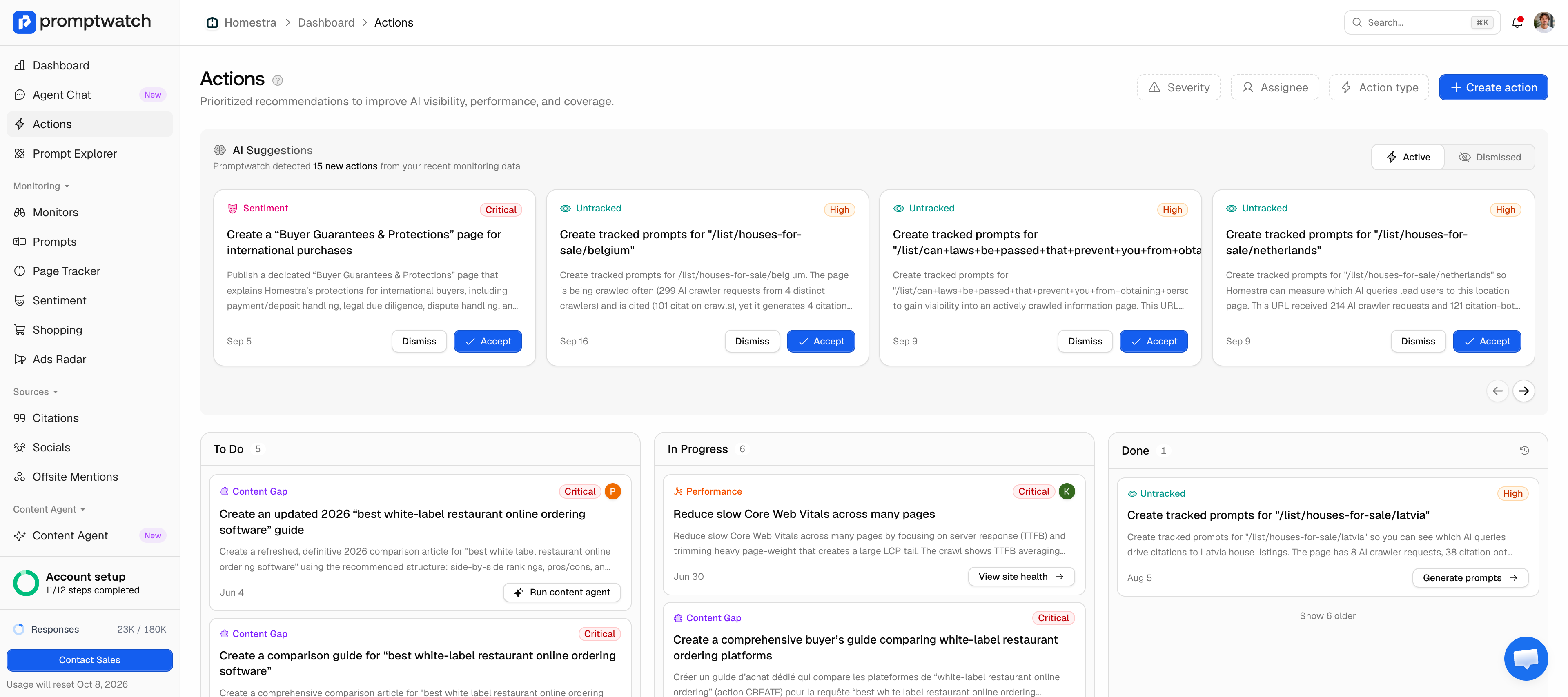
Promptwatch's Content Agent follows a similar pattern on the content side: it drafts AI-optimized content grounded in a customer's own citation and content-gap data, and every draft still routes through a review inbox before anything reaches a CMS. It's the same orchestration logic behind Promptwatch's broader agentic content strategy, applied to one draft at a time.
Promptwatch also exposes this capability directly: developers can use the Promptwatch MCP to call the platform's own tools, such as pulling action-item data or updating an action item's status, directly from their own applications or AI workflows, effectively wiring Promptwatch's agentic outputs into a system they're already building themselves. Applied specifically to search and content work, this same pattern is what Promptwatch calls Agentic SEO: a related but distinct discipline from the general "agentic AI" category discussed here.
Agentic AI in enterprise workflow orchestration
Agentic AI shows up more in back-office and operational contexts: coordinating several specialized agents (data retrieval, prioritization, validation) toward a larger outcome, the same pattern behind AI SEO automation, where Promptwatch's Action Items agent coordinates prioritization and monitoring behind the scenes.
Check Whether Your Brand Even Shows Up in the Answer
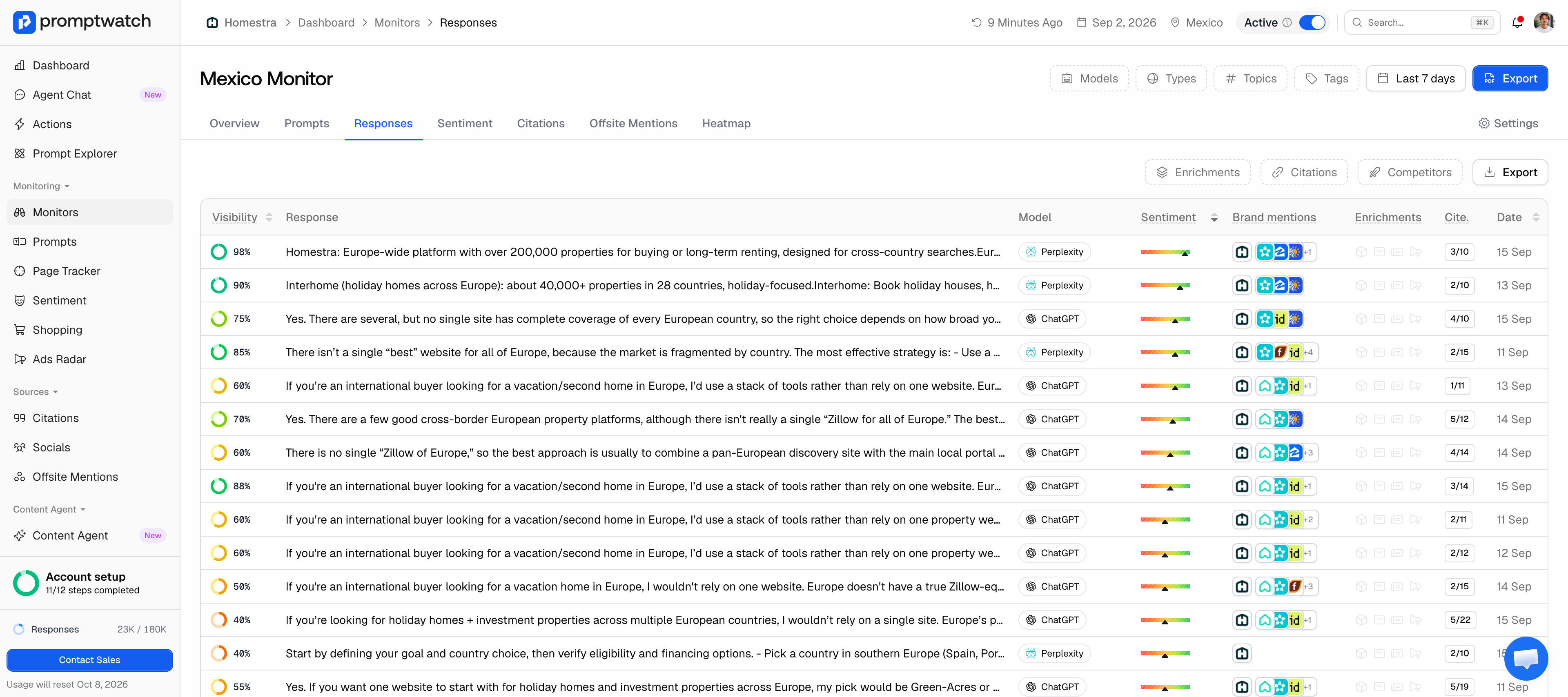
Because this exact topic is one AI answer engines already explain confidently on their own, there's a second, practical stake beyond picking the right architecture: does a brand get cited at all when someone asks an AI engine to compare vendors or explain this category?
Promptwatch's prompt tracking runs a prompt like "agentic AI vs AI agent" or "best agentic AI platforms" across ChatGPT, Perplexity, Google AI Overviews, and the other AI platforms it monitors, and shows exactly which brands get named, cited, or left out. Promptwatch's free AI Brand Visibility Report checks the same thing for a single brand and query, without needing a monitor set up first.
FAQ
Is agentic AI just marketing hype?
Not entirely, though the term gets used loosely. The underlying pattern (orchestrating specialized agents with a planning loop that can adapt mid-task) is a real architectural distinction, not just a rebrand of existing chatbots or automation. Whether a specific vendor's "agentic AI" claim holds up depends on whether the system actually re-plans dynamically, or just runs a fixed workflow under a new label.
Will my current AI agent automatically become agentic AI?
No. An AI agent stays a single-purpose unit unless it's deliberately connected into an orchestration layer with other agents, or given its own multi-step planning loop. It's an architectural decision, not something that happens on its own.
Why does the difference matter for my AI strategy?
Because the two require different investments, different governance, and different risk profiles. Treating a single chatbot project as if it were a full agentic AI initiative, or the reverse, is one of the patterns behind failed AI projects.
Is agentic AI the same as an AI agent?
No. An AI agent is a single unit; agentic AI is the property of a system that orchestrates multiple such units (or a single agent with a planning loop) with autonomy over a multi-step process.
Can an AI agent be "agentic"?
Yes. A single agent can have its own reasoning loop and act with some autonomy. "Agentic AI" as a category typically refers to systems that go further, coordinating multiple agents toward a larger goal.
Is ChatGPT an AI agent or agentic AI?
On its own, ChatGPT functions as an AI agent: a single system responding to prompts. It becomes part of agentic AI only when it's embedded in a larger system that gives it tools, memory, and coordination with other agents toward a multi-step goal.
What are the compliance considerations for agentic AI vs. AI agents?
Compliance requirements scale with autonomy. A single AI agent that drafts content for human review carries different risk than an agentic AI system that can take actions across multiple systems without per-step approval. Review your own regulatory environment before assuming either architecture is compliant by default; this isn't something a generic answer can settle.
With contributions from Jon, Senior Software Engineer at Promptwatch.