


TL;DR
- You grow AI citations by winning more of a small number of source slots: about five per ChatGPT web-search answer and about ten per Google AI Overview or Perplexity answer, according to Promptwatch's data.
- Each engine rewards different pages. Listicles led Google AI Overview citations at 18.0% in July 2026, while product pages took 32.8% of ChatGPT citations the same month.
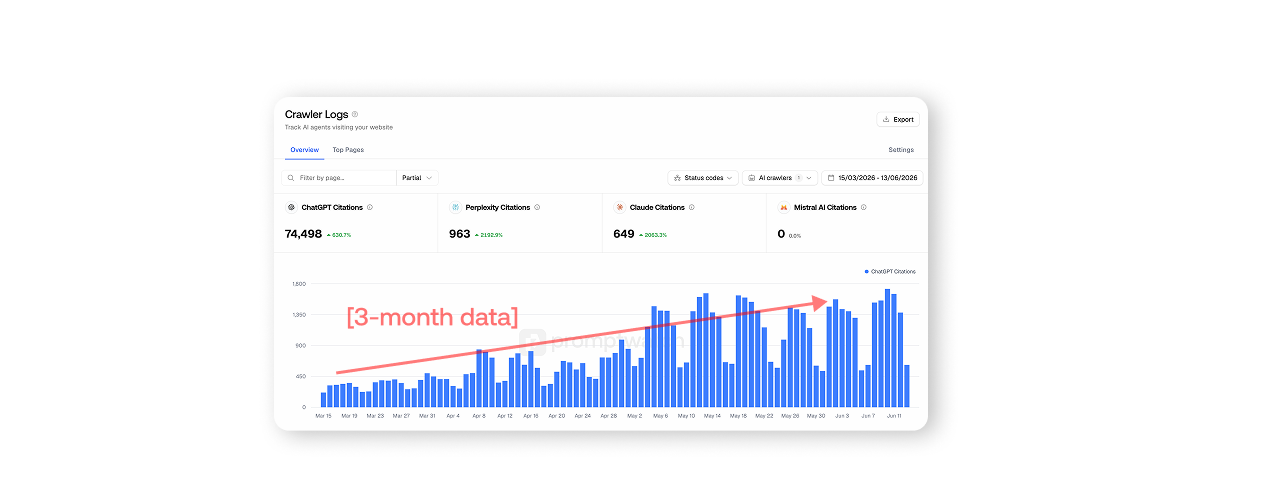
- The loop that took a new domain from about 200 to more than 1,700 daily AI citations in roughly 90 days: track organic prompts, read the query fan-outs, publish one page per recurring sub-question, watch time to crawl and time to cite, then refresh or retire.
- A page that gets crawled but never cited has a content problem, not a technical one.
- Citations fade. In Promptwatch's data, a page's citation relevance typically holds for 8 to 14 weeks before a refresh helps.
How to grow citations in AI search
An AI citation is a link to your page that an AI engine shows as a source for its answer.
Growing citations means being cited for more prompts, by more engines, more often. It is different from a brand mention, where the answer names you without linking to you. Both matter, but only citations send the engine's reader to your page.
Every citation you earn comes from three multipliers: the number of prompts where one of your pages is a credible answer, the number of engines that can reach and retrieve that page, and the share of each answer's source slots you win. Most teams work only on the third. The fastest growth usually comes from the first two.
This playbook uses Promptwatch's data from more than 26 billion AI citations, prompts, and responses, plus the process Promptwatch used to grow a new domain's citations roughly eightfold in about three months.
Where the citation slots are, engine by engine
AI engines don't cite the same number of sources, reach your site with the same crawlers, or prefer the same kinds of pages. Start with the engines your buyers use:
| Engine | Sources per answer | Crawlers that must reach you | What it cites most |
|---|---|---|---|
| ChatGPT | About 5 per web-search answer | OAI-SearchBot (search index), ChatGPT-User (live fetches) | Product pages, 32.8% of citations in July 2026 |
| Google AI Overviews and AI Mode | About 10 per AI Overview | Googlebot; Google-Extended only controls training and grounding in other Google systems | Listicles 18.0%, product pages 16.3%, how-tos 15.1% of AI Overview citations in July 2026 |
| Perplexity | About 10, very stable day to day | PerplexityBot (respects robots.txt); Perplexity-User (user-triggered, generally ignores robots.txt) | Engine-specific guides won Promptwatch's tracked Perplexity prompt; YouTube is its most-cited social platform at 2.67% |
| Microsoft Copilot | Volatile: from under 2 to nearly 17 in a few weeks | Bingbot, since Copilot is grounded in Bing's index | Too unstable to plan around; track it separately |
| Claude | Varies by answer | Claude-SearchBot and Claude-User | Its citation crawler grew more than 100x between December 2025 and April 2026 |
Sources: Promptwatch's average sources per response, AI Overviews citation types, ChatGPT citation types, social media citations by AI model (December 2025), and Claude citation crawler visits; crawler behavior from Perplexity's crawler documentation and Google's guide to AI features.
Three things follow from the table:
- ChatGPT is the hardest place to win a slot. With about five sources per answer, you are competing for half the room that Perplexity and AI Overviews offer. The ChatGPT-specific steps are in our ChatGPT SEO guide.
- One page format won't win everywhere. A comparison listicle suits AI Overviews; a clear product or use-case page suits ChatGPT. Decide which engine a page is for before you choose its format.
- Gemini is measured differently. The standalone Gemini app shows few visible source links, so there you track brand mentions and visibility rather than citation counts.
The citation growth loop
Promptwatch grew a new domain from about 200 to more than 1,700 daily citations across ChatGPT, Perplexity, Claude, and Copilot in roughly 90 days, without link building or high-volume publishing. It ran the same five steps every week.
1. Track the prompts that can bring new citations
Build a prompt set that mirrors how buyers ask about your category, then split it by type:
- Organic prompts, about 80%. Category questions and problems with no brand names in them. This is where new citations come from, because the answer isn't decided by who already knows you.
- Branded prompts, about 10%. Questions about your brand, to check how engines describe you.
- Competitor prompts, about 10%. Questions that name competitors, to see how they're framed and which sources back them up.
"It's useless to measure yourself on branded test prompts, because you're always visible. Your main goal for acquiring new customers is the non-branded prompts."
Run each set as its own prompt tracking monitor so the three trends stay separate.
2. Read the fan-outs, not the prompt
Engines don't search the prompt as written. They rewrite it into shorter sub-queries, called query fan-outs, and cite pages that answer those. The fan-outs are your content brief.
Take the prompt "how do I improve my brand's chances of being cited in Perplexity answers," which Promptwatch tracks daily. Its responses produced 140 fan-outs across Copilot, ChatGPT, and Perplexity. The most frequent were:
- "how brands get cited in perplexity ai answers" (21 times)
- "improve brand citation in ai answers perplexity" (13 times)
- "improve brand citation in perplexity ai answers" (11 times)
- a long tail of lookups for PerplexityBot and robots.txt, Perplexity's official publisher guidance, and "how sources are selected"
Two lessons show up in almost every fan-out set. Engines look for official documentation alongside practical guides, so cite the primary source where one exists. And the pages that won that prompt were all written about Perplexity specifically. For an engine-specific question, a general "AI search" article loses to a dedicated page.
3. Publish one page per recurring sub-question
When the same sub-question repeats across many prompts, one page that answers it cleanly gets many chances to be retrieved. For each page:
- Put the direct answer in the first sentence under a heading that matches the sub-question.
- Write passages that make sense on their own, because engines quote passages, not pages.
- Add evidence that competitors don't have: your own data, customer numbers, named experts.
- Match the format to the engine you're targeting (see the table above).
Content Agent does this matching automatically: it checks your tracked prompts' fan-outs against your indexed pages and lists the sub-questions none of your pages answer.
4. Watch time to crawl, then time to cite
A citation almost always follows a crawl. Track two numbers for every new or updated page:
- Time to crawl: how long until OAI-SearchBot, PerplexityBot, Claude-SearchBot, and the others request it. AI crawlers don't appear in standard analytics, so you need server or CDN logs, such as Agent Analytics.
- Time to cite: how long until the page appears as a source on your tracked prompts. In the growth loop above, the gap between the two ran from days to a few weeks.
If a page is never crawled, fix access first: robots.txt, firewall and CDN rules, or content that only renders with JavaScript. If it is crawled but never cited, the problem is the content. The earlier version of this article is an example: over 90 days it received 204 requests from seven AI crawlers and no citations on Promptwatch's tracked prompts, which is why it was rewritten.
5. Double down, refresh, or retire
Review each page's citations every few weeks and decide:
- Double down on pages that earned citations quickly. Publish more in the same format and topic cluster.
- Refresh pages that were cited and are fading. With a typical citation lifespan of 8 to 14 weeks, update figures, examples, and the "last updated" date on a schedule instead of waiting for a drop.
- Retire or merge pages that were crawled repeatedly and never cited, and move the effort to what's working.
Old pages deserve the same review. Engines keep citing content you may have forgotten about.
"It is amazing how inconsistent companies are. 'We had this blog from twenty years ago and didn't know it was showing up.' This is not a rarity. I see it on a daily basis."
Grow citations beyond your own site
Many answers about your category cite third-party pages: reviews, comparisons, community threads, videos. When those pages describe you accurately, you gain visibility even when the link isn't yours. Promptwatch tracks these as off-site mentions.
- Find the third-party domains engines cite for your prompts, and make sure you're present and correctly described on them. Our guide on how to get your brand mentioned by AI covers this in detail.
- Match the platform to the engine. In Promptwatch's December 2025 data, Reddit took 5.19% of ChatGPT's citations, while YouTube led social platforms in AI Overviews at 4.08%.
- Don't rely on one platform. Reddit's share of ChatGPT Search citations fell 86% in one week in August 2026.
How to measure citation growth
Google Search Console won't show any of this, and clicks alone understate it: click-through from AI answers stays below 0.1% in Promptwatch's data. Track these instead:
| Metric | What it tells you |
|---|---|
| Citations by engine | Whether growth is broad or depends on one engine |
| Prompts with at least one citation | How many questions you're a credible source for |
| Citation share | How often you're cited compared with competitors on the same prompts |
| Average citation position | Whether you're a lead source or a footnote |
| AI crawler requests and status codes | Whether engines can reach your new and updated pages |
| Time to first citation | How fast new content starts working |
| Brand mentions | Visibility on engines that show few links, such as Gemini |
| AI-referred visits | The traffic and conversions citations bring in |

Promptwatch puts these in one place: prompt tracking and citation reporting by engine, Agent Analytics for crawler logs, and Content Agent for the gaps to fill next. If you're comparing tools, see our comparison of GEO and AI visibility platforms.
Mistakes that stall citation growth
- Measuring on branded prompts. You'll look visible and learn nothing about new demand.
- Blocking search crawlers along with training crawlers. GPTBot, ClaudeBot, and Google-Extended relate to training or other systems; OAI-SearchBot, PerplexityBot, Claude-SearchBot, Googlebot, and Bingbot decide whether you can be cited. Block the first group if you want, but keep the second open.
- One generic page for every engine. Engine-specific questions are won by engine-specific pages.
- Adding llms.txt and waiting. Promptwatch found no measurable impact from llms.txt, and Google says its AI features need no special files or markup.
- Publishing and forgetting. Without a refresh cycle, pages that win citations lose them within a few months.
Frequently asked questions
How do I get my content cited by ChatGPT and Perplexity?
Let their search crawlers in (OAI-SearchBot and ChatGPT-User for ChatGPT, PerplexityBot for Perplexity), find the sub-queries they run for your prompts, and publish pages that answer those sub-queries directly with evidence of your own. ChatGPT cites about five sources per answer and Perplexity about ten, so there is more room in Perplexity answers.
How do AI search engines decide which websites to cite?
They rewrite the question into shorter searches, retrieve candidate pages from their index, and pick the passages that answer each search most clearly and credibly. Crawler access, a direct answer under a matching heading, original evidence, and corroboration from other sites all raise the odds.
How long does it take to grow AI citations?
In Promptwatch's own growth loop, a new domain went from about 200 to more than 1,700 daily citations in roughly 90 days. New pages were typically crawled first and cited days to a few weeks later.
How many sources does each AI engine cite?
About five per ChatGPT web-search answer, about ten per Google AI Overview and Perplexity answer, and a volatile number for Microsoft Copilot, which has ranged from under two to nearly seventeen, according to Promptwatch's data.
What's the difference between an AI citation and an AI mention?
A citation links to your page as a source. A mention names your brand in the answer, with or without a link. Track both, because some engines, such as Gemini, show few links.
Why is my page crawled by AI bots but never cited?
Access isn't the problem, so the content is. The page probably doesn't match the sub-queries engines search for, doesn't answer them in a quotable passage, or offers nothing the other candidates don't. Rewrite it around the fan-outs, or merge it into a page that is already cited.
Does blocking GPTBot stop my site from being cited in ChatGPT?
No. GPTBot is OpenAI's training crawler. ChatGPT search relies on OAI-SearchBot and ChatGPT-User, so you can block GPTBot and still be cited, as long as those two are allowed.
How often should I update content to keep AI citations?
Plan a review every 8 to 14 weeks for your most important pages. That's how long citation relevance typically holds in Promptwatch's data before a refresh helps.


