


TL;DR
- All 11 major AI platforms Promptwatch tracks are available on every plan, including the $95/month Essential tier; each project actively tracks 4 at a time.
- Traditional SEO suites like Semrush and Ahrefs track Google's AI Overviews as a built-in feature, but full LLM visibility (ChatGPT, Claude, Gemini) requires a separate paid add-on that can push the total monthly bill past $300.
- Of the seven tools compared here, only Promptwatch and Jasper.ai include built-in image creation alongside content generation, a real gap for most GEO-focused platforms.
SEO is no longer a single-channel discipline. Brands now face a split reality: Google rankings still matter, but answers generated by ChatGPT, Perplexity, Gemini, and Claude are becoming a real discovery channel in their own right. According to Adobe Analytics' Q2 2026 AI Traffic Report, AI-referred traffic to U.S. retail sites grew 393% year-over-year in the first quarter of 2026, with visitors arriving from AI assistants converting 42% better than non-AI traffic in March, a reversal from converting worse a year earlier.
The tools required to compete have evolved accordingly. Teams need platforms that handle content optimization, keyword research, technical audits, and AI search visibility, ideally in one workflow, or in a small stack that covers all of it without expensive overlap. This guide compares the seven tools most commonly evaluated for that job in 2026.
How we evaluated these tools
Every tool was assessed across five dimensions:
- AI visibility and citation tracking coverage (which LLMs are actually monitored)
- Content optimization quality (NLP scoring, topic coverage, brief generation)
- Technical SEO depth (site audits, crawler data)
- Analytics and attribution (AI-referred traffic, share of voice),
- Time-to-value (how fast a new user gets something actionable).
Pricing is verified as of August 2026 and will drift; check each vendor's own pricing page before budgeting.
1. Promptwatch: best tool for AI visibility and GEO optimization
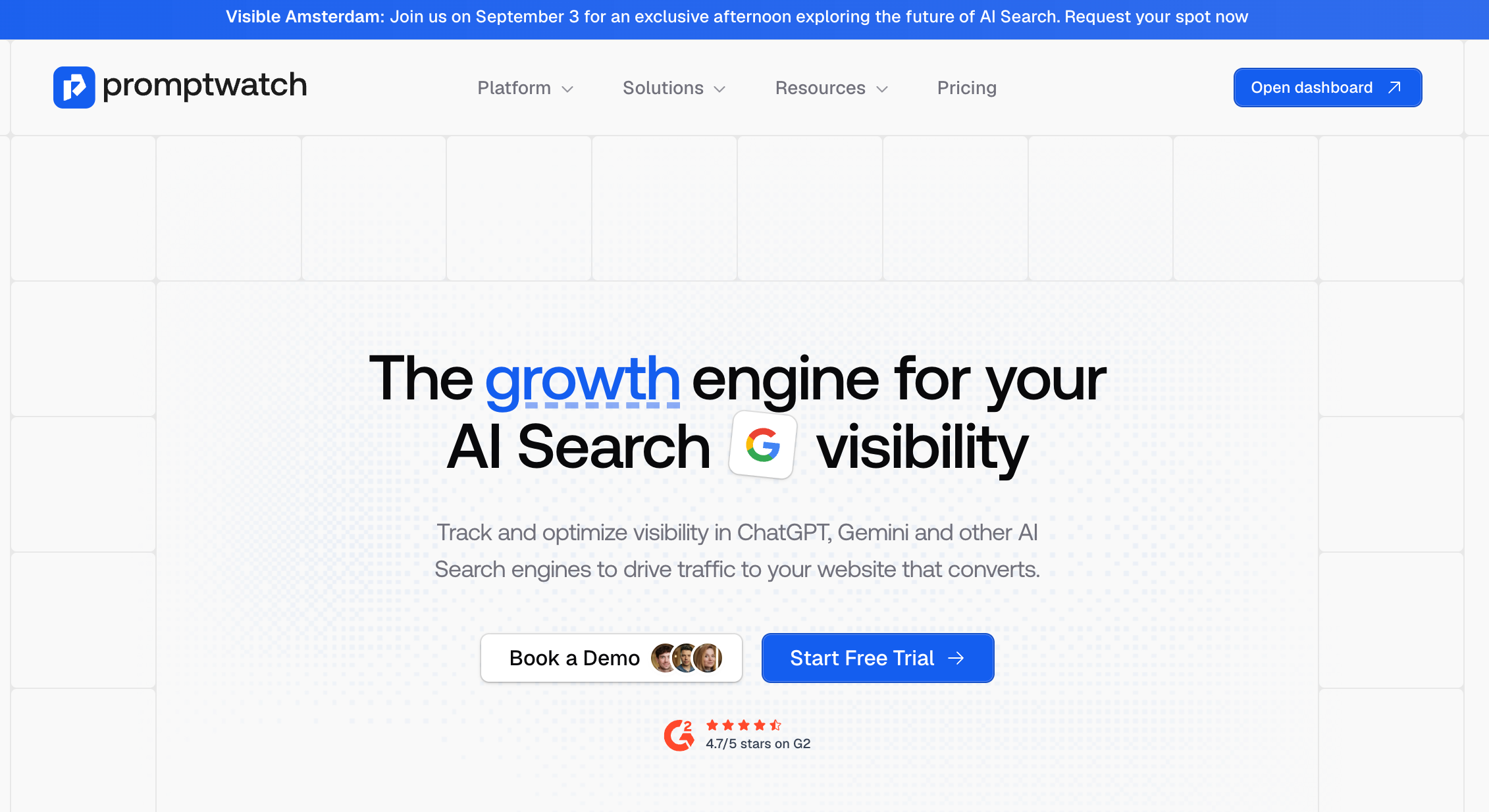
Promptwatch is an AI Search Visibility and GEO platform built to answer a different question than a prompt tracker: not just "was my brand mentioned," but how that visibility turns into AI-referred traffic and revenue. It has observed 4B+ total citations, clicks, and prompts to date, and instead of relying only on API responses, it scrapes the real interfaces of ChatGPT, Gemini, AI Overviews, and Perplexity, so what shows up in the dashboard is what an actual user would see, including localization and citation ordering.
- Core features: AI Visibility (mention tracking, sentiment, Share of Model), prompt tracking with volumes, difficulty, and query fan-outs, citation and off-site mention tracking (including Reddit and YouTube), AI crawler logs, visitor analytics tied to conversions, content gap analysis, a content agent that drafts and can publish to CMS, and prioritized Action Items with owners.
- Supported AI platforms: All 11 platforms are available to select from on every plan, including Essential. Each project actively tracks 4 of the 11 at a time; this is a per-project choice, not a plan restriction. The free Explore plan is ChatGPT-only.
- Integrations: Cloudflare, AWS CloudFront, Fastly, Vercel, Netlify, Google Cloud CDN, Google Search Console, Looker Studio (Data Studio), REST API and MCP access. Direct CMS publishing is Webflow and Framer; other CMS platforms, including WordPress, connect for data rather than as a publish target.
- Pricing: Essential $95/month, Professional $245/month, Business $579/month. Custom pricing is available for enterprise-scale accounts, including agencies managing many clients, based on prompt/response volume. A 7-day free trial is available on Essential.
- Ideal for: In-house SEO teams and agencies that need to tie AI visibility to actual traffic and revenue, not just a mention count.
- Pros: Scrapes real UI responses rather than only APIs, joins crawler logs to citations so teams can see why they're visible (or not), unique Reddit and YouTube citation tracking, and one of only two tools in this list with built-in image creation for generated content.
- Cons: Not a replacement for keyword research and backlink analysis; works best alongside a tool like Google Search Console (which connects directly) or a traditional SEO suite.
Best for: teams that need the full crawl-to-citation-to-revenue loop in one platform, not just a mention dashboard.
2. Semrush
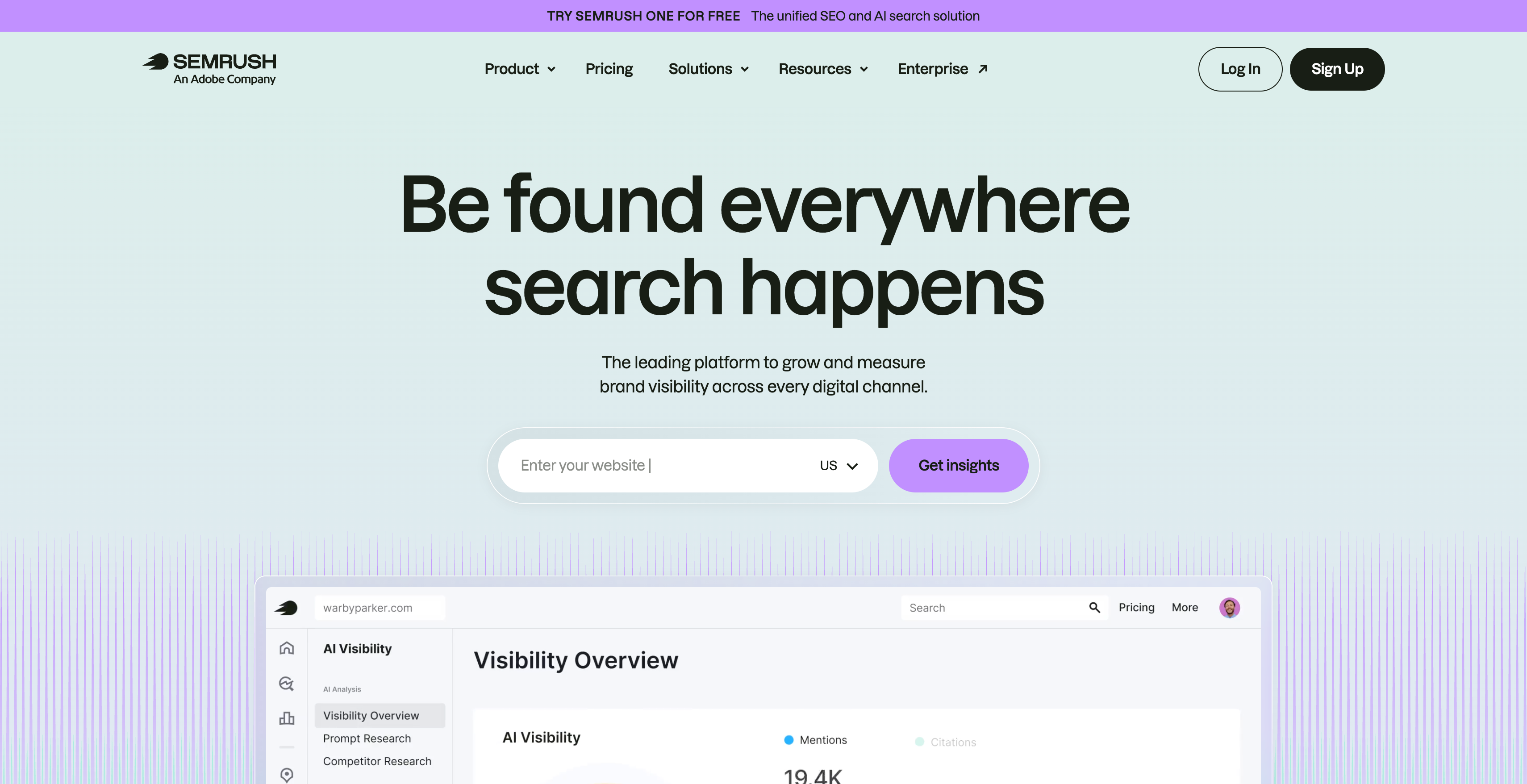
Semrush remains one of the most complete traditional SEO platforms on the market. Its AI Copilot surfaces recommendations from account data (traffic alerts, keyword gaps, competitive benchmarks) inside the core plans. For AI-answer visibility specifically, the separate AI Visibility Toolkit extends tracking to ChatGPT and other engines.
- Core features: Site audit, keyword research, competitor analysis,
- ContentShake AI, AI Visibility Toolkit, backlink analysis, AI Copilot recommendations.
- Supported AI platforms: Google AI Overviews on core plans; broader LLM coverage through the AI Visibility Toolkit add-on.
- Pricing: Pro $139.95/month, Guru $249.95/month, Business $499.95/month. AI Visibility Toolkit: $99/month per domain as a standalone add-on, or bundled into Semrush One from $199/month.
- Ideal for: Agencies and enterprise teams that want one platform covering traditional SEO, content, and paid research.
- Pros: Broad SEO data; AI Copilot cuts down manual analysis; large integration ecosystem.
- Cons: Meaningful AI-answer coverage is an added cost on top of an already premium subscription, and the toolkit's prompt/response caps are modest at the entry price. See a detailed Promptwatch vs Semrush comparison for feature-by-feature differences.
Best for: teams that need Google-side SEO breadth first, with AI-answer tracking as a secondary, paid layer.
3. Ahrefs
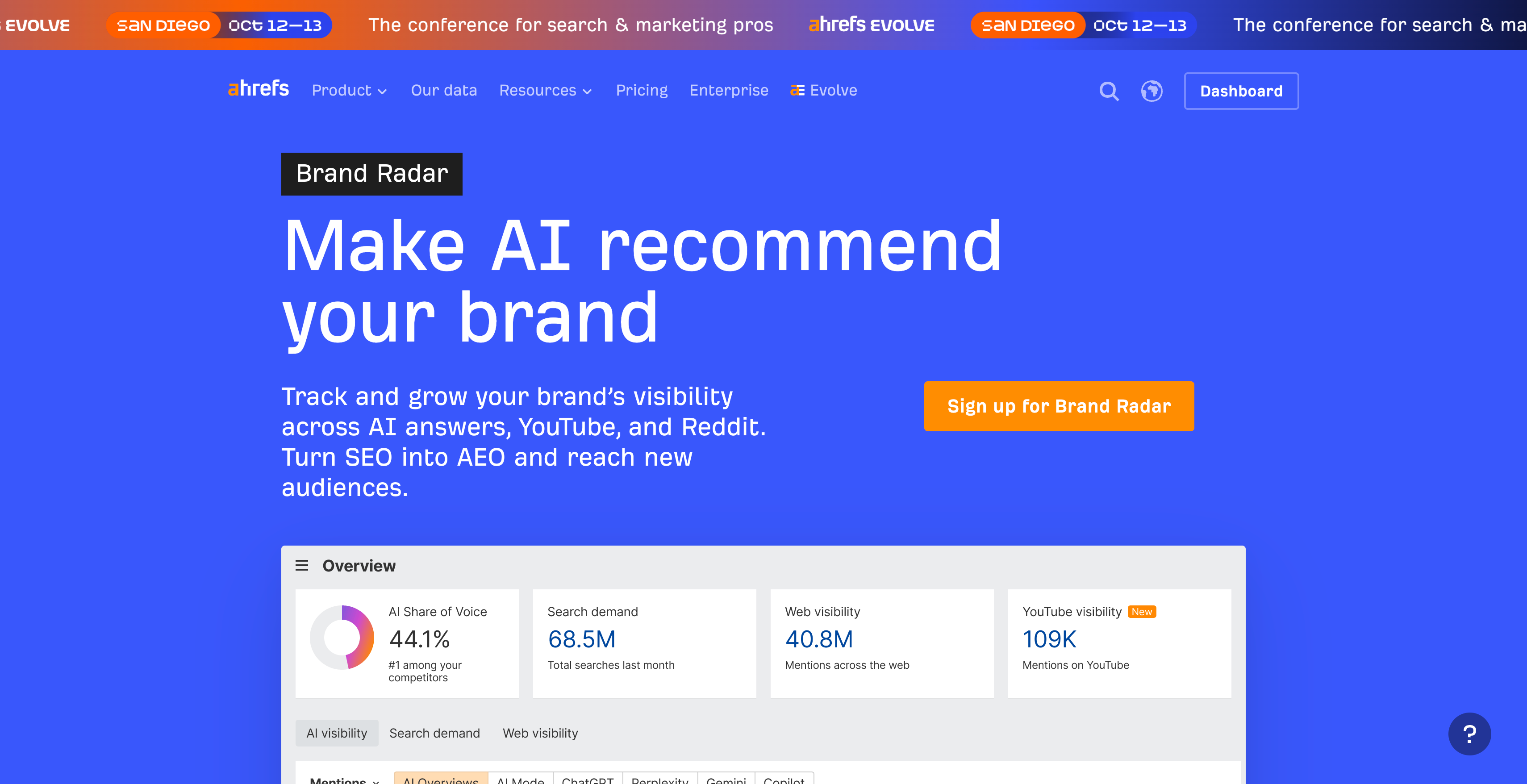
Ahrefs built AI-answer tracking into Brand Radar, covering ChatGPT, Perplexity, Google AI Overviews, and Gemini. Its backlink index is still the category benchmark for competitive link research, and the base plans include Content Explorer and rank tracking. The real limitation is stacking costs: full AI visibility requires a base subscription plus Brand Radar's separately metered pricing.
- Core features: Site Explorer, Keywords Explorer, Content Explorer, Brand Radar (AI citation tracking), Site Audit, Rank Tracker.
- Supported AI platforms: ChatGPT, Perplexity, Google AI Overviews, Gemini, via the Brand Radar add-on.
- Pricing: Lite $129/month, Standard $249/month, Advanced $449/month, Enterprise from $1,499/month (annual commitment). Brand Radar: $199/month per AI index, or $699/month for the full bundle, on top of a base plan.
- Ideal for: SEO specialists and e-commerce teams that prioritize link building and treat AI visibility as a secondary capability.
- Pros: Unmatched backlink data; the all-platform Brand Radar bundle covers a broad range of engines; tightly integrated with existing keyword workflows.
- Cons: Stacking a base plan with the full Brand Radar bundle runs $828+/month before any team seats; not built as an AI-visibility-first tool. See how Promptwatch compares to Ahrefs for a fuller breakdown.
Best for: link-building-first teams that want AI-answer tracking bundled into a tool they already pay for.
4. Surfer SEO
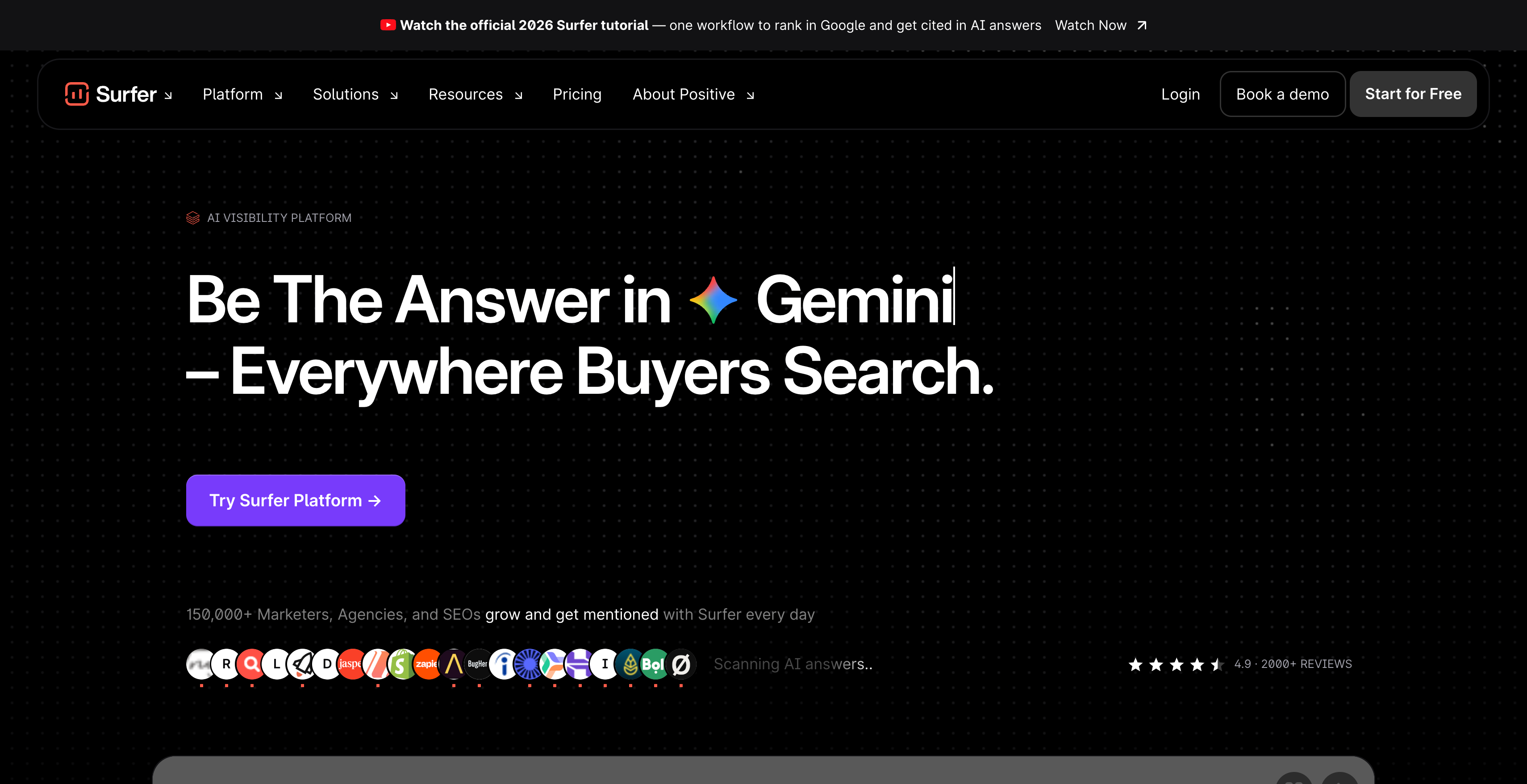
Surfer's Content Editor scores hundreds of on-page signals from top-ranking pages and gives writers a live NLP score as they type, which has made it a staple in content-heavy workflows. Surfer AI can generate full draft articles, and an add-on extends visibility monitoring toward AI search. It's built primarily as a writing tool, not a monitoring or research hub.
- Core features: Content Editor (live NLP scoring), Surfer AI (article generation), Grow Flow (task automation), SERP Analyzer, Content Audit, AI Tracker (add-on).
- Supported AI platforms: Google AI Overviews natively; broader AI tracking via the AI Tracker add-on.
- Pricing: Essential ~$99/month, Scale ~$219/month, Enterprise from $999/month. AI Tracker: ~$95/month add-on.
- Ideal for: Content teams publishing at volume who need fast, data-backed optimization guidance.
- Pros: Content Editor genuinely improves draft quality; accessible for non-technical writers; solid WordPress and Google Docs integrations.
- Cons: Native AI search visibility is thin without the add-on; AI-generated drafts typically need real editing before publishing.
Best for: writers and editors who want real-time optimization feedback while drafting, not a monitoring platform.
5. Clearscope
Clearscope's A-through-F content grading is one of the clearest benchmarks available for editorial quality. Managers can set a grade target, hand a brief to a writer, and track progress objectively, and Content Inventory automatically re-scores published pages when search behavior shifts. Pricing puts it firmly in enterprise territory.
- Core features: Live Content Editor with letter-grade scoring, Content Inventory (auto-monitoring), keyword recommendations, Google Docs and WordPress integration, team reporting.
- Supported AI platforms: Primarily Google; no dedicated LLM tracking.
- Pricing: Essentials $129/month, Business $399/month, Enterprise up to $1,500+/month.
- Ideal for: Content-heavy brands and well-funded agencies that want an objective editorial quality benchmark.
- Pros: Clean UI; the A-F system removes subjectivity from content review; reliable monitoring alerts.
- Cons: No AI search visibility features at all; a premium price for what is fundamentally a content-scoring tool.
Best for: editorial teams that need a shared, objective quality bar more than AI visibility data.
6. Frase
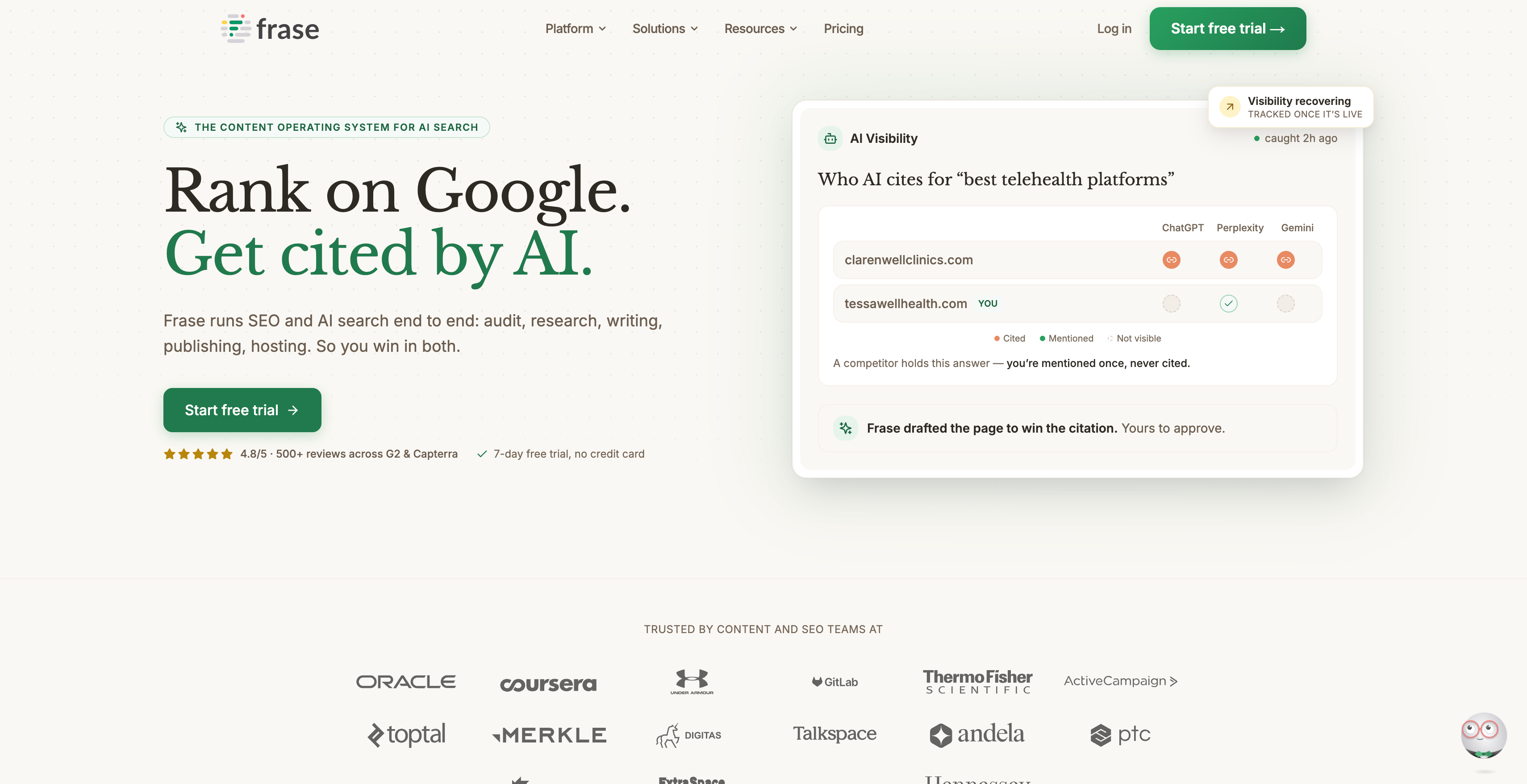
Frase builds SERP-based content briefs faster than most tools on this list, reading competitor H2s and H3s into an outline in seconds, with a semantic score as you write. Its GEO module tracks brand presence in ChatGPT and Perplexity responses, which is notable at this price. Output quality is solid for first drafts but less reliable on technical topics.
- Core features: Automated content briefs, SEO + GEO dual scoring, competitive SERP analysis, AI writing assistant, AI visibility tracking (ChatGPT, Perplexity).
- Supported AI platforms: ChatGPT and Perplexity, via the GEO module.
- Pricing: Starter ~$39/month, Professional ~$115/month, Scale ~$239/month.
- Ideal for: Lean in-house SEO teams and bloggers who want briefs, research, and basic AI visibility without a big budget.
- Pros: Strong price-to-value; brief generation is fast; a GEO module at this tier is rare.
- Cons: AI platform coverage stops at two engines; content scoring is less rigorous than Clearscope or Surfer.
Best for: small teams that want brief generation and a taste of AI visibility in one affordable tool.
7. SE Ranking
SE Ranking covers the broadest traditional SEO toolkit under $100/month: rank tracking, site audits, keyword research, and AI Overview monitoring. It won't match Semrush or Ahrefs on data depth, but for small teams the value is hard to beat, and AI Overview tracking is included rather than sold separately.
- Core features: Rank tracker, site audit, keyword research, backlink checker, AI Overview monitoring, on-page SEO checker, competitor research.
- Supported AI platforms: Google AI Overviews.
- Pricing: Essential ~$65/month, Pro ~$119/month, Business ~$259/month.
- Ideal for: Freelancers, small businesses, and solo consultants managing multiple clients on a budget.
- Pros: Strong price point; covers core SEO workflows; AI Overview monitoring included with no add-on cost.
- Cons: Data depth trails Semrush and Ahrefs; AI search coverage stops at Google.
Best for: solo consultants and small teams who need traditional SEO fundamentals cheaply, with basic AI Overview visibility included.
Which tool is right for your team?
Agency managing multiple clients: Promptwatch's agencies plan is built around this: one account, one subscription, unlimited client projects instead of per-client billing, plus white-label reporting for demonstrating AI search ROI.
In-house SEO at a mid-sized brand: Promptwatch covers the AI visibility layer that Surfer, Clearscope, and Frase don't. The AI search visibility for SEO teams page walks through how in-house teams typically structure this alongside a traditional SEO suite.
E-commerce team: Ahrefs for link building and competitor research, Surfer for product and category page optimization, Promptwatch to see whether AI search actually recommends your products. Promptwatch's ChatGPT shopping recommendations tracker is built specifically for this.
Enterprise: Semrush at the Enterprise tier with the AI Visibility Toolkit covers traditional and AI search but gets expensive fast at scale. Promptwatch adds the GEO layer, crawler log analysis and content gap recommendations, that Semrush's toolkit doesn't provide natively.
Solo consultant or freelance blogger: SE Ranking for SEO fundamentals, Frase for briefs and a first taste of AI visibility. Both fit comfortably under $200/month combined.


