


AI is now one of the main ways people discover products, tools, and services. ChatGPT alone has over 900 million weekly active users and is still growing.
When you ask it for a recommendation, you get a direct answer, a response that already names specific brands and tells you what to use. The decision is practically made for you.
If your brand isn't one of them, a competitor is.
We tracked what AI actually cites across ChatGPT, Perplexity, Gemini, Claude, and Google AI Overviews and built 6 strategies around that data. Here's what works.
TL;DR:
- Focus on listicles, landing pages, and product pages. All three are heavily cited by AI, not just blog content
- Structure every page so AI can extract a clean answer, as hidden information rarely gets cited
- Build presence in relevant Reddit communities where your audience actually asks for recommendations
- Get listed on G2, Capterra, and Trustpilot. These platforms dominate the highest-intent AI queries
- Create specific YouTube content that answers real questions
- Get featured in publications, podcasts, and industry media. AI builds its understanding of your brand from the entire web
What are AI brand mentions?
An AI brand mention is when ChatGPT, Perplexity, Google AI Overviews, or another AI platform references your brand in a response.
This happens when AI cites an external source (an article, a product page, a review, a forum thread) that mentions your brand. If that source gets cited, your brand appears in the answer.
For example, if you ask ChatGPT, "What's the best project management tool for a small team?" the response might look something like this:
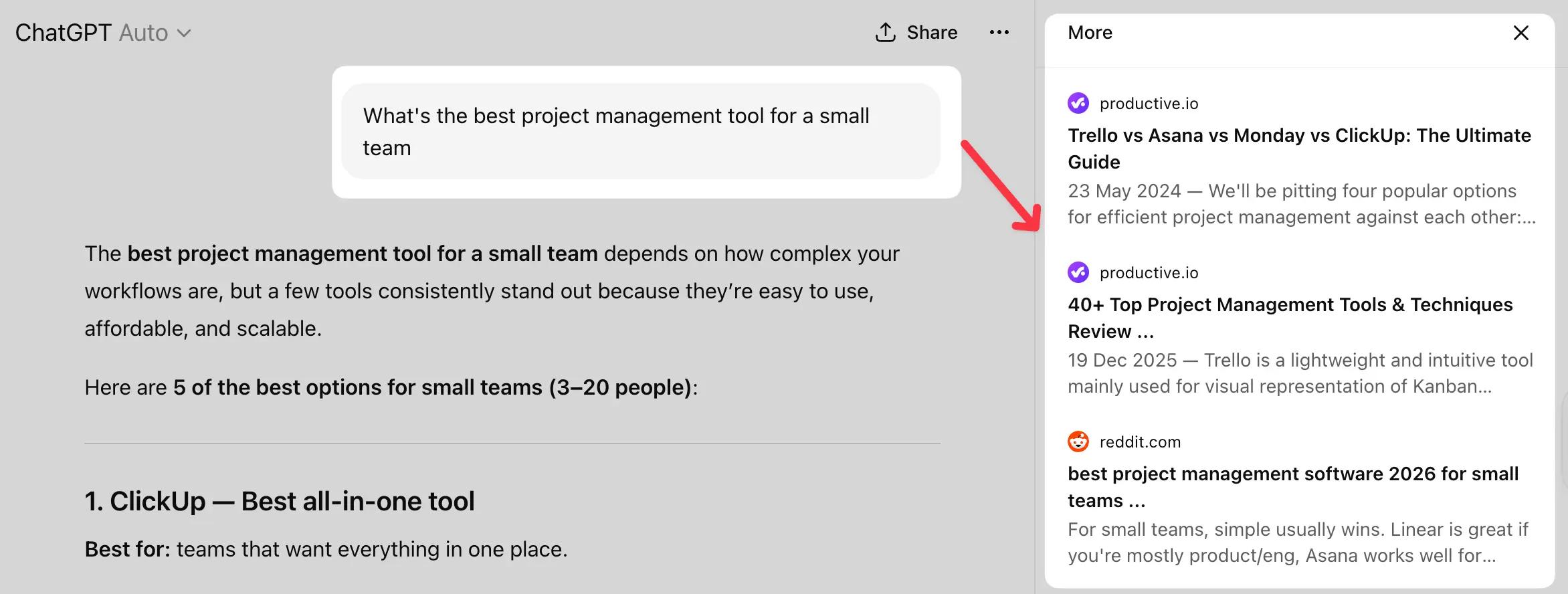
Perplexity works similarly to ChatGPT. It generates an answer and lists its sources directly alongside it, so the user can see exactly where the information came from.
In Google AI Overviews, citations appear as source cards directly inside the search results:
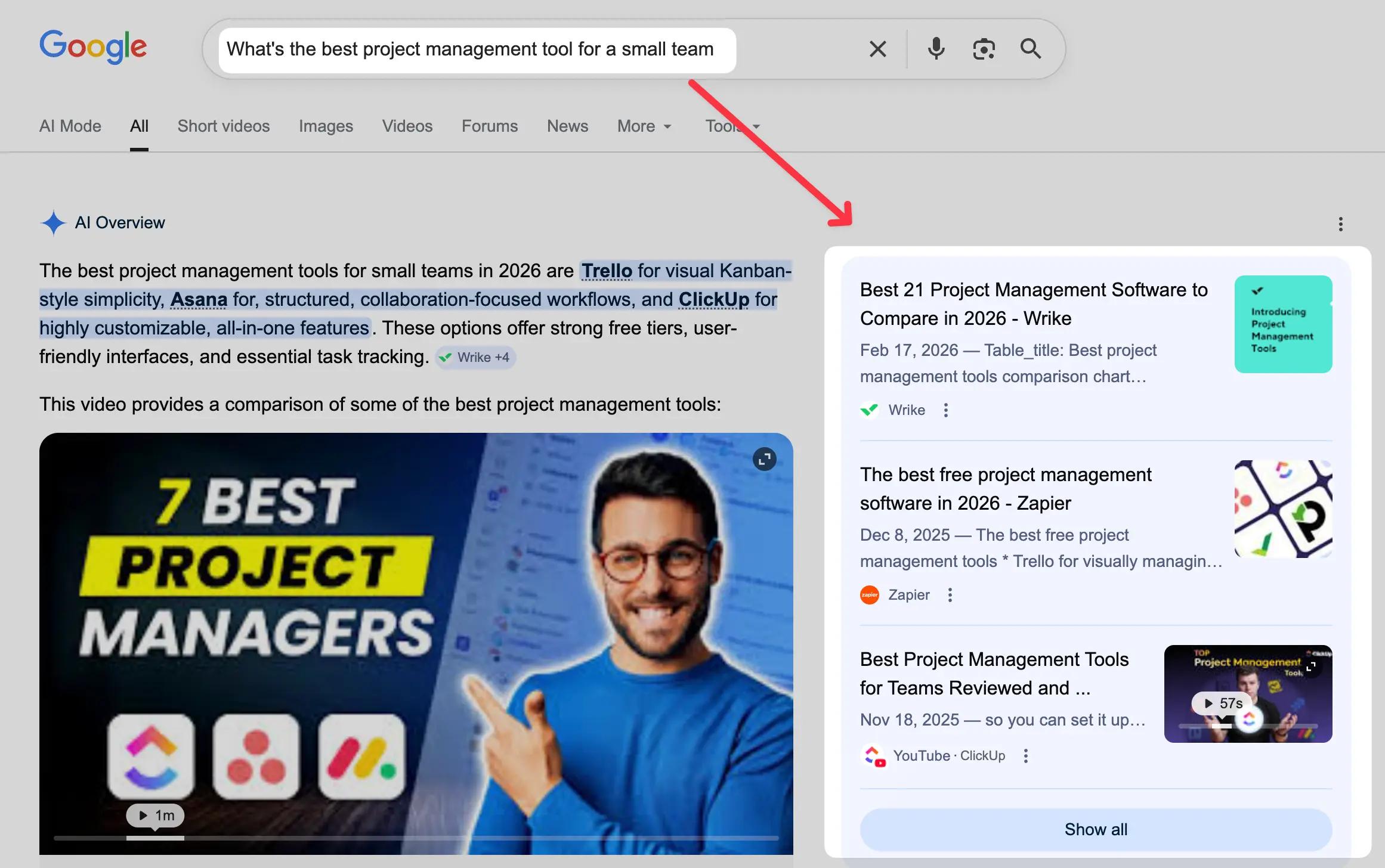
All these mentions are not fixed. AI responses are non-deterministic, meaning they change with every query: different user, different location, different moment. A brand that appears in an answer today might not appear tomorrow.
The First Official AI Citation Dashboard and What It Means
In February 2026, Microsoft launched the AI Performance dashboard inside Bing Webmaster Tools.
It is the first time any major search engine has built a dedicated tool for tracking AI citations natively, which itself signals something important: AI citations are now a measurable channel that the industry takes seriously, separate from traditional search rankings.
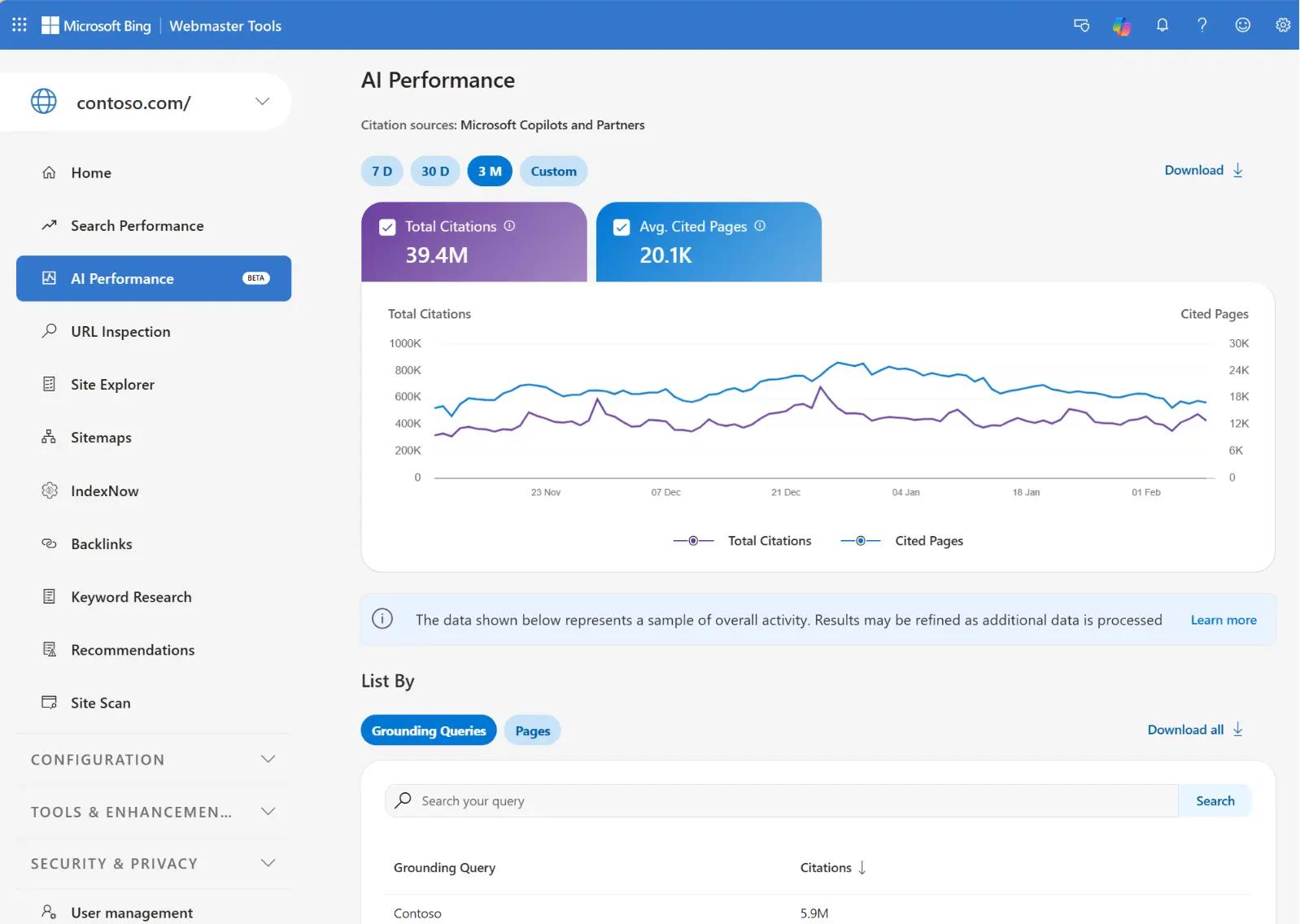
The dashboard shows you how many times your content has been cited across Copilot and Bing AI summaries, which specific pages are being referenced, what grounding queries AI used when retrieving your content, and how that citation volume changes over time.
It's also worth knowing why Bing matters more than most people realize. If your content isn't indexed by Bing, it's unlikely to be cited by AI platforms when they search the web for answers.
That said, the dashboard only covers Microsoft's own ecosystem. There's no official equivalent for ChatGPT, Perplexity, Gemini, Claude and more. For a complete picture of where your brand stands across all platforms, you need a dedicated GEO tool.
Promptwatch is built specifically for this. It tracks brand mentions at the prompt level across all major AI platforms, showing:
- when your brand is mentioned in specific prompts
- which pages get cited
- what content changes would help close those gaps
- how you and your competitors rank across each AI platform
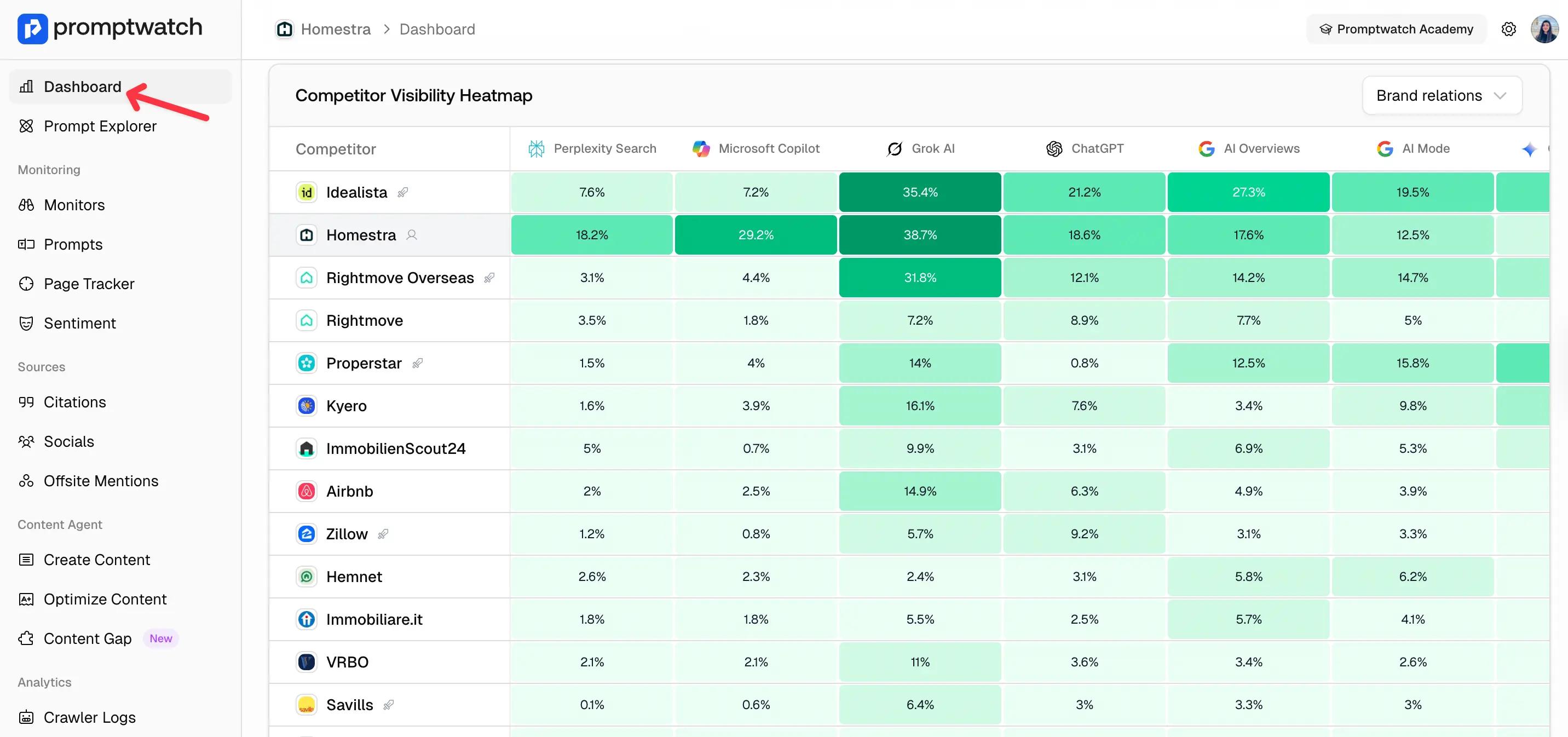
One of the features that makes this actionable is the Competitor Visibility Heatmap. It shows your visibility percentage vs. competitors across Perplexity, Copilot, Grok, ChatGPT, and Google AI Overviews, all in one view:
6 Strategies That Actually Get Your Brand Cited by AI
1. Focus on the Content Formats AI Actually Cites
Before deciding what to create, it helps to know what AI is already pulling from. To understand which content formats AI actually cites, we analyzed 978,604 ChatGPT citations and classified each one by content type. Here is what our data shows:
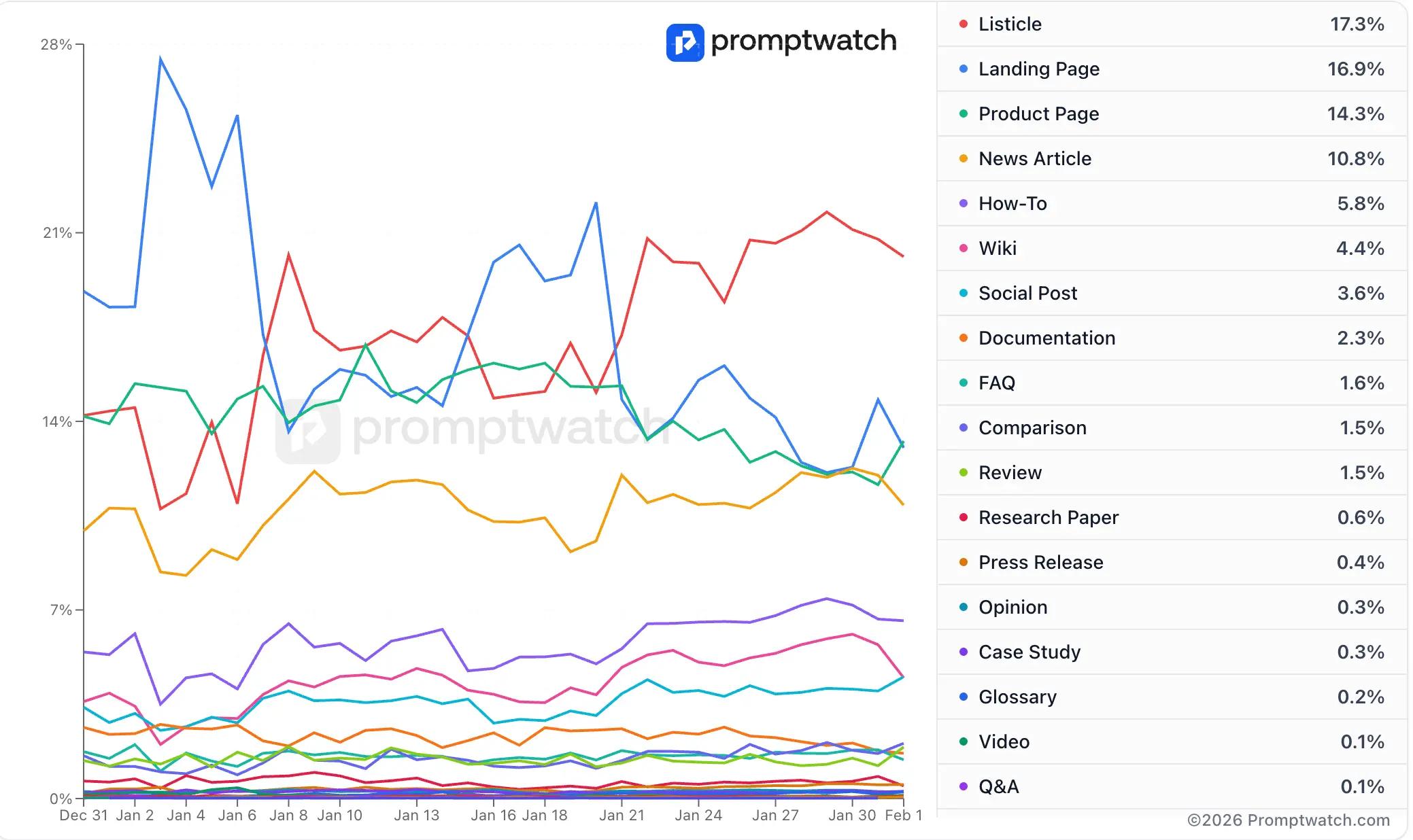
The first thing to notice is that listicles, landing pages, and product pages together account for nearly half of all citations. A well-structured landing page that clearly answers a specific question is just as likely to be cited as a blog post.
What this means in practice: look at the pages that describe what you actually do. Do they answer a specific question, or do they just list features? Can a reader, or an AI, understand in 10 seconds what you offer, who it's for, and why it's different? If not, that's the starting point.
A GEO tool like Promptwatch goes one level deeper as it shows you which content types are being cited specifically in the prompts relevant to your brand. So instead of optimizing for the general trend, you can see exactly what AI is citing when someone asks a question your brand should be answering.
We ran the same analysis on Google AI Overviews, classifying 5,533,229 citations from January to February 2026. Here are the results:
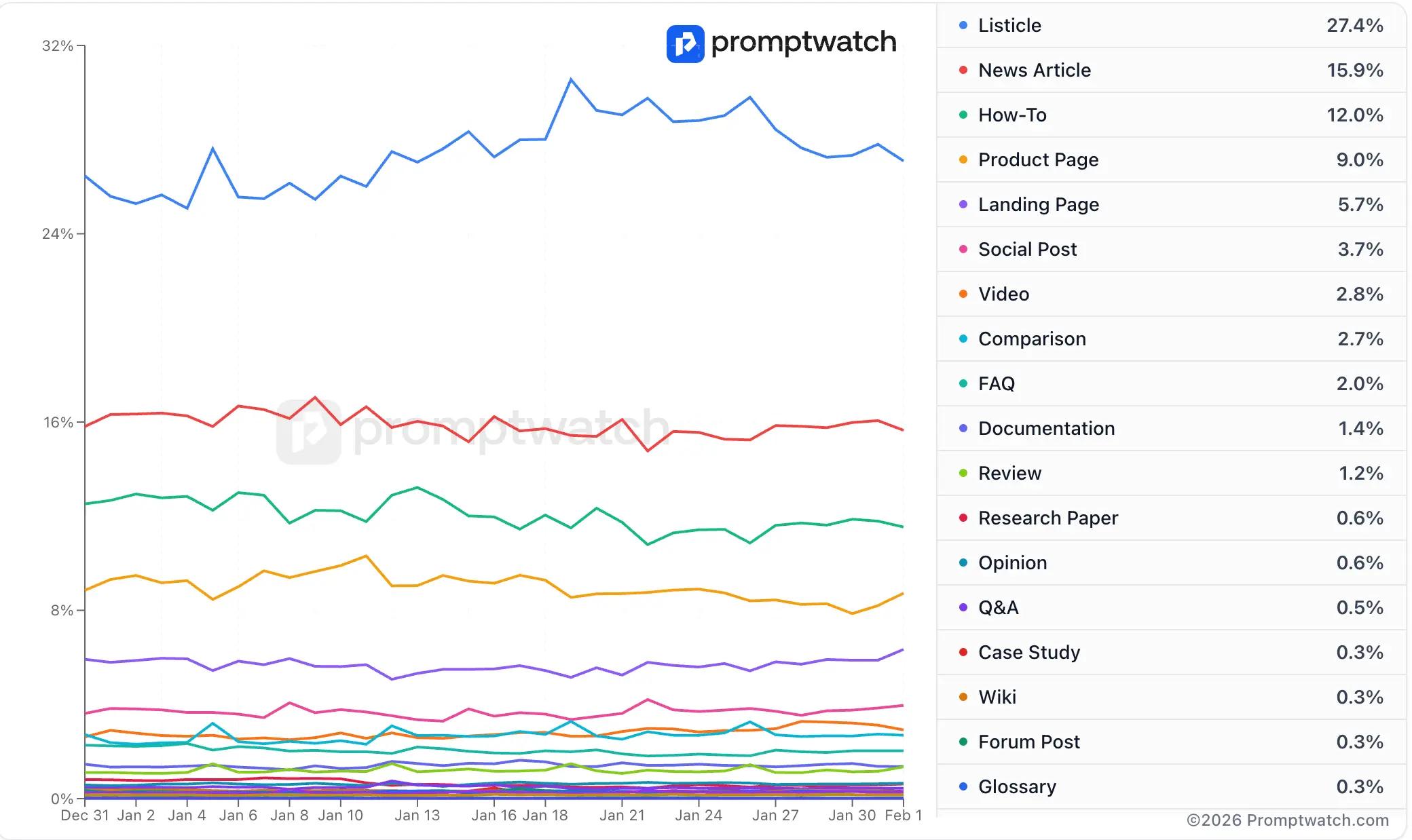
Again, listicles dominate across both platforms, but there's an important thing to note here.
Over the past year, a common tactic has been for brands to publish "best of" articles ranking their own product first, sometimes collaborating with others in the same space to mutually mention each other, and updating the title with "2026" while leaving the actual content unchanged. For a while, it worked.
But in February 2026, researcher Lily Ray identified a consistent pattern: SaaS and B2B brands using this tactic saw organic visibility drops of 30–50% following Google's January (unconfirmed) update. Because many AI models pull from Google's index, those losses carried over into AI citations too.
The listicle format still works. Structured, comparative content gets cited. But self-promotional listicles built to “game” AI answers, without genuine evaluation or transparent methodology, are now a liability in both Google and AI search. The format works. The manipulation doesn't.
2. Structure Every Page So AI Can Extract an Answer
Looking at what gets cited across all content types in our data, one pattern stands out: AI tends to cite content it can quickly extract a clear answer from.
When an AI model receives a query, it scans pages looking for the most direct and specific answer, a named comparison, a clear criteria, a specific fact. Pages with specific headings, tables, and direct answers get picked up. Pages where the key information is hidden in long paragraphs often don't.
Bing's official guidance on AI citations confirms this: "Clear headings, tables, and FAQ sections help surface key information and make content easier for AI systems to reference accurately."
Here is what that looks like in practice:
- Headings should be specific. A heading like "Our Analysis" tells an AI nothing about what's inside. A heading like "Pricing Comparison: What You Pay Per User at Each Tier" is immediately usable for a relevant query.
- Put data in tables. Instead of writing "our conversion rate improved by 40%," put it in a table comparing before and after, or benchmarking against industry averages. That's what AI can actually pull and cite accurately.
- Add FAQ sections. Think about the exact questions your buyers type into ChatGPT "Does [your tool] work with [integration]," "how much does [your product] cost for a team of 10?" and answer those directly on the relevant pages.
- Answer first, support second. If your page is about pricing, the first sentence should state the price. If it's about a feature, the first sentence should explain what it does. Everything else is context that comes after.
This applies to every page that could end up in your citation pool: landing pages, product pages, comparison pages, how-to articles. The brands consistently appearing in AI answers have pages that can be understood in a 10-second skim.
Knowing how to structure your pages is one part of the equation. The other is knowing whether AI is actually reading them. A GEO tool like Promptwatch connects to your website's CDN and shows you exactly when AI models are crawling your pages, so you can see if the content you've optimized is actually being picked up.
3. Build Presence on Reddit But in the Right Communities
Reddit accounts for 4.1– 4.2% of all ChatGPT citations in our data, making it the #1 cited social platform, more than double YouTube, and four times LinkedIn.
From our January 2026 analysis of Reddit citations, the most cited subreddits were:
- r/SaaS
- r/smallbusiness
- r/ecommerce
- r/marketing
- r/DigitalMarketing
- r/personalfinance
- r/startups
These are B2B buyer communities, places where people ask which software to use, which services to hire, and which brands are actually worth it.
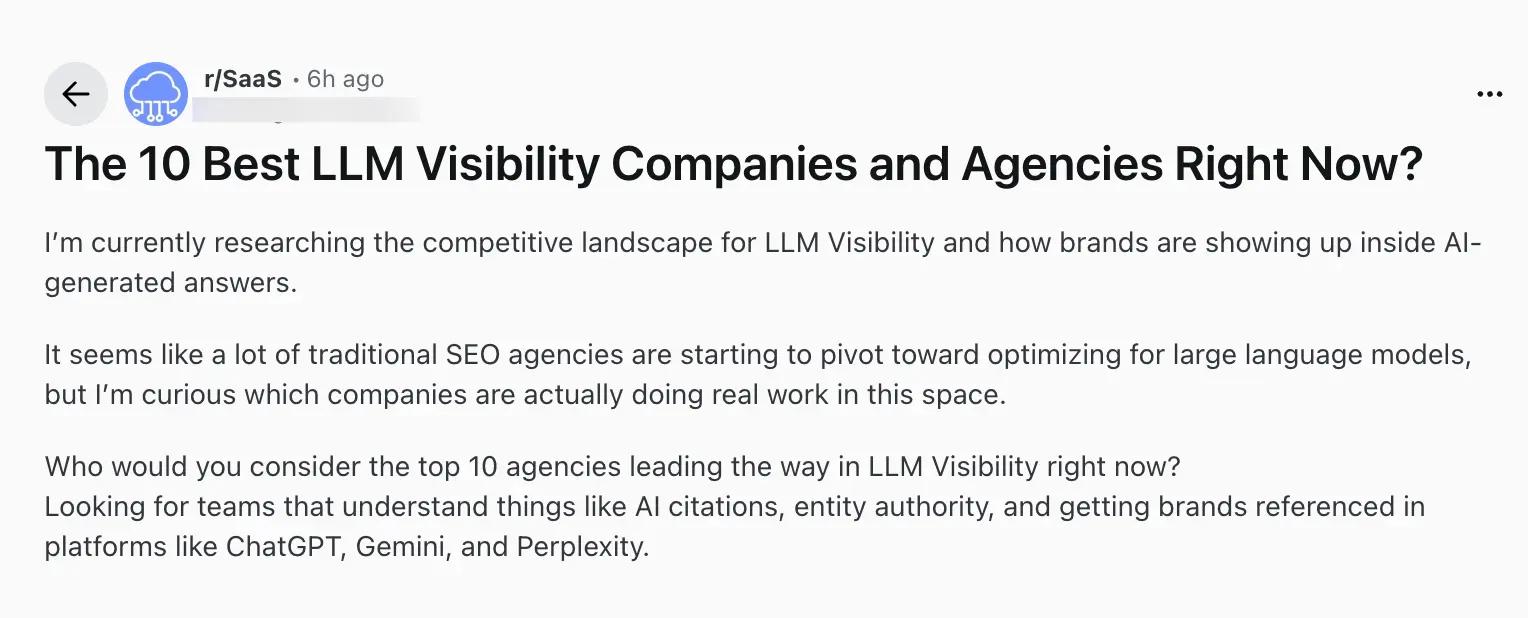
When your brand gets mentioned authentically in these threads, AI is reading them.
What's interesting is that this presence compounds over time. Our data shows a significant share of cited Reddit posts are over a year old. A thread from two years ago in r/SaaS where someone recommends your product is still being read and cited today.
Unlike most content channels where visibility fades, authentic community presence has a very long tail.
The brands that benefit from Reddit aren't the ones running promotional campaigns there. They're the ones whose products get discussed genuinely by real users answering each other's questions.
See how you can track Reddit mentions that show up in AI answers.
4. Get Listed on the Review Platforms AI Cites for Purchase Decisions
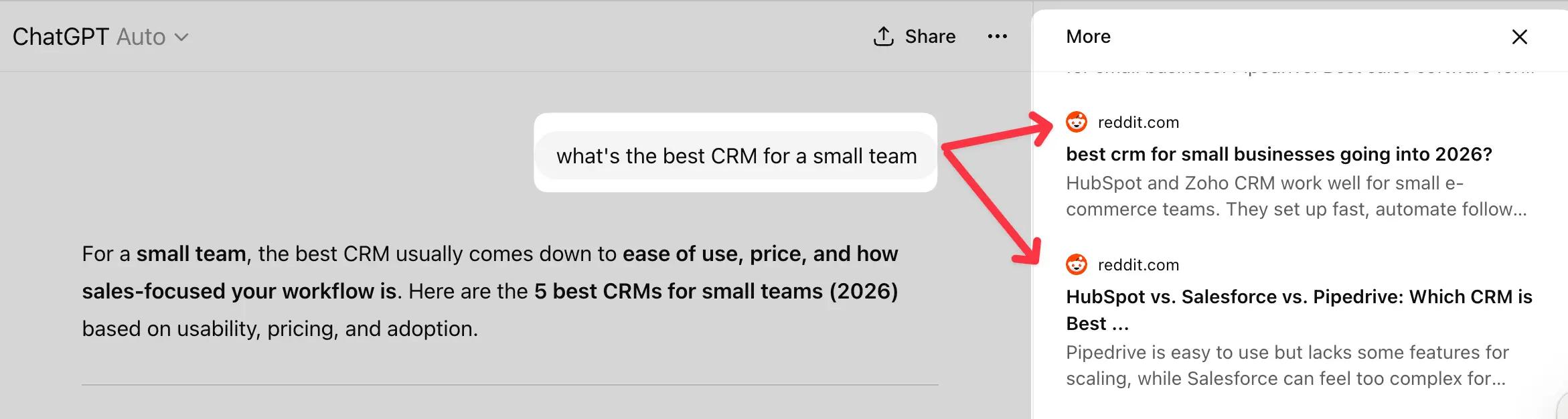
From our top ChatGPT citations by domain, review platform numbers look small at first: Trustpilot at 0.2%, G2 and Capterra each at 0.1%. But those numbers are misleading in isolation.
Review platform citations cluster heavily around the highest-intent queries in AI search:
- "what's the best CRM for a small team,"
- "top project management tools for agencies,"
- "which email marketing platform for ecommerce."
These are the moments where someone has already decided they want a solution. They're just asking AI to recommend one. A brand without a profile on these platforms is simply not part of that conversation.
It's also worth noting that G2 recently acquired Capterra, Software Advice, and GetApp, bringing together four of the leading software review platforms into one.
For software vendors, this means even more consolidated review data feeding into AI recommendations. Being present and active on these platforms is no longer optional.
If you are not on these platforms yet, that is the first step. Claim your profiles on G2, Capterra, and Trustpilot and fill them out completely, which means more than just a description.
Include your full integration list, the specific use cases you solve for, the team sizes you work with, and up-to-date pricing.
Those are the exact details AI pulls when answering "what's the best tool for X." Then, actively collect reviews and keep everything current. A profile that hasn't been updated in two years is less likely to appear than one that reflects what your product actually does today.
5. Create Specific YouTube Content That Answers Real Questions
YouTube accounts for 1.7–1.9% of ChatGPT citations in our February 2026 data, making it the second most cited social platform after Reddit.
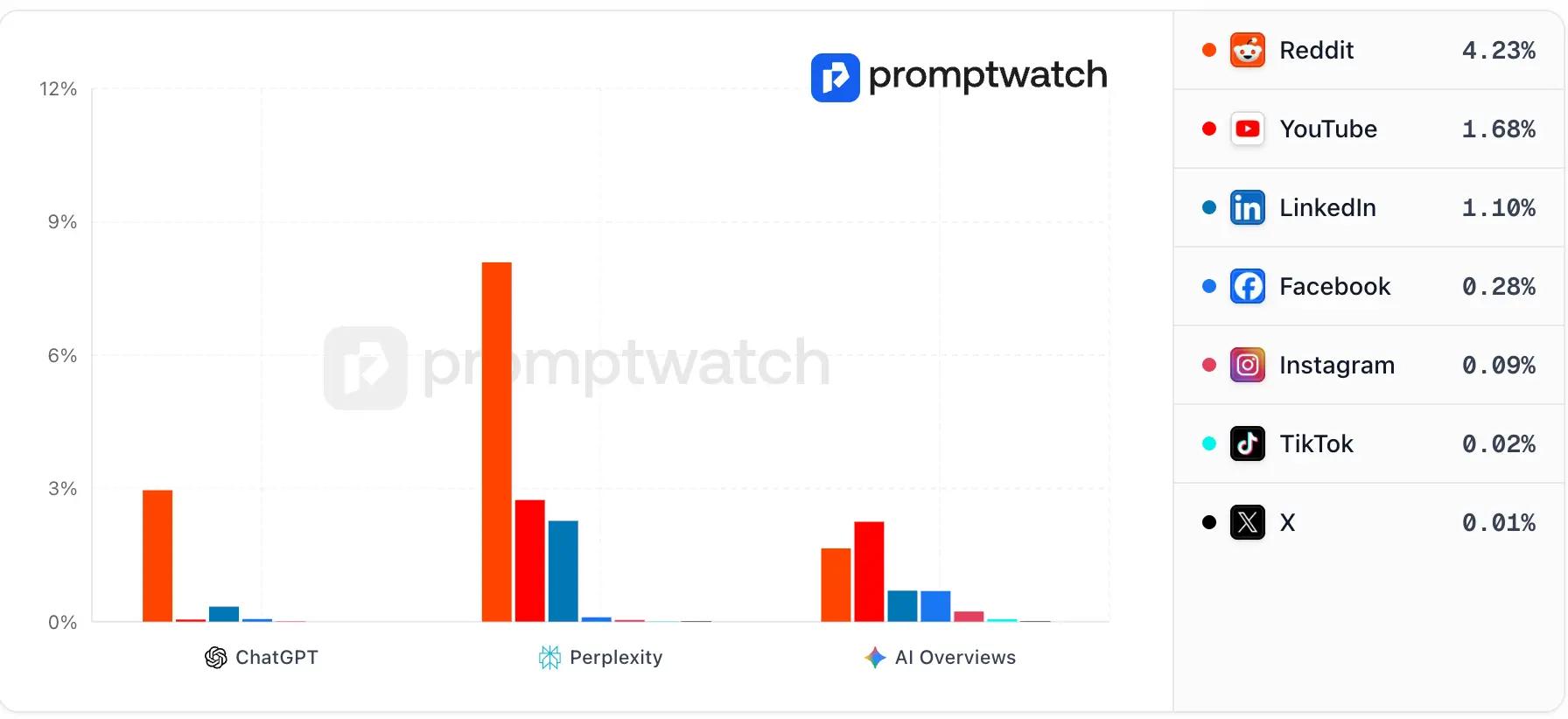
The common assumption is that only large channels get cited. Our data doesn't support that. Subscriber count is not the primary factor of citation, what matters is whether the video directly and specifically answers the question being asked.
A channel with 10,000 subscribers that publishes a focused tutorial on a specific use case will outperform a channel with 1 million subscribers publishing broad overview content. AI is retrieving the most relevant answer to a specific query, not the most popular video.
Title and description clarity matter here because AI needs to understand what a piece of content is about before it can decide whether to cite it.
Take this video from Learn With Shopify as a good example of how to structure your content:
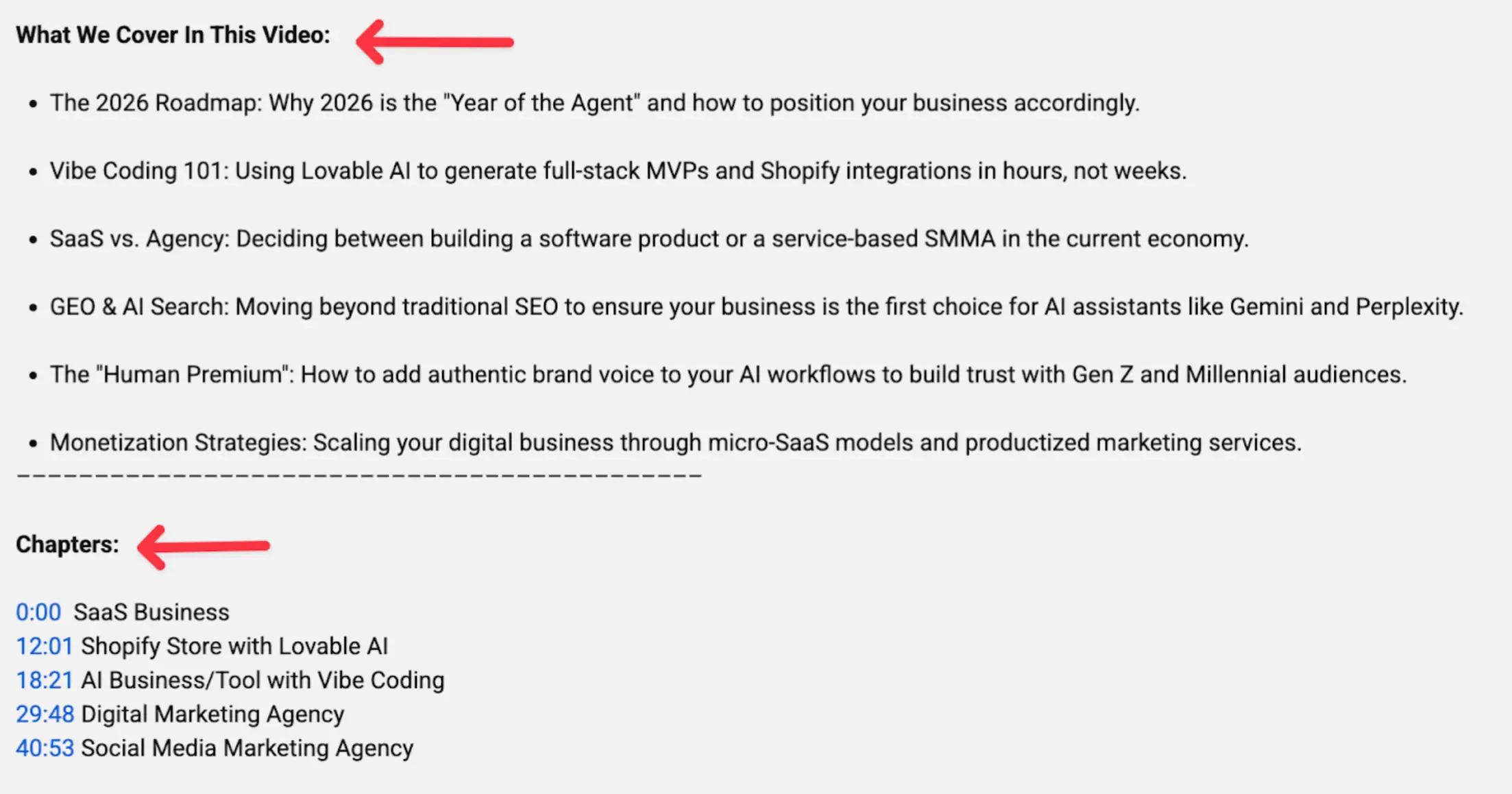
The description is detailed and clearly states what the video covers and who it's for.
The chapter timestamps break the content into specific topics, making it easy for AI to identify exactly what each section covers and cite the relevant part for a specific query.
That level of specificity is what gets cited.
6. Get Featured in Publications, Podcasts, and Industry Media
Most brands focus entirely on their own website when thinking about AI visibility. But AI doesn't just read your website, it reads everything written about you across the web.
Editorial coverage, industry publications, third-party articles, and podcast mentions all feed into how AI understands and represents your brand.
The more your brand gets mentioned in credible, relevant contexts, the more evidence AI has to include you in an answer.
In practice, this means:
- pitching for coverage in publications your buyers actually read,
- getting featured in roundups and comparisons
- finding publications in your niche that haven't written a "best of" roundup in your category yet, those are good opportunities
Pitch them a specific angle and offer a demo. If you have proprietary data or research, like citation trends in your industry (that's even better).
Writers are always looking for original data to support their articles, and a data-backed pitch is much harder to ignore than a generic outreach email.
How Do You Know If These Strategies Are Working?
Most brands implement changes and never find out if they made a difference. With AI visibility that gap is even bigger, unlike traditional SEO. Measuring your AI brand mentions is not a separate task you do after the strategies. It's part of the strategy itself.
The brands making real progress all share one thing: they know which prompts trigger a mention of their brand, which competitors appear in answers where they don't, and which of their pages AI is actually reading. That's what tells you where to focus next.
AI visibility tools like Promptwatch let you track exactly this. Monitor your brand across ChatGPT, Perplexity, Gemini, Claude, and Google AI Overviews, see how competitors compare, and spot where you're losing ground.
Here's what that looks like in practice:
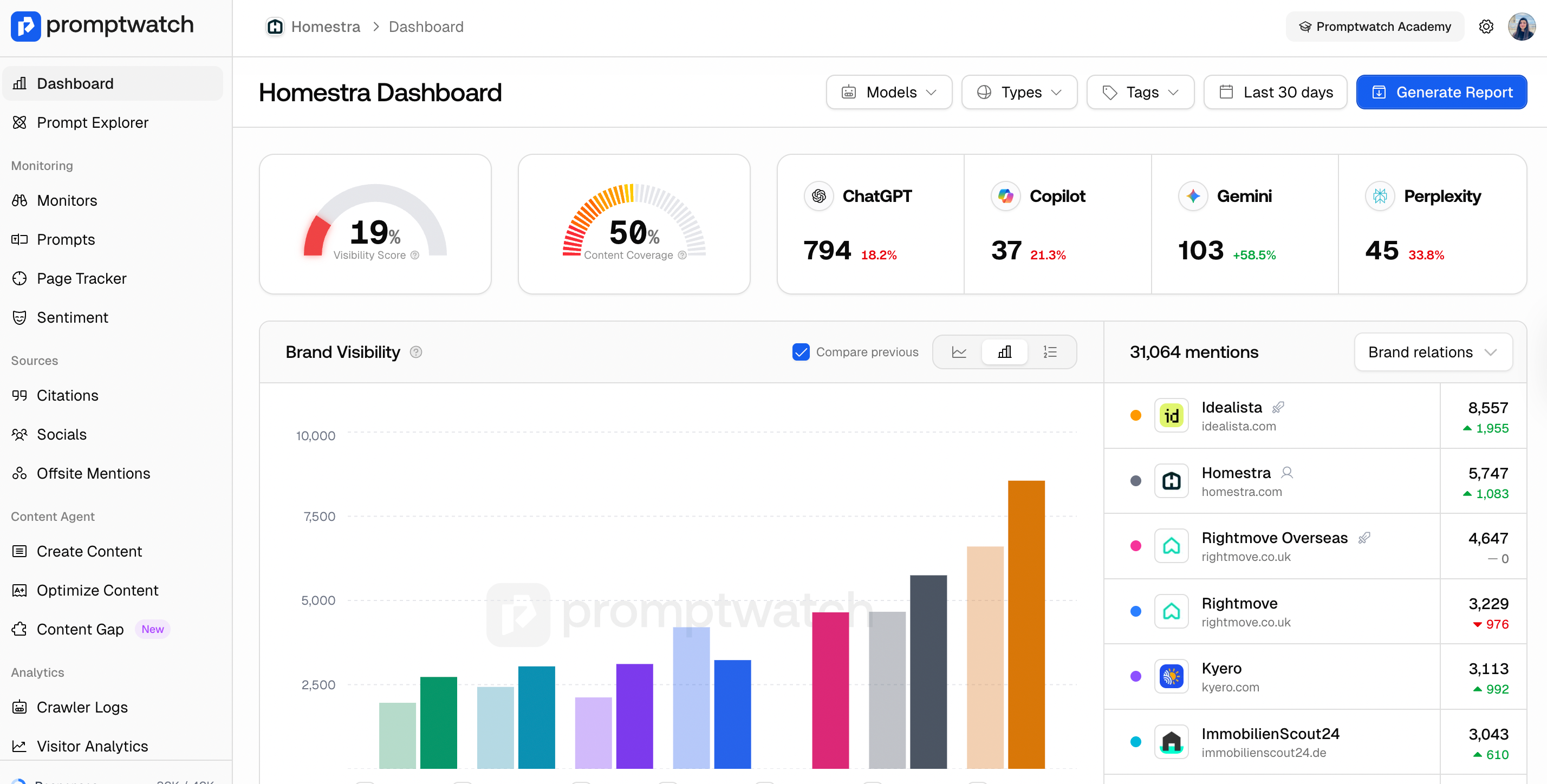
The dashboard gives you your overall visibility score, content coverage, and how your brand compares to competitors across all AI platforms.
From there, you can dig into the specific features that tell you what's actually happening.
- Citation Tracking shows which prompts mention your brand and which pages AI is citing.
- Page Tracking tells you which of your pages AI is reading and how often.
- Crawler Logs show you when AI models are on your site.
Learn more about how our AI crawler logs feature works.
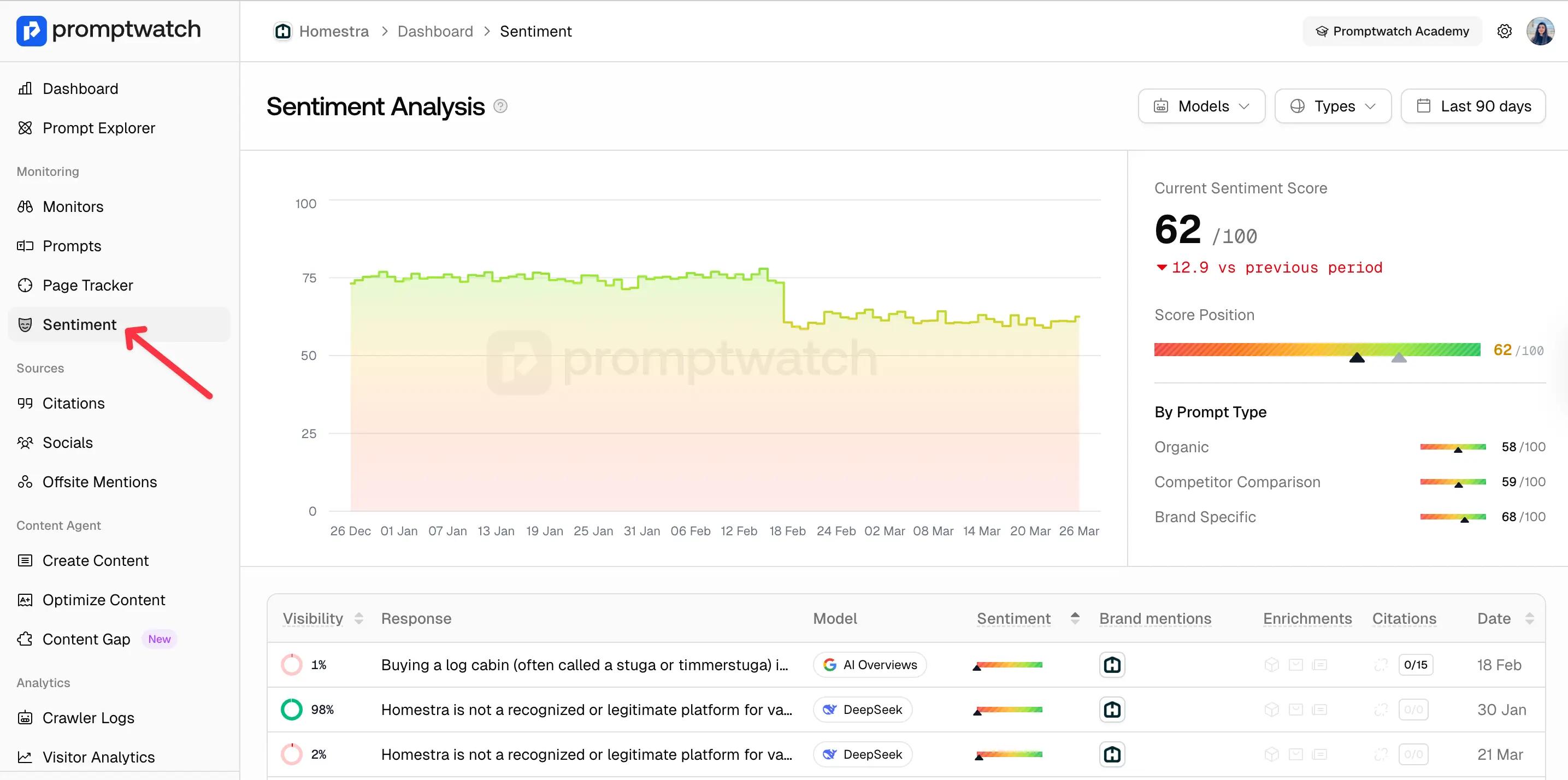
Beyond visibility, Promptwatch also tracks sentiment, not just whether AI mentions your brand, but how it actually talks about you, broken down by prompt type: organic queries, competitor comparisons, and brand-specific searches.
Start Tracking Your AI Brand Mentions
The best way to understand where you stand is to see it for yourself. Start your 7-day free trial and have a clear picture of your AI visibility by the end of the week.


