


TL;DR
- AEO is optimizing to be the answer AI engines quote, not just the link they rank.
- AEO vs GEO: same shift, different emphasis. Pick one term internally and move on.
- Ranking isn't enough anymore. Top 10 share of AI Overview citations fell from 76% to 37.1% in a year (Ahrefs).
- Schema isn't the lever. A study of 1,885 pages found no citation uplift (Ahrefs).
- Cited sources churn monthly, so AEO is monitoring, not a one off. Promptwatch tracks your prompts across all seven major answer engines and scores visibility, position and sentiment against competitors.
What is answer engine optimization?
Answer engine optimization (AEO) is the practice of structuring content, data and brand signals so that AI powered answer engines, such as ChatGPT, Google AI Overviews, Perplexity and Gemini, can extract, trust and cite your information as the direct answer to a user's question, rather than simply linking to your page.
In classic search, the unit of competition was the page: you wrote a page, it ranked, people clicked. In AI search, the unit of competition is the sentence. An engine pulls a specific claim out of your content, drops it into a generated answer, and may or may not credit you underneath.
What counts as an answer engine?
Any system that responds to a question with a composed answer instead of a list of results. In practice that's seven surfaces worth tracking today:
- ChatGPT. Conversational assistant with live web search.
- Google AI Overviews. The generated summary above Google's organic results.
- Google AI Mode. A full conversational search experience inside Google.
- Perplexity. An answer engine built around visible inline citations.
- Gemini. Google's assistant, grounded in Search.
- Microsoft Copilot. Assistant grounded in the Bing index.
- Amazon Alexa. Voice responses drawn from the web.
They behave differently, and the tactics that win on ChatGPT aren't identical to the ones that win in AI Overviews. We'll cover each engine properly in its own guide. For now, the useful thing to know is that all seven read your site, and most marketing teams have visibility into none of them.
AEO, GEO and SEO: which word should you actually use?
Short version: there is no agreed taxonomy, and the industry knows it. Fewer than a third of practitioners use these terms consistently.
| Term | Emphasis | Genuinely different in practice? |
|---|---|---|
| SEO | Ranking a page in a list of results | Yes. Different goal, different metric |
| AEO | Being the extractable answer an engine quotes | Partly. Same foundations, answer first emphasis |
| GEO | Being mentioned and recommended inside generated text | Partly. Overlaps AEO heavily |
| LLMO | Influencing the model layer and brand consensus | Somewhat. Widest scope, hardest to measure |
| AIO / AISO | Umbrella for all of the above | It's the umbrella, not a rival |
Our honest read: generative engine optimization (GEO) and AEO describe the same shift with a different centre of gravity. AEO leans toward the quotable answer. GEO leans toward being the recommended brand. The work overlaps by something like 90%.
So use whichever term your stakeholders already use, because arguing about the acronym is a worse use of your quarter than fixing what AI says about you. Internally, "AI search visibility" describes the outcome better than any of them.
And no, SEO isn't dead. Position one still gets cited far more often than position seven. Ranking is now the entry ticket rather than the finish line.
Why AEO matters now
Four numbers, and one correction to a statistic you've probably seen quoted at you.
The clicks broke before the queries did
You've likely seen the Gartner prediction that traditional search volume would drop 25% by 2026. Worth knowing: that was published in February 2024, and it didn't happen. Alphabet reported Search revenue up 17% year over year in Q2 2026, with AI Mode past a billion monthly active users. Query volume grew.
What collapsed was clicks per query. In the US, 68% of Google searches now end without a click, up from around 60% in 2024 (SparkToro, June 2026). Pew Research found users clicked a result on 8% of visits where an AI summary appeared, versus 15% where it didn't. Ahrefs measured position one click through rate down 58% on keywords with an AI Overview.
If you're still quoting the older 34.5% figure for that last one, it's been superseded by the same team's 2026 update.
Ranking no longer decides whether you get cited
This is the number that justifies AEO existing as a discipline at all.
The share of AI Overview citations coming from pages in the top 10 organic results fell from roughly 76% to 37.1% in a single year (Ahrefs, 863,000 SERPs and 4 million AI Overview URLs, March 2026). The rest now comes from positions 11 to 100, or from outside the top 100 entirely.
Read that plainly: you can rank first and still not be the answer, and your competitor can rank on page four and be quoted instead. Classic SEO still helps. It no longer decides.
The traffic that does arrive is worth more
AI referred traffic to US retail sites converted 42% better than non AI traffic in March 2026, a reversal from a year earlier when it converted 38% worse (Adobe Analytics). Similarweb found users who received an AI recommendation for a brand were 2.5 times more likely to visit that brand's site within seven days.
But stay honest about the scale
AI traffic is still under 0.15% of total web visits (Semrush, 50,000 sites). ChatGPT referrals grew over 200% year over year and remain under 1% of publisher page views.
So AEO is a positioning investment, not a channel that pays your rent this quarter. Teams who treat it as an immediate traffic play get disappointed. Teams who treat it as claiming ground before it's contested tend to be the ones who are already visible while their competitors aren't.
How answer engines decide what to cite
Most AEO advice stays vague because it skips this part. Getting cited is five separate steps, and you can fail at any of them for completely different reasons.
1. Crawl. An AI agent has to fetch the page. Different bots do different jobs, and blocking one at your CDN or in robots.txt can quietly remove you from an entire engine.
2. Retrieve. The engine selects candidate documents for the question. In AI Overviews this leans on Google's index. In ChatGPT it's a live search.
3. Chunk. Documents get split into passages, and this is the step nobody explains. You are not competing as a page. You are competing as a fragment. If your answer only makes sense with the three paragraphs above it, it won't survive extraction.
4. Ground and synthesize. The model composes an answer from retrieved fragments, reconciling where sources agree and disagree. Agreement across independent sources is itself a signal.
5. Cite. Some engines attribute, some paraphrase you without a link. Being mentioned without being cited is a real and measurable outcome.
Each stage has its own failure mode: blocked bot, never retrieved, unquotable fragment, contradicted by other sources, mentioned but not linked. Most teams only ever see stage five, and only anecdotally, which is why so much AEO advice stays generic.
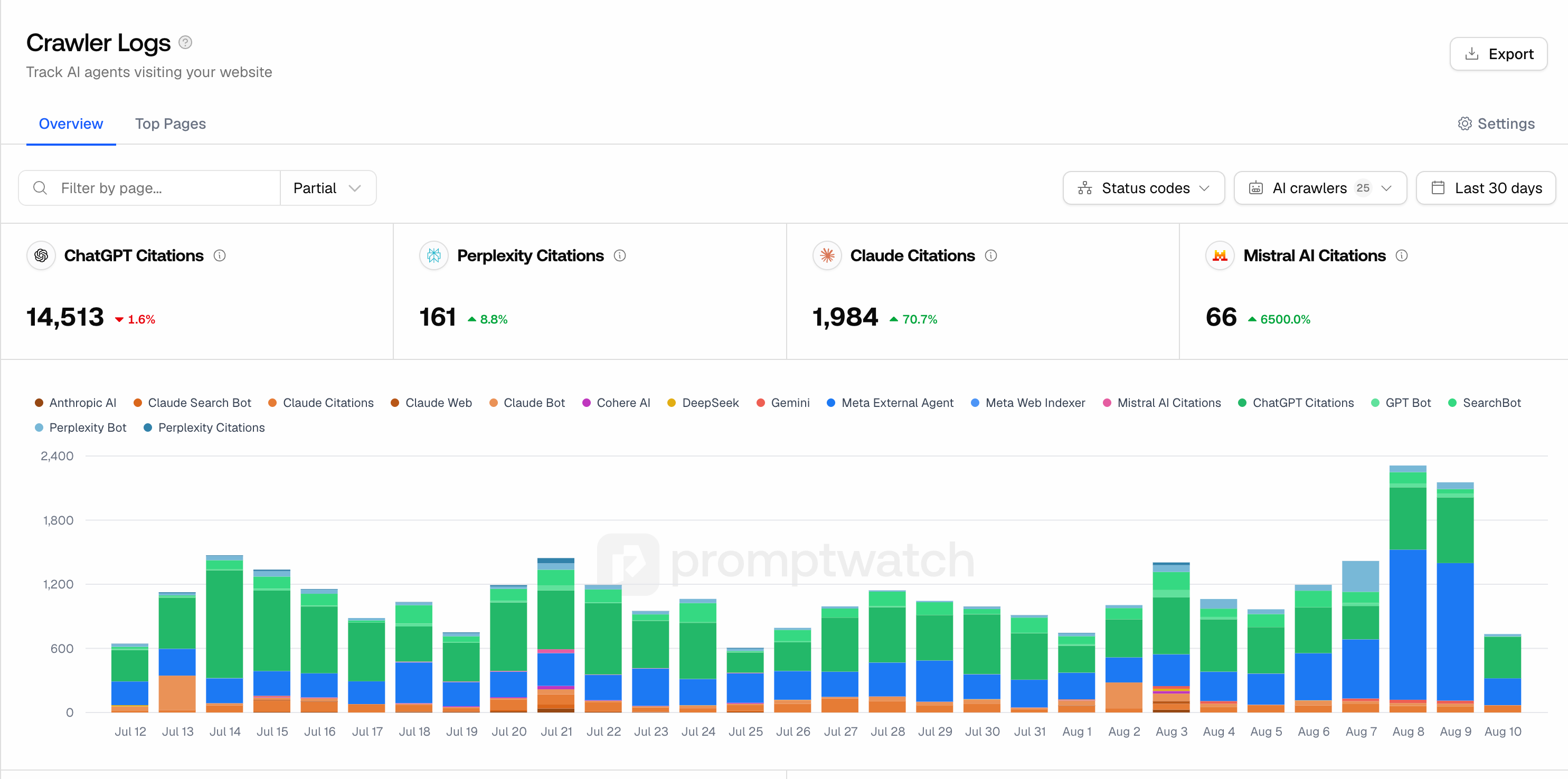
Seeing stages one and two takes server side data, because analytics tags can't see a crawler that never renders a page. That's the reason we built Promptwatch around three connected views rather than one: what the answers say, what AI crawlers and AI referrals actually do on your site, and then the work to fix what those two reveal.
As Marijn ten Bulte, Head of Organic Channels at Advise, puts it, in Promptwatch they can see how active the ChatGPT bot is on client websites and exactly how often that content is used in LLM responses. That's the difference between guessing which pages matter and knowing which ones engines actually fetch and quote.
Seven levers that actually move citations
Ordered by leverage, cheapest first.
1. Fix what AI already says about you
Before writing anything new, find out what the engines currently claim. Wrong pricing, discontinued features, a competitor named as the better choice. This is the cheapest win available and almost nobody starts here.
Run four prompts on every engine that matters: What is [brand]? Is [brand] good for [use case]? [Brand] vs [competitor]. How much does [brand] cost?
2. Answer the question in the first 50 words
Then expand. Make your headings match how people actually phrase questions, keep paragraphs to one idea, and make each block readable on its own.
❌ "Our approach to visibility combines several methodologies that, taken together, help brands navigate the complexities of modern discovery."
✅ "Answer engine optimization is the practice of structuring content so AI engines can quote it directly. It differs from SEO in one way: the goal is being the answer, not ranking near it."
The second one can be lifted into an AI answer without a single edit. The first can't be lifted at all. We go deeper on answer first formatting in a dedicated guide.
3. Optimize facts, not just pages
Engines extract claims. Make each claim self contained: entity, attribute, value, unit, date.
❌ "Our platform is affordable and covers all the major models." ✅ "Promptwatch tracks seven answer engines and starts at 50 prompts on the free tier."
One of those is a fact an engine can carry. The other is an adjective it will drop.
4. Build agreement off your own site
Because engines reconcile across sources, consistency between them is a ranking signal. Third party review platforms, industry listicles, Reddit threads, YouTube. If your own site is the only place a claim appears, it's a weaker claim.
5. Make sure engines can physically read you
Does your content exist with JavaScript disabled? Is your heading hierarchy real or visual? Is anything blocking AI bots at the CDN, WAF or robots.txt layer? This is a prerequisite, not an optimization. Nothing else on this list works if stage one fails, so it's worth knowing which AI bots are crawling your site before you spend a month on content. Our Agent Analytics shows that in real time, through server side logs rather than sampled analytics.
6. Keep it dated and current
Visible publish and update dates, accurate dateModified, and a refresh cadence on anything containing a number. Recency correlates measurably with AI visibility.
7. Remember this isn't only about blog posts
Almost every AEO guide assumes you're optimizing articles. Your commercial pages are where the money is.
| Page type | The AEO job |
|---|---|
| Product page | Be quotable on specs and use cases, in plain text |
| Pricing page | Be the source for your own price, not an image or a JS widget |
| Comparison page | Be cited on "X vs Y" prompts, with a fair and symmetrical table |
| Docs | Win how to and troubleshooting prompts, one task per page |
| Category page | Win "best X for Y" prompts with real selection criteria |
| About page | Anchor your entity: founding date, HQ, leadership, stated consistently |
For a broader view of how these fit together, see our guide to optimizing content for AI search.
How to measure AEO
Rankings and clicks stop being the scoreboard. Four metrics replace them.
| Metric | What it tells you |
|---|---|
| Visibility | Share of your tracked prompts where your brand appears at all |
| Citation rate | Share of responses that actually link your domain |
| Share of voice | Your mentions against every competitor's, across the same prompts |
| Sentiment and accuracy | How you're described, and whether it's true |
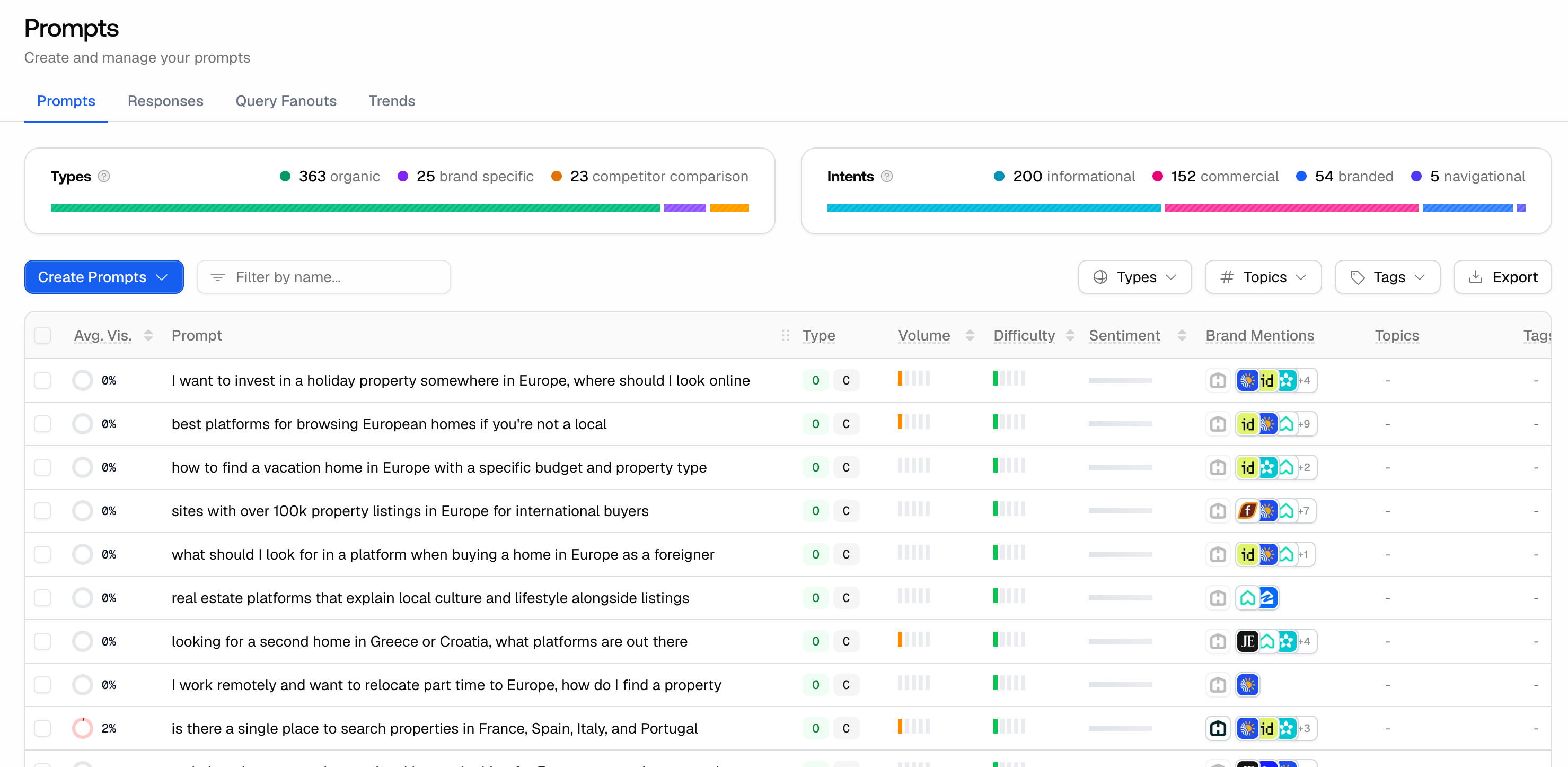
Those four cover what the answers say. They don't tell you what happens next, and that's the half most teams never instrument. When someone reads about you in ChatGPT and then visits your site, standard analytics usually files them as direct traffic, so the engine that actually sent them gets no credit and your AI work looks like it did nothing. Tracking referrals from AI assistants separately is what turns "we got cited" into "citations sent 400 visits and two demos last month", which is the version your CFO can act on.
Two practical warnings.
Build a real prompt set. 15 to 30 prompts is the minimum for a stable read, split across informational, commercial, comparison and branded intent. Below that, variance swamps the signal and you'll celebrate noise.
Expect volatility, because it's the signal and not an error. Across 230,000 prompts and over 100 million citations, Reddit's presence in ChatGPT responses fell from around 60% of prompts to roughly 10% in six weeks. Wikipedia dropped from 55% to under 20% over the same window. Judging AEO on a single snapshot is how teams talk themselves into the wrong conclusion twice.
That volatility is exactly why we built Promptwatch as continuous monitoring rather than an audit. Your prompt set runs across all seven answer engines with country, state and city targeting, every answer is scored for your brand's visibility, position and sentiment against your competitors, and the sources each engine cited are captured. Sam Franklin, VP Marketing at Landytech, describes it as making share of voice, content gaps and crawler activity a core part of their reporting stack rather than a quarterly curiosity.
If you'd rather start manually, you can. Run your prompt set by hand, log the results in a spreadsheet, repeat weekly. It works at small scale and becomes untenable somewhere around the third engine. When you outgrow it, we compare the options in our roundup of AEO tools, and there's more on turning citations into a repeatable process in our guide to growing citations in AI models.
Frequently asked questions
What does AEO stand for?
Answer engine optimization. It's the practice of structuring your content and brand signals so AI answer engines quote and cite you directly, rather than just listing your page as a link.
Is AEO the same as GEO?
Almost. Both describe optimizing for AI generated answers. AEO emphasises being the extractable answer, GEO emphasises being the recommended brand. The tactics overlap heavily, so pick one term and stay consistent.
Is AEO just SEO with a new name?
No, though it's built on SEO. The difference is measurable: only 37.1% of AI Overview citations now come from the top 10 organic results, down from 76% a year earlier. Ranking well no longer guarantees being cited.
Is SEO dead?
No. Position one is cited far more often than position seven, so rankings still matter a great deal. They're now necessary rather than sufficient.
How do you measure AEO?
With four metrics across a fixed prompt set: visibility, citation rate, share of voice against competitors, and sentiment. Because cited sources churn month to month, you measure on rolling averages rather than snapshots.
How long does AEO take to work?
For an established domain that engines already crawl, days to weeks for a new or rewritten page to start appearing. Longer for new domains, and longer again for off site agreement to build.
Does schema markup help AEO?
Not on its own. A controlled study of 1,885 pages that added schema found no meaningful citation uplift, and a small decline in AI Overviews. Keep schema for its SEO value, but don't expect it to win citations.
Do backlinks still matter for AEO?
Yes, indirectly. Links support the rankings and authority that feed retrieval. But unlinked brand mentions across independent sources now carry real weight too, because engines reconcile claims across sources.
Want to see which answer engines are citing you, and which are citing your competitors instead? Start tracking your first 50 prompts free with Promptwatch.

