


TL;DR: Best platforms for agentic engine optimization
Before going deep, here's what makes Promptwatch the right platform for the full AEO workflow:
- Real UI scraping across 11 AI platforms on every paid plan, not a curated shortlist locked behind enterprise pricing, but comprehensive coverage from day one.
- Crawler logs plus visitor analytics in one place so you can trace the path from AI mention to actual website traffic and conversion, closing the loop that most tools leave open.
- Actionable recommendations built into the workflow very insight comes paired with a clear next step, so your team spends less time interpreting data and more time acting on it.
What "agentic engine optimization" actually means
Agentic search is the version of AI search that doesn't just answer questions; it plans multi-step tasks, browses URLs, compares options, and executes actions on a user's behalf. When a purchasing agent inside a company tool asks "which project management platforms integrate with Salesforce," the agent doesn't scroll a SERP. It synthesizes an answer from crawled content and its training data, then acts on it.
For your brand to appear in that answer, three things need to be true: the agent can discover your content (discoverability), it can parse and process it efficiently within its context window (parsability and token efficiency), and the content signals what your product or service does in a machine-readable way (capability signaling). Files like llms.txt, skill.md, AGENTS.md, and robots.txt for AI crawlers are the technical layer that handles discoverability. Schema markup (JSON-LD, FAQ/HowTo) handles parsability. The platform you choose for AEO should measure outcomes from all of these but a technical stack alone is not a measurement platform, which is why the tools below exist.
How to evaluate any AEO platform (checklist)
Use this checklist before committing to any tool:
1. Engine and surface coverage at your price point. At minimum, a serious AEO platform should cover ChatGPT, Claude, Gemini, Perplexity, and Google AI Overviews. The catch across this category is that the number on the homepage and the number a given plan actually monitors are rarely the same several tools cap self-serve plans at three or four engines and reserve the rest for enterprise.
2. Prompt-level monitoring. Page-level SEO metrics don't translate to AI visibility measurement. You need prompt monitoring: the ability to run a controlled set of queries repeatedly across models and record how answers change over time. This is the equivalent of rank tracking, but for AI answer surfaces.
3. Scoring transparency. Ask the vendor: what counts as a mention? What counts as a citation? How is the visibility score calculated? If the answer is vague, the data is useless for setting actionable KPIs. Platforms with published formulas and explicit definitions let you trace score changes back to specific content changes.
4. Actionability. Monitoring without action is a dead end. The platform should provide content gap analysis for AI answers, explicit recommendations, and a way to prioritize which gaps to fix first based on prompt volume and difficulty. This is the axis that splits the category most sharply — some tools stop at dashboards, others generate and even publish content.
5. Reporting cadence and operational constraints. Know your limits before you sign. How often does the platform refresh data (daily, weekly)? Can you export to CSV or PDF? Are there scheduling constraints on reports? Does the data have a retention cutoff and does history start the day you sign up, or is there backfill? These questions matter when you're building a stakeholder reporting workflow.
6. Attribution and ROI. Can you connect AI visibility changes to traffic referrals and conversion events? Look for platforms that surface AI-referred traffic separately from crawler activity, since session attribution from ChatGPT or Perplexity requires specific referrer tracking logic. Most tools in this category track whether AI can see you; far fewer track whether AI-referred humans convert.
7. Governance and security. For enterprise teams, data handling policies matter as much as features. Where is query data stored? Is brand data used to train models? How are API keys and user permissions managed? SOC 2 and SSO/SAML are common procurement blockers at mid-market and enterprise companies.
Shortlist: platform types and which teams they fit
- Monitoring-first platforms focus on visibility and citation dashboards. Best for teams that already have content workflows and just need signal data. Weak point: they stop at insights. Peec AI is the clearest example.
- Optimization-first platforms layer in recommendations, audit workflows, and content agents on top of monitoring. Best for teams that want a closed loop from measurement to action. This is where Promptwatch and Athena HQ sit: monitoring feeds directly into content gap analysis and action items.
- Full-loop platforms go one step further and connect visibility to real traffic and conversions — closing crawl → citation → visit → conversion. This is the smallest group, and it's Promptwatch's specific claim: real UI scraping plus AI crawler logs plus visitor analytics in one platform.
Side-by-side comparison matrix
All figures below reflect each vendor's public pricing and product pages as of August 2026. This is a fast-moving category — confirm the engine list and prompt limits at the exact tier you intend to buy before committing.
| Promptwatch | Profound | Peec AI | Athena HQ | Scrunch AI | |
|---|---|---|---|---|---|
| Best for | Full crawl-to-conversion loop + measurement clarity | Enterprise budgets + prompt-demand data | Lean teams wanting fast, cheap daily tracking | Free baseline + broad model action layer | Enterprise crawler observability + page audits |
| Engines at entry paid tier | 11 on every paid plan | 1 (ChatGPT) at $99; 3 at $399; 10 at Enterprise | 3 (self-serve cap; extra models are add-ons) | 8+ on Self-Serve | 4 on Core |
| Prompts (paid entry) | 50 → 350 | 100 (Growth) | 50 → 350 | Credit-based (3,600 credits = responses) | 125 (Core) |
| Data collection | Real LLM UI scraping + crawler logs + visitor analytics | Answer monitoring + opted-in consumer panel | Reads from AI interfaces (per reviewers) | Monitoring across 8+ LLMs | Monitoring + AI crawler observability |
| Crawler logs + visitor/conversion | Both (crawl → cite → visit → convert) | Agent analytics on higher tiers | No (monitoring only) | GA / Shopify attribution | Crawler observability + journey mapping |
| Content gap / execution | Content Gap + Action Items + Content Agent (publishes to Webflow/Framer) | Documents + Agents | None (monitoring only) | Action Center (auto gap detection + drafts) | Insights, page optimization, AXP reformatting |
| Starting price | $95/mo (7-day free trial) | $99/mo (ChatGPT only); real entry $399 | €85 / ~$95/mo | Free Essential; $295/mo Self-Serve | $250–$295/mo Core (7-day trial) |
Recommended platforms for agentic engine optimization
1. Promptwatch (best for the full measurement-to-conversion loop)
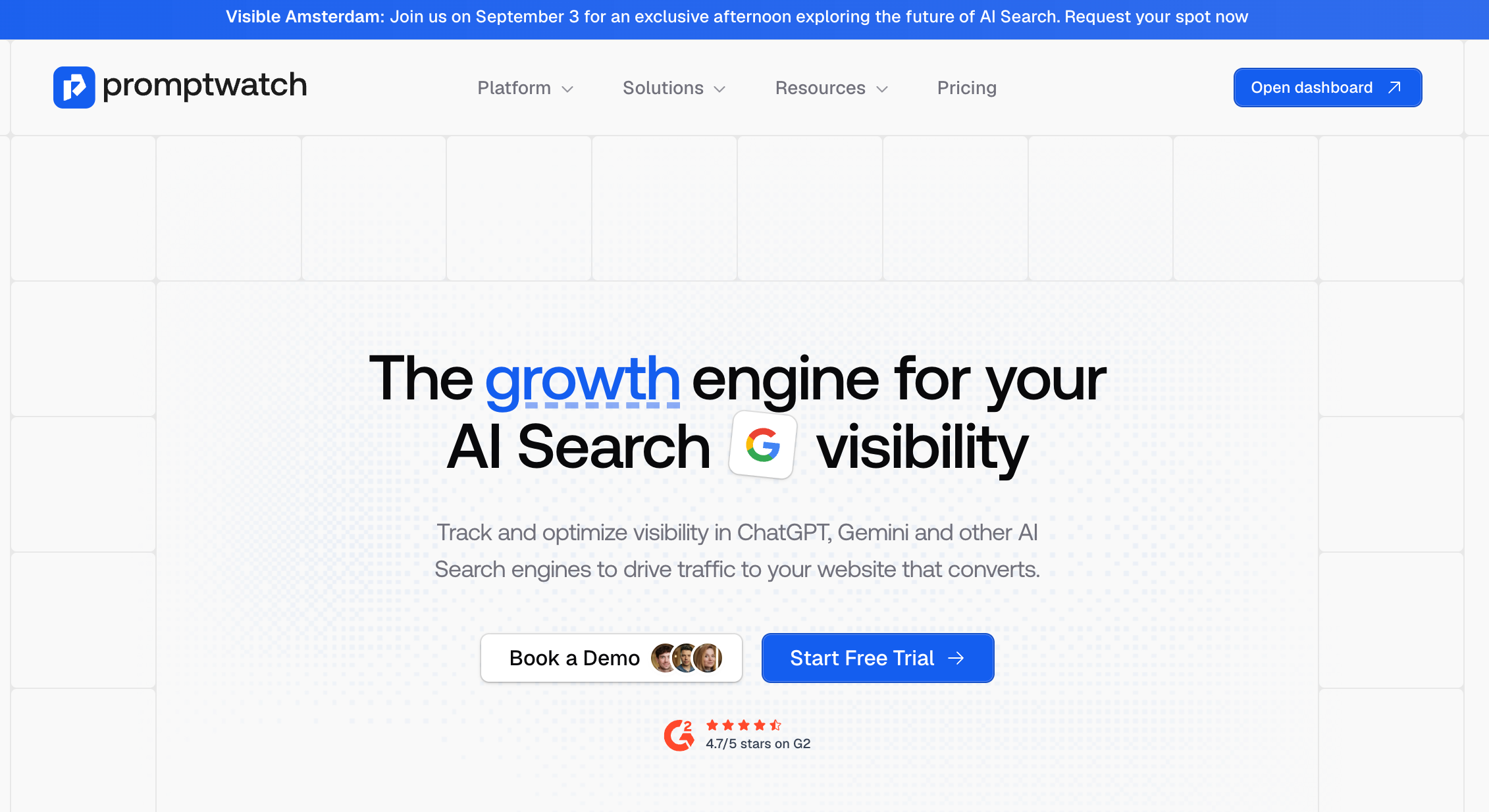
Promptwatch is the most transparent option for teams that need to prove ROI from AI search investments, not just watch a dashboard.
Founded in Amsterdam in April 2025, the platform tracks 11 AI platforms on every paid plan, ChatGPT, Perplexity, Google AI Overviews, Google AI Mode, Claude, Gemini, Meta Llama, DeepSeek, Grok, OpenCode, and Claude Code using real LLM UI scraping combined with AI crawler-log analysis and visitor analytics. That combination is the differentiator: it captures what a real user in a given market and language actually sees, ties it to which of your pages AI crawlers reach, and connects both to the human traffic and conversions AI answers drive. Most tools in this category stop at "are we mentioned?"; Promptwatch closes the loop from crawl to citation to visit to conversion. As of August 2026, it has over 1,780 brands and agencies on platform, collects 100M+ AI data points per day, and has observed more than 4.5 billion total citations, clicks, and prompts. The public Prompt Volumes index covers over 1.84 million tracked prompts.
The daily Action Items agent runs at approximately 3:00 UTC, generating prioritized, one-click recommendations mapped to concrete levers (content gaps, sentiment, offsite mentions, untracked pages, technical health). The Content Agent then grounds new or optimized drafts in your own citation and gap data, with a review inbox by default and direct publishing to Webflow or Framer.
Pricing (August 2026): Essential at $95/mo (1 project, 50 prompts, 6,000 responses, 7-day free trial); Professional at $245/mo (2 projects, 150 prompts, 18,000 responses, 25M crawler logs); Business at $579/mo (5 projects, 350 prompts, 42,000 responses, 100M crawler logs). No data retention cutoff on any tier.
Where it can fall short: Teams with very small prompt budgets may feel constrained on the Essential plan (which also has no crawler-log access), and the platform's depth rewards teams willing to define prompt sets and act on recommendations rather than passively watch a dashboard.
Quickest validation test: Run a 20-prompt set across brand, category, and competitor queries. Compare your visibility score on ChatGPT vs Perplexity. The gap between platforms usually surfaces the first content priority within 48 hours.
2. Profound (best for enterprise budgets and prompt-demand data)
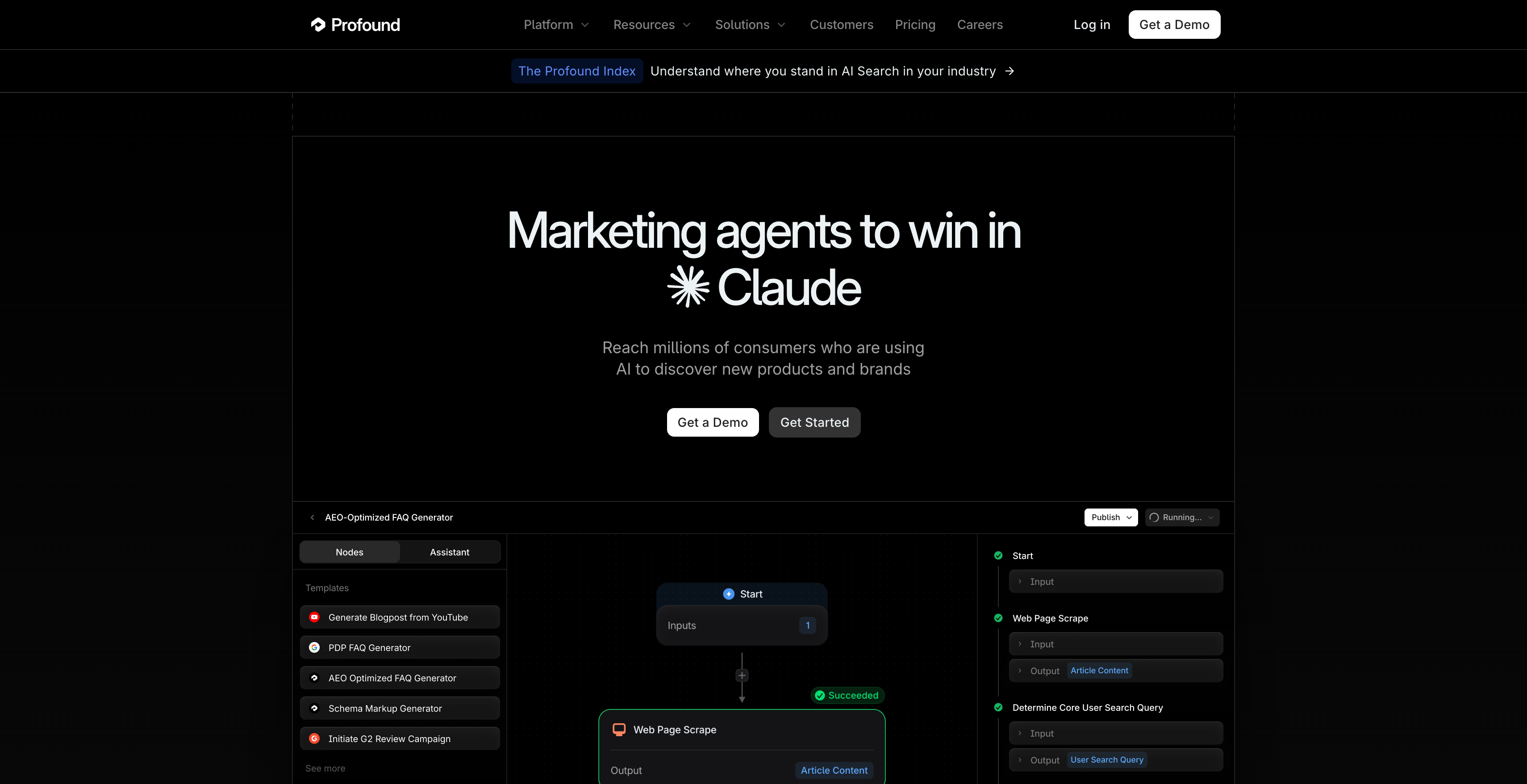
Profound is the category's most visible enterprise player, having raised roughly $155M (including a Series C at a $1B valuation in early 2026). Its reputation rests on data depth few rivals can match: its enterprise-only Prompt Volumes dataset uses opted-in consumer panel data to estimate how often real users ask a given question of AI engines, which turns visibility from a vanity score into a content-strategy input. It layers sentiment, share of voice, agent analytics, and a Documents content module on top.
The catch is the pricing ladder. Starter at $99/mo tracks ChatGPT only; Growth at $399/mo covers three engines and 100 prompts on a single workspace; full 10-engine coverage, Prompt Volumes, SSO/SAML, and SOC 2 live on custom Enterprise contracts that third-party reviews place in the low thousands per month. For a well-resourced brand treating AI search as a core channel with a dedicated owner, it's a serious tool. For most teams, the real entry point is $399, and the engine you came to track may sit behind a sales call.
Where Promptwatch differs: real UI scraping rather than panel and API estimation, 11 platforms on every paid plan instead of coverage gated by tier, and crawler logs plus visitor analytics in the same platform see the Promptwatch vs Profound comparison for the full breakdown.
3. Peec AI (best value for lean teams)
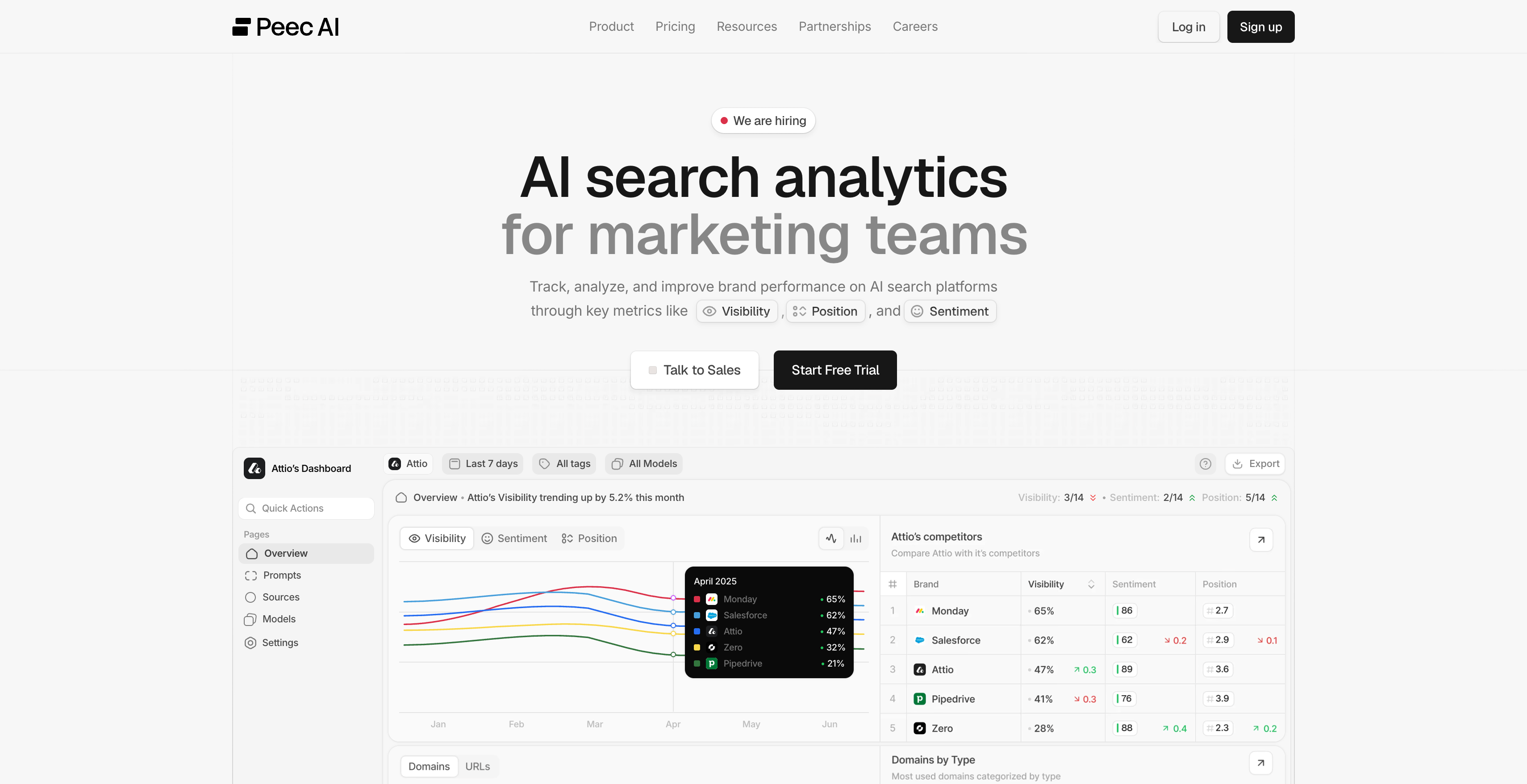
Berlin-based Peec AI is one of the fastest-growing tools in the category (roughly $29M raised, $10M ARR, 3,000+ customers by mid-2026), and it earns that with speed and clarity: you enter a domain, it builds a brand profile and auto-generates prompts, and you're live in about ten minutes with no sales call. It reports visibility as a plain percentage, and its sentiment depth and multilingual reach are genuine strengths. Pricing is public and mirrors a familiar structure — roughly €85/$95 (50 prompts), €205 (150), €425 (350) with unlimited users and daily tracking on every plan.
The two limits to plan around: self-serve plans cap tracking at three engines, with extra models sold as $35–$165 add-ons (Claude and DeepSeek can be enterprise-only), and there's no historical backfill — data starts the day you begin tracking. It's also monitoring-first: it tells you where you stand, not what content to ship next.
Where Promptwatch differs: 11 platforms included on every paid plan rather than a three-engine cap plus add-ons, full history with no retention cutoff instead of no backfill, and an execution layer (content gap, action items, content agent) on top of monitoring details in the Promptwatch vs Peec AI comparison.
4. Athena HQ (best for a free baseline and broad model coverage)
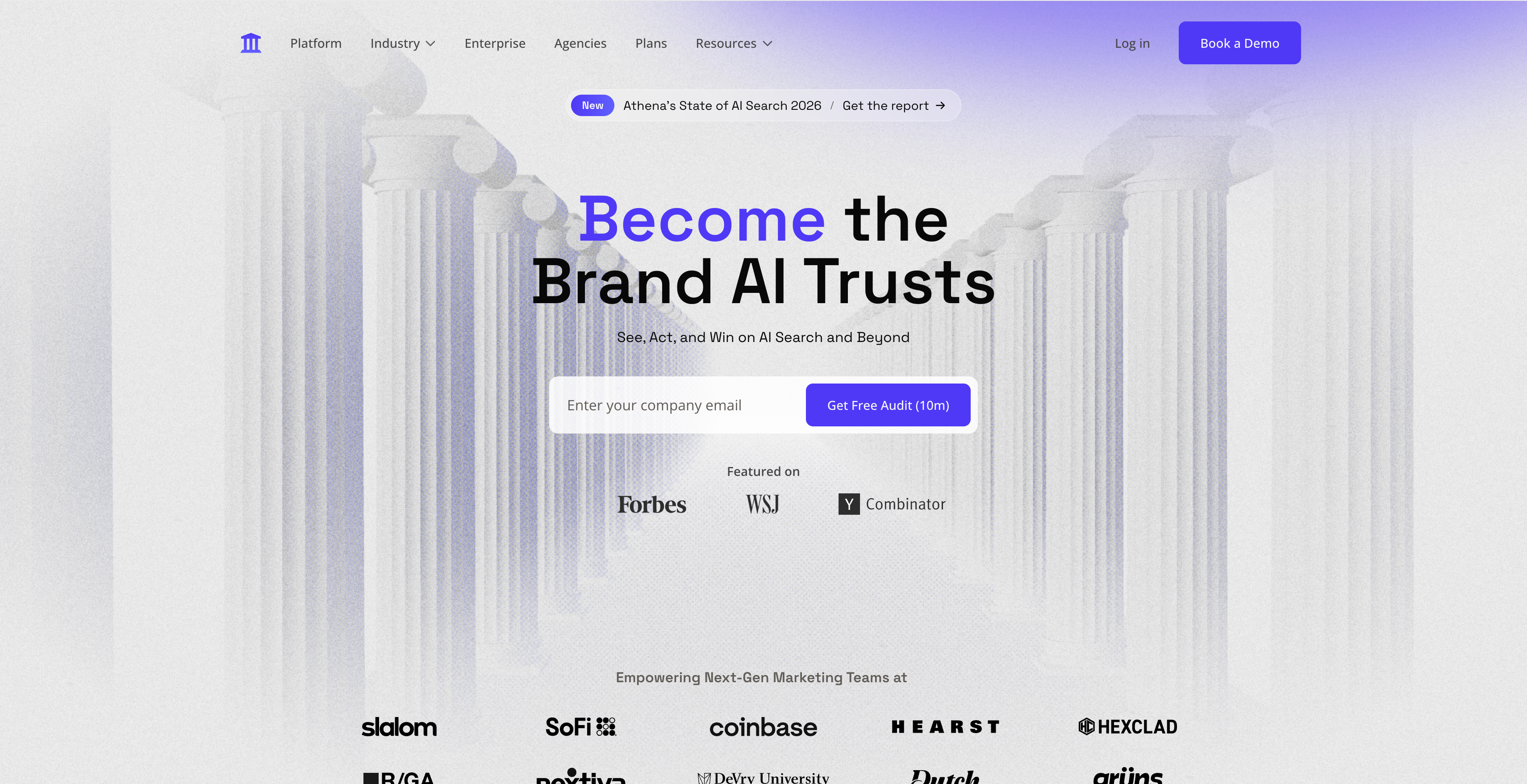
Built by founders with Google Search and DeepMind backgrounds, Athena HQ is notable for a genuinely free Essential tier that lets a team inspect prompts, responses, citations, and competitors before paying. Its paid Self-Serve plan (around $295/mo, often discounted for the first month, with annual billing far cheaper) covers 8+ LLMs, ChatGPT, Perplexity, Google AI Overviews, Google AI Mode, Gemini, Claude, Copilot, and Grok with unlimited seats. The standout is the Action Center, which auto-detects content gaps based on where competitors get cited and drafts on-page and off-page recommendations, plus a proprietary prompt-volume model.
Two things to weigh: billing is credit-based (one credit equals one AI response analysis, 3,600 on Self-Serve), which takes some modeling to map to your prompt set, and the broad "action" layer is where most of the paid value sits, so a pure-monitoring buyer may be paying for more than they need.
Where Promptwatch differs: real UI scraping plus crawler logs and visitor analytics for the full crawl-to-conversion picture, prompt-based rather than credit-based limits, and a published visibility formula rather than a proprietary black box.
5. Scrunch AI (best for crawler observability and page audits)
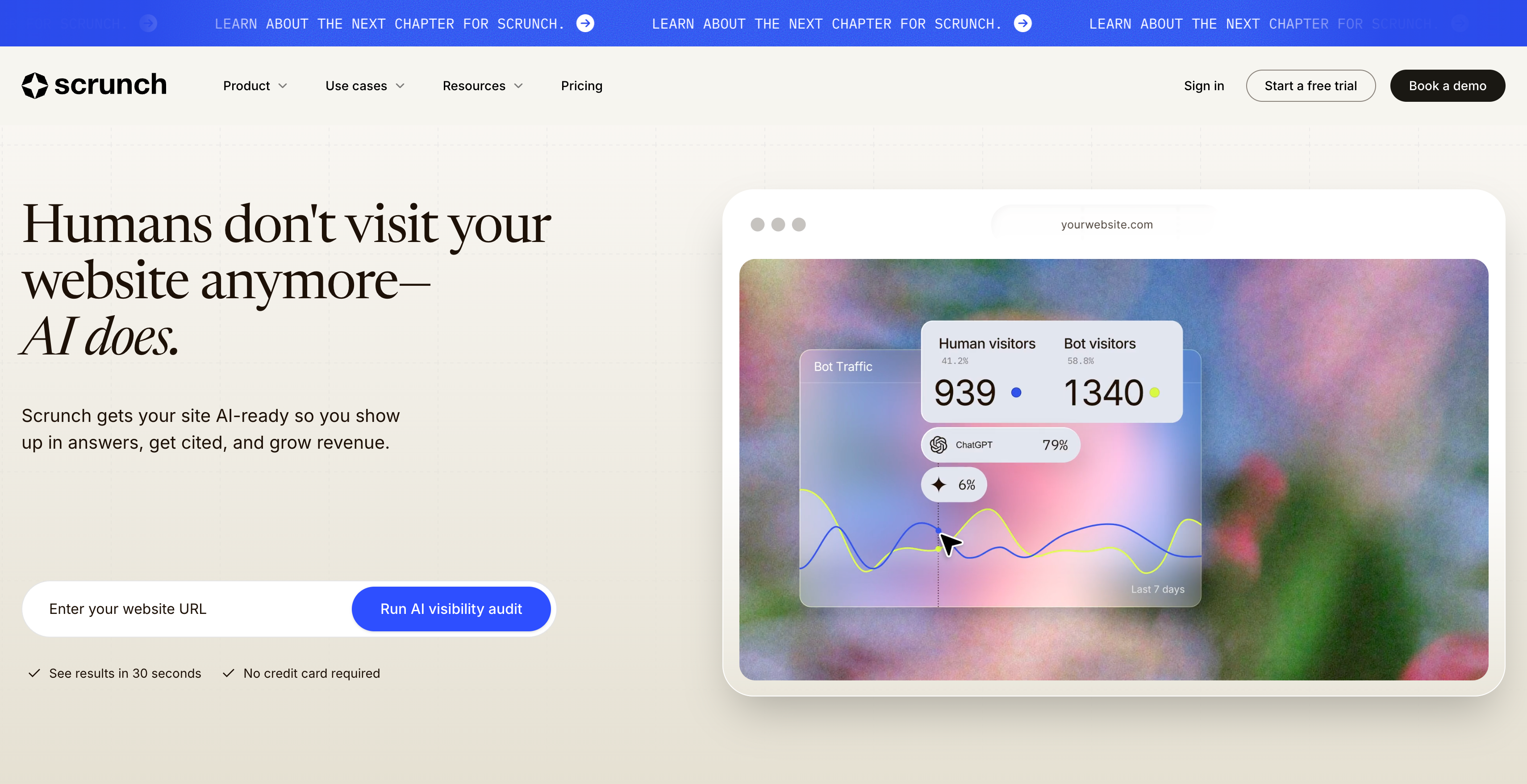
Scrunch AI leans toward the technical and enterprise end. Its Core plan (around $250–$295/mo, 7-day trial) includes 125 prompts, five monthly site audits, one brand workspace, five seats, and four AI platforms including Google AI Overviews. Beyond standard monitoring it adds crawler observability, journey mapping (how AI agents navigate a site), misinformation detection, page optimization, and its AXP technology for reformatting existing content into agent-friendly structure.
It's a strong fit for enterprise teams whose priority is understanding and fixing how AI agents crawl and experience their site. It's less suited to lean teams — traditional SEO features are minimal, and the entry price and single-brand Core workspace assume a focused enterprise use case.
Where Promptwatch differs: Scrunch sees how bots crawl your site; Promptwatch pairs that same crawler-log visibility with real UI answer scraping and visitor analytics, so you see not just how agents crawl but whether the resulting AI answers actually send converting traffic.
FAQ
AEO vs GEO: do I need both?
They describe overlapping practices with slightly different origins. AEO (answer engine optimization) started with optimizing for featured snippets and voice search. GEO (generative engine optimization) focuses specifically on AI-generated answers. In practice, a platform that handles one handles both. The distinction is largely terminological; the measurement framework and the content tactics are the same.
How long until content changes show up in AI responses?
Faster than most teams expect at first, but slower at the citation level. Promptwatch's benchmark research puts citation relevance at 8 to 14 weeks before a meaningful decay or refresh. Plan for a 90-day test window minimum. Some surface-level mention improvements can appear in 2 to 4 weeks; structural citation gains take longer.

