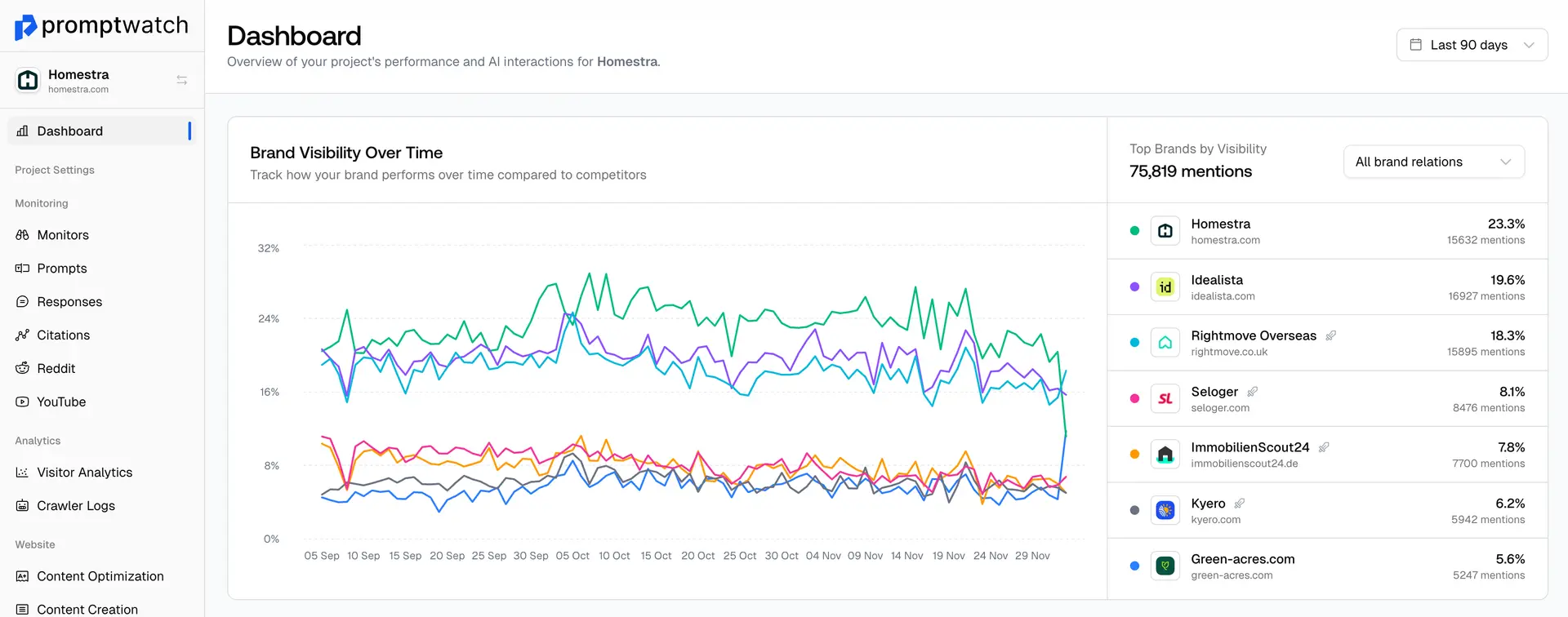
A few years ago, "getting found" meant one thing: ranking on page one of Google. Today your customers are just as likely to ask ChatGPT, Gemini, or Perplexity directly, and get a synthesized answer that either mentions your brand or doesn't, with no page one to fight for. AI search optimization is the discipline built around that shift. Below is what it actually means, how it's different from the SEO you already know, and a framework for doing it on purpose instead of by accident.
TL;DR
- AI search optimization (AISO) is the umbrella term for making content visible inside AI-generated answers. GEO, AEO, and LLMO are more specific disciplines underneath it, not synonyms for it.
- ChatGPT's share of AI-search visits fell from ~76% to ~53% in a year as Gemini and Claude gained ground. Optimizing for one platform is no longer enough.
- Being crawlable, quotable, and cited are three different problems, and most guides conflate them.
- You can, and should, measure this the same way you measure SEO: visibility score, share of voice, and citation rate are the equivalent of rankings and impressions.
What is AI search optimization?
AI search optimization (sometimes shortened to AISO) is the practice of making your brand, product, and content visible inside the answers that AI systems generate: being mentioned, cited, and recommended by ChatGPT, Gemini, Claude, Perplexity, and AI Overviews, rather than simply ranked for a search query.
It's worth being precise here, because the terminology around this space has gotten muddled fast. AI search optimization is the umbrella. Generative engine optimization (GEO) is one discipline that sits underneath it, specifically the work of getting cited inside a generative model's synthesized response. AEO (answer engine optimization) and LLMO (LLM optimization) are two more disciplines under that same umbrella, each solving a slightly different piece of the problem. None of them are interchangeable with AI search optimization itself, even though a lot of the content out there treats them that way.
AI search optimization vs. SEO vs. GEO vs. AEO vs. LLMO
| Term | What it optimizes for | Primary surface | Key lever | Best current KPI |
|---|---|---|---|---|
| SEO | Ranking position on a search results page | Google/Bing SERPs | Backlinks, on page relevance, technical crawlability | Rankings, organic clicks |
| AISO (AI search optimization) | Overall visibility inside AI mediated answers, the umbrella term | ChatGPT, Gemini, AI Overviews, Perplexity, Claude, Copilot | Crawlability, citability, and entity trust, combined | Visibility score, share of voice |
| GEO (Generative Engine Optimization) | Being included or cited in a generative model's synthesized answer | LLM chat interfaces specifically | Content structure, statistics, source authority | Citation rate |
| AEO (Answer Engine Optimization) | Being selected as the direct answer to a specific question | Featured snippets, AI Overviews, voice assistants | Direct answer formatting, schema, FAQ structure | Answer/snippet capture rate |
| LLMO (LLM Optimization) | Being represented accurately inside a model's underlying knowledge | The model's knowledge base itself | Structured data, llms.txt, entity consistency across the web | Brand entity accuracy in outputs |
Why AI search optimization matters right now
The honest case for AI search optimization isn't hypothetical anymore. It's in the traffic data. Google searches in the US ended without a single click 68% of the time between January and April 2026, up from roughly 60% in 2024. AI Overviews are a meaningful part of that shift: when they appear, click through to the underlying pages drops sharply, because the answer itself already satisfied the searcher.
That shift isn't happening on one platform. Recent analysis has found that pages ChatGPT cites are ranking in position 21 or lower on Google roughly 90% of the time, meaning a page can rank nowhere on Google and still be the source an AI model recommends, and vice versa. Ranking and citation are becoming genuinely separate games, which is exactly why treating AI visibility as its own channel rather than a side effect of SEO has turned into a real business decision, not a nice to have.
Where the traffic is actually shifting
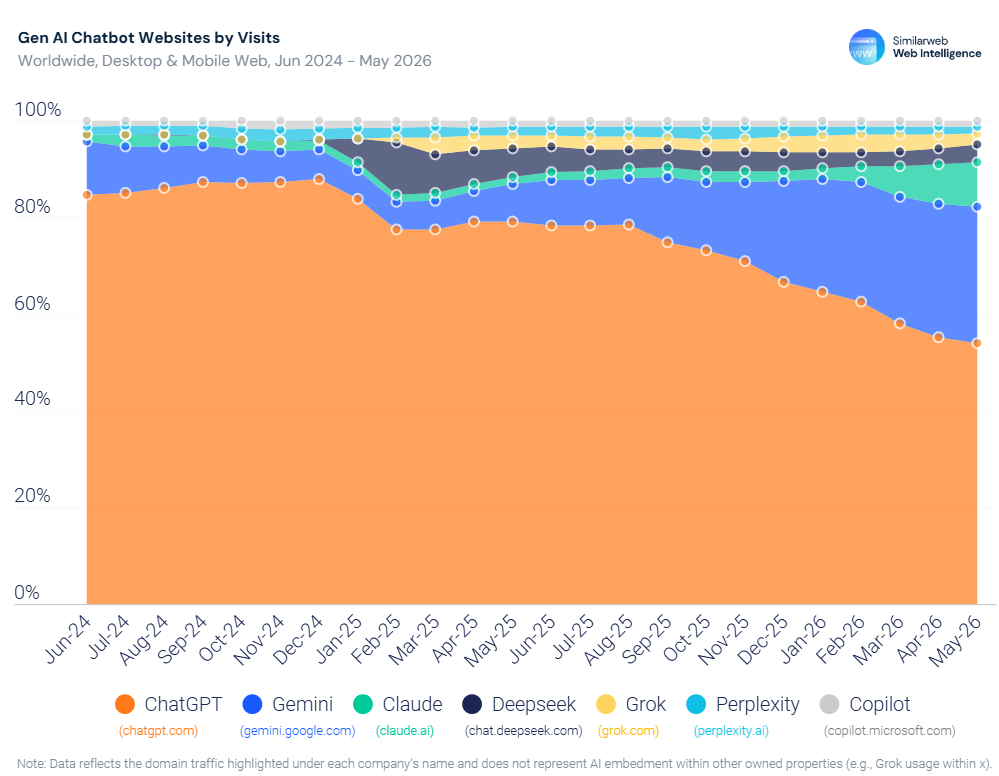
| Platform | Share of AI search visits (2026) | Trend vs. 2025 | Optimization implication |
|---|---|---|---|
| ChatGPT | ~53% | Down from ~76% | Still the largest single platform, but no longer "the only one that matters" |
| Gemini | ~27 to 28% | Up from under 9% | Directly tied to Google AI Overviews. SEO fundamentals still carry real weight here |
| Claude | ~9% | Up from ~2% | Smaller but growing fast, with less commercial saturation and room to be an early mover |
| Perplexity / others | Remainder | Stable to growing | Citation heavy interface, where structured, well sourced content performs disproportionately well |
Source: Similarweb, AI Search Engine Statistics 2026 (July 2026).
The takeaway from that table is simple: a strategy built around a single AI platform is already out of date by the time it ships. Whatever mix your customers actually use matters more than whichever platform is loudest in the trade press this month.
How AI search actually decides what to cite
A traditional search engine ranks pages that already exist. A generative engine does something different: it retrieves information from many sources, synthesizes an answer, and decides, sentence by sentence, which fragments are worth citing and which sources are worth naming. Your content can be read by a model and never once get mentioned in the output. That's a different failure mode than "not ranking," and it needs a different diagnosis.
It also means two outcomes that get talked about as if they're the same thing are actually distinct. A mention is any time an AI model brings up your brand in a response. A citation is when the model explicitly references a page or source as supporting evidence, usually with a link. You can rack up mentions without a single citation, and it's worth knowing which one is actually happening. Our own crawler log research digs into exactly how AI agents crawl and decide what to cite once they've read a page.
The AI search optimization framework
There's no single fix here. It's six separate levers, and most teams are only pulling one or two of them.
1. Make sure AI crawlers can actually reach your content
Bots aren't browsers. JavaScript rendered content, an overly restrictive robots.txt, or a CDN configuration that blocks or throttles crawler traffic can all keep an AI system from ever reading your page, before a single word of the content is even evaluated. See which AI agents are actually visiting your site and confirm they're getting through, cross referenced against the current list of known AI crawlers, not just assumed.
2. Structure content so it can be lifted as a direct answer
Front load the actual answer instead of building up to it. Use scannable structure (short paragraphs, clear headers, direct statements) and write claims so they still make sense pulled out of context, because that's exactly what happens when a model quotes a sentence back to a user. Technical signals matter here too, including llms.txt, which gives models a clean, direct map of what your site actually contains.
3. Back claims with original, current data
This is the single most under used lever in AI search optimization, full stop. Generic advice gets paraphrased and quietly dropped from an answer; a specific, sourced number gets cited by name. If you want a model to attribute a claim to you instead of restating it in its own words, give it a reason to point at you instead of just summarizing you.
4. Build entity authority beyond your own site
AI models weigh third party corroboration heavily. What other sources say about you carries real signal, not just what you say about yourself. That's most visible on Reddit right now, where threads and discussions get cited directly in AI responses with surprising frequency. Tracking that activity specifically tells you where to actually spend community effort instead of guessing.
5. Optimize per platform, not just "for AI"
Go back to the platform table above: ChatGPT, Gemini, and Perplexity don't weight sources the same way, so a single generic approach under serves all three at once. ChatGPT specifically has its own quirks in how it searches the web and selects sources, and it's worth optimizing for on its own terms rather than lumping it in with "AI" as a category.
6. Refresh on a cycle, don't publish and forget
Citations decay. Models re-crawl and re-index regularly, and content that sits untouched can lose citations quietly, with nothing visibly "broken" to alert you. Treat refresh as a scheduled task, not a reaction. Flagging which pages need it before they've already gone stale is the difference between staying cited and finding out three months later that you aren't.
How to measure whether it's working
This is where most AI search optimization advice stops short, and it's the part that actually makes the rest of this list accountable to something. If SEO has rankings and impressions, AI search optimization has its own equivalents, and they're measurable today, not someday.
Core AI visibility metrics
| Metric | What it tells you | Rough SEO equivalent |
|---|---|---|
| Visibility score | Combined signal across mentions and citations, benchmarked over time | Overall organic visibility |
| Share of voice | How often you show up versus named competitors, on the same prompts | Competitive rank tracking |
| Citation rate | Percentage of tracked responses where you're cited as a source, not just mentioned | Featured snippet capture rate |
| Sentiment | Whether the tone of AI mentions is favorable, not just present | Brand sentiment / review score |
Getting these numbers starts with knowing which prompts to watch in the first place. Tracking the actual prompts your customers ask, rather than guessing at keywords, is the foundation everything else in this table sits on. From there, monitoring mentions in real time turns this from a quarterly report into something you can act on the same week it happens. One clarification worth making explicit: prompt volume isn't the same measurement as keyword volume. The two behave differently, and conflating them is a common source of confused expectations.
Common AI search optimization mistakes
- Optimizing for ChatGPT alone. Given how fast Gemini and Claude have grown their share of AI search visits, a single platform strategy is already behind.
- Treating "mentioned" and "cited" as the same win. They're different outcomes with different causes, and conflating them makes it impossible to diagnose what's actually working.
- Publishing once and never revisiting. Citations decay quietly; a refresh cycle isn't optional maintenance, it's part of the strategy.
- Having no way to measure any of it. Without a visibility score or share of voice number to track, there's no way to tell whether any of the tactics above are actually moving anything, and no way to catch it when a brand simply never shows up at all.
Who this applies to
AI search optimization isn't a niche discipline anymore. It shows up differently depending on where you sit. For brands building direct to consumer visibility, it's about being the name AI recommends at the moment of comparison. For in house SEO teams, it's a natural extension of work you're already doing, with a new set of metrics layered on top. For agencies managing this across multiple clients at once, it's another reporting line that needs to scale without multiplying headcount. And if none of that sounds like something you want to run day to day yourself, a fully managed option exists specifically for that.
Tools for AI search optimization
Doing this manually (checking each platform by hand, guessing at which prompts matter, refreshing content on a hunch) doesn't scale past a handful of pages. For a full breakdown of what to look for and how the leading options compare, see our comparison of AI visibility tools, which covers the category in more depth than fits here.
Frequently Asked Questions
Is AI search optimization the same thing as GEO?
No. AISO is the umbrella term. GEO specifically covers being cited inside a generative model's synthesized answer; AISO also includes AEO, LLMO, and the technical crawlability work that makes any of it possible in the first place.
Do I still need traditional SEO?
Yes. AI models still lean heavily on well ranking, well structured pages as sources for their answers. AI search optimization builds on SEO fundamentals, it doesn't replace them.
Which AI platforms should I optimize for first?
Start with whichever platform your customers actually use to research, based on your own prompt data rather than assumption. ChatGPT still has the largest share, but Gemini and Claude are growing fast enough that a single platform strategy is increasingly risky.
How long does it take to see results?
It can move faster than traditional SEO in some cases, since models re-crawl and re-index frequently, but it's also less predictable, since a single model update can shift a result overnight. Track the trend over weeks, not any single day's number.
Is llms.txt required for AI search optimization?
No. It's one signal among many, not a requirement. Crawlability, content structure, and citable data all matter more than any single file.