


TL;DR
- Brand sentiment monitoring on AI platforms tracks how ChatGPT, Gemini, Perplexity, Claude, and other AI engines describe your brand inside their answers, which social listening alone doesn't capture.
- Promptwatch is built for this job: it scores sentiment from 1 to 100 on every answer collected from the live interfaces of 11 AI platforms, compares your sentiment with competitors by topic, and links each answer to the pages it cited.
When a potential customer asks ChatGPT which brand to trust in your category, the answer they get is shaped by sentiment signals you may not even know exist. That's the gap most marketing and SEO teams are running into in 2026. Traditional social listening tells you what people are saying on X or Reddit. It says nothing about whether Claude describes your brand as "reliable" or "controversial" when generating a product recommendation.
Brand sentiment monitoring on AI platforms is a distinct discipline from social listening. It tracks tone, framing, and positioning inside LLM-generated responses across ChatGPT, Gemini, Perplexity, Claude, and more, on top of whether your brand is mentioned at all. The tools that handle this well combine AI search visibility tracking with sentiment scoring, and the best ones close the loop with content recommendations.
Here are seven tools worth knowing in 2026, covering everything from purpose-built LLM monitoring to enterprise social intelligence platforms that have added AI-native layers. This list was last updated on October 12, 2026.
How this list was put together
Each tool was evaluated on five criteria:
- AI platform coverage (which LLMs are monitored)
- sentiment analysis methodology
- reporting and alerting capabilities
- content optimization features
- pricing transparency
Not all tools do all five well, and that's worth stating clearly, because the right choice depends heavily on your use case. Competitor details come from each vendor's own pages, checked on October 12, 2026.
1. Promptwatch
Best for: In-house SEO, agencies and marketing teams that need AI-native brand sentiment monitoring tied directly to content optimization
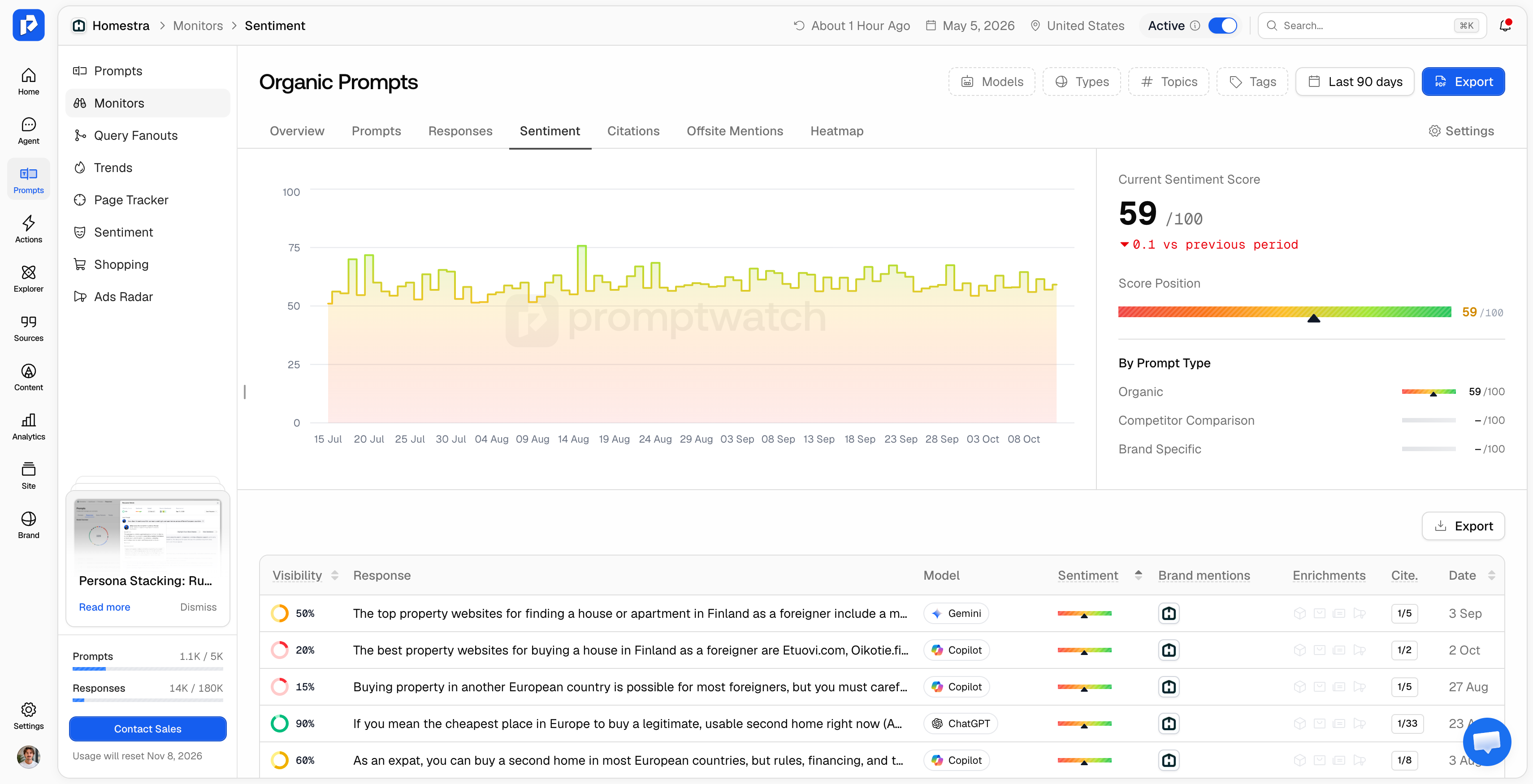
Promptwatch is the most purpose-built option on this list for monitoring how AI platforms represent your brand. It scores sentiment and visibility on every answer it collects from ChatGPT, Claude, Gemini, Perplexity, Google AI Overviews, Google AI Mode, and five more AI platforms, captured from the live user interface. That distinction matters: API responses can differ from what users see, and Promptwatch's dataset of over 4.5 billion citations, clicks, and prompts is built from live interface data.
Sentiment is scored per response on a 1 to 100 scale, based only on how your brand is described, and grouped into Positive, Neutral, and Negative. Mentions that name your brand without any opinion are left out of the averages, so thin listings don't pull every score toward neutral. Since September 8, 2026, the Sentiment page also compares your brand with competitors by topic and by competitor, so you can see where a rival is described more favorably than you.
Promptwatch also shows why the sentiment looks the way it does. Each answer links to the pages it cited, and Off-site Mentions surfaces the reviews, comparison articles, news, and Reddit and YouTube threads behind recurring themes. Content Gap Analysis identifies the questions your site doesn't answer, the content agent drafts pages to close them, and since June 9, 2026, Action Items includes sentiment-focused recommendations you can assign to a team member.
For SEO teams focused on generative engine optimization (GEO), sentiment sits next to prompt volumes, query fan-outs, competitor visibility, and AI share of voice in the same platform. Monitors can target a country, language, US state, or city on every plan, for brands operating across multiple markets. Over 1,780 brands and agencies use Promptwatch.
Key features:
- Sentiment scoring on every answer across 11 AI platforms, collected from the real interfaces
- Competitor sentiment by topic and by competitor
- Prompt-level tracking with query fan-out analysis, through AI prompt tracking
- Citation and Off-site Mentions analysis to trace the sources behind each theme
- Content gap analysis with AI-powered content generation
- AI crawler logs showing which pages AI bots are reading
Pricing: Start free. Paid plans from $95/month (Essential, 50 prompts and 6,000 AI responses), Professional $245/month, Business $579/month, and Agency plans from $199/month. Essential includes a 7-day free trial.
2. Meltwater GenAI Lens
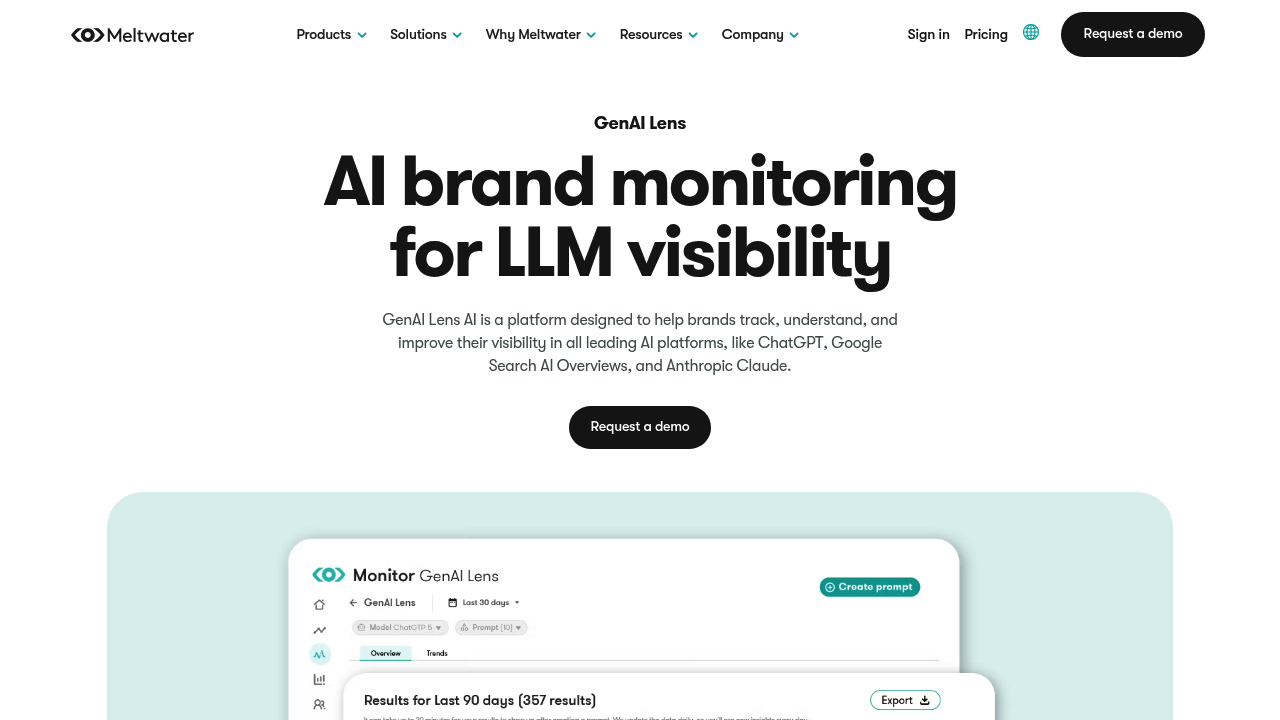
Meltwater launched GenAI Lens in July 2025 to monitor how brands are represented inside LLMs. It now covers ChatGPT, Perplexity, Google AI Overviews, Google AI Mode, DeepSeek, Llama, Claude, Gemini, and Grok, and delivers that data inside the Meltwater dashboard alongside earned media and social data.
Meltwater's mid-year 2026 release (May 18, 2026) added weekly AI-powered recommendations tied to visibility gaps and the sources shaping AI answers, plus AI-generated PowerPoint reports covering narrative, visibility, and competitive positioning. The product page lists trend tracking for visibility, sentiment, and positioning, with a 24-hour data refresh cycle.
GenAI Lens is typically offered as an add-on within the Meltwater platform, so it requires an existing Meltwater subscription. Third-party spend data from SpendHound puts Meltwater base subscriptions at around $15,000 to $25,000 a year, and GenAI Lens pricing comes through the account team.
Key features:
- Cross-LLM monitoring across nine models
- AI share of voice and competitive benchmarking
- Source and citation tracking across content types
- Weekly AI-powered recommendations and AI-generated reports
- Unified dashboard combining earned media, social, and AI visibility
Pricing: Add-on to an existing Meltwater subscription. GenAI Lens pricing is custom-quoted.
3. Brandwatch
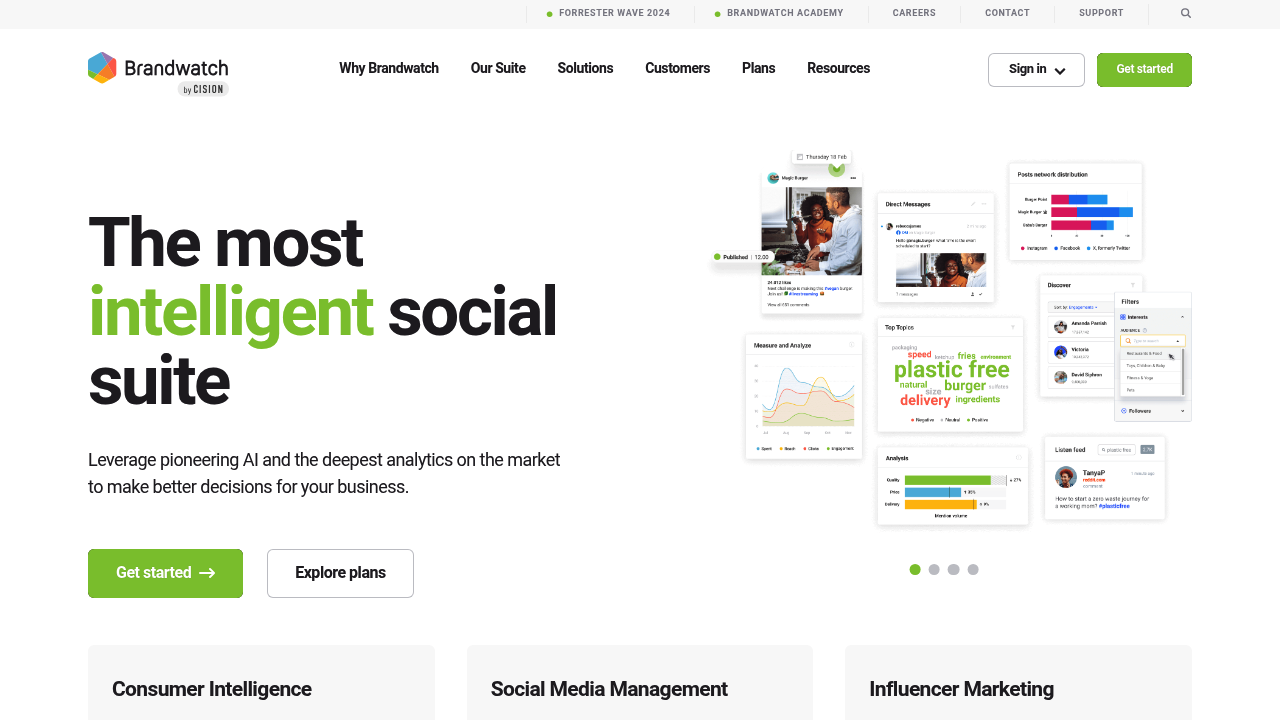
Brandwatch, part of Cision, is a consumer intelligence and social listening platform. Its Iris AI groups conversations into themes, identifies sentiment shifts, and flags anomalies across social networks, news, forums, and review sites, and its visual listening detects brand logos in images.
In the context of AI platform sentiment, Brandwatch's role is upstream. It monitors the forums, news sites, review platforms, and discussion threads that AI engines retrieve and cite. If your brand is discussed negatively in Reddit threads that Perplexity cites, Brandwatch can surface that conversation early. It reports on human conversations; for how AI models frame your brand in their answers, a dedicated AI monitoring tool sits alongside it.
Key features:
- Iris AI for theme clustering and sentiment shift detection
- Visual and image sentiment analysis with logo recognition
- Consumer research with custom audience panels
- Competitive share-of-voice benchmarking
- Crisis alerts
Pricing: Custom quotes.
4. Sprinklr Insights
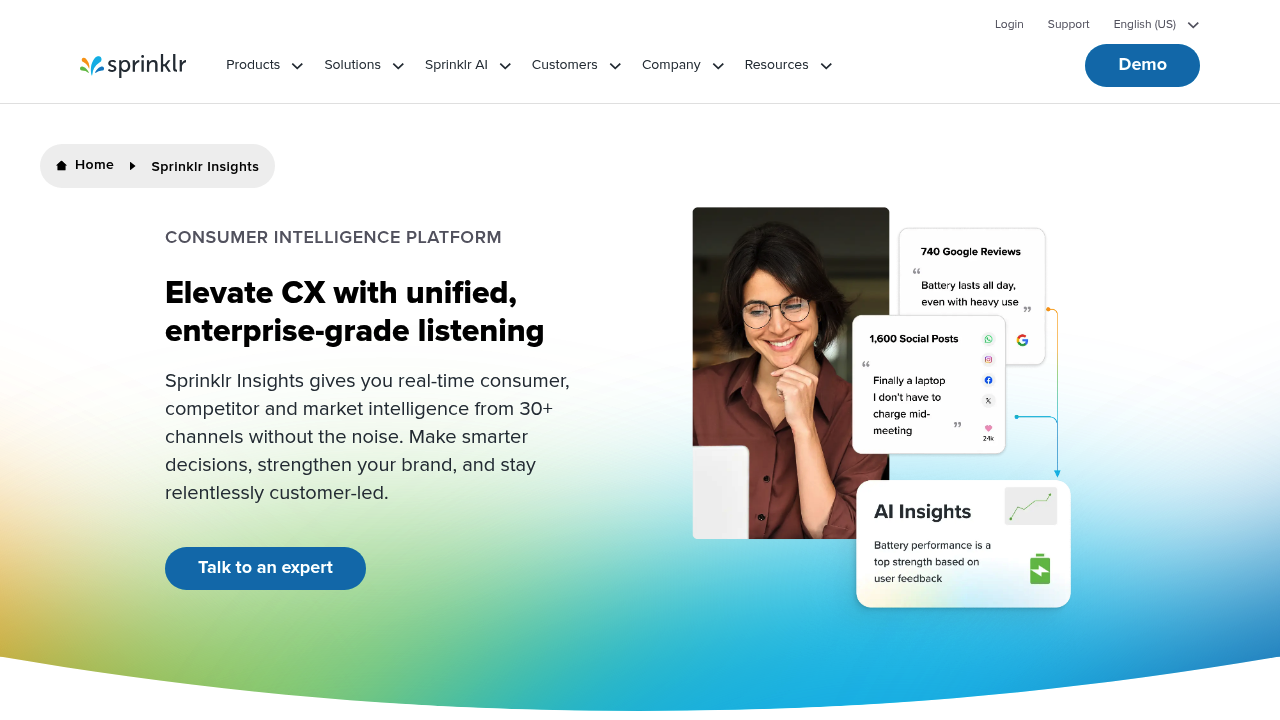
Sprinklr Insights analyzes sentiment and emotion across text, video, audio, and images from social channels, news, review sites, and owned customer data. In June 2026, Sprinklr announced LLM Insights, a feature inside Sprinklr Insights that assesses visibility, sentiment, recommendations, and competitive positioning in answers from Claude, ChatGPT, Gemini, Perplexity, Grok, and Google AI Overviews. Its prompts are built from customer conversations already captured in Sprinklr, and LLM Insights was in limited preview at launch.
Crisis Management detects reputational threats and sends real-time notifications routed to the relevant teams. For brands that already run customer care and social on Sprinklr, the advantage is having AI answer data, social data, and customer data in one environment.
The trade-off is cost and complexity. Sprinklr is an enterprise platform, implementation takes time, and pricing requires a sales conversation.
Key features:
- Sentiment and emotion analysis across text, video, audio, and images
- LLM Insights for brand visibility and sentiment in AI answers (limited preview)
- Crisis management with real-time alerts
- First-party data import alongside social and media data
- Visual insights with image detection
Pricing: Custom enterprise pricing. Contact sales.
5. Talkwalker
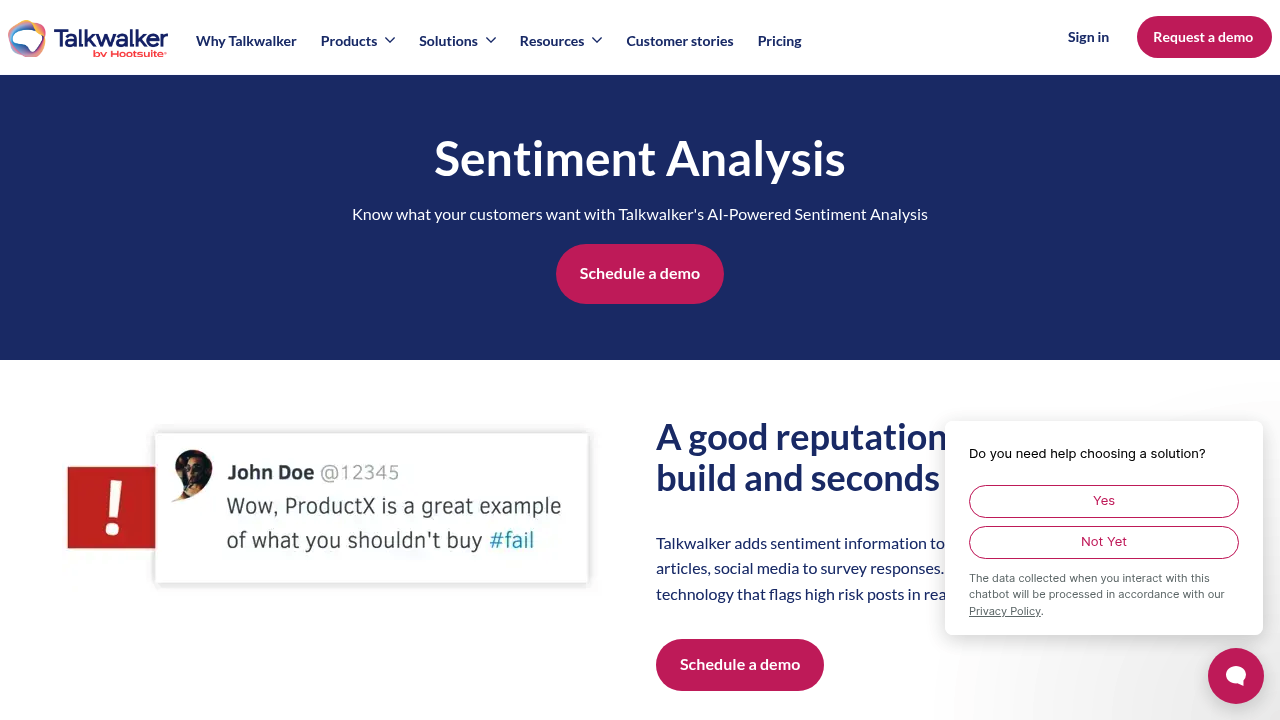
Talkwalker, acquired by Hootsuite in 2024, uses its Blue Silk AI for sentiment analysis across social platforms, news sources, and podcasts, including audio and video transcription to find brand mentions in YouTube content.
On March 10, 2026, Hootsuite released LLM Insights as an add-on. It shows how AI assistants such as ChatGPT, Gemini, Claude, and Perplexity portray your brand and your competitors, tracks sentiment trends, misinformation, and reputational risk, and monitors how AI outputs change over time. Guided templates cover brand monitoring, AI share of voice against competitors, product feedback, and crisis and risk detection.
Talkwalker's supervised classifiers let teams train custom models for specific sentiment categories, which helps in industries where generic positive or negative scoring misses nuance, such as healthcare, financial services, and B2B software.
Key features:
- Multilingual sentiment analysis across social, news, and podcasts
- Audio and video monitoring with automatic transcription
- Custom supervised classifiers for industry-specific sentiment
- LLM Insights add-on for brand sentiment in AI assistants
- Integration with Hootsuite social publishing workflows
Pricing: Custom enterprise pricing. LLM Insights pricing isn't published.
6. Brand24
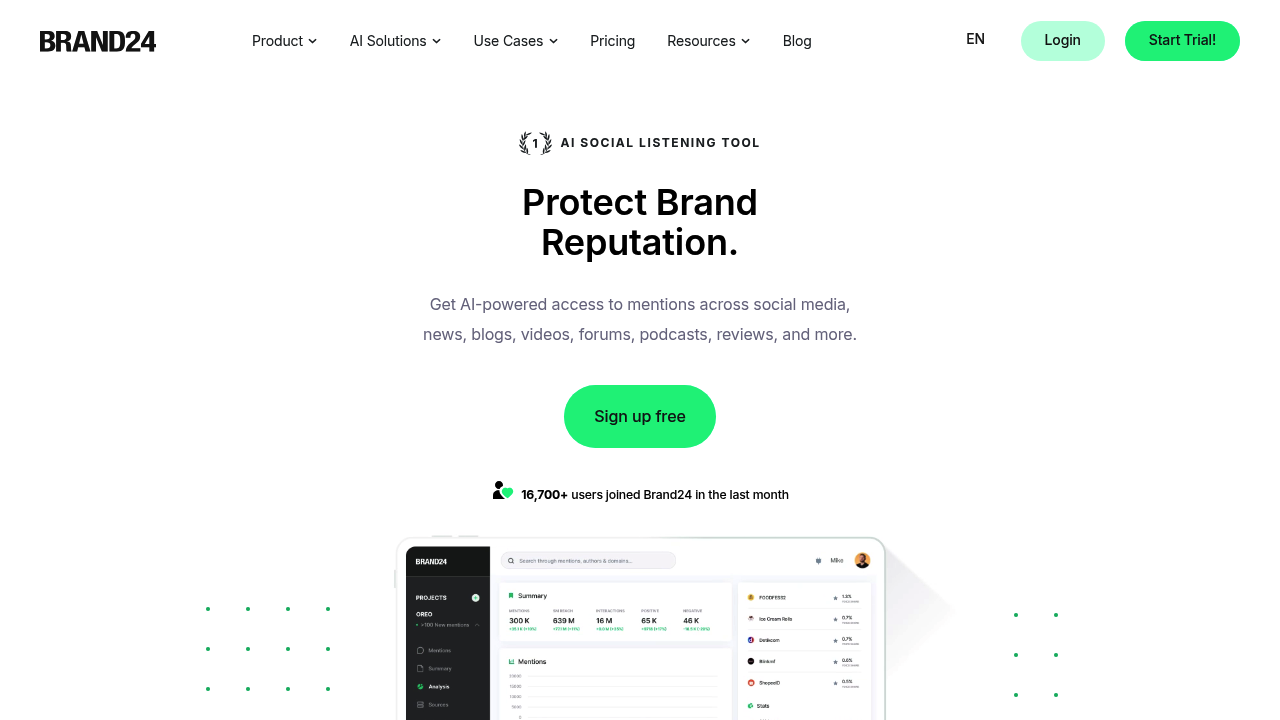
Brand24 monitors social media, news, blogs, forums, and podcasts, with AI-powered sentiment analysis and an AI Brand Assistant for conversational analysis of reputation data. Its anomaly detection flags sudden spikes in mentions or sentiment shifts, with email and Slack alerts.
Brand24 has also added an AI Visibility module, powered by its Chatbeat product. It tracks visibility, share of voice, sentiment, and position in answers from ChatGPT, Claude, Gemini, Perplexity, Google AI Overviews, Google AI Mode, DeepSeek, Grok, and Copilot, alongside the web conversations that feed those answers.
Pricing is transparent for the core plans: Individual $199/month billed annually ($249 monthly), Team $299/month, Pro $399/month, and Business $599/month, all billed annually. The AI Visibility module is an add-on on every plan, priced separately.
Key features:
- AI sentiment analysis across social, news, blogs, and podcasts
- AI Visibility module for sentiment in AI answers (add-on)
- AI Brand Assistant for conversational reputation analysis
- Spike and sentiment-shift detection for crisis alerts
- Email and Slack alert integrations
Pricing: From $199/month (billed annually). AI Visibility is an add-on. Free trial available.
7. YouScan
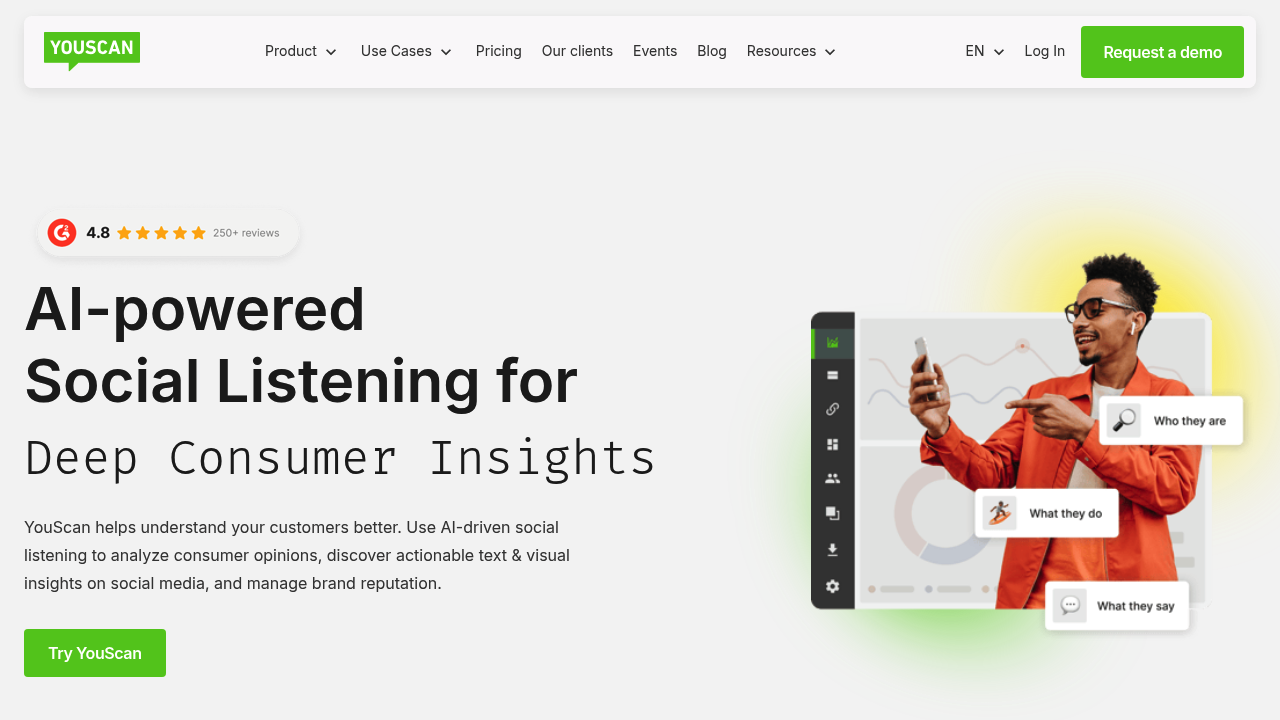
YouScan's core differentiator is computer vision. It scans user-generated images and video to find logo appearances, product shots, and scene contexts where the brand name never appears in text. For consumer brands where visual association is a major reputation signal, this closes a real gap.
The Insights Copilot feature works as a conversational analytics assistant: ask questions about your social data and get summarized answers with sentiment breakdowns. Aspect-based sentiment analysis tracks feedback by product feature or customer service dimension, beyond aggregate brand-level tone.
For AI search sentiment specifically, YouScan's value is upstream, like Brandwatch's: it captures the social and visual signals that AI engines may retrieve. Social platforms make up a meaningful share of AI citations, and the mix varies by engine, as Promptwatch's data on social media citations by AI model shows for October 2026.


