

Starting August 19, 2026, Promptwatch checks whether an AI crawler visit actually came from that provider, or from something pretending to be it.
What's new
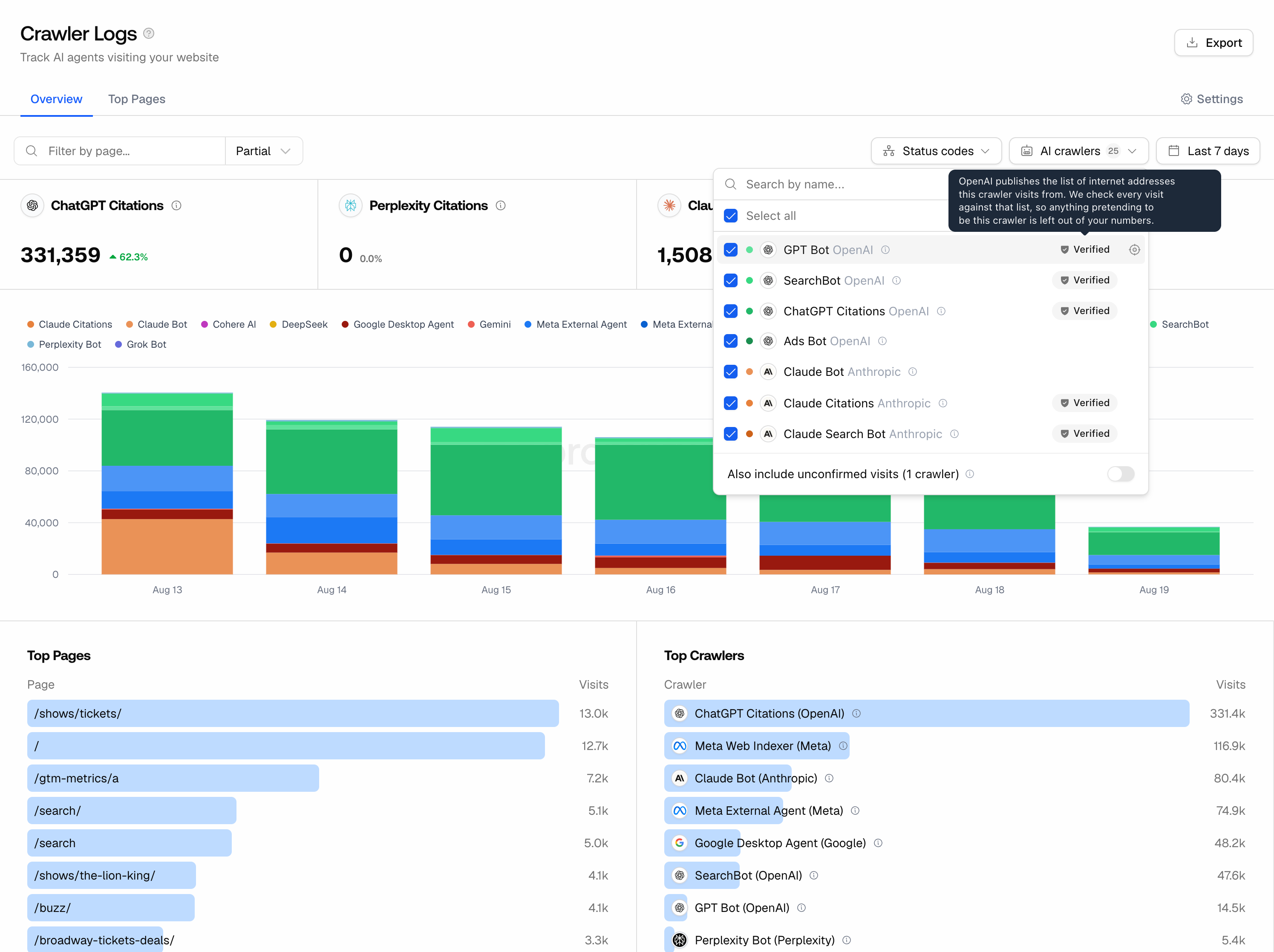
- Crawler visits are now checked against each AI provider's own published IP ranges. OpenAI, Anthropic, Google, Perplexity, and Mistral all publish the addresses their crawlers visit from, and every visit claiming to be one of those crawlers now gets checked against that list.
- Verified crawlers show a shield badge in the crawler picker.
- Dashboards, reports, and the API count verified traffic by default.
- This applies to historic data too, not just new visits going forward.
Why this matters
A crawler log only tells you a request arrived with, say, "GPTBot" in the user-agent string. It doesn't tell you the request actually came from OpenAI's infrastructure. Anyone can set a user-agent to whatever they want. Verification closes that gap: if a visit claims to be one of the providers above but doesn't come from their published address range, it's left out of your counted traffic.
What you'll see
Because impostor traffic no longer counts, your AI Crawlers numbers may look lower than before, sometimes noticeably lower. Across accounts, verified traffic came in at roughly 18% lower than the equivalent unverified count. That range varies a lot by account: some crawlers were barely affected, others dropped sharply.
The clearest example is Google's crawler traffic. In one representative week, requests claiming to be Google's desktop crawling agent had 87.7% of their volume fail verification. Almost all of that, 99.98%, came from IP addresses inside Google Cloud's customer-assignable ranges, the same rentable VM address space anyone can spin up, not Google's own crawler infrastructure. Google's actual published crawler IP ranges are narrow: 12 IPv4 prefixes and 8 IPv6 /124 blocks. Traffic from outside that narrow range, claiming to be Google's agent, is third-party software spoofing the user-agent, not Google.
Other providers showed the same pattern at different scale. Perplexity and Anthropic's consumer-facing crawlers each had a meaningful share of claimed traffic fail verification, while their search-oriented crawlers, which tend to run from more consistently published ranges, saw much smaller drops.
The honest limit
Verification only works for providers who publish their crawler IP ranges. Where a provider doesn't publish that list, Promptwatch can't check the claim either way, so that traffic is treated the way it always was. As more providers publish and maintain published ranges, more of your crawler traffic will get the shield badge.
The number that matters
Nothing broke. The old crawler counts included impostor traffic mixed in with the real thing. The new counts, wherever verification is possible, don't. If your AI Crawlers dashboard looks lower this week, that's the accurate number, the previous one was inflated by traffic that was never actually the AI provider it claimed to be.

