

TL;DR
- "AI SEO automation" gets used for two separate disciplines: AI-assisted classic SEO (keyword research, technical audits, content briefs) and AI Search Visibility tracking, also called GEO (Generative Engine Optimization).
- A real AI SEO automation stack needs connected pieces: prompt tracking across models, citation and off-site mention analysis, crawler log analytics, content generation grounded in real data, and visitor analytics tying it back to revenue. Everything Promptwatch has, in one platform.
- Content optimized for AI search decays quietly. Promptwatch's data shows citation relevance holds for roughly 8 to 14 weeks before a refresh helps, even when nothing else about the page changes.
What people mean by "AI SEO automation"
Search for "best AI SEO automation tools" right now and you'll get two different answers stitched into one list. Some entries are tools that use AI to speed up work SEOs have always done:
- keyword clustering
- content briefs
- technical audits
- alt-text generation
Others are tools built to track and improve how a brand shows up inside AI-generated answers on ChatGPT, Perplexity, Gemini, and Google AI Mode. Most published roundups don't separate the two, which leaves readers comparing a content-brief generator against a citation tracker as if they solve the same problem.
They don't. Automating classic SEO tasks with AI is mature and well understood: it speeds up research and writing, but the output still competes in traditional rankings. Tracking and improving AI Search visibility, sometimes shortened to AEO or GEO (Generative Engine Optimization), is a newer discipline that answers a different question: does an AI model actually mention your brand, cite your page, and send you a visitor when someone asks it something relevant?
What AI models are actually looking for when they research this topic
Promptwatch's own prompt tracking runs the prompt "What are the best AI SEO automation tools?" on a recurring schedule and records the model's Query Fan-Out: the sub-queries ChatGPT generates internally before it writes an answer. The pattern is worth naming plainly, because it tells you what to build content around.
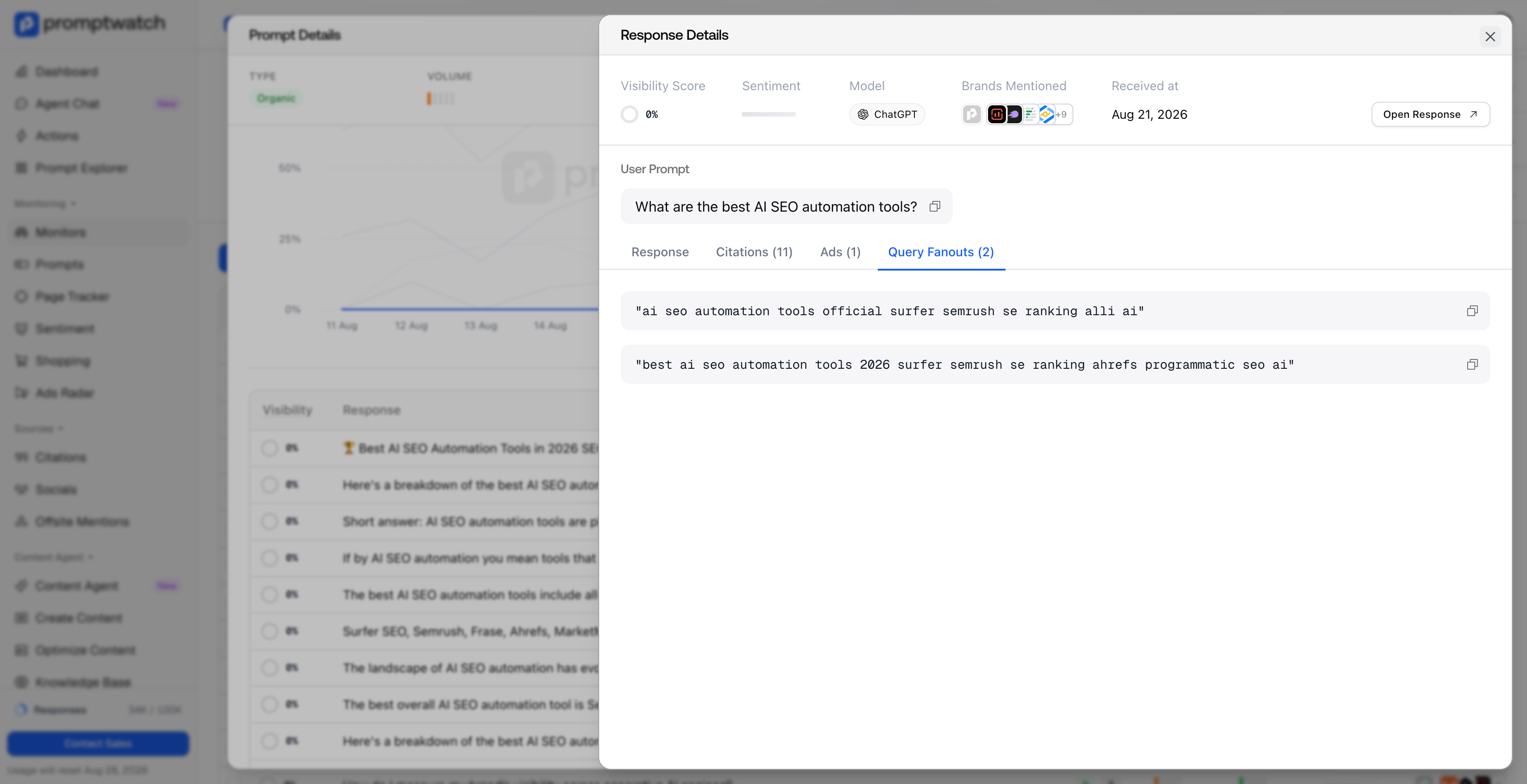
The fan-out doesn't ask vague questions like "what is AI SEO." It goes straight for named vendors and specifics: pulling up official product pages, comparing feature lists, and checking pricing pages for tools like Surfer, Semrush, Ahrefs, Alli AI, SE Ranking, Frase, and Scalenut. In other words, the model isn't synthesizing a generic definition of the category. It's hunting for authoritative, feature-anchored, verifiable sources it can attribute a specific claim to. A page that says "AI SEO tools help you rank better" gives it nothing to cite. A page that states exactly which platforms are tracked, what a feature does, and what it costs gives it something concrete to reference.
This isn't a one-off quirk of this particular prompt. Promptwatch's data shows ChatGPT Search started using the site: operator at scale on August 8, 2026, jumping from roughly 0.4% to 17% of all fan-out queries overnight. The vendor-targeted site: searches showing up in the "AI SEO automation" fan-out are part of that broader shift, not an exception to it. If ChatGPT is increasingly fanning out into direct, domain-scoped lookups, being the domain it lands on matters more than ever.
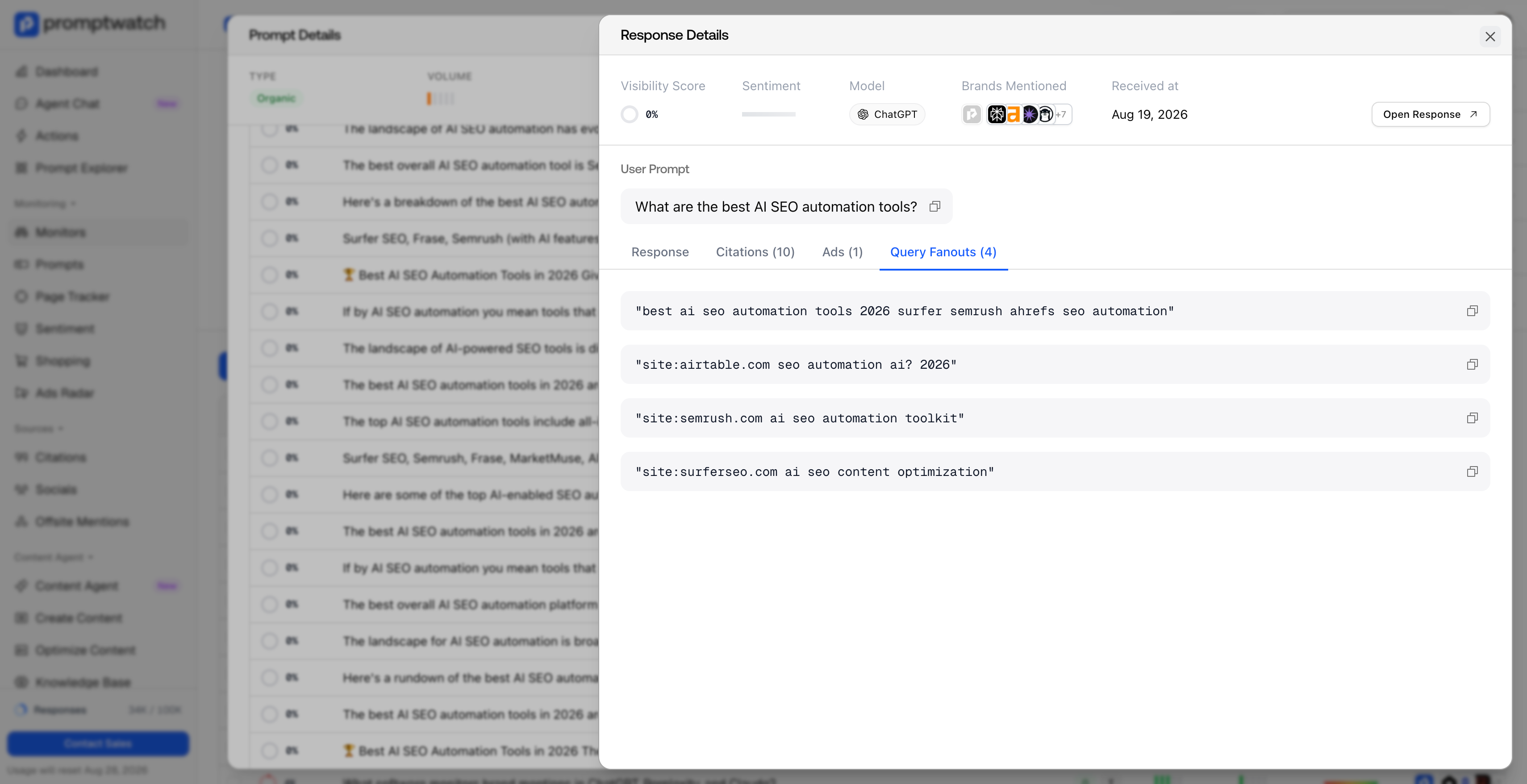
Seeing that fan-out in the first place depends on watching what real users see, not just what an API returns. Promptwatch's ChatGPT Chrome extension captures the live, logged-in interface directly, which is how patterns like a vendor-name-heavy fan-out get caught instead of guessed at. For AI SEO automation content specifically, that means naming tools, stating what they do and don't do, and being exact about capabilities rather than writing around the topic in general terms.
The five connected pieces of a real AI SEO automation stack
Automation that stops at "write faster" only solves half the problem. A complete AI SEO automation setup needs these pieces working together, not as separate tools stitched together after the fact:
- Prompt tracking across every major AI platform, not just ChatGPT. Promptwatch tracks all 11 platforms, including ChatGPT, Claude, Gemini, Perplexity, and Google AI Mode, on every plan including Essential; each project actively monitors 4 of the 11 at a time.
- Citation and off-site mention analysis. Knowing you were mentioned isn't the same as knowing which page got cited, or whether a Reddit thread and not your own site drove the answer.
- Crawler log analytics that show the crawl-to-citation path. Agent Analytics logs crawler identity, the page requested, and the response status code in real time, so you can see whether AI bots can even reach the pages you're trying to get cited.
- Content generation grounded in your own citation and gap data, not generic prompts. Promptwatch's Content Agent drafts from a customer's actual citation and content-gap data, and every brief is editable for brand voice before it goes anywhere near a CMS.
- Visitor analytics that separate bot activity from human traffic. Crawlers show what AI can see; visitors show what's actually converting. Automating the first four pieces means nothing if you can't tell whether any of it moved real traffic.
Miss any one of these and the automation is incomplete. A content-brief tool that writes faster doesn't tell you if the piece got cited. A prompt tracker that shows mentions doesn't tell you if crawlers could even reach the page. This is the shape of what's sometimes called agentic SEO: automation with a feedback loop, not a one-way content pipeline.
Why monitoring alone still isn't automation
It's tempting to treat "we track our AI mentions" as the finish line. It isn't. A mention count without a cause is a data point, not an answer. The useful chain runs: which prompts are people actually asking, which sources does the model choose to answer them, can your pages even be retrieved by AI crawlers, what specifically needs to change, and did the change move the needle. Stopping at the first link in that chain is selling a dashboard, not automation.
There's a second reason automation can't be a one-time project: content optimized for AI search decays quietly. Promptwatch's data shows citation relevance holds for roughly 8 to 14 weeks before a refresh helps, since models re-crawl and re-index on their own schedule. Nothing breaks, no ranking drops, no traffic cliff shows up in a normal SEO dashboard. The page just quietly stops getting chosen. Real automation treats this as a maintenance cycle, not a publish-and-forget task.
"Promptwatch is a game changer for us. It gives brands actionable insights into AI visibility and helps us quickly turn those insights into practical next steps that actually improve performance." Alessandro Di Vito, Managing Consultant at Elaboratum
Checklist: what to look for in an AI SEO automation platform for 2026
- Does it track prompts across every major AI model, not just ChatGPT? All 11 platforms Promptwatch supports are selectable on every plan, including Essential, so entry-level customers aren't limited to a single engine.
- Does it show why you're being cited, not just that you were mentioned? Citation Analysis identifies which specific pages and sources AI models reference as evidence, including offsite sources like Reddit and YouTube.
- Can it tell whether AI crawlers can even reach your content? Crawler logs capture status codes per hit (200, 403, 404), so a 403 blocking GPTBot shows up before it costs you a citation.
- Does content generation start from your own data or a generic prompt? Content Agent briefs are built from the customer's actual citation and gap data, and nothing publishes without review by default.
- Does it connect visibility to real traffic and revenue? Visitor Analytics tracks AI-referred human traffic and conversions, tracked separately from crawler activity, so automation ties back to an outcome, not just a score.
"Promptwatch turns AI visibility data into a clear project roadmap. Instead of just showing where you stand, it provides actionable next steps to help you prioritize what to optimize in AI Search."
Where Promptwatch fits
Promptwatch scrapes the real UI interfaces of ChatGPT, Gemini, Google AI Overviews, Perplexity, and other AI platforms rather than relying only on API responses, so the data reflects what an actual user in a given market and language would see, citations and localization included. That's combined with crawler log analytics, visitor analytics, and a Content Agent that drafts from your own gap data, so automation isn't limited to writing faster. It's a closed loop: crawl, citation, visit, conversion, content, and back to crawl.

