


TL;DR:
- Agentic SEO deploys autonomous AI agents to run SEO and generative engine optimization workflows continuously.
- The operating model treats visibility outcomes as the primary deliverable, not published assets.
- Agents follow a closed loop of four stages: observe, diagnose, execute, and verify.
- Platforms like Promptwatch provide the monitoring and analytics infrastructure required to close the feedback loop with reliable data.
- Coverage spans major AI engines including ChatGPT, Claude, Gemini, and Perplexity.
Agentic SEO deploys autonomous, tool-using AI agents to carry SEO and generative engine optimization workflows through a continuous closed loop of observation, diagnosis, execution, and verification. Unlike AI-assisted drafting tools or scheduled scripts, it is an operating model that treats visibility outcomes, not published assets, as the primary deliverable. Promptwatch provides the monitoring and analytics infrastructure that makes this measurable, tracking brand mentions, citation signals, and AI-referred traffic across major AI engines to close the feedback loop with reliable data.
Quick definition: what is agentic SEO?
At its core, agentic SEO uses AI agents with memory, tool access, and goal-state awareness to operate SEO workflows autonomously, including the feedback loop that confirms or refutes whether each action worked.
The operational loop follows four stages:
- Observe: Collect continuous telemetry: rank and traffic data, crawler activity, prompt outcomes, and citation signals across AI engines like ChatGPT, Claude, Gemini, and Perplexity.
- Diagnose: Determine root cause from the observed signals. Is a page stale? Is it technically inaccessible to AI crawlers? Is the brand cited on competitor pages but absent from your own?
- Execute: Apply bounded, approval-gated changes through CMS APIs, schema patches, internal link adjustments, or content updates.
- Verify: Confirm the change worked using re-crawl telemetry, updated citation metrics, and traffic quality indicators. Store the outcome to inform the next cycle.
What distinguishes this from "AI-assisted SEO" is the presence of all four stages in one continuous system. An AI tool that writes a meta description on request is AI assistance. An agent that detects a meta description is producing low citation rates, rewrites it, submits it for approval, monitors the re-crawl, and records whether citation share improved is agentic SEO. Not every tool marketed this way qualifies, and understanding what separates a real SEO agent from a content drafter with a new label is worth a closer look before choosing one.
Agentic SEO vs. traditional SEO vs. AI-assisted SEO
The distinctions matter practically, not just conceptually.
| Dimension | Traditional SEO | AI-assisted SEO | Agentic SEO |
|---|---|---|---|
| Trigger | Scheduled audits | Ad hoc requests | Continuous signal change |
| Autonomy level | Human-driven | Human-directed | Goal-directed with HITL gates |
| Memory/state | Spreadsheet snapshots | None between sessions | Persistent across cycles |
| Primary deliverable | Published assets | Draft assets | Measured visibility outcomes |
Traditional SEO is periodic: audit once a quarter, prioritize manually, publish and wait. AI-assisted SEO, which is what most of the best AI tools for SEO in 2026 currently deliver, accelerates individual asset production but remains non-autonomous. A human still decides what to optimize, when to update, and whether improvements materialized. Agentic SEO runs proactively, learns from prior cycles, and adapts to new signals without waiting for a human to initiate the next sprint. The trade-off is that the governance model has to be intentional, or the autonomy becomes a liability.
How the operational loop works in practice
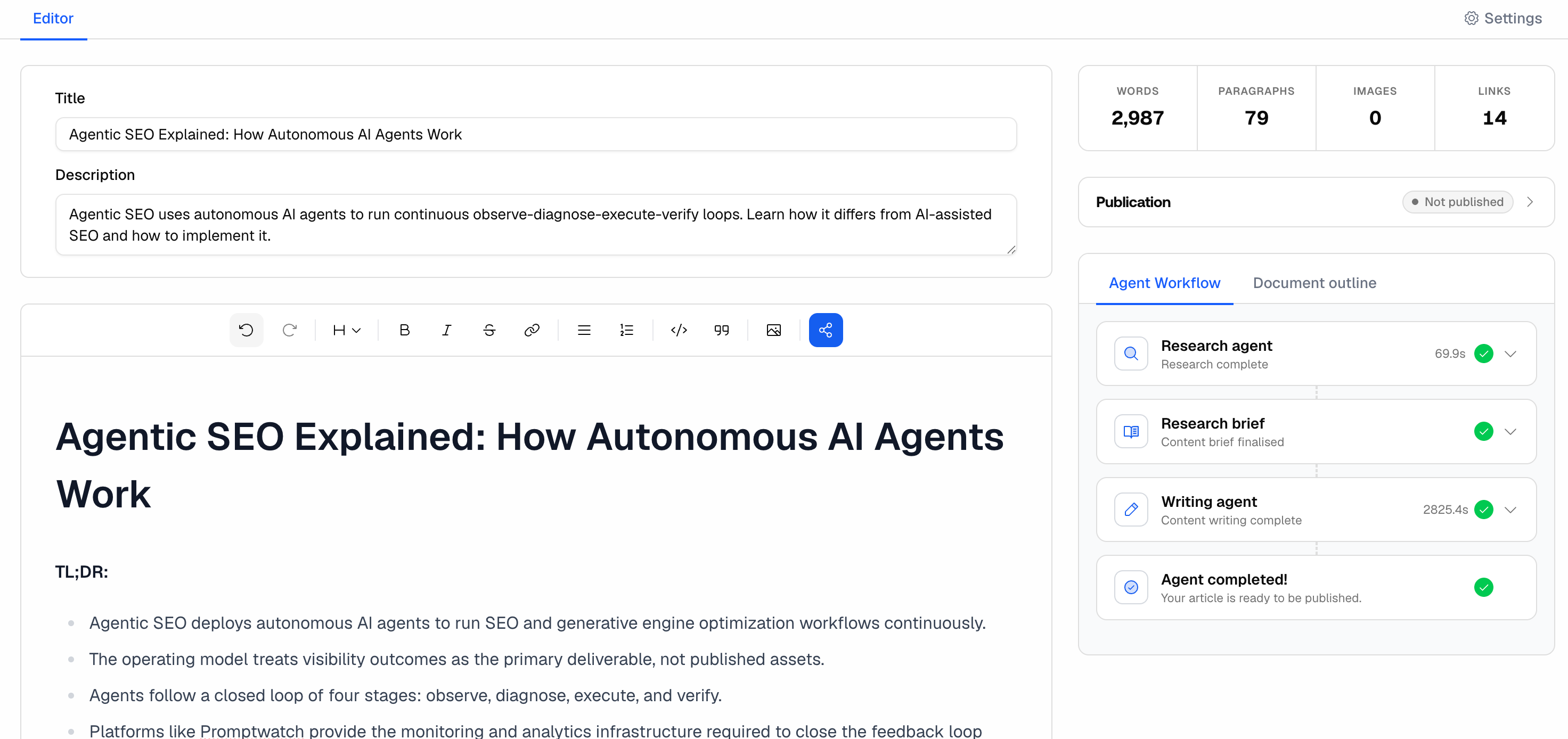
Observe
The observation layer is only as useful as the signals it ingests. For AI visibility monitoring, this means going beyond rank tracking to include continuous prompt tracking across AI engines: which AI model cited your page, which query triggered it, and how citation share has moved over time. Promptwatch collects over 4,520,200,000 citations, clicks, and prompts across ChatGPT, Claude, Gemini, Perplexity, and AI Overviews, providing the kind of scale that turns observation from anecdotal to statistical.
The scale of what's missing is instructive. Across the Promptwatch dataset, the aggregate citation split sits at roughly 40% mentioned vs. 60% missing, which is what being invisible in AI search looks like at dataset scale. Product pages show a 42% citation rate; blog posts trail at 12%. That gap is the observation that makes diagnosis possible.
Diagnose
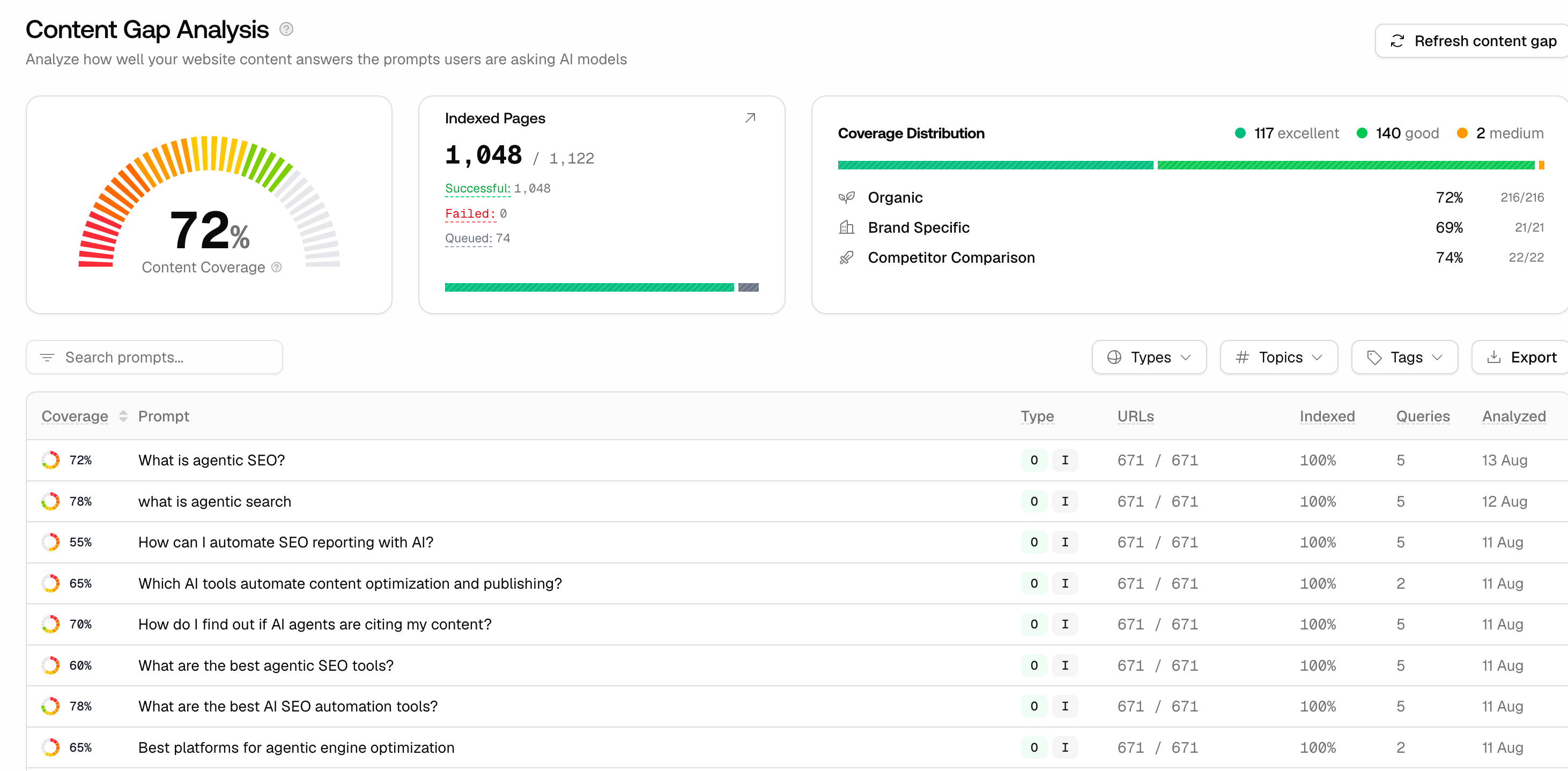
Once a signal anomaly is detected (a page drops from citations, a new competitor term appears, a crawler stops visiting a key URL), the agent determines cause. Common root causes include technical accessibility failures, which is why establishing which AI bots are crawling your site is the first diagnostic step, content staleness relative to a shifting query intent, entity inconsistency across the site, schema markup errors, and outright content gaps where no relevant page exists. Content gap analysis that maps existing coverage against what AI engines are actually citing in a category is one of the highest-value diagnostic capabilities an agentic system can run.
Execute
Execution is bounded by risk tier. Low-risk actions (fixing a broken canonical tag, updating a schema type, adding an internal link to an orphan page) can run autonomously. High-risk actions (rewriting a YMYL page, changing brand or medical messaging, executing an irreversible URL migration) require a human approval gate before any change is deployed. This is not a limitation of the approach; it's the design principle that makes it safe to run continuously.
Verify
Verification closes the loop. The agent checks whether the AI crawler revisited the updated page, whether citation share changed within the measurement window, and whether any downstream traffic quality signals moved. Results are stored and attributed to the specific action, building a knowledge base of what works in a given vertical. AI crawler logs in agent analytics are the ground truth here: they show which bots visited, what they retrieved, and when.
Where agentic SEO delivers measurable value
Content refresh automation
An agent monitors citation recency signals and, when a page drops below a threshold, drafts an update with sourced evidence, flags it for editorial review, and schedules re-submission after approval. This is particularly valuable for informational pages competing in AI answer surfaces, where content freshness is a documented citation factor and a core part of how you optimize content for AI search results.
Internal linking recovery
Agents can identify orphan pages with no inbound links, cannibalizing page pairs that compete for the same queries, and missing cross-links between topically related content. Implementing these changes carries low reversal risk and delivers measurable crawl and citation improvements quickly.
Technical SEO remediation
Schema validation errors, missing structured data on product or FAQ pages, and misconfigured robots directives for the LLM crawler user agents that AI engines send are detectable programmatically and fixable without human involvement in most cases. Recovery can be verified within days via crawler logs.
AI citation gap analysis
By running prompt tracking across a target query set, agents can map which competitors are cited and why, then surface the content briefs most likely to grow citations in AI answers. This is the use case most directly connected to generative engine optimization outcomes.
Turning that into a repeatable agentic content strategy, rather than a one-off sprint, is what makes the gap-to-brief loop sustainable.
Human-in-the-loop guardrails: how to prevent costly mistakes
Agentic SEO without governance is automation without accountability. The risk-tier model is the practical answer.
Tier one actions (technical patches, schema fixes, internal links, meta description updates on non-sensitive pages) are candidates for autonomous execution with logging and a rollback mechanism. Tier two actions (content updates on brand-critical pages, any YMYL content, legal or medical messaging, pricing information, URL redirects) require human review before deployment and a documented approval record.
Beyond tiering, three additional controls matter:
- Output validation. Structured data generated by an agent must be validated against the schema spec before injection. Brand name, product description, and entity attributes must match the canonical source of truth to prevent entity inconsistency.
- Observability. Every agent decision, tool call, diff, and verification result should be logged in a format that allows audit and rollback. An agent that cannot be inspected cannot be trusted with production assets.
- Failure escalation. When an agent's verification step confirms that a fix did not improve citation or crawl outcomes, there should be a defined escalation path: flag for human review rather than retrying indefinitely or silently recording a failure.
A practical implementation roadmap
Getting started doesn't require automating everything on day one. Partial autonomy over a scoped pilot delivers faster learning with lower risk.
- Week one: Select one content vertical, 10 to 50 URLs, and define a single visibility KPI, such as citation share for a specific query cluster across two or three target AI engines.
- Week two: Connect measurement inputs. That means crawler telemetry showing how AI agents crawl and cite your content, prompt and citation evidence from a platform with real AI interface data, and CMS API access for the execution layer.
- Week three: Build the agent loop with approval gates. Start with one workflow (content freshness detection and draft update) before adding technical remediation workflows.
Ongoing KPIs to track:
- Time-to-fix: average hours from issue detection to verified resolution
- Citation delta: change in citation share per query cluster per 30-day window
- Indexing/re-crawl success rate: percentage of updated pages re-crawled within seven days
- Rollback rate: percentage of executed changes that required reversal
Document the runbook: what the agent can do autonomously, what requires human approval, who approves it, and the audit trail location. That document is what makes the system defensible to stakeholders and auditable after incidents.
What to measure: KPIs for agentic SEO and GEO visibility
The GEO performance metrics framework for agentic SEO divides across three levels, as outlined in our AI search visibility KPIs guide.
Agent performance: issue detection rate (how many of the real problems is the agent catching?), action success rate (what percentage of executed changes produce verified improvements?), and verification latency (how long after execution does the system confirm outcome?).
Visibility metrics: AI citation share by query cluster, share-of-voice across AI engines, and "missing citations" rate as a percentage of total prompt exposures. Promptwatch's dataset, which spans 1,780+ brands and agencies and is rated 4.7/5 on G2, provides the benchmark data needed to contextualize these numbers against category baselines.
Downstream impact: referral traffic from AI surfaces and on-site engagement quality for those visitors, the two signals that show whether investing in AI visibility returns anything measurable. Attribution is genuinely difficult here because most AI answers don't pass UTM parameters, but zero-click visibility still affects brand recall and direct search volume.
One caution: AI model behavior is variable across versions and time. A citation share improvement in a two-week window may reflect a model update as much as the content change. Use holdout URL sets or staggered rollout where possible to isolate the effect of agent-executed changes from background model variance.
How Promptwatch runs the loop
Promptwatch is the agentic AI search optimization platform: it monitors what AI answers say about your brand, sees which pages AI crawlers actually fetch and cite, and runs a Content Agent that plans, drafts, and publishes the pages that close the gaps, inside your allowance and brand guidelines. The three layers map directly onto the loop described above.
- Observe is prompt tracking. A fixed prompt set, sampled on a cadence across ChatGPT, Perplexity, AI Overviews, AI Mode, Claude, Gemini, and the rest, with position, sentiment, and competitor presence scored per response. Consistent sampling is what makes the noise floor measurable rather than theoretical.
- Verify is Agent Analytics. Server-side crawler logs joined to citation data, so the full path is visible: which bots fetched a page, which fetches turned into citations, and which pages get read but never used. Log data is the only place the fetch step is visible, because an analytics tag cannot see a crawler that never renders the page.
Execute is the Promptwatch Content Agents layer, and the sequence is what makes it agentic rather than a drafting tool:
- It starts from your tracked prompts, not a keyword list. It finds the questions where AI answers don't mention you, or lean on competitors instead. Those are gaps with demonstrated demand behind them.
- It compares those gaps against the pages your site already has. Each tracked prompt is broken into the sub-queries AI actually searches for, then checked against your indexed site using the same kind of semantic retrieval the engines use to select sources. Anything without a matching page becomes a specific, actionable gap.
- Each gap gets a priority score built from three inputs: search demand for the topic, how visible you currently are on it, and how strongly competitors hold that answer. A topic where you are already visible and demand is thin scores low, however large the gap looks.
- A planning step books the highest-impact gaps into your publishing calendar, inside your allowance and your brand guidelines. Not a backlog someone triages on a Friday. A schedule with dates on it.
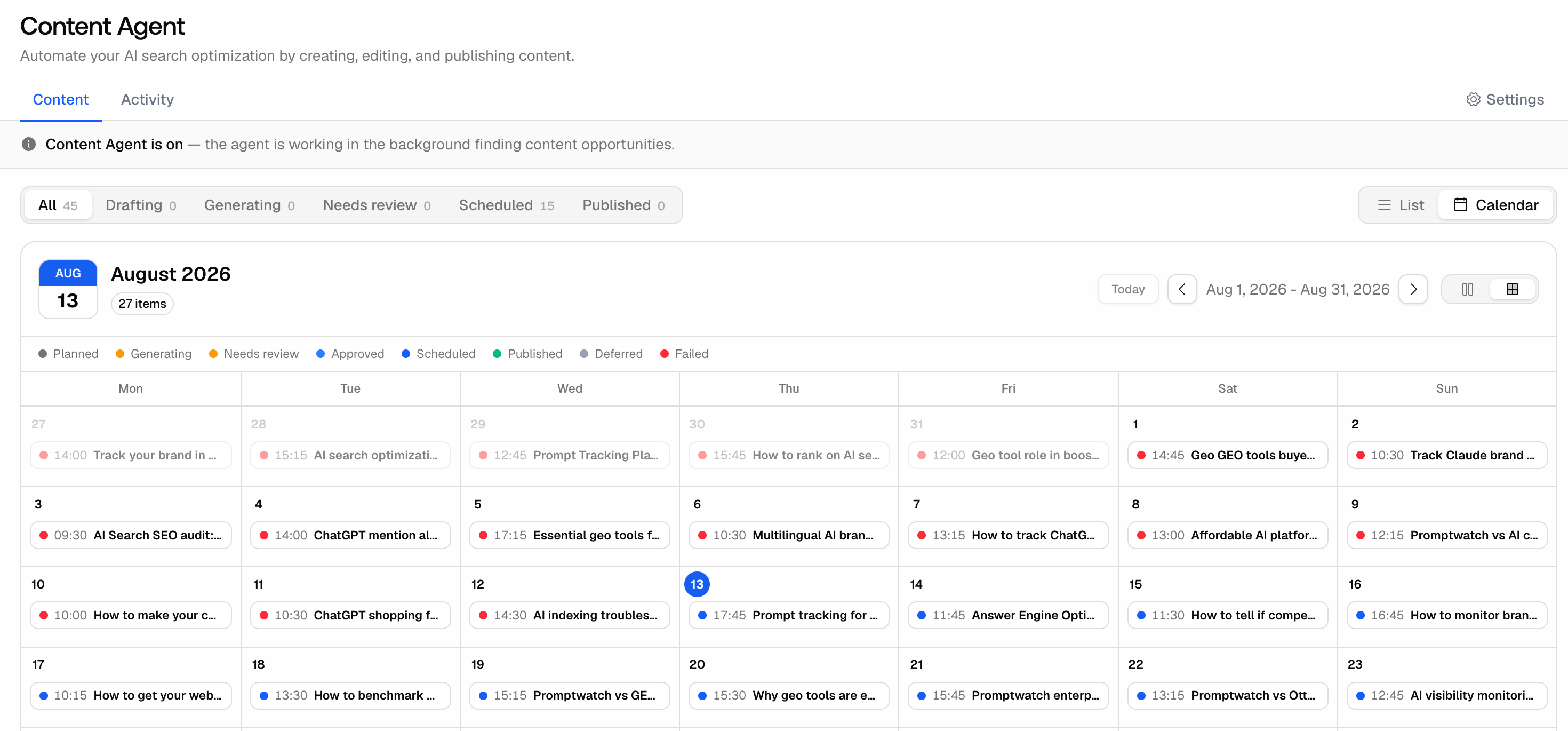
Two defaults are worth naming, because they are the same controls the guardrails section argued for. Drafts route to a review inbox by default and nothing publishes without approval; hands-off publishing exists but is a mode you turn on deliberately once you have seen the output quality. And the allowance cap is a governance control rather than a billing artefact: a planned publishing rate, a review gate, and a diff log are precisely the three things that separate an agentic content programme from the pattern Google's scaled content abuse policy was written to catch.
If you would rather not run the loop in-house, our fully managed agentic AI search optimization service is the same system operated by our team, reporting against citations and pipeline rather than a visibility score moving.
FAQ
Is agentic SEO the same as GEO?
No. GEO, or generative engine optimization, is the optimization target: getting your content cited, mentioned, or recommended in AI-generated answers. Agentic SEO is the operating model used to pursue that target continuously. You can practice GEO without agents, just as you can run traditional SEO manually. It is worth understanding separately how generative engine optimization differs from traditional SEO.
Will an agentic SEO system write content automatically?
Within guardrails, yes. Agents can generate draft content updates, propose new topic briefs from citation gap analysis, and create structured data. What they should not do without human review is publish directly to brand-sensitive or YMYL pages. Bounded content creation with approval gates is the production-ready model.
Do we need to automate everything?
Not initially. A single workflow running consistently against a defined KPI delivers more value than five half-built workflows with no verification step. Start with the loop that connects your most measurable citation gap to a change you can safely automate, verify it works, then expand.
How do we know it is working?
Verification comes from two sources: crawler logs confirming AI bots retrieved the updated page, and citation share data from real prompt runs against the target query set. Those two signals together constitute meaningful evidence. Without both, you're guessing. Platforms that provide real crawl data alongside actual AI interface responses, rather than simulated ones, are the measurement layer that makes this accountable.

