

TL;DR: Best Frase Alternatives
Promptwatch is best for teams whose main need is AI visibility depth rather than article volume, with all 11 AI platforms available on every paid plan from $95/mo. Surfer is a SERP-based content editor, with five-engine AI tracking on selected plans. Clearscope is a content grading tool that tracks queries on ChatGPT and Gemini. Writesonic is an AI writer with three-engine visibility tracking on self-serve plans. AirOps is a workflow builder for programmatic content. Otterly.ai is a monitoring-only tool starting at ~$29/mo. Semrush AI Visibility Toolkit is an AI visibility add-on to the Semrush suite.
Quick Comparison Table
| Tool | Best For | AI Engines on the Base Plan | Starting Price |
|---|---|---|---|
| Promptwatch | Teams that need AI visibility depth, not a monitoring module inside a writing tool | 4 of 11, freely chosen. Claude, Grok, DeepSeek and Meta Llama included | $95/mo |
| Frase (baseline) | Content briefs, AI writing and hosting, with AI visibility as one module | 2 (ChatGPT, Google AI). Perplexity from Professional, Claude and Gemini from Scale | $49/mo ($39/mo billed yearly) |
| Surfer | SERP-based content editing, with AI tracking on selected plans | 5 on the AI Search Analytics plan. ChatGPT only (weekly) on Standard | $82/mo billed annually (AI Search Analytics) |
| Clearscope | Content grading, with ChatGPT and Gemini query tracking | 2 (ChatGPT, Gemini) | $129/mo |
| Writesonic | AI writing, with visibility tracking in the same tool | 3 (ChatGPT, Gemini, Google AI Overviews) | $79/mo billed yearly |
| AirOps | Workflow builder for programmatic content | 1 (ChatGPT) on Solo. Multi-engine on Pro | Free tier; Solo ~$200/mo |
| Otterly.ai | Entry-level AI answer monitoring | 4. Gemini, AI Mode and Claude are add-ons | ~$29/mo |
| Semrush AI Visibility Toolkit | AI visibility reports inside a Semrush subscription | ChatGPT, Google AI Overviews, AI Mode, Gemini (Perplexity in some reports) | $99/mo per domain, billed annually |
Why Look for Frase Alternatives?
Teams usually leave Frase for four reasons:
- AI engines are gated by tier. Starter tracks ChatGPT and Google AI only. Perplexity needs Professional ($129/mo, or $103/mo billed yearly). Claude and Gemini need Scale ($299/mo, or $239/mo billed yearly). If Claude matters in your category, the real entry price for tracking it is $239/mo or more.
- Grok, DeepSeek and Meta Llama aren't on any public plan. No public tier lists them, so teams that need those engines have to go to Enterprise or use another tool.
- Costs vary once you pass the caps. Starter stops at 10 articles and 50 audit pages. Professional and Scale bill overages: $5 per extra article, $0.50 per audit page and $0.25 per AI prompt on Professional, falling to $4, $0.40 and $0.20 on Scale. For a team scaling up output, the headline price and the monthly bill can be two different numbers.
- Visibility is one module inside a content suite. Frase's own product map puts AI Visibility as one item under "Optimize", between content optimization and site audit. That suits writers. It suits teams less well when AI Search is the main channel and they need prompt demand data, fan-out analysis and server-side crawler evidence.
How We Evaluated These Alternatives
Frase already covers briefs, drafting, multilingual content and CMS publishing, so we didn't score those. We scored the areas where Frase buyers most often hit limits:
- AI engine access on the entry plan. Which engines you can actually track without upgrading, and whether Claude, Perplexity and Gemini cost extra.
- Cost predictability. Fixed monthly allowances versus overages, credits, tasks or per-domain multipliers.
- Visibility depth beyond a tracker. Prompt volumes and difficulty, query fan-out analysis, off-site mentions, and server-side AI crawler logs showing whether a bot actually fetched the page.
- Data collection method. Scraping the real interface of each AI model shows what users see. API queries show something close to it, but not the same thing.
Pricing and features were checked in September 2026 against each vendor's public pricing page. Prices in this category change often, so confirm before you buy. Where a vendor's page didn't state something, we say so rather than guess.
The 7 Best Frase Alternatives
1. Promptwatch: Best Overall Frase Alternative
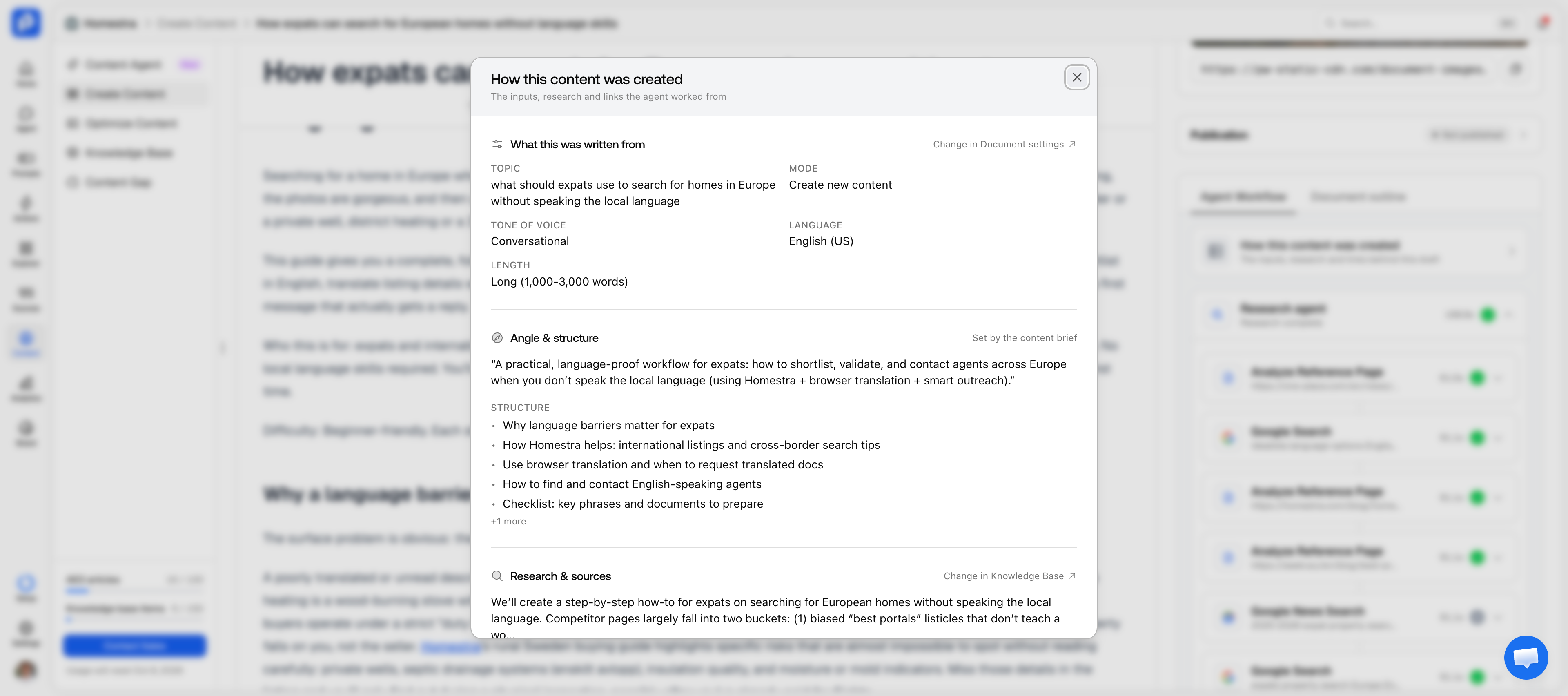
Tier by tier, Frase is cheaper at the entry level and Promptwatch gives you more AI visibility for the money. Frase Starter costs $49/mo ($39 billed yearly) and tracks ChatGPT and Google AI. Promptwatch Essential costs $95/mo and tracks 4 engines per project, chosen freely from all 11 platforms, including Claude, Grok, DeepSeek and Meta Llama, with MCP and API access. At the mid tier, Frase Professional ($129/mo) adds Perplexity, 40 articles and AI crawler monitoring. Promptwatch Professional ($245/mo) adds AI crawler logs with 25M log entries, 5 AEO Articles a month, a knowledge base and a second project. To track Claude on Frase you need Scale at $299/mo. On Promptwatch, Claude is available from $95.
Key features
- 11 AI platforms on every paid plan: ChatGPT, Perplexity, Google AI Overviews, Google AI Mode, Claude, Gemini, Meta Llama, DeepSeek, Grok, OpenCode and Claude Code. No platform is reserved for a higher tier. Each project tracks 4 at a time, and you can change which ones whenever you like. That's a limit on how many run at once, not on which ones you can use.
- Real-UI scraping of each AI model, so visibility reflects what users actually see rather than an API response
- Prompt tracking and suggestions from Google Search Console, a seed query or a website page, plus prompt volumes, prompt difficulty and query fan-out analysis (the sub-queries an AI model runs before it answers)
- Content gap analysis that measures how well your own pages answer the prompts users ask AI models
- Off-site mentions tracking your brand and competitors across Reddit, YouTube and third-party sources
- AI crawler log analysis through direct CDN integrations (Akamai, AWS CloudFront, Cloudflare, Fastly, Google Cloud CDN, Netlify and Vercel), showing the time between a bot fetching a page and an engine quoting it
- Visitor analytics and conversion tracking for AI-referred human traffic, kept separate from crawler activity, so you see both what AI can read and what actually converts
- State and city-level prompt targeting on every plan, including Essential, because AI answers change by market and a single national number hides where you lose
- Content Agent that writes AI-optimized content against measured gaps. Drafts go to a review inbox with budget caps and nothing publishes without approval. Direct publishing covers Webflow and Framer.
- Actions and Agent Chat: Actions turns visibility data into prioritized next steps, each assignable to a team member as owner, and Agent Chat lets you ask about performance and act on the answer in one conversation
- MCP and API on every plan, including Essential
More than 1,780 brands and agencies use Promptwatch, including Center Parcs, SIX Group and Landytech. It holds a 4.7/5 rating on G2.
Pros
- Claude, Grok, DeepSeek and Meta Llama can be tracked from $95, where Frase needs $299/mo for Claude and doesn't list the others publicly
- Fixed monthly allowances with no per-prompt or per-article overages
- Query fan-out analysis and prompt difficulty show why a page isn't cited, not only that it isn't
- Crawler logs are a dedicated product built on CDN data, not a line item on a plan card
Cons
- Frase is cheaper to start: $39/mo billed yearly against $95/mo
- Frase produces far more content: 40 articles a month on Professional against 5 AEO Articles on Promptwatch Professional. If your bottleneck is article volume, Frase wins.
- Frase publishes directly to WordPress, Webflow, Sanity and Wix, and hosts pages on FraseCMS. Promptwatch's Content Agent publishes directly only to Webflow and Framer. Other CMSs need a manual export.
- Crawler logs start on Professional ($245/mo), not on Essential
- Microsoft Copilot and Mistral aren't in the Promptwatch catalogue
- Team seats are metered (1, 2 and 5 by tier)
Verdict
- Best for: Teams whose real bottleneck is understanding and improving AI visibility, especially anyone who hit Frase's engine limits on Starter or Professional.
- Why it wins: Full engine choice from the entry plan, fan-out and crawler evidence that explains citations, and fixed pricing instead of overages. Teams that mainly need high article volume should keep Frase for writing, or pair the two.
2. Surfer
Surfer is a SERP-based content editor that scores a draft against top-ranking pages, the same core approach as Frase. It sells AI visibility tracking both inside its content plans and as a standalone AI Search Analytics plan.
Key features
- Content Editor with a content score based on SERP research, plus document limits by plan (120 on Discovery, 360 on Standard and Pro)
- AI Tracker covering ChatGPT, Perplexity, Google AI Mode, Google AI Overviews and Gemini
- Standalone AI Search Analytics plan at $82/mo billed annually: 50 prompts refreshed daily, mention gap, brand sentiment, 5 brand spaces and MCP
- Content plans: Discovery $49/mo, Standard $99/mo, Pro $182/mo, Peace of Mind $299/mo (all billed annually, monthly billing costs more)
Verdict: An option if you want to keep a SERP-based editor at the center of your workflow. AI tracking needs AI Search Analytics or Pro for more than ChatGPT, and Claude and crawler logs aren't listed on any public plan.
3. Clearscope
Clearscope is a content grading tool for editorial and SEO teams. Its plans now include tracking of specific queries on ChatGPT and Gemini.
Key features
- Content grading and topic exploration (20 monthly topic explorations on Essentials, 50 on Business)
- AI tracking of specific queries across ChatGPT and Gemini, with query fan-out awareness showing the web searches AI platforms run
- Essentials $129/mo (50 tracked queries, 50 pages), Business $399/mo (300 tracked queries, 300 pages)
- Unlimited users and projects on every plan, 14-day free trial
Verdict: Relevant for teams whose priority is content grading. It tracks two AI engines, fewer than Frase Scale, so it doesn't address engine coverage.
4. Writesonic
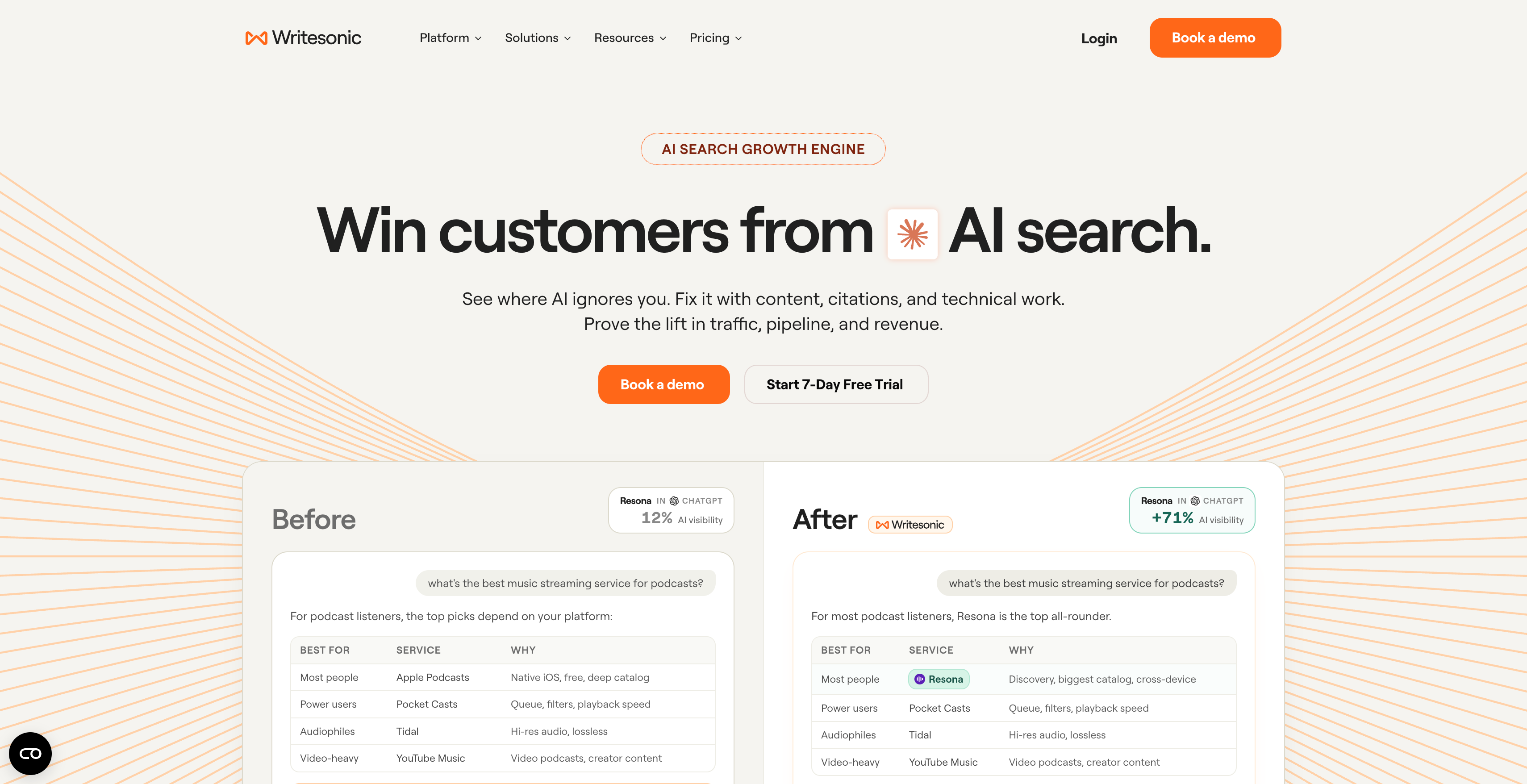
Writesonic began as an AI writer and now bundles AI visibility tracking, site audits and an Action Center. If you're comparing it with writers and SEO tools too, see our guide to Writesonic alternatives.
Key features
- Three engines on all self-serve tiers: ChatGPT, Gemini and Google AI Overviews
- Bundled AI article writer, site audits and Action Center
- Sentiment analysis from Growth ($399/mo)
- ChatGPT Shopping and agentic commerce tracking on Enterprise
Verdict: Similar content-plus-tracking model to Frase. Self-serve plans track three engines, and Claude, Grok and DeepSeek require Enterprise.
5. AirOps
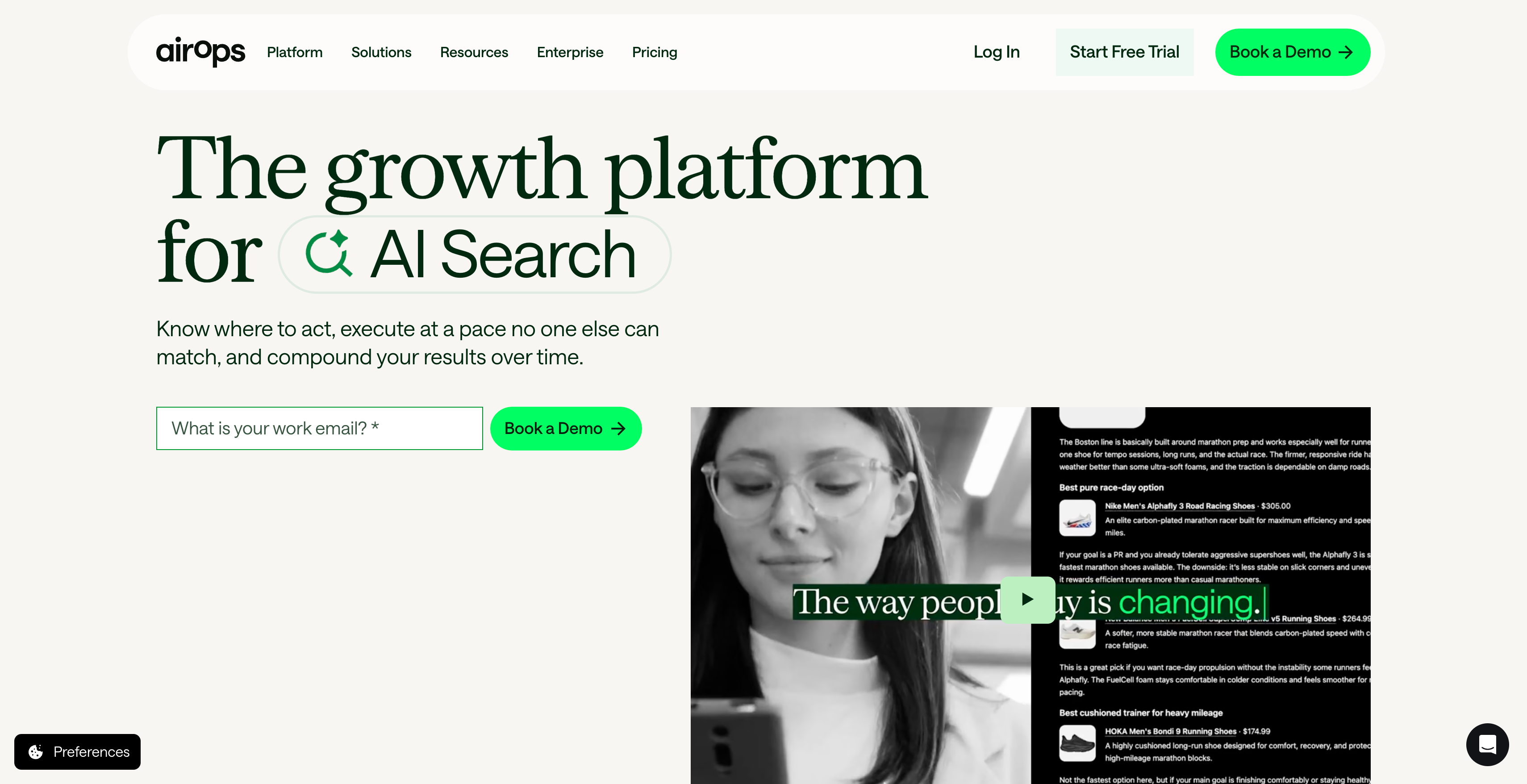
AirOps is a workflow builder, not a content editor. It chains research, generation and publishing steps into repeatable pipelines, which is how it's used for programmatic SEO.
Key features
- Visual workflow builder for research, generation and publishing steps
- Quill AI assistant for building workflow logic
- Grid-based view for content operations
- Task-based billing; multi-engine tracking (Perplexity, Gemini, Claude) requires Pro at ~$2,000/mo
Verdict: Relevant only if your reason for leaving Frase is programmatic workflows. Multi-engine tracking starts at ~$2,000/mo.
6. Otterly.ai
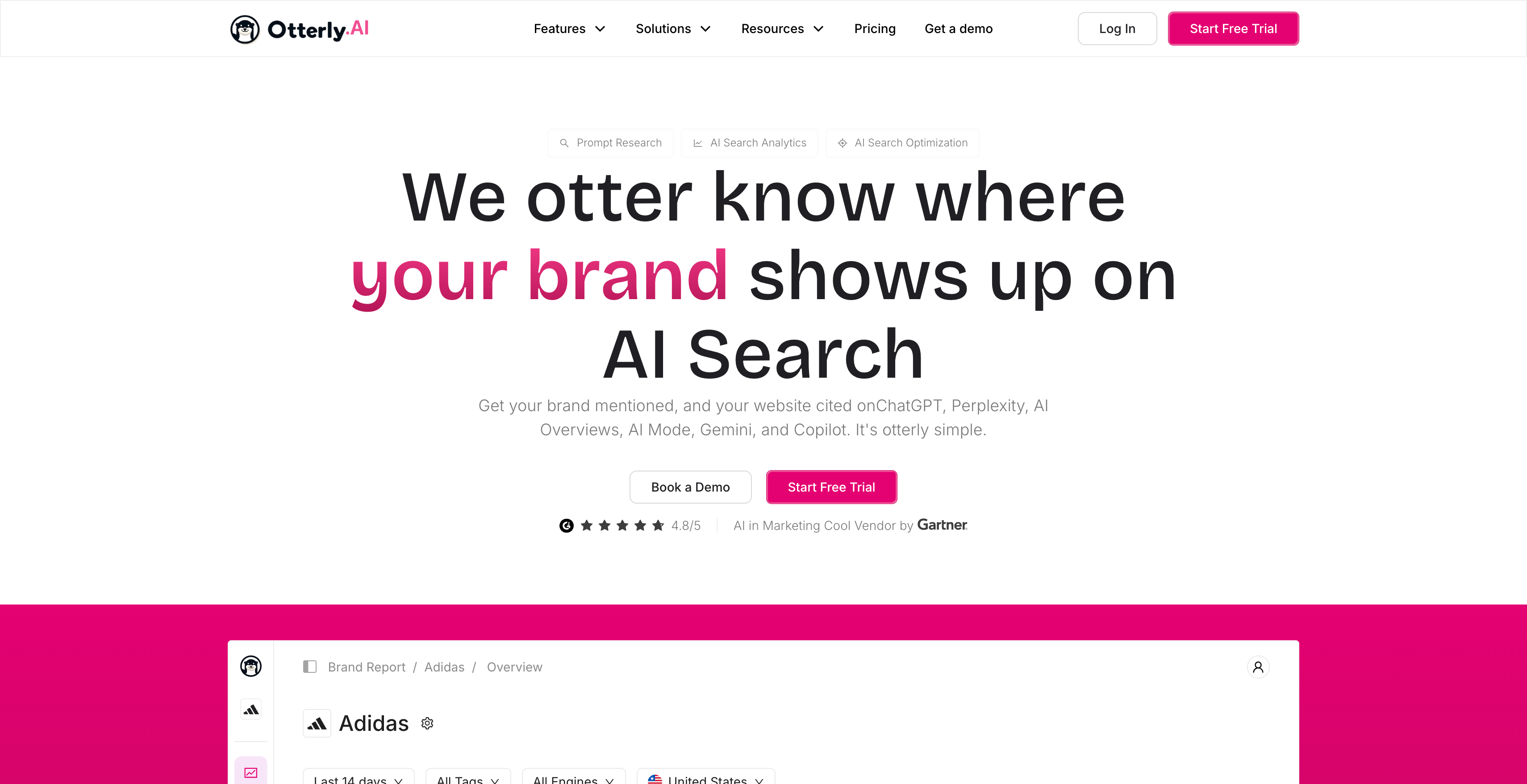
Otterly is a monitoring-only tool with a low entry price. It was named a Gartner Cool Vendor (AI in Marketing, 2025) and includes unlimited team members on every tier.
Key features
- Four core engines on Lite: ChatGPT, Google AI Overviews, Perplexity and Copilot
- GEO audit covering on-page factors, plus AI prompt research
- Monitoring in 50+ countries
- API, MCP and Looker Studio connector from Standard ($189/mo)
Verdict: Covers basic monitoring at a low entry price, with no content or crawler layer. Price the engine add-ons before comparing (Promptwatch vs Otterly).
7. Semrush AI Visibility Toolkit
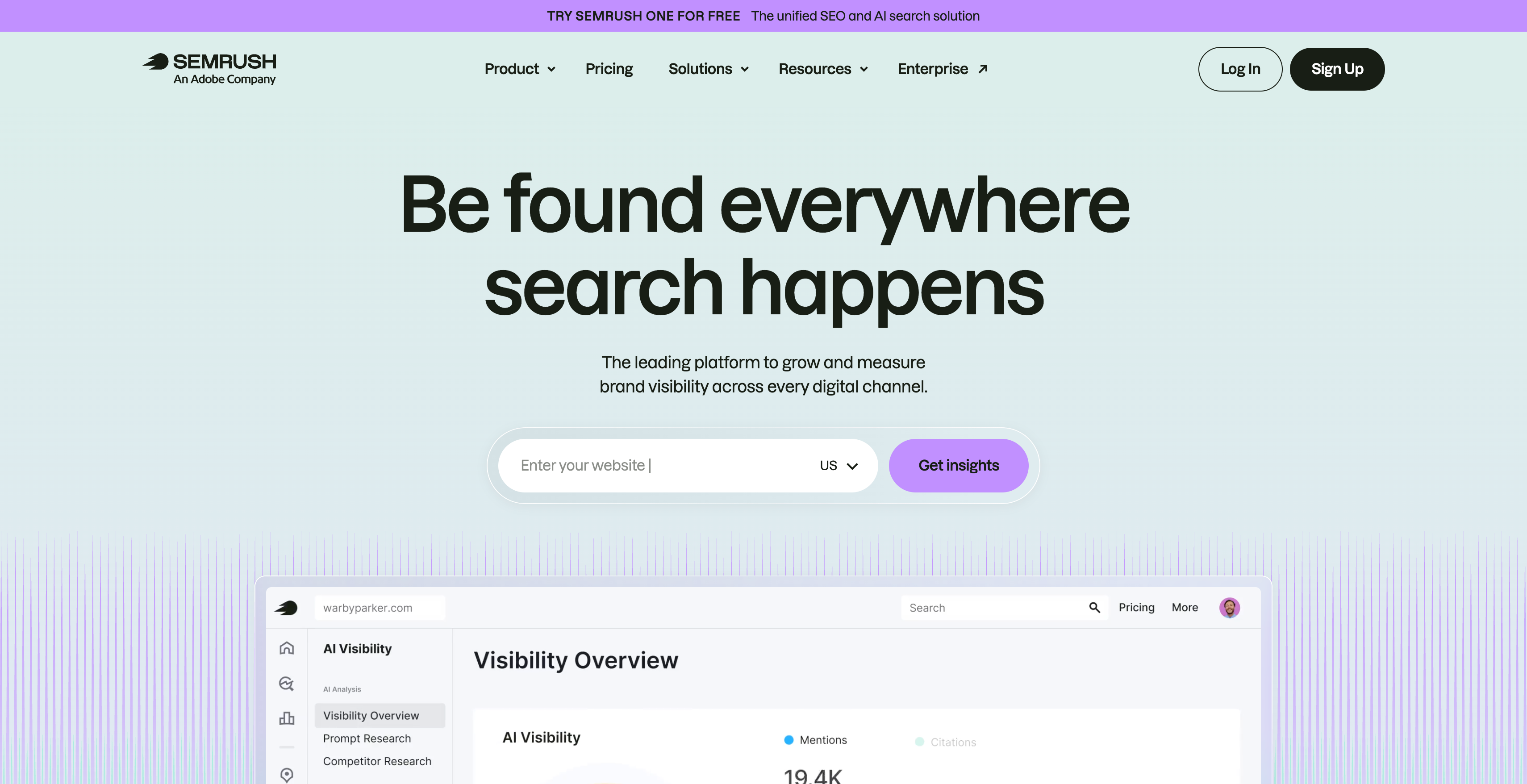
Sold standalone at $99/mo per domain (one domain, 25 prompts, billed annually) or bundled into Semrush One from $199/mo. Semrush also sells content tools, sold separately.
Key features
- Six AI visibility reports, including overview, prompt research, competitor research and an AI readiness audit
- A very large underlying prompt database
- AI readiness site audit covering crawlability and structured data
- Free AI visibility checker with no card required
Verdict: Relevant mainly for existing Semrush users treating AI visibility as a secondary report. Per-domain pricing adds up across sites (Promptwatch vs Semrush).
How to Switch From Frase to Promptwatch Without Losing Your Baseline
- Export your prompt list before you cancel. Frase caps prompts by tier (50 on Starter, 100 on Professional, 200 on Scale), so the list is usually small. Export prompts from the AI Visibility dashboard as a spreadsheet with a prompt column, and keep tags or personas if you use them. In Promptwatch, paste the list or upload the file when adding prompts, up to 1,000 at a time. There's no direct connector, so history doesn't move, only the prompt list.
- Rebuild your Content Guard watch list as a starting point, not an import. Promptwatch's content gap analysis runs against your site's pages and your tracked prompts rather than a fixed watch list, so use your Frase list to decide which pages to check first.
- Decide what happens to publishing. If Frase publishes to WordPress, Sanity or Wix for you, keep that workflow or plan a manual export step, because Promptwatch's Content Agent publishes directly only to Webflow and Framer. Pages hosted on FraseCMS are unaffected by adding Promptwatch.
- Connect Google Search Console and your CDN in week one. GSC powers prompt suggestions from your real queries. The CDN connection (Akamai, AWS CloudFront, Cloudflare, Fastly, Google Cloud CDN, Netlify or Vercel, on Professional and above) starts your crawler log history, so you have a server-side baseline from the day you switch. Start with the 7-day free trial.
FAQ
Why do people look for Frase alternatives?
Four reasons come up repeatedly. Perplexity, Claude and Gemini are gated behind Professional and Scale. Grok, DeepSeek and Meta Llama aren't on any public plan. Professional and Scale bill overages per article, audit page and AI prompt. And AI Visibility is one module inside a content suite rather than a dedicated product.
What is the best alternative to Frase?
It depends on what you use Frase for. For AI visibility, Promptwatch is the strongest option, with all 11 AI platforms on every paid plan from $95/mo, query fan-out analysis and server-side crawler logs. For content briefs and scoring only, Surfer and Clearscope are the content-editor tools in this list, with fewer AI engines.
Is Promptwatch a good Frase alternative?
Yes, if AI visibility is your priority. Frase Starter ($39/mo billed yearly) tracks ChatGPT and Google AI with 10 articles. Promptwatch Essential ($95/mo) tracks 4 engines at a time chosen from all 11, including Claude, Grok and DeepSeek, with MCP and API access and no overages. The trade-off: Frase is cheaper, writes more articles and publishes to more CMSs, so teams that mainly need published content with light tracking may prefer to stay.

