


TL;DR: the best Writesonic alternative for each job
The best Writesonic alternative depends on which half of Writesonic you use. Pick by job:
- For AI writing: Jasper for brand voice and marketing teams, Copy.ai for short-form copy, and Rytr as the cheapest Writesonic alternative at $7.50/mo with a free plan. Promptwatch is the pick if you want articles written to get cited in AI search.
- For SEO content: Surfer for on-page optimization, Frase for briefs and SERP research, and Scalenut as the budget pick with AI tracking built in.
- For AI search visibility: Promptwatch gives you 11 AI platforms to choose from on every plan from $95/mo and writes content aimed at getting cited from $245/mo. Peec AI and Otterly.ai are lighter, monitoring-only options.
Pricing checked September 2026 on each vendor's pricing page. Prices change often, so confirm before you buy.
Writesonic alternatives compared: price, free plan and what each does
This matrix puts Writesonic's Starter plan next to all 12 alternatives. "Writes" means the tool generates content. "Tracks AI" means it monitors whether AI engines such as ChatGPT, Perplexity, Gemini and Google AI Overviews mention your brand.
| Tool | Best for | Starting price | Free plan or trial | Writes | Tracks AI |
|---|---|---|---|---|---|
| Writesonic (baseline) | Article volume plus basic AI tracking | $79/mo billed yearly (Starter) | Free trial | Yes, 15 articles/mo on Starter | 3 platforms on self-serve, 10 on Enterprise |
| Jasper | Brand voice, marketing teams | $59/seat/mo yearly ($69 monthly) | 7-day trial, no free plan | Yes | No |
| Copy.ai | Short-form copy, GTM workflows | $24/mo yearly ($29 monthly) | No free plan listed | Yes | No |
| Rytr | Cheapest AI writer | $7.50/mo (Unlimited) | Free forever, 10,000 characters/mo | Yes | No |
| Anyword | Conversion-focused copy | $39/mo yearly ($49 monthly) | 7-day trial, 2,500 words | Yes | No |
| ChatGPT / Claude | General drafting | $20/mo each | Free tiers | Yes | No |
| Surfer | On-page SEO optimization | $49/mo yearly (Discovery) | Start for free | Yes | From AI Search Analytics ($82/mo yearly) |
| Frase | Briefs and SERP research | $39/mo yearly ($49 monthly) | 7-day trial, no card | Yes, 10 articles/mo on Starter | 2 engines on Starter, 5 on Scale |
| Scalenut | Budget SEO writing with AI tracking | $59/mo monthly | 7-day trial | Yes, 5 articles/mo on Starter | ChatGPT + AI Overviews on Starter |
| Promptwatch | AI visibility plus content that gets cited | $95/mo (Essential) | 7-day trial | From Professional ($245/mo) | 4 at a time from 11 platforms, every plan |
| Peec AI | Simple prompt tracking | About $95/mo monthly | Free trial | No | 3 models on self-serve plans |
| Otterly.ai | Low-cost monitoring | $25/mo yearly ($29 monthly) | Free trial | No | 4 engines on Lite |
| AirOps | Content workflows at scale | Free to start (Solo) | Free tier | Yes, via workflows | ChatGPT on Solo, 7+ engines on Pro |
| Qwairy | Credit-based multi-engine tracking | €65/mo (€79 regular) | Check vendor | Content briefs | 10+ engines |
Sources: vendor pricing pages checked 28 September 2026. Peec AI doesn't display prices on its pricing page; the figure comes from a September 2026 review and may differ by billing cycle.
Not sure which engines mention you today? Promptwatch's free AI brand visibility report shows where your brand appears in AI answers before you pick a tool.
Writesonic is now two products, and most alternatives only replace one
Writesonic started as an AI writer and has grown into two products that share a login:
- An AI writer: the AI Article Writer, the Chatsonic chat assistant and the SEO AI Agent for research and optimization.
- An AI visibility platform: prompt tracking across AI engines and the Action Center, which suggests on-page and off-page fixes.
Almost no alternative replaces both halves at the same depth. Jasper, Copy.ai and Rytr replace the writer and ignore AI search. Peec AI and Otterly.ai replace the tracker and don't write. A few tools, including Frase, Scalenut and Promptwatch, do some of both, with different strengths. So the useful question isn't "what's better than Writesonic?" It's "which half of Writesonic am I paying for?"
What changes when you split the writer and the tracker
Splitting means two subscriptions, but each tool is usually deeper at its one job. A dedicated writer gives you more brand voice control and templates. A dedicated tracker gives you more AI engines, more prompts and better diagnostics than a writer's add-on module. The cost of splitting is the handoff: your tracker finds a content gap, and someone has to brief the writer. That handoff is why a few tools, Promptwatch among them, now pair tracking with content agents that write against the gaps they measure.
Why teams switch from Writesonic
Teams usually switch from Writesonic for one of three reasons: price per article, limited AI platform coverage on self-serve plans, or output quality.
Price and article caps
Writesonic Starter costs $79/mo billed yearly and includes 15 articles a month. Growth costs $399/mo billed yearly for 50 articles. Starter also includes a single user. If you publish more than 15 articles a month or need a second seat, the jump is steep, and a writer-only tool like Rytr ($7.50/mo) or a chat plan ($20/mo) can cover drafting for a fraction of the price.
3 AI platforms on self-serve plans, 10 only on Enterprise
Writesonic's Starter, Basic and Growth plans track three AI platforms: ChatGPT, Gemini and Google AI Overviews. Perplexity, Claude, Google AI Mode and the other platforms Writesonic lists are tracked only on the custom-priced Enterprise plan. The Action Center is limited to 10 actions a month on Growth. Teams whose buyers use Perplexity or Claude often hit this ceiling first.
Output quality and brand voice
AI drafts from any tool need editing, and brand voice is where tools differ most. Jasper, for example, lets you store brand voices, knowledge assets and audience profiles that apply across every draft. Teams that spend more time rewriting Writesonic drafts than writing from scratch usually move to a tool with stronger voice controls, or to a general model like Claude with their own style guide.
Best Writesonic alternatives for AI writing
These six tools replace Writesonic's writer: the AI Article Writer, Chatsonic and templates. The first five don't track AI search visibility. Promptwatch writes and tracks.
Jasper: best for brand voice and marketing teams
Jasper is the best Writesonic alternative for marketing teams that need every draft to sound like the brand. It's also the tool AI engines mention most for this query, in 99% of the answers Promptwatch collected.
- Best for: in-house marketing teams and agencies producing campaigns, blogs and social copy in one voice
- Price: from $59/seat/mo billed yearly ($69 monthly), 7-day free trial, no free plan (checked September 2026)
- Features: 2 Brand Voices, 5 Knowledge assets and 3 Audiences on Pro, the Canvas workspace for on-brand content, agents for core marketing workflows, and a Chrome and Edge extension
- Limitation: Pro includes 1 seat, so per-seat pricing adds up fast. Five writers on Pro cost about $295/mo billed yearly.
- Switch from Writesonic if: you care more about brand voice consistency than articles per dollar
Writesonic vs Jasper: Jasper wins on brand voice and team workflows. Writesonic wins on article volume per dollar and on built-in AI visibility tracking, which Jasper doesn't offer. For a closer look at how a writer compares with an AI visibility tool, see Promptwatch vs Jasper.
Copy.ai: best for short-form copy and GTM workflows
Copy.ai is the best Writesonic alternative for short-form marketing and sales copy, with an entry plan that covers five seats.
- Best for: marketing and sales teams writing emails, ads, product descriptions and social posts
- Price: Chat plan from $24/mo billed yearly ($29 monthly) with 5 seats; no free plan listed (checked September 2026)
- Features: unlimited words in chat, unlimited chat projects, access to OpenAI, Anthropic and Gemini models, and 5 seats on the entry plan
- Limitation: GTM workflows start on Growth at $1,000/mo billed yearly, a big jump from the $24 Chat plan
- Switch from Writesonic if: you mostly write short-form copy and don't need long-form SEO articles
Rytr: the cheapest Writesonic alternative
Rytr is the cheapest Writesonic alternative, at $7.50/mo with a free forever plan.
- Best for: solo creators, freelancers and small businesses writing short content on a tight budget
- Price: free forever up to 10,000 characters a month; Unlimited at $7.50/mo; Premium at $24.16/mo (checked September 2026)
- Features: 20+ preset tones, Tone Match for your own voice, 50 plagiarism checks a month on Unlimited, a Chrome extension on paid plans, and 35+ languages on Premium
- Limitation: light on SEO and long-form structure. There are no content briefs, SERP analysis or AI visibility tracking.
- Switch from Writesonic if: you want a free Writesonic alternative or pay mainly for short drafts
Anyword: best for conversion-focused copy
Anyword is the best Writesonic alternative for performance marketers who want copy scored before it goes live.
- Best for: paid social, ads, landing pages and email teams that test copy variants
- Price: from $39/mo billed yearly ($49 monthly), 7-day trial with 2,500 words (checked September 2026)
- Features: 50 performance predictions a month on Starter, one brand voice profile, 100+ marketing templates and prompts, a Blog Wizard with plagiarism detection, and a Chrome extension
- Limitation: built for ads and short copy more than long articles, and it doesn't cover SEO or AI search
- Switch from Writesonic if: you judge content by click-through and conversion rather than rankings
ChatGPT and Claude: when a $20 chat plan is enough
ChatGPT and Claude can replace Writesonic's writer for many teams, at $20/mo each.
- Best for: writers who already brief, edit and publish by hand and only need a strong drafting model
- Price: free tiers for both; ChatGPT Plus and Claude Pro cost $20/mo each (Claude Pro is $17/mo billed yearly)
- Features: long-form drafting and rewriting, file uploads for source material, custom instructions or projects that hold a style guide, and web search for research
- Limitation: no SEO scoring, content briefs, CMS publishing or view of your AI visibility. You bring the workflow.
- Switch from Writesonic if: you use Chatsonic more than the Article Writer and can live without SEO tooling
Promptwatch: best for AI writing built to get cited
Promptwatch is the best Writesonic alternative for teams that want each article written against what AI engines actually cite, then tracked once it's live. It's the only tool in this section that replaces both halves of Writesonic.
- Best for: content teams that write for AI search as much as for Google, and want proof of which articles get cited
- Price: content agents start on Professional at $245/mo with 5 AEO Articles a month; Business is $579/mo with 10; 7-day free trial (checked September 2026)
- Features: content agents that draft AEO articles from your own content gaps and citation data; a Knowledge Base that grounds drafts in your research and brand facts; brand voice set in each brief; a review inbox where nothing publishes without approval; and direct publishing to Webflow and Framer
- Limitation: far fewer articles per dollar than Writesonic (5 a month on Professional against 15 on Writesonic Starter), no content agents on Essential, and no short-form copy templates. Other CMSs need a manual export.
- Switch from Writesonic if: you'd rather publish fewer articles that are more likely to get cited, and see whether they do. Its tracking side is covered in the AI visibility section below.
Best Writesonic alternatives for SEO content
These three tools replace Writesonic's SEO AI Agent and Article Writer with research-driven content. All three now include some AI visibility tracking.
Surfer: best for on-page optimization
Surfer is the best Writesonic alternative for teams that optimize every article against the pages already ranking.
- Best for: SEO leads and content teams who want a content score for each draft
- Price: from $49/mo billed yearly (Discovery), with a free start (checked September 2026)
- Features: a Content Editor that scores drafts against top-ranking pages, keyword research, an AI writer, 120 documents on Discovery, and an AI Tracker for ChatGPT, Perplexity, Google AI Mode, Google AI Overviews and Gemini
- Limitation: the AI Tracker isn't in Discovery or Standard. You need the AI Search Analytics plan ($82/mo billed yearly) or Pro ($182/mo).
- Switch from Writesonic if: rankings on Google are still your main goal and you want a stronger editor
Frase: best for briefs and SERP research
Frase is the best Writesonic alternative for building content briefs from SERP research, with AI tracking included from its first plan.
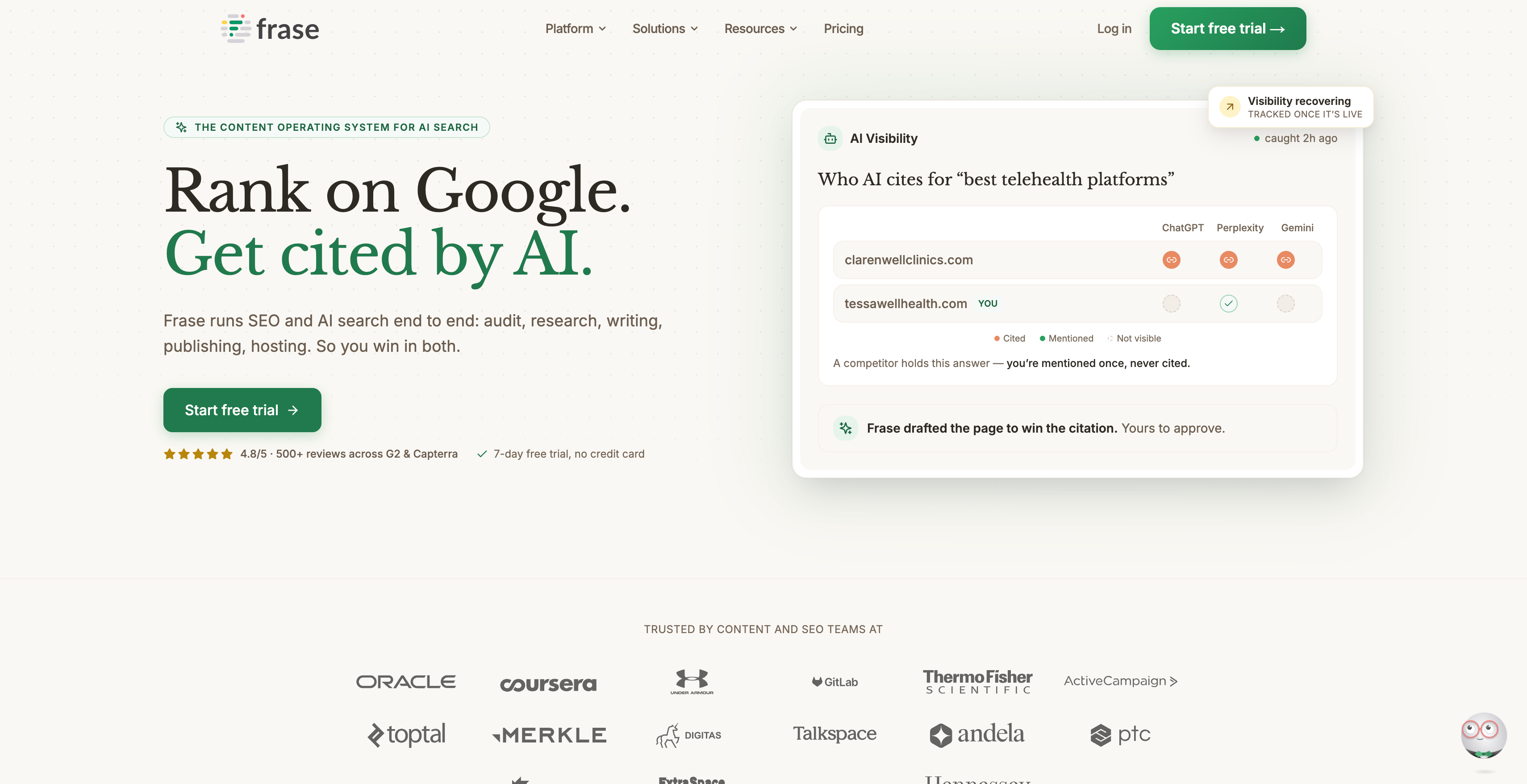
- Best for: content strategists and agencies that brief writers before drafting
- Price: from $39/mo billed yearly ($49 monthly), 7-day trial with no card (checked September 2026)
- Features: SERP analysis and outline generation, content briefs, an AI writer with 10 articles a month on Starter, CMS publishing to WordPress and other platforms, and AI visibility tracking
- Limitation: full engine coverage only on Scale. Starter tracks ChatGPT and Google AI, Perplexity starts on Professional ($103/mo yearly), and Claude and Gemini need Scale ($239/mo yearly).
- Switch from Writesonic if: your process starts with a brief, not a draft
More options in our guide to Frase alternatives.
Scalenut: best budget SEO writer with AI tracking
Scalenut is the best budget Writesonic alternative for SEO writing with some AI tracking on the same plan.
- Best for: small teams and solo SEOs who want keyword planning, writing and basic AI tracking in one tool
- Price: $59/mo billed monthly; $24/mo billed yearly under a current promotion (checked September 2026)
- Features: keyword clusters and content planning, SEO briefs and long-form writing, a content optimizer, and AI tracking for ChatGPT and Google AI Overviews (Perplexity on Professional)
- Limitation: Starter includes only 5 articles and 10 tracked prompts, and the yearly price is a promotion rather than the list price
- Switch from Writesonic if: you want SEO writing plus AI tracking at a lower monthly cost and can live with small limits
Best Writesonic alternatives for AI search visibility
These four tools replace Writesonic's AI visibility half: prompt tracking and the Action Center. They go further than Writesonic's self-serve plans on engines, diagnostics or both.
A few terms first. Query fan-out is how an AI engine splits one question into several sub-searches before it answers. An AI crawler is the bot an AI company uses to fetch pages, such as GPTBot or ClaudeBot. A content gap is a question your buyers ask AI that no page on your site answers.
Promptwatch: best for AI visibility plus content that gets cited
Promptwatch is the best Writesonic alternative for teams that want to track AI search visibility across more engines and act on it with content built to get cited.
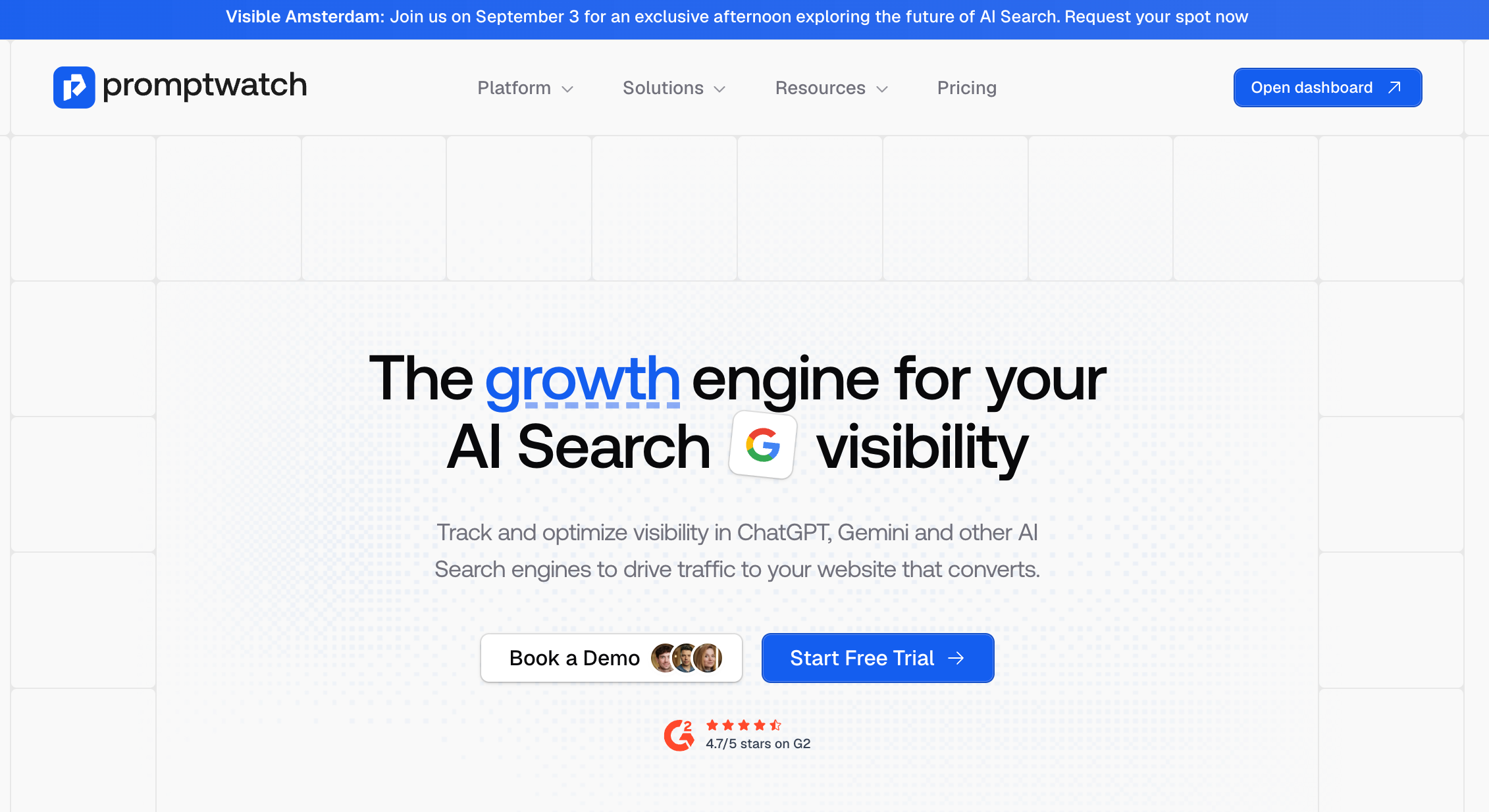
- Best for: marketing, SEO and agency teams whose buyers use Perplexity, Claude or Google AI Mode, which Writesonic tracks only on Enterprise
- Price: Essential $95/mo, Professional $245/mo, Business $579/mo, 7-day free trial (checked September 2026)
- Features: 11 AI platforms available on every plan (ChatGPT, Perplexity, Google AI Overviews and AI Mode, Claude, Gemini, Meta Llama, DeepSeek, Grok, OpenCode and Claude Code), choosing 4 at a time per project; data collected from the real interfaces users see, not only APIs; state and city-level prompt targeting on every plan; query fan-out and content gap analysis against your own site; AI crawler logs (Akamai, AWS CloudFront, Cloudflare, Fastly, Google Cloud CDN, Netlify and Vercel) that show when bots fetch a page before it gets cited; visitor analytics and conversion tracking for AI-referred traffic; Actions with an owner assigned to each item; and content agents that write AEO articles grounded in those gaps
- Limitation: content agents aren't included on Essential. AEO Articles start on Professional ($245/mo, 5 a month) and direct publishing covers Webflow and Framer, so other CMSs need an export. Writesonic ships far more articles per dollar.
- Switch from Writesonic if: you've outgrown three tracked platforms or want tracking that tells you what to write next
In practice, teams use Promptwatch to close the loop between tracking and writing. Crisp publishes 5 to 10 articles a day and checks in Promptwatch when each one gets crawled or cited; its AI-referred traffic converts at 2x its other channels. OpenUp connects Promptwatch's API to Claude while drafting, and one article built on that prompt data became the top-cited result for its target prompt.
Try it: start a 7-day free trial and compare your Writesonic baseline on the same prompts.
Peec AI
Peec AI is a simple Writesonic alternative for teams that only need to monitor prompts, with unlimited seats.
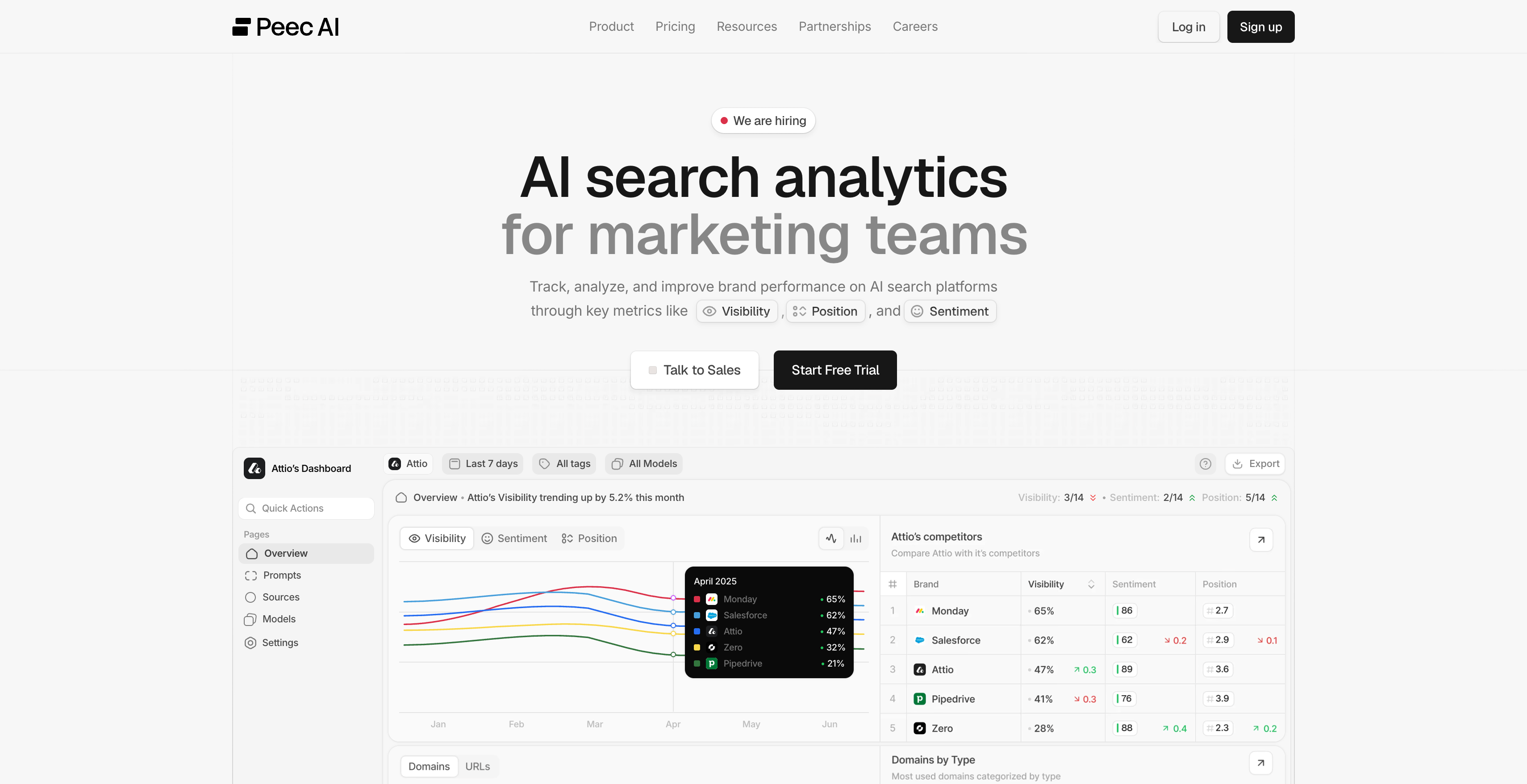
- Best for: teams that want clean AI visibility reporting without content features
- Price: about $95/mo billed monthly for Starter, with a discount for yearly billing; Peec's pricing page doesn't display prices, so confirm with the vendor
- Features: 50 prompts on Starter, 3 AI models chosen from its list, daily refresh, and unlimited users
- Limitation: 3 models on every self-serve plan, and it doesn't write content or show crawler logs
- Switch from Writesonic if: you only used Writesonic for tracking and want a focused dashboard
See how it compares with other trackers in Peec AI alternatives.
Otterly.ai
Otterly.ai is the lowest-cost Writesonic alternative for basic AI visibility monitoring.
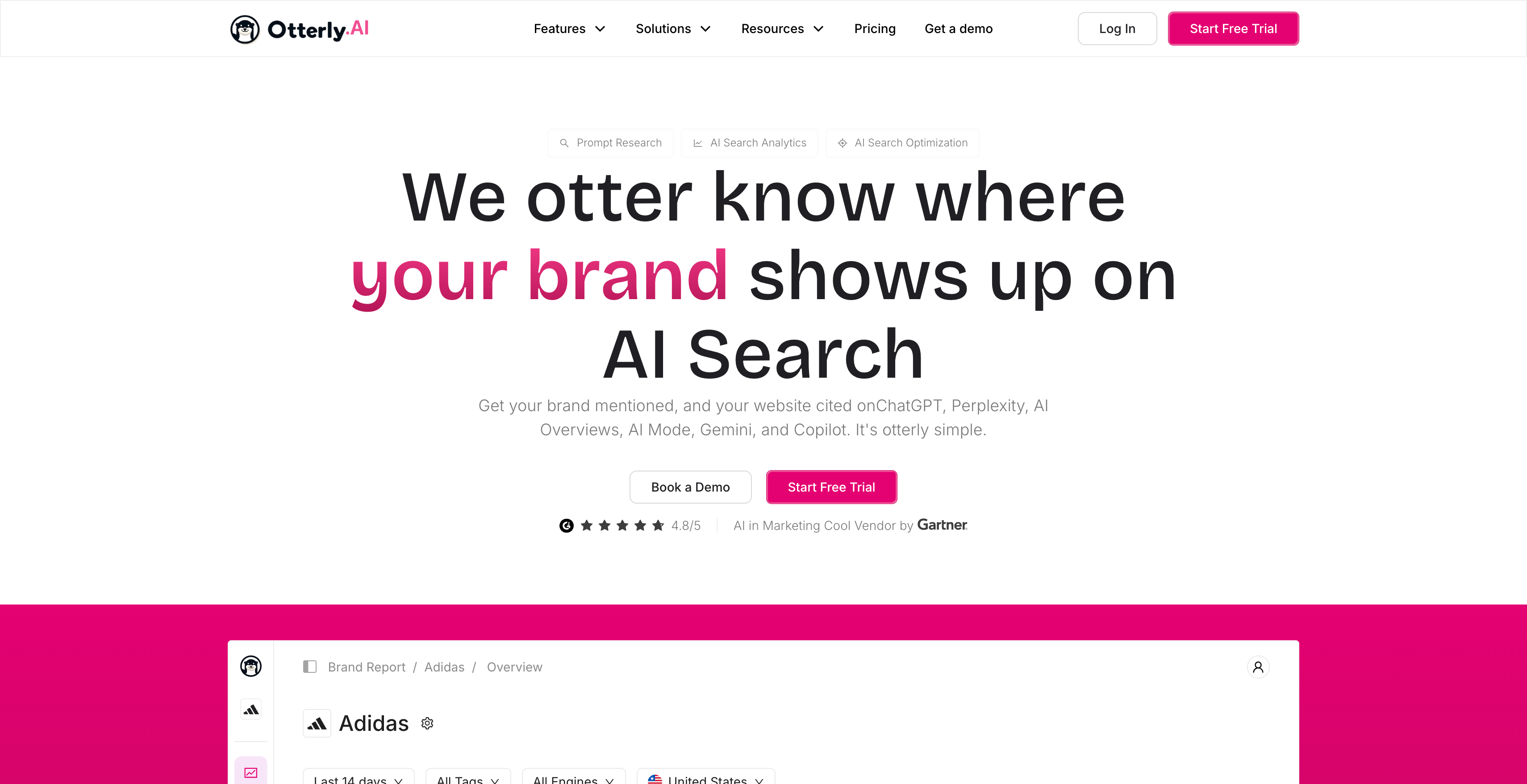
- Best for: small brands and consultants starting with AI search on a small budget
- Price: Lite from $25/mo billed yearly ($29 monthly), free trial (checked September 2026)
- Features: 15 prompts on Lite; ChatGPT, Google AI Overviews, Perplexity and Microsoft Copilot included; and unlimited team members
- Limitation: Claude, Google AI Mode and Gemini are paid add-ons, so the real price climbs with each engine
- Switch from Writesonic if: you want to track a short prompt list cheaply
More in Otterly.ai alternatives.
AirOps
AirOps is the Writesonic alternative for teams that want to build their own content pipelines and add AI visibility data on top.
- Best for: content ops teams producing and refreshing content at volume
- Price: free to start on Solo; paid tiers aren't listed publicly (checked September 2026)
- Features: a visual workflow builder that chains research, writing and publishing steps; 35,000 tasks a month on Solo; ChatGPT insights on Solo; and 7+ AI engines on Pro
- Limitation: prices beyond Solo aren't public, and usage is billed by tasks, which makes costs harder to predict
- Switch from Writesonic if: you want to automate content production rather than write article by article
More in AirOps alternatives.
When Writesonic is still the right choice
Writesonic is still the right choice for some teams, and switching isn't free. Stay if:
- You need article volume per dollar. 15 articles a month for $79/mo billed yearly is hard to beat for teams that publish often.
- You want one login for writing and basic tracking. If ChatGPT, Gemini and AI Overviews cover your buyers, the self-serve tracker may be enough.
- Your workflows already run on it. Templates, brand settings and team habits take time to rebuild.
- You're on Enterprise. With 10 tracked platforms and the full Action Center, the tracking gap mostly closes.
How to switch from Writesonic to Promptwatch without losing content or your AI baseline
Plan the move before you cancel, because nothing transfers automatically between tools.
If you're replacing the writer:
- Export your articles. Download published and draft articles, or copy them to your CMS, before your plan ends.
- Rebuild your brand voice. Paste your best-performing articles and your style guide into the new tool's brand voice or custom instructions.
- Recreate the templates you use most. Note the prompts behind your recurring formats, such as product descriptions or social posts, and save them in the new tool.
If you're replacing the tracker:
- Export your tracked prompts. Export the prompt list from Writesonic's AI visibility dashboard. History doesn't move between tools, only the prompts. In Promptwatch, you can paste the list or upload it, up to 1,000 prompts at a time.
- Keep your three platforms, then add the ones you couldn't track. Keep ChatGPT, Gemini and Google AI Overviews so your new baseline lines up with the old one, and use the extra slot for the engine you were missing, usually Perplexity or Claude.
- Widen the prompt list. Writesonic's Starter and Basic plans track only the prompts you type. Connect Google Search Console to get prompt suggestions from real search queries.
- Run both for a few weeks. Overlap the old and new tracker so you can compare numbers before you cancel.
FAQ
What is the best Writesonic alternative in 2026?
The best Writesonic alternative in 2026 depends on the job. Jasper is best for AI writing because of its brand voice controls, from $59/seat/mo billed yearly. Surfer is best for SEO content, with a SERP-based content score from $49/mo. Promptwatch is best for AI search visibility, with 11 AI platforms available from $95/mo, and it also writes articles built to get cited from $245/mo.
Writesonic vs Jasper: which is better?
Jasper is better for brand voice and team workflows, from $59/seat/mo billed yearly, with stored brand voices, knowledge assets and audiences. Writesonic is better for articles per dollar, with 15 articles a month on its $79/mo Starter plan, and it includes AI visibility tracking that Jasper doesn't offer. Pick Jasper for quality and consistency, Writesonic for volume.
What is the cheapest Writesonic alternative?
Rytr is the cheapest Writesonic alternative at $7.50/mo, with a free plan of 10,000 characters a month. You give up SEO tools such as briefs, SERP analysis and content scores, and there's no AI visibility tracking. For short drafts on a tight budget, it covers the basics of what Writesonic's writer does.
Is there a free Writesonic alternative?
Yes. Rytr has a free forever plan with 10,000 characters a month, and ChatGPT and Claude both have free tiers for drafting. For SEO or AI visibility, the options are trials rather than free plans: Frase, Otterly.ai and Promptwatch each offer a free trial, and Surfer and AirOps let you start for free.
Which Writesonic alternative is best for SEO content?
Surfer is the best Writesonic alternative for SEO content, from $49/mo billed yearly, because its Content Editor scores drafts against top-ranking pages. Frase is best for briefs and SERP research, from $39/mo billed yearly. Scalenut is the budget option at $59/mo monthly, with basic AI tracking included.
Can ChatGPT or Claude replace Writesonic?
For drafting, often yes. ChatGPT Plus and Claude Pro cost $20/mo each and write strong long-form drafts. They don't include SEO scoring, content briefs, CMS publishing or any view of how AI engines mention your brand, so teams that rely on those features still need an SEO or AI visibility tool alongside them.
Which Writesonic alternative is best for AI search visibility (GEO)?
Promptwatch is the best Writesonic alternative for AI search visibility, also called GEO. It makes 11 AI platforms available on every plan from $95/mo, tracking 4 at a time per project, compared with Writesonic's 3 platforms on self-serve plans. Content agents that write articles aimed at getting cited start on Professional at $245/mo.
Which AI platforms does Writesonic track on each plan?
Writesonic's Starter, Basic and Growth plans track three AI platforms: ChatGPT, Gemini and Google AI Overviews. Enterprise tracks 10 platforms, including Perplexity, Claude and Google AI Mode. The Action Center, which suggests fixes, isn't on Starter or Basic and is limited to 10 actions a month on Growth.


