


Both tools track where your brand shows up in AI answers. That's where the similarity ends.
Peec AI is built for teams that need to monitor AI visibility and report on it clearly.
Promptwatch is built for teams that want to know why they're aren't being mentioned in AI responses and how to fix it.
Those are different jobs. One is a monitoring job. The other is an improvement job. The right tool depends on which one you're actually trying to do.
Quick Overview
| Promptwatch | Peec AI | |
|---|---|---|
| Best for | Teams actively improving AI visibility | Teams monitoring and reporting on AI visibility |
| AI platforms tracked | 11 available, 4 tracked per project (Agency plans: all 11) | 3 of 6 (Starter–Advanced); more on Enterprise (not Grok) |
| Citation analysis | Yes, in-depth | Yes, core metrics |
| Sentiment tracking | Yes, by platform and prompt type | Yes, overall score |
| Crawler logs | Yes, from Professional plan | No |
| Content gap analysis | Yes, higher tiers | No |
| Content creation | Yes, higher tiers | No |
| Page-level AI analysis (360 Insights) | Yes | No |
| Unlimited users | No, by plan tier | Yes, all plans |
| Brand entry price | $95/mo | $95/mo |
How Both Tools Handle AI Visibility
Both Promptwatch and Peec track where your brand appears in AI answers, how you compare to competitors, and how things change over time. Here's how they compare on each feature.
Prompt Tracking
This is where both tools start: which prompts trigger a mention of your brand, and which ones hand the answer to a competitor.
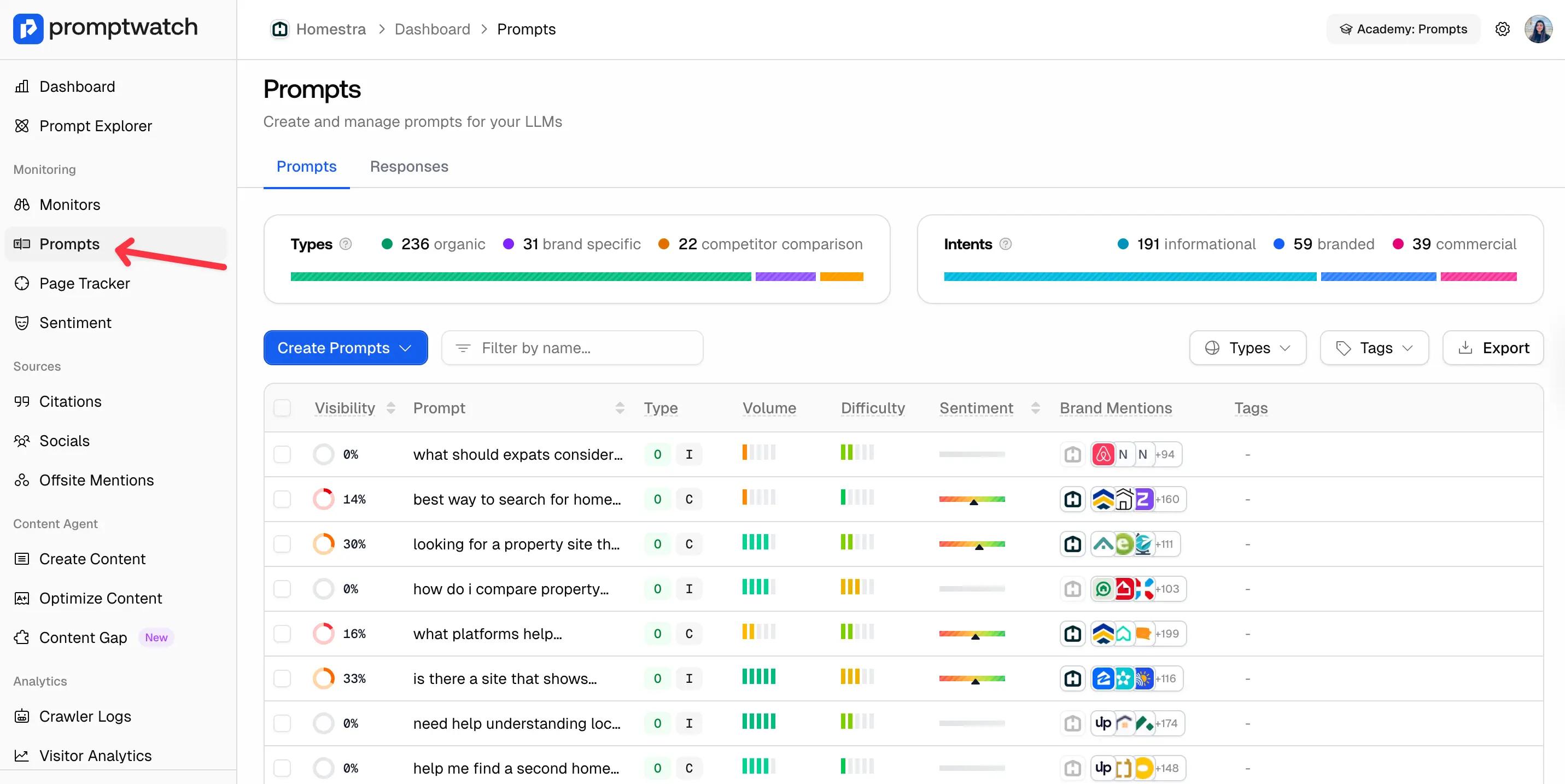
Promptwatch tracks each prompt across your 4 selected AI platforms (chosen from all 11 supported) at the same time. For every prompt you can see your visibility score, how much search volume it gets, how competitive it is, and which competitors show up in answers where you don't.
You also see the full AI response, so you know exactly how your brand is being described or ignored.
See the full breakdown on our prompt tracking feature page.
For example, you track the prompt "best CRM for small teams." Promptwatch shows you that you appear on ChatGPT at 40% visibility but only 12% on Perplexity, and that two competitors consistently outrank you on Google AI Overviews. That's three different problems on three different platforms, visible in one view.
Peec's search query overview is designed with simplicity in mind. Each query is listed in a table that includes key metrics: visibility, sentiment score, average position, mentions on AI platforms, and estimated volume.
Less data to interpret, faster to set up, and easier to share with people who aren't deep in GEO: a CMO, a client, a leadership team who just need to know if things are improving.
One practical difference in platform coverage:Promptwatch gives you access to all 11 AI platforms at $95/mo, choosing 4 to actively track per project. Peec's Starter, Pro, and Advanced plans cap you at 3 models chosen from a pool of six. If you're already tracking ChatGPT, Google AI Overviews, and Perplexity, that's your full allocation — Claude, DeepSeek, Qwen, and Mistral only unlock on Peec's Enterprise plan, and Grok isn't offered by Peec at any tier.
Competitor Analysis
Both tools show you how your brand compares to competitors in AI answers. The difference is in what angle they take.
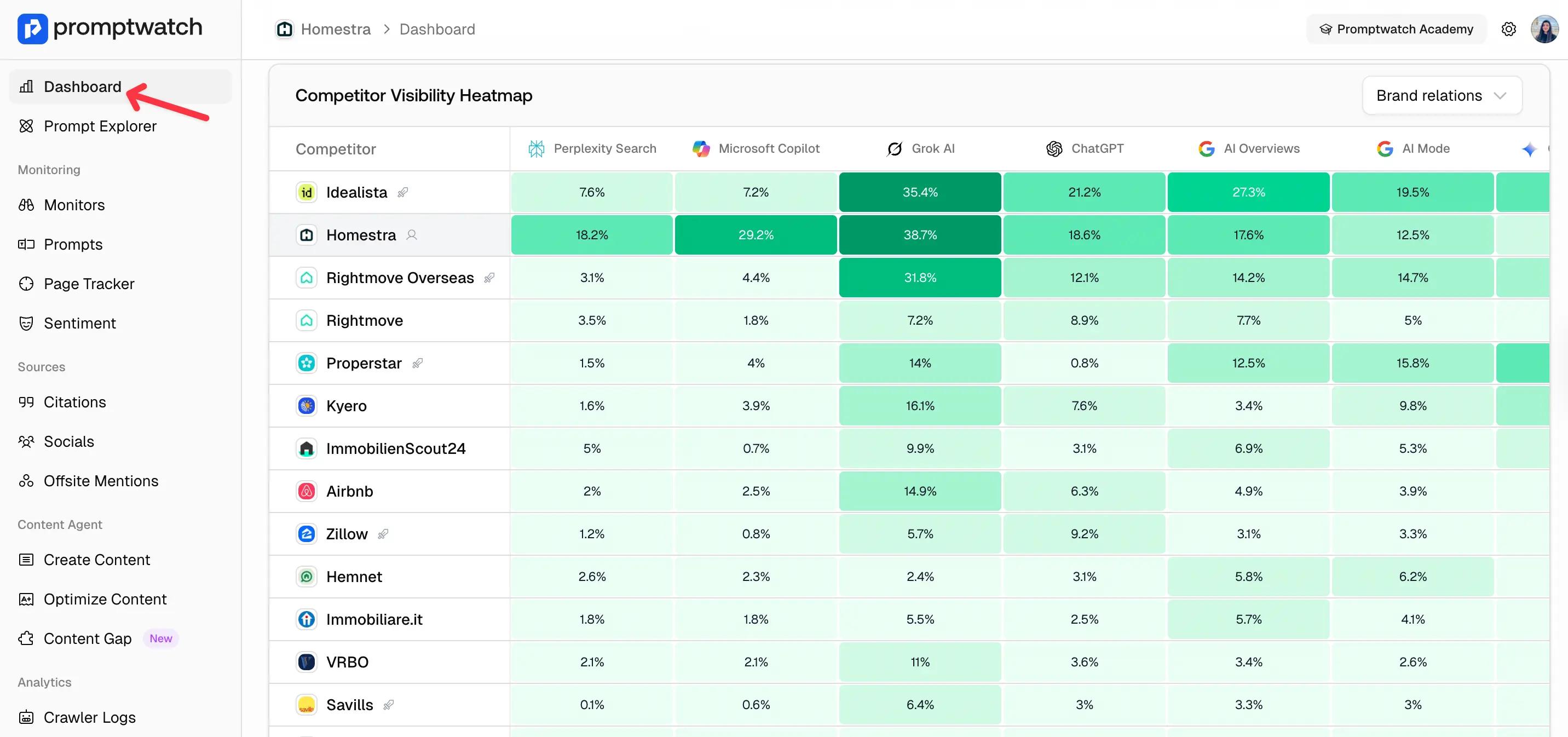
Promptwatch breaks competitor visibility down by platform. You can see a competitor at 35% on Grok, 21% on ChatGPT, and 27% on AI Overviews (all in one view). That tells you exactly where you're losing ground and where to focus first.
For example, you notice a competitor is dominant on Perplexity but weak on ChatGPT. Your buyers use both. That split tells you which platform to prioritise and where you actually have a realistic chance to close the gap faster.
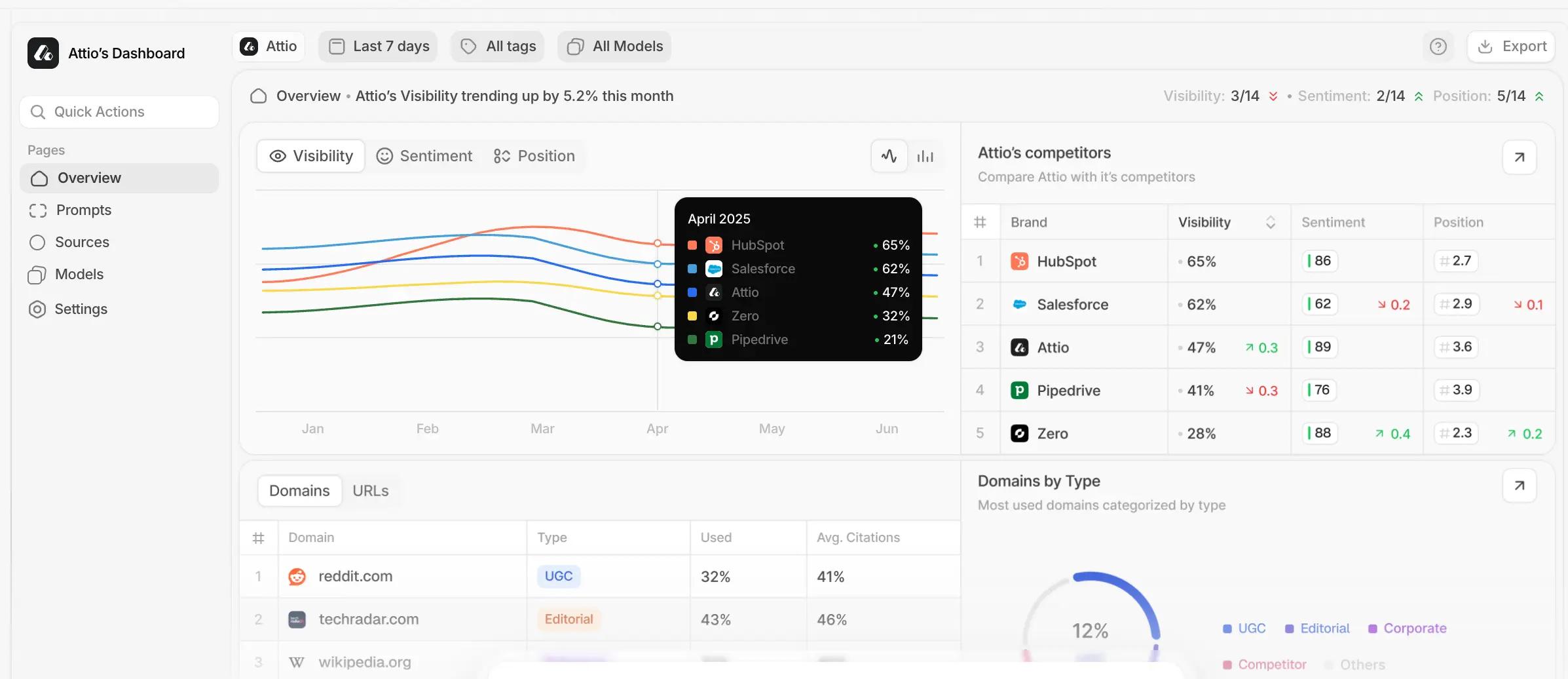
Peec shows visibility, sentiment, and position scores per competitor with trend lines over time. You can see how the gap has shifted across months. Useful for proving whether your content efforts are actually working.
Citation Analysis
Both tools show you which sources AI is citing in your category. The difference is in how much you can do with that data.
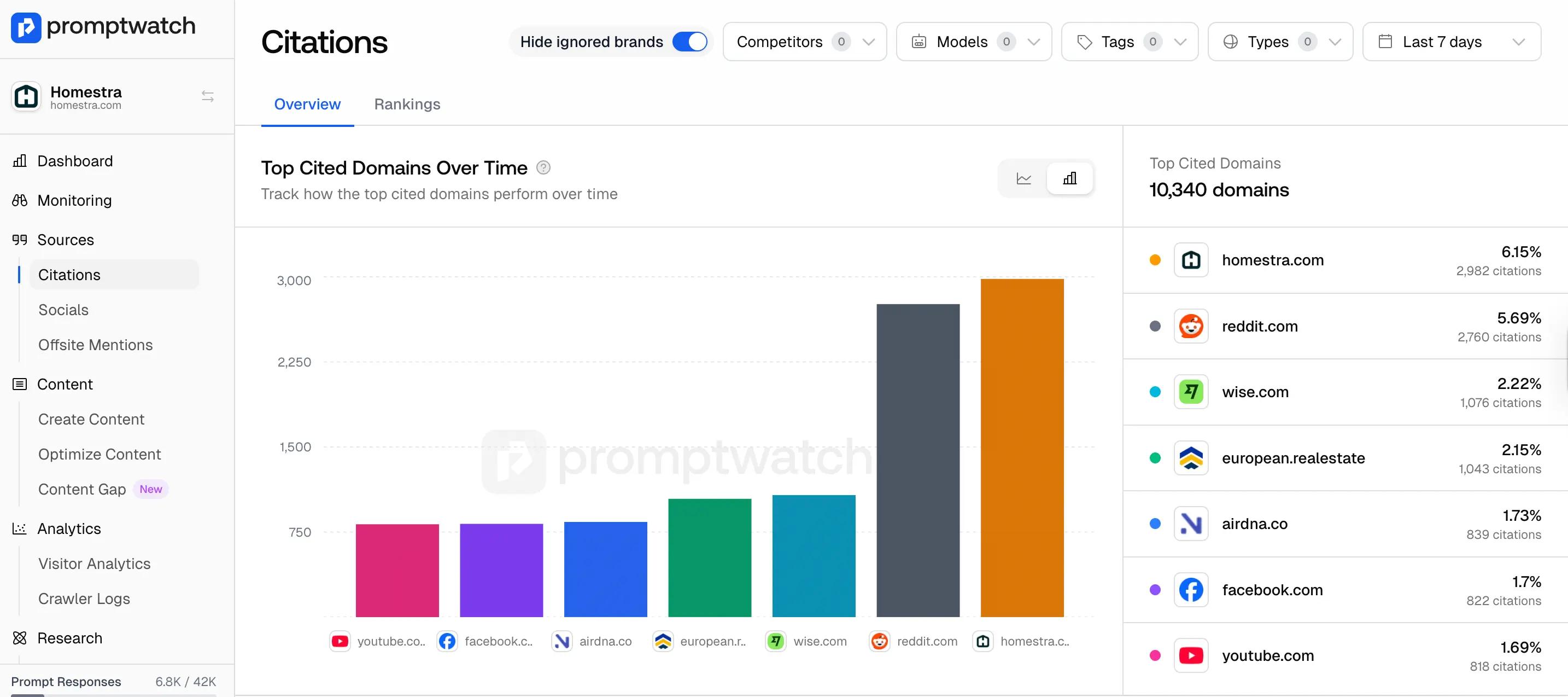
Promptwatch shows you the top-cited domains over time with citation counts, trend direction, and percentage share. You can see that reddit.com accounts for 5.6% of citations in your category, that a competitor domain is at 5.9% and trending down, and that a third domain just entered the top results.
Below the domain view, you get the specific URLs being cited, each one with its source type, content type, and which AI model cited it. You can search by URL and filter by source type, content type, and model.
For example: you see a competitor domain at 5.9% of citations. You click into it and find that one specific listicle is driving almost all of those citations. That's the page to analyze and compete with, not the domain as a whole.
Peec also shows citation data at both domain and URL level with citation frequency and trends. The difference is in the depth of analysis around each citation.
Promptwatch layers in source type classification, content type, model-level filtering, and Reddit Insights at the community level, showing which specific subreddits and posts AI is pulling from in your category, not just Reddit as a domain.
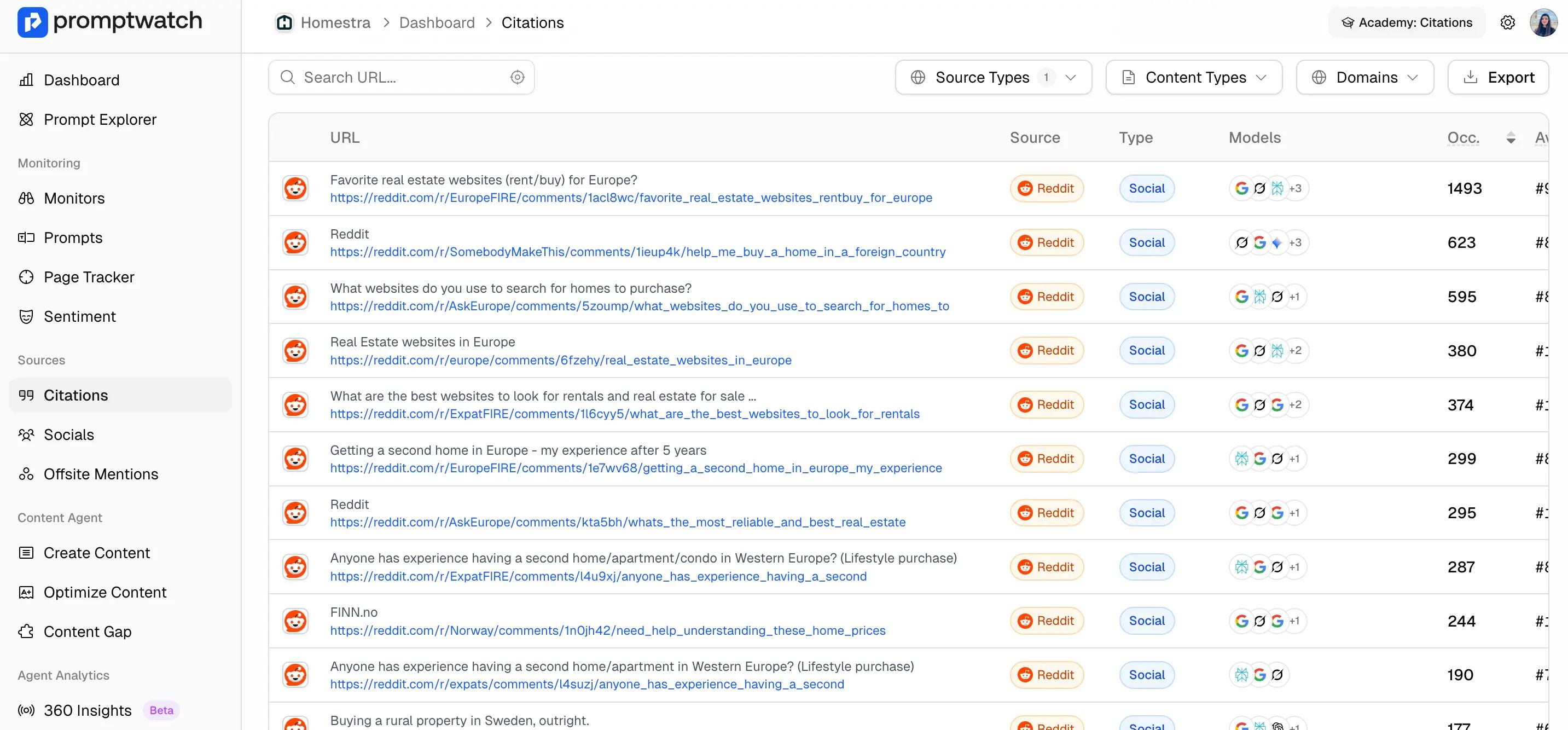
Both tools show citations. Promptwatch gives you more filters, more context per citation, and community-level Reddit data.
Sentiment Analysis
Both tools track how AI talks about your brand, not just whether you appear, but whether the mention is positive, neutral, or negative.
Promptwatch breaks this down by platform and by prompt type. You might find that ChatGPT frames your brand positively on organic queries but neutrally on competitor comparisons. That's a specific signal: it tells you which content to improve and on which platform.
For example, your sentiment on brand queries is strong, but on "X vs Y" comparison prompts you're consistently framed as the more expensive option. That tells you exactly what your content needs to address.
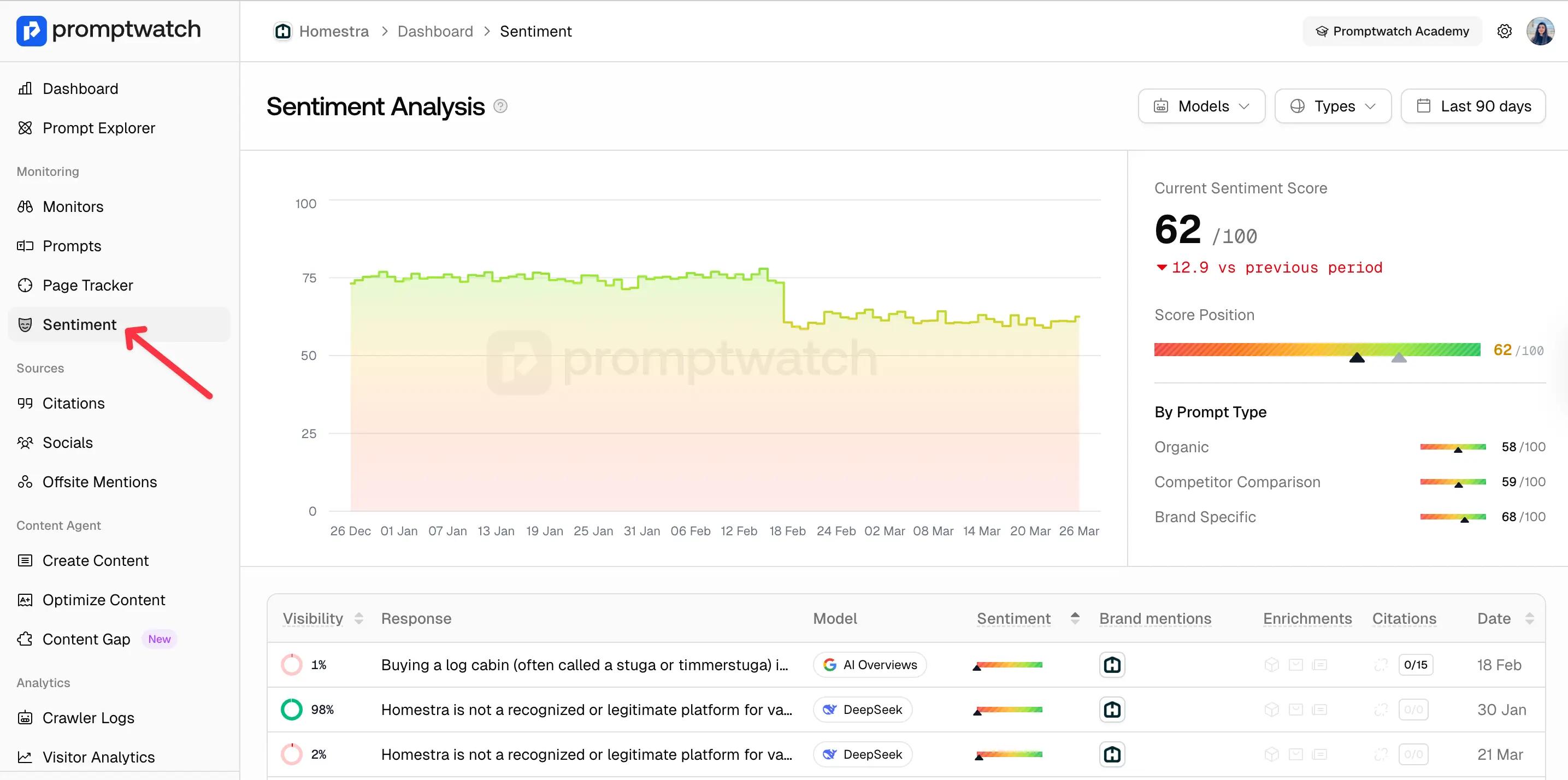
Peec AI shows sentiment as one of its three main dashboard metrics alongside visibility and position. It's a clean read, easy to track over time and easy to present to a CMO or client who doesn't need the full breakdown.
Where Promptwatch Goes Further
The features above are ones both tools cover, just differently. These are features Peec AI doesn't have at any price tier.
Crawler Logs
Most SEO teams focus on content and never think about whether AI can actually read it. This is where a lot of citation gaps come from.
AI crawlers (GPTBot, PerplexityBot, ClaudeBot, Googlebot for AI Overviews) don't show up in Google Analytics. They visit your pages, decide whether to cite them, and leave no trace in your standard reports. Our data shows that 1 in 4 websites gets daily visits from AI crawlers. Most teams have no idea it's happening.
Also, CDN security settings (Cloudflare, Vercel, AWS) can silently block AI crawlers before they reach your server. If that's happening, your content strategy can't fix it.
For example, you improve three pages targeting high-priority prompts. Your citations don't move. The reason turns out to be that GPTBot has been blocked by a Cloudflare rule for several months. Without crawler logs, you'd keep optimising content that AI was never reading.
Promptwatch connects directly to your CDN and captures every AI crawler visit. You can see which bots are visiting, which pages they're reading, and whether any requests are being stopped.
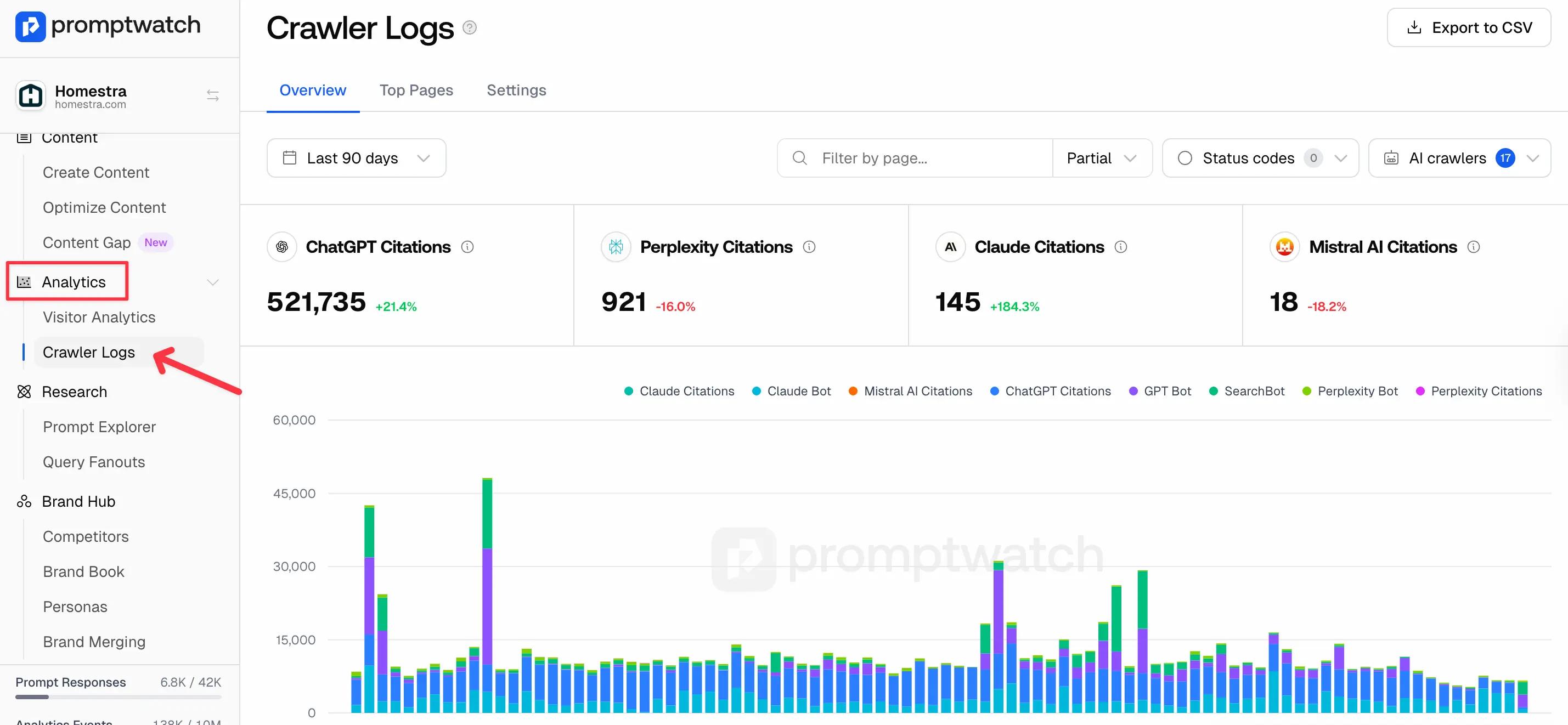
Full details are on our AI crawler logs feature page.
Content Gap Analysis and Content Creation
Knowing you're missing citations is step one. Knowing what to build to fix it is step two. Most tools stop at step one.
Promptwatch's Content Gap Analysis shows how well your existing content covers the prompts your buyers are actually using.
You get a coverage score broken down by prompt type (organic queries, brand-specific searches, competitor comparisons) so you can see exactly where your content is leaving citations on the table.
For example, your organic prompt coverage sits at 50% and your competitor comparison coverage at 43%. That means for nearly half the prompts where buyers are comparing tools in your category, you have no content that matches. Those are the exact prompts where competitors get cited instead of you.
Once the analysis surfaces what's missing, Promptwatch's content creation and optimisation features let you act on it directly: generating new content built around those gaps, or improving existing pages so AI can extract and use them.
That workflow runs through our content agent feature.
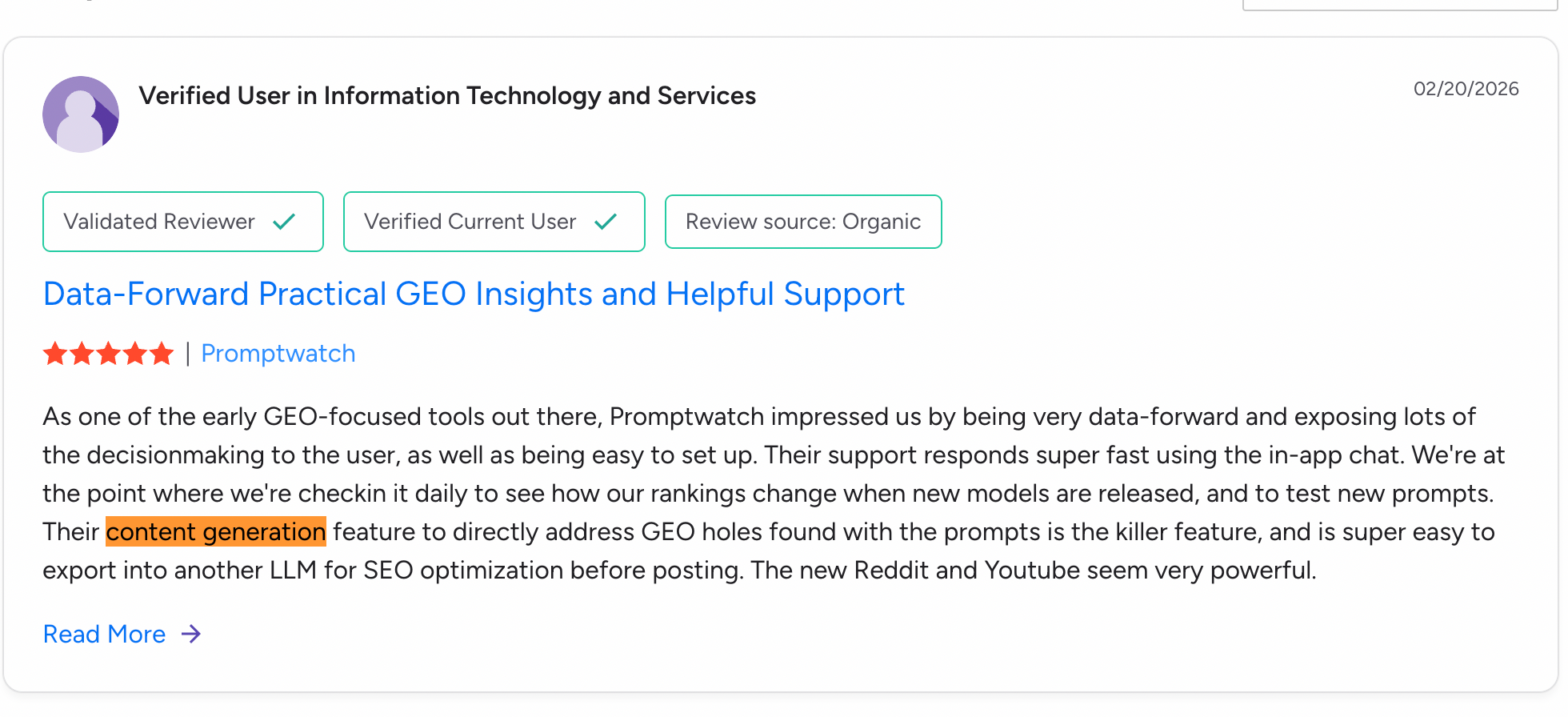
Here's what a G2 reviewer said after using the full workflow:
360 Insights
The 360 Dashboard is a new feature on Promptwatch and gives you a unified view of how AI is actually interacting with your site.
You have four core metrics: active pages, your AI crawl to citation click ratio, total AI crawls, and citation clicks. The crawl to citation ratio is the one to watch. It tells you how well your crawled pages are actually converting into citations.
A low ratio means AI is visiting your pages but not using them, which points to a content quality or relevance problem, not a crawl access problem.
Then, you get a trend view of AI crawls and citation clicks over time. That chart tells you whether your visibility is growing, declining, or stalling and whether crawl activity and citation activity are moving together or drifting apart.
From there, you can see which pages are getting the most AI traffic, which prompts are driving citations to each page, and how each page benchmarks against underperforming ones on your site.
The whole dashboard is built around one question: which pages are earning citations, which ones aren't, and why.
Pricing
Both platforms price differently for brands and agencies. Here's the brand comparison first.
| Promptwatch | Peec AI (brands) | |
|---|---|---|
| Entry | $95/mo | $95/mo |
| Mid | $245/mo | $245/mo |
| Higher | $579/mo | $495/mo |
| All AI platforms | Yes (4 tracked/project on Brands; Agency plans track all 11 at once) | Enterprise only (3 of 6 on self-serve) |
| Unlimited users | By tier | All plans |
| Free Trial | 7 days | 7 days |
For brands, the entry price is identical: $95/mo. Both give you 50 prompts and daily tracking. The difference is in what you get beyond the basics.
Promptwatch includes access to all 11 AI platforms from day one, choosing 4 to actively track per project. Peec's Starter caps you at 3 models from a pool of six; Claude, DeepSeek, Qwen, and Mistral are Enterprise-only, and Grok isn't offered by Peec at any tier. Peec includes unlimited users on every plan. Promptwatch limits users by tier.
As you move up, Promptwatch adds deeper analysis and optimization features: content creation, content gap analysis, and crawler logs. Peec's higher plans add more prompts and projects but stay focused on monitoring and reporting.
For Agencies
Both platforms also run separate, named pricing tracks for agencies managing multiple clients and the two structures diverge more here than they do on the Brands side.
| Promptwatch (agencies) | Peec AI (agencies) | |
|---|---|---|
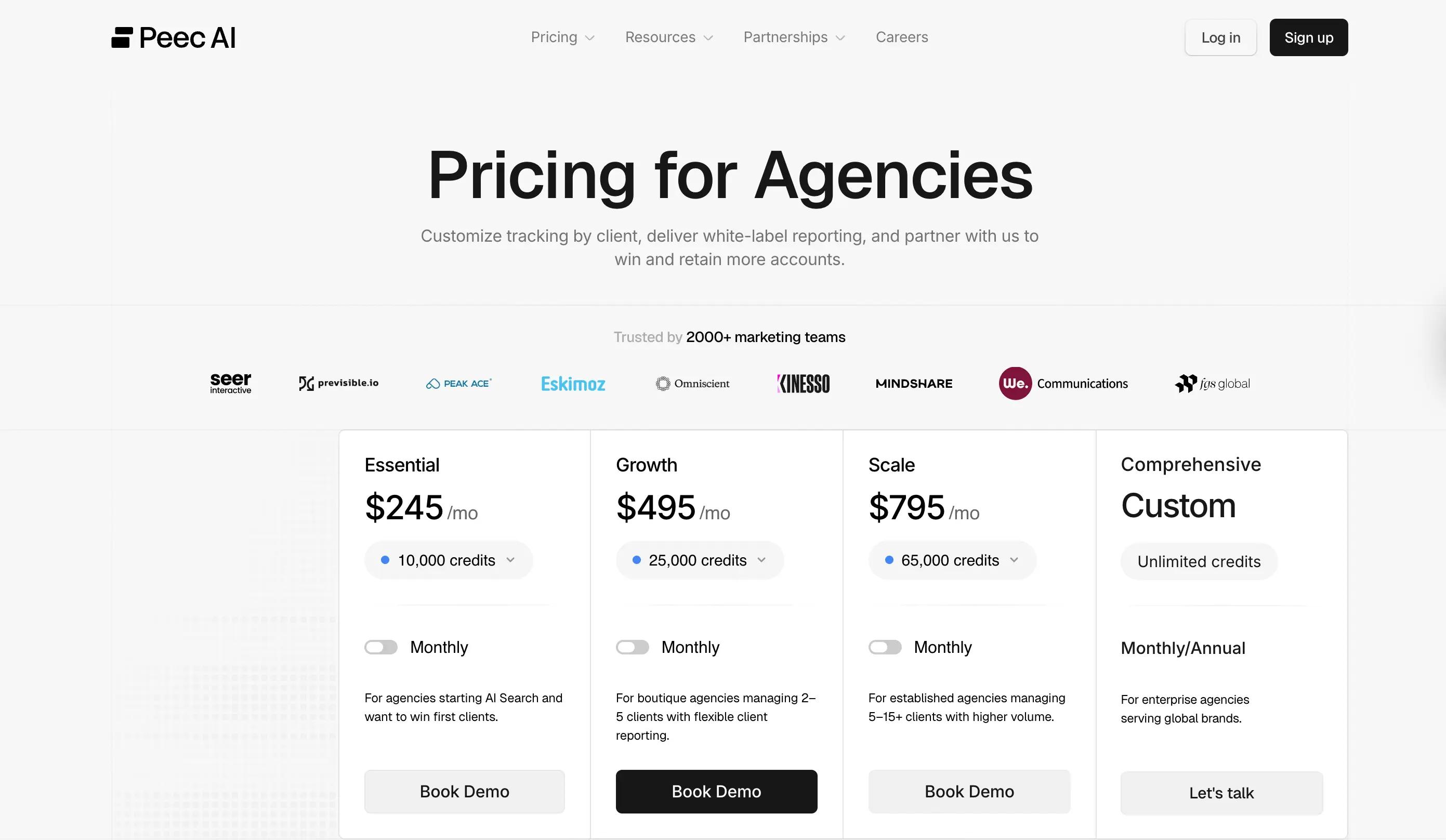
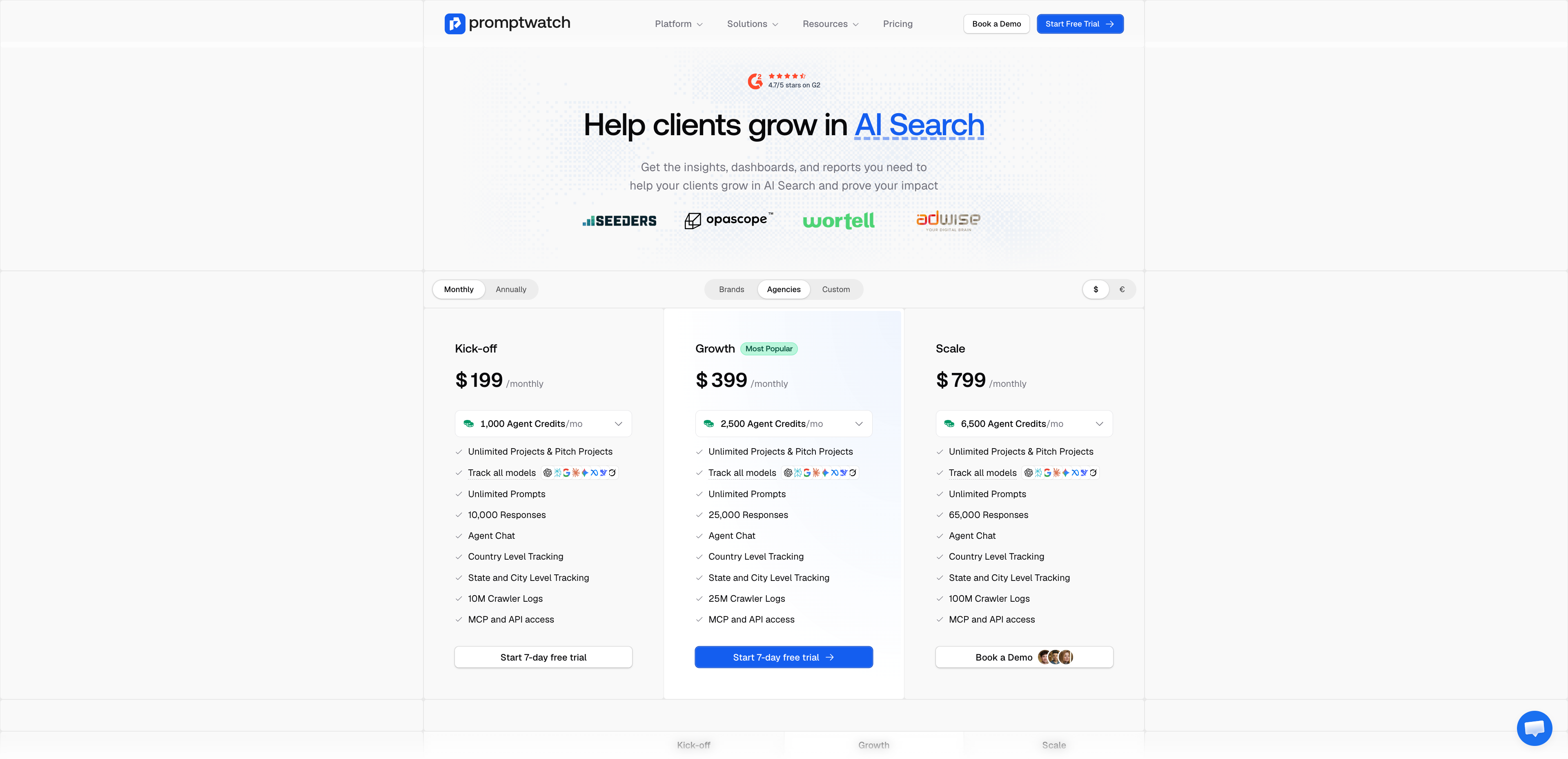
| Entry | Kick-off, $199/mo | Essential, $245/mo |
| Mid | Growth, $399/mo | Growth, $495/mo |
| Higher | Scale, $799/mo | Scale, $795/mo |
| Prompts | Unlimited, every tier | Capped, scales by tier (credit-based) |
| Client & pitch projects | Unlimited, every tier | Capped, scales by tier |
| AI platforms tracked | All 11, every tier, no per-model add-on | Limited selection; more unlocked on higher tiers |
Peec also runs a separate, named agency structure, Essential, Growth, and Scale priced from $245/mo up to $795/mo on a credit-based model, with prompts, client projects, and model access all scaling by tier.
Promptwatch's agency plans are named Kick-off ($199/mo), Growth ($399/mo), and Scale ($799/mo), cheaper than Peec's agency tiers at entry and mid, and within $4/mo at the top. All three remove the caps that apply to Promptwatch's own Brands plans: unlimited prompts, unlimited client and pitch projects, and all 11 AI platforms tracked at once instead of 4 per project.
If monitoring and reporting is all you need, Peec gives you solid value: unlimited users and clean dashboards at a similar entry price. If you need deeper analysis and optimization, that's Promptwatch's mid and higher tiers — and for agencies specifically, Promptwatch's named tiers match or beat Peec's agency pricing while dropping the per-project model cap.
Which One Is Right for Your Team
Choose Peec if:
- Your main goal is to monitor AI visibility and report it to stakeholders
- You need clean dashboards that your whole team can read without a learning curve
- Multiple people across your organisation need access and you don't want per-seat limits
- You're earlier in your GEO journey and want to understand the landscape before taking action
Choose Promptwatch if:
- The goal is to go beyond monitoring and actively close citation gaps
- Knowing whether AI crawlers can reach your pages matters to you and you're on a mid or higher plan
- Deeper citation analysis with source type, content type, and model-level filtering is important
- Reddit Insights at the community level is a priority, not just domain-level tracking
- You're an agency that wants unlimited prompts, unlimited client projects, and every AI platform tracked at once, without paying extra per model
- Tracking all 11 supported AI platforms without paying extra per model at any price tier is important
If AI visibility is becoming a real acquisition channel for your team (not just a metric you report on), Promptwatch gives you what you need to act on it.
Still comparing options? See our roundup of the best AEO platforms for how Promptwatch and Peec AI stack up against Profound, Athena HQ, and Scrunch AI.
FAQs
Is Promptwatch better than Peec AI?
It depends on what you need. Promptwatch covers more: all 11 AI platforms available on every plan (4 tracked per project, or all 11 at once on Agency plans), deeper citation analysis with source type and model-level filtering, Reddit Insights at the community level, content gap analysis, and content creation on higher tiers. Peec is cleaner, faster to use, and includes unlimited users on every plan. For teams actively improving AI visibility, Promptwatch is the more complete platform. For teams focused on monitoring and reporting, Peec is a good choice.
Which tool is better for agencies?
Both have dedicated agency pricing. Promptwatch's agency tiers run Kick-off ($199/mo), Growth ($399/mo), and Scale ($799/mo), each with unlimited prompts, unlimited client and pitch projects, and all 11 AI platforms tracked at once. Peec's agency tiers run Essential ($245/mo) to Scale ($795/mo) on a credit-based structure with prompts and client projects capped by tier. Promptwatch is cheaper at the entry and mid tiers and roughly at parity at the top, without the per-project model cap that applies to its own Brands plans.
Does Peec AI track AI crawler activity?
No. Peec doesn't have crawler logs. If you need to know whether AI bots are reaching your pages or whether your CDN is blocking them, you need Promptwatch's Professional plan or higher, which includes crawler log integration with Cloudflare, Vercel, AWS, and other CDNs.
Does Peec AI have content gap analysis?
No. Peec shows how your existing content is performing but doesn't identify specific gaps or help you fill them. That workflow happens outside the platform. Promptwatch's content gap analysis and content creation features are available on higher tiers.


