


TL;DR: Best Otterly.ai Alternatives
Promptwatch matches Otterly's Lite entry point closely enough to compare directly, but includes all 11 tracked AI platforms to choose from on every plan, crawler logs, and a Content Agent that publishes to your CMS, none of which Otterly offers at any tier. Peec AI is the cleanest dashboard in the category, at the cost of a permanent three-engine cap. Trakkr removes Otterly's add-on problem entirely with all 8 models flat-priced on every plan. LLM Pulse is the strongest European budget option, with five core models from 49 euro a month. Qwairy covers 10 or more engines with no per-provider surcharge. Searchable bundles visibility tracking with content generation and technical audits. AthenaHQ is the enterprise upgrade path once a single tool needs to tie AI visibility to revenue.
Quick Comparison Table
| Tool | Best For | AI Engines on the Base Plan | Starting Price |
|---|---|---|---|
| Otterly.ai | Lean teams that want the lowest possible entry price | 4, Gemini/AI Mode/Claude are paid add-ons | $29/mo |
| Promptwatch | Teams that need execution, not just monitoring | 4 of 11, freely chosen, including Claude and Grok at no extra cost | $95/mo |
| Peec AI | Clean, fast monitoring with the tidiest UI in the category | 3 of 6 to 7, Claude and DeepSeek are Enterprise-only | $95/mo |
| Trakkr | Teams that never want to price an engine add-on again | 8, all included on every plan | $100/mo |
| LLM Pulse | Budget-conscious European teams | 5 | 49 euro/mo (roughly $53) |
| Qwairy | Broad engine coverage without per-engine surcharges | 10+ | roughly 59 to 79 euro/mo, credit-based |
| Searchable | Teams that want visibility tracking bundled with content generation | 3, Claude and others require a custom Enterprise tier | $125/mo |
| AthenaHQ | Teams that need AI visibility joined to revenue attribution | 8, including Claude and Grok, on every tier | $295/mo (credit-based) |
Why Look for Otterly.ai Alternatives?
Four reasons teams look elsewhere come up repeatedly in reviews and buyer discussion.
- The $29 headline doesn't include the engines most teams actually need. Lite, Standard, and Premium all share the same four core engines. Google Gemini, Google AI Mode, and Claude are priced separately as add-ons, running roughly $9 to $149 a month each depending on plan tier. Price all three add-ons on the Premium plan and the realistic monthly cost can approach $787, a very different number from the $29 headline.
- The jump from Lite to Standard is a cliff, not a step. Lite caps at 15 tracked prompts with no rollover. The next tier up, Standard, costs $189 a month, more than six times the Lite price, for 100 prompts. There is no plan in between, so the moment 15 prompts stops being enough, the bill changes character all at once.
- API and MCP access don't arrive until Standard. Teams that want to pull Otterly's data into their own BI stack or an agent workflow need to be on the $189 tier before that's possible at all.
- It monitors. It doesn't act. Otterly tracks brand mentions, sentiment, and rankings, but it has no AI crawler log product, no content generation, and no CMS publishing. Reviewers describe a consistent pattern: solid diagnosis, no treatment. Teams whose bottleneck is production rather than measurement find they've bought the dashboard and still need the execution layer.
How We Evaluated These Alternatives
Every tool was assessed against one question: does it help a team change how AI models talk about their brand, or only observe it?
- Real engine coverage on the base plan, not the marketing page's full list. Otterly's add-on structure is the single biggest gotcha a buyer coming from its $29 plan needs priced out before comparing anything else.
- Total realistic monthly cost. Including per-engine add-ons, credit burn, and the tier where API or MCP access actually unlocks, since headline prices in this category routinely understate the real bill.
- Whether the tool acts on its own data. Does it produce an instruction (update this page, fix this crawl error, publish this draft), or does it stop at a dashboard the way Otterly does?
- Where the technical access tier sits. Since Otterly gates API and MCP behind a 6x price jump, this guide checks where each alternative places that same gate.
The 7 Best Otterly.ai Alternatives
Ranked by overall fit for teams that want to change AI visibility, not just watch it move. Each solves a different part of the job Otterly leaves undone.
1. Promptwatch: Best Overall Otterly.ai Alternative
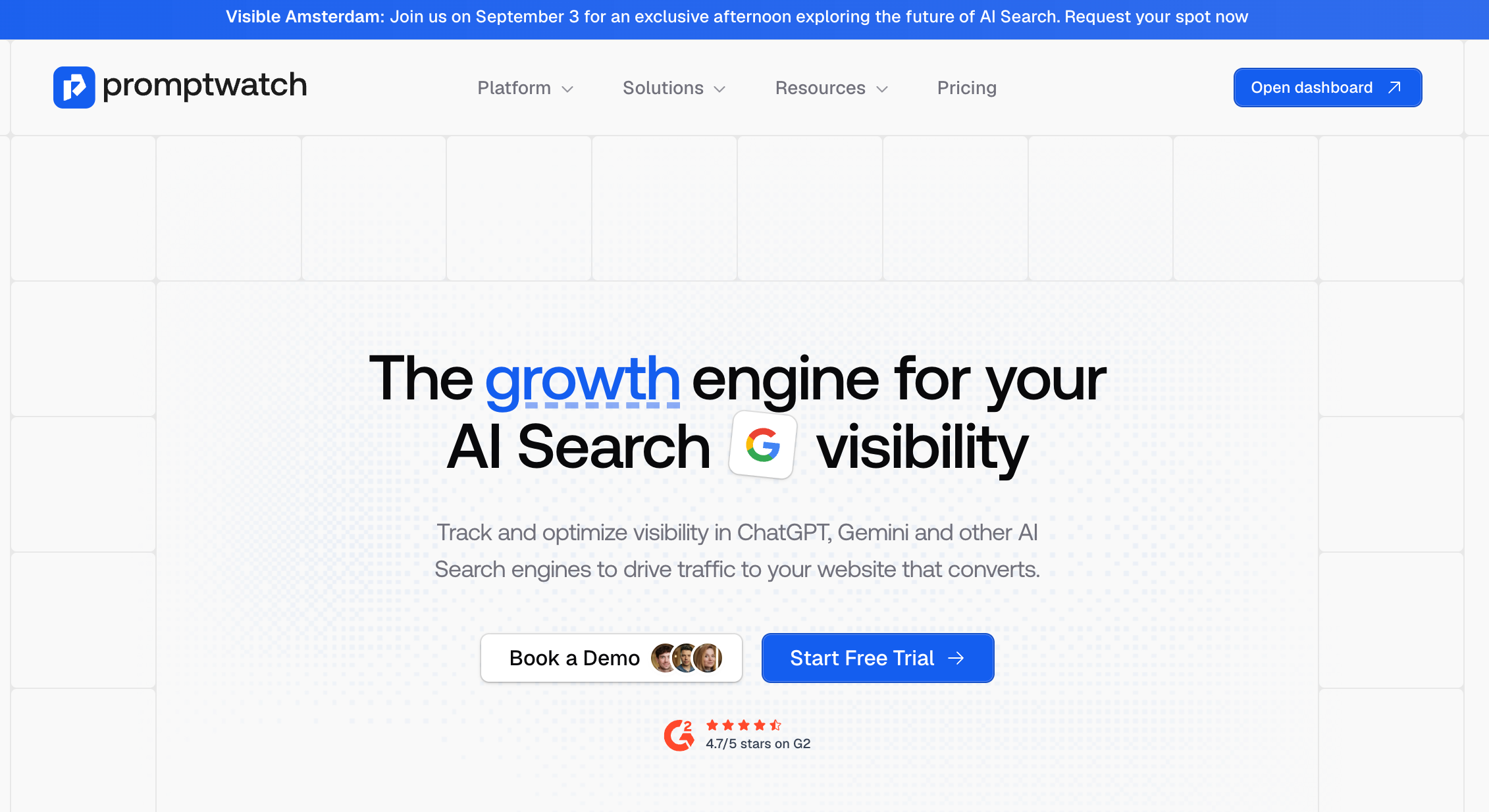
Promptwatch's Essential plan costs more than Otterly's Lite plan on paper, $95 versus $29, but the comparison is closer than the sticker suggests once Otterly's real cost is priced out. At $95, Promptwatch gives access to all 11 tracked AI platforms including Claude and Grok, with 4 selected per project at no extra charge. Matching that coverage on Otterly means paying for the Gemini, Google AI Mode, and Claude add-ons on top of the base price, which can add well over $100 a month before you've touched a second feature.
Key features
- 11 AI platforms available on every plan, including the $95 entry tier, ChatGPT, Perplexity, Google AI Overviews, Google AI Mode, Claude, Gemini, Meta Llama, DeepSeek, Grok, OpenCode, and Claude Code, with 4 tracked per project at a time. This is a per-project selection, not a coverage ceiling, so switching which 4 you track costs nothing.
- Real UI scraping, so visibility reflects what a user actually sees, not an API approximation.
- AI crawler log analysis through direct CDN integrations (Akamai, AWS CloudFront, Cloudflare, Fastly, Google Cloud CDN, Netlify and Vercel), showing the elapsed time between a bot fetching a page and an engine quoting it, a product category Otterly does not have at any tier.
- Visitor analytics and conversion tracking for AI-referred human traffic, kept separate from crawler activity, so you see both what AI can read and what actually converts.
- Content Agent that drafts AI-optimized content grounded in your own citation and content-gap data, and publishes to Webflow or Framer with a review inbox in between.
- Content gap analysis measured against your own indexed site, not a generic keyword gap.
- Actions and Agent Chat: Actions turns visibility data into prioritized next steps, each assignable to a team member as owner, and Agent Chat lets you ask about performance and act on the answer in one conversation.
- Prompt tracking with volumes, difficulty scoring, and query fan-out, refreshed daily.
- State and city-level prompt targeting on every plan, including Essential, useful for any brand where "best dentist near me" or "plumber in Chicago" answers change city by city.
- API and MCP access included on every paid plan, no tier gate to clear.
More than 1,780 brands and agencies run on Promptwatch, including Center Parcs, SIX Group, and Landytech, and it holds a 4.7/5 rating on G2.
Promptwatch has: all 11 tracked platforms selectable at the entry price, AI crawler log analysis, a Content Agent that publishes to Webflow or Framer, REST API and MCP on every paid plan, and prompt difficulty scoring.
Otterly.ai doesn't: entry-plan coverage beyond 4 core engines, with Gemini, AI Mode, and Claude priced as separate add-ons; API or MCP access before the $189 Standard tier; a crawler-log product; or any content generation and publishing, it's monitoring only.
Pros
- All 11 engines are selectable at the entry price, where matching coverage on Otterly means stacking three separate add-ons
- API and MCP ship on the entry plan, where Otterly reserves them for a tier 6x the price of Lite
- Crawler logs and a CMS-publishing Content Agent, two product layers Otterly doesn't have at any tier
Cons
- Seats are metered (1, 2, and 5 by tier), where Otterly includes unlimited team members on every plan
- Otterly's $29 Lite plan still wins on raw price for a team that only needs 15 prompts and has no interest in crawler data or content generation
- Microsoft Copilot, one of Otterly's four core engines on Lite, isn't in the Promptwatch catalogue
- Crawler logs start on Professional ($245/mo), not on the $95 Essential plan
Verdict
- Best for: Teams that hit Otterly's add-on wall, or that need the crawler-to-citation and content-execution layers Otterly doesn't have at any price.
- Why it wins: The real cost gap narrows once Otterly's add-ons are priced in, and Promptwatch adds two full product layers, crawler logs and content publishing, that Otterly doesn't offer at all.
2. Peec AI
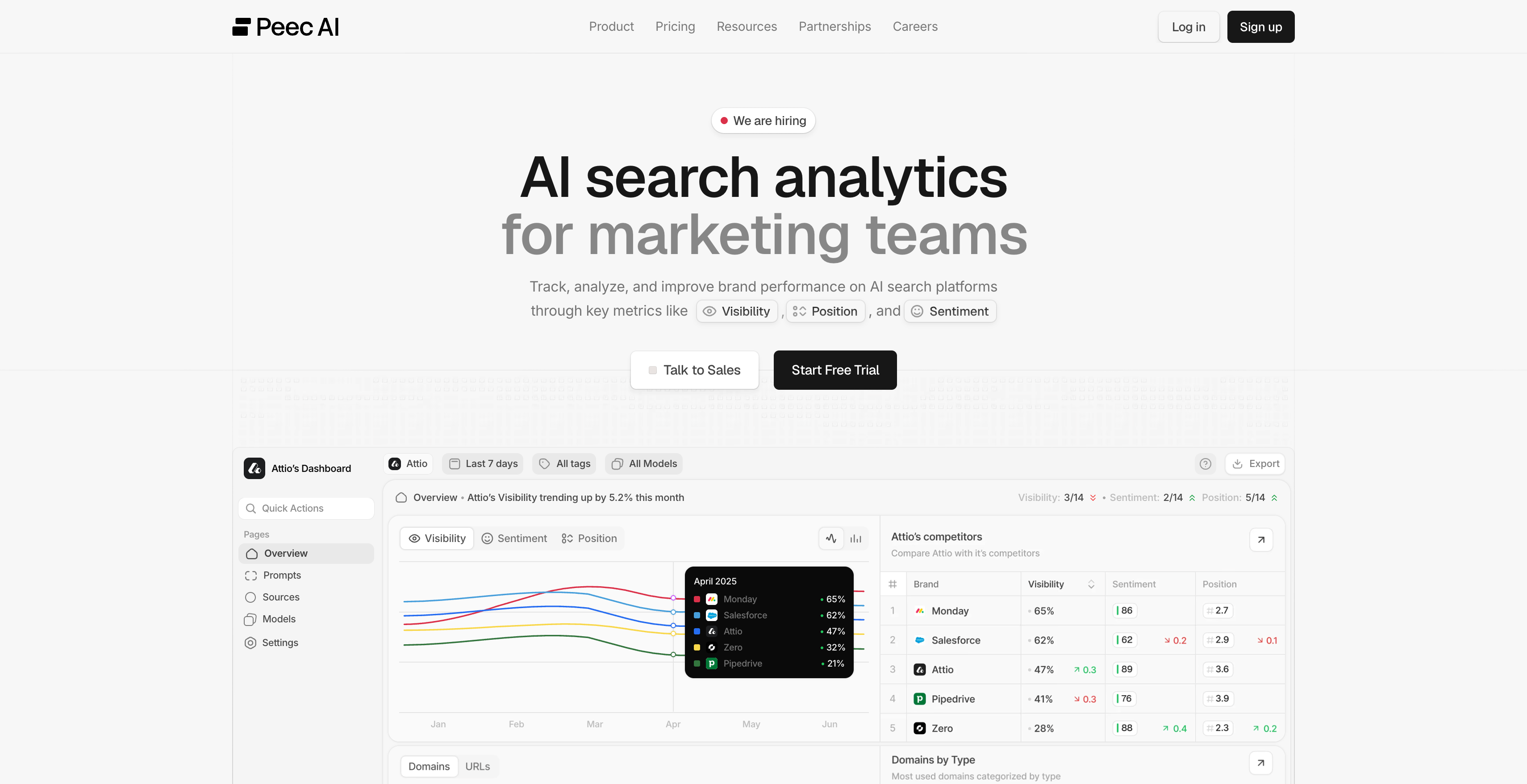
Peec AI is the tool most often mentioned in the same breath as Otterly, and for good reason: both are self-serve, both publish pricing openly, and both start with a hard cap on how many engines you get. Peec's cap is three, chosen from a pool of six to seven engines depending on the source, and it holds at every self-serve tier.
Key features
- Starter at $95/mo (50 prompts), Pro at $245/mo (150 prompts), Advanced at $495/mo (350 prompts), each letting you choose 3 engines from a pool that includes ChatGPT, Google AI Mode, Google AI Overviews, Microsoft Copilot, Perplexity, and Gemini.
- Claude and DeepSeek are Enterprise-only, not available as an add-on on any self-serve tier.
- A native MCP server, an early and genuine strength for the category.
- Daily refresh, unlimited seats, and a 7-day free trial, no credit card required.
Promptwatch has: the full 11-platform catalogue selectable at the entry price, REST API on every paid plan, and a Content Agent that publishes to your CMS.
Peec AI doesn't: more than 3 engines on any self-serve tier (from a pool of 6 to 7, with Claude and DeepSeek Enterprise-only), REST API below Enterprise, or any content generation or crawler-log product.
Verdict
- Best for: Teams that want the tidiest possible UI and already have a content and execution layer elsewhere.
- Why it loses the top spot: Same entry price as Promptwatch, fewer engines, no API below Enterprise, and no path to Claude without an Enterprise contract.
3. Trakkr
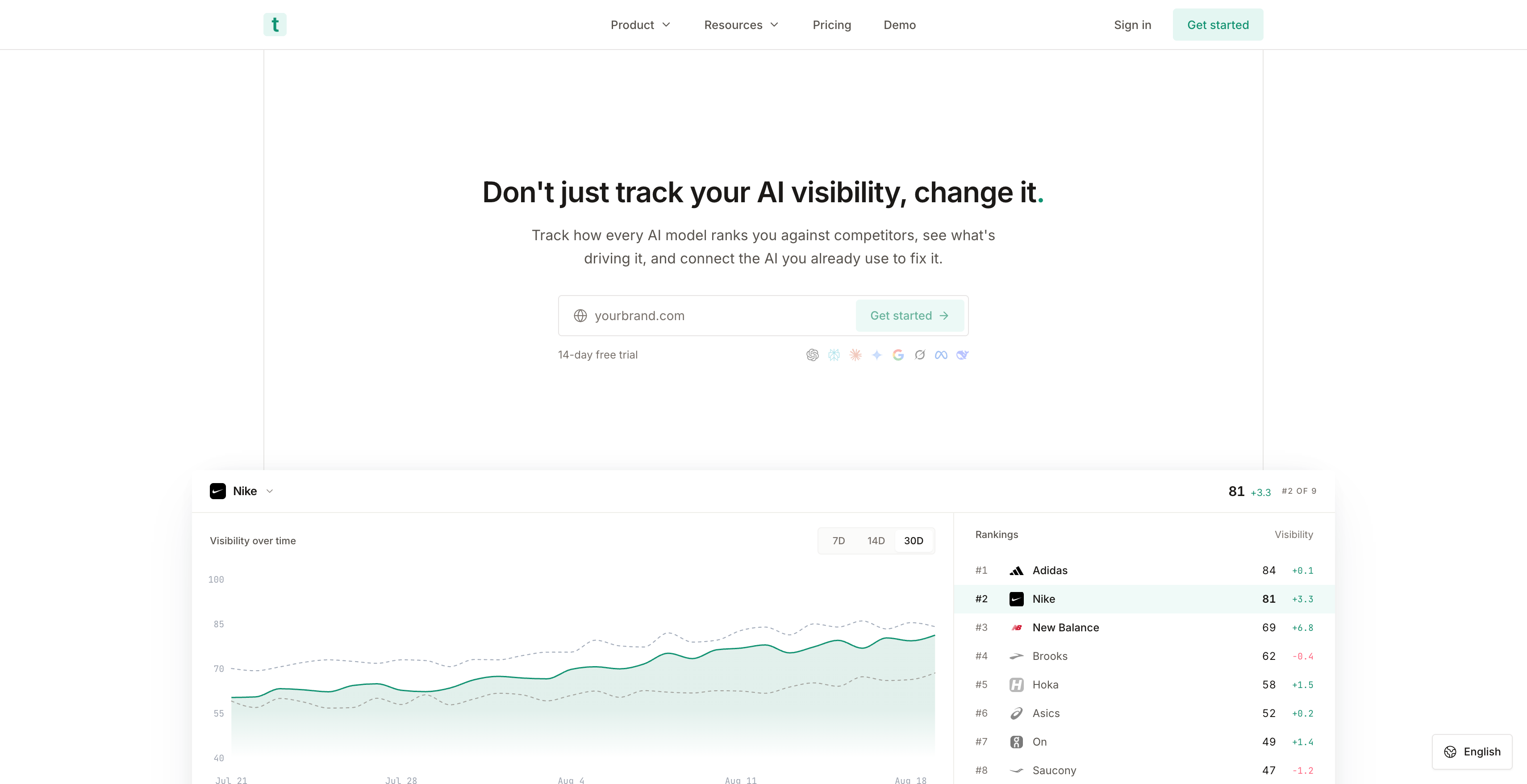
Trakkr takes the opposite approach to both Otterly and Peec: instead of a low headline price with per-engine add-ons, it prices all 8 major models into every plan and calls that the whole story. Its own pricing page lists Growth at $100/mo and Scale at $500/mo as the two self-serve tiers, though a separate Trakkr blog post elsewhere on its own site references a $49 Starter plan; the two pages don't agree, so confirm current tiering directly before budgeting.
Key features
- 8 AI models on every paid plan (ChatGPT, Claude, Gemini, Perplexity, and 4 more), with no per-model add-on at any tier.
- Reddit intelligence and a stated "actions, not dashboards" philosophy, weekly recommendations rather than charts alone.
- Full white-label agency support with client portals.
- 14-day free trial on every plan.
Promptwatch has: a Content Agent that publishes to Webflow or Framer, content gap analysis against your own indexed site, Reddit and YouTube citation feeds together, and one consistent published price.
Trakkr doesn't: any published claim of content generation or publishing, a YouTube citation feed to sit alongside Reddit, and its own pricing pages disagree with each other on the entry tier.
Verdict
- Best for: Teams that specifically want to stop calculating engine add-ons and are comfortable with a monitoring-and-recommendations tool.
- Why it loses the top spot: Strong on flat pricing and Reddit signal, but nothing in its public materials suggests it closes the loop into published content the way Promptwatch's Content Agent does.
4. LLM Pulse
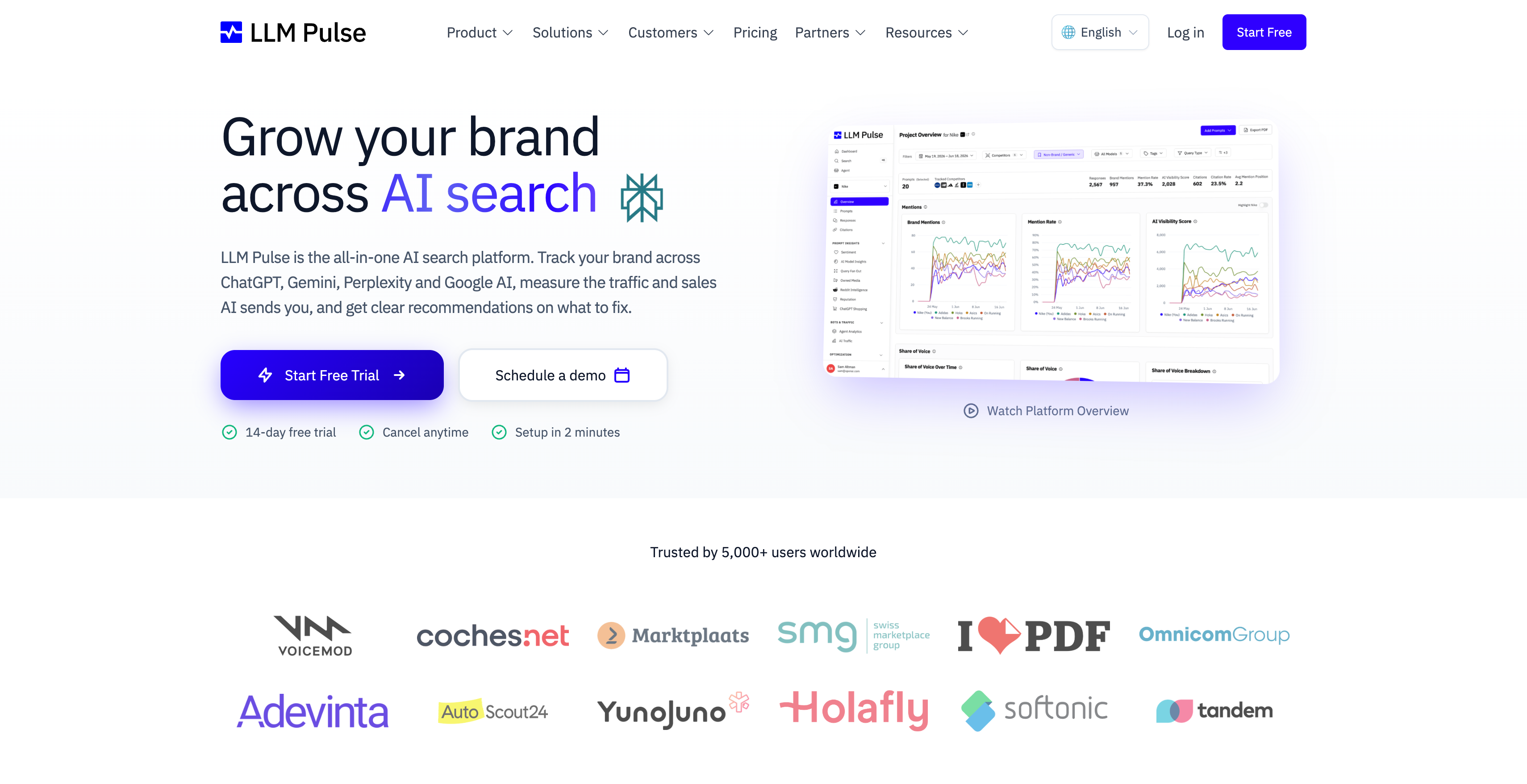
LLM Pulse publishes one of the more transparent pricing ladders in the category, in euros, and undercuts most rivals on a per-model basis at the entry tier.
Key features
- Starter at 49 euro/mo with 5 core models (ChatGPT, Perplexity, Gemini, Google AI Mode, Google AI Overviews) included on every plan. Sources differ on the exact prompt cap at this tier, either 40 or 50 prompts depending on the page checked, so verify the current number before signing up.
- Growth at 99 euro/mo adds sentiment, AI traffic analytics, and a "GEO Writer" content tool, plus white-label client portals, unusually early in the pricing ladder for this category.
- MCP server included on every plan, though raw REST API keys don't unlock until the 299 euro Scale tier.
- Claude, Copilot, Grok, DeepSeek, and Meta AI are available as paid add-ons rather than included in the core five.
Promptwatch has: REST API on the entry-level paid plan, AI crawler log analysis, and a Content Agent that publishes directly to your CMS.
LLM Pulse doesn't: raw API access below its 299 euro Scale tier, any published crawler-log product, or a confirmed direct-to-CMS publishing step, GEO Writer generates content but doesn't document what happens after that.
Verdict
- Best for: Budget-conscious European teams that want five core models and a real MCP connection without an Enterprise conversation.
- Why it loses the top spot: Strong per-euro value, but the API gate and the missing crawler-log layer are the same structural gaps that push teams off Otterly in the first place.
5. Qwairy
Qwairy attacks the add-on problem from a different angle than Trakkr: rather than a flat price for a fixed 8 models, it offers 10 or more engines on a credit-based plan with no per-provider surcharge.
Key features
- 10+ AI models tracked, including ChatGPT, Claude, Perplexity, Gemini, Copilot, Grok, AI Overviews, AI Mode, Mistral, and DeepSeek, with no per-model add-on.
- Five-module workflow: Visibility, Insights, Strategy, Technical, Analytics.
- Content Studio producing briefs in 45-plus languages.
- Credit-based pricing, roughly 59 to 79 euro a month at entry.
Promptwatch has: prompt volume and difficulty scoring, a Content Agent that drafts and publishes to your CMS, and fixed published pricing rather than credit metering.
Qwairy doesn't: any prompt volume or difficulty data, a publishing step beyond a brief, or flat, predictable pricing.
Verdict
- Best for: Teams that want the widest engine list without pricing out add-ons, and are comfortable with credit-based billing.
- Why it loses the top spot: Genuinely wide engine coverage, but content still ends at a brief rather than a published page, and credit billing is harder to plan against than a fixed monthly number.
6. Searchable
Searchable's own pricing page now lists a $125/mo entry point, materially higher than the roughly $50 figure that circulates in older comparison pages, so this is worth pricing against Otterly with current numbers rather than dated ones.
Key features
- $125/mo entry tier: 100 prompts across ChatGPT, Google AI Overviews, and Perplexity, with 9,000 AI answers analyzed monthly, unlimited domains, 20 articles a month, and 200 site audits.
- Mid tier: 500 prompts, 45,000-plus AI answers analyzed, 80 articles a month, white-label reports.
- Custom Enterprise tier: Claude, Microsoft Copilot, Grok, and DeepSeek are only available here, alongside API access and an SLA.
- AI-optimized content generation and technical site audits bundled into the same product as visibility tracking.
Promptwatch has: all 11 platforms selectable at the entry price, AI crawler log analysis, and REST API plus MCP on a self-serve plan.
Searchable doesn't: more than 3 engines below its custom Enterprise tier, any published crawler-log product, or self-serve API access.
Verdict
- Best for: Teams that want tracking and content generation in one subscription and don't need Claude coverage below Enterprise.
- Why it loses the top spot: No longer the budget option its older reputation suggests, and the same engine and API gates that push teams off Otterly show up here too, just at a higher price.
7. AthenaHQ
AthenaHQ is the clearest upgrade path for a team that outgrows Otterly's scope entirely, at roughly ten times Otterly's Lite price.
Key features
- Self-Serve at $295/mo, 3,600 credits (1 credit equals 1 AI response), with all 8 major engines including Claude and Grok included from day one, no add-ons.
- Revenue attribution through GA4 and Shopify, joining AI visibility to actual conversion data.
- Unlimited seats and unlimited topics tracked, bounded only by credit usage.
- ACE Citation Engine, persona targeting, multi-region tracking, and BI integrations are Enterprise-only, not available on Self-Serve at any price.
Promptwatch has: an MCP server, REST API on a self-serve plan, state and city-level prompt targeting on every plan, and fixed, predictable monthly pricing.
AthenaHQ doesn't: an MCP server at any published tier, self-serve API access, multi-region tracking below Enterprise, or flat pricing, Self-Serve is credit-metered.
Verdict
- Best for: Teams whose main blocker with Otterly was proving revenue impact, not prompt coverage.
- Why it loses the top spot: Full engine coverage and genuine attribution, but the credit model and Enterprise-gated API and MCP recreate a different version of the access problem teams are trying to leave behind.
How to Switch From Otterly.ai to Promptwatch Without Losing Your Baseline
Export your prompt list and engine add-on spend before you cancel. What moves is the prompt list, not the history, there's no direct connector between the two platforms. Export your tracked prompts from Otterly, and while you're in the account, note exactly which paid add-ons (Gemini, Google AI Mode, Claude) are active and at what price, since that add-on spend is the real number to compare against Promptwatch's flat entry price, not the $29 headline. In Promptwatch, paste the prompt list in when setting up your first project, up to 1,000 at a time, and rebuild your competitor set manually since that doesn't carry over either.
FAQ
Why do people look for Otterly.ai alternatives?
Four reasons come up repeatedly: the four core engines on every tier leave Gemini, Google AI Mode, and Claude as separate paid add-ons that can push real cost well past the $29 headline; the jump from the 15-prompt Lite plan to the 100-prompt Standard plan is a 6x price increase with nothing in between; API and MCP access don't unlock until that same $189 Standard tier; and the platform monitors without executing, no crawler logs, no content generation, no CMS publishing.
Is Promptwatch a good Otterly.ai alternative?
Yes, particularly for teams that have already priced out Otterly's add-ons and found the real number closer to $95 to $150 a month than $29. At that point, Promptwatch's $95 Essential plan includes all 11 platforms to choose from, crawler logs, and a Content Agent that publishes to Webflow or Framer, none of which Otterly offers even on its $489 Premium tier. The trade-off is metered seats where Otterly offers unlimited users on every plan.

