

TL;DR
- AI search visibility for a law firm is whether ChatGPT, Gemini, Perplexity, and Google AI Overviews name your firm when someone asks a legal question, not whether your website ranks for a keyword.
- Because "best divorce lawyer in Chicago" and "best divorce lawyer in Denver" pull entirely different AI answers, a single national visibility score hides exactly where a firm is winning or losing.
- Promptwatch tracks AI visibility at the city and state level on every plan, scrapes the real ChatGPT and Gemini interfaces rather than just their APIs, and separates AI crawler activity from AI-referred human traffic.
- Persona Stacking lets a firm run the same tracked prompts from a specific audience's perspective (a car-accident victim versus a corporate GC vetting counsel, for example), so visibility doesn't get averaged across clients who don't ask AI the same way.
What "AI Search Visibility" Actually Means for a Law Firm
When someone asks ChatGPT or Google "who's a good personal injury lawyer near me," the model doesn't rank ten blue links. It reads across directories, review sites, news coverage, and the firm's own site, then either names a firm in its answer or leaves it out entirely. AI search visibility is the measure of how often, and how favorably, that naming happens for a given firm.
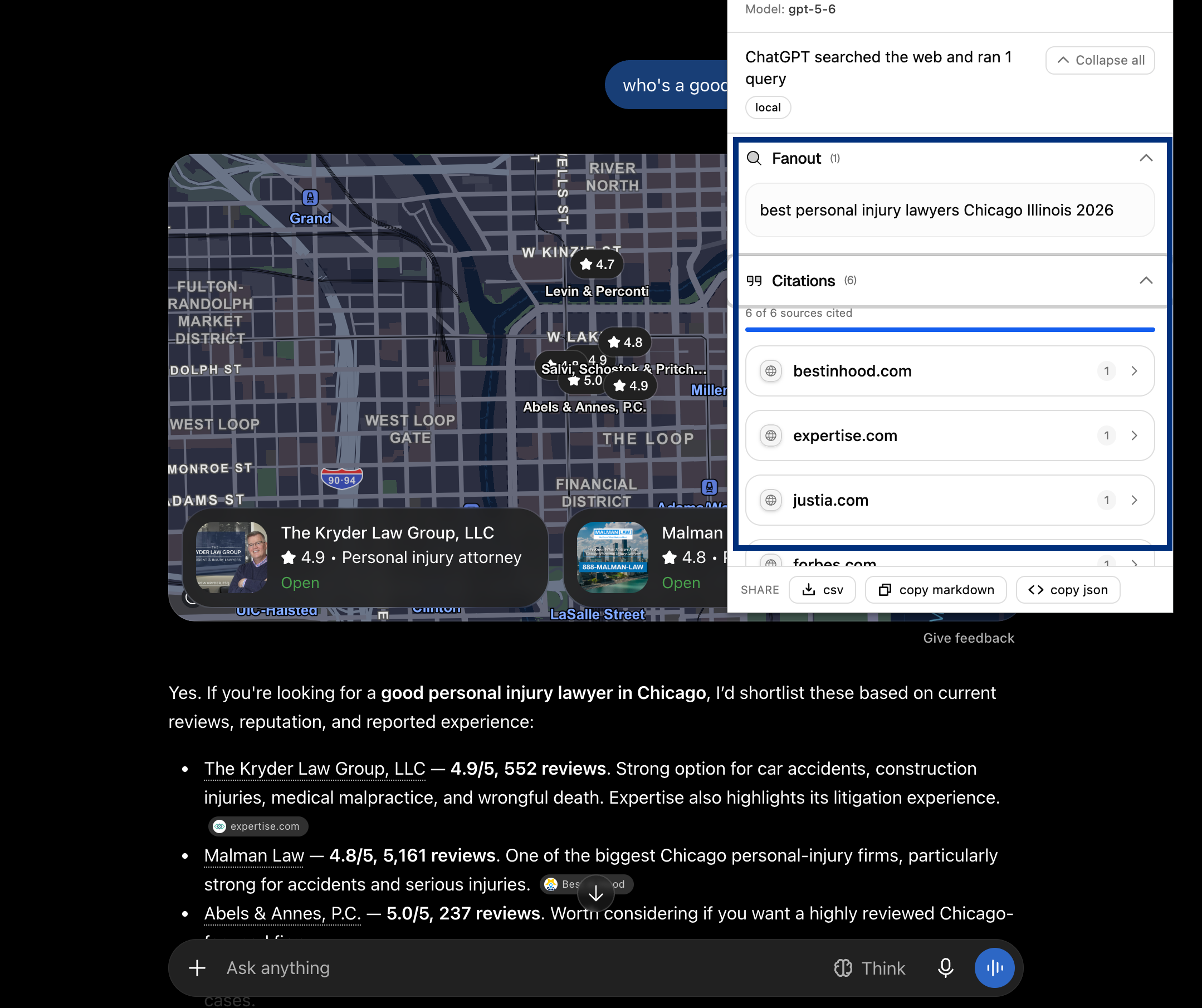
That's a different mechanism than traditional SEO, and it's worth being precise about three terms that get used interchangeably:
- Mention is any AI response that includes the firm's name, regardless of how many times it appears in that one answer.
- Citation is the model explicitly pointing to a source, usually a directory profile, news article, or the firm's own page, as the evidence behind what it said.
- Visibility score goes further: it weighs where the firm landed in the answer, how it was described, and how many competitors crowded it out. A firm can be mentioned constantly and still score low if it's always buried third, described vaguely, or overshadowed by two other names in the same response.
That last distinction matters more for law firms than most verticals, because a firm that only shows up in branded searches ("is [Firm Name] good") but never in the actual buyer-intent questions ("best estate planning lawyer in Austin") has an organic visibility gap, not a reputation problem.
Why Directories Often Outrank Law Firm Websites in AI Answers
Ask an AI model for a lawyer recommendation, and the sources behind the answer are frequently third-party directories rather than the firm's own domain. That's consistent with how these models work: they favor sources with broad, structured, frequently-updated coverage of many firms at once, which a single-firm website usually can't match on its own.
This is where the distinction between a citation and an off-site mention matters.
- A citation points back to a page the firm controls.
- An off-site mention is a third-party source (a directory listing, a local news writeup, a bar association page, a client review site) discussing the firm without necessarily linking to it. Both count toward visibility, but they require different work: content on your own site earns citations, while PR, consistent directory profiles, and earned press earn off-site mentions.
Practically, that means the fastest lever for many firms isn't a new blog post, it's making sure the firm's name, practice areas, and attorney bios read identically across every directory, review platform, and social profile the firm controls.
Inconsistent listings (a different phone number on Avvo than on the firm's own contact page, an outdated practice area on Martindale) make it harder for a model to confidently attach a consistent identity to the firm, which is exactly the kind of gap worth tracking down before writing new content to close it. Promptwatch's guide on how to get your brand mentioned by AI walks through the mechanics of earning that kind of third-party mention in more detail.
How ChatGPT and Google AI Overviews Decide Which Firm to Recommend
Before an AI system answers a question like "best malpractice attorney in Ohio," it typically breaks that single question into several related sub-queries behind the scenes, a process called query fan-out. It might separately check for malpractice case results in Ohio, attorney credential verification, client review sentiment, and recent bar disciplinary records, then synthesize an answer from whatever sources it finds for each piece.
That means a firm can rank in Google for its primary keyword and still be invisible in the AI answer, because the model never surfaced the firm's content for one of the sub-queries feeding the response. It also means AI Overviews and AI Mode results in Google Search behave differently from the standalone Gemini app: Overviews and AI Mode tend to show citations prominently, while Gemini's own interface often synthesizes an answer with few or no visible source links. For a law firm checking its own visibility across models, that's worth knowing before assuming a lack of citations in Gemini means a lack of visibility.
Why City- and State-Level Tracking Matters for Law Firm Visibility
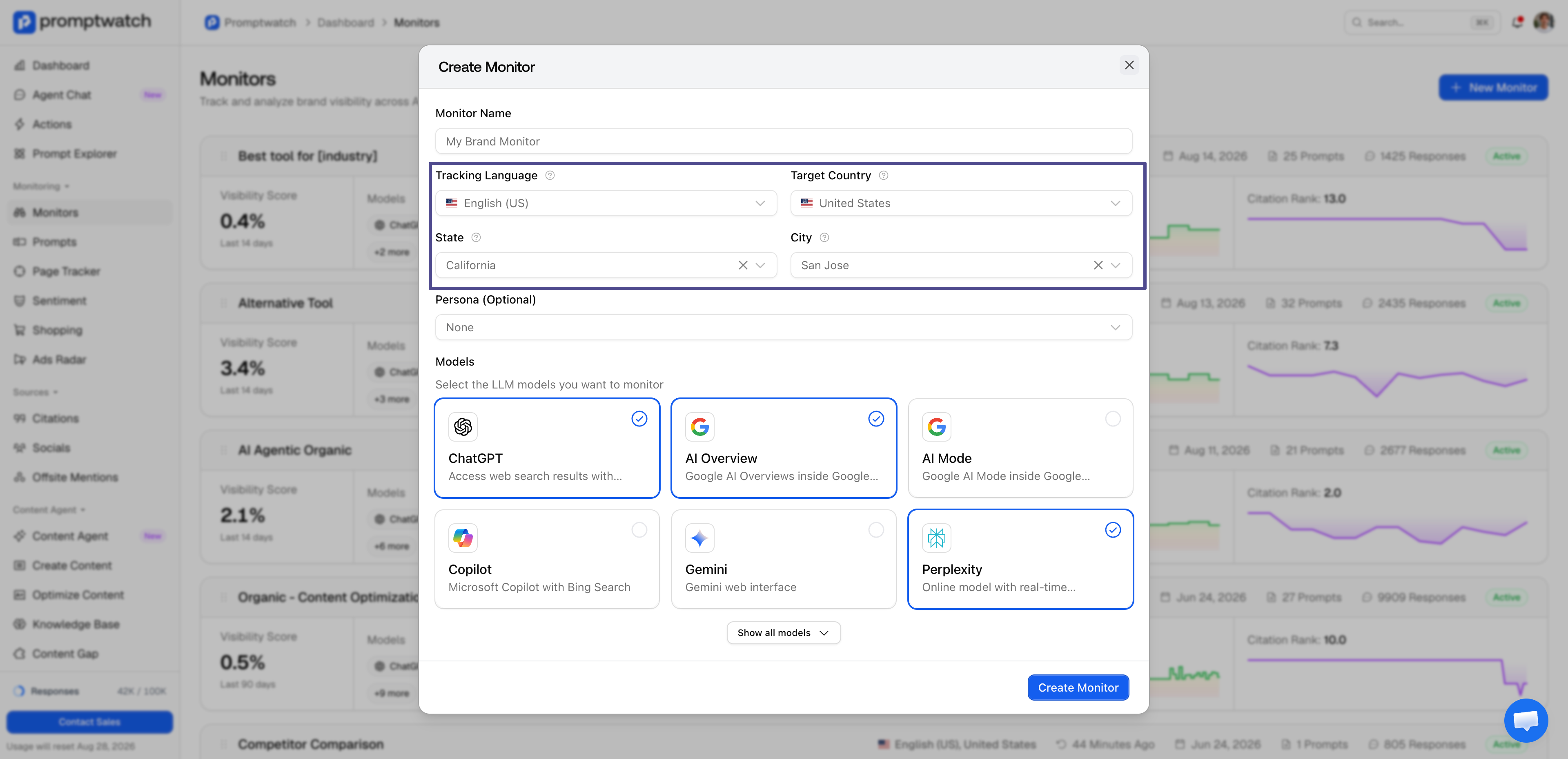
Legal services are about as local-intent as any category gets. "Best immigration lawyer in Miami" and "best immigration lawyer in Sacramento" are functionally different questions to an AI model, because the sources available, the competitors mentioned, and even the tone of the answer can vary by location. A single blended, national visibility number averages all of that away and hides exactly where a multi-office firm, or a firm competing in one specific market, is actually winning or losing.
This is the same reasoning behind why Promptwatch scopes each tracked prompt monitor to one country, language, and optionally one U.S. state or city at a time, rather than blending everything into a single average. A firm with offices in three states, or a single-location firm competing hard for one metro area, can see whether its visibility in Chicago looks nothing like its visibility in Denver, instead of assuming one number represents the whole practice.
Track Visibility From the Exact Client Asking, With Persona Stacking
Location isn't the only thing that changes an AI answer. Who's asking changes it too. "Best divorce lawyer in Denver" gets a different response depending on whether the model is answering someone who just got served papers and needs someone fast, or a small business owner untangling a partnership dispute who's comparing firms on experience and fee structure. A visibility score that blends both audiences together hides which one the firm is actually winning.
Promptwatch's Persona Stacking lets a firm layer a persona on top of a monitor's prompts, so every tracked prompt runs from that audience's specific point of view instead of a generic, unstated one. For a law firm, that might mean stacking separate personas for someone searching right after a car accident, a first-time DUI defendant, and a corporate general counsel vetting outside employment counsel, then tracking whether the firm shows up differently for each. Each persona gets its own dedicated stacking prompt describing who's asking, stacking can be turned on when a monitor is created or enabled later in monitor settings, and personas already in use are protected: detaching one requires confirmation, and a persona tied to tracked responses can't be deleted outright.
For a multi-practice firm, this pairs naturally with city- and state-level monitors: a firm can see not just whether it's visible in a given market, but whether it's visible to the specific type of client it's actually trying to reach there.
How to Improve Your Firm's AI Search Visibility
- Keep directory and profile data identical everywhere. Name, practice areas, attorney bios, and contact details should read the same on Avvo, Super Lawyers, Martindale, Google Business Profile, and the firm's own site. This is exactly the kind of inconsistency Promptwatch's Off-site Mentions feature is built to surface, since it tracks third-party sources discussing the firm even when they don't link back.
- Publish content that answers the specific questions clients actually ask AI, not just what ranks in Google. A page written for "how long does a personal injury settlement take in [state]" answers a real sub-query an AI model may fan out to, where a generic "our personal injury practice" page doesn't. Promptwatch's Content Gap Analysis maps tracked prompts against the firm's existing pages specifically to flag which real questions have no matching content yet.
- Earn coverage in local news and legal trade press, not just backlinks. AI models weigh third-party authority signals (bar association mentions, local news coverage, peer recognition) heavily when deciding whether to trust and name a firm. This is measured as Off-site Mentions rather than Citations specifically because the source doesn't need to link back to count.
- Check whether AI crawlers can actually reach your practice area pages. A page that's technically live but blocked by a misconfigured robots rule, or that returns a slow or error response, can't be cited even if it perfectly answers the question. Promptwatch's AI crawler logs show exactly which bots, GPTBot, ClaudeBot, PerplexityBot, requested which pages and what status code came back.
- Track visibility by market, not just by firm name. A multi-office firm needs to know if it's invisible in one specific city rather than assuming national averages tell the whole story. This is the reasoning behind scoping monitors to a single city or state rather than blending markets into one score.
How Promptwatch Tracks AI Visibility for Law Firms
For a law firm, three things matter most:
- Seeing what a real prospective client in a specific city actually gets back from ChatGPT or Gemini
- Scoring sentiment fairly on fact-heavy legal content
- Turning gaps into content without publishing anything unreviewed.
Promptwatch scrapes the real interfaces of ChatGPT, Gemini, Google AI Overviews, Perplexity, and other platforms rather than relying only on their APIs, so a firm sees the same localized, cited answer a prospective client in that market would get. All 11 supported platforms are available on every plan, with four tracked per project at a time. Sentiment is scored only on how the firm is discussed, not how prominently, and bare mentions are excluded rather than counted as neutral, so a factual case outcome or settlement figure doesn't get misread as negative just for lacking upbeat language.
Content Gap Analysis and the content agent turn those tracked prompts and citation gaps into drafts grounded in the firm's own content, all routed to a review inbox by default, so nothing reaches the firm's site unapproved. And because Agent Analytics separates AI crawler activity from AI-referred human traffic, a firm or its agency can tell "AI can see our pages" apart from "AI is actually sending people who convert."
FAQ
What does AI search visibility mean for a law firm?
It's how often, and how favorably, AI platforms like ChatGPT, Gemini, Perplexity, and Google AI Overviews name a firm when someone asks a legal question, as distinct from how the firm's website ranks in traditional Google search.
Do AI Overviews cite law firm websites directly, or mostly directories?
Both, but directory sites and review platforms are cited frequently because they offer broad, structured, regularly updated coverage across many firms, something a single firm's own site usually can't match on its own for every practice area and market it serves.
Can I track how my firm appears across ChatGPT, Claude, and Gemini at once?
Yes. Every prompt tracked in Promptwatch runs across all of a project's active models at once, so visibility, citations, and sentiment can be compared model by model in one place.
How many prompts should a law firm track to start?
There's no fixed minimum, though most firms starting out track a mix of branded, practice-area, and city-specific prompts rather than just their firm name. Multi-location firms typically need one monitor per city or state to see market-by-market differences rather than a single blended number.


