

TL;DR
- The best platform for local GEO runs AI prompts from a precise location, keeps one monitor per location, and shows which businesses and sources each AI answer uses there.
- Promptwatch's Local GEO/SEO Targeting pins a monitor to an exact point with a 20 m to 5 km radius, so ChatGPT, Google AI Overviews and Google AI Mode answer as if the question was asked from that spot.
What is a local GEO platform?
A local GEO platform measures how AI assistants answer location-based questions for your business. It runs prompts such as "best dentist near me" or "pizza place open now" as if a real person asked them from a specific place, then records:
- Mentions: whether the AI names your business.
- Position: where it ranks you in its shortlist.
- Competitors: which nearby businesses it names instead.
- Sources: which pages it cited to build the answer.
The deciding feature is the location signal. A tool that runs "near me" prompts without one gets an answer for whatever place the AI engine guesses, which tells you little about any single branch.
Why the exact location matters for AI answers
ChatGPT, Google AI Overviews and Google AI Mode adapt "near me" answers to where the user is. Since ChatGPT added location sharing in March 2026, a user who shares a precise location gets a shortlist built around that spot, with distances, ratings and map links. Promptwatch's guide to local GEO shows how much that shortlist shifts from one neighborhood to the next.
That changes what a business has to measure:
- A city is too wide. Two neighborhoods in the same city can get completely different shortlists for the same question.
- Each branch competes locally. A chain can be recommended in one district and absent a few kilometers away.
- Sources are local too. Neighborhood guides, review sites and local directories decide which businesses AI names, and they change from one area to the next.
A platform that only tracks at country or city level averages all of this together. A platform that pins prompts to a point shows what a real customer at that spot sees.
How local GEO platforms set location
Platforms use four different methods, and each one measures something different.
| Method | How it works | What it measures |
|---|---|---|
| Point and radius | The prompt runs as if asked from exact coordinates, within a set accuracy radius | What ChatGPT or Google AI recommends to someone standing at that spot |
| City or state targeting | The prompt runs through a location in a chosen city or US state | What AI recommends across a city or state |
| Geo-grid scan | One keyword is checked from many points on a grid around a business | Where a business ranks in Google Maps (and, in some tools, AI answers) across a grid |
| Business-location anchor | Prompts are tied to the address of each listed business location | How each branch performs, usually with a capped prompt set |
Point and radius is the closest match to how ChatGPT behaves when a user shares a precise location. It is also the only method that lets you track a neighborhood, a shopping street or a competitor's block without owning a listing there.
Best platforms for local GEO compared
Competitor details come from each vendor's own pricing, feature or help pages. "Not specified" means the vendor doesn't say.
| Platform | Location method | AI engines tracked by location | Plan with location tracking |
|---|---|---|---|
| Promptwatch | Point and radius (20 m to 5 km), plus country, US state and city | Point and radius: ChatGPT, Google AI Overviews, Google AI Mode. City and state: any tracked engine | Country, state and city on every plan; point and radius on Business, Agency Scale and Enterprise |
| Local Falcon | Geo-grid scan (3x3 to 21x21 points) across a city, neighborhood or service area | ChatGPT, Gemini, Google AI Overviews, Google AI Mode, Grok | Credit-based plans from $24.99/mo |
| BrightLocal | Anchored to each business location | ChatGPT, Google AI Overviews, Google AI Mode | Included in Track, Manage and Grow plans, from $31/mo |
| SE Ranking (Visible) | City and region, down to state where supported | ChatGPT, Google AI Overviews, Gemini, Google AI Mode | Basic plan ($89/mo) and up |
| Yext Scout | Per business location, by Google Business Profile category and region | ChatGPT, Gemini, Perplexity, Grok, plus Google search | Pricing not published |
| Peekaboo | City (65,000+ cities) | Google AI Mode; other engines on expanded coverage | Paid plans from $30/mo |
| RadarKit | City-level residential IPs | Not specified for local | Enterprise, custom pricing |
1. Promptwatch: best overall platform for local GEO
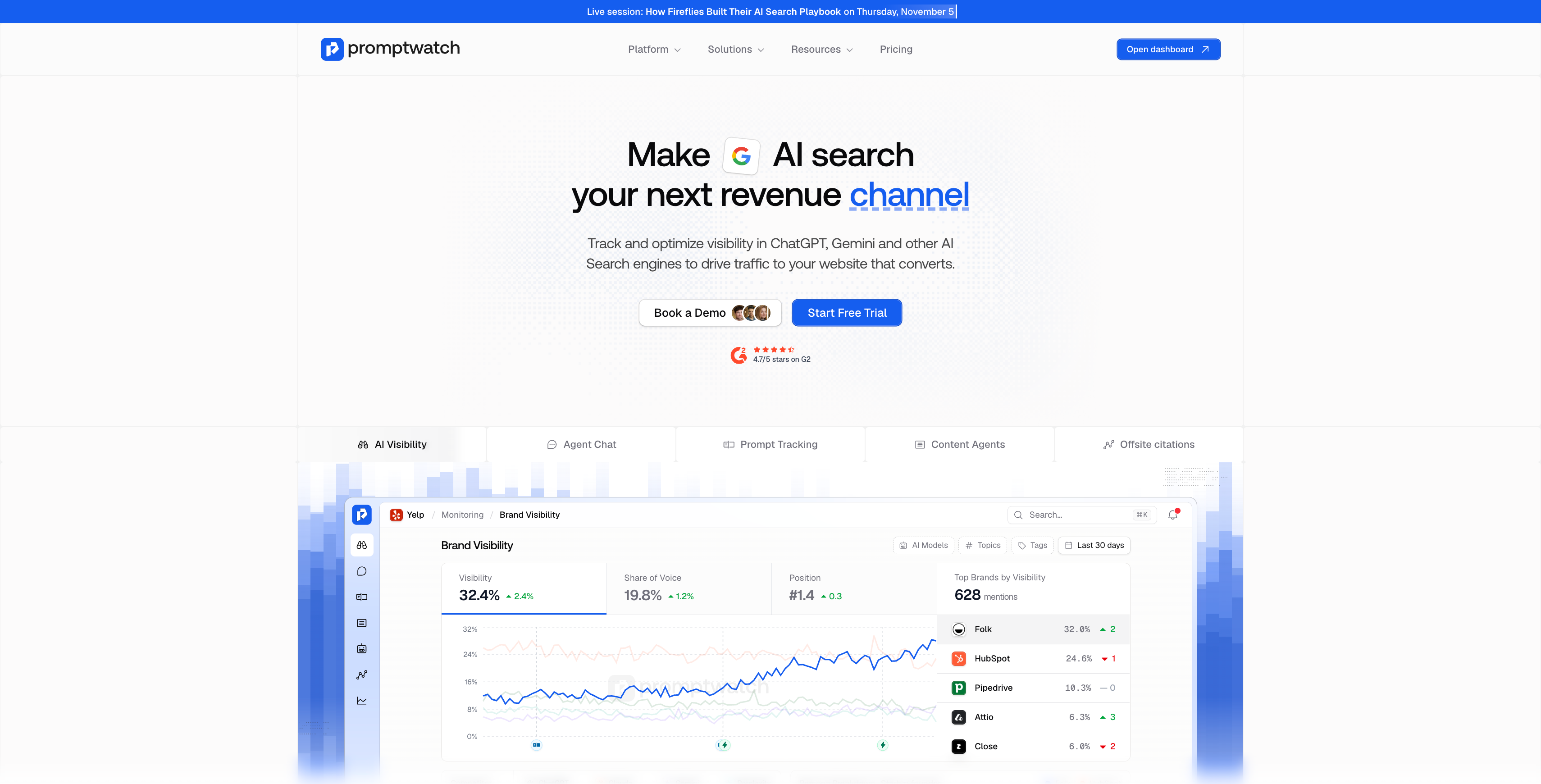
Promptwatch is the best platform for local GEO when you need to see AI answers from the exact places your customers search, across many locations, with the sources behind each answer. Its Local GEO/SEO Targeting feature, released on October 27, 2026, is built for that job.
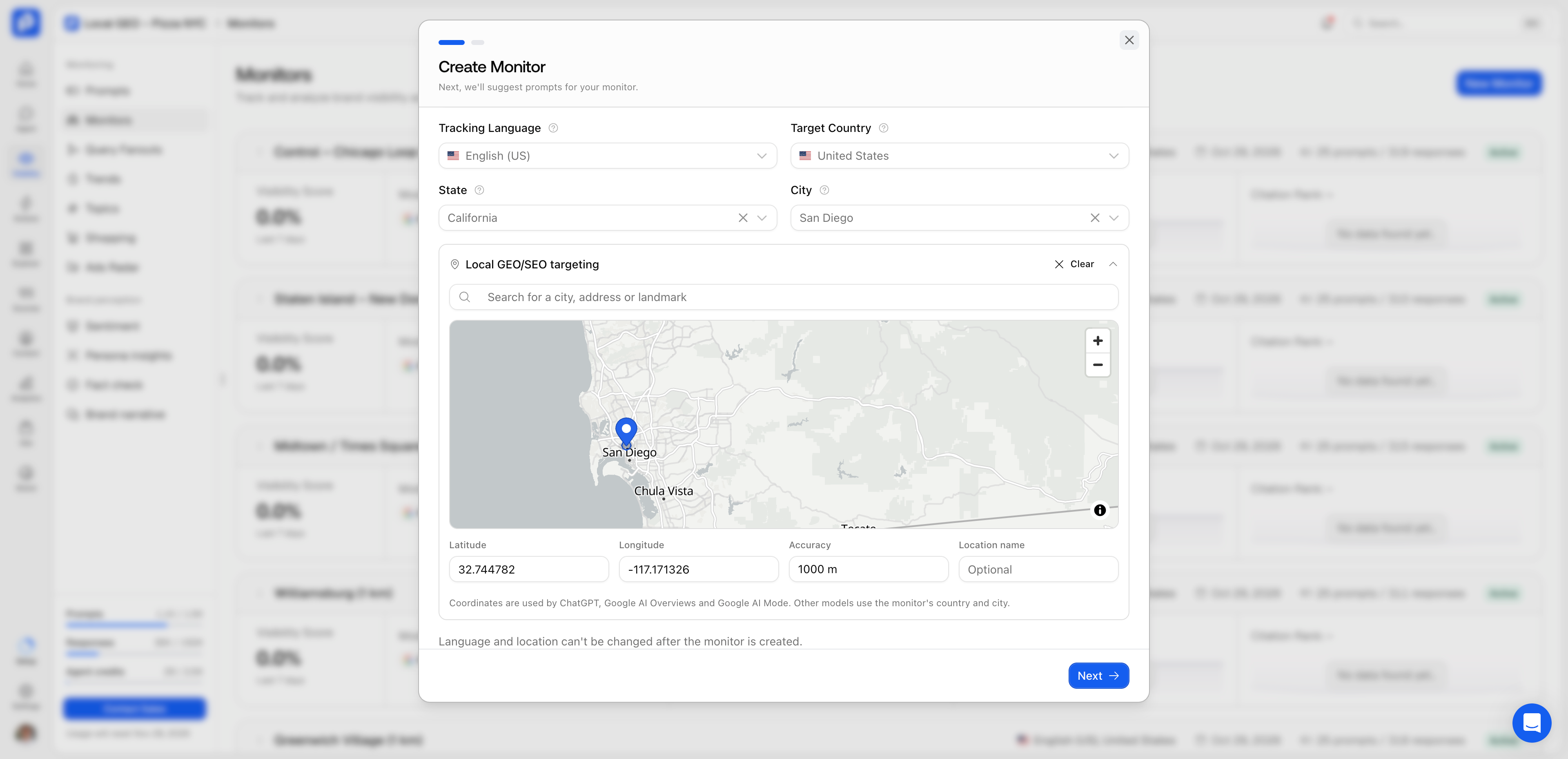
How Local GEO/SEO Targeting works:
- Pick the spot. When you create a monitor, search for an address, city or landmark, click the map, or type coordinates.
- Set the precision. Choose a radius from 20 m to 5 km: small for a single store, larger for a neighborhood or town.
- Get local answers. ChatGPT, Google AI Overviews and Google AI Mode answer as if the question was asked from that spot. Other models use the monitor's country, state and city.
Why it stands out:
- One location per monitor: each branch or neighborhood keeps its own time series and competitor set, and copying a monitor keeps its location, so a 40-branch rollout takes minutes.
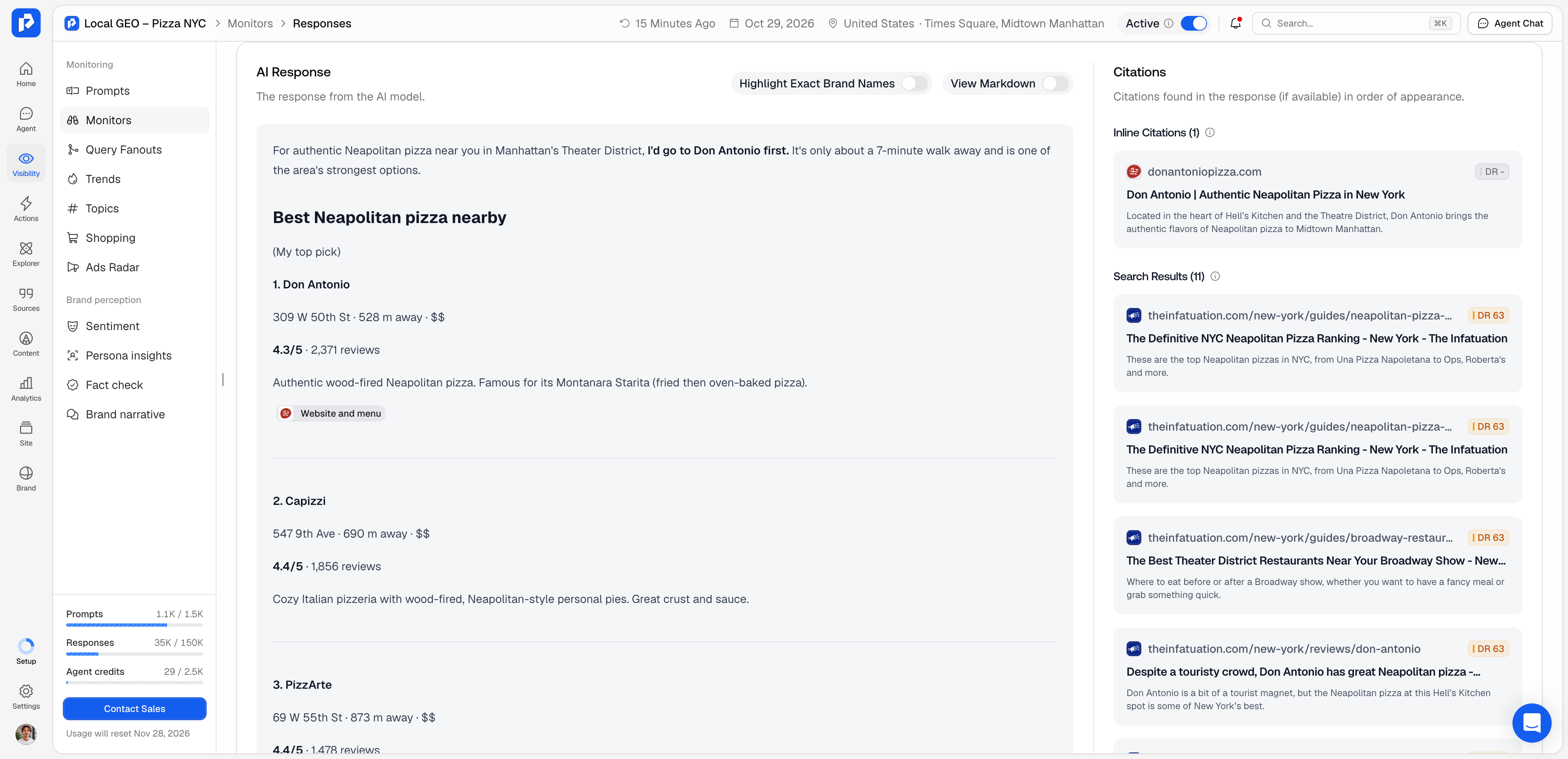
- Real interface data: Promptwatch collects answers from the live ChatGPT and Google interfaces, so you see the distances, ratings and map links a local user sees. Promptwatch's article on AI search monitoring API data explains why API answers differ.
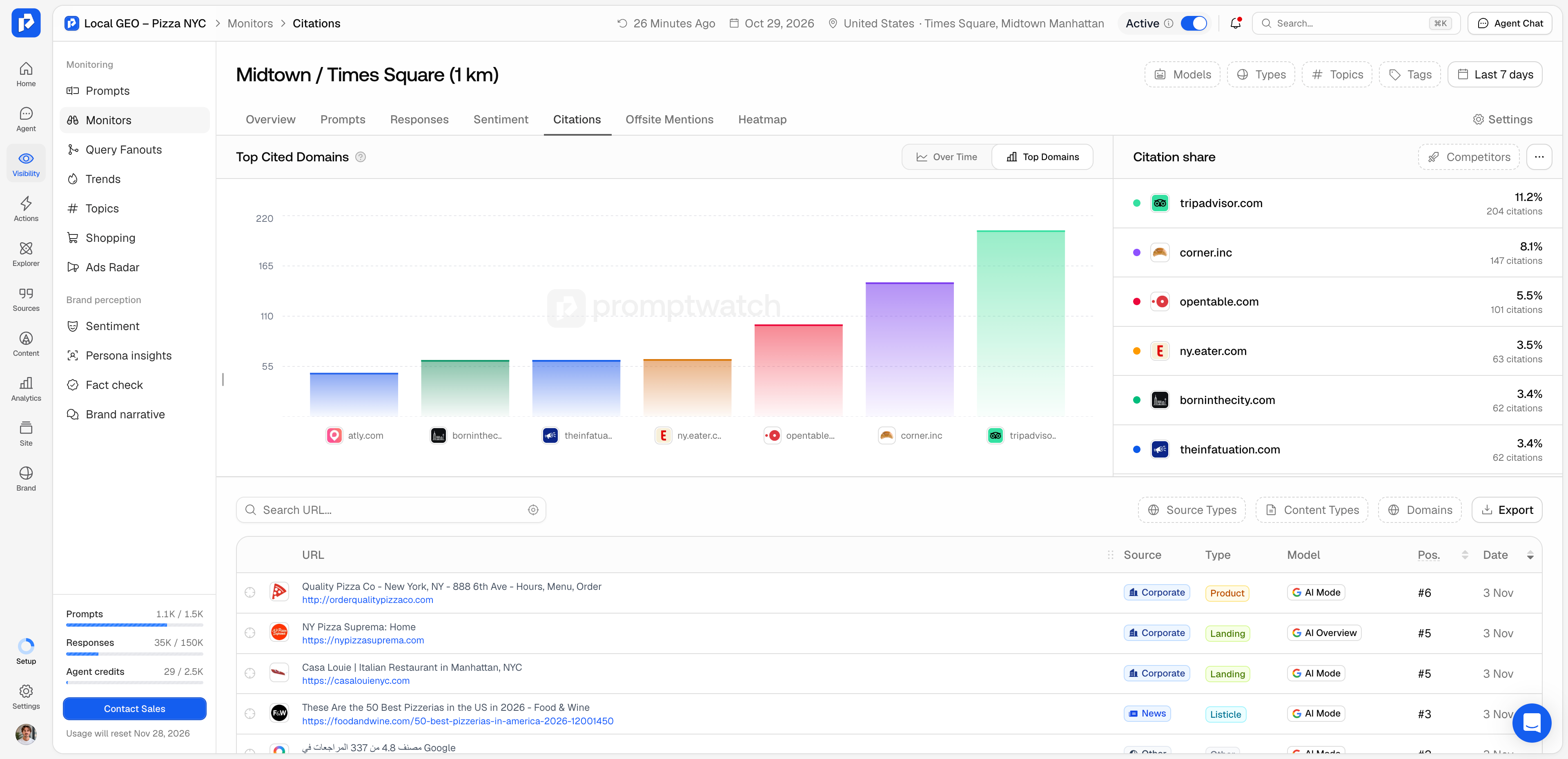
- Sources per location: the Citations view shows which directories, review sites, editorial lists and business pages each answer used for that pin, and Content Gap Analysis tests the sub-queries behind those answers against your site.
- Coverage: 12 AI platforms in total. Brands plans track 4 per project; Agency plans track all 12 at once with unlimited prompts and client projects.
- API and MCP: the REST API and MCP tools accept and return the same location fields, so agencies can create and report on location monitors in bulk.
Good to know: the pinned location is fixed once a monitor is created, and point-and-radius targeting is on Business, Agency Scale and Enterprise. Promptwatch measures AI answers and citations. It does not manage listings, reviews or Google Business Profiles.
"I tested several tools to measure brand visibility in LLMs, and Promptwatch was the only one that ticked all our boxes. It keeps improving with new features and has become essential for our marketing team."
2. Local Falcon
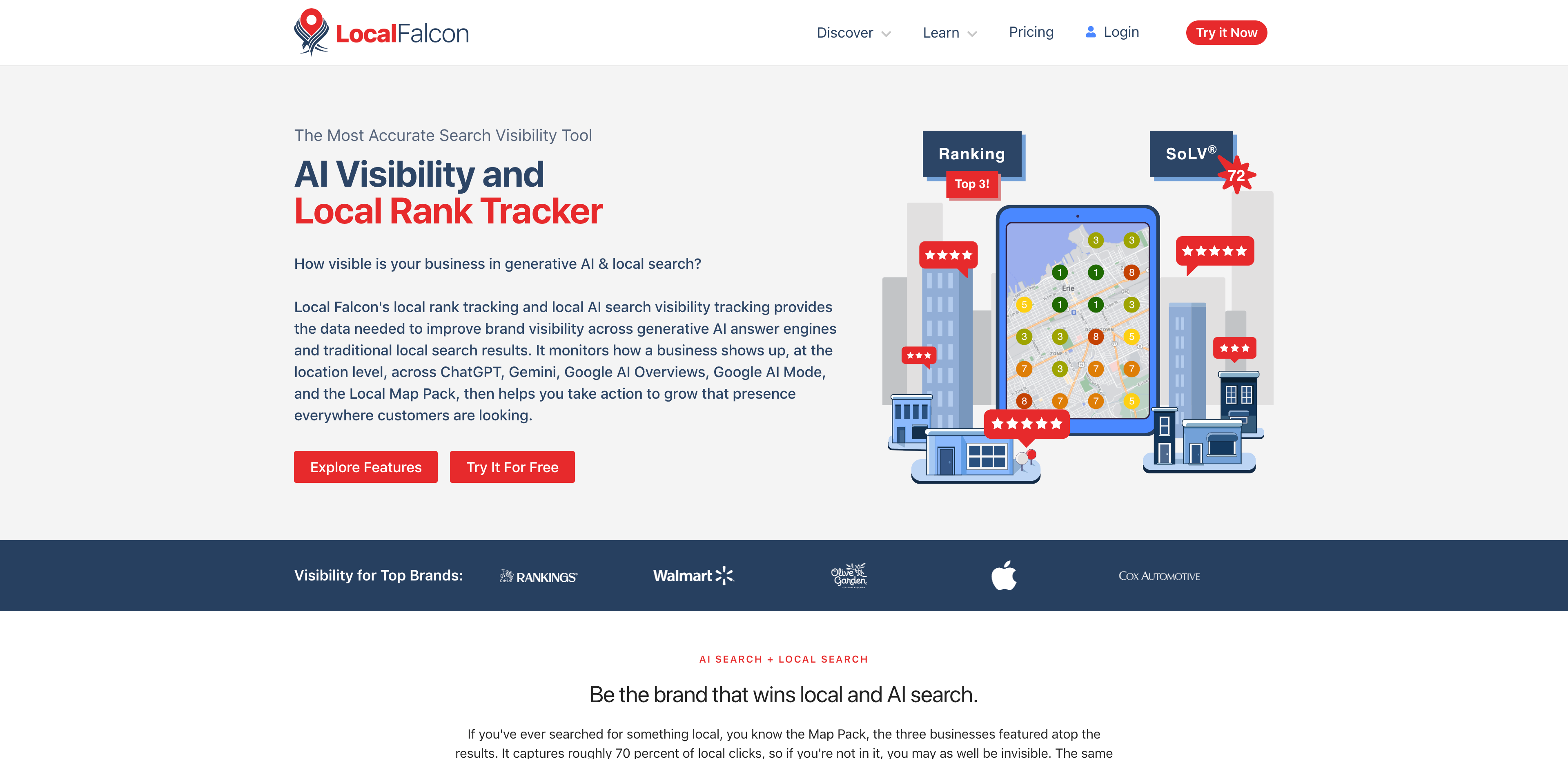
Local Falcon started as a geo-grid rank tracker for Google Maps and now runs AI prompts the same way: from many points on a grid around a business.
- How location works: the same prompt runs from every point of a grid, from 9 points (3x3) up to 441 points (21x21), across a city, neighborhood or service area.
- AI engines: ChatGPT, Gemini, Google AI Overviews, Google AI Mode and Grok.
- What you get: Share of AI Voice (the share of grid points where AI names the brand), a Buyer Persuasion Score, the phrases AI uses to describe the brand, cited sources, a competitor report, trend reports and scheduled scan campaigns. AI results can be compared with Google Maps visibility for the same keyword.
- Pricing: credit-based plans: Starter $24.99/mo (7,500 credits), Basic $49.99/mo, Pro $99.99/mo and Premium $199.99/mo. AI scans use the same credits as map scans, and a free account includes 100 credits.
- Best for: local SEO teams that already work with geo-grids and want AI and map visibility side by side.
3. BrightLocal
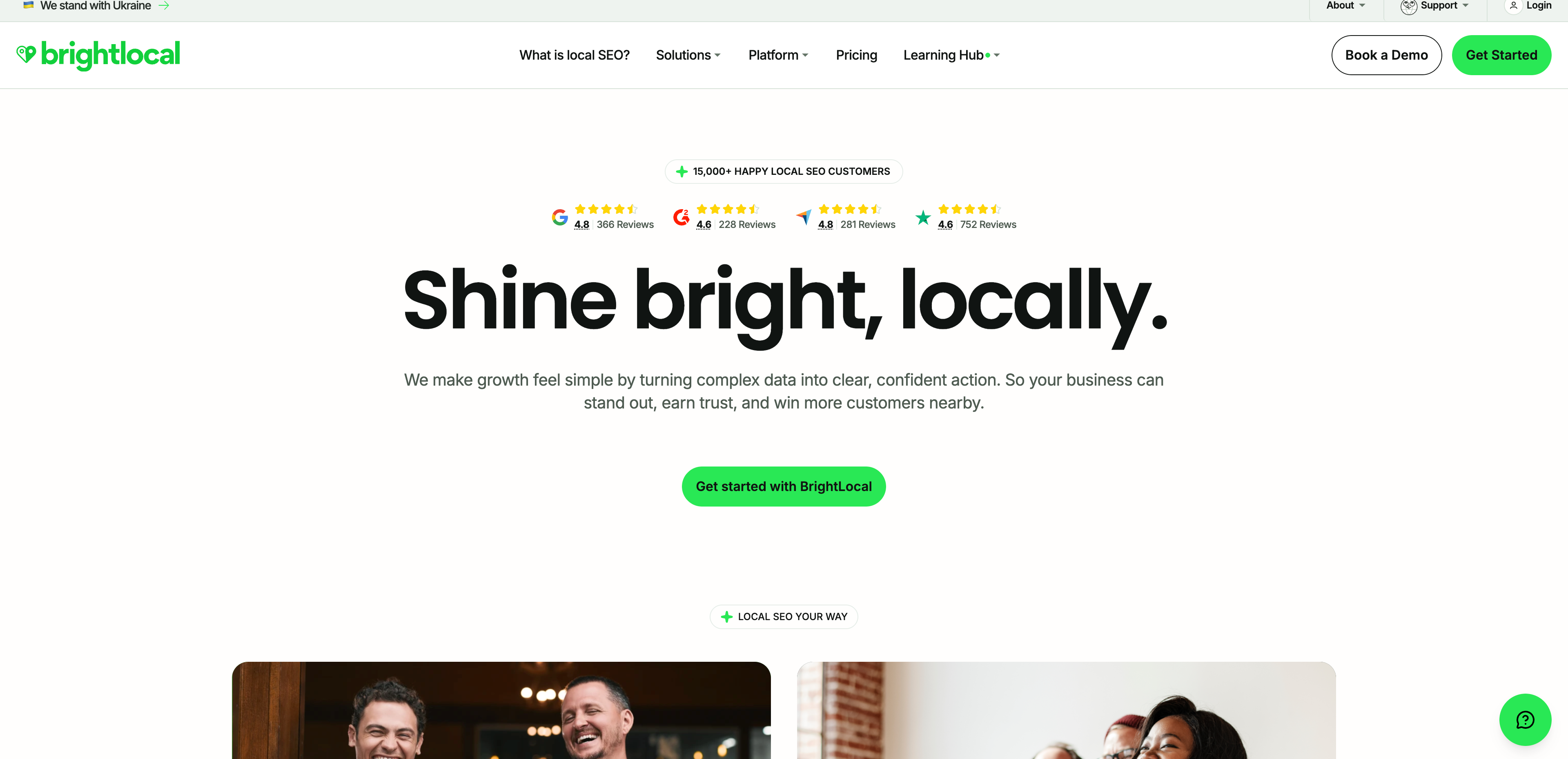
BrightLocal added Local AI Visibility to its local SEO suite, with every prompt anchored to one of your business locations.
- How location works: each tracked location is the anchor for its prompts, in the same way as BrightLocal's Local Rank Tracker and Local Search Grid.
- AI engines: ChatGPT, Google AI Overviews and Google AI Mode.
- What you get: a 0 to 100 visibility score per location, results by platform and prompt with sentiment, competitor mention rate, share of voice and average position, a leaderboard of cited domains, and prioritized actions that can send citation gaps to its Citation Builder.
- Pricing: included in the Track, Manage and Grow plans, from $31/mo, with a 14-day free trial.
- Limits: up to 20 prompts per location, suggested from the business category and editable.
- Best for: businesses already managing listings, reviews and citations in BrightLocal.
4. SE Ranking (Visible)
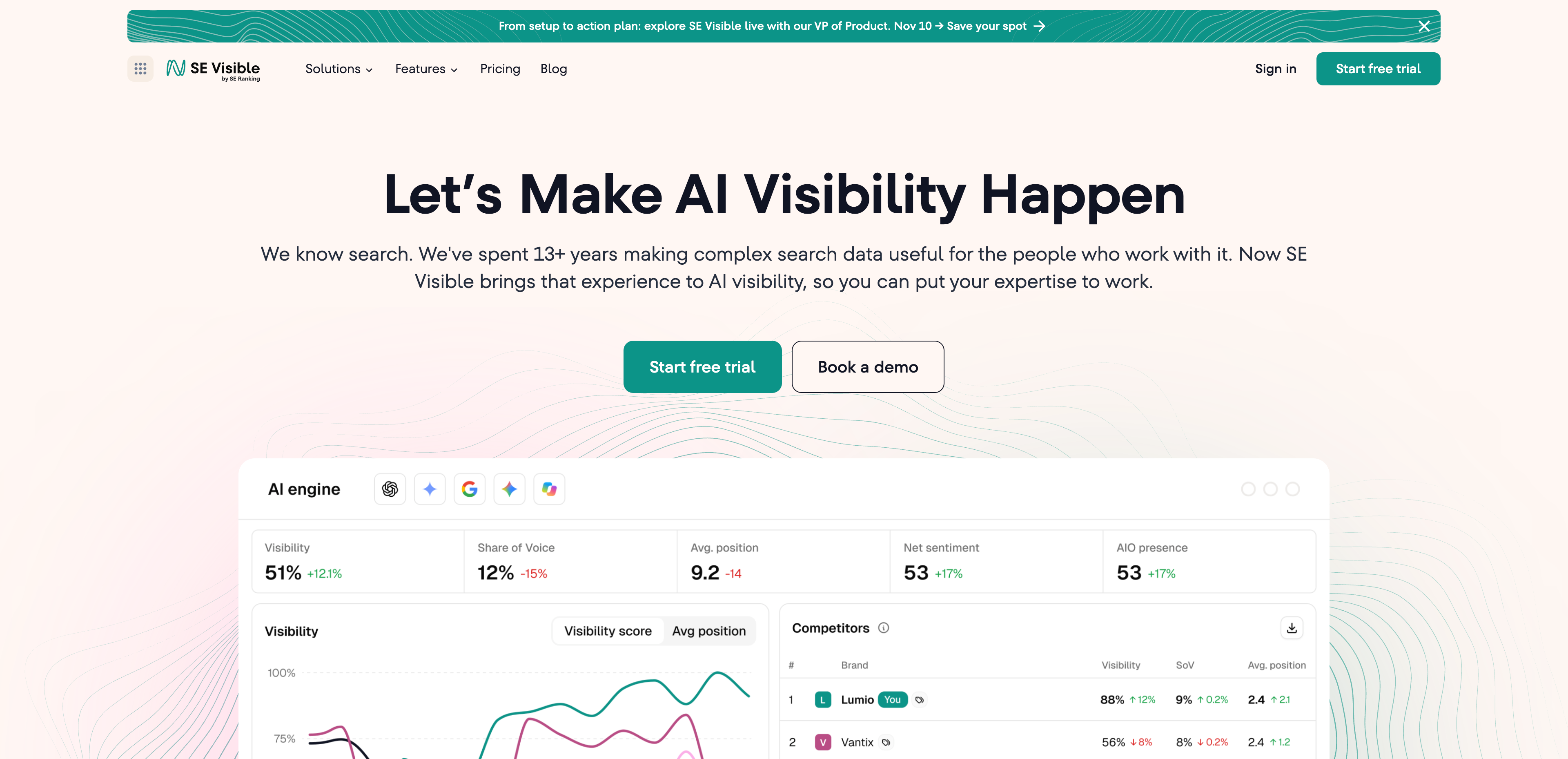
SE Ranking's Visible product includes Local AI Visibility, which gives each city or region its own visibility score.
- How location works: a whole project can be set to one geography, or single prompts can target different cities in the same project. Locations can be grouped into regions, brands or franchise groups. The location method itself is not specified.
- AI engines: ChatGPT, Google AI Overviews, Gemini and Google AI Mode.
- What you get: visibility per city or region, whether each location is named per engine and prompt, which competitor is named instead, mentions, citations, sentiment and answer history per location.
- Pricing: Basic $89/mo (75 prompts tracked daily, 5 projects), Core $189/mo (200 prompts, 10 projects), Agency $399/mo (1,000 prompts, 30 projects), with a 10-day free trial.
- Best for: SEO teams that want local AI tracking inside an SEO suite.
5. Yext Scout
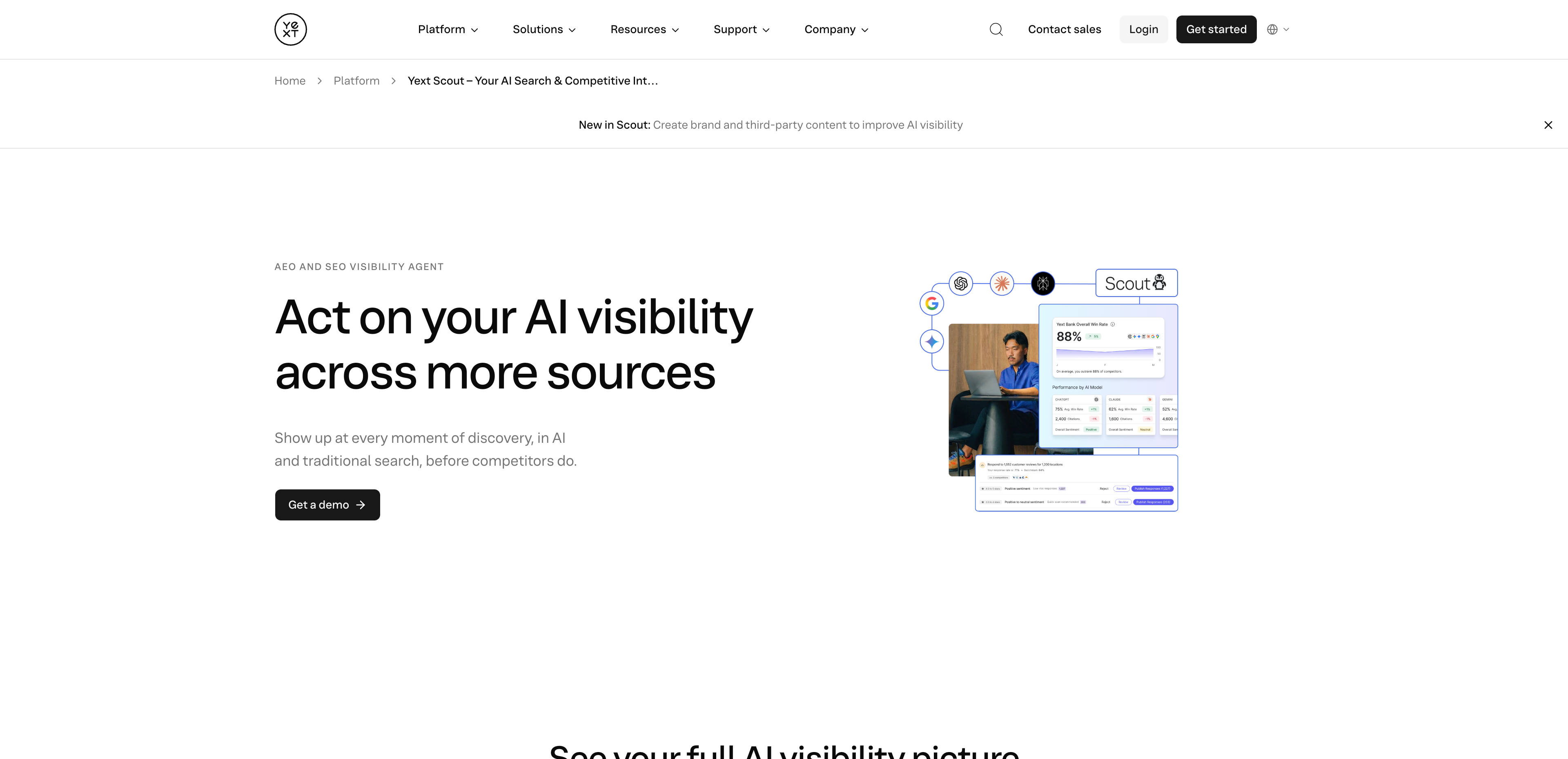
Yext Scout is the AI search and competitive intelligence agent inside the Yext platform, built for multi-location brands.
- How location works: Scout scans by Google Business Profile primary category within a region and reports how often each of a brand's locations appears.
- AI engines: ChatGPT, Gemini, Perplexity and Grok, alongside traditional Google search.
- What you get: location-level visibility, AI sentiment split into positive, neutral and negative, nearby competitors that win, and prioritized recommendations that connect to Yext Listings, Reviews and Pages. Scout is also available to partners through an API and MCP.
- Pricing: not published; a demo is required.
- Best for: enterprises that already run their listings on Yext.
6. Peekaboo
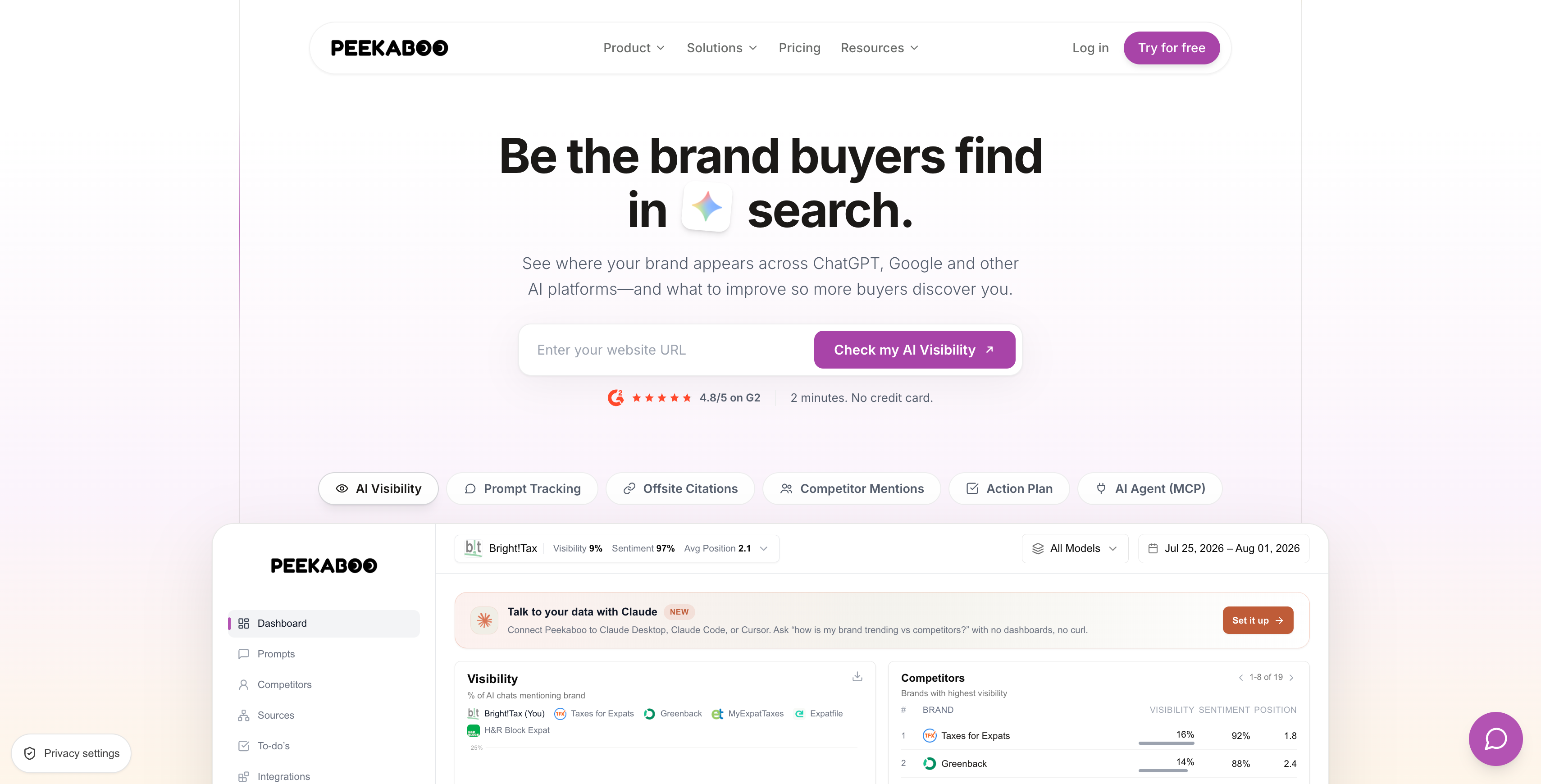
Peekaboo offers city-level tracking across more than 65,000 cities, with a separate history for local results.
- How location works: each prompt is set to one city as its search location.
- AI engines: Google AI Mode for local tracking, with AI Overviews, ChatGPT, Gemini and Perplexity on expanded coverage. Its docs note that some non-Google models may only support state or country precision.
- Pricing: paid plans from $30/mo, with no separate local price.
- Limits: up to 10 prompts per brand once local tracking is on, and local results are kept out of the main visibility score.
- Best for: small teams testing city-level AI Mode results on a budget.
7. RadarKit
RadarKit's Local Radar tracks which businesses AI recommends using city-level residential IPs.
- How location works: requests run through residential IPs in the chosen city.
- Pricing: Lite $29, Growth $79 and Pro $139/mo cover country tracking. State and city tracking are Enterprise only, with custom pricing.
- Best for: larger teams that need residential-IP city tracking and can go through an Enterprise sale.
How to choose a local GEO platform
Use these questions in every demo or trial. Each one is answered in the vendor's own documentation.
- Can I pin a prompt to an exact point, or only to a city? City-level data averages whole neighborhoods together, and ChatGPT builds a different shortlist a few kilometers away.
Promptwatch: Local GEO/SEO Targeting sets coordinates and a 20 m to 5 km radius per monitor. - Which engines receive the location? Some tools localize one engine and run the rest from a default location.
Promptwatch: point and radius apply to ChatGPT, Google AI Overviews and Google AI Mode; other engines use country, state and city. - Does the tool read the real interface? Local answers in the interface include distances, ratings and maps that API answers can leave out.
Promptwatch: answers are collected from the live ChatGPT and Google interfaces. - Does each location keep its own history? Blended scores hide the branch that is losing.
Promptwatch: one location per monitor, each with its own Visibility Score and competitor set. - Can I see the sources behind each local answer? A missing location is fixed at the source level: a neighborhood list, a review site, a location page.
Promptwatch: the Citations view and Content Gap Analysis work per monitor. - What does it cost at 20, 50 or 200 locations? Per-location pricing and prompt caps add up fast.
Promptwatch: Agency plans include unlimited prompts and projects, metered by responses and Agent Credits.
Who needs a local GEO platform
- Multi-location brands and franchises: one monitor per branch shows which locations AI recommends and which it skips.
- Local businesses in competitive areas: restaurants, clinics, dentists, gyms and real estate agencies, where "near me" questions decide the visit.
- Agencies with local clients: one project per client, monitors copied across cities, and reporting through the API or MCP.
- Brands entering a new area: pin the new neighborhood before opening to see which competitors and sources AI already relies on there.
How to set up local GEO tracking in Promptwatch
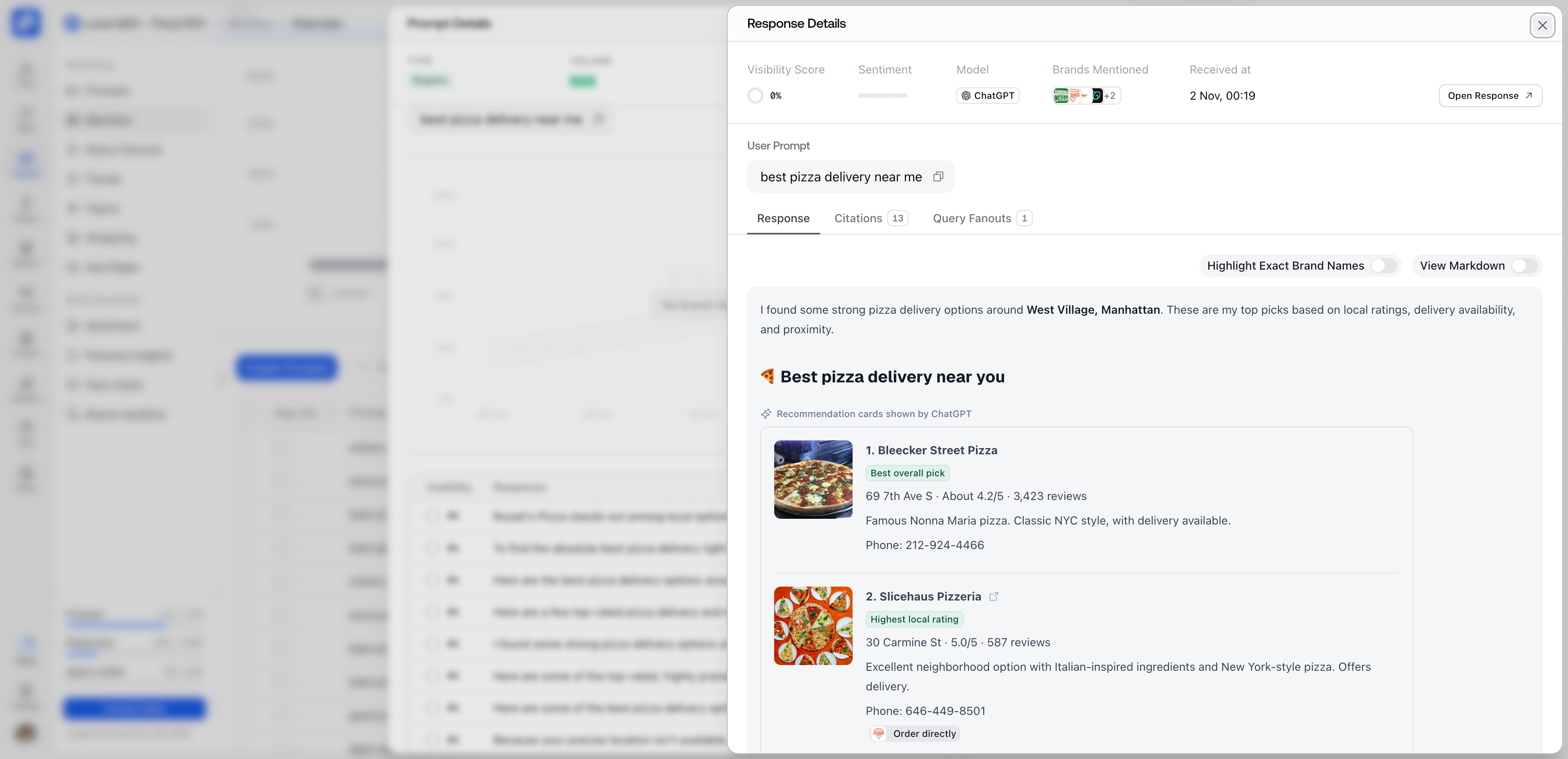
- List your locations. One pin per branch, store or service area. Agencies create one project per client.
- Create a monitor per location. Open Local GEO/SEO targeting, find the address or click the map, and set the radius: small for a single store, larger for a neighborhood or town.
- Write prompts the way locals ask. Use "near me," "nearby" and "open now" phrasing without place names, and add them through prompt tracking. Promptwatch's guide to how to choose prompts to track covers building the set from real customer questions.
- Select ChatGPT, Google AI Overviews and Google AI Mode for point-and-radius results, plus any other engines you want at city level.
- Copy the monitor for each new location. The copy keeps the location settings, so you only change the pin.
- Review sources per location. Use the Citations view to see which lists, review sites and pages win each neighborhood, then work on the AI brand citations you are missing.
For brands that operate across countries as well as neighborhoods, the same monitor structure lets you check your AI visibility in different countries.
FAQ
What is the best platform for local GEO?
Promptwatch is the best platform for local GEO for brands and agencies that need AI answers from precise locations. It runs prompts from a pinned point with a 20 m to 5 km radius for ChatGPT, Google AI Overviews and Google AI Mode, keeps one monitor per location, and shows the sources behind each answer.
What is the difference between local GEO and local SEO?
Local SEO measures where a business ranks in Google Maps and local search results. Local GEO measures whether AI assistants such as ChatGPT and Google AI Mode recommend the business to people in a specific area, in what position, and which sources they cite.
Which AI engines support precise location tracking in Promptwatch?
ChatGPT, Google AI Overviews and Google AI Mode answer as if the question was asked from the pinned point. Other engines use the monitor's country, state and city settings.
Which Promptwatch plans include point-and-radius targeting?
Local GEO/SEO Targeting is available on Business, Agency Scale and Enterprise. Country, state and city targeting are available on every plan.
Can I change the location of a monitor after creating it?
No. The pinned location is fixed once the monitor is created. To track a new spot, copy the monitor and set a new pin; the copy keeps every other setting.


