

TL;DR
- The best tool to fact-check what AI says about your brand extracts individual claims from real AI answers, verifies each one against a source of truth, and shows the evidence behind every verdict.
- Most AI visibility tools only monitor whether your brand is mentioned; claim-level fact-checking is a separate, smaller category.
- The biggest difference between fact-checking tools is what they check claims against: your live website, a knowledge base you maintain, or your own manual review.
- Promptwatch Fact Check verifies each claim against every page of your site and the top 50 sources AI cites, labels it with one of five statuses, and sends conflicting pages to the Content Agent to fix.
AI assistants now answer questions about your pricing, features and reputation before a buyer ever reaches your site. Those answers are often wrong. A 2025 study by the European Broadcasting Union (EBU) and the BBC evaluated more than 3,000 answers from ChatGPT, Copilot, Gemini and Perplexity. It found that almost half of all AI answers had at least one significant issue.
To see which tools AI itself recommends for this job, Promptwatch asked seven AI models, including ChatGPT, Gemini, Perplexity, Claude and Google AI Overviews, "What is the best tool to fact-check what AI says about my brand?" on November 9, 2026. Nine of the 14 answers drew the same line: most tools tell you whether AI mentions your brand, and only a few check whether what it says is true. This guide covers the tools in that second group, how they differ, and how to test them.
What's the Difference Between AI Brand Monitoring and AI Fact-Checking?
AI brand monitoring measures presence: how often ChatGPT, Gemini or Perplexity mention you, where you rank in the answer, which sources they cite and how the answer sounds. Promptwatch's guide on how to track brand mentions in AI covers that layer in detail.
AI fact-checking measures accuracy. It takes a single statement from an AI answer, such as "starts at $49 per month" or "doesn't integrate with Salesforce," and checks it against a source of truth. A brand can score well on visibility and still be described wrongly in every answer that mentions it.
Sentiment tracking sits between the two and answers a third question: how does the answer sound? A flattering claim about a feature you don't offer is still an error, so sentiment scores can't replace fact-checking. Promptwatch's roundup of tools to track brand sentiment in generative AI search engines covers that category.
What Should an AI Fact-Checking Tool Do?
A tool that fact-checks AI answers about your brand should handle six jobs:
- Extract claims from real AI answers. The tool should pull individual statements from the answers to prompts you track, keep the exact quote, and group claims that mean the same thing.
Promptwatch Fact Check extracts claims about your brand and your competitors from every tracked answer and groups them by meaning. - Check claims against a source of truth. This is where tools differ most: some check against your website, some against a knowledge base you write and maintain, and some leave the verdict to you.
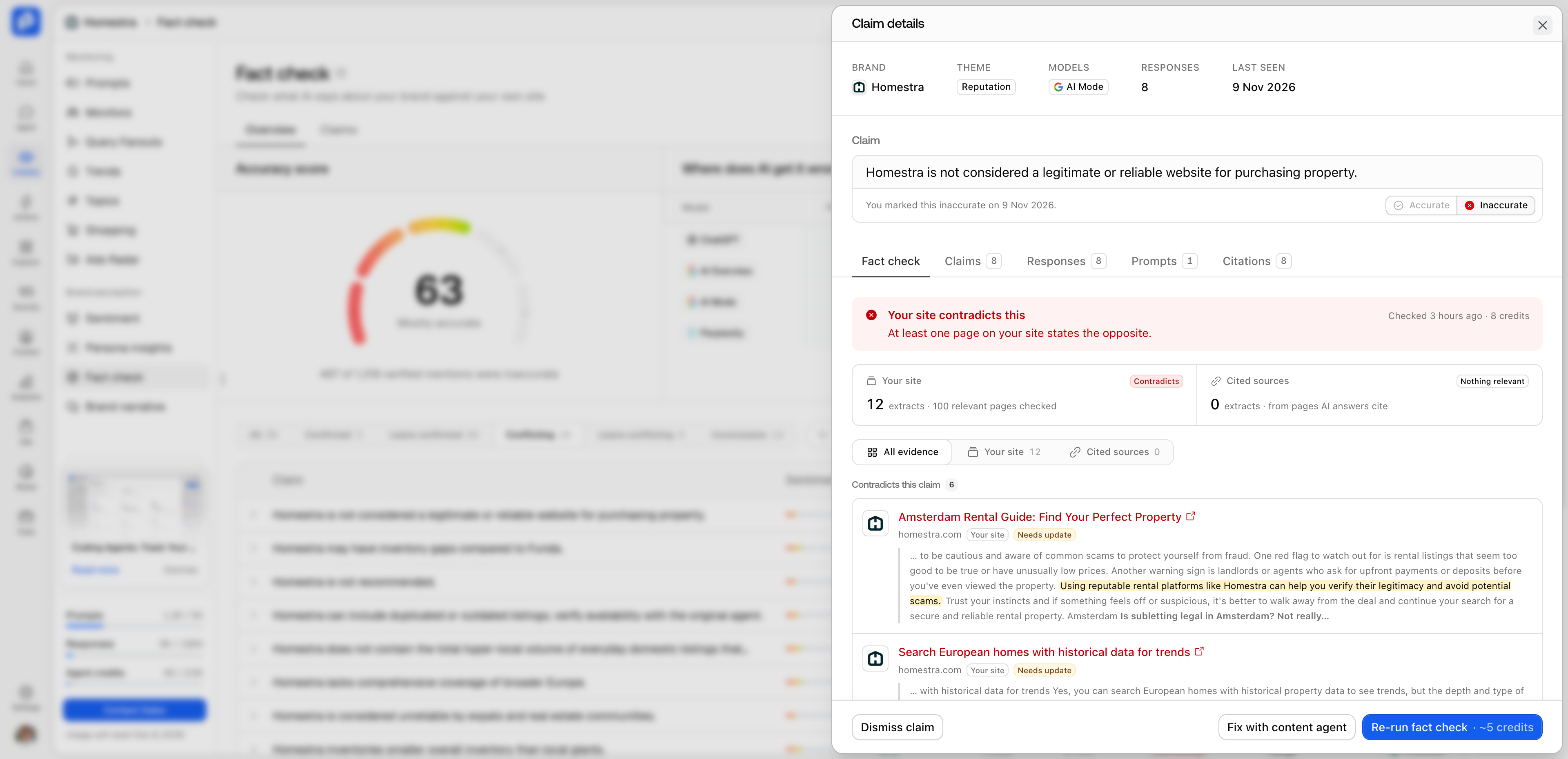
Promptwatch searches every page of your crawled site for evidence, so the check reflects what your site says today. - Check the sources AI cites. Wrong claims often come from third-party pages such as old reviews, comparison articles and forum threads.
Promptwatch checks the top 50 sources AI cites for each claim, including off-site mentions. - Show the evidence. A verdict without the passage behind it can't be acted on. Look for the exact quote from the AI answer and the exact passage from the source.
Promptwatch separates evidence from "Your site" and "Cited sources" and highlights the passage on each page. - Help you fix what's wrong. Finding an error is half the job; the tool should point to the page that needs changing.
Promptwatch sends conflicting pages to the Content Agent, which can refresh up to 10 pages at once and publish to your CMS. - Let you prioritize. Filters by model, prompt group and topic stop teams drowning in low-stakes claims.
Promptwatch filters claims by model, monitor and theme (pricing, features, support, reputation), and lets you dismiss claims that don't matter.
The Best Tools to Fact-Check What AI Says About Your Brand
1. Promptwatch Fact Check
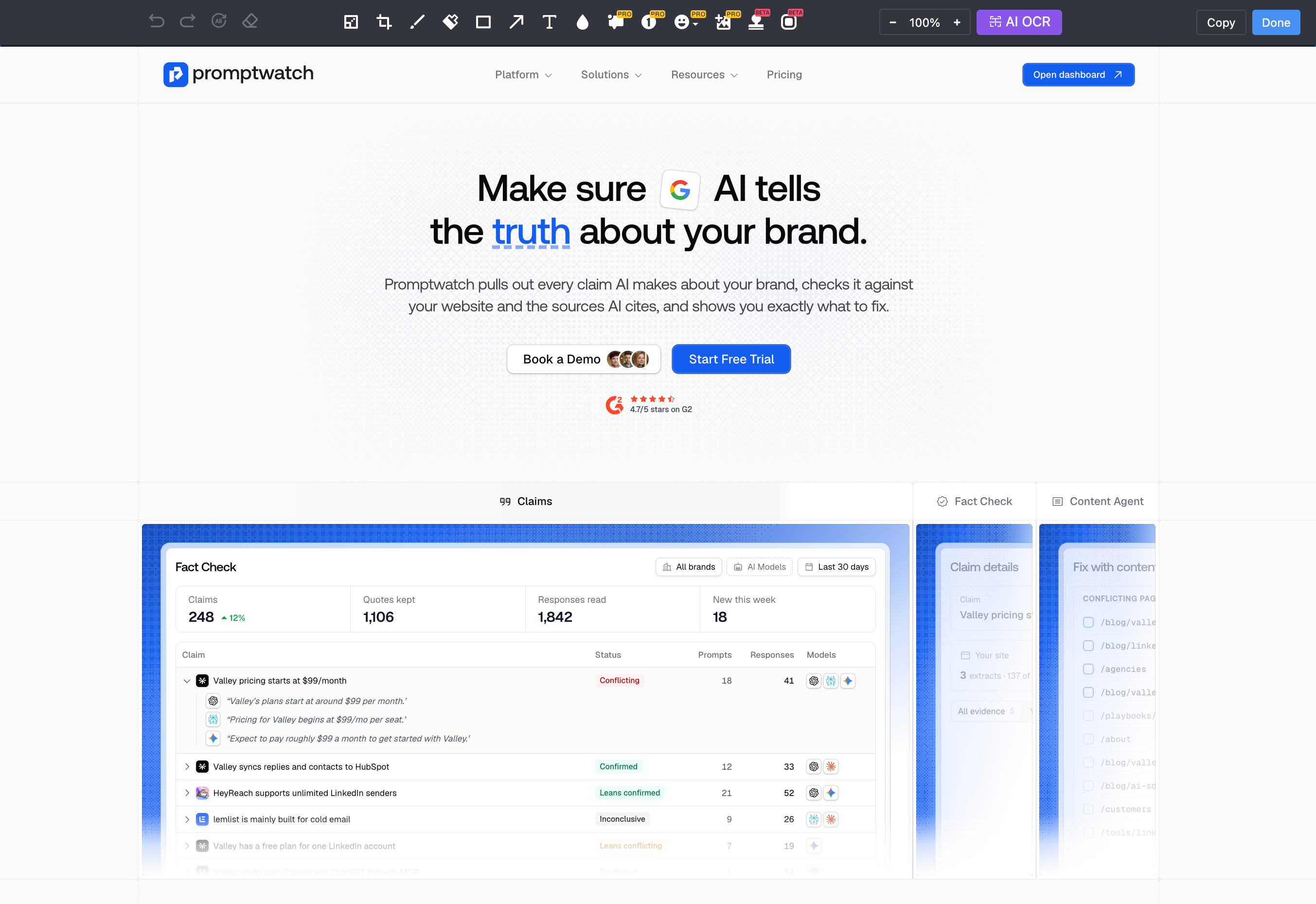
Promptwatch Fact Check is built to make sure AI tells the truth about your brand. It pulls out every claim AI makes about you from the prompts you track, checks each one against your website and the sources AI cites, and shows you exactly what to fix.
The workflow runs in three stages:
- Claims. Fact Check extracts statements about your brand and your competitors from every tracked answer, keeps the exact quote, and groups claims by meaning. You mark each claim Accurate or Inaccurate, or dismiss it.
- Verification. Each marked claim is checked against every page of your site and the top 50 sources AI cites, including off-site mentions. A check usually takes 1 to 2 minutes and uses Agent Credits, with the estimate shown before it runs.
- Fixes. Conflicting pages on your own site go to the content agent, which refreshes up to 10 pages in one go. For third-party pages, Fact Check shows which cited source conflicts with the truth so you can contact the site owner.
Every checked claim gets one of five statuses: Confirmed, Leans confirmed, Conflicting, Leans conflicting or Inconclusive. Inconclusive is often the most useful result: it means AI keeps saying something your site never addresses, which points straight to a page you should publish.
The Overview tab adds an Accuracy Score, the share of verified mentions that were accurate, and a "Where does AI get it wrong?" heatmap by model and theme. Because claims come from the same prompts Promptwatch already tracks through AI prompt tracking, fact-checking sits next to visibility, citations and crawler data in one platform.
We fact-check what the AI is saying against your own website, to make sure there's no old or contradictory information sitting there. Does your website actually say what you want it to say? That's basically it.
Availability: Business, Agency Scale and Enterprise plans. Paid Promptwatch plans start at $95/month.
Worth knowing: Fact Check uses AI to read your pages, so it can sometimes surface a page that is only loosely related to a claim. You make the final call by confirming or dismissing each claim. Claims come from your tracked prompts.
2. Profound FactCheck
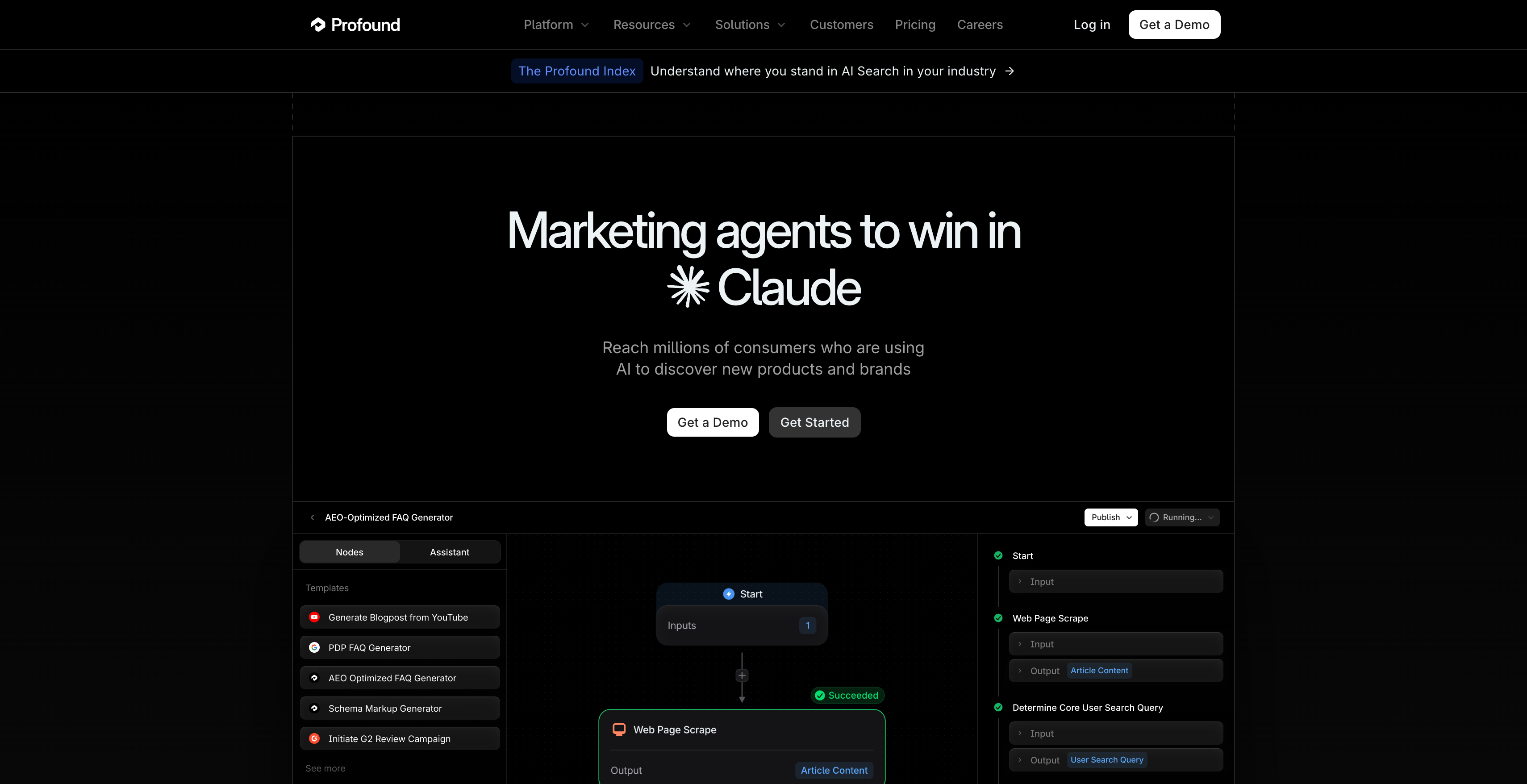
Profound added FactCheck in June 2026, according to its product changelog. You tag prompts for FactCheck, and Profound compares the claims AI makes in those answers to a Knowledge Base you create, which acts as your source of truth. Each claim is classified as accurate, inaccurate or not relevant, and inaccurate claims are linked to the citation URLs that appear to drive them. A Profound Agent can then draft outreach, update the Knowledge Base or create content.
Source of truth: a Knowledge Base you maintain. FactCheck needs one to run.
Availability: Profound's help center lists FactCheck on all plans.
How Promptwatch Fact Check differs: Promptwatch checks claims against your live crawled website, so there is no separate Knowledge Base to write and keep current. That also means it catches your own pages contradicting each other, such as an old blog post that still states a retired price, which a reference document can't reveal. Every claim is also checked against the top 50 sources AI cites, including off-site mentions. Results come in five statuses, and Inconclusive claims flag topics AI keeps raising that your site never addresses. Conflicting pages go straight to the Content Agent, which refreshes up to 10 pages at once and publishes to your CMS.
3. Peec AI Brand Perception
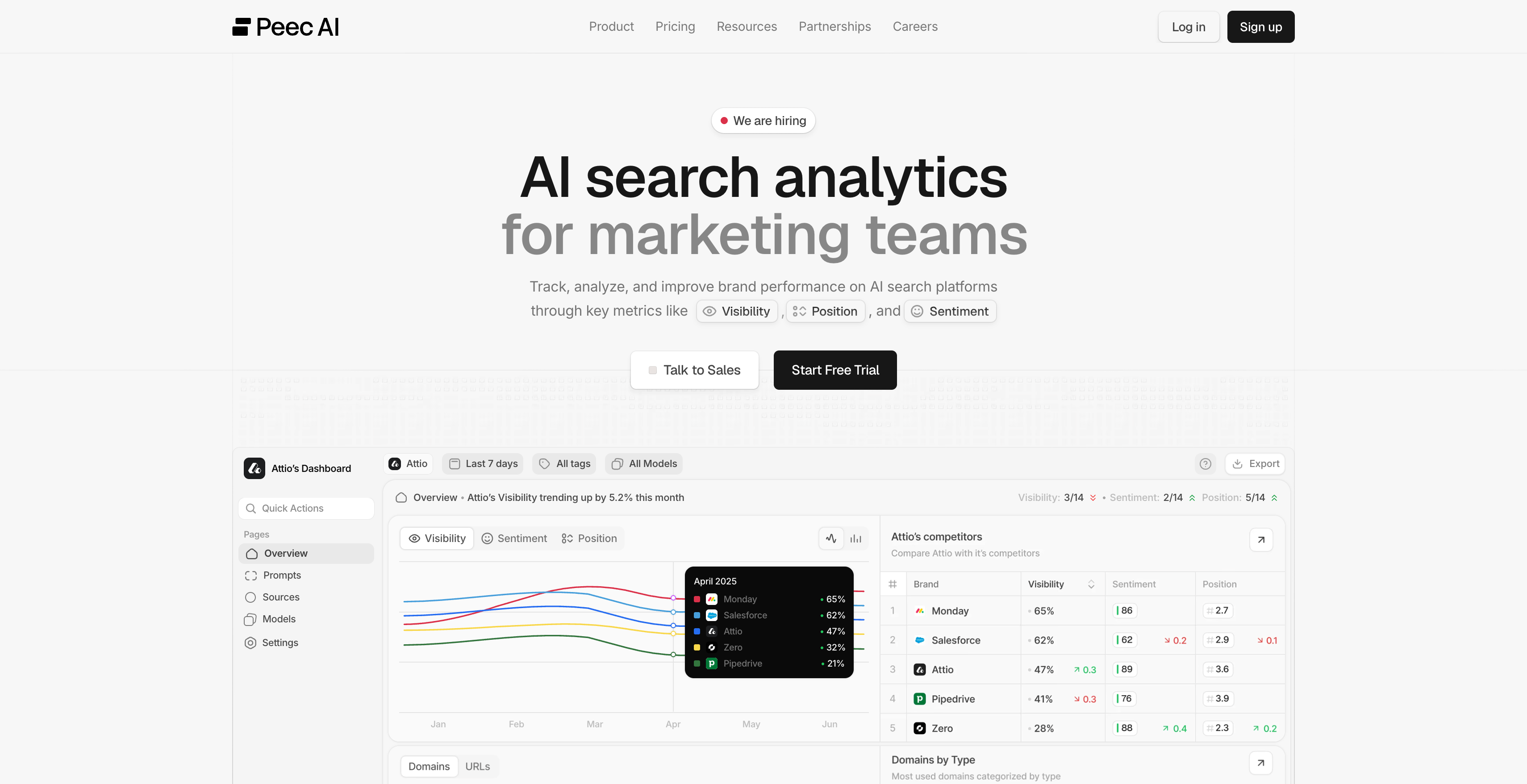
Peec AI's Brand Perception section includes a Fact-checking tab that checks whether what AI says about your brand is true, measured against facts you provide. It reads the answers to the tracked prompts you select. Brand Perception also covers Market (how AI describes you against competitors, by attribute) and Objections (what AI argues against your brand).
Source of truth: a set of facts you provide.
Availability: not specified in Peec AI's documentation.
How Promptwatch Fact Check differs: Peec AI checks claims against a list of facts you supply, which only covers what you thought to write down. Promptwatch checks against every page of your crawled site and the top 50 sources AI cites, so it also finds third-party pages and your own outdated pages that feed AI the wrong answer. When nothing confirms or contradicts a claim, Promptwatch marks it Inconclusive and points to the content gap to fill. Fixes run in the same platform: conflicting pages go to the Content Agent and can be refreshed and published from there.
4. Waikay Fact Tracker
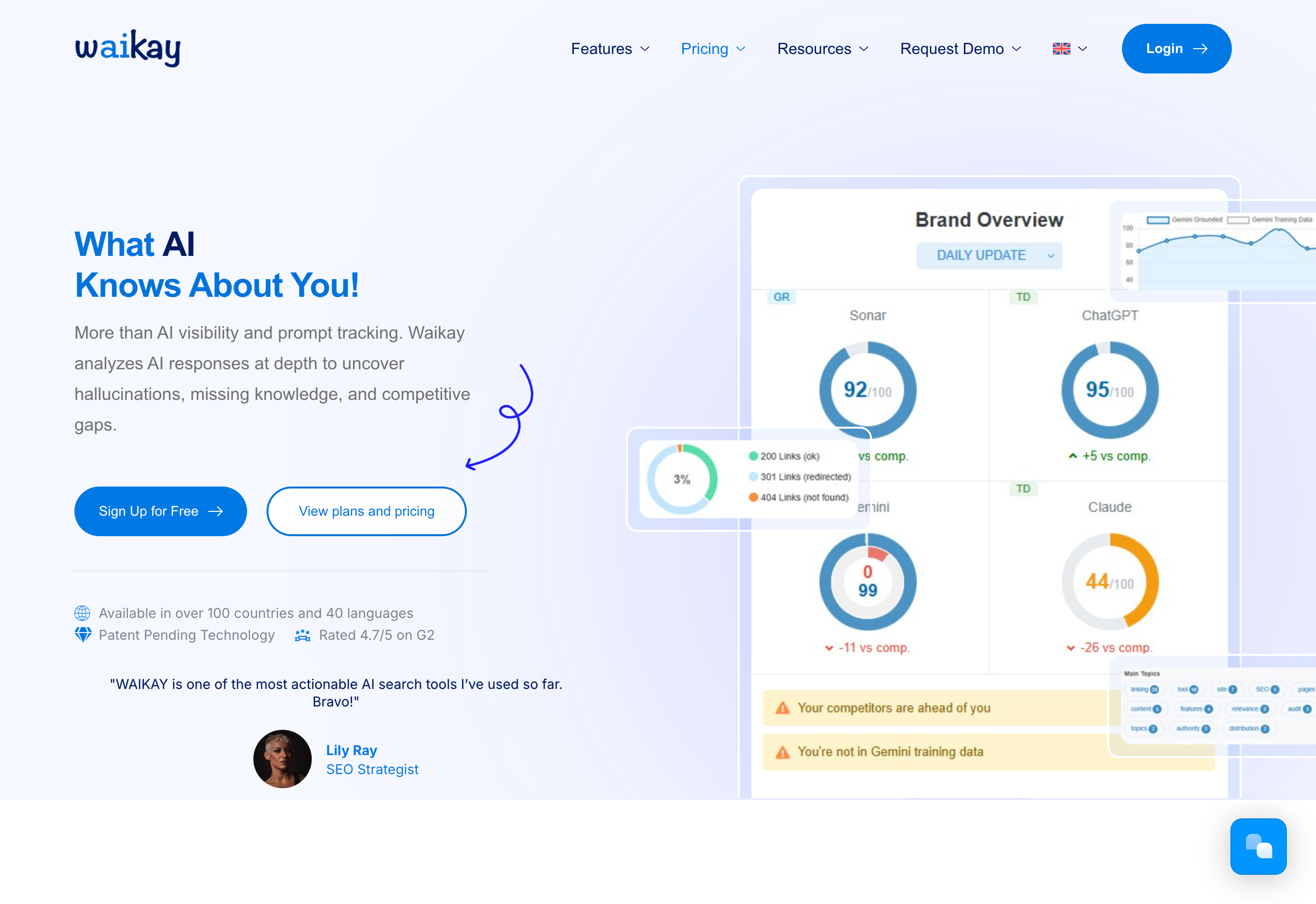
Waikay's Fact Tracker extracts full statements about your brand from ChatGPT, Gemini, Claude and Perplexity answers, collected through topic reports. You review each statement and mark it correct, flag it as wrong or harmful, or delete it. Flagged facts link to Waikay's Source Tracking, which shows LLM-suggested citations that Waikay describes as potential sources, not confirmed originals.
Source of truth: your own manual review.
Availability: refresh frequency (daily, weekly or monthly) depends on plan; pricing not specified on the feature page.
How Do AI Fact-Checking Tools Compare?
| Tool | Claims checked against | Checks third-party cited sources | Fix workflow |
|---|---|---|---|
| Promptwatch Fact Check | Your live crawled website | Yes, top 50 cited sources incl. off-site mentions | Content Agent refreshes up to 10 pages; conflicting sources flagged for outreach |
| Profound FactCheck | A Knowledge Base you maintain | Links inaccurate claims to likely citation URLs | Agent drafts outreach, content or Knowledge Base updates |
| Peec AI Brand Perception | Facts you provide | Not specified | Not specified |
| Waikay Fact Tracker | Your manual review | LLM-suggested potential sources | Manual flagging and review list |
Feature details reflect each vendor's public documentation as of November 2026.
Why Does the Source of Truth Matter So Much?
A fact-checking tool is only as good as what it checks against. A knowledge base or fact list you maintain separately can drift out of date just like any other document, and when it does, an outdated claim can pass the check. A manual review depends on whoever has time to do it.
Checking against your live website catches a problem the other approaches miss: your own site contradicting itself. An old blog post announcing a retired plan, a comparison page with last year's feature list or a pricing FAQ nobody updated can all feed AI the wrong answer, even when your main pages are correct. That drift is constant. Promptwatch tracked every page ChatGPT cited on July 6, 2026 for 90 days to measure the half-life of content in ChatGPT: product pages, reviews and how-to guides lost half their citations in 74 to 77 days, and news pages in 36 days.
Promptwatch saw this on its own site. When Promptwatch ran Fact Check on its own brand before launch, the check returned a passage from Promptwatch's own AEO platform comparison page, tagged "Needs update," that still described "11 platforms included on every paid plan," a figure that no longer matches the current model roster. The page AI was reading was a page Promptwatch had written and never refreshed.
How Do You Test an AI Fact-Checking Tool Before Buying?
Run a short trial built around answers you already know are wrong:
- Pick 10 to 15 real buyer prompts, such as "[your brand] pricing," "[your brand] vs [competitor]" and "best [category] tool for [use case]."
- Collect three or four AI answers you know contain errors about your pricing, features or policies.
- Check the evidence for each verdict. The tool should show the exact claim, the AI answer it came from, the passage it compared against and the cited source.
- Test a contradiction on your own site. If an old page still states something outdated, see whether the tool finds it.
- Fix one claim and re-run the check to see how the tool reports the change.
If you want to run the process by hand first, Promptwatch's guide to AI brand checks walks through a manual method step by step.
FAQ
What is the best tool to fact-check what AI says about my brand?
The best tool extracts individual claims from real AI answers, checks each one against a source of truth, and shows the evidence behind every verdict. Promptwatch Fact Check does this against your live website and the top 50 sources AI cites, then sends conflicting pages to the Content Agent to fix.
Can AI visibility tools tell me if AI is wrong about my brand?
Most AI visibility tools track whether and how often your brand is mentioned. Checking whether those statements are true is a separate capability offered by a smaller set of tools, including Promptwatch, Profound, Peec AI and Waikay.
What should a fact-checking tool check AI claims against?
It should check claims against an up-to-date source of truth. Your live website is the most direct option, because it's what AI reads and it reveals pages that contradict each other. A separate knowledge base works only as long as someone keeps it current.
Can I fact-check AI answers about my brand for free?
Yes, manually, for a small set of prompts: run the same questions across ChatGPT, Gemini and Perplexity, split each answer into individual claims, and check each claim against your site and the sources the model cites. It becomes hard to sustain once you track more than a handful of prompts across several models.
How do I fix wrong information AI gives about my brand?
Fix the source AI is reading. If your own page states the wrong fact or contradicts another page, update it. If a third-party page is the source, contact the site owner with the correct information, starting with the sources AI cites most often.
Which Promptwatch plans include Fact Check?
Fact Check is available on the Business, Agency Scale and Enterprise plans, and each check uses Agent Credits. Brand Narrative, which shows how AI perceives your brand overall, is available on all plans.

