


TL;DR
- A prompt tracker can tell you your brand was mentioned in ChatGPT. It can't tell you whether an AI crawler ever reached your compliance-approved pages, or whether the citation it earned came from a page your legal team signed off on. That gap matters more for fintech than almost any other vertical.
- For regulated content, review workflow is not optional. Promptwatch's Content Agent sends every AI-drafted page to a review inbox by default: nothing publishes to your CMS until a human approves it, which matters when compliance has to sign off before anything goes live.
- Fintech AI answers lean heavily on third-party comparison and review sites (think NerdWallet-style aggregators, Reddit threads, trade press). Promptwatch's Off-site Mentions and Reddit tracking surface those sources even when they don't link back to your domain, which most prompt trackers simply don't capture.
AI Visibility Tools for Fintech Companies: What to Look for in 2026
If someone asks ChatGPT to compare payment processors, or asks Perplexity which robo-advisor has the lowest fees, your fintech brand is either in that answer or it isn't. There's no page two. That's the entire premise of AI visibility (also called Generative Engine Optimization, or GEO): tracking and improving how often, and how favorably, AI models mention your company when people ask the questions that actually lead to a signup or a sales call.
Fintech has a specific version of this problem. Financial content sits in Google's "Your Money or Your Life" category, which means AI models are more conservative about which sources they trust, and more likely to lean on comparison sites, regulators, and community discussion over a vendor's own marketing pages. A generic AI visibility tool built for e-commerce or SaaS won't necessarily surface that pattern.
"Since implementing Promptwatch, we've seen a measurable increase in our LLM visibility. Its clear insights into share of voice, content gaps, and AI crawler activity have made it a core part of our marketing reporting stack." Sam Franklin, VP Marketing, Landytech
What "AI visibility" actually means for a regulated brand
Three terms get conflated constantly, and getting them straight matters more once compliance is asking questions about your marketing stack:
- Mention: any AI response that includes your brand name, even in passing.
- Citation: the model explicitly points to a page as its source, usually with a link.
- Visibility score: a composite that weighs position, tone, and competitor presence into one number, so a brand mentioned often but buried or hedged can still score low.
For fintech specifically, the citation layer matters more than the mention count. If ChatGPT tells a user your APR is 2 points higher than it actually is, and the source it cited is a stale comparison page, that's not a marketing problem, it's a compliance exposure. Tools that only count mentions won't catch that a crawler pulled from an outdated page, or that a citation traces back to a source with no relationship to your actual disclosures.
"Promptwatch gives us a comprehensive way to explore AI visibility data in depth, uncover patterns, and better understand where our brand appears across generative search experiences." Susanna Marsiglia, Senior SEO Consultant and UX Specialist, Six Group
What to look for in an AI visibility tool for fintech
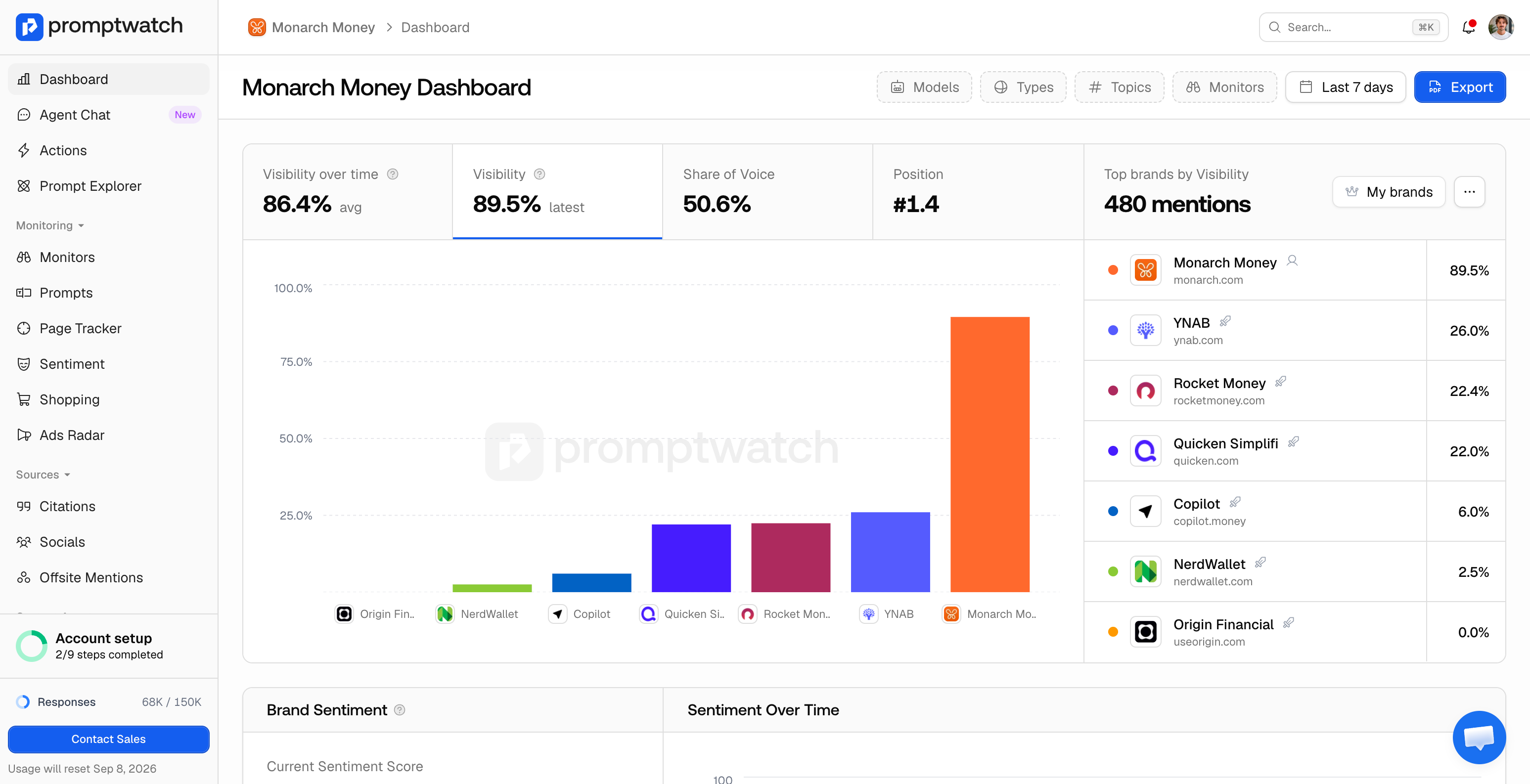
- Crawler-to-citation tracing, not just crawl logs. Knowing that GPTBot hit your site 400 times last week tells you nothing on its own. What matters is whether the pages it crawled are the ones actually getting cited, and whether crawlers are being blocked on the compliance-approved pages you want surfaced. Promptwatch's AI crawler logs capture the crawler identity, page requested, and status code per hit, and connect that path to which pages actually earn citations, rather than reporting crawl volume in isolation.
- A review step before anything reaches your CMS. If a tool auto-publishes AI-drafted content, that's a non-starter for most compliance teams. Promptwatch's content agent defaults every draft to a review inbox; nothing publishes until a human approves it, and hands-off publishing is opt-in and schedule-bounded rather than the default.
- Coverage of where fintech AI answers actually draw from. Comparison aggregators, Reddit threads, and trade press carry more weight in financial queries than in most categories. Promptwatch's Off-site Mentions tracks third-party sources that discuss your brand even without a link back, categorized by type (review, comparison, community, news), and its Reddit tracking shows exactly which threads are getting cited.
- Visitor analytics separate from crawler activity. Bot traffic tells you what AI can see. Human clicks from an AI answer tell you what's converting. Confusing the two produces a dashboard that looks impressive and means nothing for pipeline. Promptwatch tracks AI-referred visitor traffic and conversions as a separate metric from crawler logs, never blended into one number.
- Published methodology. When your score differs from a competitor's tool by 10 points, you want a formula you can explain to your own team, not a black box. Promptwatch calculates Visibility Score as Position + Context − Competitors, counts unmentioned responses as zero, and publishes that formula rather than treating it as proprietary.
Comparing the field
For a broader rundown across all 21 tools in the category, not just the four below, see the full list of Promptwatch competitors.
| Feature | Promptwatch | Otterly.AI | Profound | Semrush AI Toolkit | Ahrefs Brand Radar |
|---|---|---|---|---|---|
| Entry price | $95/mo | ~$29/mo (Lite) | $99/mo (ChatGPT only) | $99/mo per domain, billed annually | ~$328/mo (Lite + Radar + 1 index) |
| Engines on entry plan | 4 of 11, chosen from full roster | 4 core; Claude/Gemini are paid add-ons | ChatGPT only; 3 engines at $399/mo Growth | AI Overviews + select LLMs | Multiple, index-based add-on pricing |
| Crawler / agent logs | Yes | Not offered | Yes | Not offered | Not offered |
| Visitor analytics | Yes, on every plan | Not offered | Yes | Add-on | Partial, no AI-specific attribution |
| Off-site / Reddit mentions | Yes, dedicated tracking | Partial, source-level only | Partial, source-level | Partial, source-level | Partial, free beta |
| Content generation | Yes, review-inbox by default before anything publishes | Not offered | Yes | Partial, add-on | Not offered |
Why the compliance layer changes the calculus
Two patterns come up specifically in fintech and insurance evaluations that don't show up as often in other verticals:
- Sentiment nuance. A phrase like "high fees" or "denied claim" can register as negative sentiment even when it's a factually accurate, neutral description pulled from your own disclosures. A tool that scores sentiment without letting you review the underlying response can misrepresent how your brand is actually being discussed. Promptwatch scores sentiment per response on a 1-100 scale based only on how the brand is discussed, excludes bare mentions with no opinion from the average rather than counting them as neutral, and lets you read the full response behind every score.
- Brand-name consolidation. Financial services brands frequently operate under multiple legal entities, whether from acquisitions, rebrands, or regional subsidiaries, and AI models don't always know they're the same company. Promptwatch's brand merging rolls multiple entities into one visibility tracking view, so a holding company doesn't have to run five separate monitors to see its actual footprint.
Neither of these is unique to Promptwatch in principle, but they're the kind of detail that only shows up once you've actually onboarded a regulated brand, which is a large part of why they're worth asking about directly in any vendor evaluation rather than assuming a generic "AI visibility platform" checkbox covers it.
FAQ
Does content generated by an AI visibility tool need compliance review before it publishes?
With Promptwatch, yes by default: every draft goes to a review inbox and nothing publishes without approval. An opt-in hands-off mode exists for teams that want to automate publishing once drafts pass an automatic quality check, but it isn't the default behavior.
Can an agency manage multiple regulated financial clients from one account without their data mixing?
Yes. Promptwatch is built around one account and one subscription per agency, with no sub-accounts and no per-client billing, so only the agency is invoiced. Client separation happens at the project level: each client's brand, competitors, prompts, and dashboards live in their own project, and nothing crosses between them. Seats can be restricted per project as viewer or editor, and white-label access gives clients branded, read-only visibility into their own reporting only.
Can I track AI visibility separately across different countries or regulatory jurisdictions?
Yes, at country, state, and city level, including local languages per region. A Monitor is scoped to one country, language, and optionally a US state or city at a time, so a multi-market fintech runs separate monitors (for example, "US — English" and "UK — London") rather than one blended number that would average away where a brand wins or loses in a specific jurisdiction.


