

TL;DR
- An AI visibility tool for healthcare runs the questions patients, caregivers, and clinicians ask through ChatGPT, Google AI Overviews, Gemini, and Perplexity, then reports which hospitals, clinics, pharma, and health brands get recommended and which sources each answer used.
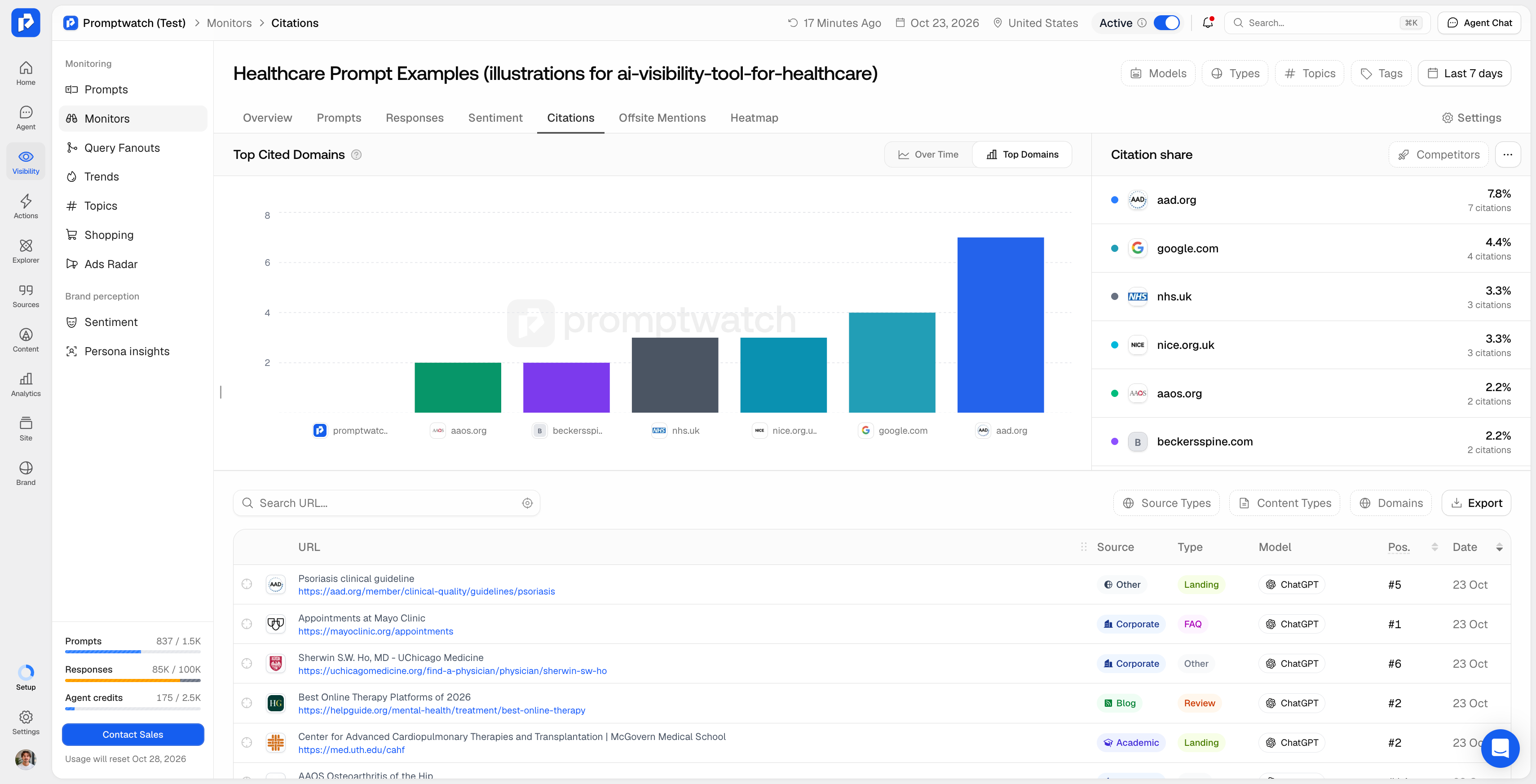
- Healthcare answers lean heavily on government, research, and medical association sources, so the tool has to show citation sources by domain and source type, alongside brand mentions.
- Accuracy, local results by city, and a privacy-safe setup matter more in healthcare than in most categories, because AI repeats outdated claims at scale and buyers face IT and compliance review.
- Promptwatch covers that path with real-interface tracking across 12 AI platforms, citation and Off-site Mentions reports, city-level monitors on every plan, Agent Analytics crawler logs that keep bot requests only, and visitor and conversion tracking.
Patients now ask ChatGPT which dermatologist to see in Chicago, whether a medication interacts with another, and which hospital has the best cardiology program near them. An AI visibility tool for healthcare measures what those assistants answer: whether your hospital, clinic, pharma brand, or health app is named, how it is described, which competitors appear instead, and which websites the answer was built from.
This guide draws on Promptwatch's ChatGPT citation share for healthcare prompts report, published October 9, 2026, which analyzed which domains ChatGPT cited for organic healthcare prompts between September 9 and October 8, 2026.
What an AI Visibility Tool for Healthcare Measures
An AI visibility tool sends a fixed set of prompts to AI assistants on a schedule, stores every answer, and scores how each brand appears. For healthcare, those prompts mirror the questions people ask before they book a doctor, choose a treatment, compare insurance plans, or start a medication. The output is a time series per prompt, per AI platform, and per location.
Three metrics carry most of the reporting, and each measures something different:
- Mention: the answer names your organization. Naming it three times in one answer still counts as one mention.
- Citation: the answer links to one of your pages as a source. A hospital can be cited for a condition guide without being recommended as a place to get treated.
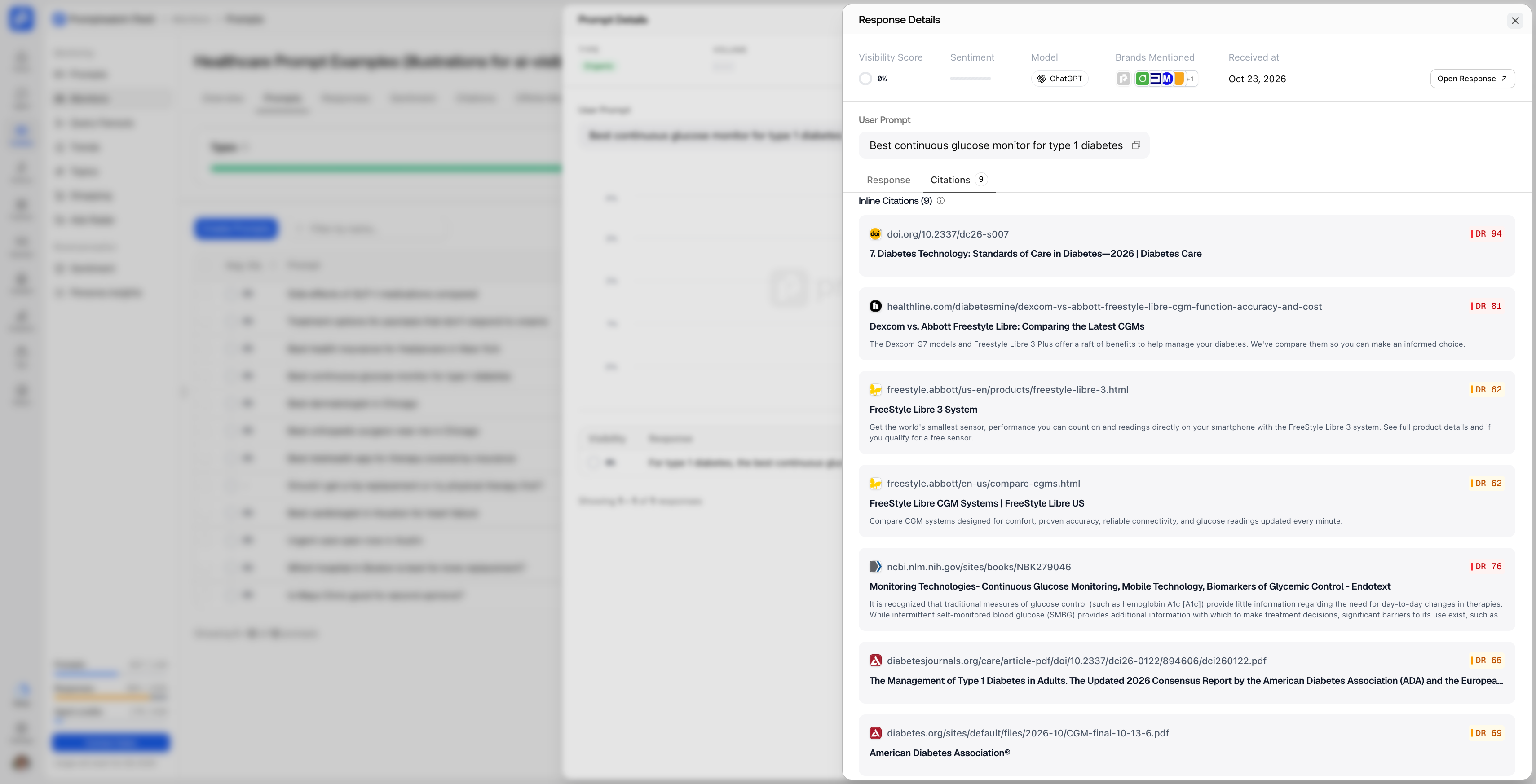
- Visibility Score: a 0 to 100 score per answer based on placement. A sole recommendation scores 100, first place in a ranked list scores 90 to 94, second 65 to 80, and a brief passing mention 10 to 24. Answers that leave your brand out score 0, and the headline number averages every answer, zeros included. Promptwatch's guide to the visibility score explains the bands in full.
Healthcare teams also need a fourth layer: whether the answer is correct. A wrong opening hour, a discontinued service line, or an outdated dosage description gets repeated in every answer that draws on the same source.
Why Healthcare Needs a Different AI Visibility Setup
Healthcare sits in the category Google's Search Quality Rater Guidelines call "Your Money or Your Life": topics where inaccurate information can harm health. AI assistants apply similar caution, which shapes who gets cited and recommended. Four differences change what a healthcare team should track.
AI answers favor authoritative medical sources
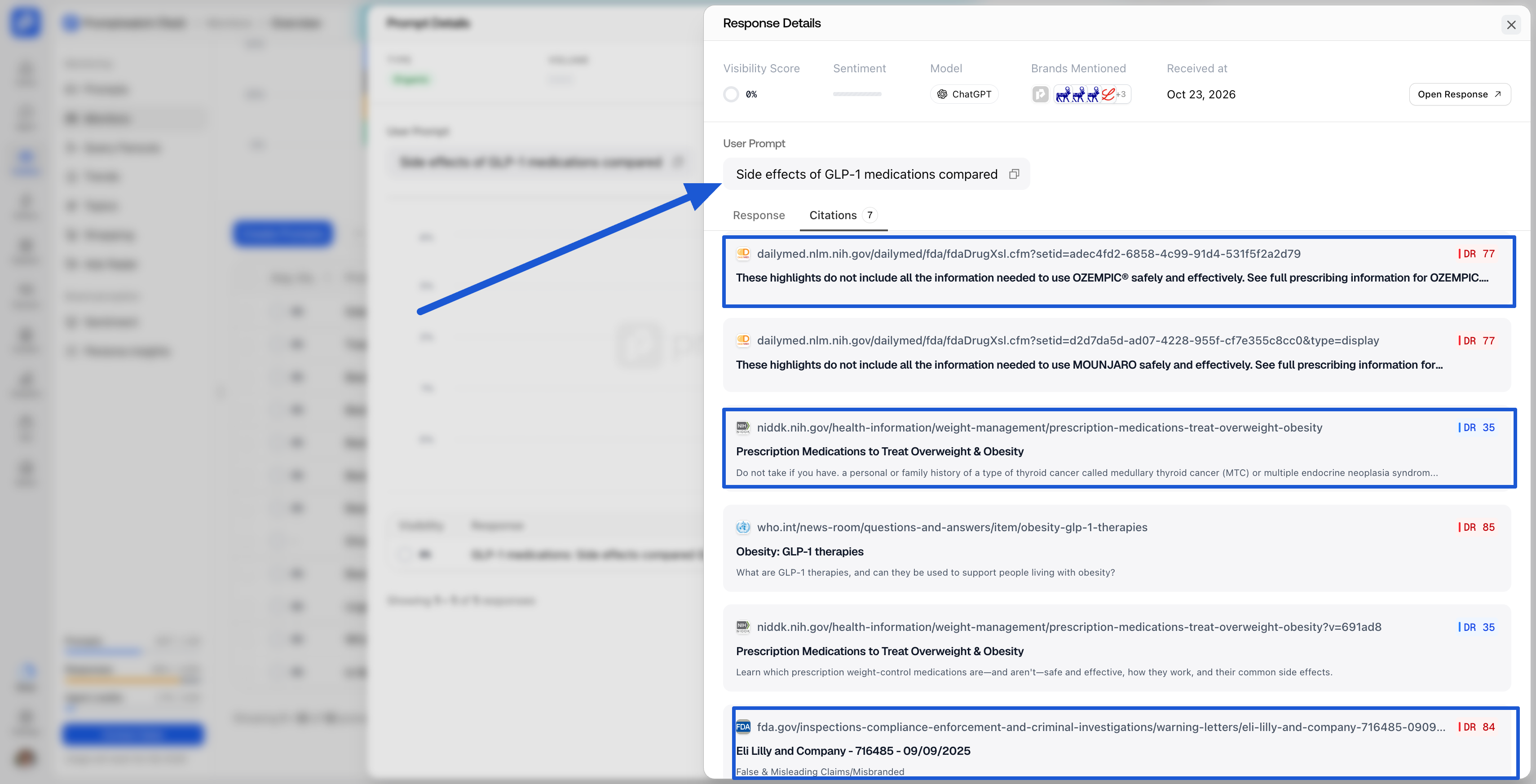
For health questions, AI assistants cite government agencies, research databases, and medical associations far more often than brand sites. A hospital or pharma brand competes for citations with NIH and the FDA, and for recommendations with other providers. The tool needs to show both sides.
Accuracy carries clinical and legal weight
An AI answer that misstates a treatment, a side effect, or an insurance policy can mislead patients and create regulatory exposure for regulated brands. Healthcare teams need to read the full answer text and trace each claim to the page it came from, then fix the source.
Local answers decide appointments
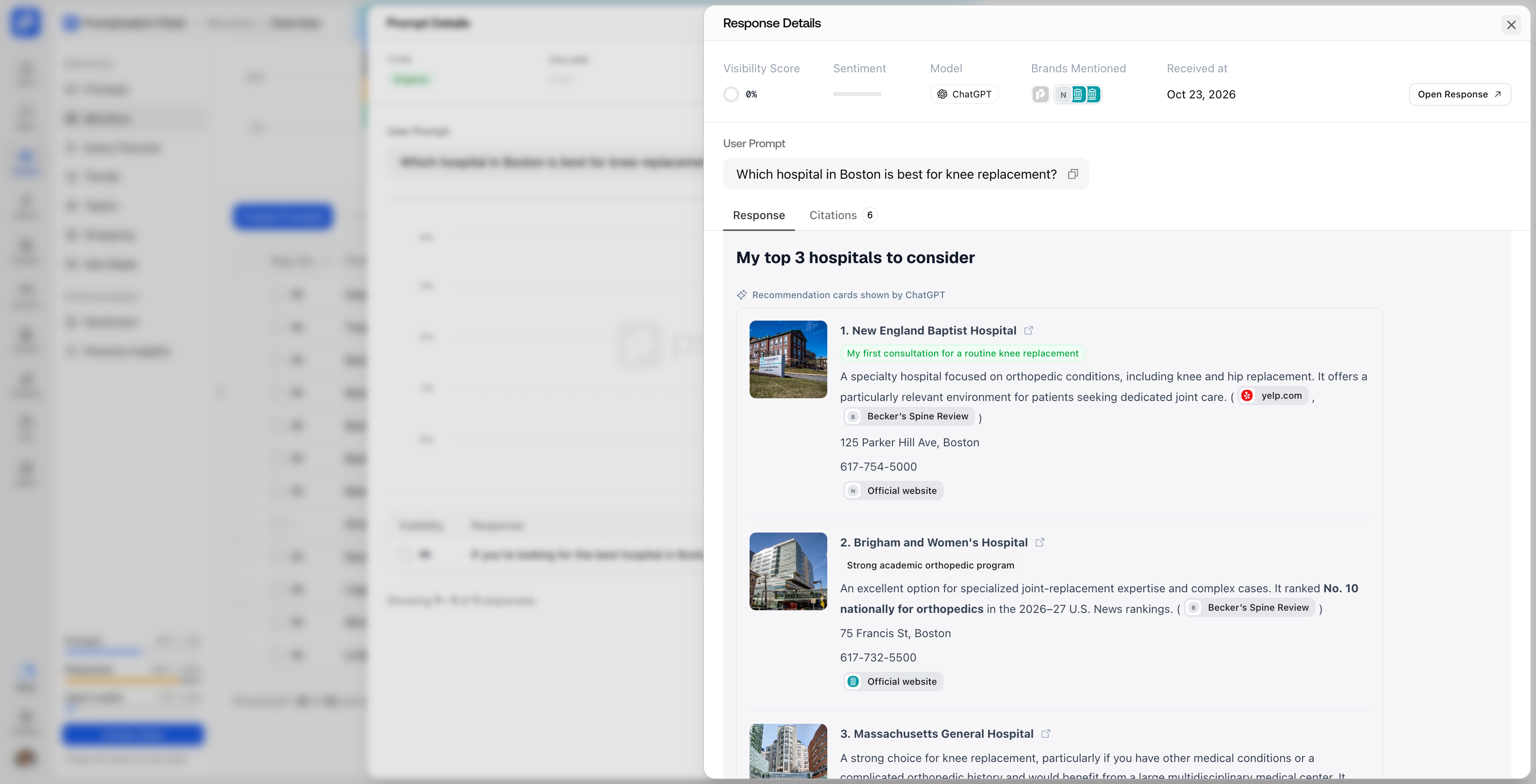
"Best orthopedic surgeon near me" and "urgent care open now in Austin" return different providers in every city. Health systems with many locations need each market reported separately, since a national average hides where a facility disappears.
Buyers face IT, security, and compliance review
Hospitals, insurers, and pharma companies run vendor reviews before connecting any tool to their infrastructure. Based on Promptwatch's analysis of around 150 customer conversations, regulated and healthcare buyers repeatedly raise sentiment nuance, fact-checking against approved medical documents, and strict IT and security review. A tool that is clear about what data it stores clears that review faster.
What ChatGPT Cites for Healthcare Prompts: Promptwatch Data (October 2026)
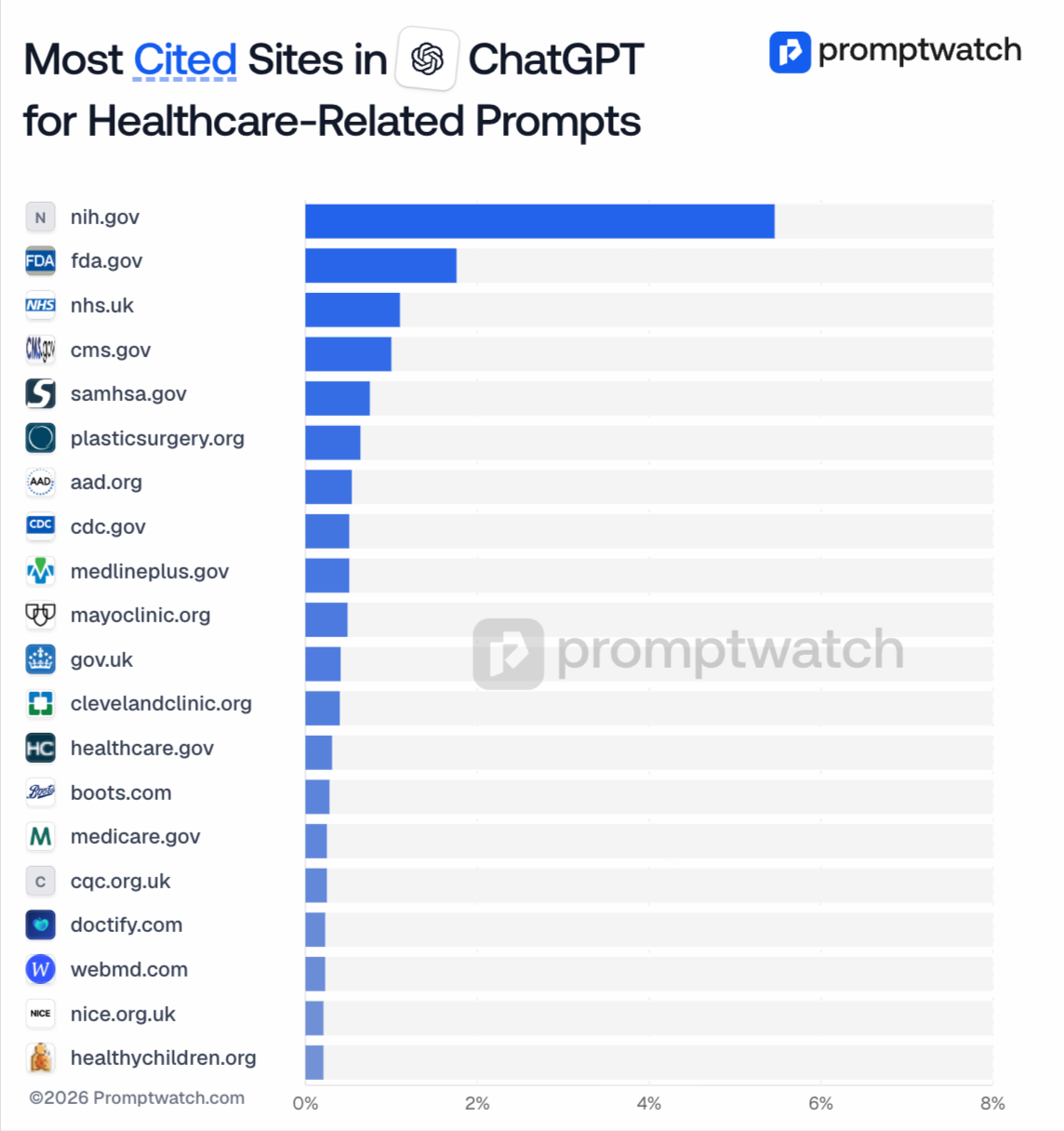
Promptwatch analyzed ChatGPT citations for organic healthcare prompts covering treatments, medications, health insurance, and finding doctors, from September 9 to October 8, 2026. Citation share is each domain's percentage of all healthcare citations in that period.
| Rank | Domain | Share of healthcare citations |
|---|---|---|
| 1 | NIH (six nih.gov subdomains, including PubMed Central at 2.38% and PubMed at 2.33%) | 5.46% |
| 2 | FDA (including accessdata.fda.gov) | 1.76% |
| 3 | NHS | 1.10% |
| 4 | American Society of Plastic Surgeons | 0.64% |
| 5 | American Academy of Dermatology | 0.54% |
| 6 | Mayo Clinic | 0.49% |
| 7 | Cleveland Clinic | 0.40% |
| 8 | Boots | 0.28% |
| 9 | Doctify | 0.23% |
| 9 | WebMD | 0.23% |
Government and research sources dominate
NIH alone earns more ChatGPT healthcare citations than the FDA, NHS, CMS, and SAMHSA combined. The source-type split shows how far public sources lead:
- Government and public health sites: 7.06% of all healthcare citations.
- NIH and medical research databases: 5.46%.
- Combined: more than three quarters of the 15.54% earned by the 20 charted domains.
For a healthcare brand, many prompts are answered from public research and regulatory pages. Content aligns with the sources ChatGPT already trusts when it:
- Links medical claims to peer-reviewed studies on PubMed or PubMed Central.
- Stays consistent with FDA, CDC, NHS, and NICE guidance.
Specialty associations outrank hospitals
Medical associations earn more ChatGPT healthcare citations than the best-known hospitals:
- American Society of Plastic Surgeons and American Academy of Dermatology: 1.18% combined.
- Mayo Clinic and Cleveland Clinic: 0.89% combined, and the only hospitals in the chart.
For providers and medtech brands, specialty associations are a citation channel worth working with. Guidelines, member directories, and patient education pages on those sites shape what ChatGPT says about a specialty.
Directories and pharmacies still earn a share
Third-party directories and one pharmacy also make the chart:
- Boots: 0.28%, the only pharmacy.
- Doctify and WebMD: 0.23% each.
- Reviews and directories combined: 0.46%.
For clinics and individual practitioners, complete and current profiles on directory sites are part of AI visibility work, since those pages feed "find a doctor" answers.
What the data means for tool choice
A healthcare team needs a tool that:
- Reports citations by domain and source type.
- Includes third-party pages that mention the brand without linking to it.
- Separates prompts by intent.
Mention counts alone would miss that most citations in this category go to sources the brand does not own.
Which Healthcare Prompts to Track
The prompt set decides what the data can tell you. A useful set mirrors the questions each audience asks, and it leans on non-branded prompts, because a prompt that names your brand almost always returns it. Teams that need a method to choose prompts to track can start from this matrix:
| Prompt type | Example | Who needs it |
|---|---|---|
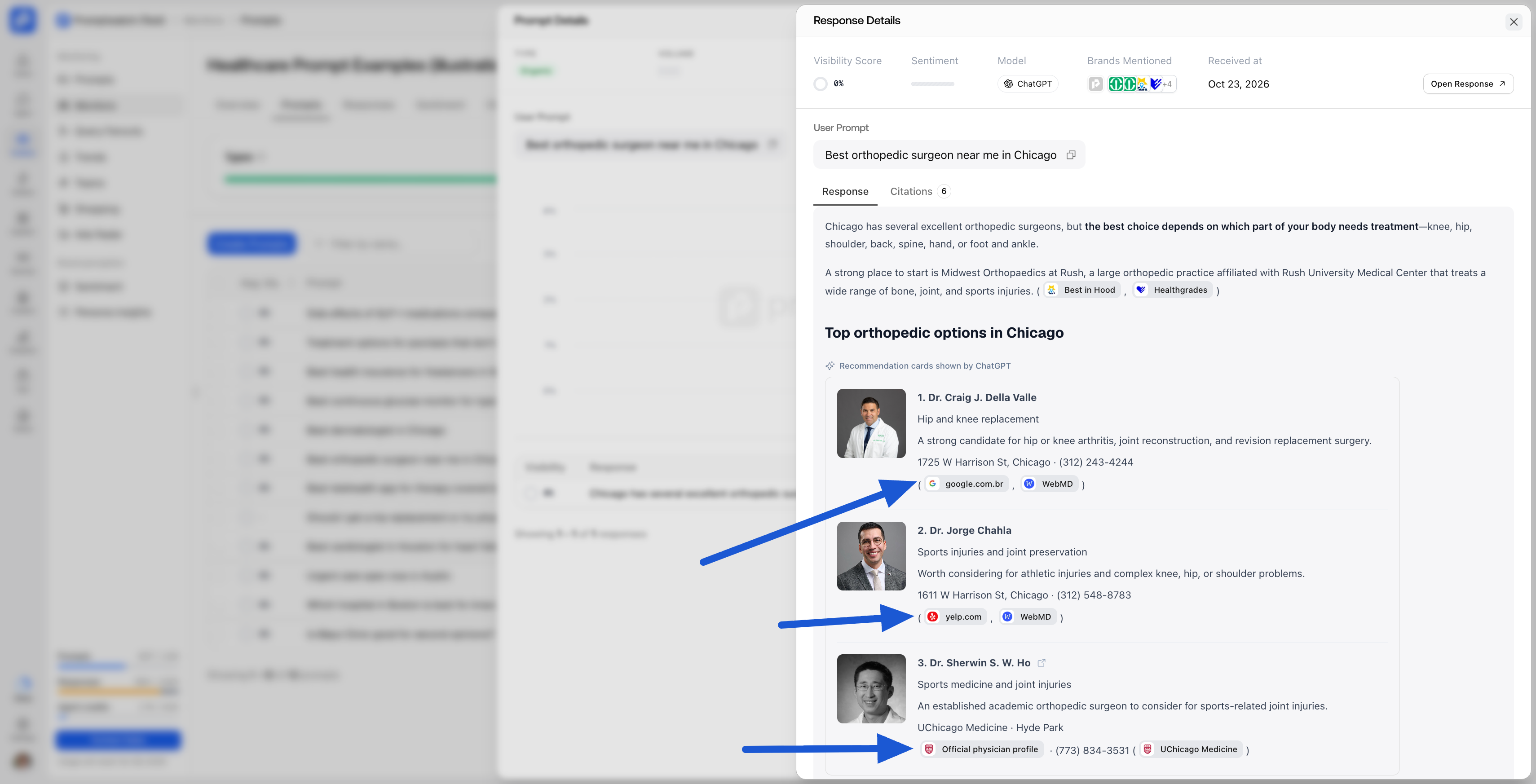
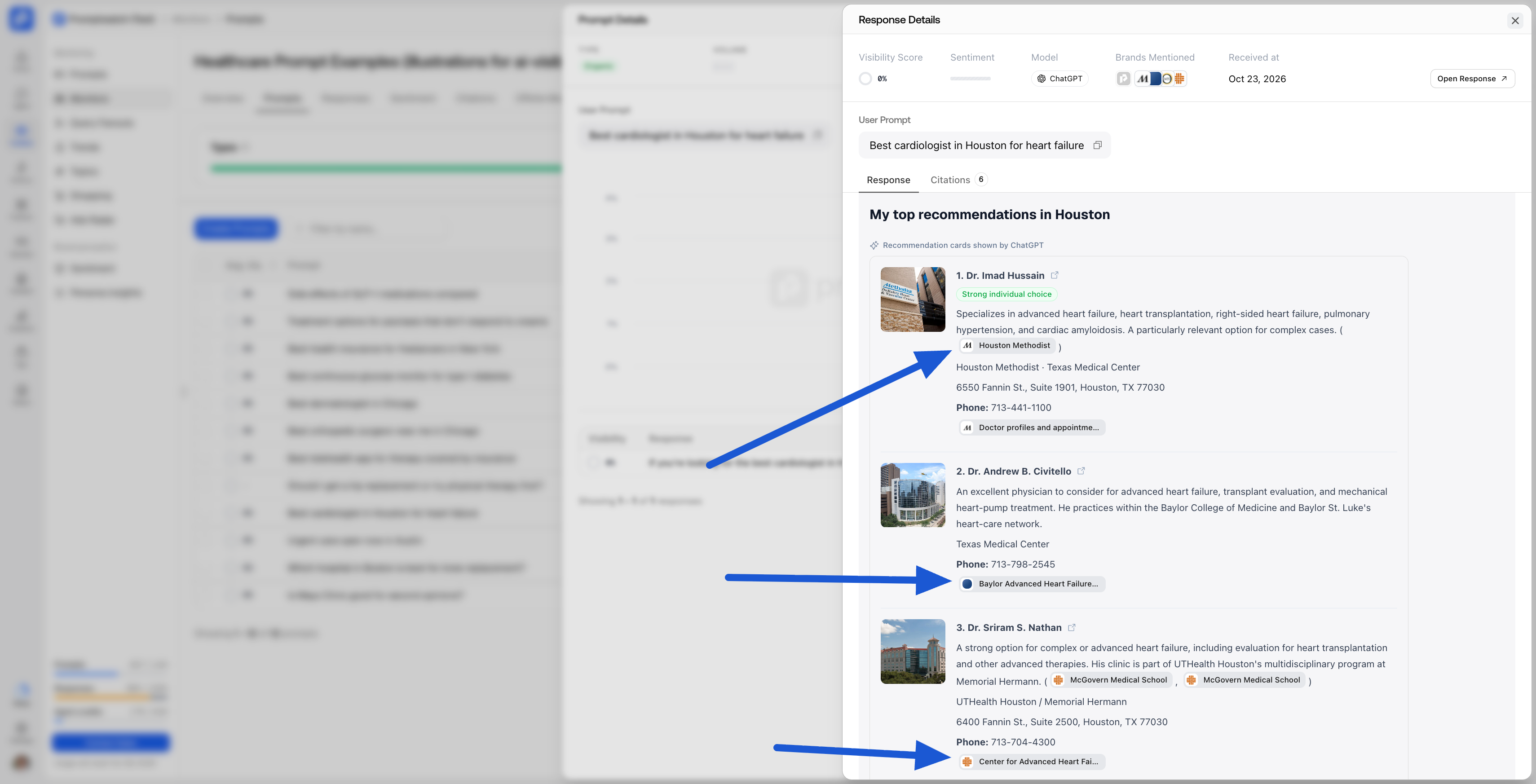
| Find a provider | "Best cardiologist in Houston for heart failure" | Hospitals, health systems, clinics |
| Facility | "Which hospital in Boston is best for knee replacement?" | Health systems, specialty hospitals |
| Condition and treatment | "Treatment options for psoriasis that don't respond to creams" | Pharma, medtech, specialty clinics |
| Medication | "Side effects of GLP-1 medications compared" | Pharma, pharmacies |
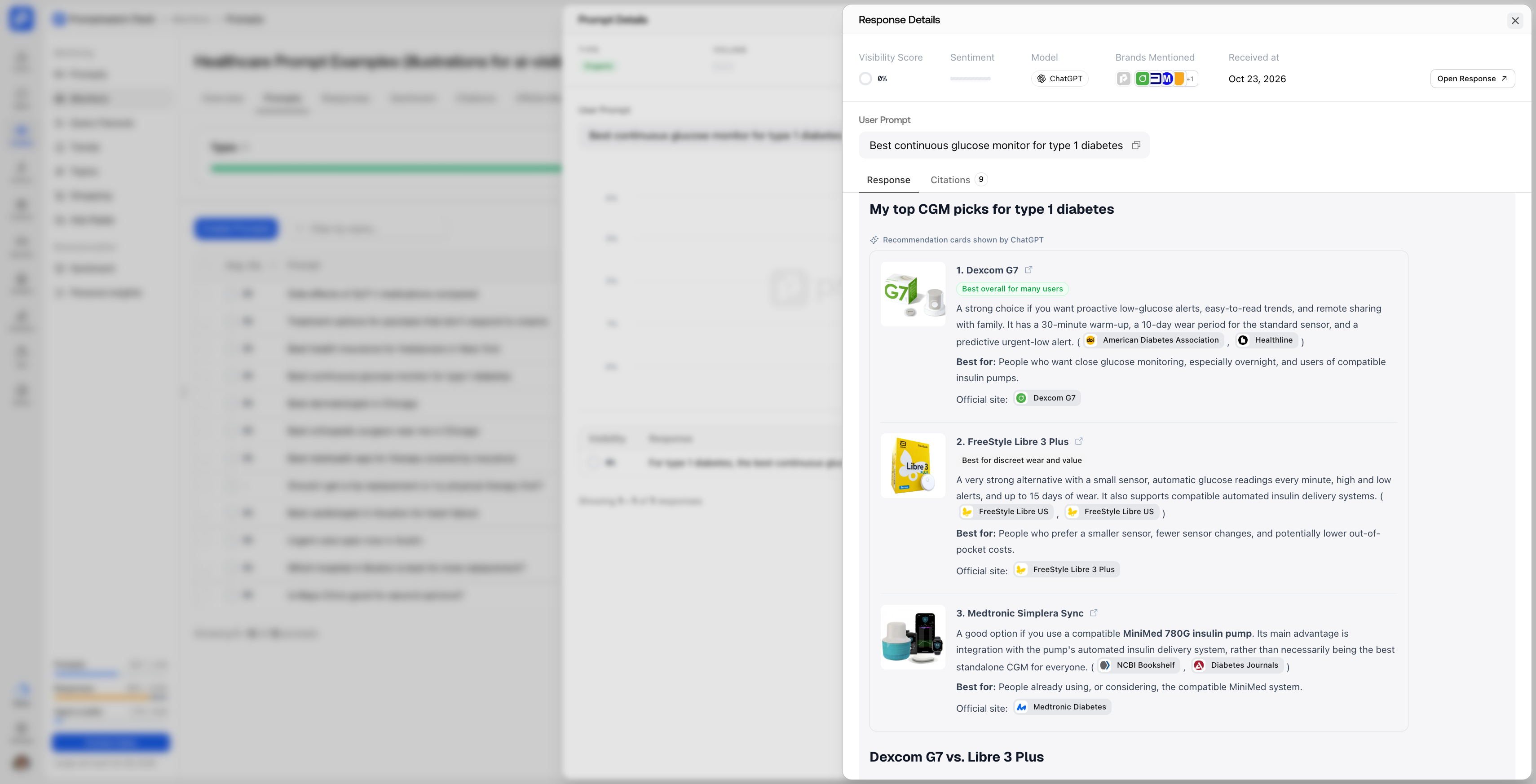
| Device | "Best continuous glucose monitor for type 1 diabetes" | Medtech |
| Insurance | "Best health insurance for freelancers in New York" | Health insurers |
| Digital health | "Best telehealth app for therapy covered by insurance" | Telehealth, digital health |
| Trust | "Is [brand] safe?" / "[clinic] reviews" | All segments |
Tagging prompts by type and intent
Promptwatch's AI prompt tracking tags each prompt by Prompt Type (Organic, Brand Specific, Competitor Comparison) and Intent Type (Informational, Commercial, Transactional, and others). It attaches prompt volume and difficulty, so teams can prioritize the health questions people ask AI most.
Keep patient information out of every prompt. Monitoring prompts are written by the marketing team to represent typical questions, so no patient record, symptom history, or identifier ever needs to enter the tool.
Using query fan-out to find missing content
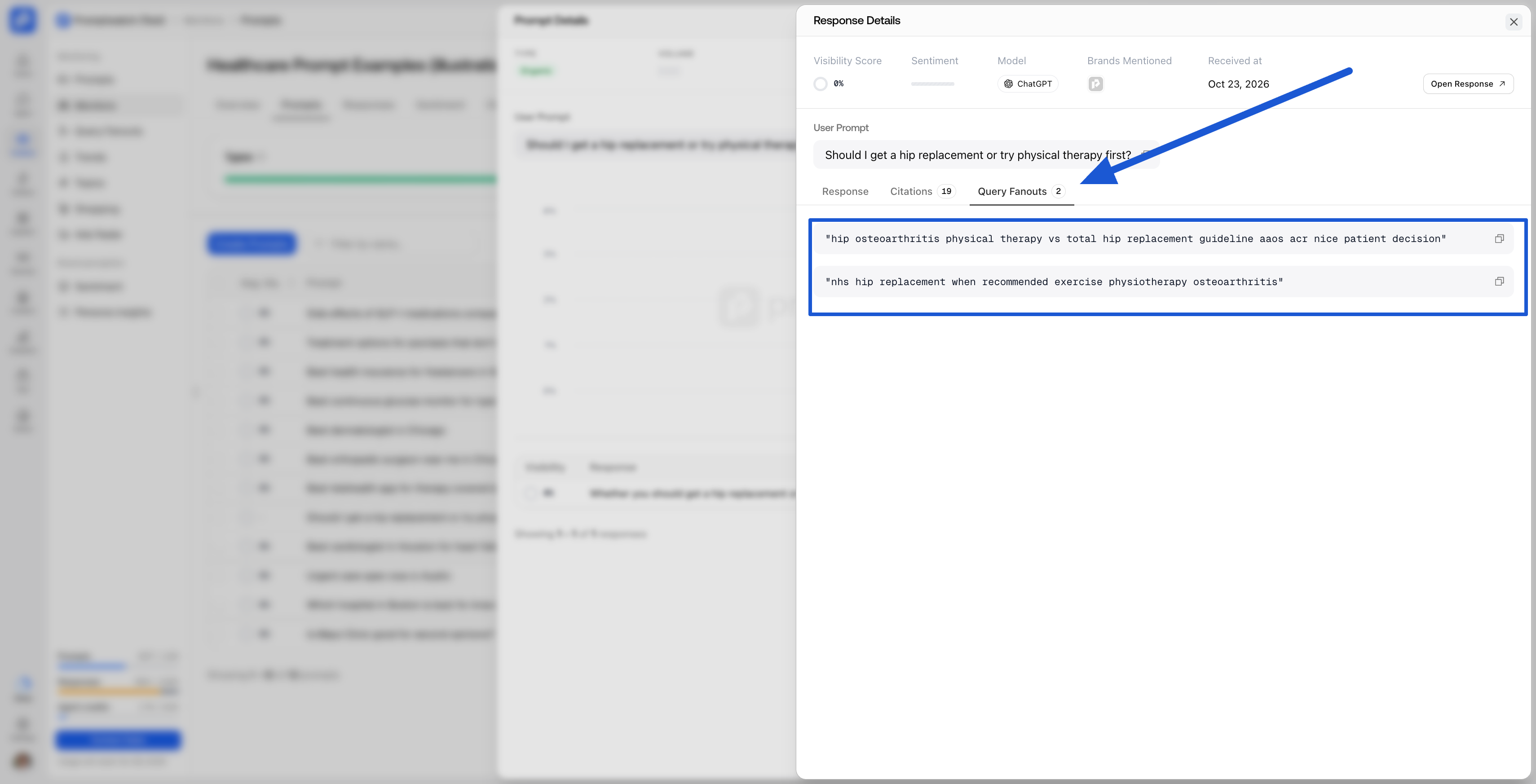
AI models split one health question into several web searches before answering. A patient asking "should I get a hip replacement or physical therapy first" can trigger sub-queries about recovery time, success rates, and costs. Promptwatch records the fan-out for every tracked prompt and re-runs those sub-queries against your own indexed pages, which shows whether your site has a passage that answers each one.
How Each Type of Healthcare Organization Should Set Up Tracking
Each segment loses visibility in a different place, so the setup differs.
Hospitals and health systems
Health systems compete on "best hospital for [procedure] in [city]" prompts and on condition prompts where their patient education pages can be cited. Set up one monitor per market, scoped to the city or US state each facility serves. Promptwatch includes city and state targeting on every plan, and each monitor routes through a geo-located residential proxy so the AI platform returns the local answer. Systems operating across countries can follow the guide to multi-language AI visibility tracking.
Clinics, practices, and specialists
Local, trust-driven prompts decide bookings: "best dentist near me," "[clinic] reviews." The October 2026 data shows directories such as Doctify and WebMD earning ChatGPT citations, so Off-site Mentions matters as much as the clinic's own website. A monitor per location covers most practices.
Pharma and medtech companies
Pharma and medtech prompts are informational and high-stakes: treatment comparisons, side effects, device recommendations. Answers draw on NIH, FDA, and specialty association pages, so citation source analysis shows which public sources shape the answer about your product. Sentiment needs careful reading here, since an accurate mention of side effects can read as negative. Teams comparing approaches can read Promptwatch's guide to LLM brand sentiment monitoring.
Health insurers
Insurance prompts compare plans, coverage, and costs by state or country. They are commercial and comparison-heavy, so track competitor comparison prompts and check that coverage details in AI answers match current policy documents.
Digital health and telehealth brands
Telehealth and health app prompts look like software comparisons: "best app for," "alternatives to," "is it covered by insurance." Track competitor comparison prompts and the review and comparison sites AI cites for your category.
How to Evaluate an AI Visibility Tool for Healthcare
AI visibility products range from measurement platforms to agencies that bundle some AI reporting with SEO services. Evaluate measurement tools on these criteria:
- Data collection method. Check whether the tool runs prompts through the real ChatGPT, Gemini, and AI Overviews interfaces or through model APIs. Local provider answers depend on location and live search results, and the guide to whether AI search monitoring tools query the real ChatGPT explains why API responses differ from what patients see.
Promptwatch scrapes the live interfaces of 12 AI platforms, including ChatGPT, Perplexity, Google AI Overviews, Google AI Mode, Gemini, Claude, and Microsoft Copilot. - Citation source analysis. Check whether the tool shows which government site, research database, association, or directory each answer cited, including third-party pages that mention you without linking.
Promptwatch's Citations and Off-site Mentions reports separate citations of your own site from third-party sources, with dedicated Reddit and YouTube feeds. - Accuracy review. Check whether you can read full answers, filter to the prompts where AI gets your organization wrong, and trace each claim to its source. Promptwatch's guide to AI brand checks walks through that process.
Promptwatch stores every response with its cited sources, so a team can build a monitor from only the prompts with wrong answers and see where the misinformation comes from. - Sentiment that handles medical language. Check how sentiment is scored and whether thin mentions skew it.
Promptwatch scores sentiment per response on a 1 to 100 scale based only on how the brand is discussed, and excludes bare-name mentions from the average. Negative tone does not lower the Visibility Score. - Local and multi-market tracking. Check whether city, state, and country targeting is available, and on which plan.
Promptwatch includes city and state monitors on every plan, Essential included. - Crawler access. Check whether the tool shows if AI crawlers can reach your condition pages, provider directories, and location pages.
Promptwatch's Agent Analytics logs each AI crawler request (GPTBot, ClaudeBot, PerplexityBot) with page, status code, and timestamp. - Privacy and data handling. Check exactly what the vendor stores from your logs and whether any patient data is involved.
Promptwatch keeps a 10-field record per AI or search bot request and drops all human visitor requests, page content, cookies, and other headers before anything is saved. The breakdown of how Promptwatch helps teams monitor AI crawler activity logs is written for security reviewers. - Conversion tracking and a path to fixes. Check whether the tool connects AI referrals to appointment requests or sign-ups, and whether it tells you what to change.
Promptwatch's Visitor Analytics tracks AI-referred visitors and conversions separately from crawler activity, and Content Gap Analysis, Action Items, and Content Agent turn missing prompts into briefs and drafts that wait in a review inbox.
Healthcare AI visibility tools compared
Pricing below was checked against each vendor's public information as of 2026 and should be confirmed on the vendor's site before purchase.
| Tool | Collection | Entry price | City/state tracking | Crawler logs | Notes |
|---|---|---|---|---|---|
| Promptwatch | Real UI scraping, 12 platforms | $95/mo (Essential) | Every plan | Professional ($245/mo) and up | Visitor and conversion tracking; agency tiers from $199/mo |
| Profound | Not specified | $99/mo (ChatGPT only); $399/mo for three engines | Not specified | Yes | Public plans billed annually |
| Semrush AI Visibility Toolkit | Not specified | $99/mo per domain, 25 prompts | Not specified | No | Extra domains, seats, and prompts are paid add-ons |
| Ahrefs Brand Radar | Not specified | Requires an Ahrefs base plan plus per-index fees | Not specified | No | Tracks AI Overviews, AI Mode, ChatGPT and other indexes |
| Otterly.AI | Not specified | $29/mo (Lite), 15 prompts | Not specified | No | Gemini, AI Mode, and Claude are paid add-ons |
| Scrunch | Not specified | About $250/mo (Core), 4 engines, 125 prompts | Not specified | Yes | API and full engine coverage on Enterprise |
Pricing and plan fit
Promptwatch's Brands plans start at $95/mo (Essential: 50 prompts, 6,000 responses per month, 4 of the 12 AI platforms selected per project, city and state tracking). Professional ($245/mo) adds crawler logs and a second project. Business ($579/mo) adds five projects and 350 prompts, which suits a health system tracking several hospitals or service lines as separate brands. Healthcare marketing agencies use the separate Agency tiers (Kick-off $199/mo, Growth $399/mo, Scale $799/mo), which include unlimited projects and prompts and track all 12 platforms at once.
From Tracking to Fixes: A Healthcare AI Visibility Plan
Tracking shows where your organization is missing or misdescribed. This sequence puts the fixes in a practical order:
- Start with a small, approved prompt set. Pick 30 to 50 non-branded prompts per audience and market, reviewed by whoever signs off on medical content. Large regulated organizations often move faster by starting with one brand or business unit while the wider review runs.
- Audit what AI says about you. Read the full answers for your branded and trust prompts, list every wrong fact (services, locations, opening hours, approvals, coverage), and trace each one to its cited source.
- Confirm AI crawlers can reach your pages. Use Agent Analytics to track AI crawler activity on condition pages, provider profiles, and location pages, and catch 403 errors, 404s, and accidental blocks. Crawler log connections at larger organizations often need IT or security sign-off, so plan for a multi-week approval at a hospital or insurer.
- Align content with the sources AI trusts. Link medical claims to peer-reviewed studies, keep wording consistent with FDA, CDC, NHS, and NICE guidance, and show clinical review on condition and treatment pages.
- Work the off-site sources. Keep directory profiles complete, and contribute to specialty association resources where ChatGPT already draws citations.
- Fill content gaps per market. Content Gap Analysis lists the tracked prompts no page on your site answers. Promptwatch's content agent drafts pages grounded in your citation and gap data and your own Knowledge Base, such as approved medical documents. Every draft waits for approval in a review inbox, which fits a medical-legal review step. Direct publishing works with WordPress, Webflow, and Framer; other CMSs use export.
- Refresh on a cycle. Promptwatch data shows citation relevance holds for roughly 8 to 14 weeks before a refresh helps. Treatment pages and pages with dated statistics need that cadence most.
Regulated organizations often find the tool review slower than the work itself. Koen Gijsman, who leads AI visibility work across the health insurance labels at Achmea, described how his team handled it:
"We call it controlled cowboying. In a company like ours it's very slow to get a tool through all the compliance and security checks. So at the health insurance labels we jumped ahead and just started doing it."
Off-site sources carry particular weight in a category where most citations go to third-party domains. For a pharma brand, tracking earned media is part of the daily workflow:
"Promptwatch stands out for its powerful features, especially its earned media tracking for off-site mentions, the 'Actions' feature, and its well-documented API integrations. It overall helps us take the right actions to improve our visibility in AI Search engines."
Report progress with a short list of metrics: Visibility Score per market and service line, share of voice against named competitors, citation share by source type, the number of open accuracy issues, sentiment, crawl frequency on key pages, and AI-referred appointment requests or conversions. Read them as weekly trends, since individual AI answers change from one day to the next.
FAQ
What is an AI visibility tool for healthcare?
An AI visibility tool for healthcare runs the prompts patients, caregivers, and clinicians ask through AI assistants such as ChatGPT, Gemini, Perplexity, and Google AI Overviews. It reports which hospitals, clinics, pharma, and health brands get recommended, how they are described, which competitors appear, and which sources were cited. Promptwatch collects these answers by scraping the live interfaces of 12 AI platforms.
Which websites does ChatGPT cite most for healthcare questions?
In Promptwatch's October 2026 analysis of organic healthcare prompts, NIH led with 5.46% of all ChatGPT healthcare citations, followed by the FDA (1.76%) and the NHS (1.10%). The American Society of Plastic Surgeons and the American Academy of Dermatology were the top non-government sources, and Mayo Clinic and Cleveland Clinic were the only hospitals among the most cited domains.
Is AI visibility tracking HIPAA-relevant?
AI visibility tracking runs prompts written by the marketing team, so no patient data is needed in the tool. Crawler log integrations are the part security teams review most. Promptwatch stores only requests from AI and search bots, with 10 fields per request, and drops all human visitor traffic before anything is saved. Organizations should still run their own vendor review.
Can one tool track a health system's visibility in several cities?
Yes. In Promptwatch, each brand is a project, and each market gets its own monitor scoped to one country and language and, optionally, one city or US state. City and state targeting is included on every plan, so a health system can report each facility's market separately.
How do healthcare brands fix wrong information in AI answers?
Healthcare brands fix wrong AI answers by finding the source of the error and correcting it there. That means updating outdated pages on their own site, correcting directory and association profiles, and contacting third-party publishers when their pages carry the wrong fact. Tracking the affected prompts afterward shows when the answers change.
How much does an AI visibility tool for healthcare cost?
Promptwatch starts at $95/mo on the Essential plan, which includes city and state tracking. Crawler logs start on Professional at $245/mo, and Business at $579/mo covers five projects for health systems with several brands or hospitals. Healthcare agencies can use the Agency tiers at $199, $399, or $799 per month.


