

TL;DR
- Local GEO (local generative engine optimization) is the work of getting a business recommended when someone asks an AI assistant for something "near me."
- ChatGPT builds a different shortlist for every neighborhood it thinks the user is in, so a business can lead the answer in one part of a city and be absent a few kilometers away.
- When ChatGPT has no location signal, it guesses one, which makes country-level tracking of "near me" prompts close to meaningless.
- Promptwatch's pin location setting runs each monitor from an exact latitude, longitude and accuracy radius, so you can see which businesses and sources ChatGPT uses for each neighborhood you serve.
On March 26, 2026, OpenAI added location sharing to ChatGPT. Users can share an approximate location (roughly a city or neighborhood) or a precise, address-level location from their device, and ChatGPT uses it to answer local questions such as "what are the best coffee shops near me?".
That change had two effects:
- "Near me" prompts became a measurable channel for every restaurant, clinic, store and service business.
- Most AI visibility data for local prompts became unreliable, because a tracker that runs prompts without a location gets an answer for a place it didn't choose.
To see what changes once ChatGPT knows exactly where the user is, Promptwatch pinned the same 25 pizza prompts to six locations and ran them on a repeating schedule. This article covers what local GEO is, what the test showed, and how to run the same kind of prompt tracking for your own locations.
What is local GEO?
Local GEO is generative engine optimization for location-based intent. It covers prompts where the right answer depends on where the user is: "best pizza near me," "dentist open Saturday," "plumber in my area," "where should I get pizza right now."
Classic local SEO measures rankings in the map pack and local organic results. Local GEO measures something narrower and more decisive in AI answers like ChatGPT and Google AI Mode:
- Inclusion: whether the assistant names your business in its short list.
- Position: where you appear in that list (first, third, last).
- Sources: which pages it cited to build the recommendation.
The unit of measurement is a location. A national average hides the fact that an AI answer is rebuilt for every neighborhood, as the test below shows.
How ChatGPT decides where "near me" is
ChatGPT needs a location before it can search for local options. It gets one from three places:
- Shared location. Since March 2026, users on iOS and web can turn on location sharing in Settings > Data Controls. Approximate sharing gives a city or neighborhood. Precise sharing gives an address-level position, and OpenAI says the coordinates are deleted after the response is generated.
- A place named in the prompt. "Best pizza in Williamsburg" carries its own location. Most real users type "near me" instead.
- A fallback guess. With no shared location and no place in the prompt, ChatGPT infers one or asks for it.
The third case is where most AI visibility tools sit by default. Their prompts run from a server or proxy, with no shared location, so ChatGPT fills the gap with whatever it infers. The test shows how random that gets.
The test: 25 pizza prompts, 7 monitors, 698 ChatGPT answers
Promptwatch set up seven monitors in one project, each with the same 25 prompts. None of the prompts contains a city or neighborhood name. They were written the way people ask for food, for example:
- "best pizza near me"
- "late night pizza open now near me"
- "cheap pizza slice near me"
- "pizza place that can seat a group of 10 near me"
- "where should I get pizza right now"
| Monitor | Location setting | Accuracy radius |
|---|---|---|
| USA (country level) | Country only, no pin | n/a |
| NYC (city level) | Pin in Midtown Manhattan | 5,000 m |
| Midtown / Times Square | Pin at Times Square | 1,000 m |
| Greenwich Village | Pin in Greenwich Village | 1,000 m |
| Williamsburg | Pin in Williamsburg, Brooklyn | 1,000 m |
| Staten Island, New Dorp | Pin in New Dorp | 1,000 m |
| Control: Chicago Loop | Pin in the Loop | 1,000 m |
Test scope at a glance:
- Engine: ChatGPT (ChatGPT Search), live interface.
- Volume: 698 ChatGPT responses and 8,965 citations.
- Control: the Chicago monitor. If location drives the answer, a Chicago pin should return Chicago pizzerias for identical prompts.
What changed when the pin was on
Without a pin, ChatGPT picked a different city on every run
The country-level monitor asked "best pizza near me" four times. ChatGPT answered from four different places:
| Run | Where ChatGPT placed the user | First recommendation |
|---|---|---|
| Run 1 | "Your precise location isn't available," general NYC list | L'Industrie Pizzeria |
| Run 2 | Brickell, Miami | DC Pie Co. |
| Run 3 | Financial District, Manhattan | Joe's Pizza, 124 Fulton St |
| Run 4 | Downtown Houston | The Gypsy Poet |
[screen: graph local-geo-where-chatgpt-placed-the-user.png | Grid of where ChatGPT said the user was, 4 runs per location: no pin = Miami, FiDi, Houston, no location; 1 km pins = right neighborhood | Alt: Without a pin, ChatGPT placed the user in a different city on every run, while 1 km pins kept answers in the pinned neighborhood]
Across all 25 prompts, the pattern held:
- At least 10 metro areas appeared in the country-level monitor's citations, including Houston, Miami, Philadelphia, Seattle, Atlanta, Denver, Phoenix and Los Angeles.
- Only 199 of 1,287 citations (15.5%) were New York pages.
- The first recommendation changed with every run, because the city changed with every run.
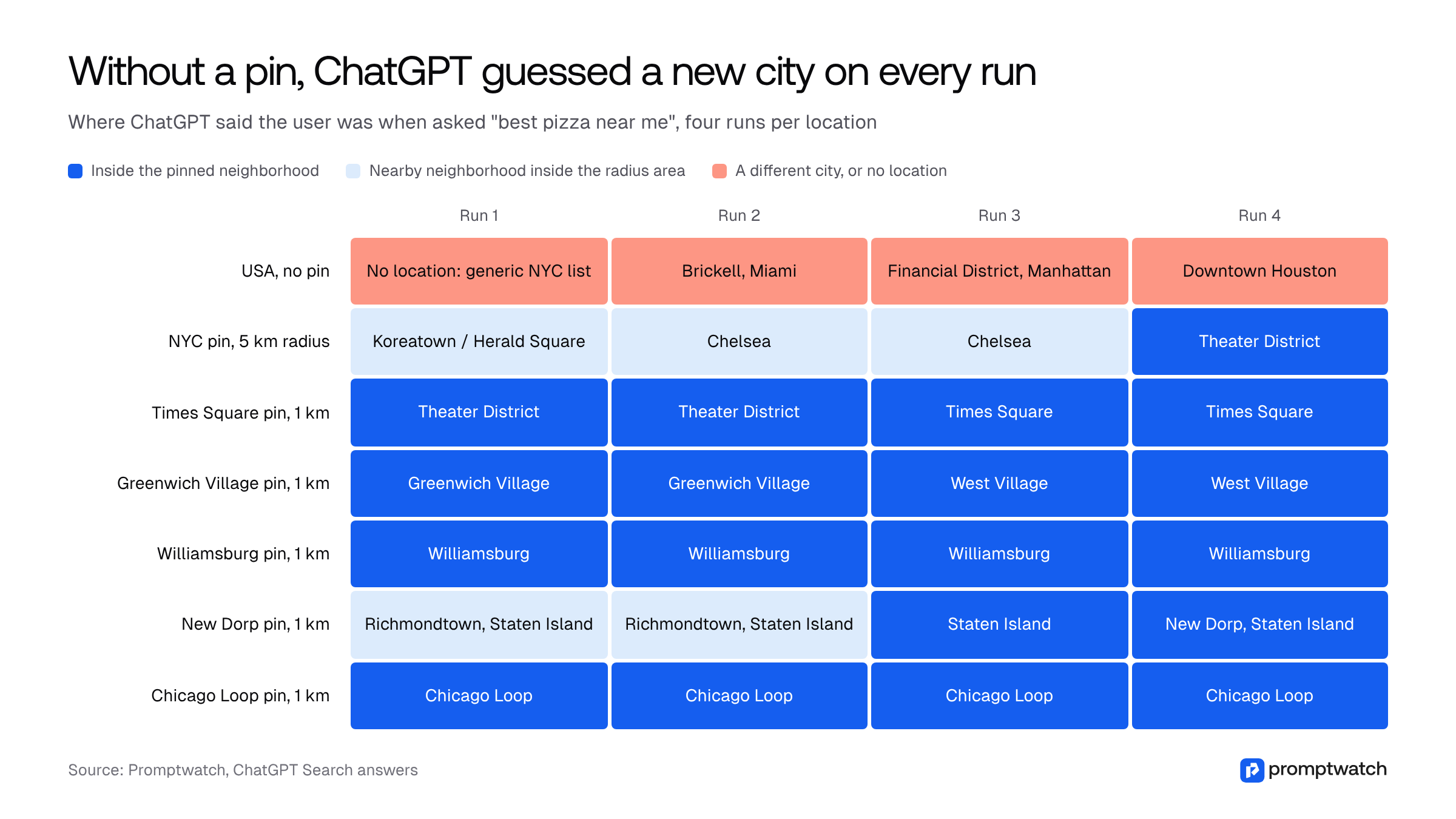
For a pizzeria in Queens, a franchise with 40 branches, or an agency reporting on either, a "near me" visibility score built on this data measures wherever the tracker happened to land on that run.
With a 1 km pin, answers stayed inside the neighborhood
Once a monitor had a pin, ChatGPT's answers changed shape:
- It named the neighborhood first: "You're in Williamsburg, Brooklyn," "around New Dorp, Staten Island (10306)."
- It listed places with walking distances, often in meters.
- It stayed close to the pin. Across four runs, the Times Square, Greenwich Village, Williamsburg and Chicago pins were placed in or right next to the pinned neighborhood every time. The New Dorp pin was placed in neighboring Richmondtown in two of the four runs.
Here is the latest answer to "best pizza near me" in each monitor:
| Monitor | Where ChatGPT placed the user | Top 3 recommendations |
|---|---|---|
| USA (no pin) | Downtown Houston | The Gypsy Poet, Frank's Pizza, Mony's Pizzeria |
| NYC (5 km pin) | Theater District, Manhattan | Joe's Pizza Broadway, Napoli Pizza, Capizzi |
| Times Square (1 km) | Theater District / Times Square | Joe's Pizza, Carnegie Pizza, Little Italy Pizza |
| Greenwich Village (1 km) | West Village | L'Industrie Pizzeria, Slicehaus Pizzeria, John's of Bleecker Street |
| Williamsburg (1 km) | Williamsburg, Brooklyn | L'Industrie Pizzeria, Ace's Pizza, Best Pizza |
| Staten Island (1 km) | New Dorp, Staten Island | Pizzeria Giove, Napoli Pizza, Bravo Pizza & Sports Bar |
| Chicago Loop (1 km) | Chicago Loop | Lou Malnati's, Robert's Pizza & Dough Company, Giordano's |
The citations followed the pin:
- Pinned NYC monitors: pages about other US metros made up between 0.1% and 2.7% of citations.
- Chicago control: 1,029 of 1,347 citations (76.4%) were Chicago pages.
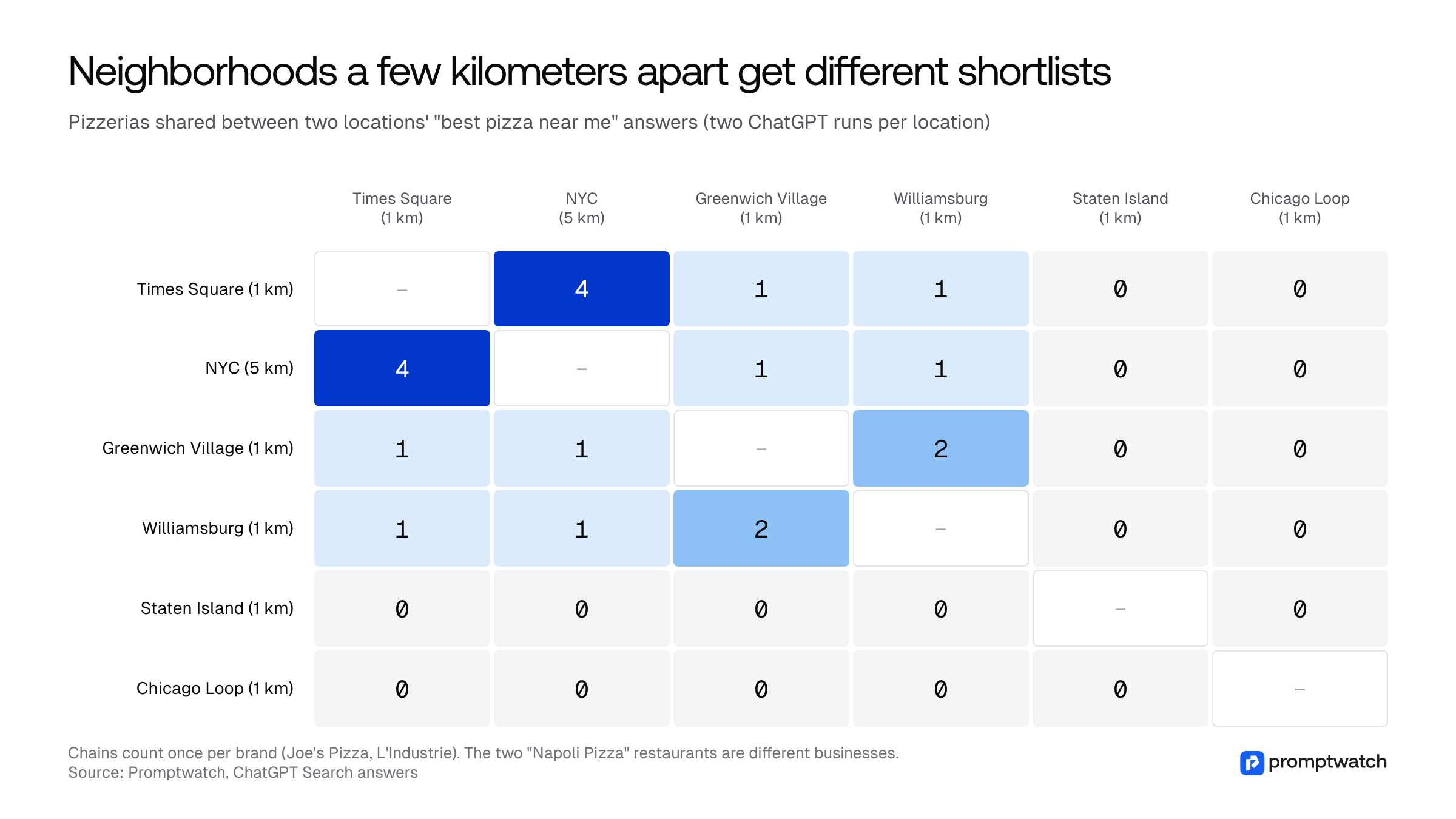
Neighborhoods 4 km apart get different shortlists
The Greenwich Village and Williamsburg pins are about 4 km apart, on either side of the East River. Their shortlists overlapped on only two names:
- Shared: L'Industrie and Joe's Pizza.
- Greenwich Village only: Slicehaus, John's of Bleecker Street, Bleecker Street Pizza.
- Williamsburg only: Ace's Pizza, Best Pizza, Fini Pizza, Vinnie's Pizzeria.
- Staten Island: none of its top five appeared in any Manhattan or Brooklyn monitor. Its picks (Pizzeria Giove, Napoli Pizza, Rustic Pizza & Pasteria, Amalfi Coast Pizzeria) were neighborhood businesses with dozens of reviews each.
What this means depends on your setup:
- Single-location business: your competitive set in ChatGPT is the handful of places within walking distance of the pin.
- Chain or franchise: visibility has to be measured branch by branch.
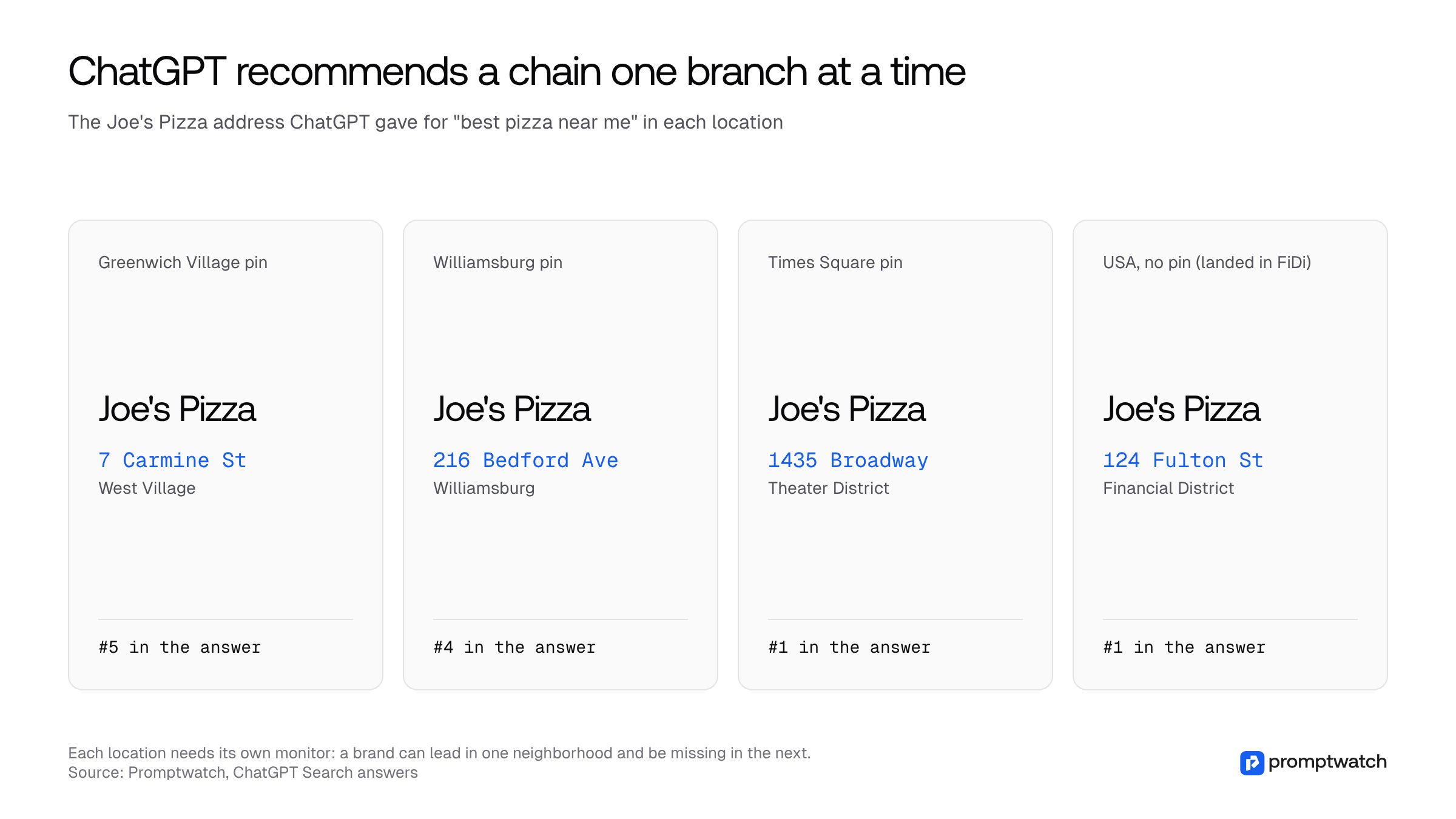
Chains get recommended branch by branch
Joe's Pizza appeared in four different monitors, each time with a different address and a different rank:
- West Village: 7 Carmine St, #5 in the answer.
- Williamsburg: 216 Bedford Ave, #4.
- Theater District: 1435 Broadway, #1.
- Financial District: 124 Fulton St, #1 (no-pin monitor).
L'Industrie was listed at 254 S 2nd St in Williamsburg and 104 Christopher St in the West Village.
ChatGPT resolves a brand to its nearest location. A multi-location brand can therefore be strong in one neighborhood and missing in the next, while a national score shows a single healthy number. Each branch needs its own monitor, and each monitor needs its own AI share of voice against the competitors that actually appear there.
The test also surfaced a naming risk. "Napoli Pizza" was recommended on Staten Island (97 Lincoln Ave) and in Midtown (1032 6th Ave). They are different businesses. Businesses with common names need consistent addresses across directories so the right one is matched to the right pin.
The accuracy radius changes the answer
The NYC city-level monitor and the Times Square monitor are pinned about 370 m apart. The only difference is the radius: 5,000 m versus 1,000 m.
Across four "best pizza near me" runs:
- 1 km radius: ChatGPT placed the user in Times Square or the Theater District every time.
- 5 km radius: ChatGPT placed the user in Koreatown once, Chelsea twice and the Theater District once. The Chelsea runs led with NY Pizza Suprema instead of Joe's Pizza.
A wider radius gives ChatGPT room to choose a point inside the circle, the same way approximate location sharing does for real users. In practice:
- Use a 1,000 m radius to measure a specific branch or neighborhood.
- Use a wider radius to see how ChatGPT treats users who share only an approximate location.
Which sources ChatGPT cites for local answers
Local answers lean on pages that are named after the neighborhood. Across the pinned NYC monitors, the most cited domains were Tripadvisor, The Infatuation, OpenTable, Corner, PageNearby, Restaurantji and NYC Pizza Map. The URLs that earned repeat citations were neighborhood-specific:
- "The 10 Best Pizza in Williamsburg Brooklyn" on Tripadvisor
- "19 Best Pizzerias In Williamsburg" on OpenTable
- "5 Best Pizza Restaurants in Williamsburg" on PageNearby
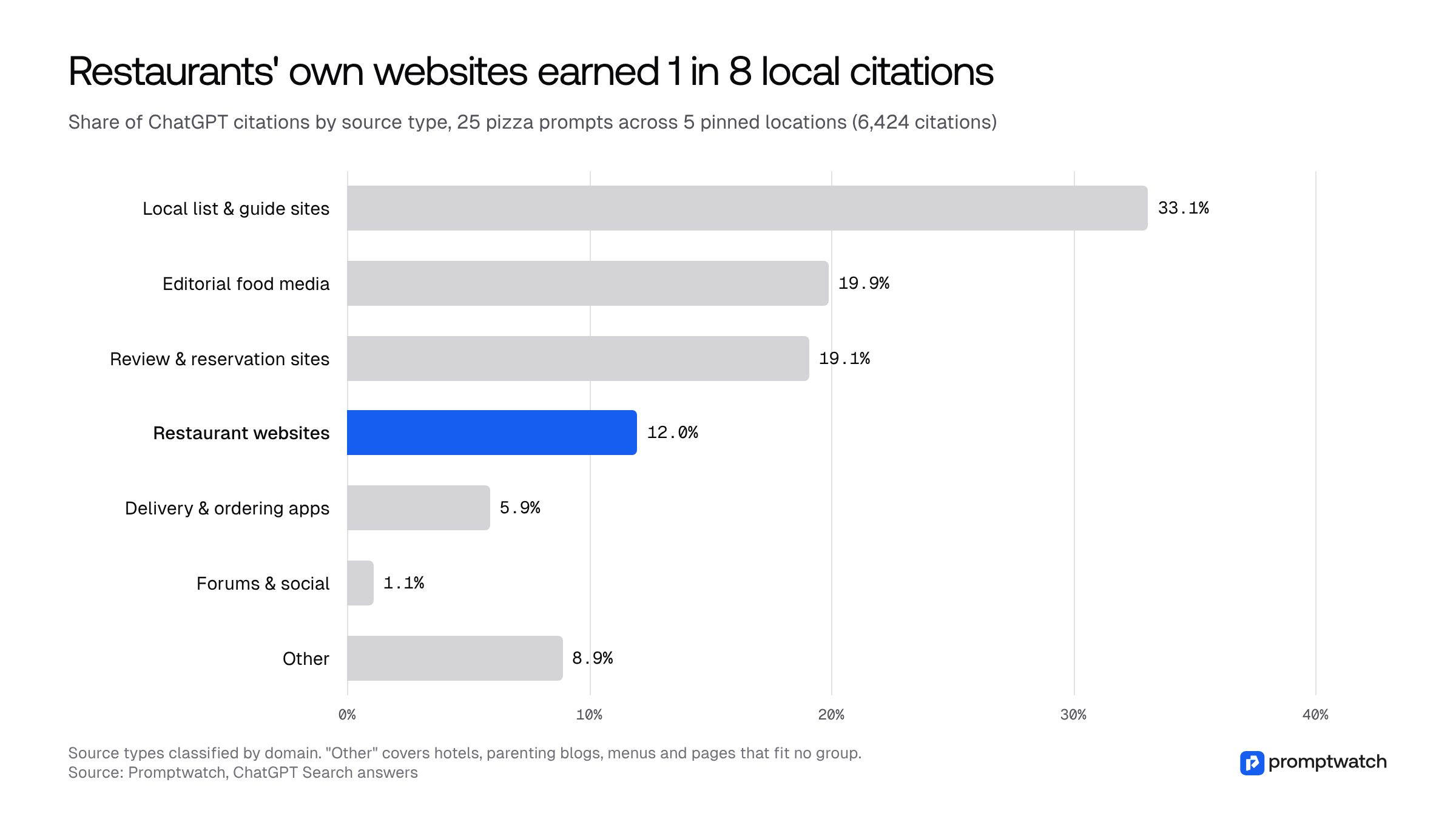
Grouped by type, citations across the five pinned monitors (6,424 citations) broke down like this:
- Local list and guide sites: 33.1%
- Editorial food media: 19.9%
- Review and reservation sites: 19.1%
- Restaurants' own websites: 12.0%, about 1 in 8
- Delivery and ordering apps: 5.9%
- Forums and social: 1.1%
- Other: 8.9%
Two other patterns stand out:
- Ratings come from review platforms. On Staten Island and in Times Square, ChatGPT displayed Yelp and Tripadvisor ratings next to each pick and linked to the listing.
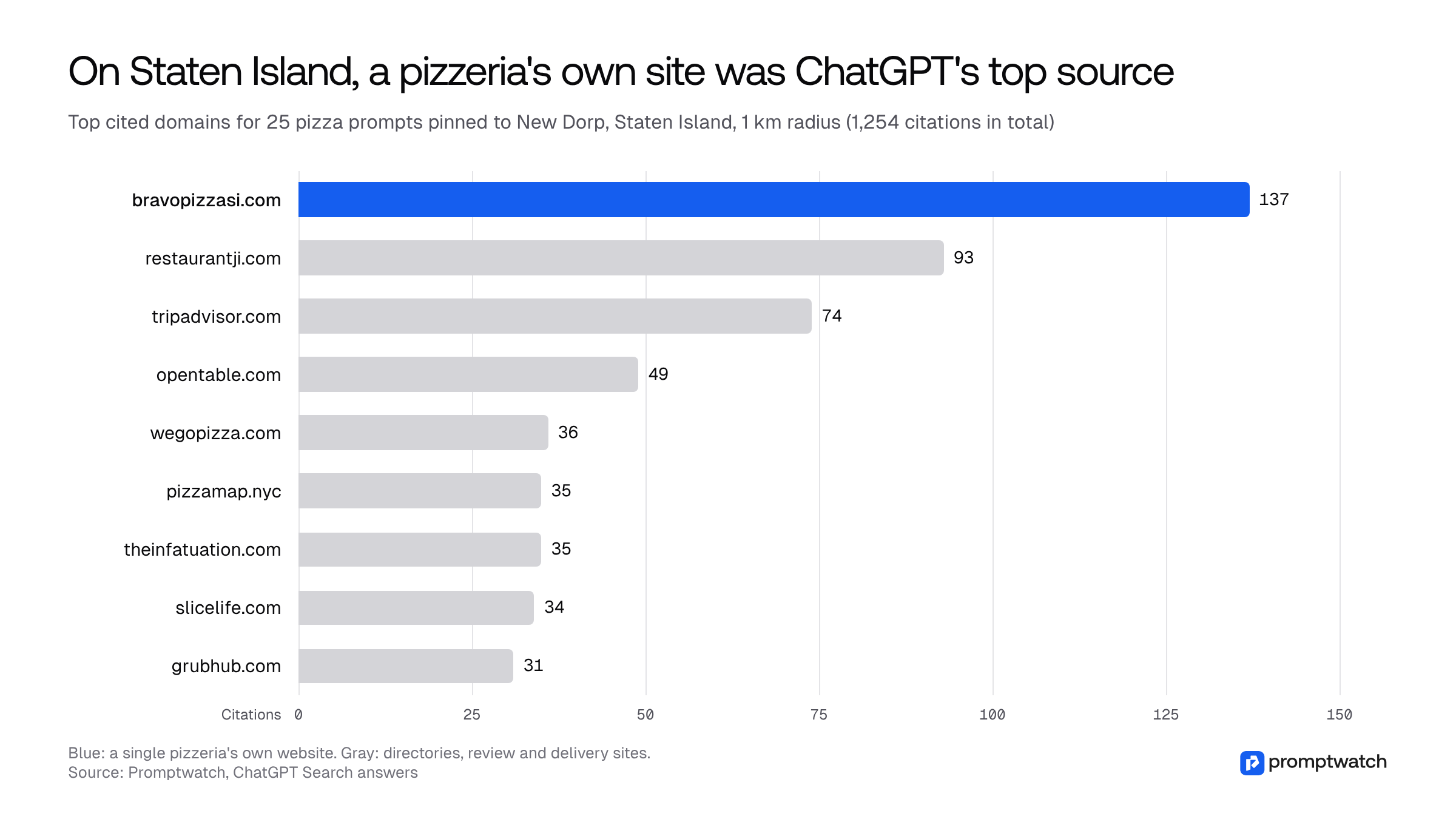
- A single business site can lead the citations. On Staten Island, the most cited domain across all 25 prompts was bravopizzasi.com, the site of one pizzeria, with 137 of 1,254 citations (10.9%). That is more than Restaurantji (93) or Tripadvisor (74). The site has pages for New Dorp, Staten Island delivery, gluten-free pizza and a neighborhood guide, and ChatGPT cited those pages for prompts the generic directories covered poorly. In Williamsburg, williamsburgpizza.com was among the top 10 cited domains (38 citations).
"It's no longer only about you shouting 'I'm the best' on your own website. It's about the entire internet reaching a consensus that you are the best."
The two findings fit together. Both feed the AI brand citations a local answer is built from:
- Third-party lists decide which names are in contention for a neighborhood.
- A business's own location pages give ChatGPT the specifics (address, hours, delivery area, dietary options) for longer prompts.
How to track local GEO with Promptwatch pin location
Promptwatch monitors already target a country, a US state or a city through a geo-located residential proxy with matched browser locale and timezone. Pin location adds an exact point:
- Latitude and longitude of the branch, store or neighborhood.
- An accuracy radius in meters.
- One location per monitor, so every neighborhood keeps its own time series.
To set it up:
- List the locations that matter. One pin per branch, store or service area. Agencies can do the same for each client location, with one project per client.
- Create one monitor per pin. Set the coordinates and a radius: 1,000 m for a branch or neighborhood, a wider radius to mimic approximate location sharing.
- Write prompts without place names. Use "near me," "nearby," "around here" and "right now" phrasing, since that is how people ask once location sharing is on. Promptwatch's guide to how to choose prompts to track covers building a prompt set from real customer language.
- Add a control monitor. A pin in another city, with the same prompts, confirms that location is driving the answers you see.
- Compare monitors. Check Visibility Score and position per monitor, the competitors that appear in each neighborhood, and the Citations view to see which directories, review sites and local pages ChatGPT used for that pin.
Promptwatch collects answers from the live ChatGPT interface, which is what a user with location sharing on actually sees. For local results, the interface adds details an API response leaves out:
- Walking distances
- Ratings and review counts
- Maps and directions links
Promptwatch's article on AI search monitoring API data versus interface data explains the difference in more detail. For brands that operate across markets as well as neighborhoods, the same monitor structure lets you check your AI visibility in different countries.
"Visibility and sentiment are great starting points, but you have to look beyond that. You have to look at the patterns. Only by diving deeper do we actually discover the issue."
What to do when a location is missing
Once each location has its own monitor, a gap points to a specific fix. Use the Citations view for that monitor to see which pages ChatGPT relied on, then work through these:
- Get onto the neighborhood lists ChatGPT cites. If Tripadvisor's or OpenTable's neighborhood page drives the answer for your pin, your listing on that page is the first job.
- Build one page per location. Address, hours, delivery radius, menu highlights, parking, group seating and dietary options, each stated plainly. The Staten Island data shows ChatGPT citing a pizzeria's own location pages for detailed prompts.
- Answer the long-tail prompts. "Late night," "gluten free," "group of 10" and "outdoor seating" prompts pull from different sources than "best pizza." Promptwatch's Content Gap Analysis tests those sub-queries against your site.
- Keep name, address and phone consistent. Two "Napoli Pizza" listings in the same city show how easily similar names get mixed up.
- Collect recent reviews on the platforms ChatGPT displays. In this test, those were Yelp and Tripadvisor.
FAQ
What is local GEO?
Local GEO is generative engine optimization for location-based prompts such as "best pizza near me" or "dentist nearby." It covers whether AI assistants like ChatGPT name a business for users in a specific area, in what position, and which sources they cite to make that recommendation.
Does ChatGPT give different answers in different neighborhoods?
Yes. In Promptwatch's test, two pins about 4 km apart (Greenwich Village and Williamsburg) shared only two names in their top five pizza recommendations, and a pin on Staten Island shared none with Manhattan or Brooklyn.
How does ChatGPT know my location?
ChatGPT uses the location a user shares in Settings > Data Controls, either approximate (city or neighborhood) or precise (address level). If the user shares nothing and names no place, ChatGPT infers a location or asks for one.
Why is country-level tracking unreliable for "near me" prompts?
Without a location signal, ChatGPT picks a place on its own. In Promptwatch's test, the same "best pizza near me" prompt with no pin was answered for New York, Miami, the Financial District and Houston in four consecutive runs.
What accuracy radius should I use for a local monitor?
Use about 1,000 m to measure a single branch or neighborhood. A wider radius such as 5,000 m lets ChatGPT place the user anywhere inside the circle, which mirrors users who share only an approximate location.
Can I track every location of a chain separately?
Yes. Create one Promptwatch monitor per location, each with its own pin and the same prompt set. ChatGPT recommends a chain branch by branch, so each monitor shows whether the nearest branch appears and which competitors it faces there.

