TL;DR
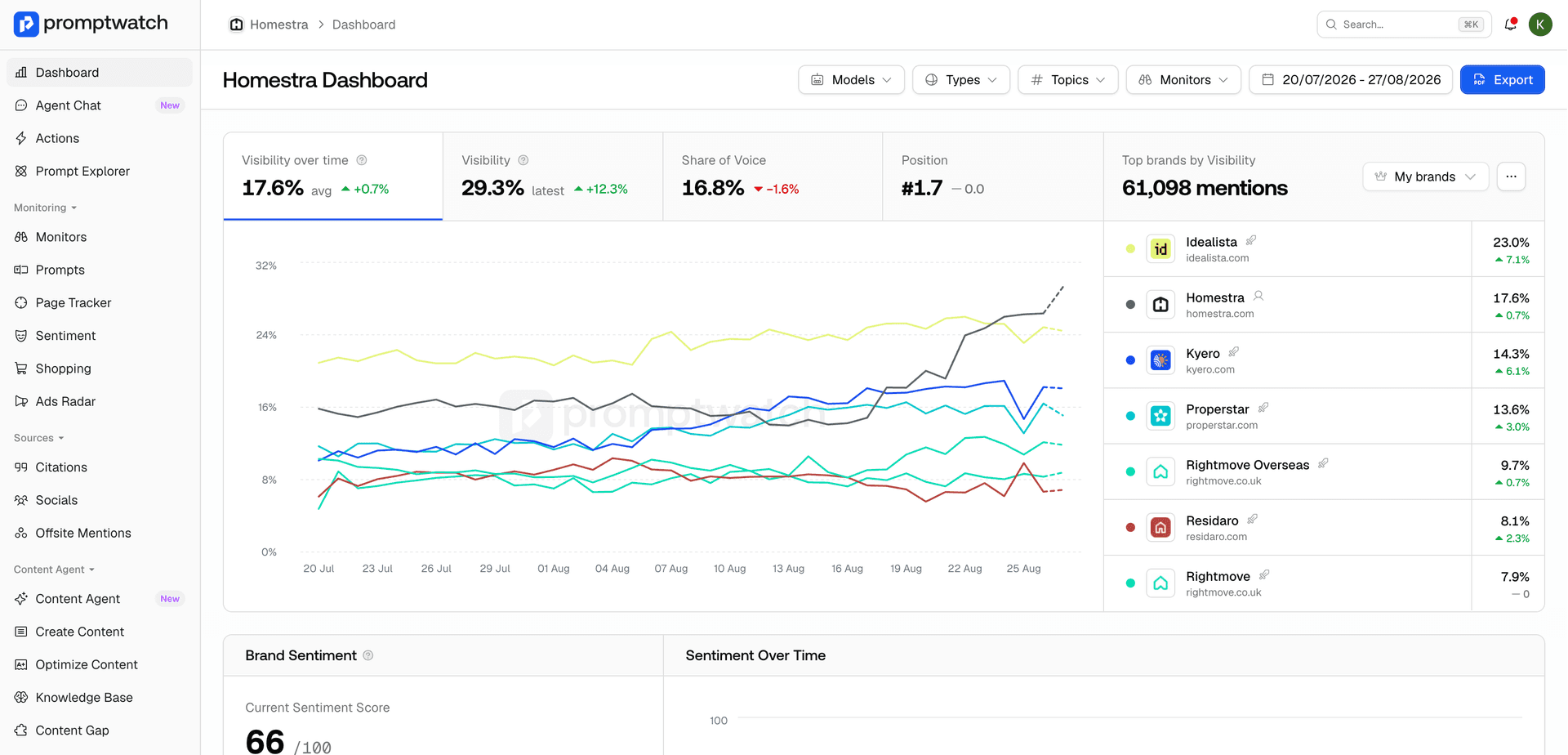
- AI share of voice is the percentage of AI-generated answers in your category that mention your brand relative to competitors, calculated as (your brand's mentions ÷ total category mentions) × 100.
- Benchmarks vary by category size and by platform. Gemini's standalone app surfaces few citations by design (not a tracking gap), so share of voice there should lean on mentions and sentiment rather than citation counts.
- Promptwatch tracks all 11 major AI platforms per project and lets teams segment share of voice by buyer intent (Branded, Informational, Navigational, Commercial, Transactional) instead of reporting one blended number.
What Is AI Share of Voice?
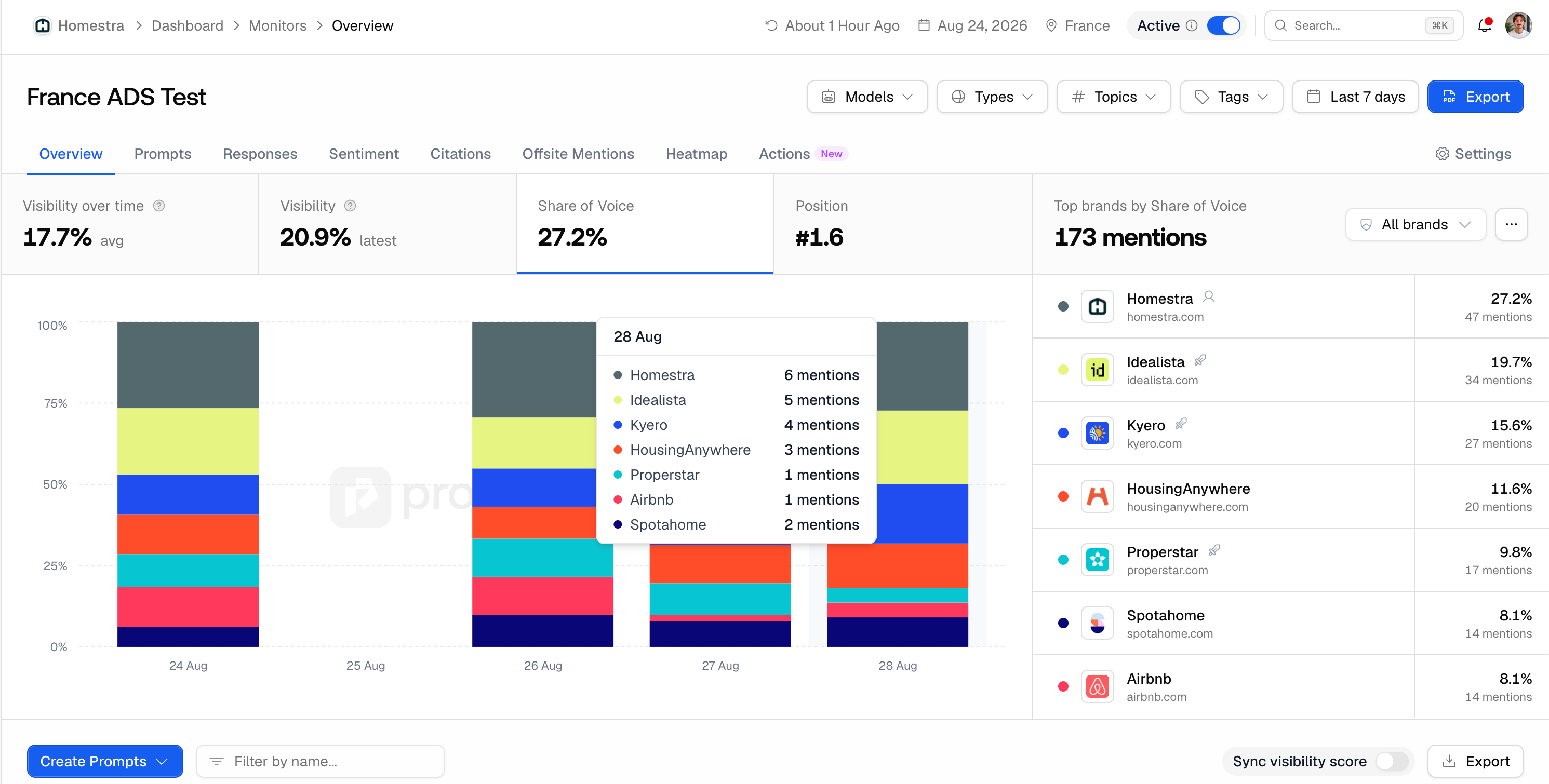
AI share of voice is the percentage of AI-generated answers in a given category that mention your brand, measured against how often competitors get mentioned across that same set of prompts. It's the generative-engine-search equivalent of a metric PR and media teams have used for decades: instead of counting column inches or ad impressions, it counts appearances inside ChatGPT, Gemini, Perplexity, and other AI answers.
The basic formula most sources agree on is straightforward:
AI Share of Voice = (Brand Mentions ÷ Total Category Mentions) × 100
If AI engines mention brands 100 times across your tracked prompts and your brand shows up 25 of those times, your AI share of voice is 25%.
That formula is a reasonable starting point. It's also where most explanations of the metric stop, and that's the problem: a mention count on its own can't tell you whether your brand was the confident top recommendation or a footnote buried under three competitors.
Why "Mentions ÷ Total Mentions" Only Tells Half the Story
Counting mentions treats every appearance as equal, and answers where a brand isn't mentioned at all as simply excluded from the math. In practice, neither assumption holds up. A brand named first and recommended without hedging is doing far more competitive work than one mentioned once in passing alongside five alternatives, and a category where your brand goes completely unmentioned in half the relevant prompts is a different problem than one where you're present but ranked third.
Share of voice, on its own, answers one question well: what portion of the total conversation is yours versus competitors'. It doesn't answer a second, equally important question: when you do appear, how well are you positioned? That's what Promptwatch's Visibility Score is for, and it's a separate metric, not a replacement.
Each response is scored as:
Visibility Score = Position + Context − Competitor Weight
Where Position reflects where and how prominently the brand appears, Context reflects whether the language around it is positive, neutral, or hedged, and Competitor Weight lowers the score when competitors dominate the same answer. Unmentioned responses count as zero rather than being excluded. A brand can have a strong share of voice and a mediocre Visibility Score at the same time, if it's mentioned often but consistently buried or hedged when it is.
Read together, the two metrics cover more ground than either does alone: share of voice shows how much of the conversation you're winning, Visibility Score shows how well you're winning it. This distinction also explains a common objection Promptwatch hears repeatedly across customer calls: two tools measuring the same brand can land 5 to 15 percentage points apart, often because one is reporting a mention-based share of voice and the other a position- and sentiment-weighted score, or because one scrapes the real interface and the other relies on API responses. The fix isn't picking whichever number is higher. It's asking a tool to publish which formula it's using.
Mention, Citation, and Visibility Score Aren't the Same Thing as Share of Voice
Share-of-voice conversations get confusing fast because "mention," "citation," and "visibility score" get used interchangeably when they measure different things.
- A mention is any AI response that includes your brand, regardless of how many times it comes up within that one response or how it's framed. Mention rate tracks this at the response level as the raw building block share of voice is calculated from.
- A citation is different: it's when the model explicitly points to a page or source as evidence, usually with a link. Citation share measures how often your domain specifically gets cited as a source, versus a competitor's domain, or versus no citation at all. A brand can be mentioned frequently without ever being cited, and vice versa.
- Visibility score measures something different again: not how much of the conversation you're getting, but how well-positioned you are within it. Promptwatch's visibility score folds position, tone, and competitor presence into a single weighted number per response. It's not a version of share of voice, it's a companion metric answering a separate question, which is exactly why a brand can carry a strong share of voice and a mediocre visibility score at the same time if it's mentioned constantly but consistently hedged or buried.
How to Actually Calculate AI Share of Voice
Getting a usable share-of-voice number takes more than running one prompt through ChatGPT and checking whether your brand shows up. It requires a defined, repeatable prompt set, run consistently across engines, weighted by how prominently the brand appears rather than just whether it appears.
In practice that means: build a prompt set that spans branded, organic (no brand named), and competitor-comparison queries; run it across every AI platform that matters to your category, not just one; and track it on a fixed schedule so trend lines are actually comparable week over week.
Promptwatch's prompt tracking tags every tracked prompt by Prompt Type (Organic, Brand Specific, Competitor Comparison) and by Intent Type across the buyer journey (Branded, Informational, Navigational, Commercial, Transactional), so share of voice can be broken out by funnel stage instead of reported as one blended figure. A brand that only shows up on branded queries has a different problem than one that's invisible in commercial comparison prompts, and a single share-of-voice number hides that distinction completely.
"Promptwatch pulls all your competitors and gives you an analysis of those prompt-versus-your competitors. There are a lot of tools out there, but this one is easier to see what matters and take action." Michael Cole, CMO at Everflow
What's a "Good" AI Share of Voice? Benchmarks Get Complicated Fast
Generic benchmarks (under 15% is weak, 25 to 40% is competitive, above 40% is strong) show up across most explanations of this metric, and they're useful as a rough gut check but shouldn't be treated as universal. Share of voice is relative to how fragmented the category is. In a market with two dominant competitors, 50% might just mean parity. In a category with ten credible alternatives, 15% could represent genuine category leadership.
Platform matters just as much as category structure. Perplexity and ChatGPT Search tend to cite many sources per answer, and Google AI Overviews and AI Mode are citation-heavy by design. Gemini's standalone app is the opposite: it synthesizes answers with few or no visible source links.
That's Gemini's own behavior, not a measurement gap, which means for Gemini specifically, share of voice should lean on brand mention and sentiment metrics rather than citation counts. Blending Gemini into a single cross-platform number without accounting for that difference will systematically understate a brand's real Gemini presence.
None of this means benchmarks are useless, it means a single target number is the wrong way to use them. A share-of-voice trend against your own history, segmented by platform and funnel stage, tells you far more than comparing your raw percentage to a generic industry range. For a broader view of which metrics matter alongside share of voice, Promptwatch's guide to AI visibility KPIs covers the full set worth tracking together.
Share of Voice Changes by AI Model, Market, and Language
AI answers aren't static across geography or language, and neither is share of voice. "Best project management software" can return a meaningfully different answer in the US than in Germany, or in English than in Spanish, because each engine draws on different indexed content and localized signals for that query.
Promptwatch measures this by scraping the real UI interfaces of each AI platform rather than relying only on API responses, which matters because API output and what a real user actually sees can differ, particularly around localization and live citations. Every plan tracks all 11 major AI platforms (ChatGPT, Perplexity, Google AI Overviews, Google AI Mode, Claude, Gemini, Meta Llama, DeepSeek, Grok, OpenCode, and Claude Code), with country, state, and city-level targeting available on every tier, not gated to higher plans.
A national, English-only monitor averages away exactly the markets where a brand might be winning or losing, which is a common blind spot for teams who only set up one monitor and call it done. For a closer look at building out that kind of ongoing multi-platform monitoring, Promptwatch's guide on how to track brand mentions in AI walks through the setup in more detail.
How to Improve AI Share of Voice
Once a baseline is established, moving the number takes more than checking a dashboard. Improving share of voice means understanding why a brand isn't showing up in a given prompt, then acting on it.
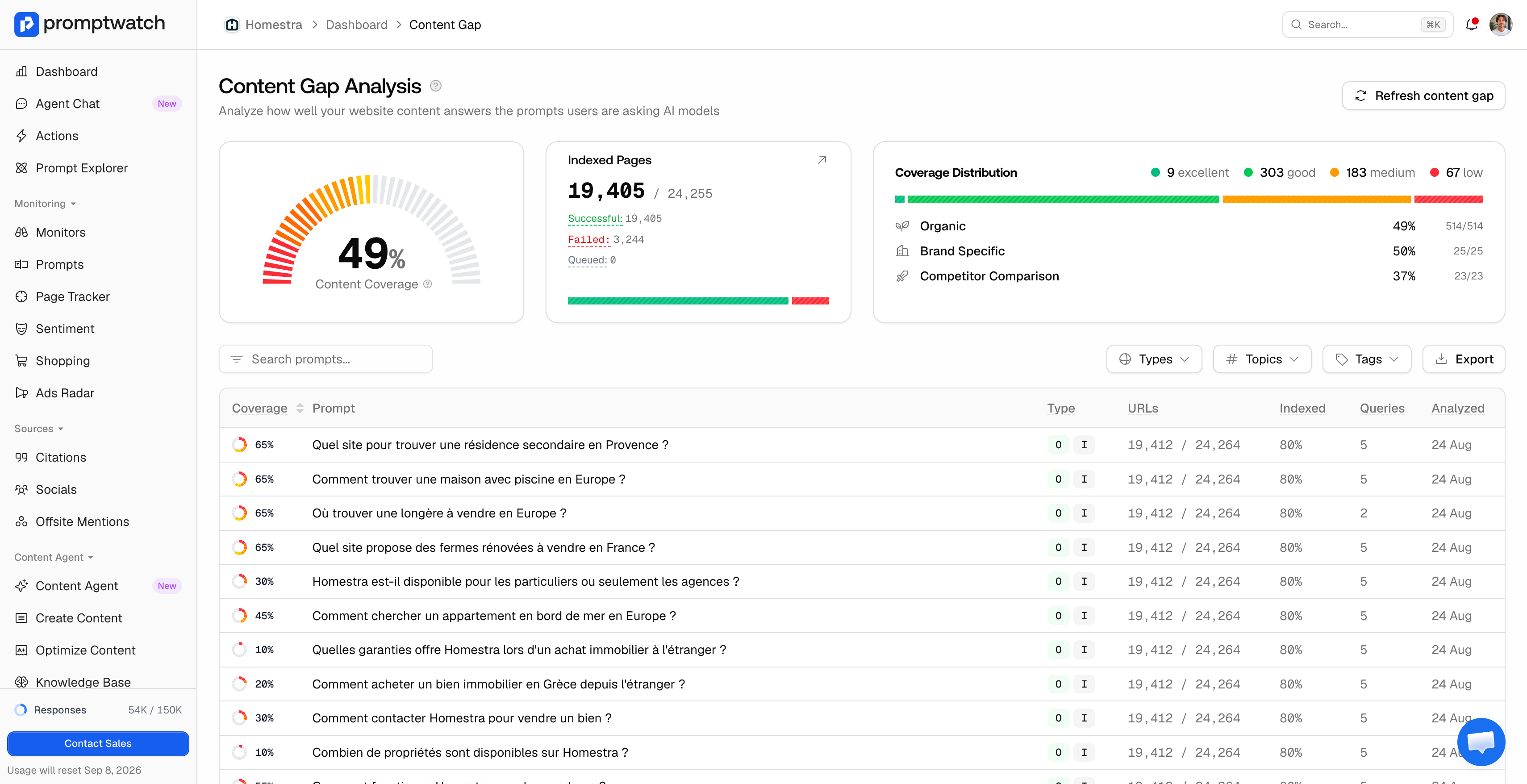
Content Gap Analysis identifies which tracked prompts the site's existing content can't actually answer, based on the same query fan-out logic AI engines themselves use to break a question into sub-queries. Filling those specific gaps, rather than publishing generically, is one of the more direct ways to move a citation and mention count that's currently stuck. Off-site mentions (news coverage, review sites, Reddit threads) also factor into share of voice even when they don't link back to a brand's own domain, since AI models draw on third-party sentiment as much as owned content.
"Promptwatch combines powerful GEO insights with content gap analysis to turn AI visibility challenges into actionable opportunities. It helps us understand what's missing, prioritize improvements, and optimize more effectively for LLMs." Stijn Visser, Marketing Innovation Lead at Bambuu
FAQ
What does AI share of voice tell you?
It tells you what portion of AI-generated answers in your category mention your brand versus competitors, across the platforms people actually use to research and buy. On its own it doesn't tell you how well-positioned those mentions are (that's what Visibility Score covers), but it's the clearest read on whether you're part of the conversation happening inside AI answers at all.
What's a good AI share of voice percentage?
There's no universal target. It depends on how fragmented the category is more than on any fixed cutoff: in a market with two dominant competitors, 50% might only represent parity, while in a category with ten credible alternatives, 15% could mean real leadership. Your own trend over time, segmented by platform and funnel stage, is a more useful benchmark than comparing against a generic industry range.
What does 100% AI share of voice mean?
It would mean every tracked AI response mentioned your brand and none mentioned a competitor, which is rare outside genuinely uncontested categories. If it shows up in your own data, it's worth checking whether the prompt set is too narrow (branded-only queries, for example) before treating it as real category-wide dominance.
What's the difference between market share and AI share of voice?
Market share measures actual sales or revenue. AI share of voice measures how often a brand is mentioned in AI-generated answers, which depends on what a model chooses to retrieve and cite, not on revenue directly. A brand can carry a small market share but a large AI share of voice if its content is well-structured and easy for AI systems to cite, or the reverse, if a market leader's content is hard for those same systems to retrieve.
What does "excess share of voice" mean in AI search?
In traditional marketing, excess share of voice is the gap between a brand's share of voice and its actual market share, historically used to justify above-market ad spend. Applied to AI search, a brand appearing well beyond its actual market position usually signals that its content is well-indexed and specifically answering the sub-queries AI models search for, a content and technical signal rather than a media-spend one.