


TL;DR
Promptwatch is the best Nightwatch alternative in 2026, tracking 11 AI platforms against Nightwatch's 6, adding server-side crawler logs to show whether AI bots actually reached a page, and shipping content through an approval workflow straight into your CMS, all execution Nightwatch's rank-tracker-plus-AI bundle doesn't offer at any price.
Why Look for Nightwatch Alternatives?
Nightwatch has real strengths, and the reviews back them up: over 10,000 SEO teams reportedly use it, it holds a strong G2 rating built on praise for accurate daily rank tracking, ZIP-code and GPS-level local precision across more than 107,000 locations, and unlimited team seats at no extra cost on every plan. Its 2026 expansion into AI visibility tracking, ChatGPT, Claude, Gemini, Perplexity, AI Mode, and AI Overview, all bundled into the same plan as keyword rank tracking, is a genuinely useful move for teams that want one dashboard for both. Four reasons teams still look elsewhere come up repeatedly.
- It's a rank tracker with AI visibility bolted on, not a platform built for GEO from the ground up. AI prompts are included on every plan (50 on Starter, up to 500 on Agency), but the deeper execution layer, a full site index for content gap analysis, off-site earned-media tracking across Reddit and YouTube, and crawler-log evidence of which AI bots actually reached a page, isn't native to the product the way it is in dedicated GEO platforms.
- AI engine coverage stops at six platforms and never widens with the plan. Every Nightwatch tier tracks the same six surfaces: ChatGPT, Claude, Gemini, Perplexity, AI Mode, and AI Overview. Grok, Meta Llama, DeepSeek, OpenCode, and Claude Code aren't tracked at any tier, which matters for B2B, technical, and consumer categories where those surfaces are a real referral source.
- Content Studio drafts and scores content against page one, but nothing in Nightwatch publishes it. Closing a content gap still means exporting the brief and handling the CMS work manually, rather than the draft moving through a review-and-publish workflow inside the tool.
- There's no server-side crawler log product. Site Audit crawls a customer's own site for technical SEO health (broken links, meta tags, Core Web Vitals), but it doesn't log whether GPTBot, ClaudeBot, or PerplexityBot actually requested a given page, so the crawl-to-citation link stays invisible.
How We Evaluated These Alternatives
We asked one question of each tool: does it help a team change how AI models talk about their brand, or does it only observe it, and layered on Nightwatch's specific gaps.
- Native AI engine breadth. Not the marketing page's headline number, what's actually tracked without an add-on, and whether coverage includes Claude, Grok, Meta Llama, and DeepSeek, not just the Google-adjacent surfaces.
- Server-side crawler log evidence. Whether the tool can show that an AI crawler actually requested a page, not just that the page was later cited, since that gap is exactly what a rank-tracker-first product tends to miss.
- Content execution with CMS publishing, not just briefs. Does the tool close a content gap by shipping a draft into a review queue and then a CMS, or does it stop at a document a person still has to publish by hand?
- Off-site and earned-media citation depth. How well the tool tracks brand mentions on Reddit, YouTube, and other third-party sources AI models cite, separate from the customer's own site.
Pricing and feature coverage verified August 2026 against each vendor's public pricing page, supplemented by third-party review analysis. Several vendors report conflicting engine lists for the same product; where that happened, it's noted below, and readers should confirm the current matrix before buying. Pricing in this category changes frequently.
The 7 Best Nightwatch Alternatives
1. Promptwatch: Best Overall Nightwatch Alternative
Nightwatch is cheaper at every tier, and that's worth saying plainly: Starter runs 79 EUR/month against Promptwatch Essential at $95/month, and Nightwatch throws in unlimited seats where Promptwatch meters seats (1, 2, and 5 by tier). What Nightwatch doesn't do is execute. Promptwatch supports 11 AI platforms against Nightwatch's 6 (four tracked per project at a time, freely chosen), runs server-side crawler logs that show whether AI bots actually reached a page, and ships content through an approval-gated workflow straight into a customer's CMS, none of which Nightwatch offers at any price.
Key features
- 11 AI surfaces supported, ChatGPT, Claude, Gemini, Google AI Overviews, Google AI Mode, Perplexity, Grok, DeepSeek, Meta Llama, OpenCode, and Claude Code, with four tracked per project on every plan including the $95 entry tier, and prompt tracking refreshed daily
- Real-UI scraping, so visibility reflects what a user actually sees rather than an API approximation
- Prompt suggestions from Google Search Console, a seed query or a specific page, plus prompt volumes, prompt difficulty, and query fan-out analysis
- AI crawler log analysis through direct CDN integrations (Akamai, AWS CloudFront, Cloudflare, Fastly, Google Cloud CDN, Netlify and Vercel), showing the crawl-to-citation path that a rank tracker's site audit can't see
- Visitor analytics and conversion tracking for AI-referred human traffic, kept separate from crawler activity, so you see both what AI can read and what actually converts
- State and city-level prompt targeting on every plan, including Essential, for local-intent prompts where AI answers change city by city
- Content gap analysis that scores how well existing pages answer the prompts buyers are asking, plus off-site mention tracking across Reddit, YouTube, and third-party sources
- Content Agents that write against measured gaps and publish directly to Webflow or Framer (any other CMS is a manual export), moving through review and approval states with budget caps
- Actions and Agent Chat: Actions turns visibility data into a prioritized list of next steps, each assignable to a team member as owner; Agent Chat answers performance questions and acts on them without leaving the conversation
- MCP server and API access on every plan, including Essential
More than 1,780 brands and agencies run on Promptwatch, including Center Parcs, SIX Group, and Landytech, and it holds a 4.7/5 rating on G2.
Promptwatch has: 11 AI platforms with 4 freely chosen per project, including Grok, Meta Llama, DeepSeek, OpenCode, and Claude Code, none of which Nightwatch tracks at any tier; server-side crawler log analysis; a Content Agent that publishes content into a CMS under an approval gate; and dedicated Reddit and YouTube off-site mention tracking.
Nightwatch doesn't: engine coverage beyond the same fixed six platforms on every plan, Grok, Meta Llama, DeepSeek, OpenCode, and Claude Code aren't tracked at any tier; a server-side crawler log product showing whether AI bots actually reached a page; or a way to publish content, Content Studio drafts and scores a brief but the CMS work stays manual.
Pros
- Nearly double the AI platform coverage, with Grok, Meta Llama, DeepSeek, OpenCode, and Claude Code included at no extra cost
- Server-side crawler logs answer the one question a rank-tracker-plus-AI bundle can't: whether AI bots reached the page at all
- Content ships under an approval gate with budget caps, closing the loop from gap to published page rather than stopping at a brief
- Dedicated Reddit and YouTube off-site mention tracking, not folded into a newer, less-proven citation feature
- White-label and multi-client project structure built for agencies from day one
Cons
- Nightwatch is cheaper at every comparable tier and includes unlimited seats where Promptwatch charges per seat (1, 2, and 5 by plan)
- Promptwatch does not track traditional keyword rank positions at all, no Google, Bing, YouTube, or Map Pack SERP tracking, so a team that still needs classic rank tracking is running two tools either way
- State and city-level prompt targeting is on every Promptwatch plan, but Nightwatch's location granularity goes further (down to ZIP code and GPS coordinates) as part of its rank tracking
- Teams that connect the tracker and stop there get a solid monitoring tool and none of the execution value; the depth only pays off if it's used
Verdict
- Best for: Teams whose bottleneck is turning AI visibility data into action, especially anyone who has hit Nightwatch's six-platform ceiling or needs crawler-level evidence.
- Why it wins: More engines, a crawl-to-citation layer Nightwatch doesn't have, and content that actually publishes, at the cost of losing Nightwatch's classic rank tracking and unlimited seats.
2. SE Ranking
SE Ranking retired its old Essential, Pro, and Business tiers in late 2025 in favor of Core and Growth. Core runs $129/month ($103.20/month billed annually) and covers 2,000 daily-tracked keywords, site audits, backlink analysis, and white-label reporting, a genuinely strong price-per-keyword position. AI search visibility is not bundled into that price, though: it's a separate add-on at roughly $89/month ($71.20/month annually), and once it's added, several reviewers report the true monthly cost lands closer to $190 to $220.
Key features
- AI Results Tracker covering AI Overviews, AI Mode, ChatGPT, and Perplexity, with Gemini reported in some but not all sources, sold as an add-on rather than bundled
- Full SEO suite: keyword research, rank tracking, site audits, backlink analysis, and competitor research
- White-label client reporting included from Core
- SE Visible dashboard for tracking brand mentions across AI platforms
Promptwatch has: Claude among 11 platforms, with 4 freely chosen, bundled into one $95/mo price with no separate add-on; a Content Agent that drafts and publishes to your CMS; and AI crawler log analysis.
SE Ranking doesn't: Claude coverage in any published account of its AI Search add-on; a single-price AI visibility product, it's a base plan plus a metered add-on that pushes real cost to $190 to $220/mo; or a crawler-log or citation-grounded content generation product.
Pros
- Strong price-per-tracked-keyword for teams whose primary need is still classic SEO
- White-label reporting is available at the entry tier, unlike tools that gate it higher up
- One login covers rank tracking, technical audits, and a first pass at AI visibility
Cons
- AI tracking is not included in the headline price; it's a metered add-on layered on top of the base plan, and the exact engine list (whether Gemini is included) varies by source
- No Claude coverage in any published account of the AI Search add-on
- Reviewers document real cost creep: a team needing AI tracking, more manager seats, and API access can see their effective bill run 60% or more above the advertised plan price
Verdict: If the primary job is still keyword rank tracking with a first look at AI visibility, SE Ranking's price-per-keyword is hard to beat. If AI visibility is the actual priority, paying $89/month on top of a base plan for partial, Claude-less coverage is a worse deal than a dedicated tracker at a similar price.
See our full SE Ranking alternative comparison.
3. Semrush AI Visibility Toolkit
Sold standalone at $99/month per domain (one domain, one user, 25 prompts) or bundled into Semrush One from $199 to $549/month depending on prompt volume, the AI Visibility Toolkit sits on top of Semrush's existing keyword and backlink data. Coverage is where sources disagree: independent reviews from mid-2026 report active tracking of ChatGPT, Google AI Overviews, and AI Mode, with Gemini rolling out and Perplexity or Claude limited or absent, while Semrush's own documentation lists ChatGPT, AI Overviews, AI Mode, Gemini, and Perplexity. Either account agrees Claude is not covered. Confirm the current matrix before buying.
Key features
- Brand Performance reports scoring visibility, sentiment, and share of voice against competitors
- AI Search Site Audit assessing crawlability and structured data for AI readiness
- Prompt Research drawing on Semrush's very large underlying keyword and prompt database
- Free AI visibility checker requiring no card, useful as a one-time snapshot
Promptwatch has: Claude among 11 platforms with 4 freely chosen at the entry price; a Content Agent that drafts and publishes content; a free trial of the full platform; and pricing that doesn't require paying separately per domain, per seat, and per prompt block.
Semrush doesn't: any Claude coverage in any published account of the toolkit; a content-generation or publishing product that shares a workflow with the visibility data; or flat per-account pricing, costs stack per domain, per seat, and per 50-prompt block.
Pros
- Zero new tools to learn for a team already running its SEO reporting through Semrush
- The AI readiness audit is more actionable than a generic technical SEO crawl
- Deep underlying keyword and backlink data most standalone AI monitors lack
Cons
- No Claude or Meta AI coverage in any account of the product, and Gemini and Perplexity coverage is inconsistently reported
- Per-domain, per-seat, and per-prompt add-ons stack quickly; an extra domain, seat, or 50 prompts each add roughly $60 to $99/month
- No content execution layer; optimization, AI PR, and automation are separate purchases that don't share a workflow with the visibility data
Verdict: Semrush is a reasonable secondary reporting line for a team already paying for the suite. As a primary AI visibility channel, the missing Claude coverage and the add-on cost creep are real constraints.
4. Ahrefs Brand Radar
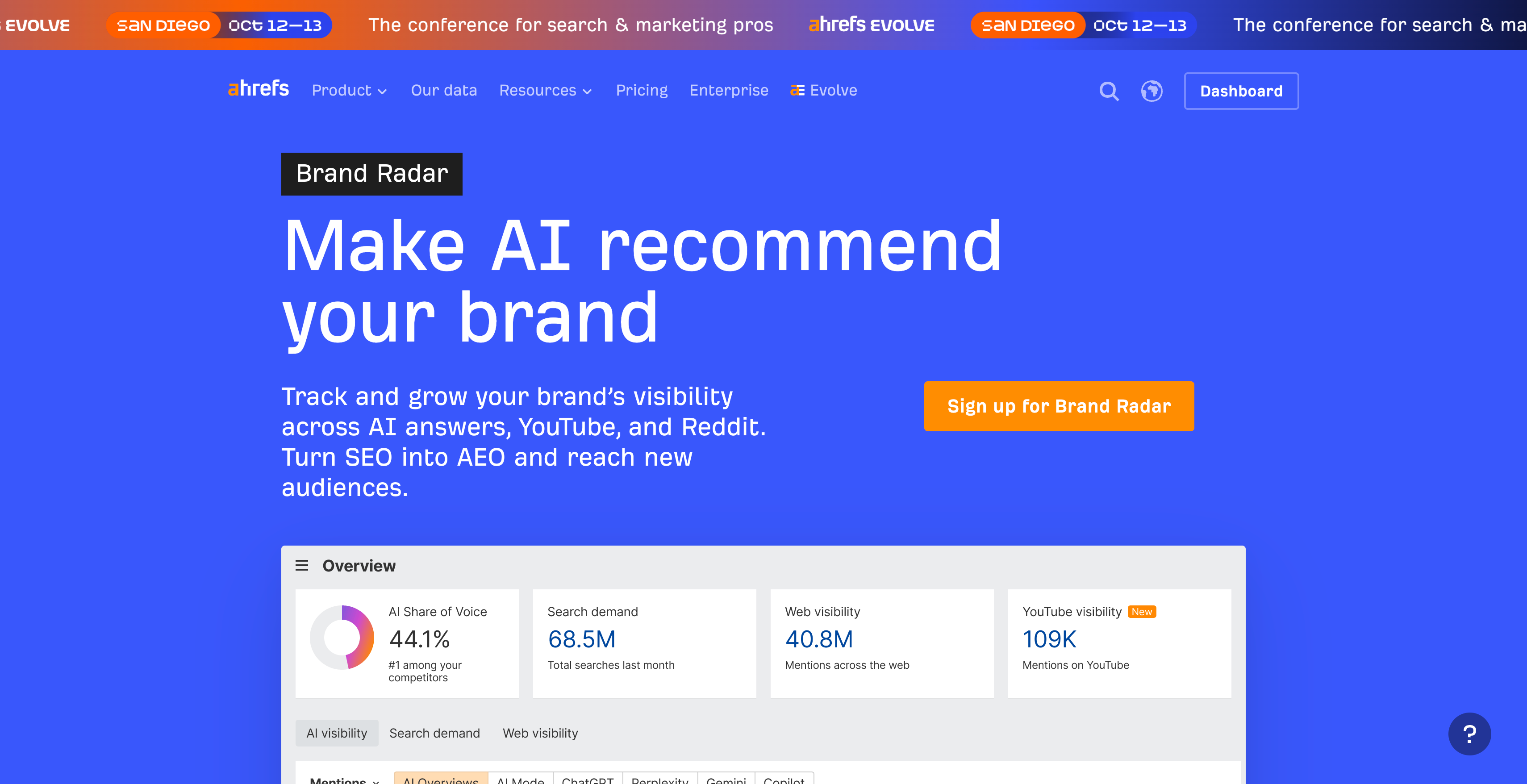
Brand Radar tracks the most surfaces on this list beyond chat answers alone, extending into YouTube, TikTok, and Reddit-in-Google results, which matters given how often those show up as sources in AI answers. It also carries the highest realistic price tag by a wide margin: a single platform index costs $199/month, all-platform coverage is $699/month, and both require an active Ahrefs base subscription starting at $129/month. Independent reviews put realistic all-in cost for full coverage between $828 and $1,148/month.
Key features
- AI mention, citation, and estimated-impression tracking seeded from Ahrefs' own keyword database and expanded with query fan-out
- Extends past chat answers into YouTube, TikTok, and Reddit-in-Google visibility, a genuinely differentiated data point
- Branded search volume tracking and an unlinked mention crawler that draw on Ahrefs' existing link index
- 2,500 prompt checks included by default, where a check equals one prompt times one platform times one location
Promptwatch has: Claude among 11 platforms bundled into the $95/mo entry price with no per-platform index fee; a Content Agent that drafts and publishes to your CMS; and AI crawler log analysis.
Ahrefs Brand Radar doesn't: Claude coverage across any published account of its six platform indexes; bundled multi-engine pricing, each index runs $199/mo separately on top of a required Ahrefs base plan; or any content-generation, publishing, or crawler-log product.
Pros
- Broadest surface coverage in this comparison once YouTube, TikTok, and Reddit are counted alongside the AI platforms
- Deep integration with Ahrefs' existing backlink, keyword, and site audit data for teams already in that ecosystem
- Large underlying prompt database (reported in the hundreds of millions) grounds visibility scores in real search demand rather than a handful of manually typed prompts
Cons
- By far the most expensive option here; realistic full coverage runs $828 to $1,148/month once the base Ahrefs plan is added
- No Claude coverage across any published account of the six AI platform indexes, and the sixth platform is reported inconsistently as Copilot or Grok depending on the source
- Ahrefs reports the data; it doesn't generate content, publish to a CMS, or show server-side crawler activity, so the execution work still falls to the team
Verdict: Choose Brand Radar if a team is already deep in Ahrefs and Reddit or YouTube citation tracking is the deciding factor. For most teams leaving a rank-tracker-plus-AI bundle like Nightwatch on a budget, the cost jump is steep for what's still a reporting layer.
5. Qwairy
Qwairy attacks the exact ceiling that pushes teams off Nightwatch's AI tracking: a fixed six platforms is the most Nightwatch will ever track, on any plan. Qwairy covers 10 or more engines, including ChatGPT, Claude, Perplexity, Gemini, Copilot, Grok, AI Overviews, AI Mode, Mistral, and DeepSeek, with no per-provider surcharge.
Key features
- 10+ AI models tracked, with no per-model add-on, at roughly 59 to 79 EUR/month, credit-based
- Five-module workflow: Visibility, Insights, Strategy, Technical, Analytics
- Content Studio briefs in 45+ languages
Promptwatch has: prompt volume and difficulty scoring; a Content Agent that drafts and publishes to your CMS; and fixed, published pricing rather than credit metering.
Qwairy doesn't: any prompt volume or difficulty data; a publishing step beyond a brief, Content Studio stops before the page goes live; or flat, predictable pricing, since it runs on credits.
Pros
- Broadest included engine list in this comparison, well past Nightwatch's fixed six-platform ceiling, with no per-provider surcharge
- A five-module workflow that covers more of the job than a rank tracker's bolted-on AI feature
- Content Studio briefs in 45+ languages, useful for international brands
Cons
- Credit-based pricing makes monthly cost harder to forecast than a flat plan
- No prompt volumes or prompt difficulty data
- Content Studio produces briefs, not published pages, so a human still has to take it from there
Verdict: If Nightwatch's fixed six-platform ceiling was the actual complaint, Qwairy is the most direct swap for engine breadth, provided credit-based billing is a workable trade-off.
6. AthenaHQ
AthenaHQ solves a reporting problem none of the rank-tracker-plus-AI bundles address: all eight engines, including Claude and Grok, ship on every tier with no add-ons, and revenue attribution runs directly through GA4 and Shopify, so AI visibility sits beside conversion data instead of in a separate dashboard.
Key features
- Eight AI engines on every plan with no per-model surcharge
- Ask Athena copilot for natural-language questions about performance
- GA4 and Shopify revenue attribution tying visibility to actual conversions
- Credit-based metering, where one credit equals one AI response
Promptwatch has: an MCP server; REST API on a self-serve plan; state and city-level prompt targeting on every plan; and fixed, predictable monthly pricing.
AthenaHQ doesn't: an MCP server at any published tier; API access, BI integrations, or the ACE Citation Engine below Enterprise; multi-country tracking below Enterprise, Self-Serve is single-country; or flat pricing, Self-Serve is credit-metered.
Pros
- Full engine coverage at the entry tier, including Claude and Grok, which most bundled rank trackers don't offer at all
- The revenue attribution join makes the budget conversation with finance far easier
- Unlimited seats and an action-oriented workflow rather than a pure dashboard
Cons
- $295/month entry point, and credit-based pricing makes real spend hard to forecast month to month
- Self-Serve is single-country, so multi-market teams land on Enterprise immediately
- No MCP server, and API access, BI integrations, and the ACE Citation Engine are Enterprise-only
Verdict: If closing a revenue-attribution gap matters more than saving money, AthenaHQ is the strongest option here, at roughly three times Nightwatch's entry price.
7. Otterly.ai
At roughly $29/month, Otterly is the cheapest credible entry point on this list and the natural move for a team that wants dedicated AI tracking without Nightwatch's rank-tracking overhead. It carries Gartner Cool Vendor recognition for AI in Marketing (2025) and monitors across 50+ countries with unlimited seats on every plan, including the cheapest one.
Key features
- Four core engines on Lite: ChatGPT, Google AI Overviews, Perplexity, and Copilot
- GEO audit covering on-page factors, plus AI prompt research
- 50+ country monitoring and unlimited seats on every plan
- API, MCP server, and Looker Studio connector arrive at Standard ($189/month)
Promptwatch has: all 11 platforms selectable at the entry price with no per-engine add-on; API and MCP included on the entry plan; AI crawler log analysis; and a Content Agent that publishes to Webflow or Framer.
Otterly.ai doesn't: engine coverage beyond four core engines without paying $9 to $149/mo per add-on for Gemini, AI Mode, or Claude; API or MCP access before the $189/mo Standard tier; any crawler-log product; or content generation and CMS publishing at any tier.
Pros
- Lowest real paid entry point among dedicated AI visibility tools, and a working plan rather than a teaser
- Unlimited seats at $29/month is unusual at that price
- MCP and API arrive at $189/month, well below where most rivals place them
Cons
- Lite caps out at 15 prompts with no rollover for unused ones
- Gemini, Google AI Mode, and Claude are paid add-ons ranging from roughly $9 to $149/month
- Monitoring only: no content generation, no CMS publishing, and no crawler logs
Verdict: Otterly is the honest recommendation for a team whose budget is the binding constraint and that needs a baseline reading rather than a full program.
How to Switch From Nightwatch to Promptwatch Without Losing Your Baseline
Export both lists before canceling, because Nightwatch tracks two separate things Promptwatch handles differently. Nightwatch's AI prompts sit in a separate allowance from its keyword rank tracking (50 AI prompts and 500 keywords on Starter, for example), and only the AI prompt list carries over conceptually to Promptwatch, since Promptwatch does not track traditional Google, Bing, or YouTube SERP positions at all. Export the AI prompt list as a spreadsheet with a column headed prompt; topic, type, and intent columns are optional but worth keeping if available. In Promptwatch, paste the list or upload the file when adding prompts, up to 1,000 at a time. Separately, export Nightwatch's 3-year SERP history for any keyword tracking a team wants to keep running elsewhere, since that data has no equivalent inside Promptwatch and there's no connector between the two platforms. Document the competitor set at the same time, since that also gets rebuilt manually.
FAQ
Why do people look for Nightwatch alternatives?
Four reasons come up repeatedly: AI engine coverage is capped at six platforms on every plan with no way to add Grok, Meta Llama, DeepSeek, OpenCode, or Claude Code, Content Studio drafts and scores content but doesn't publish it anywhere, there's no server-side crawler log product showing whether AI bots actually reached a page, and the off-site citation tracking that does exist is newer and less proven than dedicated Reddit and YouTube mention tracking elsewhere.
Is Promptwatch a good Nightwatch alternative?
Yes, for teams whose priority is AI visibility execution rather than classic rank tracking. Promptwatch tracks 11 AI platforms against Nightwatch's 6, adds server-side crawler logs, and ships content through an approval workflow into a CMS. The trade-off is real: Nightwatch is cheaper at every tier, includes unlimited seats where Promptwatch meters them, and does genuine keyword-level rank tracking across Google, Bing, YouTube, and the Map Pack, which Promptwatch doesn't do at all.


