


TL;DR: Best Peec AI Alternatives
Promptwatch is best for teams that need execution, not just monitoring, same $95 entry price as Peec, but with Claude and Grok selectable on day one, crawler logs, and content that ships.
| Tool | Best For | AI Engines on the Base Plan | Starting Price |
|---|---|---|---|
| Promptwatch | Teams that need execution, not just monitoring | 4 of 11, freely chosen. Claude, Grok, DeepSeek and Meta Llama included | $95/mo |
| Peec AI | Clean, fast monitoring for teams that already have an execution layer | 3 of 6 — Claude and DeepSeek are Enterprise-only | $95/mo |
| Profound | Enterprises that need real AI search demand data | 1 (ChatGPT); 3 on Growth at $399 | $99/mo, billed annually |
| AthenaHQ | Teams that need AI visibility joined to revenue | 8 on every tier | $295/mo (credit-based) |
| Otterly.ai | Solo operators and small teams on a tight budget | 4; Gemini, AI Mode and Claude are add-ons | ~$29/mo |
| Qwairy | Broad engine coverage without per-engine surcharges | 10+ | ~€59 to €79/mo (credit-based) |
| Scrunch AI | Enterprise brands treating agent traffic as its own channel | 4 on Core; 7 to 9 on Enterprise | ~$250/mo |
| Semrush AI Visibility Toolkit | Teams already living in Semrush | ChatGPT, Google AI Overviews, AI Mode, Gemini (Perplexity in some reports) | $99/mo per domain, billed annually |
Why Look for Peec AI Alternatives?
Four reasons teams look elsewhere come up repeatedly in reviews and buyer discussion.
- The engine cap is fixed regardless of tier. Every self-serve tier, Starter at $95, Pro at $245, Advanced at $495, lets you track exactly three engines, chosen from six. Climbing the ladder buys prompts and projects, not coverage. Each extra model is an add-on at $35/month on Starter, $85 on Pro and $165 on Advanced, so full six-engine coverage on Starter is really $200/month and on Advanced it's $990/month. The headline price and the coverage price are different numbers.
- Claude, DeepSeek, Qwen and Mistral are Enterprise-only, and Grok isn't offered at all. No add-on price unlocks them below Enterprise, which affects B2B and technical categories where Claude is a common referral surface.
- It monitors, it doesn't execute. The Actions module turns source data into a task list, but Peec doesn't write content, doesn't publish to a CMS, and doesn't show server-side crawler activity.
- Extensibility and agency reporting are gated or absent. API access is reserved for Enterprise, the Looker Studio connector starts on the $495 Advanced plan, and there's no native white-label reporting for agencies presenting to clients. There's also no free tier, just a 7-day trial.
How We Evaluated These Alternatives
We didn't assemble this list by skimming landing pages. Every tool was assessed against one question: does it help a team change how AI models talk about their brand, or only observe it?
Four criteria:
- AI engine coverage on the base plan. Not the marketing page's list, what you actually get without an add-on. This is the single biggest gotcha in the category, and Peec is far from the only offender.
- Real monthly cost. Including per-engine add-ons, per-domain multipliers, credit burn and annual-billing requirements. Per-domain pricing is the most commonly missed cost for agencies; credit models are the most commonly missed cost for everyone else.
- Actionability. Does the data produce an instruction, update this page, target this prompt cluster or does it fill a dashboard?
- Data collection method. Scraping real model interfaces shows you what users see. API queries show you something adjacent to it.
Pricing and feature coverage verified August 2026 against each vendor's public pricing page, supplemented by third-party review analysis. We evaluated AI search visibility specifically, not traditional SEO capability, several tools here are strong at SEO and that isn't scored. Pricing in this category changes frequently; confirm before you buy.
The 7 Best Peec AI Alternatives
Ranked by overall fit for teams that want to improve AI visibility rather than only measure it. Each solves a different problem, so the right answer depends on which part of the job you can't currently staff.
1. Promptwatch: Best Overall Peec AI Alternative
Promptwatch and Peec cost the same at the first two tiers, $95 and $245 which makes this the cleanest comparison on the list, because the price is fixed and only the contents change. At $95, Peec gives you 50 prompts across three engines with no API and no Claude. At $95, Promptwatch gives you 50 prompts across four engines you pick freely from a list that includes Claude, Grok, DeepSeek and Meta, plus roughly a third more monthly responses, MCP and API access, and Agent Chat. At $245, Peec adds prompts and multi-country. At $245, Promptwatch adds AI crawler logs, a branded knowledge base and content that publishes to your CMS.
Promptwatch has: the full 11-platform catalogue selectable at the entry price, REST API on every paid plan, and a Content Agent that publishes to your CMS. Peec AI doesn't: more than 3 engines on any self-serve tier (from a pool of 6 to 7, with Claude and DeepSeek Enterprise-only), REST API below Enterprise, or any content generation or crawler-log product.
Key features
- All 11 AI surfaces supported: ChatGPT, Claude, Gemini, Google AI Overviews, Google AI Mode, Perplexity, Grok, DeepSeek, Meta Llama, OpenCode and Claude Code, with four tracked per project on every plan including the $95 entry tier, and prompt tracking refreshed daily
- Real-UI scraping, so visibility reflects what users see rather than an API approximation
- Prompt suggestions from Google Search Console, a seed query or a specific page, plus prompt volumes, prompt difficulty and query fan-out analysis
- AI crawler log analysis through direct CDN integrations (Akamai, AWS CloudFront, Cloudflare, Fastly, Google Cloud CDN, Netlify and Vercel), this is how you get the actual elapsed time between a bot fetching a page and an engine quoting it
- Visitor analytics and conversion tracking for AI-referred human traffic, kept separate from crawler activity, so you see both what AI can read and what actually converts
- State and city-level prompt targeting on every plan, including Essential, because AI answers change by market and a single national number hides where you lose
- Content gap analysis that scores how well your existing pages answer the prompts your buyers are asking, plus offsite mention tracking across Reddit, YouTube and third-party sources that shape AI recommendations
- Content Agents that write against measured gaps and publish to Webflow or Framer (other CMS platforms via manual export), moving through review and approval states you control
- Actions and Agent Chat, Actions turns visibility data into a prioritised list of next steps, each assignable to a team member as owner; Agent Chat lets you ask about performance and act on the answer without leaving the conversation
- MCP server and API access on every plan, including Essential
More than 1,780 brands and agencies run on Promptwatch, including Center Parcs, SIX Group and Landytech, and it holds a 4.7/5 rating on G2.
Pros
- Claude, Grok, DeepSeek and Meta are selectable at $95 rather than gated to Enterprise
- API and MCP on the entry plan, where Peec reserves API for Enterprise
- Country, state and city-level targeting on the $95 plan, where Peec adds multi-country tracking only from its $245 Pro tier
- Crawler logs answer the question no prompt tracker can: whether AI bots reached the page at all
- Content ships under an approval gate with budget caps, which matters when software has write access to your live site
- White-label and multi-client workflows are first-class for agencies, not an enterprise upsell
Cons
- Peec includes unlimited seats on every plan; Promptwatch meters seats (1, 2 and 5 by tier)
- Crawler logs start on Professional ($245/mo), not on the $95 Essential plan
- Microsoft Copilot, which sits in Peec's engine pool, isn't in the Promptwatch catalogue, and neither is Mistral
Verdict
- Best for: Teams that need to change AI visibility, not just report on it, especially anyone who hit Peec's three-model wall or needs Claude.
- Why it wins: Same price, more engines, plus the two layers Peec doesn't have: crawler logs underneath the citation and content agents on top of it.
2. Profound
Key features
- Prompt Volumes panel data drawn from opted-in consumers
- Agents for content generation, plus MCP and Shopping insights
- Agent analytics covering how AI systems crawl and interpret your site
- SOC 2 and enterprise governance
Pros
- Includes proprietary prompt demand data with demographic detail
- Analytics dashboard available at the top tier
- SOC 2 certification and enterprise governance controls
Cons
- Starter at $99/month covers ChatGPT only; the functional entry point is Growth at $399 for three engines, and full ten-engine coverage is Enterprise-led
- Both public plans require annual billing
- Reviewers report a learning curve, and there is no white-label reporting
Verdict:If Peec's data depth is the limitation and budget isn't the constraint, Profound is a comparable alternative; the Promptwatch vs Profound breakdown covers where the two diverge. Profound's Growth plan carries the same three-engine cap as Peec's self-serve tiers.
3. AthenaHQ
All eight engines, including Claude and Grok, are on every AthenaHQ plan with no add-ons, and revenue attribution runs through GA4 and Shopify, joining AI visibility data with conversion data.
Key features
- Eight AI engines on every tier with no per-model surcharge
- Action Center that turns findings into assignable, trackable tasks
- Ask Athena copilot and GA4 / Shopify revenue attribution
- Credit-based metering: 1 credit = 1 AI response
Pros
- Full engine coverage at the entry tier, which is the exact thing Peec gates
- Provides attribution data usable in reporting to finance stakeholders
- Unlimited seats, with an Action Center that assigns tasks
Cons
- $295/month entry; the credit model draws from a shared pool across cadence, competitors and Ask Athena, so monthly spend varies
- Self-Serve is single-country, so multi-market teams land on Enterprise immediately
- No MCP server, and API, BI integrations and the ACE Citation Engine are Enterprise-only
Verdict: If Peec's engine cap and missing attribution are both blockers, AthenaHQ covers both, at roughly triple the entry price, with credit-based pricing to manage.
4. Otterly.ai
Otterly is priced at roughly $29/month. It monitors across 50+ countries and includes unlimited team members on every tier.
Key features
- Four core engines on Lite: ChatGPT, Google AI Overviews, Perplexity and Copilot
- GEO audit covering on-page factors, plus AI prompt research
- 50+ country monitoring and unlimited seats on every plan
- API, MCP server and Looker Studio connector from Standard ($189)
Pros
- Lowest paid entry point among the tools compared here
- Unlimited seats are included at the $29 tier
- MCP and API access begin at the $189 Standard tier
Cons
- Lite caps you at 15 prompts, and unused prompts don't roll over
- Gemini, Google AI Mode and Claude are paid add-ons ranging from roughly $9 to $149/month
- Monitoring only: no content generation, no CMS publishing, no crawler logs
Verdict: If budget is the binding constraint and a baseline is enough, Otterly fits. Price the engine add-ons before comparing further.
5. Qwairy
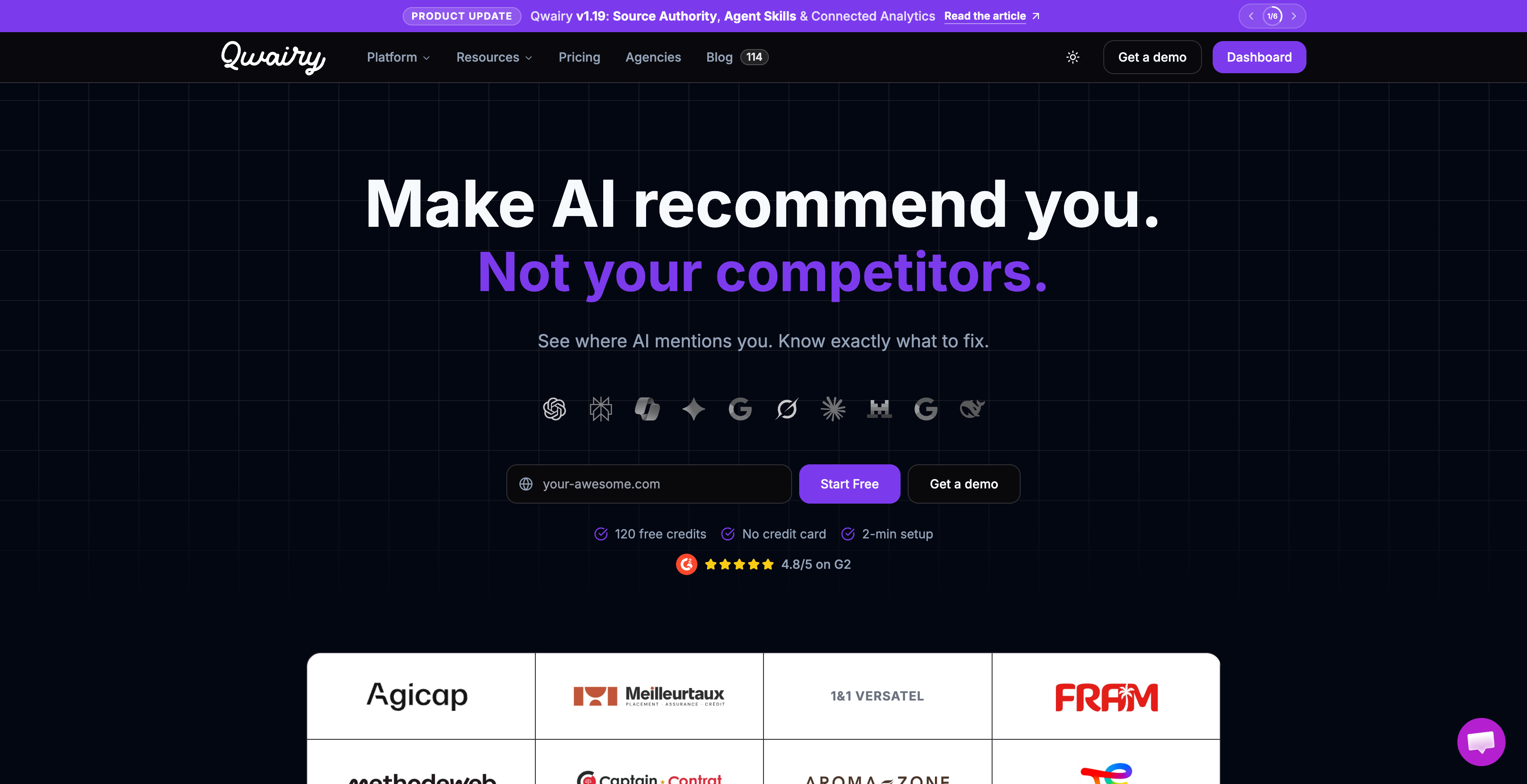
Qwairy covers 10+ engines (ChatGPT, Claude, Perplexity, Gemini, Copilot, Grok, AI Overviews, AI Mode, Mistral and DeepSeek), with no per-provider surcharge and no feature gates reserved for enterprise plans. It is used by 2,000+ brands.
Key features
- 10+ AI models tracked, monitoring both API and UI responses where relevant
- Five-module workflow: Visibility → Insights → Strategy → Technical → Analytics
- Action Center with impact scores and effort estimates
- Content Studio briefs in 45+ languages, plus log analysis and agency audits
Pros
- Broadest included engine list among the tools compared at this price point
- Action Center produces prioritized recommendations
- Multilingual coverage for European and international brands
Cons
- Credit-based pricing makes monthly cost hard to forecast, and reviewers report credits draining fast once you add engines
- No prompt volumes or prompt difficulty data
- Content Studio produces briefs, not published pages
Verdict: If your only complaint about Peec is the three-model cap, Qwairy is a direct alternative, provided you can live with credit math instead of a flat fee.
6. Scrunch AI
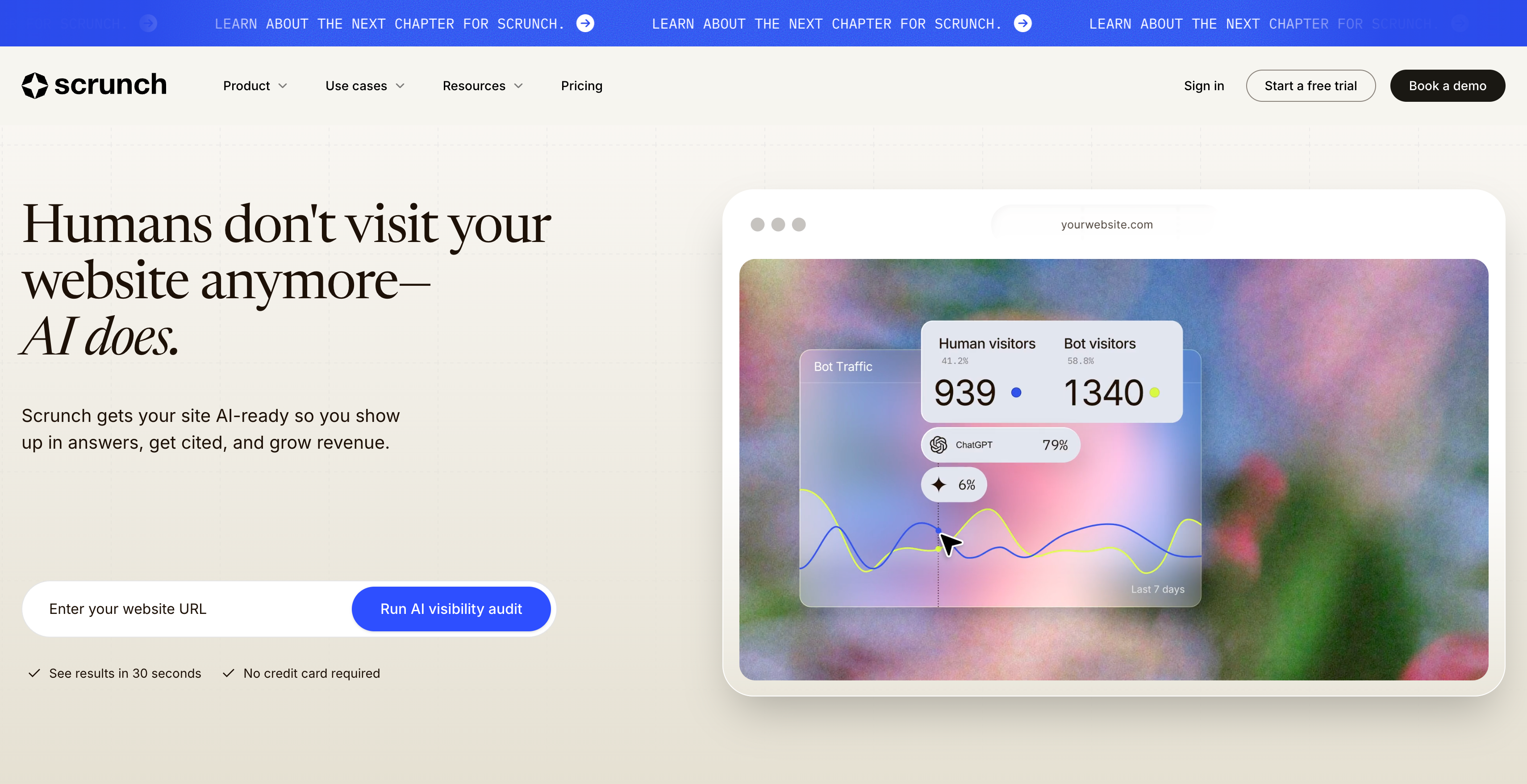
Scrunch approaches the problem from a different angle: rather than only tracking what AI answers say, it focuses on the experience AI agents have when they arrive at your site. Its Agent Experience Platform serves a machine-readable version of your site to AI crawlers. Sitecore acquired the company in June 2026 in a deal reported at around $225M, and Scrunch continues to operate as a standalone platform.
Key features
- Prompt monitoring, citations, page audits and site maps
- Agent traffic analytics showing which bots visited, what they read and how often
- Agent Experience Platform (AXP) for serving optimised content at the edge
- Hallucination detection for catching false AI claims about your brand
Pros
- Focuses on agent-experience tracking, a distinct approach among the tools compared here
- Crawler and agent-traffic analytics
- SOC 2 Type II certification; now part of Sitecore
Cons
- Core at ~$250/month tracks four engines and 125 prompts, the same cap problem at a higher price
- AXP, hallucination detection, API access and full engine coverage are Enterprise-only
- Plan packaging has churned repeatedly through 2026, so confirm the current lineup before you commit
Verdict:Scrunch fits teams treating agentic traffic as a board-level topic, or teams already using Sitecore.
7. Semrush AI Visibility Toolkit
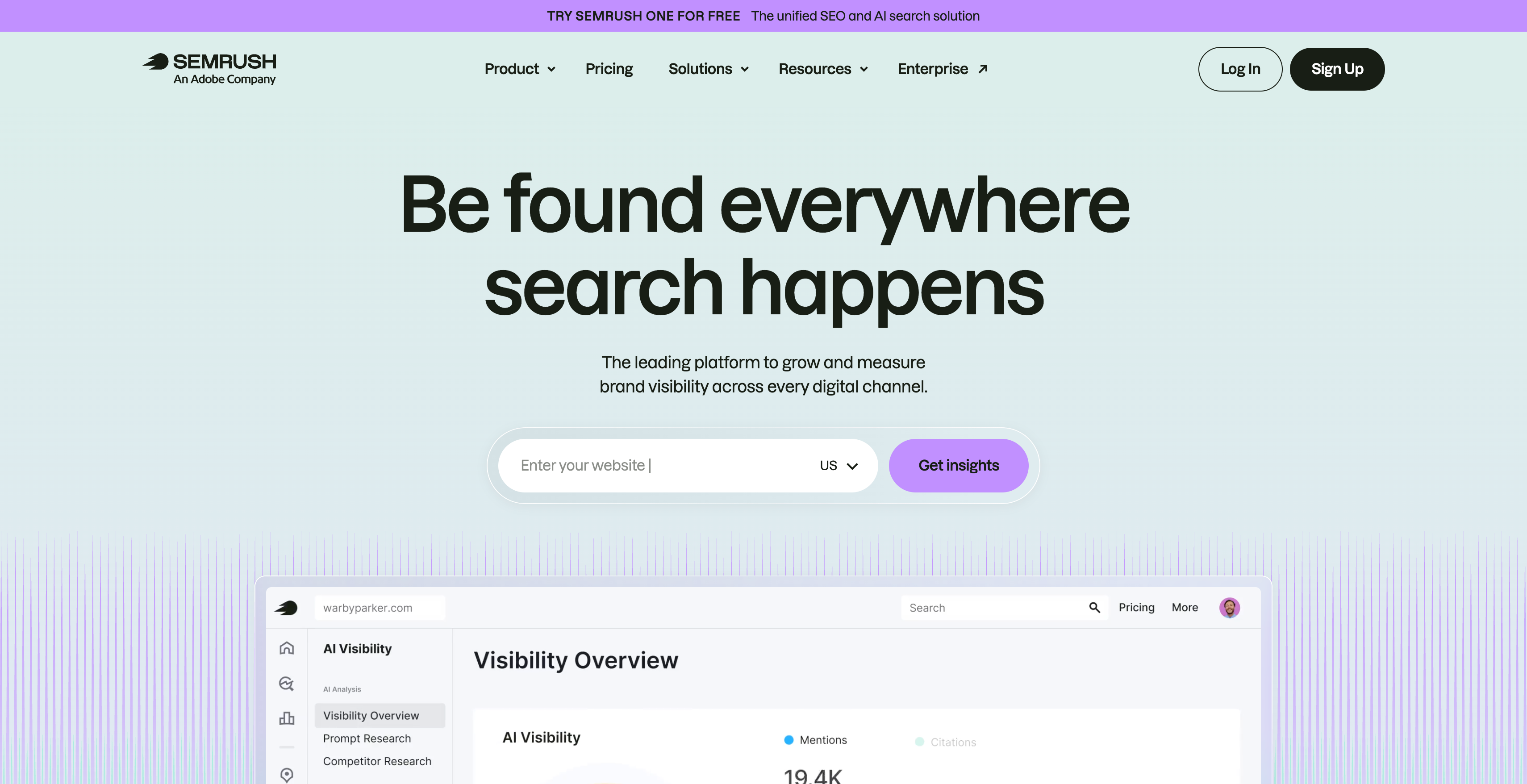
Sold standalone at $99/month per domain (one domain, 25 prompts, billed annually) or bundled into Semrush One from $199/month. Six reports cover visibility overview, prompt research, competitor research, brand performance and an AI readiness site audit, sitting on a large prompt database. A free AI visibility checker is also available at no cost.
Key features
- Six AI visibility reports inside the familiar Semrush interface
- Prompt Research drawing on Semrush's existing keyword and prompt database
- AI Search Site Audit covering crawlability and structured data
- Free checker with no card required
Pros
- Uses the existing Semrush interface for teams already using Semrush
- Includes an AI readiness site audit covering crawlability and structured data
- Combined SEO and AI visibility reporting in one export
Cons
- Per-domain, per-seat and per-prompt add-ons stack fast: an extra domain is +$99/mo, an extra seat +$99/mo, 50 extra prompts +$60/mo
- Methodology disclosure is thin, Semrush doesn't publish sample sizes or run counts
- No crawler logs, no content execution, and no free trial for the toolkit itself
Verdict: Suited to teams where AI visibility is a secondary reporting line and Semrush is already in use. If it's the primary channel, a suite add-on will cap capability quickly, and the per-domain pricing makes it the most expensive option compared here for agencies.
How to Switch From Peec to Promptwatch Without Losing Your Baseline
Export your prompt list and competitor set before you cancel. What moves is the prompt list, not the history, there's no connector between platforms. Export your prompts from Peec as a spreadsheet and keep a column headed prompt; topic, type and intent columns are optional but worth carrying over if you have them. In Promptwatch, paste the list or upload the file when adding prompts, up to 1,000 at a time. Document your competitor set at the same time, since that gets rebuilt manually too.
FAQ
Why do people look for Peec AI alternatives?
Four reasons come up repeatedly: every self-serve plan caps you at three engines no matter how much you spend, Claude and DeepSeek are Enterprise-only while Grok isn't offered at all, the platform monitors without executing, no content generation, no CMS publishing, no crawler logs and API access is reserved for Enterprise with no white-label reporting for agencies.
Is Promptwatch a good Peec AI alternative?
Yes, and it's the cleanest comparison in the category because the entry prices match exactly. Both cost $95/month for 50 prompts. Peec gives you three engines from six, no API and no Claude. Promptwatch gives you four engines freely chosen from nine-plus including Claude, Grok and DeepSeek, roughly a third more monthly responses, MCP and API access, and Agent Chat. From the $245 tier it adds server-side crawler logs and content agents that publish to your CMS. The trade-off is metered seats where Peec offers unlimited users.
How much do Peec AI alternatives cost?
Roughly $29/month at the bottom (Otterly Lite) to $1,000/month or more at the top once you add engines, domains or credits. Most self-serve tools land between $95 and $295/month for meaningful multi-engine coverage. Budget $100 to $250/month for a real program, and check whether pricing is per domain, per prompt, per engine or per credit before comparing headline numbers.


