

TL;DR
- AI brand perception is the picture of your brand that ChatGPT, Gemini and Google's AI surfaces build from hundreds of specific claims about your pricing, features, quality, support and reputation.
- AI perception is best measured theme by theme: a brand can score well overall while one theme, such as support or pricing, trails every competitor.
- A negative claim can be true, so the fix is sometimes better framing on your own pages and sometimes a correction at the source AI cites.
- Promptwatch Brand Narrative extracts every claim ChatGPT, Gemini, Perplexity, Meta AI and Google's AI surfaces make about your brand and competitors, scores nine themes from 0 to 100, and opens each claim into the answers, prompts and cited pages behind it.
In the seven days to November 16, 2026, AI models made 1,924 distinct claims about Fireflies.ai in answers to the prompts Fireflies tracks in Promptwatch. 869 were positive, 517 neutral, 464 mixed and 74 negative. Fireflies ranks first of 15 meeting-assistant brands on how AI describes the company itself, and 13th on how AI describes its support.
Those numbers come from Brand Narrative, a new Promptwatch report that measures AI brand perception and answers a question every marketing team now asks: how does AI describe my brand? It reads every tracked AI answer that mentions you or a competitor, pulls out each claim, files it under a theme and scores the sentiment. This article walks through how it works using Fireflies' own data, with Fireflies' permission.
What Is AI Brand Perception, and Why Is It Hard to See?
AI brand perception is how AI models such as ChatGPT, Gemini and Perplexity describe your brand when buyers ask about it. It is built from individual claims about your pricing, features, support and reputation, each drawn from whichever source the model trusts for that point.
A buyer who asks Gemini whether a meeting assistant is worth it for a small team gets an answer that mixes a pricing statement, a feature limit and a line about support quality. Across hundreds of prompts and six AI surfaces, those claims add up to a description of your brand that nobody on your team wrote.
Visibility metrics measure how often AI mentions you and leave out what it says. A visibility score tells you how often you appear, and an AI share of voice figure tells you how much of the conversation you hold. Neither shows the claims AI makes about your brand once you're in the answer, or which part of your story it tells badly.
A single overall sentiment score hides which theme drives it. It averages the claims AI repeats about your pricing with the claims it makes about your audience fit, and those usually need different owners and different fixes.
Why We Built Brand Narrative
Promptwatch already scored the sentiment of every tracked response. Customers kept asking the next question: which sentences in those answers drive the score, and where do they come from?
If someone else is answering the questions my consumers have about my brand, I need to know what those answers are, and I need to know where that content is coming from.
Brand Narrative answers that question. It breaks every tracked AI answer down to individual claims, groups the claims into nine themes a marketing team already works in, and links each claim back to the answers, prompts and cited pages it came from.
How Do You Measure AI Brand Perception?
Promptwatch measures AI brand perception in three steps: extract the claims, file each one under a theme, and score the sentiment. Brand Narrative runs these steps on every answer collected for your tracked prompts that mentions your brand or a tracked competitor.
1. Extract the claims
Each statement AI makes about a brand is lifted out together with the quote it came from. A claim is kept only when it's quoted word for word from the answer, so every claim in the report can be traced to a real sentence a model wrote. Claims about specific prices are dropped.
When several answers make the same point in different words, Brand Narrative groups them into one claim. That shows how often AI repeats it and which models say it. For Fireflies, Meta AI, Gemini, Google AI Overviews, AI Mode and ChatGPT all stated that the Enterprise plan has no monthly billing option, in 14 slightly different phrasings, and they appear as one claim.
2. File each claim under a theme
Every claim goes under one of nine themes:
| Theme | What the claims cover | Fireflies score (last 7 days) |
|---|---|---|
| Audience | Who the product is for | 75 |
| Reputation | Trust, standing, track record | 73 |
| Features | What the product does and doesn't do | 70 |
| Quality | Accuracy and output quality | 69 |
| Usability | Ease of setup and use | 68 |
| Pricing | Plans, billing terms, free tiers | 67 |
| Support | Help, onboarding, admin and service | 64 |
| Range | Breadth of offering and coverage | 57 |
| Company | Facts about the business itself | 53 |
Source: Promptwatch Brand Narrative, Fireflies.ai project, November 10 to 16, 2026.
Themes show which parts of your story AI tells well and which it doesn't. They also map to owners: pricing claims go to product marketing, support claims to customer success, features claims to product.
3. Score the sentiment
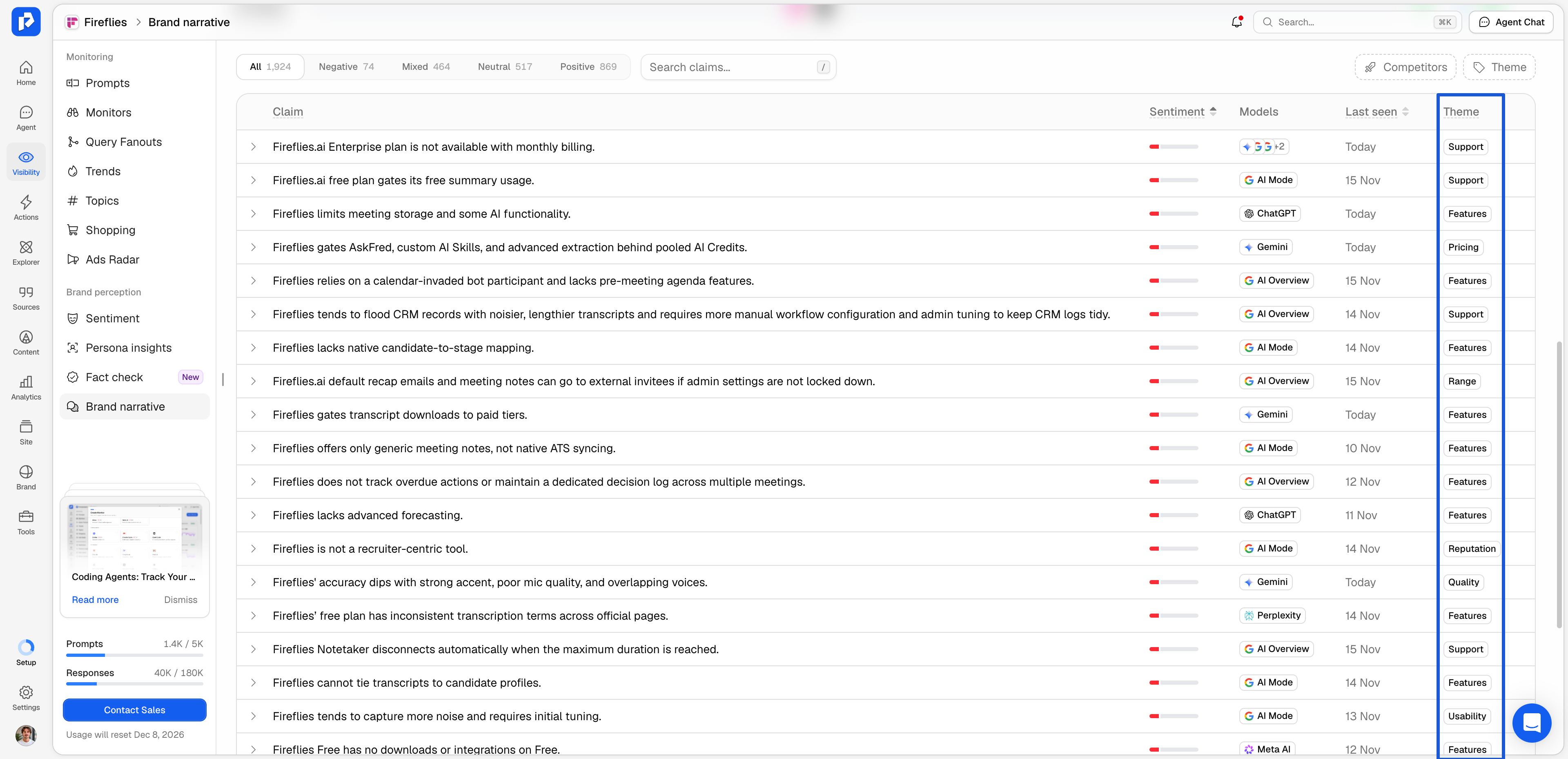
Each claim is marked positive, neutral or negative, or mixed when the quotes behind it disagree. Per theme, those labels roll up into a score from 0 (all negative) to 100 (all positive), so every brand you track gets nine theme scores.
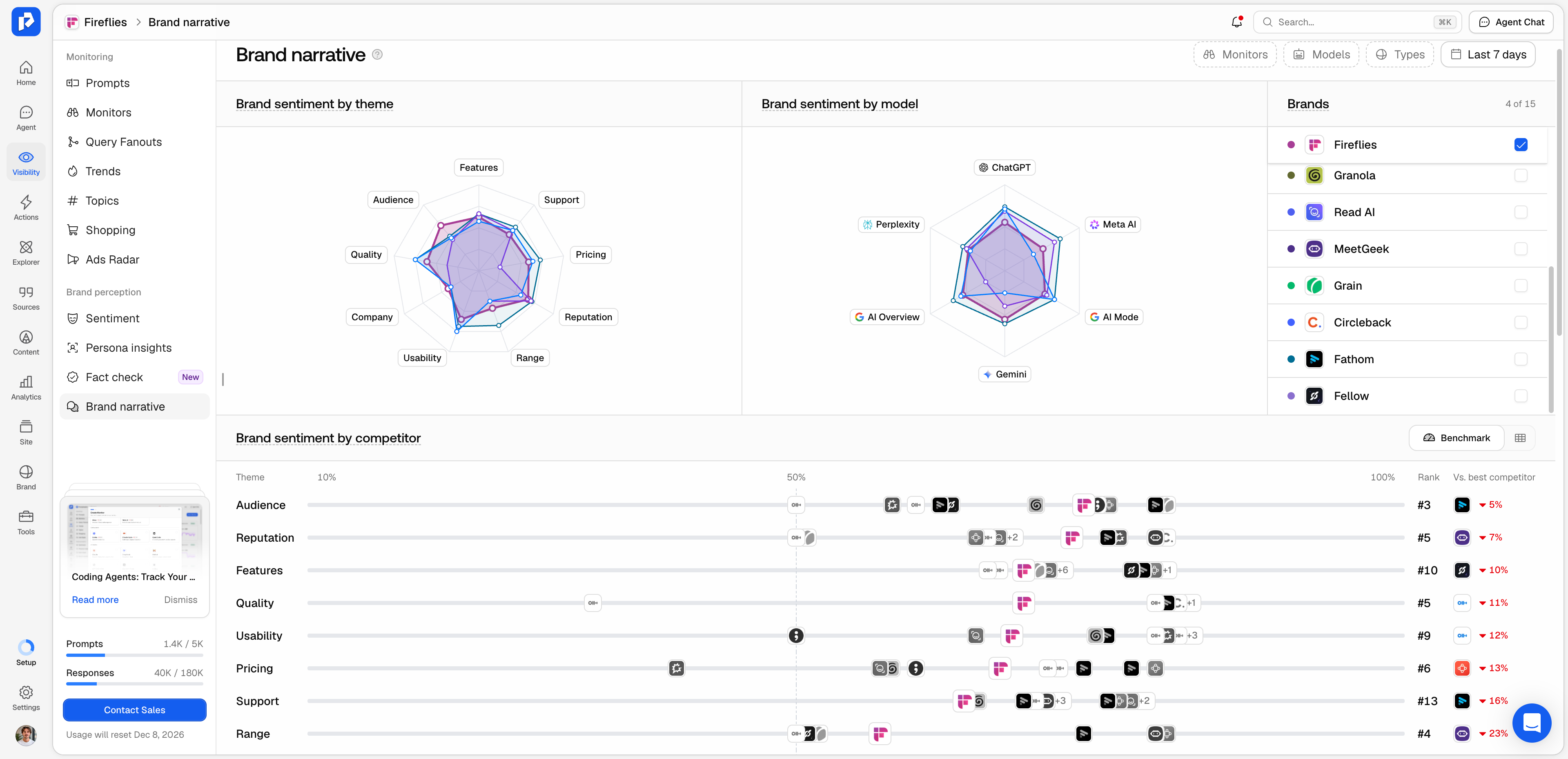
The page shows the result in four views: a radar of sentiment by theme, a radar of sentiment by AI model, a benchmark that ranks your brand against competitors on each theme, and a claims list sorted with the most negative first. Promptwatch's roundup of tools for tracking brand sentiment in AI answer engines or generative search covers how per-response sentiment is measured upstream of this.
What Does AI Say About Fireflies? A Seven-Day Example
Fireflies.ai, an AI meeting assistant and Promptwatch customer, tracks 15 brands in Promptwatch, itself included, among them Fathom, Gong, Otter, Avoma, Fellow, Granola and tl;dv. Here is what Brand Narrative showed for November 10 to 16, 2026.
Where Fireflies leads and where it trails
Fireflies' strongest theme is Audience, at 75. AI is confident about who Fireflies is for. Its weakest scores are Range (57) and Company (53), but the Company score still ranks first among the 15 brands, three points ahead of Otter. Most competitors sit at exactly 50 on Company, which means AI's claims about these businesses are mostly neutral facts.
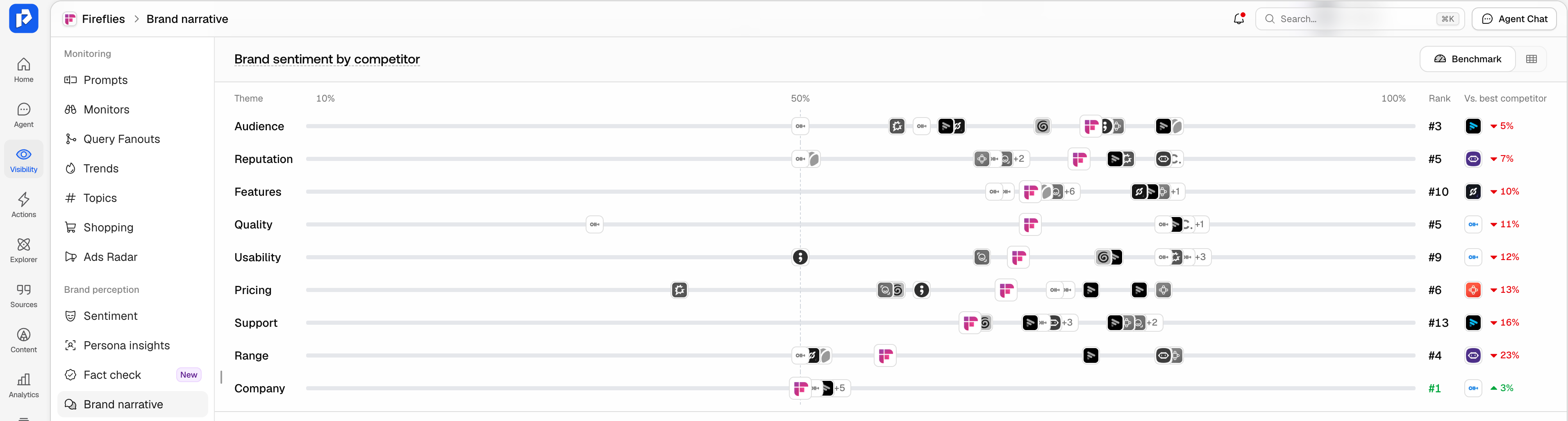
The benchmark view turns those scores into ranks, with the gap to the best competitor on each theme:
| Theme | Fireflies rank | Best competitor | Gap |
|---|---|---|---|
| Company | #1 | Otter | +3 |
| Audience | #3 | Fathom | −5 |
| Range | #4 | MeetGeek | −23 |
| Reputation | #5 | MeetGeek | −7 |
| Quality | #5 | Otter | −11 |
| Pricing | #6 | Avoma | −13 |
| Usability | #9 | Otter | −12 |
| Features | #10 | Fellow | −10 |
| Support | #13 | Fathom | −16 |
Source: Promptwatch Brand Narrative benchmark view, Fireflies.ai project, November 10 to 16, 2026. Gap is the difference in theme score, in points.
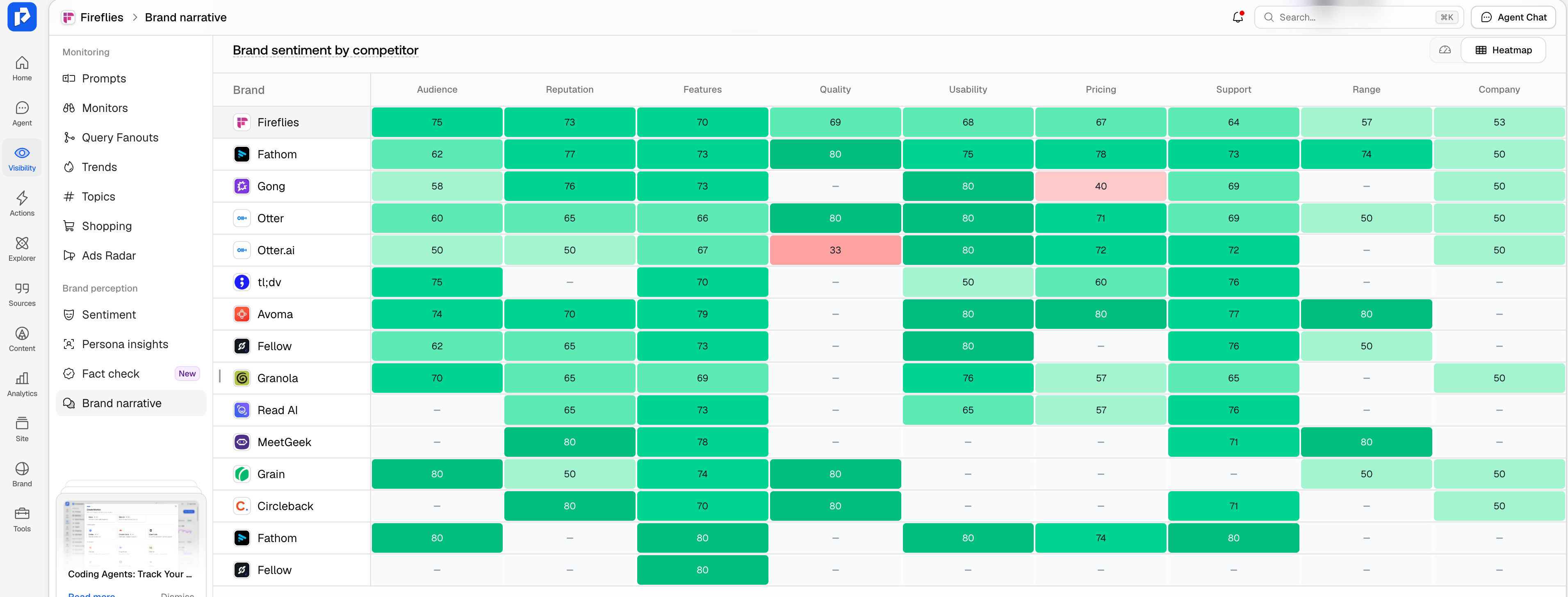
Support is the clearest priority. Fireflies scores 64 there, and Fathom scores 80, the highest any brand reaches on that theme. Range has the largest gap (23 points), but fewer brands receive Range claims at all, so Support affects more answers.
The negative claims cluster around comparisons
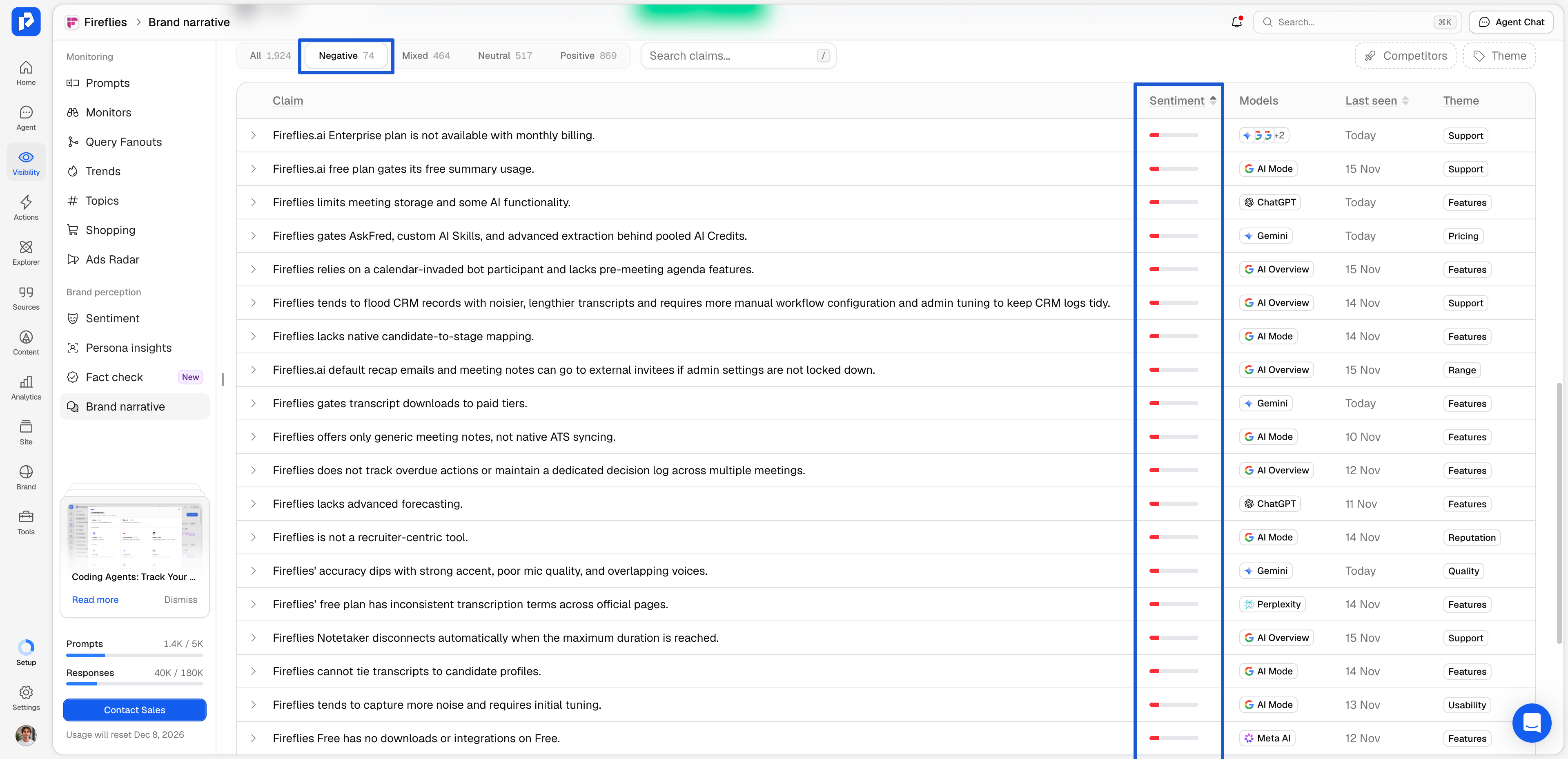
Of the 1,924 claims, 74 are negative, about 4%. Reading them in order shows a pattern: many come from prompts where AI compares Fireflies with a specialist tool.
- Recruiting prompts. AI Mode says Fireflies "lacks native candidate-to-stage mapping," "cannot tie transcripts to candidate profiles" and "is not a recruiter-centric tool." These are claims about fit, made while AI answers questions about hiring software.
- Revenue intelligence prompts. ChatGPT says Fireflies "lacks advanced forecasting," a capability buyers associate with Gong.
- Free plan limits. Gemini, Perplexity and Meta AI repeat that the free plan restricts downloads, storage and smart features, and that starter credits don't refill.
Each cluster of negative claims needs a different response. Fit claims in recruiting prompts call for a clear page on who Fireflies serves in hiring workflows, or a decision to let that audience go. Free-plan claims are a pricing-page and help-center question.
One negative claim stands out for a different reason: Perplexity says Fireflies' free plan "has inconsistent transcription terms across official pages." That claim is about Fireflies' own website. It is the kind of claim to send straight to Fact Check, which compares claims against every page on your site and the sources AI cites.
Inside One Claim: "Fireflies.ai Enterprise Plan Is Not Available With Monthly Billing"
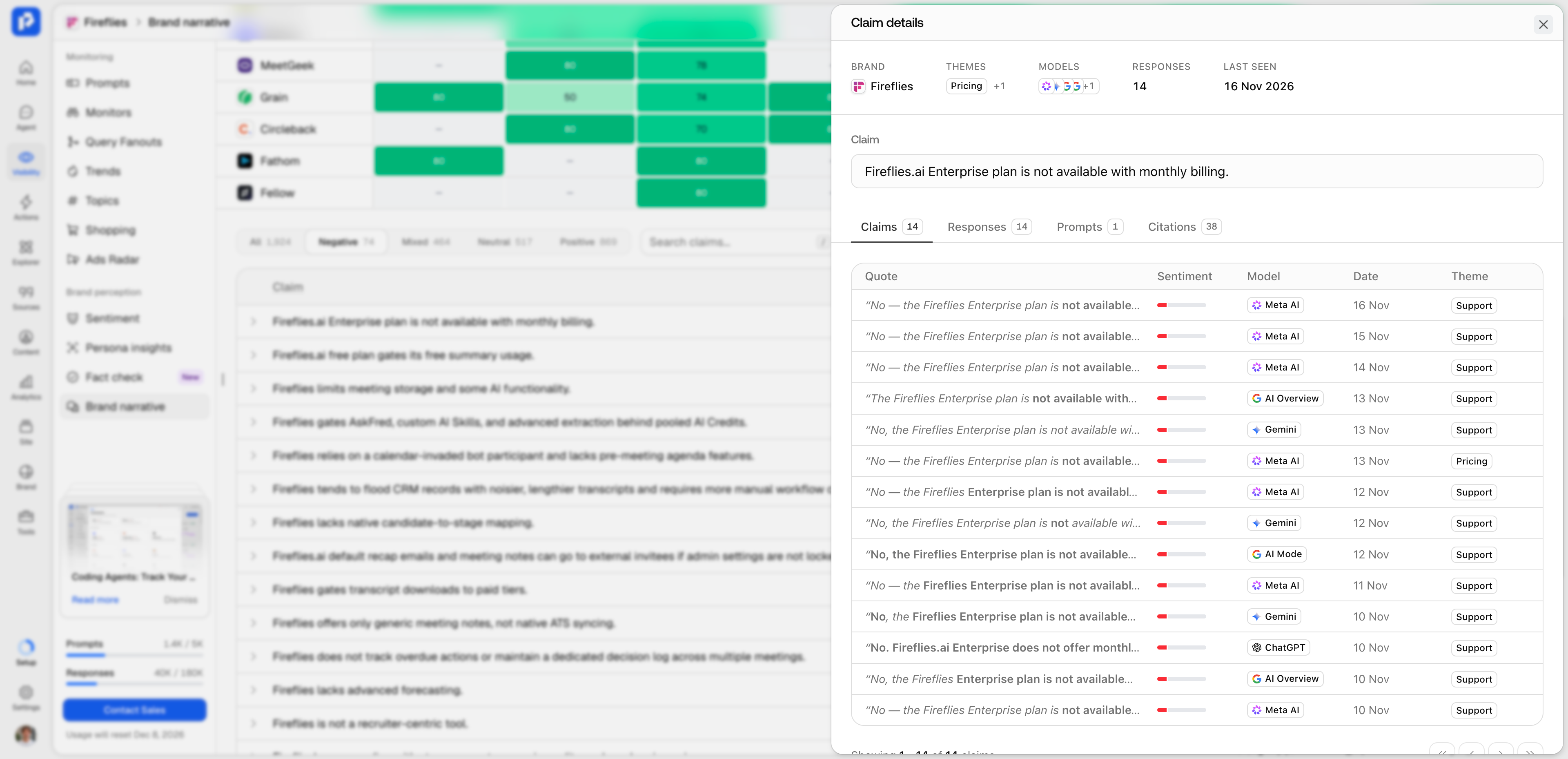
The most negative claim at the top of Fireflies' list is about billing. Opening it shows everything behind it:
- Responses: 14 answers in the period, last seen November 16, 2026.
- Models: Meta AI, Gemini, Google AI Overviews, Google AI Mode and ChatGPT.
- Prompts: one prompt, "Is the Fireflies Enterprise plan available with monthly billing, and what is the minimum price?"
- Themes: mostly Support, with Pricing as a second theme.
- Citations: 38 cited pages. The most cited are third-party pricing explainers from getvoibe.com (8 responses), javisreview.com, anygen.io and getquietnote.com (7 each). Fireflies' own pricing page, pricing blog post and Enterprise help article are each cited in 5 or 6 responses.
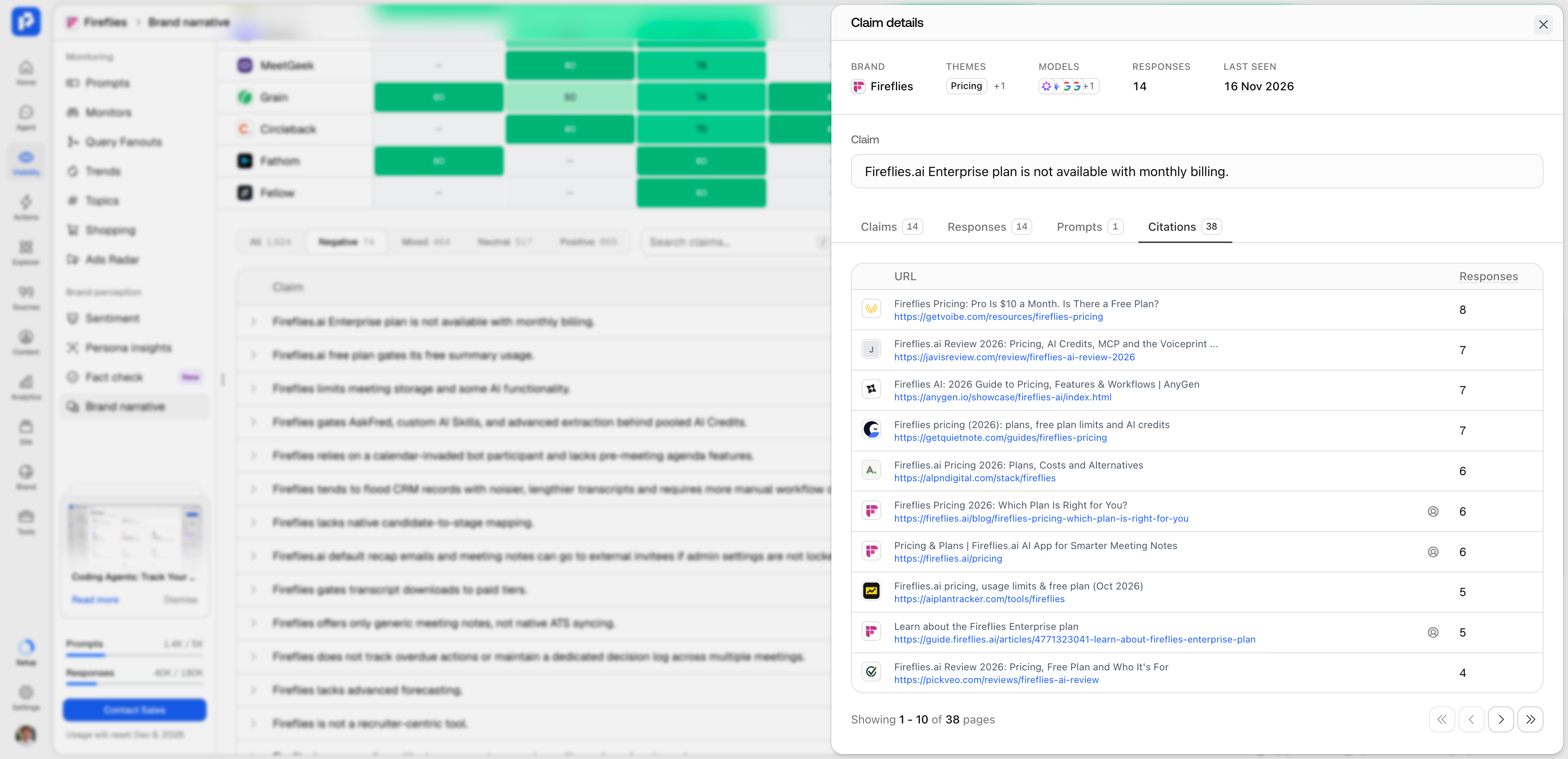
The claim is accurate. Fireflies' help center states that the Enterprise plan is available only as an annual subscription. AI is reading it correctly from Fireflies' own pages and from the third-party explainers that repeat it.
A true claim can still score negative, and that changes the fix. There is nothing to correct at the source. The opportunity is framing: AI answers the question with a bare "no," because the pages it reads state the rule without context. A short explanation on the pricing page and the Enterprise help article (what annual billing includes, and what a team that needs monthly terms should choose instead) gives AI something better to repeat.
The citation list also shows where the narrative is set. Four third-party pricing pages are cited more often than any Fireflies page. Promptwatch's analysis of whether review sites like G2 and Capterra help a software brand get recommended by ChatGPT looks at how much weight these pages carry for software brands.
Which AI Model Is Least Positive About Your Brand?
The second radar plots sentiment by model for each brand you select: ChatGPT, Meta AI, Google AI Mode, Gemini, Google AI Overviews and Perplexity. Models read different sources, so they often tell different versions of the same story. Fireflies' billing claim, for example, comes up most often in Meta AI.
When one model sits far below the others, filter the claims list to that model and read its negative claims together. They usually point to a small set of cited pages that model favors.
What they had was what I call narrative drift. The LLMs did not know how to interpret them, so their context and standing shifted with each and every prompt, from favorable to unfavorable.
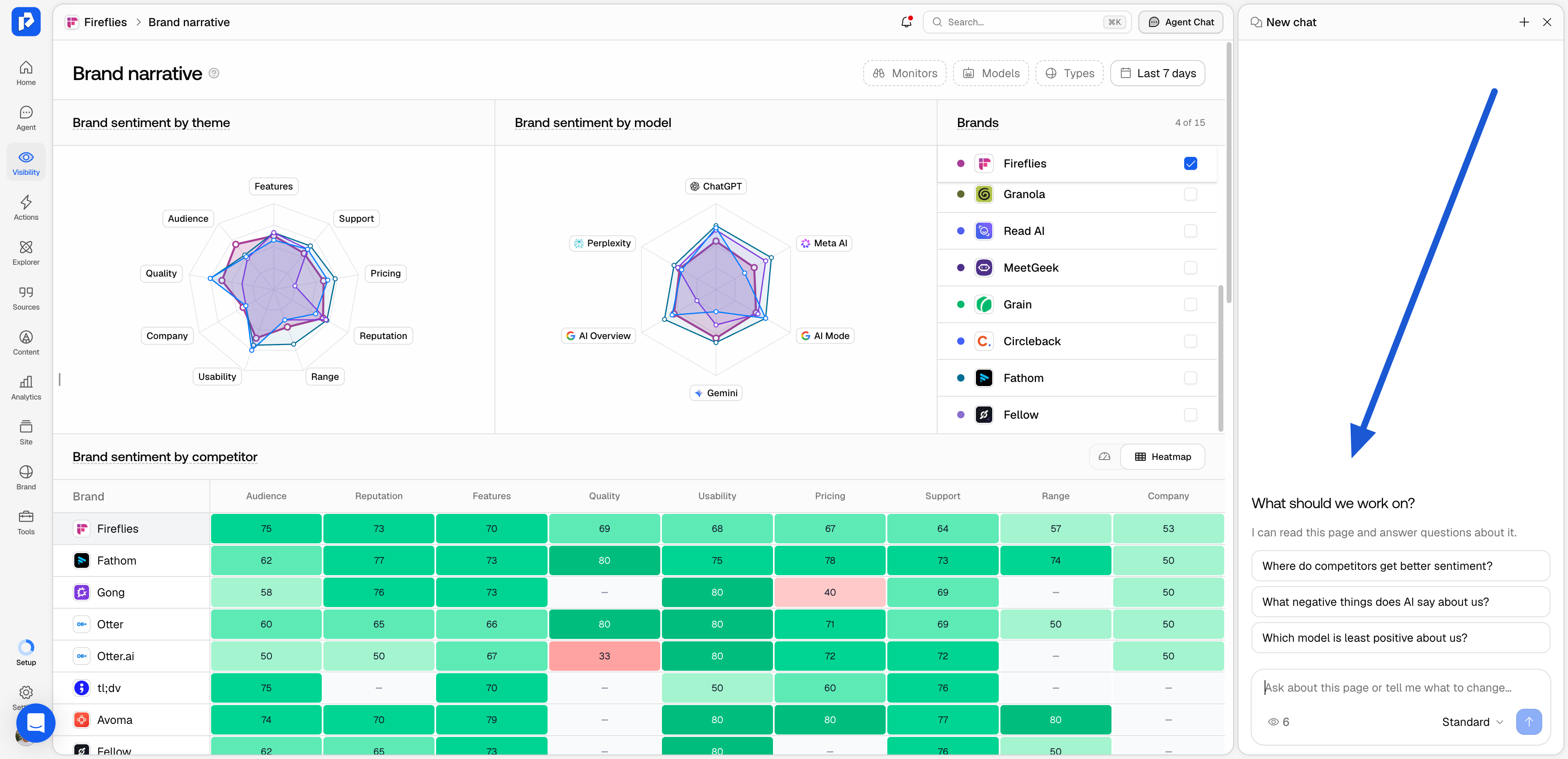
Narrative drift shows up first in the model radar, as one model's score falls away from the others. You can also ask Promptwatch's Agent Chat from the Brand Narrative page, with questions such as "Where do competitors get better sentiment?" or "Which model is least positive about us?"
How to Improve Your AI Brand Perception
To improve your AI brand perception, find the theme where you trail competitors most, check whether the negative claims behind it are true, then fix the pages AI cites. This is the order Promptwatch recommends:
- Start with the widest benchmark gap on a theme that affects revenue. For Fireflies that is Support (rank #13, 16 points behind Fathom). Click the theme to see the claims behind the score.
- Read the negative and mixed claims first. The claims list is already sorted most negative first. Mixed claims are worth a look too: they mean the quotes disagree, which often means your own pages disagree.
- Sort each claim into true or wrong. A true negative claim, like the annual-only Enterprise plan, needs better framing on your pages. A wrong claim needs a correction at the source. Run uncertain ones through Fact Check.
- Fix your own pages. When the cited pages include your own site, update them. The content agent refreshes up to 10 pages at a time and publishes to WordPress, Webflow or Framer.
- Contact the third-party sources AI cites most. Start with the pages cited in the most responses, such as getvoibe.com for Fireflies' billing claim.
- Recheck after the next crawl. New claims can take up to about a day to appear after an answer comes in. Watch the theme score and the claim count over the following weeks.
Brand Narrative, Fact Check and Sentiment: What Each One Answers
| Report | Question it answers | Plans |
|---|---|---|
| Sentiment | How positive is each AI answer about us overall? | All plans |
| Brand Narrative | What exactly does AI say about us and our competitors, by theme, and where does it come from? | All plans |
| Fact Check | Is each claim true, according to our own site and the sources AI cites? | Business, Agency Scale, Enterprise |
Brand Narrative tells you what AI says and how it feels about it. Fact Check tells you whether it's true. Most teams use them in that order: Brand Narrative to find the claims that hurt, Fact Check to decide which ones are wrong. For a comparison of other tools to detect false claims AI makes about a brand, see Promptwatch's roundup.
FAQ
What is AI brand perception?
AI brand perception is how AI models such as ChatGPT, Gemini and Perplexity describe your brand to buyers. AI makes specific claims about your pricing, features, quality, usability, support, reputation, audience, range and company whenever it answers a question that mentions you. Promptwatch Brand Narrative collects those claims from every tracked answer, groups repeated ones, and scores each theme from 0 to 100 so you can see what AI says about your brand and which parts of your story it tells well.
How is AI brand perception different from AI visibility?
AI visibility measures how often and how prominently AI mentions your brand. AI brand perception measures what AI says about your brand once it mentions you, claim by claim and theme by theme. A brand can have high visibility and still lose buyers if AI repeats negative claims about its support or pricing.
How does Brand Narrative decide what counts as a claim?
A claim is a statement AI makes about a brand, kept only when it's quoted word for word from the answer. Statements that make the same point in different words are grouped into one claim, which shows how often it's repeated and by which models. Claims about specific prices are dropped.
What are the nine Brand Narrative themes?
The themes are Pricing, Features, Quality, Usability, Range, Support, Reputation, Audience and Company. Every claim is filed under one theme, and each theme gets its own sentiment score per brand.
How is the theme score calculated?
Each claim is labeled positive, neutral, negative or mixed, where mixed means the quotes behind it disagree. Those labels roll up per theme into a score from 0, meaning all negative, to 100, meaning all positive.
Can I compare my brand with competitors?
Yes. Claims are collected for every tracked competitor. The radars compare the brands you select by theme and by AI model, and the benchmark view ranks every brand theme by theme with the gap to the best competitor.
What should I do when AI says something negative but true?
Improve the framing on the pages AI cites. A true negative claim usually means your pages state a limit without explaining it, so add the context you want AI to repeat, such as what a plan includes and which option fits a buyer the limit excludes.
Which plans include Brand Narrative?
Brand Narrative is available on every Promptwatch plan. It's in the dashboard only, with no export or API, and new claims can take up to about a day to appear after an answer comes in. Fact Check, which verifies claims against your site, is on Business, Agency Scale and Enterprise.


