

TL;DR
- GEO for ecommerce is the work of getting your products named in AI written answers, placed in AI shopping carousels and selected by AI shopping agents.
- Each surface reads different inputs: buying guides and roundups for written answers, Google Shopping rank and product feeds for carousels, and clean structured data for agents.
- The core work is consistent product data everywhere AI reads it, product pages AI crawlers can reach, and coverage on the third-party pages AI already cites.
- Promptwatch tracks all three surfaces on the same prompts: brand visibility and citations in written answers, every product card with its price, merchant and position, and AI crawler activity on your product URLs, market by market.
GEO for ecommerce (Generative Engine Optimization for online stores) is the practice of making your products, product data, and brand easy for AI systems to find, trust, and recommend. When a shopper asks ChatGPT or other LLMs for "What are the best running shoes for marathon training right now?," the answer names a handful of brands, cites a few sources, and often attaches a row of product cards. GEO decides whether your store is in that answer.
This guide covers how generative AI in ecommerce changes product discovery as of October 2026, what AI engines read when they pick products, a seven-step process for AI optimization of an ecommerce site, and how to measure the results. It draws on Promptwatch's own tracking of ecommerce prompts, their query fan-outs, and the pages AI cites in response. If you need the full generative engine optimization definition first, start there.
“I said to the leadership team: none of our car brands are being mentioned in the top 10, so what are we going to do about it? Our CEO agreed and said: let's try to be consistently the number one answer.”
What is GEO for ecommerce?
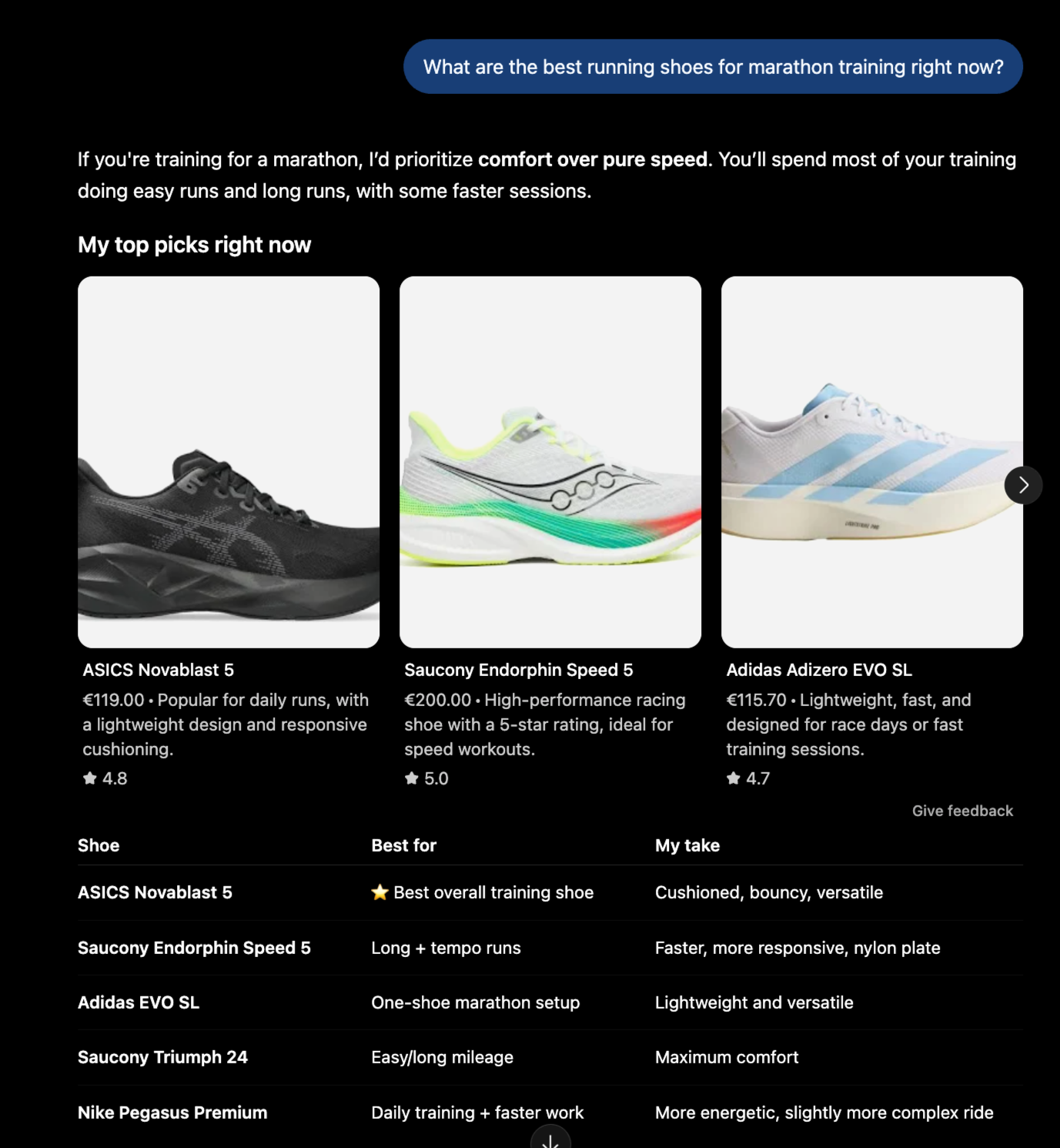
GEO for ecommerce applies Generative Engine Optimization to the specific way AI handles buying questions. A B2B software brand mostly cares about being named in a written answer. An online store has three places to win:
- the written answer,
- the shopping carousel attached to it
- the AI agent that may complete a purchase on the shopper's behalf
The terms overlap in practice. "AI optimization for ecommerce," "generative AI optimization for ecommerce," and "AEO for online stores" all describe the same job. Promptwatch treats GEO and AEO as interchangeable.
How GEO differs from ecommerce SEO
Ecommerce SEO ranks category and product pages in Google's blue links. GEO aims to get those same products into answers that a model writes from several sources at once. Ranking first in Google does not guarantee a mention in ChatGPT, because AI synthesizes from whichever sources it judges most relevant for each prompt.
Most of the groundwork carries over:
- crawlable pages
- clean structured data
- strong reviews
The difference is in what gets measured and which sources matter. The debate over whether generative engine optimization is replacing traditional SEO is covered separately; for a store, the practical answer is that both run on the same product data.
How generative AI in ecommerce changes product discovery
Generative AI in ecommerce moves product discovery into a single conversation. The shopper describes a need, the model researches it with several background searches, and the answer arrives with recommendations already filtered. Each of the three surfaces below rewards a different kind of work.
Written answers cite listicles, comparisons, and guides
Written AI answers lean heavily on third-party roundups. Promptwatch tracked the prompt "What are the best running shoes for marathon training right now?" across ChatGPT, Perplexity, Gemini, Google AI Overviews, and AI Mode from September 5 to October 4, 2026, and grouped every cited URL. The top source, a listicle from an ecommerce analytics vendor, appeared in 43.3% of analyzed responses. The next four each appeared in 33% to 41%. Of the top 15 cited URLs, 14 were listicles or comparisons.
The same pattern holds for consumer product categories: when a shopper asks for "the best" anything, the model goes looking for pages that have already ranked the options. Being included, and described accurately, in the roundups your category relies on is one of the most direct ways to get AI mentions for your products.
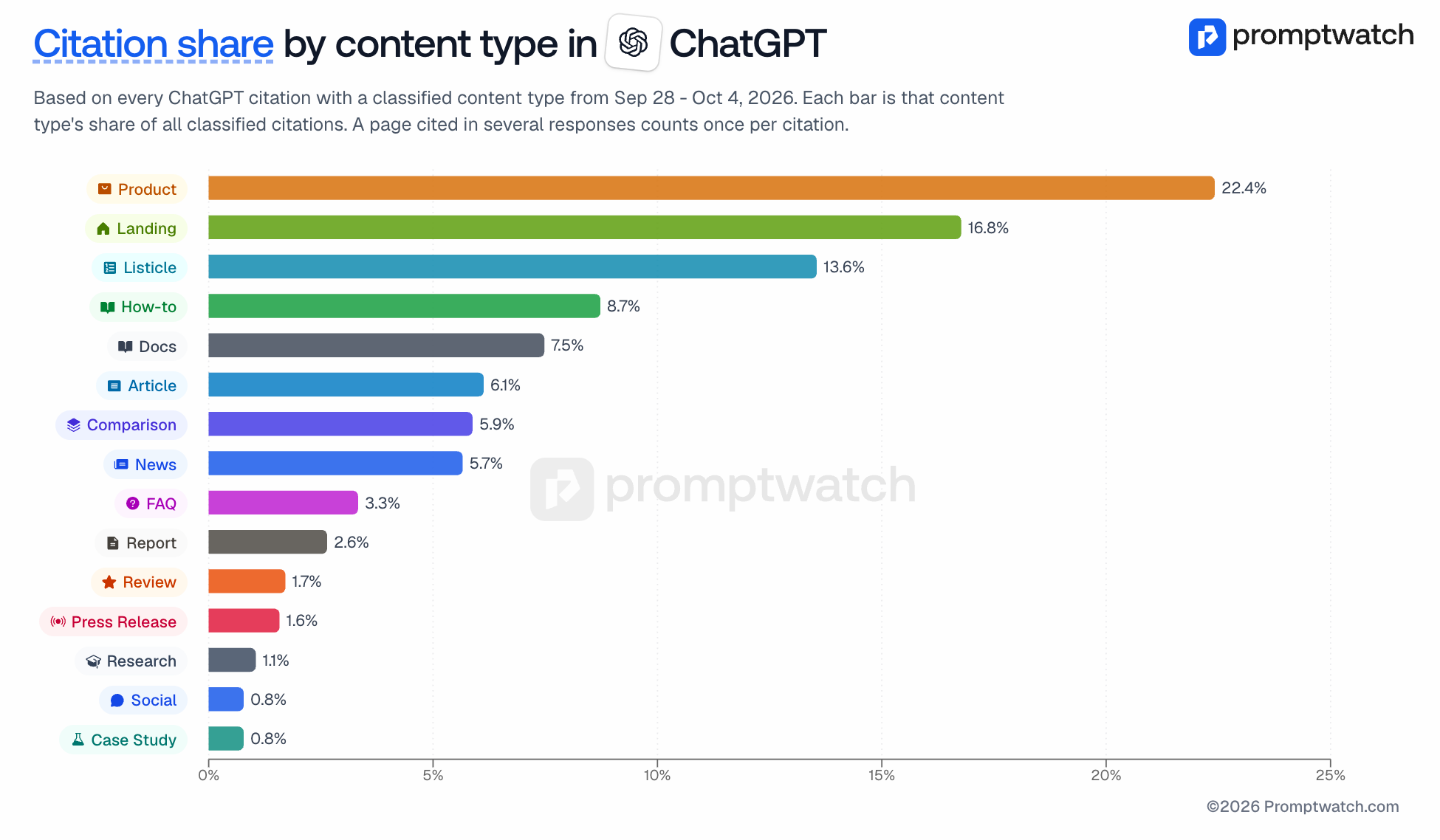
Format matters too. In Promptwatch's ChatGPT citation data for September 28 to October 4, 2026, product pages were the most-cited content type at 22.4% of citations, ahead of landing pages at 16.8%, listicles at 13.6% and how-to guides at 8.7%. On commercial prompts, where shoppers compare and choose, product pages rose to 26.0% and listicles to 15.0%. For a store, that means your product detail pages are already a primary citation target, with buying guides and roundups close behind.
Shopping carousels run on product data
A ChatGPT shopping carousel is the row of product cards ChatGPT attaches to a buying question, each showing title, image, price, merchant, rating, and review count. OpenAI states that these product results are chosen independently by ChatGPT and are not ads.
The inputs are mostly structured data. A study published by Search Engine Land on March 5, 2026 analyzed more than 43,000 carousel products and found 83% strongly matched a product in Google Shopping's top 40 organic results, and around 60% of those matches came from Google's top 10 positions. The second route in is a direct product feed to OpenAI through the Agentic Commerce Protocol or Shopify Catalog.
AI agents for ecommerce act on what they can parse
AI agents for ecommerce go a step further than recommending, which is what defines agentic commerce: they compare offers, check stock, and in some flows complete checkout. An agent reads structured product data, prices, availability, and policies, and it skips anything it cannot parse quickly. How to prepare for agentic commerce covers checkout, agentic commerce protocols such as ACP and UCP, and feed architecture on top of the GEO work described here.
Promptwatch data shows these agents draw on a different source pool. For the prompt "how do I get my online store ready for AI shopping agents," the most-cited page appeared in 30.2% of responses across six providers. Shopify's growth services blog, Stripe's agentic commerce field guide, and an agency readiness checklist were cited mainly by Amazon Alexa, Microsoft Copilot, and ChatGPT, while Gemini and Google AI Overviews leaned on a different set of how-to pages. A store that measures only ChatGPT sees one slice of that picture.
What AI engines look at when they recommend products
When Promptwatch tracked the prompt "What influences which products ChatGPT and Perplexity recommend: product feeds, reviews, or retailer listings?", ChatGPT ran fan-out queries that went straight to the platforms' own sites, including site:openai.com searches about product feeds, site:perplexity.ai searches about retailer data, and a site:blog.google search about shopping feeds. A query fan-out is the set of sub-queries an AI system runs in the background before it writes an answer. Those fan-outs point to four inputs that matter most:
- Product feeds: titles, GTINs, prices, availability, and attributes in Google Merchant Center and any direct AI feed. Feed titles are often matched string by string against shopping indexes.
- Structured data on the product page: Product, Offer, and AggregateRating schema that agrees with the feed. Conflicting prices across feed, page, and marketplace give the model three versions of the truth.
- Reviews and ratings: star ratings and review counts appear on every product card, and written answers quote review sites and forums.
- Third-party coverage: buying guides, gift guides, comparison pages, Reddit threads, and YouTube reviews that describe your products in context.
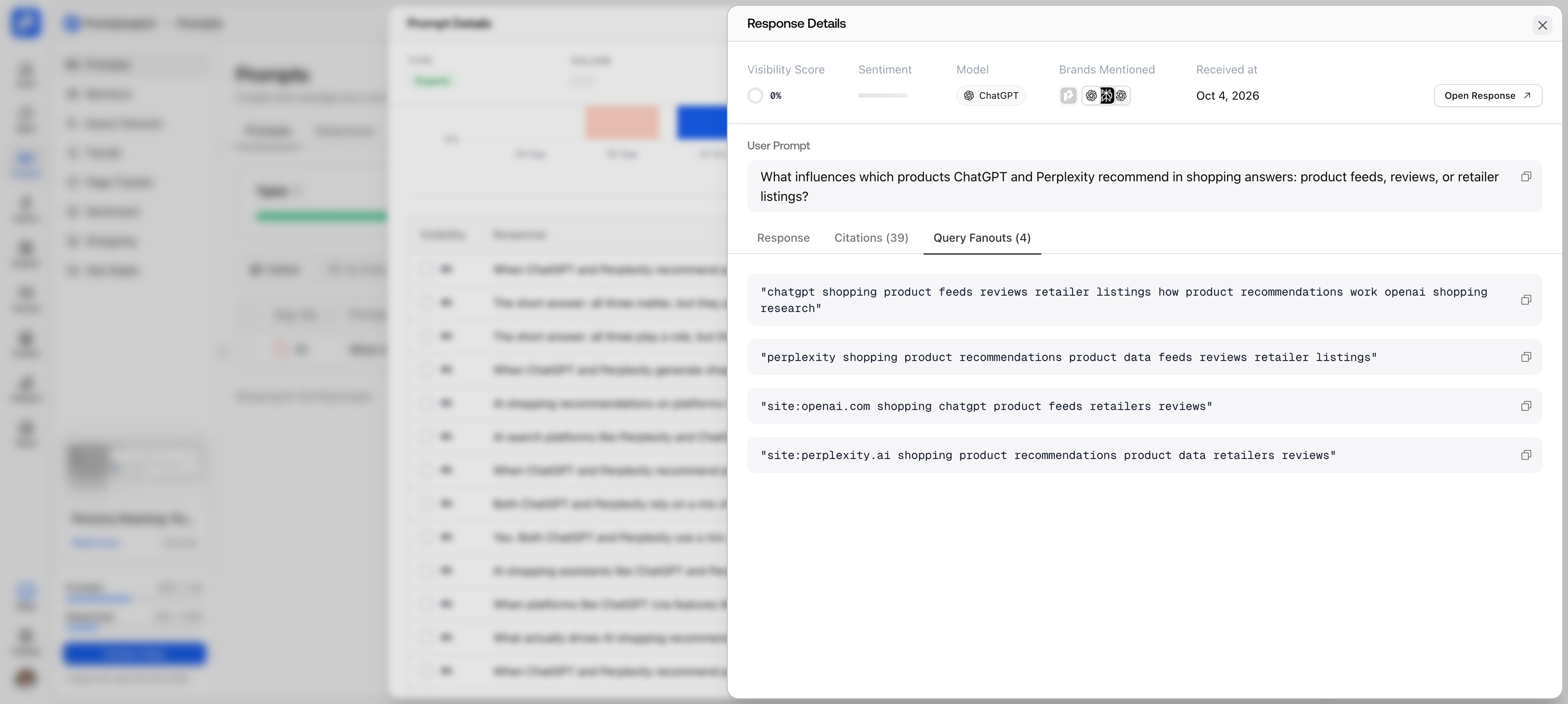
ChatGPT also checks brands' own sites directly. In the fan-outs Promptwatch recorded for "best AI visibility tool for ecommerce brands," ChatGPT ran repeated site: searches against individual vendors' own sites, including their pricing pages. Promptwatch data shows ChatGPT Search began using the site: operator at scale on August 8, 2026, jumping from about 0.4% to about 17% of fan-out queries overnight. For a store, your own shipping, returns, sizing, and pricing pages need to answer the questions a model will look them up for.
How to do GEO for an ecommerce website: 7 steps
The steps below run from setup to maintenance. Most stores already have the raw material; the work is making it consistent, reachable, and measurable.
1. Build a prompt set that mirrors how shoppers ask
Start with the questions shoppers ask AI in your category, grouped by funnel stage. Promptwatch tags prompts by intent:
- Informational ("what to look for in trail running shoes")
- Commercial ("best trail running shoes for wide feet")
- Transactional ("where to buy [model] in size 11")
Commercial and transactional prompts are where product recommendations happen, so weight your set toward them.
Keep a separate set for shopping carousels. Short purchase-completion prompts of roughly 5 to 15 words, one product per prompt, trigger product cards more reliably than evaluation questions. AI prompt tracking can generate suggestions from Google Search Console queries, your own site content, or a competitor gap analysis.
2. Read the fan-outs behind each prompt
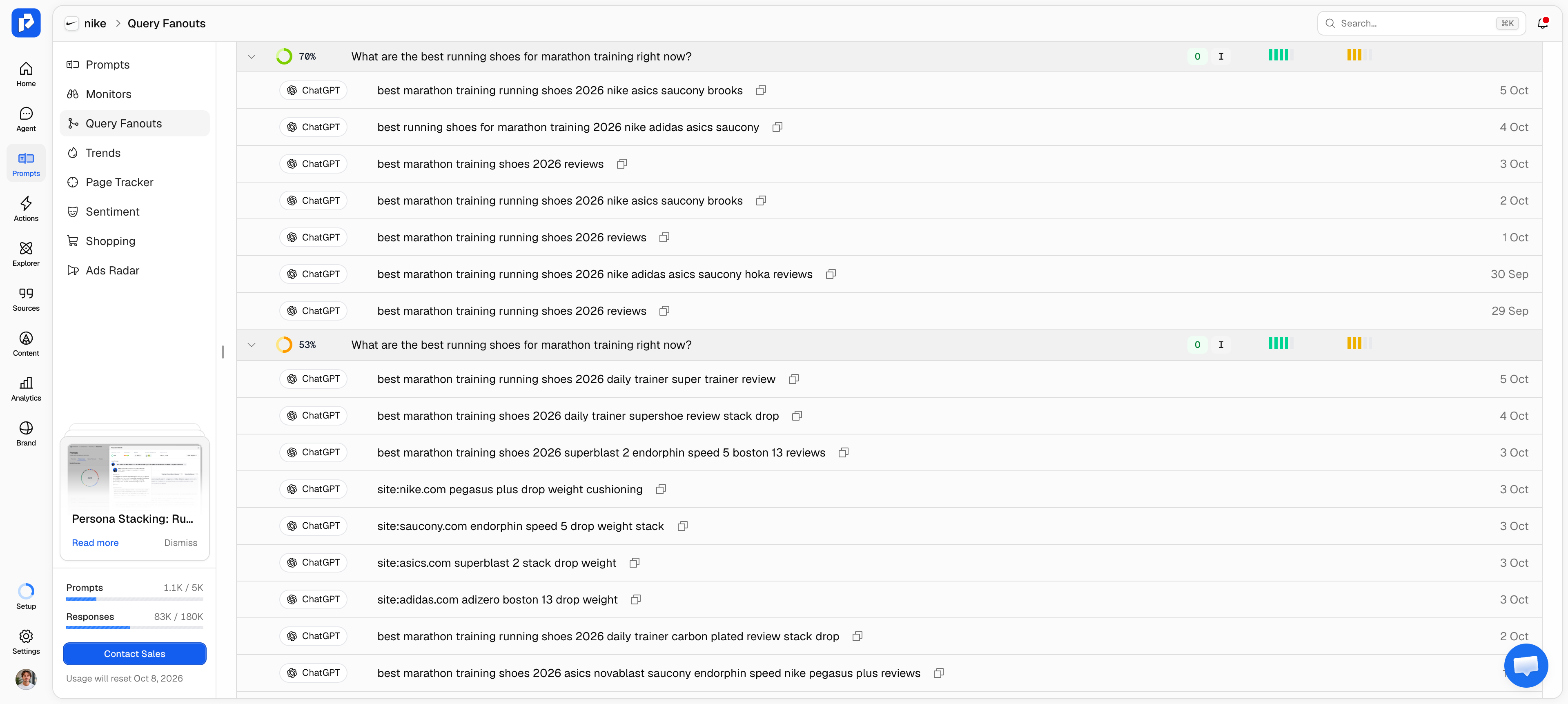
The shopper's prompt is rarely the query that decides placement. ChatGPT turns a long question into shorter sub-queries, and shopping fan-outs in the Search Engine Land study averaged about 7 words against 12 for the contextual fan-outs used to write the answer. Promptwatch records the fan-out for every tracked prompt, so you can see the exact strings ChatGPT searched and check your Google Shopping position for each one.
Fan-outs also reveal intent you did not plan for. In the Promptwatch prompts used for this guide, ChatGPT repeatedly appended "2026," named specific vendors, and added "pricing" and "reviews" to ecommerce tool queries. The equivalent for a store would be fan-outs that add a year, a price ceiling, or a competitor brand to your category term.
3. Make product data consistent everywhere AI reads it
Use one source of truth for title, price, and availability, and push it to Merchant Center, your direct AI feed, on-page schema, and marketplace listings. The Search Engine Land study found 45.8% of carousel products were exact title matches to a Google Shopping listing, which makes identical title strings a simple rule to enforce.
Fill the attributes a shopper would filter on: material, size range, compatibility, use case, and who the product is for. If you want field-by-field guidance, the guide on how to make product data discoverable to AI agents maps feed fields to their schema.org equivalents.
4. Open your product pages to AI crawlers
A product page AI cannot fetch cannot be cited. Check robots.txt, bot-protection rules, and rate limits for GPTBot, OAI-SearchBot, ClaudeBot, PerplexityBot, and Google's crawlers. Bot-protection and firewall rules on product URLs can block AI crawlers without anyone noticing.
Then confirm with real data. AI crawler logs in Promptwatch show which bot requested which product URL, with the status code and timestamp, connected through Cloudflare, Vercel, Fastly, AWS CloudFront, Akamai, and other CDNs with no code changes. A 403 on your bestselling category page explains a lot of missing citations.
“Our server logs showed a tremendous amount of LLM bots already crawling our websites. So we stopped asking whether we should step into AI search. We are already in AI search, whether we like it or not.”
5. Publish the content AI cites for your category
Map your tracked prompts against your site. Promptwatch's Content Gap Analysis re-runs each prompt's fan-out queries against your own indexed pages and flags the questions no page answers. For stores, the gaps are usually buying guides, comparison pages ("[your model] vs [competitor model]"), sizing and fit guides, and care instructions.
Write those pages so each paragraph answers one question and stands on its own when extracted. A content agent can draft them from your citation and gap data, and every draft goes to a review inbox before anything publishes.
6. Earn coverage on the sources AI already trusts
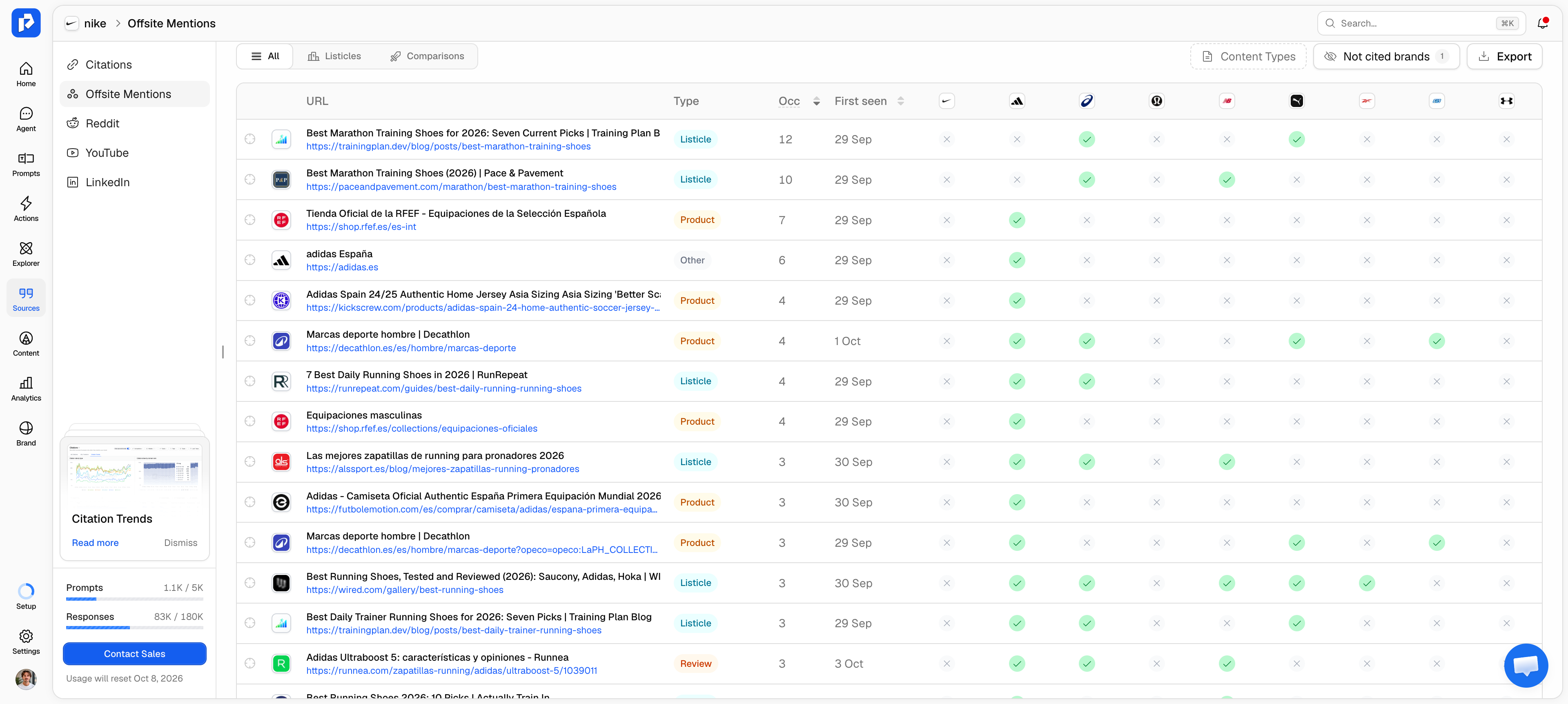
Find the third-party pages AI cites for your category, then work to be included in them. Promptwatch's Off-site Mentions shows where your brand and competitors appear on news sites, blogs, review sites, and forums that AI cites, even when there is no link back to your store.
Community sources carry weight for consumer products. Promptwatch can also track Reddit mentions that show up in AI answers, down to the thread, which tells you which discussions are shaping product recommendations. Note that Reddit's share of ChatGPT Search citations fell from roughly 4% to 0.5% on August 14, 2026, according to Promptwatch data, so check current citation share before investing heavily in one platform.
7. Refresh on a cycle
Promptwatch's data shows citation relevance holds for roughly 8 to 14 weeks before a refresh helps. Models re-crawl and re-index regularly, and an unchanged buying guide can quietly stop being chosen with no ranking drop or traffic cliff to warn you. Schedule updates for your highest-value guides and comparison pages, and update prices, stock, and seasonal ranges in the feed as they change.
How to measure AI optimization for ecommerce
Ecommerce GEO needs three layers of measurement, because a brand can be mentioned warmly in the text while only competitor products appear in the carousel.
Brand-level visibility
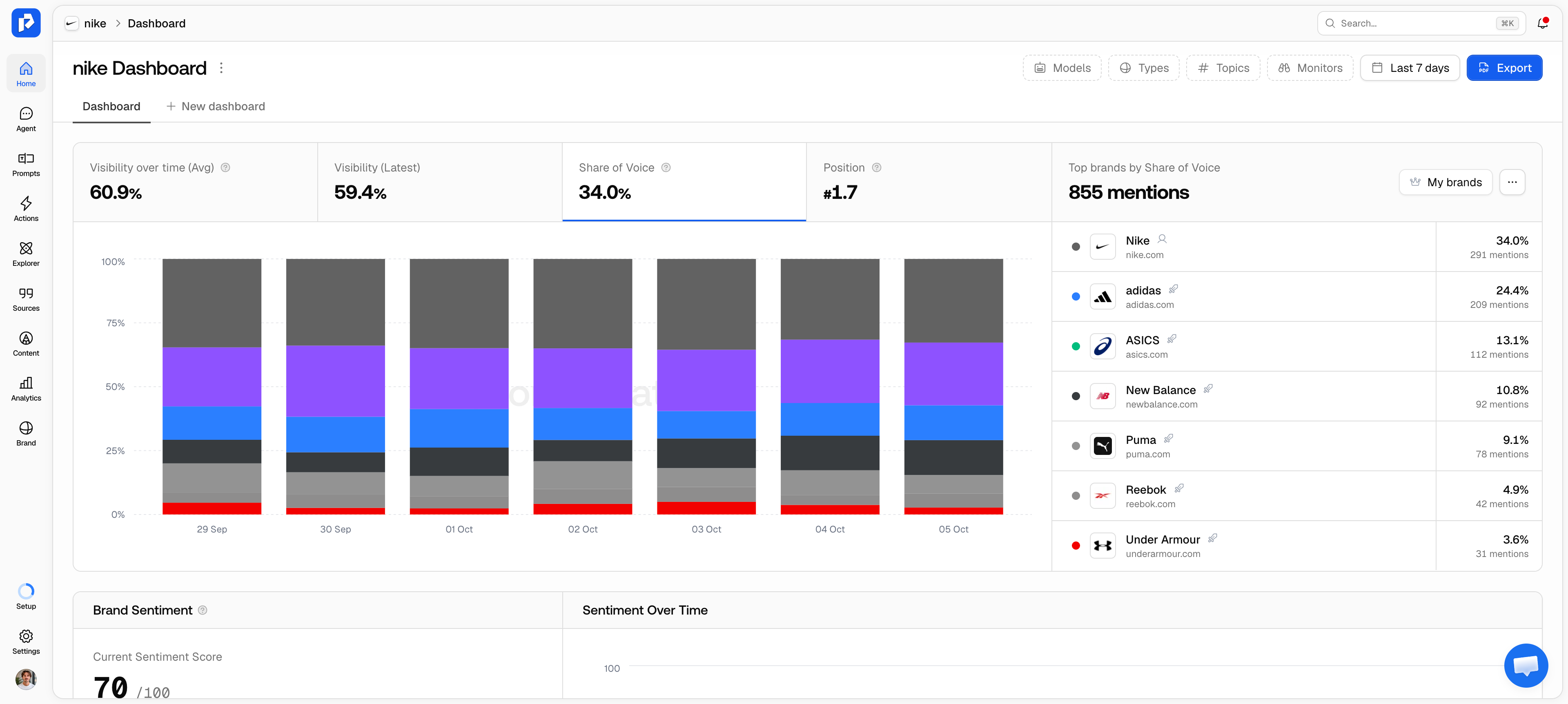
Visibility Score, share of voice, sentiment, and citations show how often and how favorably AI names your brand. Promptwatch's Visibility Score weighs position in the answer, how the brand is described, and competitor presence, and counts responses where the brand is absent as zero. Track it per market: Promptwatch monitors are scoped to one country and language, with optional state or city targeting on every plan, because AI answers change by location.
Product-level shopping visibility
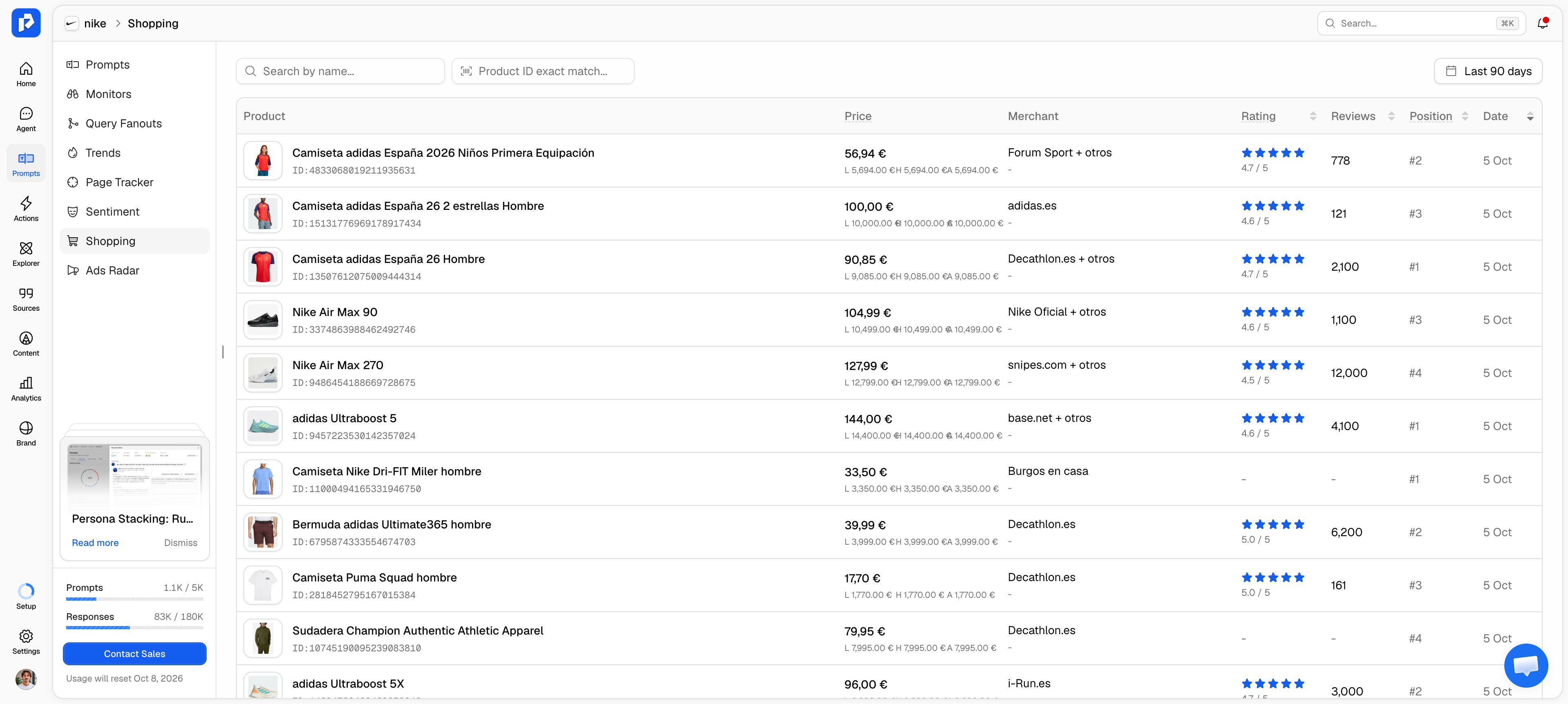
Product cards need their own tracking. Promptwatch's AI shopping tracker stores every product card from tracked ChatGPT responses with product, price, merchant, rating, review count, and carousel position. Upload your catalog as a CSV (id and name required, up to 5,000 rows), and the My products view matches it against extracted cards by exact product ID. The merchant field shows whether a card sends buyers to your store or to a reseller.
Shopping Insights is available from the Business plan up. Shopping extraction currently covers ChatGPT and Amazon Alexa. Google AI Overviews and AI Mode shopping results are visible inside responses but are not yet extracted or matched in the Shopping section.
Crawler activity and AI-referred revenue
Crawler logs show what AI can see. Visitor analytics show which AI-referred shoppers arrive and convert. Promptwatch tracks the two separately, since bot requests and human visits answer different questions. Expect low click-through: CTR from AI answers routinely sits below 0.1%, because most of the value happens inside the answer, where the shopper sees your product named and recommended.
What to look for in GEO tools for ecommerce
Take a shopper prompt such as "What are the best running shoes for marathon training right now?" A useful GEO tool shows what happens to that one question in every engine and market you sell in: which brands the answer names, which shoe models appear as product cards and at what price, which retailer each card links to, and whether AI crawlers reached your product pages for those models. Use the criteria below when you compare platforms, or see our comparison of the best tools to track AI visibility for ecommerce.
- Product-level tracking alongside brand tracking. The answer to the marathon prompt can name your brand in its text while the product cards show only competitor models. Promptwatch stores each product card with price, merchant, and position, and matches it to your uploaded catalog by product ID.
- Data from the real interface. The cards a runner sees in ChatGPT can differ from what an API returns for the same prompt, including which shoes appear and at what price. Promptwatch scrapes the live UI of ChatGPT, Gemini, Perplexity, Google AI Overviews, and other engines, and routes state- and city-level monitors through geo-located residential proxies.
- Coverage across the engines your shoppers use. The same marathon question can return different shoes in ChatGPT, Gemini, Perplexity, and Google AI Overviews, and Alexa and Copilot cite different sources than ChatGPT for shopping questions. Promptwatch supports 11 platforms on every paid plan, with four selected per project on Brands plans and all 11 at once on Agency plans.
- Query fan-out data. Before answering, the model rewrites the prompt into shorter searches, and it may add a year, a race distance, or a cushioning type. Those sub-queries decide which shoes get considered. Promptwatch records the fan-out for each tracked prompt and re-runs it against your indexed site in Content Gap Analysis.
- Crawler and conversion data in the same place. You need to know whether AI crawlers reached the product pages for the shoes you want recommended, and whether runners who click through from an AI answer buy. Promptwatch's Agent Analytics joins AI crawler logs to citations, and Visitor Analytics tracks AI-referred traffic and conversions separately.
- Per-market tracking. A "right now" prompt follows season, stock, and local retailers, so the shoes recommended to a runner in the US and in the UK can differ. Each Promptwatch monitor targets one country and language, with state and city targeting on every plan.
Frequently asked questions
What is GEO for ecommerce?
GEO for ecommerce is Generative Engine Optimization applied to online stores. It covers the work of getting products named in AI written answers, placed in AI shopping carousels, and selected by AI shopping agents, mainly through consistent product data, crawlable product pages, strong reviews, and coverage on the third-party sources AI cites.
Is GEO different from SEO for an ecommerce site?
They share the same foundation: crawlable pages, structured data, and good reviews. SEO measures rankings and clicks in search results. GEO measures whether AI names, cites, and recommends your products, and it depends more on feed consistency, third-party roundups, and query fan-outs than on blue-link position.
How do AI shopping assistants choose which products to recommend?
They combine structured product data (feeds, schema, price, availability), reviews and ratings, and third-party content such as buying guides and forums. For ChatGPT's shopping carousel, a March 2026 study published by Search Engine Land found 83% of products strongly matched Google Shopping's top 40 organic results, so Merchant Center rank is a major input.
What are AI agents for ecommerce?
AI agents for ecommerce are systems that research, compare, and in some cases buy products on a shopper's behalf, such as ChatGPT's shopping features, Amazon Alexa, and Microsoft Copilot. They rely on machine-readable product data, fast responses, and clear pricing, stock, shipping, and returns information.
How long does ecommerce GEO take to show results?
Feed and crawler fixes can affect AI answers as soon as models re-crawl the pages. Content and third-party coverage take longer. Promptwatch data shows citation relevance holds for roughly 8 to 14 weeks before a refresh helps, so plan GEO as an ongoing maintenance cycle and judge progress by trends over several weeks.
Can I track whether my products appear in ChatGPT Shopping?
Yes. Promptwatch extracts product cards from tracked ChatGPT and Amazon Alexa responses and stores product, price, merchant, rating, review count, and position. Uploading your catalog as a CSV lets Promptwatch match cards to your own products by exact product ID.


