

TL;DR
- An agentic content strategy replaces periodic manual audits with agents that continuously research prompts, diagnose content gaps, and flag decay before it shows up as a ranking or traffic drop, which is the approach Promptwatch is built around.
- Citation relevance in AI search holds for roughly 8 to 14 weeks before a refresh helps, since models re-crawl and re-index content on their own schedule, independent of any technical error.
- Query Fan-Out (the sub-queries an AI model runs before it answers) is what should define a content gap analysis, not keyword search volume from traditional search.
What Is Agentic Content Strategy?
Agentic content strategy is the practice of using AI agents, not just AI writing tools, to run the ongoing loop of researching what people are actually asking AI models, diagnosing where a site's content can't answer those questions, drafting grounded content to close the gap, and monitoring whether that content keeps earning citations over time.
That's a different claim than "we use AI to help write blog posts." A single AI-assisted draft is a tool. An agentic content strategy is a system: agents that plan, check, and re-check content performance against real AI behavior, on a schedule, without a human having to remember to run the audit.
This matters because content strategy built for traditional search doesn't transfer cleanly to agentic search, where a model breaks one question into several sub-queries, retrieves passages from wherever it judges most relevant, and either names a brand or leaves it out.
Ranking #1 in Google says nothing about whether a page gets chosen as a source for an AI answer. A content strategy built for AEO has to be built around that retrieval behavior directly, not bolted onto an SEO calendar after the fact.
Why Manual Content Workflows Break Down in AI Search
Most content teams still run on a quarterly or monthly audit cycle: review analytics, spot what's underperforming, brief a writer, publish, wait for the next cycle. That cadence was built for a search engine that ranks a fixed page and mostly holds that ranking until something changes.
AI search doesn't work that way. Three specific mechanics break the manual model:
- Content decays quietly. Citation relevance in AI search holds for roughly 8 to 14 weeks before a refresh helps. Models re-crawl and re-index regularly, so a page that hasn't changed can simply stop being chosen as a source, with no ranking drop, no crawl error, and no traffic cliff that a standard SEO dashboard would flag. A quarterly audit cycle finds this two months too late.
- Low click-through isn't a signal you can wait on. Click-through from AI answers routinely sits below 0.1%, dramatically lower than traditional search. That's by design, not a failure: most of the value happens inside the response, in whether a brand gets named and described favorably, not in a click. If a team is watching for a traffic signal to trigger a content review, it's watching the wrong instrument.
- One national number hides where you're actually losing. AI answers change by country, language, and even city. A single blended visibility score averages away exactly the markets where a brand is invisible.
None of these are things a person catches by skimming a monthly report. They require something that checks continuously, at the same pace the models themselves re-crawl and re-index.
The Agentic Content Strategy Framework
This is the sequence Promptwatch's own product is built around, and it holds regardless of which platform a team uses to run it. Each step below names the specific mechanism doing the work, not just the outcome, because "AI-powered analysis" is not a strategy.
1. Map real demand with prompt tracking and Query Fan-Out
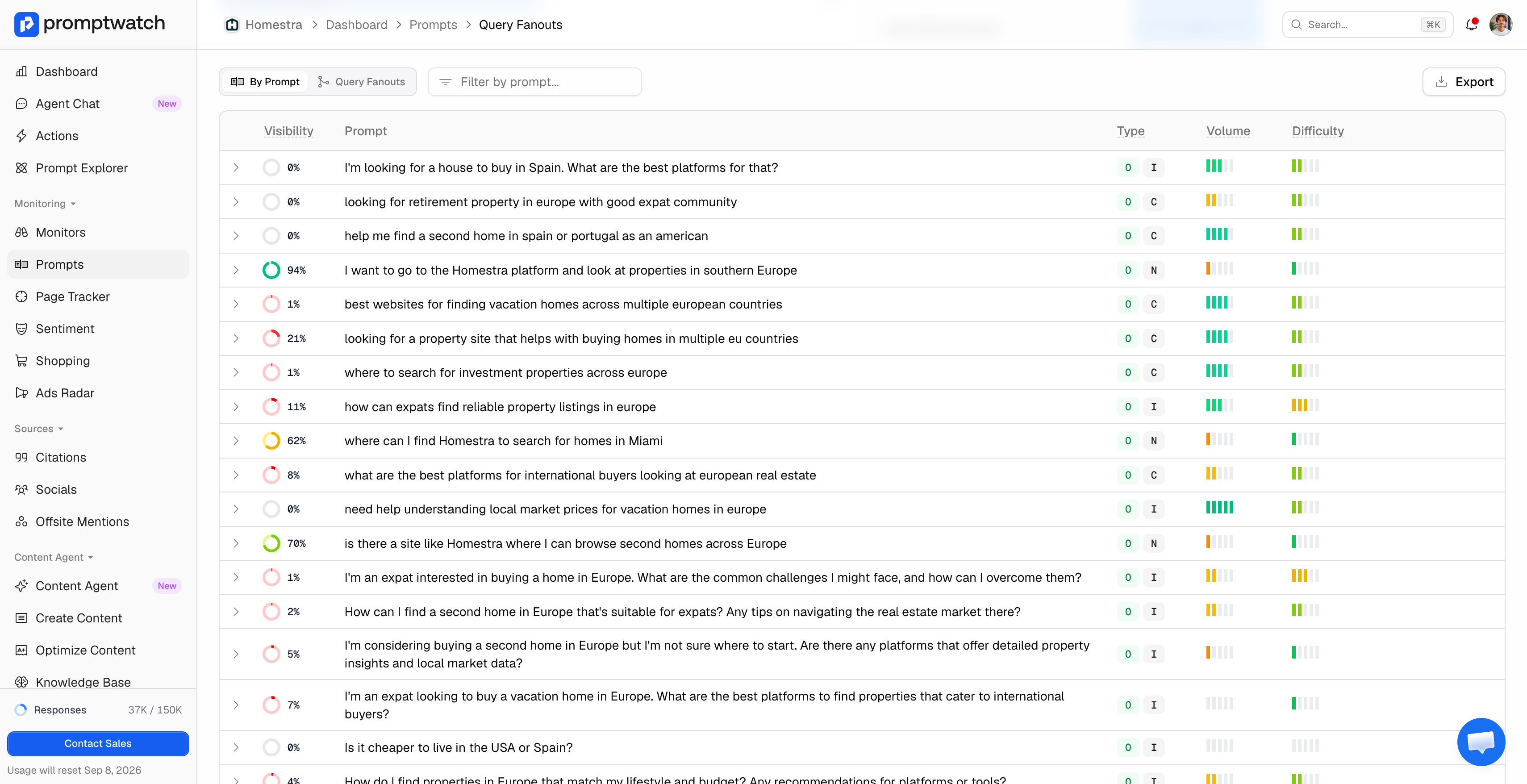
Start from what people actually ask AI models, not from a keyword list built for Google. A prompt is tagged with a Prompt Type (organic, brand-specific, or competitor comparison) and an Intent Type across the buyer journey, so a team can see whether they only show up in branded searches, which usually means weak organic visibility.
Underneath each tracked prompt sits its Query Fan-Out: the sub-queries the model actually runs before retrieving sources. This is the real unit of demand. Two prompts that read almost identically can fan out into completely different sub-queries, which means completely different content is required to answer them.
2. Diagnose gaps against your own indexed site
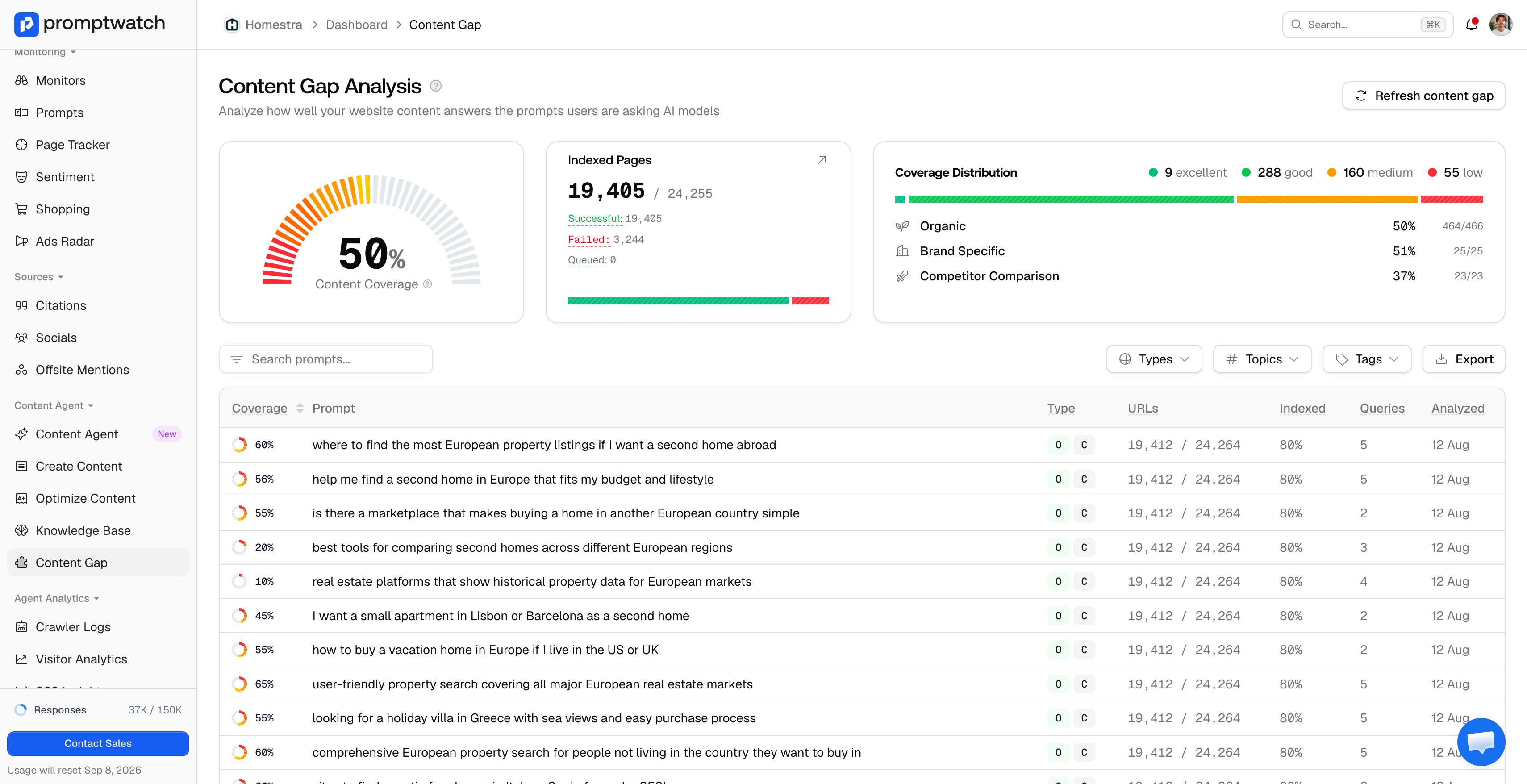
Content Gap Analysis works in three steps: Prompt Analysis breaks out each tracked prompt's fan-out, Content Search checks the indexed sitemap for pages that already answer it, and Gap Detection turns the unmatched prompts into specific write-or-update recommendations.
The key detail is "your own indexed site." This isn't a generic keyword gap against competitors, it's a semantic search over paragraph-level embeddings of a customer's actual pages, running the same kind of retrieval a real AI model runs. That's a materially different, and more defensible, basis for a content calendar than "competitors rank for this term too."
"Promptwatch combines powerful GEO insights with content gap analysis to turn AI visibility challenges into actionable opportunities. It helps us understand what's missing, prioritize improvements, and optimize more effectively for LLMs."
3. Ground every draft in your own evidence, not a generic prompt
This is where most agentic content pipelines quietly fail: a generic prompt to a generic model produces generic, forgettable prose, which is exactly what a customer voices as a worry almost every time content automation comes up in a sales conversation.
The fix is a Knowledge Base: a private context layer of proprietary research, brand voice guidelines, product facts, and customer evidence that a content agent retrieves from before writing. The model can only repeat what's actually in the Knowledge Base, which is what makes a grounded draft more accurate, more on-brand, and harder for a competitor to simply copy.
4. Keep a human in the review loop by default
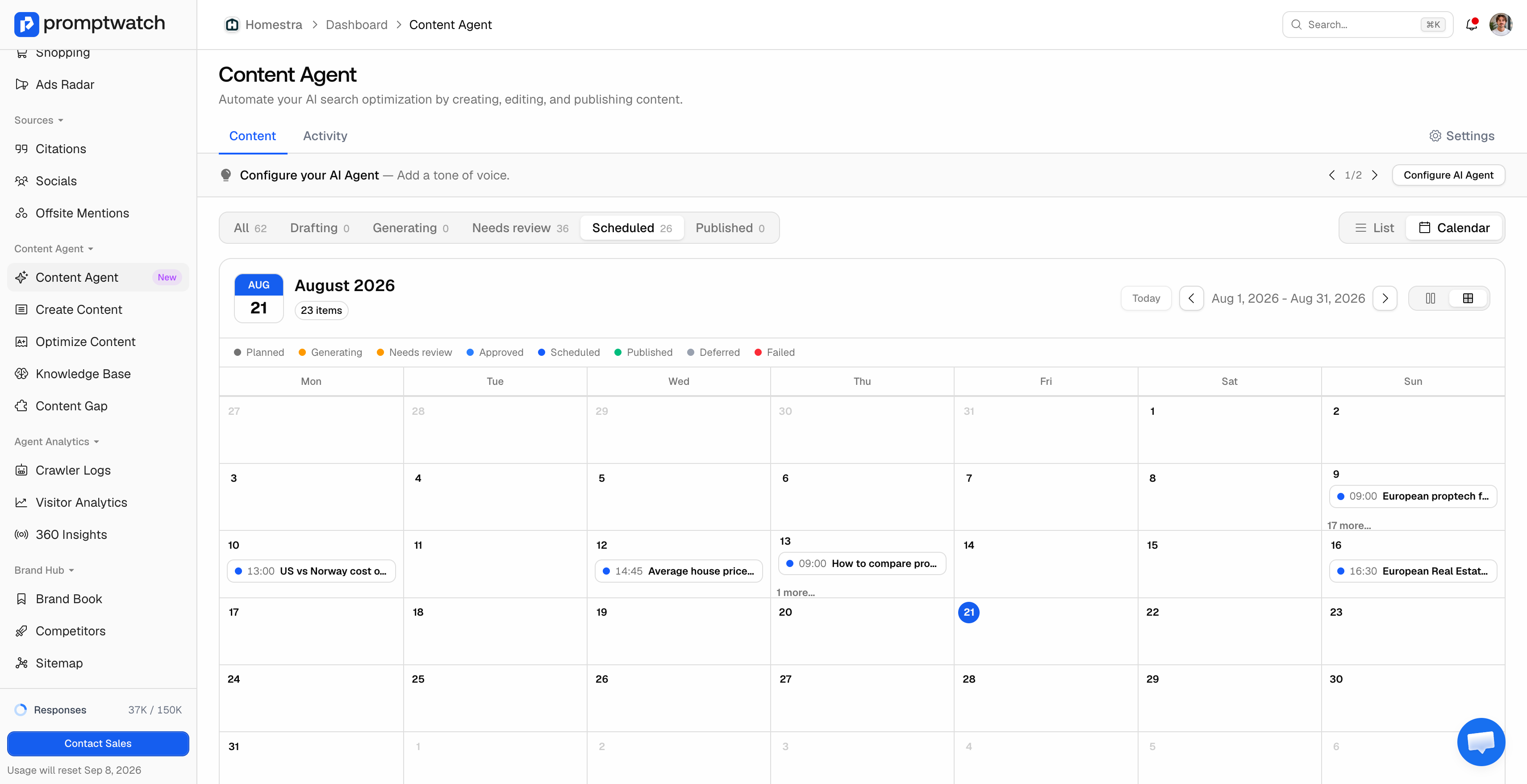
An agentic workflow is not the same thing as an unsupervised one. The honest default is a review inbox: every AI-drafted piece lands there for approval, edits, or rejection, and nothing reaches the CMS until a person moves it forward. Publishing is a deliberately separate, explicit step from drafting.
Teams that want less manual touch can opt into a hands-off mode where pieces that pass an automatic quality check publish on a schedule the team sets, with allowed days, blackout dates, and a cap on pieces per day. That's an opt-in escalation, not the starting point, and it's worth stating plainly rather than letting a prospect assume content ships unsupervised by default.
5. Prioritize the fixes and assign an owner
A content gap report or a decay alert is only useful if it turns into someone's task. Action items should be prioritized in plain language, with a reason and a severity badge attached, not just dumped onto a shared board where they get ignored. Assigning a specific owner to each item, rather than leaving it in a general queue, is what actually moves a recommendation into a Kanban "done" column.
"Promptwatch is a game changer for us. It gives brands actionable insights into AI visibility and helps us quickly turn those insights into practical next steps that actually improve performance." Alessandro Di Vito, Managing Consultant at Elaboratum
6. Monitor crawl activity and re-run the loop on a decay cycle
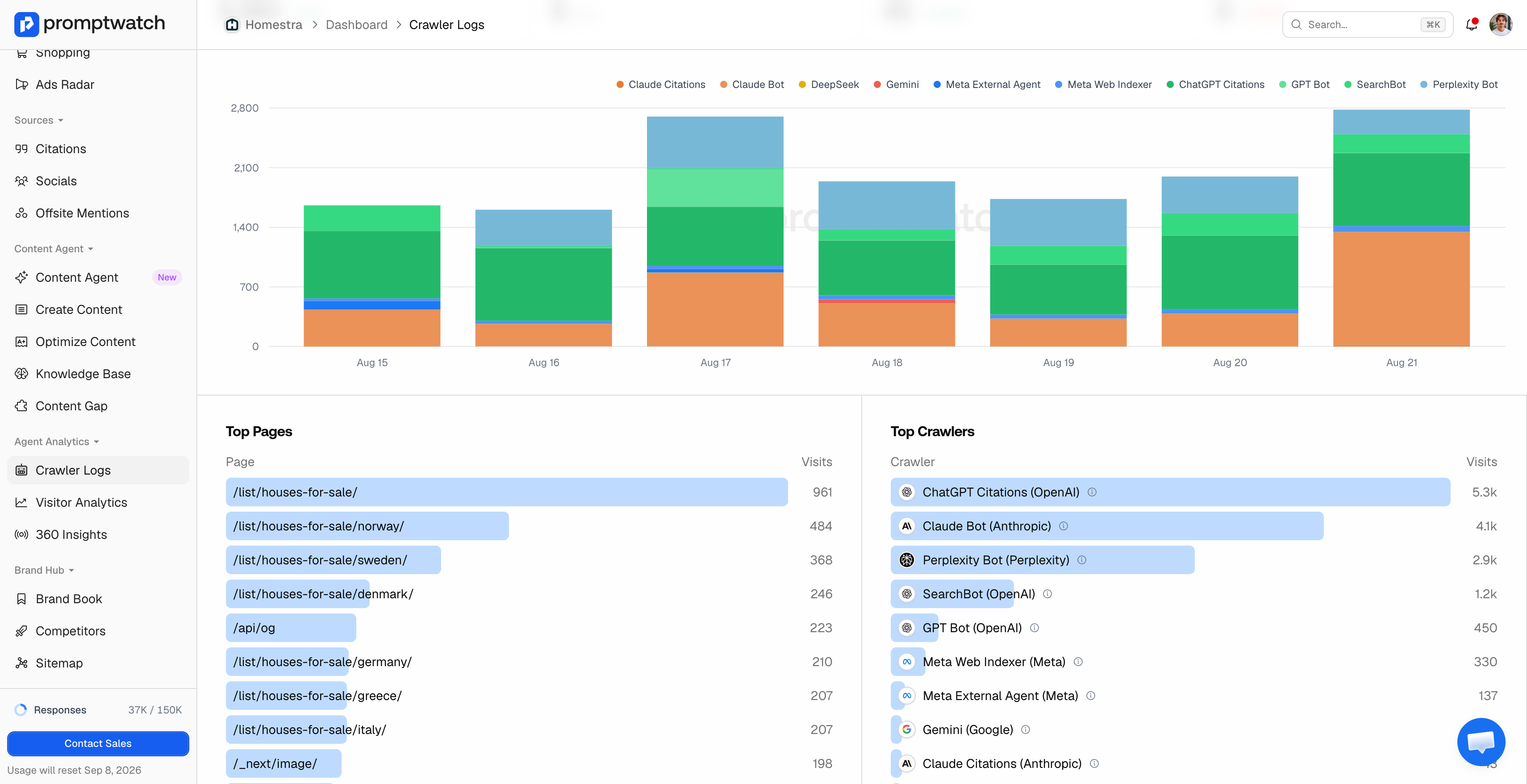
Crawler activity (bots requesting pages) shows what AI can actually see. Visitor traffic (human clicks arriving from an AI answer) shows what's converting. An agentic content strategy has to track these separately, because a page can be heavily crawled and still cited nowhere, or cited often with almost no referred traffic, and the fix for each is different.
Given the roughly 8-to-14-week decay window, the loop needs to re-run on a cycle, not on a calendar-quarter guess. That's the difference between "publish and forget" and treating AI content as a maintained asset. Real-time AI crawler logs, tied back to citations, are what make that cycle possible to run without waiting for a traffic drop to notice something's wrong.
How to Choose the Right Level of Agent Autonomy
Match the level of automation to how much oversight the team actually wants, not to what looks most impressive in a demo.
- Self-serve, human-driven: dashboards, monitors, and content agent tools that a marketing team runs itself, drafting on demand and reviewing everything before it publishes. Grounded in the same review-inbox default described in Step 4 above, this is the right starting point for most in-house teams.
- Self-serve with hands-off publishing: the same self-serve tools, but with the optional quality-gated auto-publish mode turned on for lower-risk content types. This uses the schedule-bounded hands-off mode, not an ungated autopublish switch.
- Fully managed: a vendor's own agents handle monitoring, drafting, and CMS publishing end to end while the team reviews results rather than individual drafts. This is what Promptwatch's Agentic AI Search Optimization service does, running the same underlying methodology with less day-to-day operation required from the customer.
Be honest about where the current setup sits before committing to more automation than the team is ready to trust.
FAQ
Will AI-generated content sound generic or robotic?
Not if it's grounded in the site's own citation and content-gap data rather than a generic prompt. Every brief should still be editable for brand voice, and a human should review it before it publishes.
Does content gap analysis replace keyword research?
It works alongside it, but answers a different question. Keyword research says what people search for on Google; content gap analysis, run against a site's own indexed pages, says which AI prompts that site currently can't answer.
How often does agentic content actually need to be refreshed?
Roughly every 8 to 14 weeks, since AI models re-crawl and re-index content on their own schedule rather than in response to anything visibly breaking on the page.


