


TL;DR: Best AthenaHQ Alternatives
Promptwatch is best for teams that want AthenaHQ's action orientation on flat pricing, with a real free trial, crawler logs, and content that publishes. Profound is the enterprise upgrade with unmatched prompt demand data. Peec AI is the cleanest flat-priced monitor with unlimited seats. Writesonic bundles GEO into a full content suite. Otterly.ai is the strongest budget option with a working free scan. SE Ranking folds AI tracking into a full SEO suite for a fraction of the cost. Scrunch AI treats agent traffic as its own channel.
Quick Comparison Table
| Tool | Best For | AI Engines on the Base Plan | Starting Price |
|---|---|---|---|
| Promptwatch | Teams that want action on flat pricing with a free trial | All 11 models available on every paid plan; 4 tracked per project at a time | $95/mo |
| AthenaHQ | Teams that need AI visibility joined to revenue | 8 on every tier, no gating | $295/mo (credit-based) |
| Profound | Enterprises that need real AI search demand data | 1 (ChatGPT); 3 on Growth at $399 | $99/mo, billed annually |
| Peec AI | Clean, fast monitoring for teams that already have an execution layer | 3 of 6 (Claude and DeepSeek Enterprise-only) | $95/mo |
| Writesonic | Teams that want GEO bundled with a full content suite | 10+, but only from the GEO tier | $79/mo; GEO from ~$199/mo |
| Otterly.ai | Solo operators and small teams on a tight budget | 4; Gemini, AI Mode and Claude are add-ons | ~$29/mo |
| SE Ranking | Teams that want AI tracking inside a full SEO suite | 4 (AI Overviews, AI Mode, ChatGPT, Perplexity) | $129/mo (AI tracking included) |
| Scrunch AI | Enterprise brands treating agent traffic as its own channel | 4 on Core; 9 on Enterprise | ~$250/mo |
Why Look for AthenaHQ Alternatives?
Four reasons teams still look elsewhere come up repeatedly.
- The floor is $295, and there's no real free trial. Self-Serve starts at $295/month month to month (around $245 to $270 billed annually), and signup grants only a one-time pool of about 300 credits rather than a true trial of the paid tier. You largely commit before you can test at production volume. There's also no middle tier: the next steps up are a Growth plan around $545 and Enterprise starting north of $2,000, so the ladder jumps in large increments.
- Credit-based pricing makes monthly cost hard to predict. One credit equals one AI response, and because every prompt is run against every engine you track, a single question across eight engines spends eight credits per run. Daily, multi-engine monitoring drains an allowance faster than most teams expect, and top-ups run $100 per 1,250 credits. Reviewers consistently flag surprise overages as the main downside.
- The best features are Enterprise-only, and there are no crawler logs. The ACE Citation Engine and the strongest recommendation features are reserved for Enterprise, and there's no MCP server. More importantly, AthenaHQ attributes traffic after the fact through GA4 and Shopify but does not show server-side AI crawler activity, so it can tell you a human arrived from ChatGPT but not whether GPTBot or ClaudeBot ever fetched the page.
- Managing several brands is friction, and self-serve is single-country. Reviewers note there's no consolidated multi-brand view, so agencies switch between workspaces, and the Self-Serve plan is limited to a single country, which pushes multi-market teams toward Enterprise sooner than the price ladder suggests.
How We Evaluated These Alternatives
We didn't assemble this list by skimming landing pages. Every tool was assessed against one question: does it help a team change how AI models talk about their brand, or only observe it?
Four criteria:
- Predictable versus credit-based cost. Whether you can forecast a monthly bill, or whether spend floats with how many engines and prompts you run. Credit math is the single most-flagged issue in AthenaHQ's model, so we weighted flat, forecastable pricing.
- Ability to test before committing. Whether there's a genuine free trial or free tier, not just a one-time credit grant, so you can see a visibility score move before you pay.
- Crawler and agent visibility, not just attribution. Whether the tool shows server-side AI bot activity, or only that a human eventually arrived. Attribution answers what converted; crawler logs answer whether AI could see the page at all.
- Execution depth. Whether recommendations turn into published content and closed gaps, or stop at a prioritised task list.
Pricing and feature coverage verified August 2026 against each vendor's public pricing page, supplemented by third-party review analysis. We evaluated AI search visibility specifically, not traditional SEO capability. Pricing in this category changes frequently; confirm before you buy.
The 7 Best AthenaHQ Alternatives
Ranked by overall fit for teams that want to improve AI visibility rather than only measure it. Each solves a different problem, so the right answer depends on which part of the job you can't currently staff.
1. Promptwatch: Best Overall AthenaHQ Alternative
The cleanest way to compare these two is on how you pay. AthenaHQ meters usage in credits with a $295 floor and no true trial. Promptwatch charges a flat monthly price per tier, starts at $95, and lets you begin with free prompt tracking and a 7-day trial before you commit a card.
At $295, AthenaHQ Self-Serve gives you roughly 3,600 credits (each AI response spends one), all major engines, unlimited seats and revenue attribution, in a single country. At $95, Promptwatch Essential gives you 50 prompts counted as prompts, 6,000 responses, all 11 models available with four tracked per project at a time, and MCP plus API access. At $245, Promptwatch Professional adds server-side crawler logs, content gap analysis and Content Agents that publish to your CMS, still on a flat price you can forecast. The trade AthenaHQ wins is revenue attribution: its native GA4 and Shopify join is more turnkey for e-commerce than anything Promptwatch ships.
Key features
- All 11 AI surfaces on every paid plan (ChatGPT, Claude, Gemini, Google AI Overviews, Google AI Mode, Perplexity, Grok, DeepSeek, Meta Llama, OpenCode and Claude Code), with four tracked per project at a time, freely chosen and changeable, and prompt tracking refreshed daily
- Flat pricing per tier, so monthly cost is fixed rather than floating with engine and prompt volume
- Real-UI scraping, so visibility reflects what users see rather than an API approximation
- Prompt suggestions from Google Search Console, a seed query or a specific page, plus prompt volumes, prompt difficulty and query fan-out analysis
- AI crawler log analysis through direct CDN integrations (Akamai, AWS CloudFront, Cloudflare, Fastly, Google Cloud CDN, Netlify and Vercel), showing the elapsed time between a bot fetching a page and an engine quoting it
- Visitor analytics and conversion tracking for AI-referred human traffic, kept separate from crawler activity, so you see both what AI can read and what actually converts
- State and city-level prompt targeting on every plan, including Essential, because AI answers change by market and a single national number hides where you lose
- Content gap analysis plus offsite mention tracking across Reddit, YouTube and third-party sources that shape AI recommendations
- Content Agents that write against measured gaps and publish directly to Webflow or Framer (any other CMS is a manual export), moving through review and approval states you control
- Actions and Agent Chat. Actions turns visibility data into a prioritised list of next steps, each assignable to a team member as owner; Agent Chat lets you ask about performance and act on the answer without leaving the conversation
- MCP server and API access on every plan, including Essential
More than 1,780 brands and agencies run on Promptwatch, including Center Parcs, SIX Group and Landytech, and it holds a 4.7/5 rating on G2.
Pros
- Flat pricing with a $95 entry and a real 7-day trial, where AthenaHQ starts at $295 with only a one-time credit grant
- Multi-market and city-level tracking from the $95 plan, where AthenaHQ Self-Serve is limited to a single country
- Prompts and responses counted per tier, so no credit overages when you add engines or track daily
- Server-side crawler logs, the crawl-to-citation view AthenaHQ's attribution model doesn't provide
- MCP and API on every plan, where AthenaHQ has no MCP and gates its strongest features to Enterprise
- Content ships under an approval gate, turning recommendations into published pages
Cons
- AthenaHQ's native GA4 and Shopify revenue attribution is more turnkey for e-commerce revenue reporting than Promptwatch's visitor and conversion analytics
- AthenaHQ includes unlimited seats on every plan; Promptwatch meters seats (1, 2 and 5 by tier)
- Promptwatch crawler logs start at $245, so the $95 plan is monitoring only
- Neither tool tracks Mistral, and Promptwatch does not cover Microsoft Copilot
- The Data Studio connector and custom reports start on Professional, not on the $95 Essential plan
Verdict
- Best for: Teams that like AthenaHQ's action orientation but want predictable pricing, the ability to test first, and a view of what AI crawlers actually do on the site.
- Why it wins: The same turn-data-into-tasks philosophy, but flat pricing from $95, a real trial, crawler logs underneath the citations, and content that publishes rather than a task you still have to build. AthenaHQ keeps the edge only on native revenue attribution.
2. Profound: Best for Enterprise-Grade Prompt Demand Data
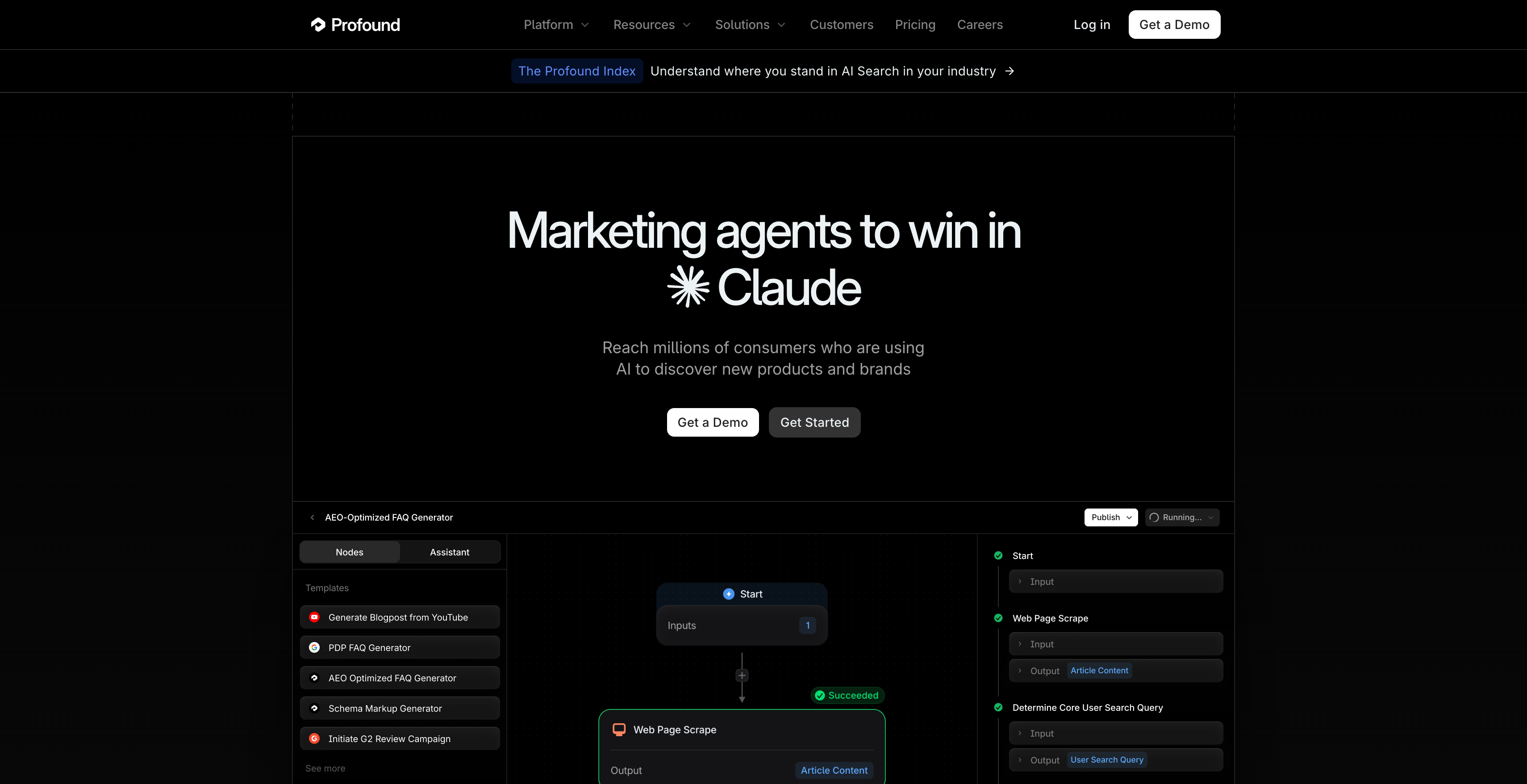
Profound is the most funded and most enterprise-validated platform in the category, with roughly $155M raised at a $1B valuation and customers including Ramp, MongoDB, Figma and Walmart. Its Prompt Volumes panel data, showing what people actually ask AI with demographic cuts, is the thing genuinely no one else has.
Key features
- Prompt Volumes panel data drawn from opted-in consumers
- Agents for content generation, plus MCP and Shopping insights
- Agent analytics covering how AI systems crawl and interpret your site
- SOC 2 and enterprise governance
Pros
- The prompt demand dataset is a real competitive moat, not a feature claim
- Deepest analytics in the category at the top tier
- Enterprise security posture that most startups in this space can't match
Cons
- Starter at $99/month covers ChatGPT only; the functional entry point is Growth at $399 for three engines, and full ten-engine coverage is Enterprise-led
- Both public plans require annual billing
- Reviewers report a steep learning curve and no white-label reporting
Verdict: If your problem is that AthenaHQ's data isn't deep enough and budget isn't the constraint, Profound is the upgrade. The Promptwatch vs Profound breakdown covers where the two diverge.
3. Peec AI: Best for Clean, Flat-Priced Monitoring
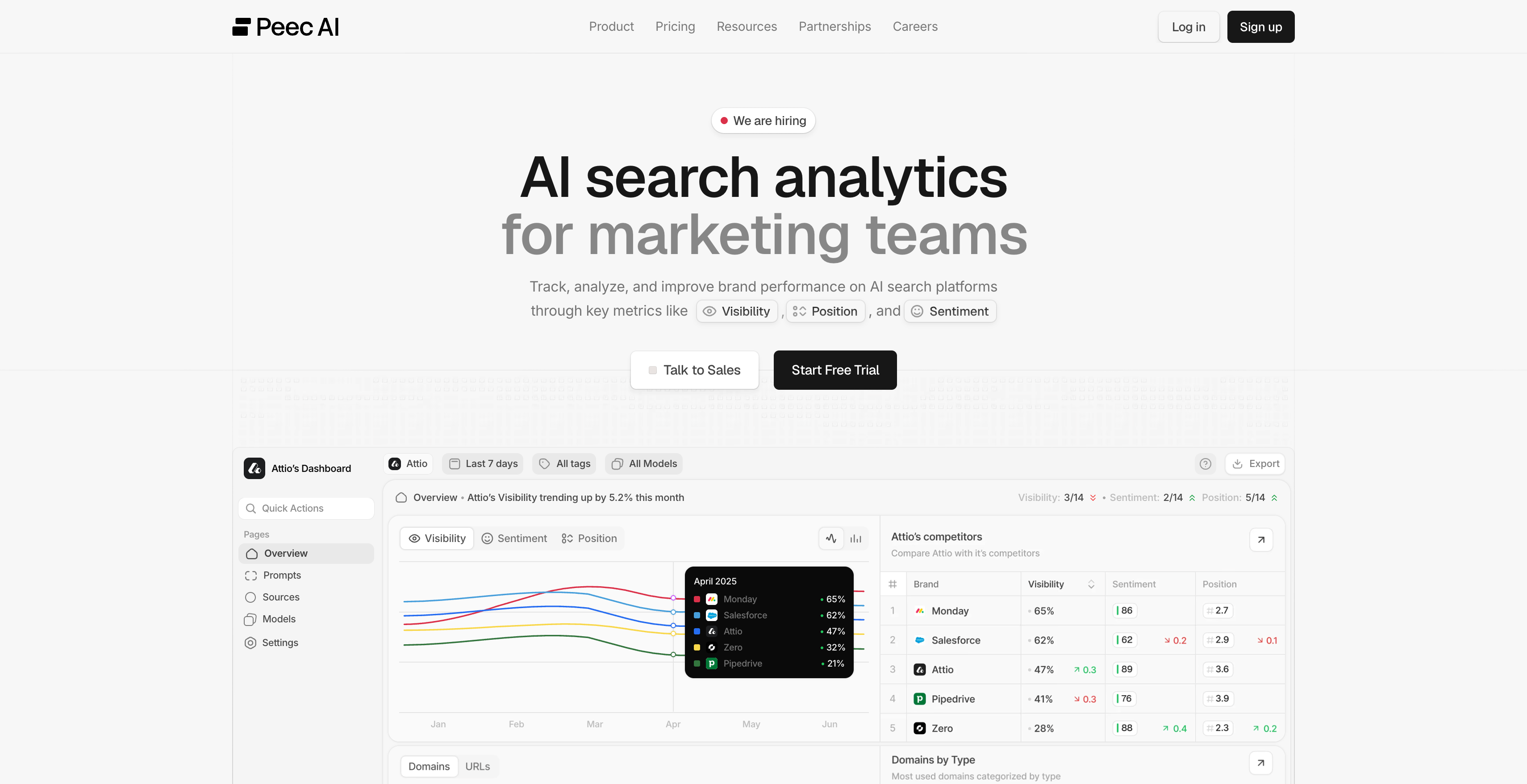
Peec is the flat-pricing answer to AthenaHQ's credit model. The Berlin company raised $29M, crossed $10M ARR roughly 16 months after launch, and serves 2,000+ teams including Hugo Boss, n8n, TUI and ElevenLabs, with a 4.9/5 on G2. Setup takes minutes and every plan includes unlimited seats.
Key features
- Three engines from six on every self-serve tier, with a clean, fast dashboard
- Unlimited users on all plans, including the $95 Starter
- Actions module that turns source data into a prioritised task list
- Flat monthly pricing, no credit metering
Pros
- Flat, forecastable pricing, the exact thing AthenaHQ's credits make hard
- Unlimited seats, matching AthenaHQ on seats while undercutting it on price
- Among the fastest onboarding in the category
Cons
- Every self-serve tier caps you at three engines; extra models cost $35 to $165/month depending on plan
- Claude, DeepSeek, Qwen and Mistral are Enterprise-only, and Grok isn't offered at all
- No content generation, no CMS publishing, no crawler logs, and no revenue attribution
Verdict: If AthenaHQ's credit unpredictability is your main complaint and you mainly need clean monitoring, Peec is the flat-priced swap, provided you can live with three engines.
4. Writesonic: Best for GEO Bundled With a Content Suite
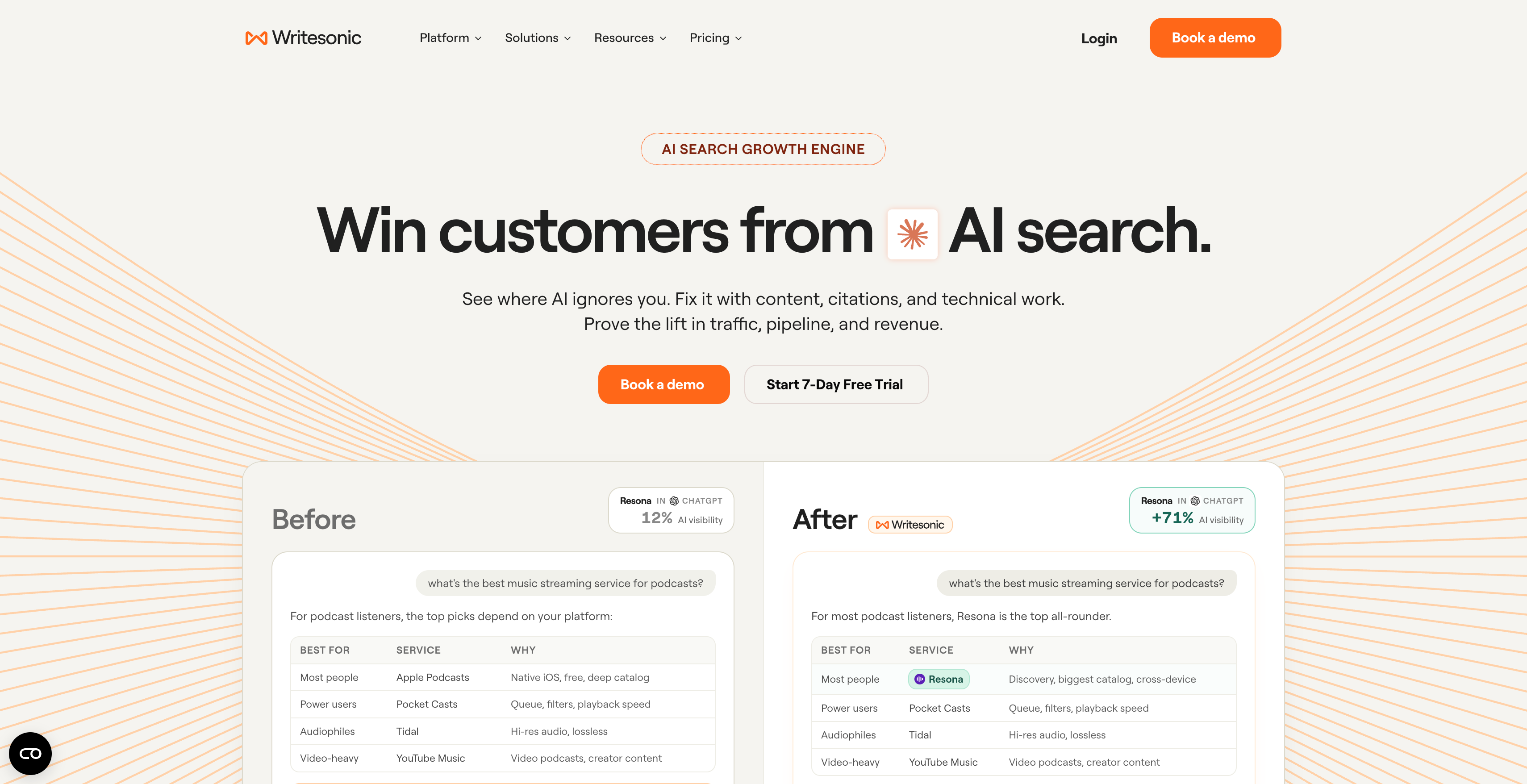
Writesonic started as an AI writing tool in 2020 and pivoted hard into AI search visibility. Where AthenaHQ points you toward content opportunities, Writesonic tries to close them in the same dashboard, drawing on a claimed 120M+ AI conversation dataset to surface real user prompts.
Key features
- 10+ platforms tracked including Claude, Copilot, AI Mode, Meta AI and DeepSeek
- AI Visibility Action Center prioritising fixes by impact
- Article writer, site audits and agentic page rewrites in the same dashboard
- Cloudflare-based AI bot tracking
Pros
- The all-in-one workflow is real: find a gap and fill it without switching tools
- Broad platform coverage once you're on the GEO tier
- Bot-level crawl auditing, which AthenaHQ's attribution model doesn't provide
Cons
- GEO features don't exist on the entry plan; the practical starting point is roughly $199/month annually, closer to $249 monthly, so the $79 headline is a content plan, not a visibility one
- Add-ons stack: extra seats around $50/user/month, extra articles around $100 per 20
- No white-label reporting on the standard tiers, and reviewers report tracking depth is shallower than dedicated visibility tools
Verdict: If you want the content production AthenaHQ only points you toward, Writesonic is the trade. Price the GEO tier, not the homepage number. To see what else replaces its writer and its tracker, read our comparison of Writesonic alternatives.
5. Otterly.ai: Best Budget Alternative
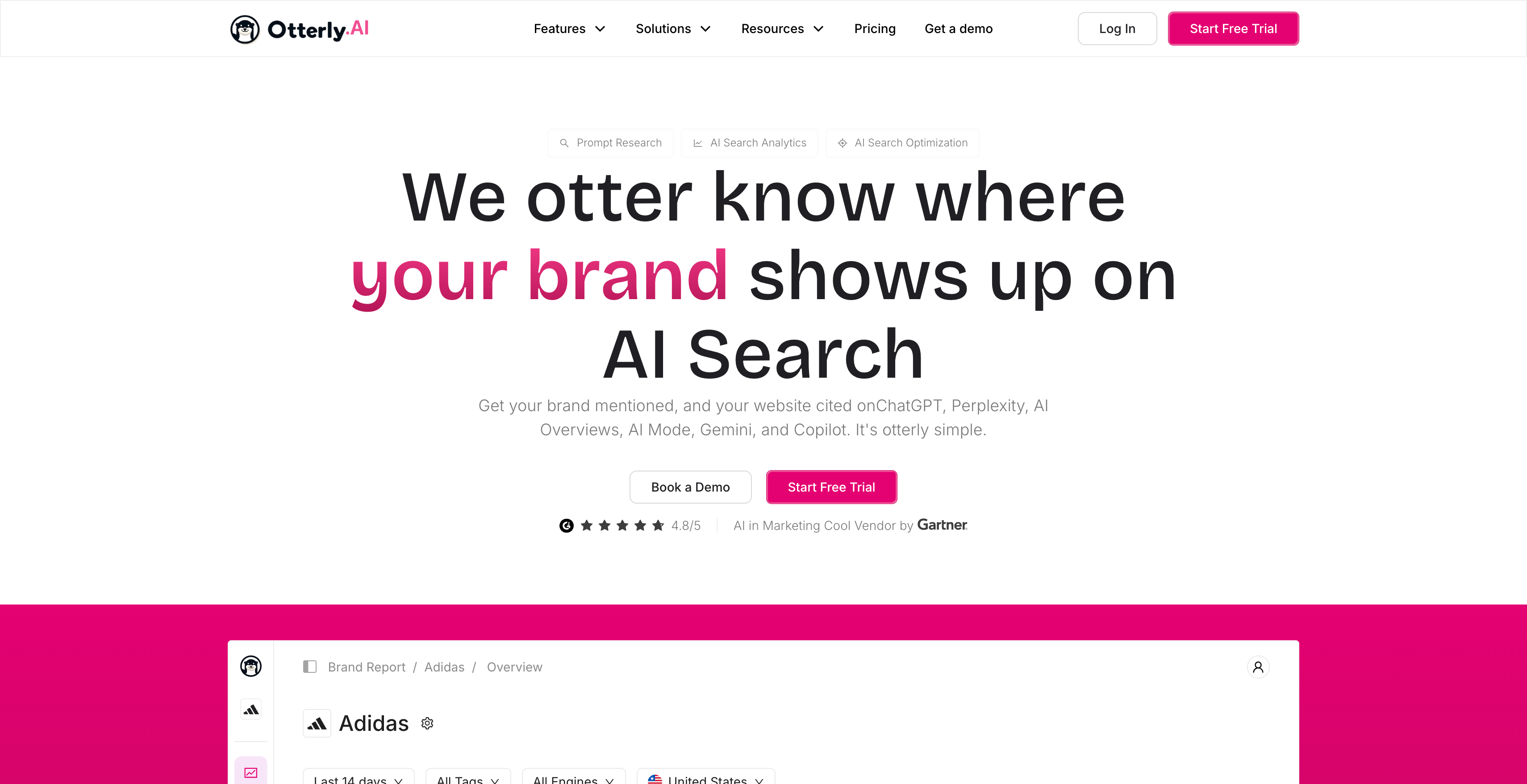
At roughly $29/month, Otterly is the cheapest credible entry in the category and the obvious move if AthenaHQ's $295 floor is what stopped you. It carries Gartner Cool Vendor recognition for AI in Marketing (2025), monitoring across 50+ countries and unlimited team members on every tier, and it offers a working free scan rather than a one-time credit grant.
Key features
- Four core engines on Lite: ChatGPT, Google AI Overviews, Perplexity and Copilot
- GEO audit covering on-page factors, plus AI prompt research
- 50+ country monitoring and unlimited seats on every plan
- API, MCP server and Looker Studio connector from Standard ($189)
Pros
- Lowest real paid entry point in the category, a tenth of AthenaHQ's floor
- Unlimited seats and 50+ country monitoring even on the cheapest tier
- Flat pricing with no credit math to forecast
Cons
- Lite caps you at 15 prompts, and unused prompts don't roll over
- Gemini, Google AI Mode and Claude are paid add-ons ranging from roughly $9 to $149/month
- Monitoring only: no content generation, no CMS publishing, no crawler logs, no revenue attribution
Verdict: If budget is the binding constraint and you need a baseline rather than a revenue program, Otterly is the honest recommendation. Price the engine add-ons before you compare it to anything.
6. SE Ranking: Best for AI Tracking Inside a Full SEO Suite
SE Ranking folds AI search tracking into an established SEO platform, which makes it the value play against AthenaHQ's premium, standalone positioning. Its in-suite AI tracker covers AI Overviews, AI Mode, ChatGPT and Perplexity, included in the base subscription rather than sold as a credit pool, and it captures which URLs an AI Overview pulls in, turning a mention into a page-level task.
Key features
- In-suite AI tracking across AI Overviews, AI Mode, ChatGPT and Perplexity, included on core plans
- Full SEO suite alongside: rank tracking, site audits, competitor and backlink research
- 14-day free trial with no credit card
- An official MCP server on the SE Ranking platform
Pros
- Flat, predictable pricing from $129/month, with AI tracking bundled rather than metered
- A genuine free trial, which AthenaHQ lacks
- Strong value if you also need traditional SEO in the same tool
Cons
- AI packaging is split and confusing: an in-suite add-on plus a separate standalone product (SE Visible) with its own pricing, so confirm which you're buying
- Traffic figures are modeled estimates rather than measured data
- Narrower AI engine coverage than dedicated trackers, and no revenue attribution to rival AthenaHQ's
Verdict: If AthenaHQ feels like a lot of money for a standalone tool and you also run SEO, SE Ranking gives you more surface area for less. Confirm the AI packaging before you buy.
7. Scrunch AI: Best for Treating Agent Traffic as Its Own Channel
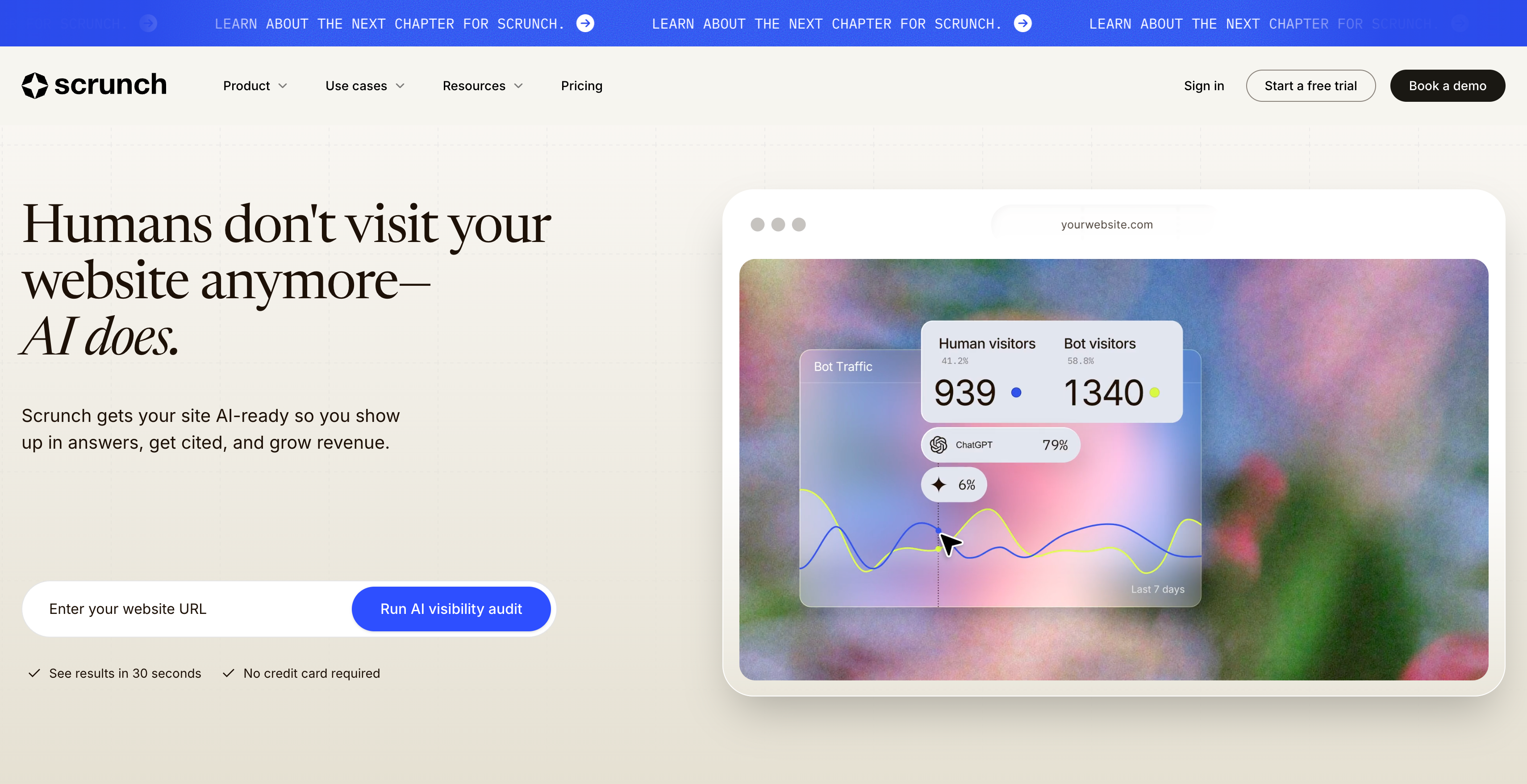
Scrunch approaches the problem from the infrastructure side: alongside monitoring, it serves a machine-readable version of your site to AI crawlers and tracks named bots (GPTBot, ClaudeBot, PerplexityBot) with a GA4-connected referral view. Sitecore acquired it in June 2026 in a deal reported around $225 million, and it continues to operate standalone.
Key features
- Prompt monitoring, citations, page audits and site maps
- Agent traffic analytics showing which bots visited and how often
- Agent Experience Platform for serving optimised content at the edge
- Hallucination detection for catching false AI claims about your brand
Pros
- The agent-experience angle is genuinely differentiated and increasingly relevant
- Crawler and agent-traffic depth that most attribution-focused tools skip
- SOC 2 Type II and enterprise credibility, now with Sitecore behind the roadmap
Cons
- Core at ~$250/month tracks four engines and 125 prompt credits that deplete across engines, with Claude, Gemini and Grok reserved for Enterprise
- The Agent Experience Platform and hallucination detection are Enterprise-only
- No Reddit tracking, and plan packaging has churned through 2026, so confirm the current lineup
Verdict: Choose Scrunch if agent traffic is a board-level topic. For most teams leaving AthenaHQ over price or credit math, it solves a different problem at a higher entry point.
How to Switch From AthenaHQ to Promptwatch Without Losing Your Baseline
Export your prompt list and competitor set before you cancel. What moves is the prompt list, not the history, since there's no connector between platforms. Export your prompts from AthenaHQ as a spreadsheet and keep a column headed prompt; topic, type and intent columns are optional but worth carrying over if you have them. In Promptwatch, paste the list or upload the file when adding prompts, up to 1,000 at a time. Document your competitor set at the same time, since that gets rebuilt manually too.
FAQ
What is an alternative tool to AthenaHQ?
Promptwatch is the closest alternative for teams that like AthenaHQ's action orientation but want predictable pricing. It charges a flat monthly rate from $95 with a 7-day free trial, makes all 11 AI models available on every plan (four tracked per project at a time), adds server-side crawler logs at $245, and publishes content to Webflow or Framer. Peec AI and Otterly are cheaper flat-priced monitors, Profound is the enterprise upgrade for demand data, and SE Ranking bundles AI tracking into a full SEO suite.
Why do people look for AthenaHQ alternatives?
Four reasons come up repeatedly: the $295 floor with no real free trial, only a one-time credit grant; credit-based pricing that makes monthly cost hard to predict as you add engines or track daily; the strongest features (ACE Citation Engine, recommendation engine) reserved for Enterprise with no MCP and no crawler logs; and multi-brand friction with single-country self-serve.
Is Promptwatch a good AthenaHQ alternative?
Yes, especially on pricing predictability. Promptwatch Essential is $95 flat for 50 prompts with all 11 models available and a real 7-day trial, where AthenaHQ starts at $295 on a credit model. From $245 Promptwatch adds server-side crawler logs, content gap analysis and Content Agents. The honest trade-off: AthenaHQ's native GA4 and Shopify revenue attribution is more turnkey for e-commerce, and it includes unlimited seats where Promptwatch meters them.


