TL;DR
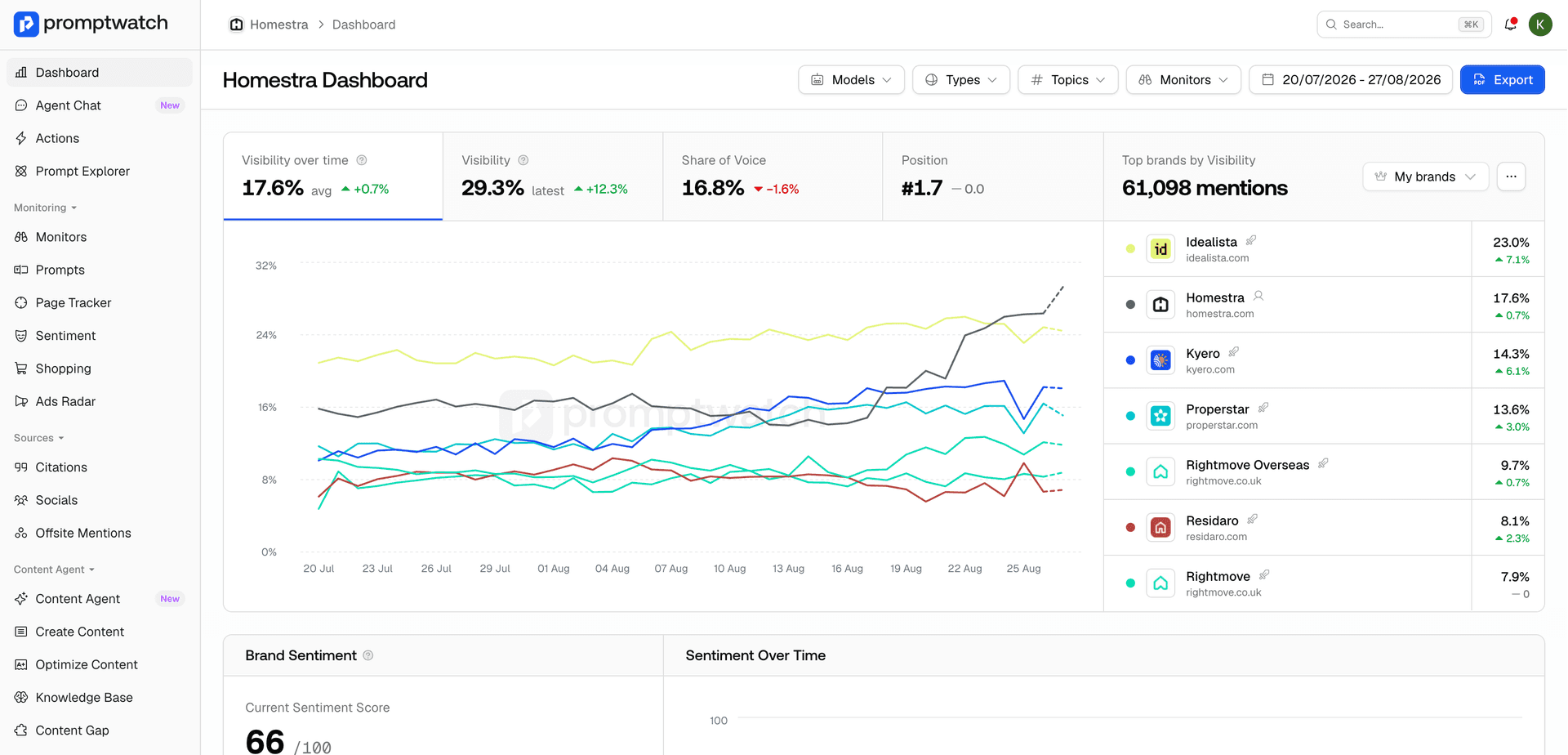
- An AI visibility tool for travel runs real trip-planning prompts through ChatGPT, Gemini, Perplexity, and Google AI Overviews, then reports which hotels, tours, and travel brands get recommended and which sources each answer relied on.
- Travel citations are spread across thousands of sites, so a hotel, tour operator, or destination can earn citations directly from its own pages and from the guides that cover it.
- Travel answers change by country, language, and city, so a single global visibility number hides the markets a brand wins and loses.
- Promptwatch tracks travel prompts per country, language, and city on every plan, scores each answer with a published Visibility Score formula, and shows the booking, review, and guide pages behind every recommendation.
Travelers now ask AI assistants where to stay, which tour to book, and how to fill three days in a city they have never visited. An AI visibility tool for travel measures what those assistants answer: whether your hotel, tour, or destination is named, how it is described, which competitors appear instead, and which websites the answer was built from.
This guide is built on Promptwatch data on the most cited sites in ChatGPT for travel-related prompts, covering organic travel and tourism prompts Promptwatch ran through ChatGPT in September and October 2026.
Where ChatGPT Gets Its Travel Answers: A Long Tail of Sources
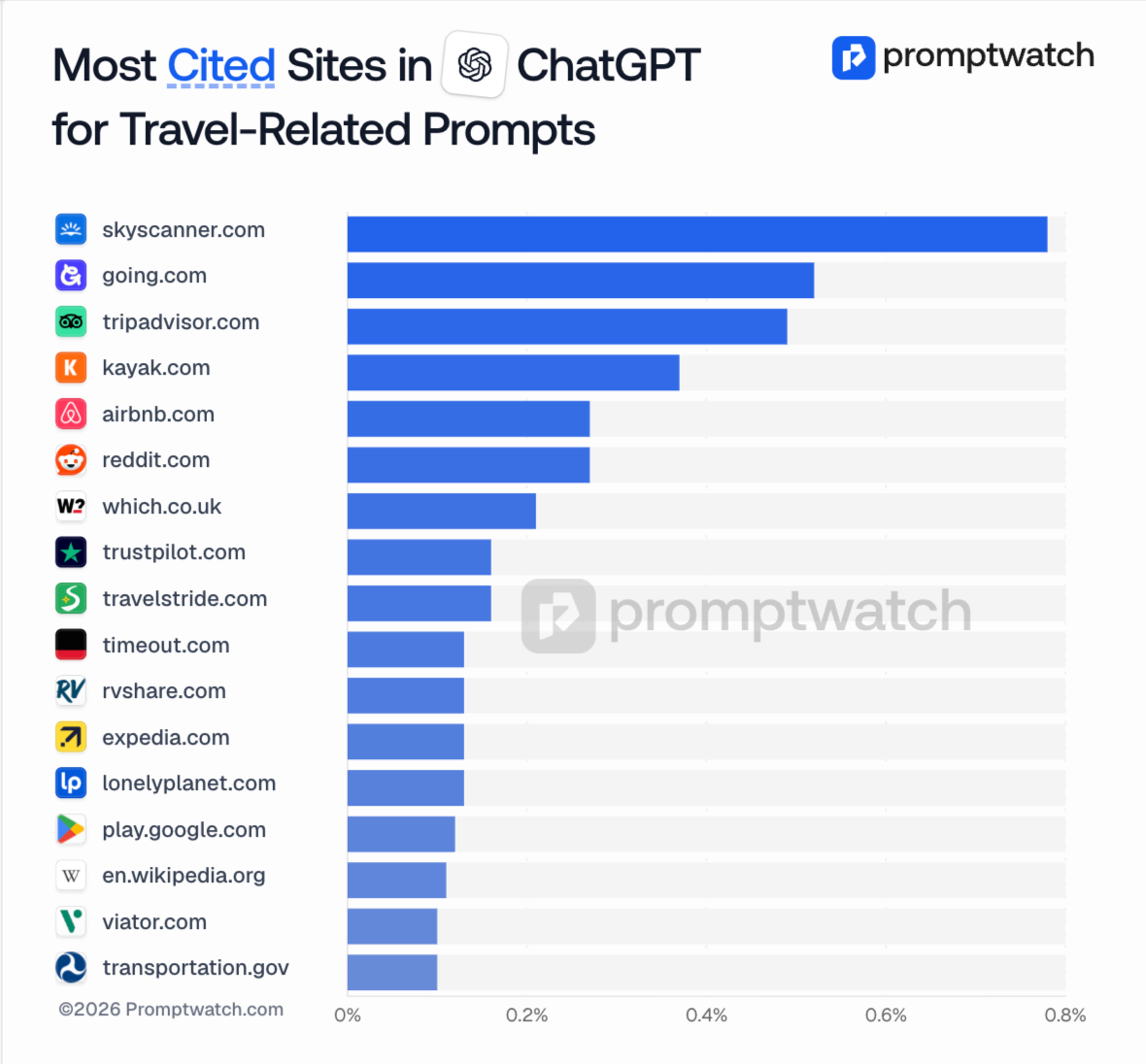
No single website dominates ChatGPT's travel answers. Skyscanner was the most cited travel domain in September and October 2026 with a 0.78% citation share, followed by Going.com at 0.52% and Tripadvisor at 0.49%. The 17 leading travel domains together held 4.18% of all travel citations, which leaves more than 95% spread across the rest of the web.
| Rank | Domain | ChatGPT travel citation share (September to October 2026) |
|---|---|---|
| 1 | Skyscanner | 0.78% |
| 2 | Going.com | 0.52% |
| 3 | Tripadvisor | 0.49% |
| 4 | Kayak | 0.37% |
| 5 | Airbnb | 0.27% |
| 5 | 0.27% | |
| 7 | Expedia | 0.13% |
| 7 | Lonely Planet | 0.13% |
| 7 | Time Out | 0.13% |
Booking and search sites accounted for 2.42% of travel citations, reviews and advice sites for 0.86%, travel guides and reference sites for 0.37%, Reddit for 0.27%, tour sites for 0.16%, and transportation.gov for 0.10%. Automotive works very differently: in Promptwatch's August 2026 automotive data, marketplaces and listings alone held 14.65% of ChatGPT's automotive citations.
What a fragmented citation pool means for hotels and tour operators
A fragmented pool is an opening. Travel answers draw on hotel websites, local guides, regional blogs, and destination pages far more than on a handful of booking giants, so a property or tour operator with clear, specific pages has a real chance of being cited directly. The work is to find which of those pages AI already uses for your prompts, then make sure your own pages and the guides covering you answer the question better.
Going.com, a flight deal service, out-ranked Tripadvisor, and Expedia sat level with Lonely Planet and Time Out at 0.13%. Brand size in travel search does not carry over one-to-one into AI citations, which is why each travel business needs its own prompt-level data.
Reddit's role in travel answers
Reddit held a 0.27% share of ChatGPT's travel citations in September and October 2026, level with Airbnb. That share reflects a period after ChatGPT references to Reddit plummeted over eighty percent in August, so community threads still appear in travel answers at a smaller scale than many travel marketing guides assume.
Which Travel Prompts an AI Visibility Tool Should Track
The prompt set decides what your data can tell you. A useful set mirrors the questions travelers ask at each stage of a trip, and it leans on non-branded prompts, because branded prompts almost always return your brand. Teams that need a method to choose prompts to track can start from the matrix below.
| Prompt type | Example | Who needs it |
|---|---|---|
| Destination discovery | "Best boutique hotels in Lisbon" | Hotels, hotel groups |
| Attribute | "Family-friendly resorts with a kids club in Mallorca" | Hotels, resorts, holiday parks |
| Itinerary | "3-day itinerary for Amsterdam with kids" | Tour operators, destinations |
| Experiences | "Best food tour in Rome" | Tour and activity operators |
| Flights and deals | "Cheapest time to fly from London to New York" | Airlines, OTAs, deal sites |
| Comparison | "[Your resort] vs [competitor] for a family holiday" | Hotels, resorts, OTAs |
| Practical and policy | "Does [hotel] allow dogs?" / "Free cancellation hotels in Paris" | Hotels, OTAs |
Mapping prompts to the trip-planning journey
Destination and itinerary prompts come first, when the traveler has not chosen where to go. Attribute and experience prompts narrow the shortlist. Comparison, deal, and policy prompts arrive last, close to booking. Tagging each prompt by stage shows where a brand drops out of the answer.
Promptwatch's prompt tracking tags each prompt by Prompt Type (Organic, Brand Specific, Competitor Comparison) and by Intent Type (Informational, Commercial, Transactional, and others), and it attaches prompt volume and difficulty so teams can prioritize the prompts travelers ask most.
How query fan-out shapes travel answers
AI models split one travel question into several web searches before answering. A traveler asking "where should we stay in Barcelona with kids" can trigger sub-queries about neighborhoods, family hotels, and nearby attractions. Promptwatch records the fan-out for every tracked prompt and re-runs those sub-queries against your own indexed pages, which shows whether your site has a passage that answers each one.
Tracking Travel Answers by Country, Language, and City
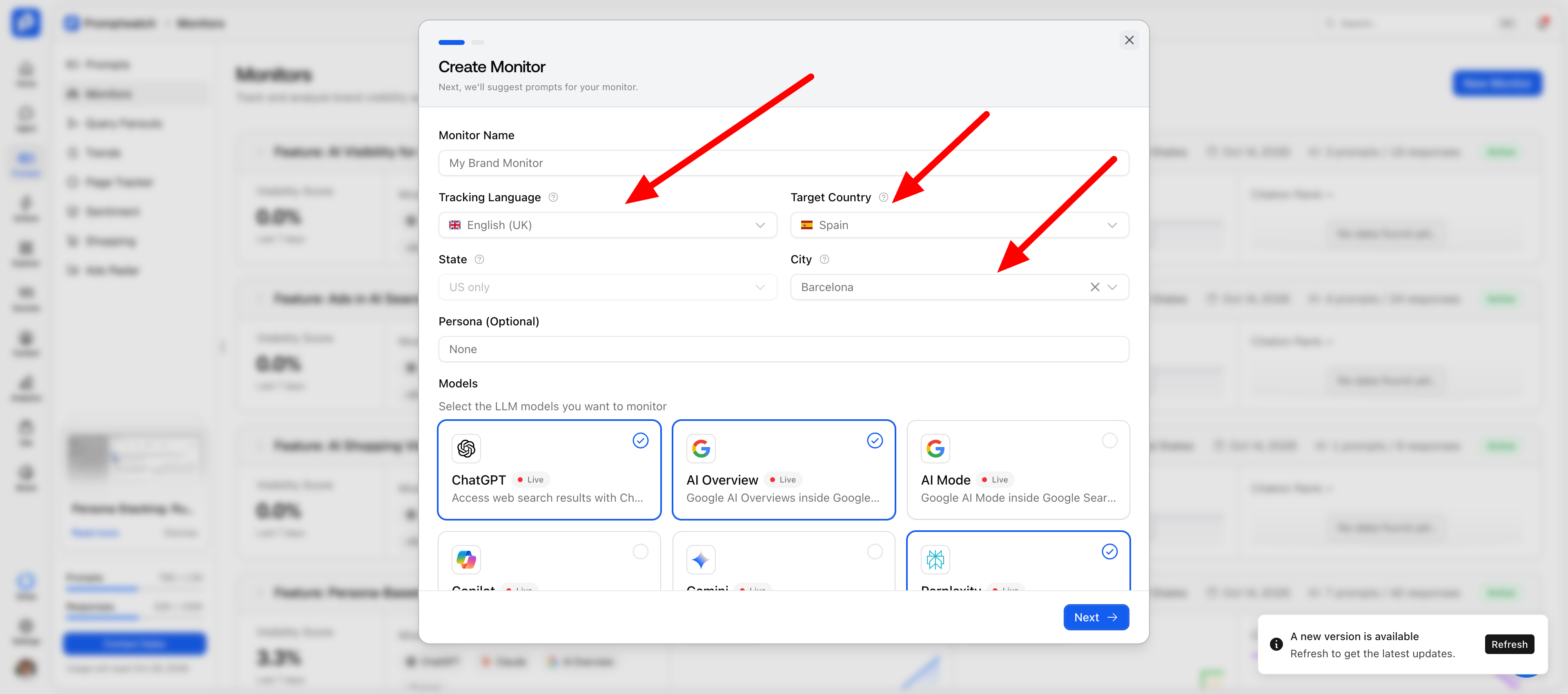
Travel is international by default, and AI answers change with the traveler's location and language. A German family asking for holiday parks in the Netherlands can receive a different answer than a British family asking the same question in English. A single global visibility score averages those markets together and hides where a brand loses.
Promptwatch handles this with Monitors. A Monitor is a set of prompts run on a daily schedule, scoped to one country and one language and, optionally, one US state or city. Each monitor routes through a geo-located residential proxy for its location, with browser locale and timezone matched, so the AI engine sees a real local traveler and returns the local answer. City targeting covers many countries, and it is included on every plan, Essential included.
Multi-market brands feel this first. Iain Davenport, who works with international brands at Monks, describes how AI exposes uneven content across markets:
"The amazing thing about AI is that it amplifies the mistakes. In the past, your UK website may not have been as good as your Dutch website, and you could get away with it. But because AI pulls from so many sources, and you have little control over where it pulls from, it became a serious issue."
Iain Davenport, Director of Business Solutions at Monks
Single property, hotel group, and agency setups
- Single property: one project with one monitor per source market, for example "UK, English" and "DE, German".
- Hotel group or multi-property brand: one project per brand, with monitors per source market and city. Brands and competitors are set once at project level and apply to every monitor.
- Agency serving travel clients: one account with one project per client. Agency plans (Kick-off $199/mo, Growth $399/mo, Scale $799/mo) include unlimited projects and prompts and track all 11 AI platforms at once.
How Travel Brands Measure Recommendations Against Competitors
A mention count tells a travel brand little. If ChatGPT lists your resort sixth after five competitors, with a note about dated rooms, the brand was mentioned and still lost the booking. Travel teams need a metric that weighs position, tone, and competitor presence.
Promptwatch's AI visibility score is calculated per response as Position + Context − Competitors. A top recommendation scores highest, positive framing raises the score, and a crowded answer lowers it. Responses where the brand is absent count as zero, which is why a brand can have many mentions and a low score. The competitor heatmap then shows, prompt by prompt, which rival properties or operators win each comparison.
Spotting wrong prices, policies, and facts in AI answers
Travel answers often repeat outdated room rates, old cancellation policies, closed facilities, or wrong check-in times. Sentiment is scored per response on a 1 to 100 scale and averaged, with thin mentions excluded so bare listings don't drag the score toward neutral. Running regular AI brand checks on price and policy prompts, then tracing each wrong claim to its cited source, tells the team which listing, guide, or review page to correct.
How to Evaluate an AI Visibility Tool for Travel
Travel tool roundups often mix two kinds of products: tools that measure AI answers, and tools that manage listings, reviews, or location data. Listing platforms keep property data consistent across the web, which supports AI visibility, and they sit outside measurement. Evaluate measurement tools on these criteria:
- Data collection method. Check whether the tool runs prompts through the real ChatGPT, Gemini, and AI Overviews interfaces or through model APIs. Travel answers depend on location, language, and live search results, and the guide to whether AI search monitoring tools query the real ChatGPT explains why API responses differ from what travelers see.
Promptwatch scrapes the live interfaces of 11 AI platforms, so reported answers match what a traveler in that market receives. - Country, language, and city tracking. Check whether each source market can be tracked separately, and on which plan.
Promptwatch scopes every monitor to one country and language, with optional city targeting, on every plan. - Citation source analysis. Check whether the tool shows which booking site, review page, guide, or forum thread each answer cited, including third-party pages that mention you without linking to you.
Promptwatch's Citations and Off-site Mentions reports separate citations of your own site from third-party sources, with dedicated Reddit and YouTube feeds. - Crawler access. Check whether the tool shows if AI crawlers can reach your room, tour, and destination pages.
Promptwatch's Agent Analytics logs each AI crawler request (GPTBot, ClaudeBot, PerplexityBot) with page, status code, and timestamp. - Path from data to fixes. Check whether the tool tells you what to change and helps produce the content.
Promptwatch's Content Gap Analysis, Action Items, and Content Agent turn missing prompts into briefs and drafts that go to a review inbox before anything publishes.
Practical fit matters as much as features. As one hospitality customer put it:
"Promptwatch stands out due to how practical it is. A tool built for real business needs in the growing AI Search space"
Pim Broekstra, SEO manager at Center Parcs
Travel AI visibility tools compared
Pricing below was checked against each vendor's public information as of 2026 and should be confirmed on the vendor's site before purchase.
| Tool | Collection | Entry price | Country/language/city tracking | Crawler logs | Notes |
|---|---|---|---|---|---|
| Promptwatch | Real UI scraping, 11 platforms | $95/mo (Essential) | Country and language per monitor; city on every plan | Professional ($245/mo) and up | Agency tiers from $199/mo |
| Profound | Not specified | $99/mo (ChatGPT only); $399/mo for three engines | Not specified | Yes | Public plans billed annually |
| Semrush AI Visibility Toolkit | Not specified | $99/mo per domain, 25 prompts | Not specified | No | Extra domains, seats, and prompts are paid add-ons |
| Ahrefs Brand Radar | Not specified | Requires an Ahrefs base plan plus per-index fees | Not specified | No | Tracks AI Overviews, AI Mode, ChatGPT and other indexes |
| Otterly.AI | Not specified | $29/mo (Lite), 15 prompts | Not specified | No | Gemini, AI Mode, and Claude are paid add-ons |
| Scrunch | Not specified | About $250/mo (Core), 4 engines, 125 prompts | Not specified | Yes | API and full engine coverage on Enterprise |
Pricing and plan fit
- Essential ($95/mo): 50 prompts, 6,000 responses per month, 4 of the 11 platforms selected per project, and country, state, and city tracking.
- Professional ($245/mo): adds crawler logs and a second project.
- Business ($579/mo): five projects and 350 prompts, which suits hotel groups tracking several brands.
- Agency tiers (from $199/mo): for agencies with several travel clients, with all 11 platforms tracked at once.
Teams comparing a broader set of tools beyond travel can use the general guide to choosing an AI visibility platform.
From Tracking to Fixes: How Travel Brands Earn More AI Citations
Tracking shows where the brand is missing. The fixes follow the citation data:
- Fix the sources AI already uses. Verify your listings on the booking and search sites in your citation report, such as Skyscanner, Kayak, Airbnb, and Expedia, and correct rates, policies, and facilities there first.
- Build review and guide coverage. Collect reviews on Tripadvisor and Trustpilot, and pitch features to travel guides such as Lonely Planet and Time Out, which appear in ChatGPT's travel citations.
- Confirm AI crawlers can reach your pages. Use Agent Analytics to track AI crawler activity on your website and catch 403 errors or blocked room, tour, and booking pages.
- Fill content gaps per market. Content Gap Analysis lists the tracked prompts no page on your site answers, per language. Promptwatch's content agent drafts pages grounded in your citation and gap data, and every draft waits for approval in a review inbox. Direct publishing works with Webflow and Framer; other CMSs use export.
- Watch community threads. Use AI mention tracking for Reddit to see which travel threads AI cites for your prompts, and where your property is discussed.
- Refresh on a cycle. Promptwatch data shows citation relevance holds for roughly 8 to 14 weeks before a refresh helps. Schedule seasonal and destination pages for review on that cadence.
Report progress with a small set of AI visibility KPIs: Visibility Score per source market, competitor share of voice per prompt group, citation share by source type, sentiment, and crawl frequency on key pages. Track them as trends over weeks, since individual AI answers change from one day to the next.
FAQ
What is an AI visibility tool for travel?
An AI visibility tool for travel runs trip-planning prompts through AI assistants such as ChatGPT, Gemini, Perplexity, and Google AI Overviews, then reports which hotels, tours, destinations, or travel brands get recommended, how they are described, which competitors appear, and which sources were cited. Promptwatch collects these answers by scraping the live interfaces of 11 AI platforms.
Which sites does ChatGPT cite most for travel questions?
In Promptwatch's September to October 2026 data, Skyscanner (0.78%), Going.com (0.52%), and Tripadvisor (0.49%) led ChatGPT's travel citations, followed by Kayak (0.37%), Airbnb (0.27%), and Reddit (0.27%). The 17 leading travel domains together held 4.18% of travel citations, so most citations go to a long tail of hotel, guide, and destination pages.
Can I track AI visibility for hotels in several countries and languages?
Yes. In Promptwatch, each monitor is scoped to one country and one language, with optional city targeting, so a hotel group can track "UK, English," "DE, German," and "FR, French" as separate markets. Brands and competitors are set once per project and apply to every monitor.
How much does an AI visibility tool for a hotel cost?
Promptwatch starts at $95/mo on the Essential plan, which includes country, state, and city tracking. Crawler logs start on Professional at $245/mo, and Business at $579/mo covers five projects for multi-brand groups. Agencies with several travel clients can use the Agency tiers at $199, $399, or $799 per month, which include unlimited projects and prompts.
How long before changes show up in AI answers?
AI models re-crawl and re-index content regularly, so updates can appear within weeks, and results vary by engine and prompt. Promptwatch data shows citation relevance holds for roughly 8 to 14 weeks, after which pages benefit from a refresh. Visibility Score is most reliable read as a weekly trend.
Does tracking ChatGPT also cover Google AI Overviews and AI Mode?
No. ChatGPT, Google AI Overviews, Google AI Mode, and the Gemini app each return different answers and cite different sources. Promptwatch tracks them as separate platforms, so you can compare visibility and citations model by model.