


TL;DR
- An AI visibility tool for real estate runs the questions buyers, renters, sellers, and investors ask through ChatGPT, Perplexity, Gemini, and Google AI Overviews, then reports which portals, agencies, and property brands get recommended and which sources the answer used.
- Real estate answers change by city, country, and language, so the tool has to report each market as its own time series.
- Visibility only becomes a business case when it connects to crawler access, cited pages, and the conversions AI-referred visitors produce.
- Promptwatch covers that full path: city and country monitors on every plan, Agent Analytics crawler logs, and visitor and conversion tracking, which TreeHouse (Pararius, Huurwoningen.nl) uses to show AI Search drives about 1 in 4 of its organic conversions.
People now ask ChatGPT where to rent in Utrecht, which brokerage to hire in Austin, and which REITs hold logistics assets. An AI visibility tool for real estate measures what those assistants answer: whether your portal, agency, or property brand is named, how it is described, which competitors appear instead, and which websites the answer was built from.
What an AI Visibility Tool for Real Estate Measures
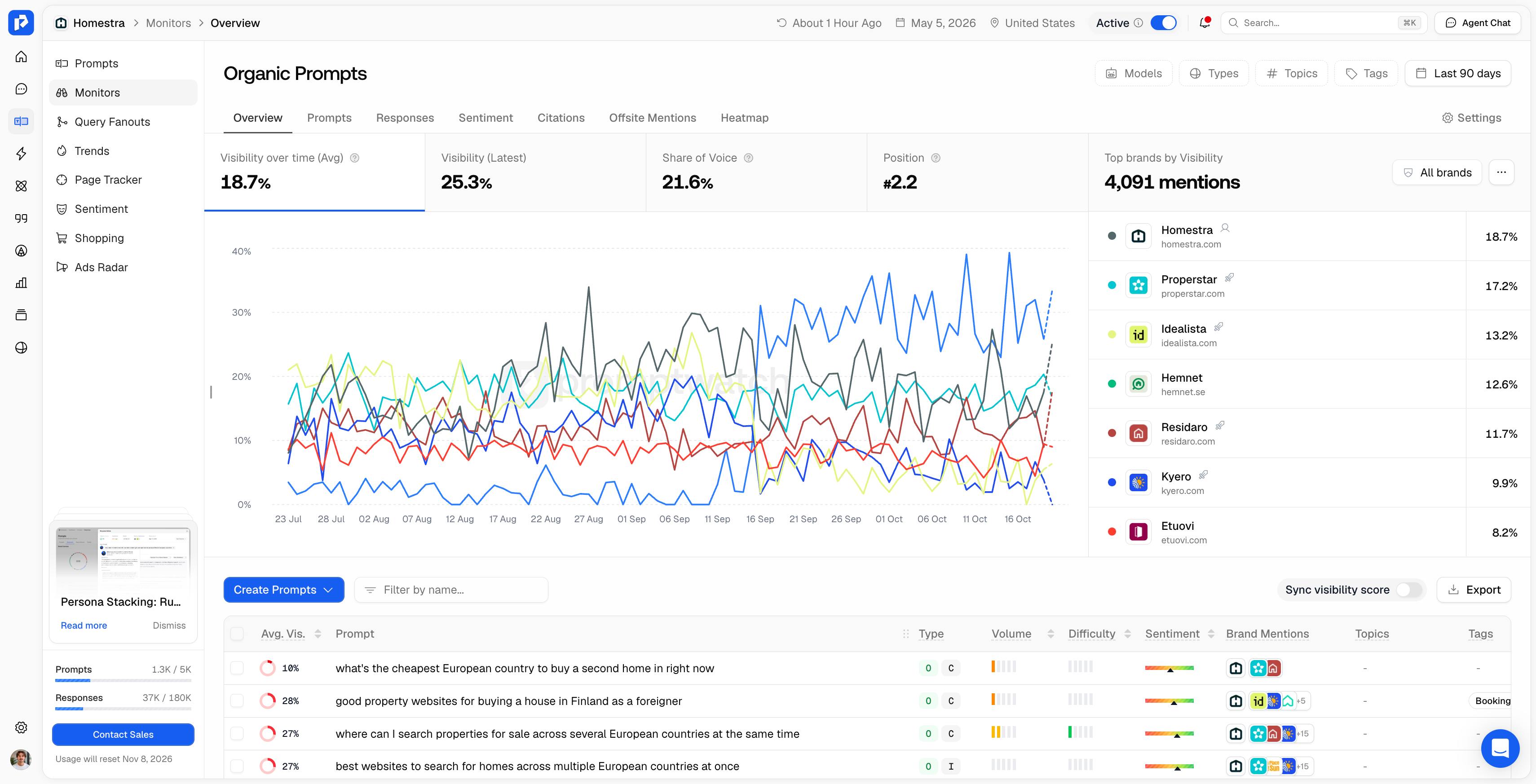
An AI visibility tool sends a fixed set of prompts to AI assistants on a schedule, stores every answer, and scores how each brand appears. For real estate, those prompts mirror the questions people ask before they rent, buy, sell, list, or invest. The output is a time series per prompt, per AI platform, and per market.
Three metrics carry most of the reporting, and they measure different things:
- Mention: the answer names your brand. Naming it three times in one answer still counts as one mention.
- Citation: the answer links to one of your pages as a source. A portal can be cited for its market data without being recommended as a place to search.
- Visibility Score: a 0 to 100 score per answer based on placement. A sole recommendation scores 100, first place in a ranked list scores 90 to 94, second 65 to 80, and a brief passing mention 10 to 24. Answers that leave your brand out score 0, and the headline number averages every answer, zeros included.
Case Study: How TreeHouse Tracks AI Visibility Across Its Rental Platforms
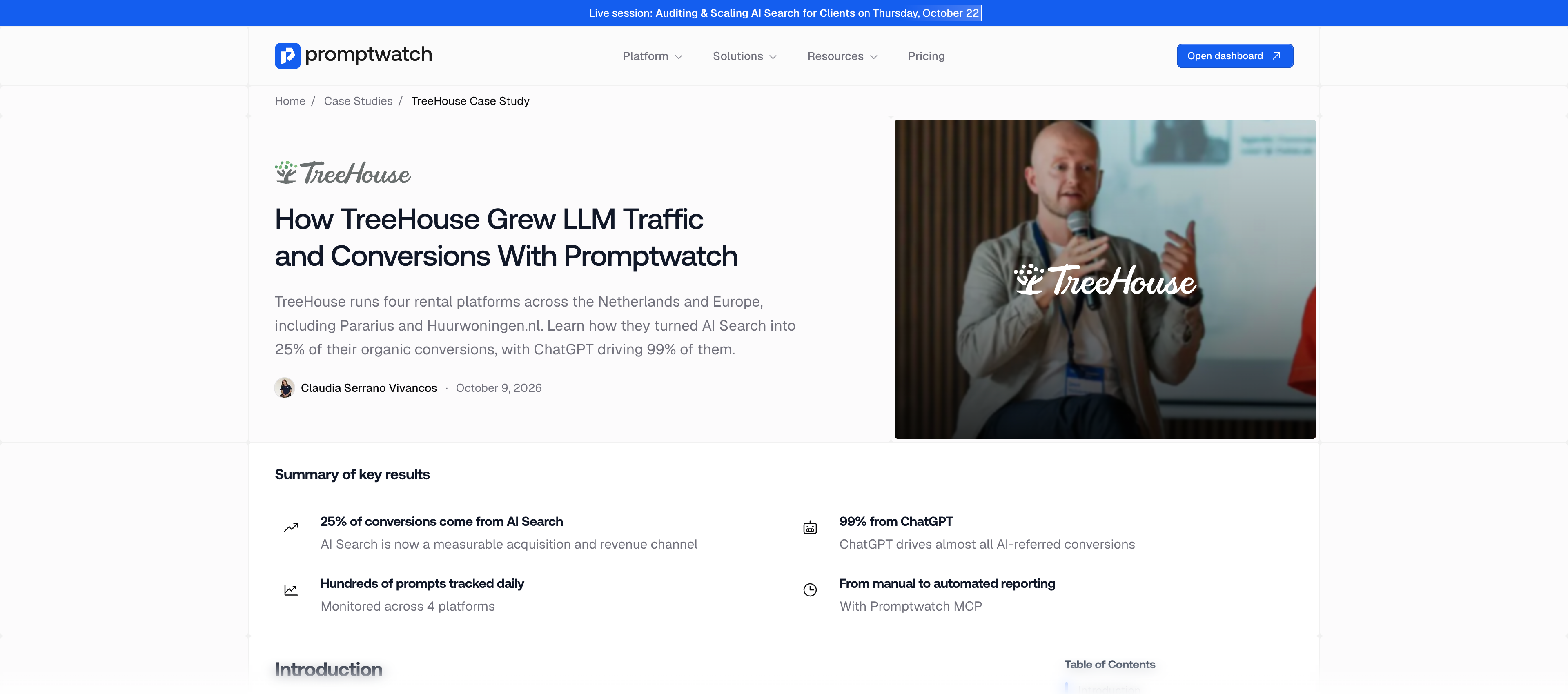
TreeHouse is the group behind some of Europe's best-known rental platforms. Its brands include Pararius and Huurwoningen.nl in the Netherlands, Rentaroof in the United Kingdom, Toitpourtoi in France, and Immomiet, alongside B2B products for real estate professionals such as Realstats, Pararius Office, and Leadflow. The platforms connect home seekers with landlords and real estate agents, and SEO was already one of the group's largest acquisition channels.
From manual prompt checks to daily tracking
Before Promptwatch, the TreeHouse team measured AI visibility by asking ChatGPT and Perplexity three prompts hundreds of times a day and logging the results in spreadsheets. Their SEO tools (Semrush and Ahrefs) could not show which brands AI recommended, which competitors appeared alongside them, or which sources the answers cited. The manual method did not scale across several platforms.
The team started in Promptwatch with branded prompts to set a baseline, then expanded to organic and competitor prompts. Today it monitors hundreds of prompts daily, connected to Google Search Console data.
Crawler logs showed what was holding visibility back
Agent Analytics, Promptwatch's AI crawler log product, showed that AI crawlers were already visiting TreeHouse's sites in large numbers. Dave Vollebregt, Head of Marketing at TreeHouse, described what that changed internally:
"Our server logs showed a tremendous amount of LLM bots already crawling our websites. So we stopped asking whether we should step into AI search. We are already in AI search, whether we like it or not."
The logs also showed technical and content issues that limited how AI understood and cited the platforms. The team allowed AI crawlers it had been blocking, fixed 404 errors, removed thin and outdated pages, added noindex tags, and corrected inconsistent information across pages.
Proprietary market data earned more citations
Competitive content analysis compared the group's own platforms. Huurwoningen.nl, which publishes market reports and proprietary rental data, earned far more AI citations than Pararius. That finding set TreeHouse's AI Search strategy: original data was what language models valued most, so the team invested in producing more of it.
This matches how AI assistants build real estate answers. A question about average rents in Amsterdam or vacancy rates in Rotterdam needs a source with numbers, and a portal that publishes its own rental data becomes that source.
Connecting AI answers to conversions
TreeHouse tracks AI referrals through to paid subscription trials. AI Search now drives about 25% of its organic conversions, roughly 1 in 4, and 99% of AI-referred conversions come from ChatGPT. The team uses the Promptwatch MCP connection with Claude to investigate conversion spikes and generate weekly reports on gains, declines, and priorities, which it says saves hours each week.
That data built the internal business case. Before Promptwatch, AI Search kept losing priority because the case was hard to make. With visibility, crawler activity, and conversions in one place, it moved onto the organization's technical roadmap.
Which Real Estate Prompts to Track
The prompt set decides what your data can tell you. A useful set mirrors the questions each audience asks at each stage, and it leans on non-branded prompts, because a prompt that names your brand almost always returns it. Teams that need a method to choose prompts to track can start from this matrix:
| Prompt type | Example | Who needs it |
|---|---|---|
| Search platform | "Best website to find a rental apartment in Amsterdam" | Portals, rental platforms |
| Local agent | "Best real estate agent in Pasadena for first-time buyers" | Brokerages, agents |
| Neighborhood | "Is Kreuzberg a good area to rent for families?" | Portals, agents, developers |
| Market data | "Average rent for a 2-bedroom in Rotterdam in 2026" | Portals, data providers |
| Commercial | "Top commercial real estate brokers for office leases in Chicago" | CRE firms |
| Investment | "Best industrial REITs for long-term income" | Investment firms, REITs |
| Property | "Best luxury apartment communities in Los Angeles" | Multifamily operators |
| Trust | "Is [brand] legit?" / "[brand] reviews" | All segments |
Tagging prompts by type and intent
Promptwatch's prompt tracking tags each prompt by Prompt Type (Organic, Brand Specific, Competitor Comparison) and Intent Type (Informational, Commercial, Transactional, and others). It attaches prompt volume and difficulty, so teams can prioritize the questions people ask AI most.
Expect the score to move when the prompt set changes. When TreeHouse added prompts, its Visibility Score dropped from about 65 to 40 while nothing on the website had broken: the new, harder prompts lowered the average.
Using Google Search Console to seed the prompt set
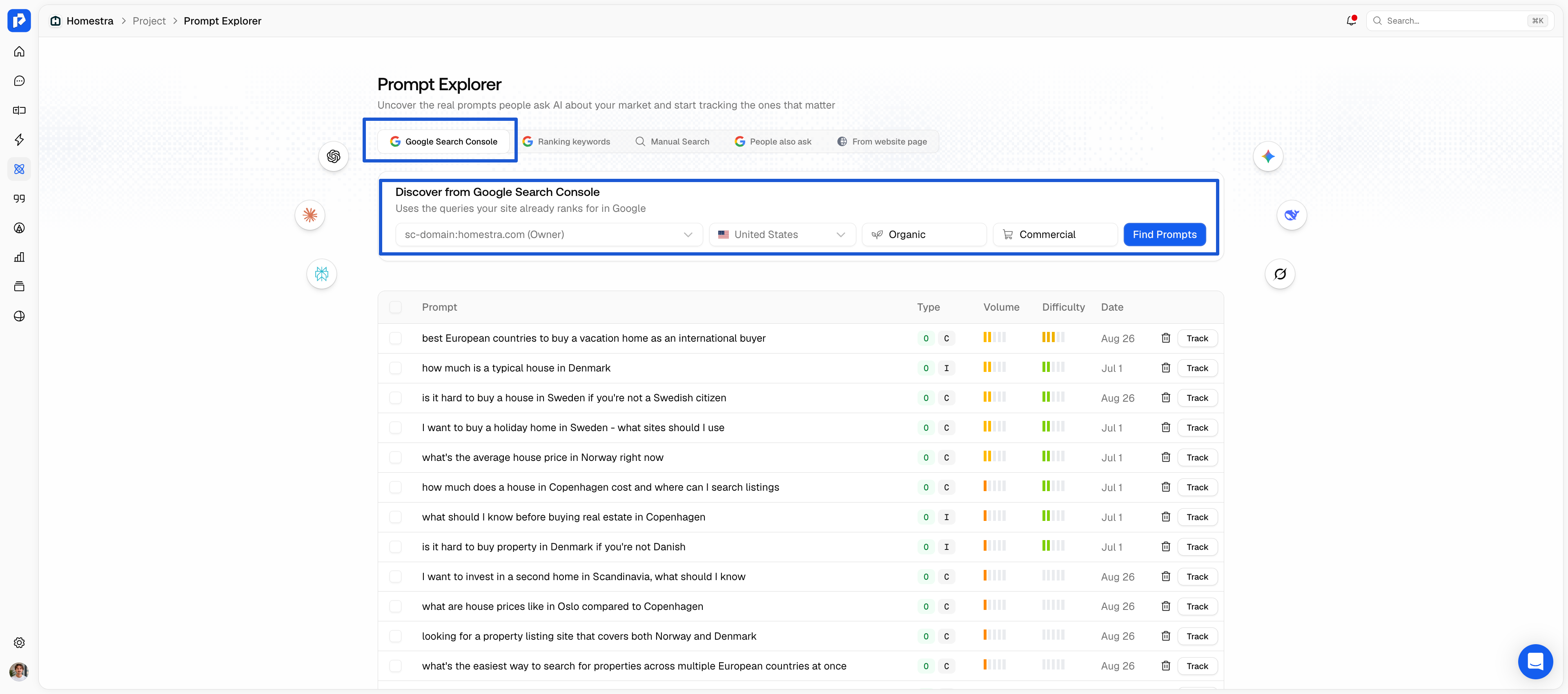
Search Console queries show the language your audience already uses. Promptwatch connects directly to Search Console, and the queries then feed prompt suggestions automatically, which is how TreeHouse paired the two. Teams comparing setups can read how an AI visibility tool with Google Search Console integration turns ranking keywords into prompts.
How query fan-out changes what you monitor
AI models split one question into several web searches before answering. A renter asking "where should I live in Utrecht" can trigger sub-queries about rent levels, commute times, and neighborhood safety. Promptwatch records the fan-out for every tracked prompt and re-runs those sub-queries against your own indexed pages, which shows whether your site has a passage that answers each one.
Tracking Real Estate Answers by City, Country, and Language
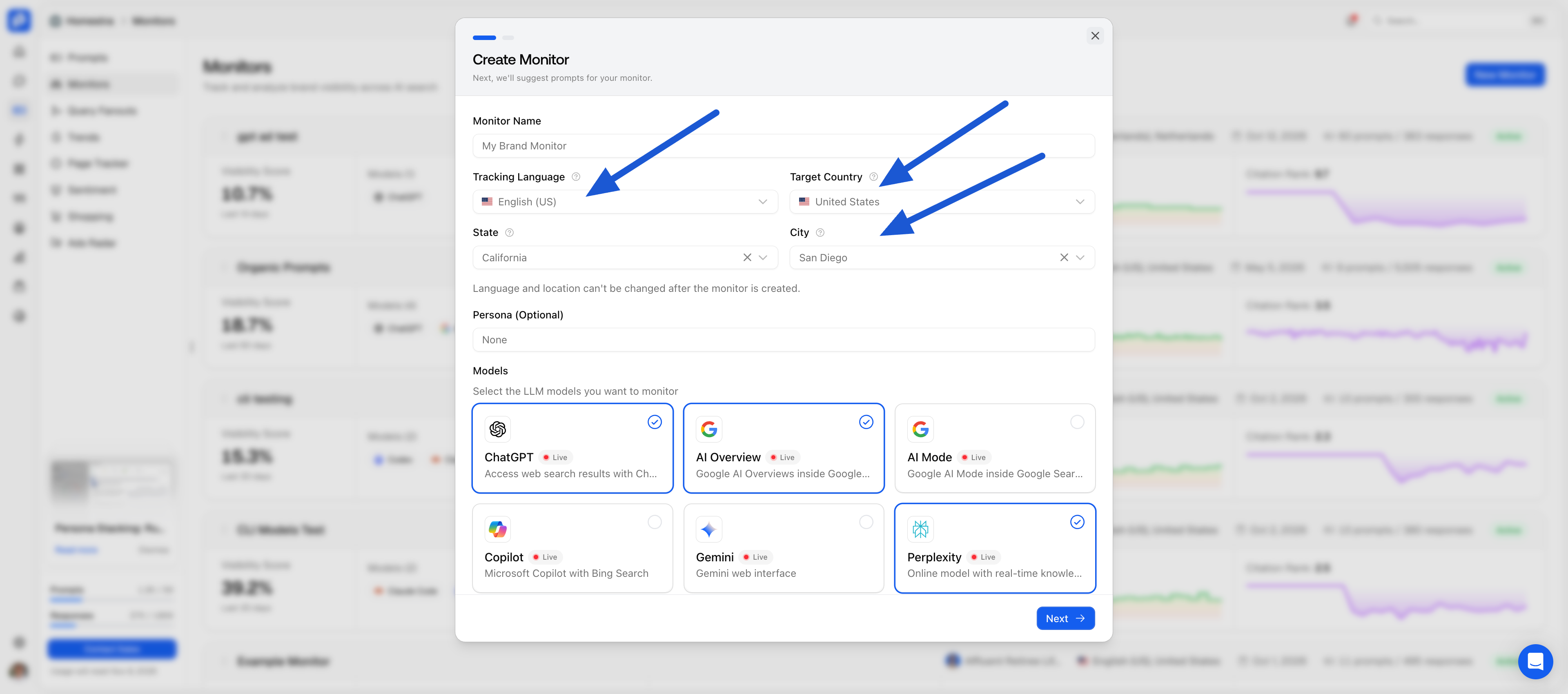
Real estate answers change with location. "Best rental site" returns different platforms in the Netherlands, France, and the UK, and "best agent near me" returns different agents in Phoenix and Denver. A national average hides which markets you win and which you lose.
Promptwatch handles this with Monitors. A Monitor is a set of prompts run on a daily schedule, scoped to one country and language and, optionally, one US state or city. Each monitor routes through a geo-located residential proxy for its location, with browser locale and timezone matched, so the AI platform sees a local user and returns the local answer. City and state targeting are included on every plan, Essential included.
A multi-country group like TreeHouse would set up one project per brand and one monitor per market, such as "NL, Dutch" for Huurwoningen.nl and "FR, French" for Toitpourtoi. Brands and competitors are set once per project and apply to every monitor. For groups running platforms in several markets, the guide to multi-language AI visibility tracking covers the setup in more detail.
Which AI Visibility Setup Fits Each Type of Real Estate Company
Each segment of real estate loses visibility in a different place, so the tracking setup differs.
Portals and rental platforms
Portals compete with each other and with listing aggregators for "where should I search" prompts, and with news sites for market-data prompts. Track platform-recommendation prompts per city, plus market-data prompts where proprietary data can earn citations. Citation reports show which of your market reports and city pages AI already uses.
Brokerages and real estate agents
Agent prompts are local and trust-driven: "best agent in [city]," "[agency] reviews." Answers often draw on third-party profiles, review sites, and portal agent pages, so Off-site Mentions matters as much as your own site. One project per brokerage with a monitor per office location covers most setups.
Commercial real estate firms
Commercial prompts cover leasing, tenant representation, and market outlooks by city. Answers lean on industry publications and research reports, which makes original market research the main lever. Track competitor comparison prompts, since large brokerages appear together in most answers.
Real estate investment firms and REITs
Investment prompts ask about sectors, yields, and fund strategies. They are informational and high-stakes, so sentiment and accuracy matter: an outdated dividend figure or a wrong portfolio description repeats across every answer that cites the same source. Promptwatch scores sentiment per answer on a 1 to 100 scale and lets teams trace each claim to its cited source.
Multifamily operators and property managers
Property-level prompts ("best apartments near downtown Austin") decide leases. Track each community or building as a prompt group, and watch which listing sites and review platforms AI cites for your properties.
How to Evaluate an AI Visibility Tool for Real Estate
AI visibility products range from tools that measure AI answers to marketing services that bundle some AI reporting with SEO work. Evaluate measurement tools on these criteria:
- Data collection method. Check whether the tool runs prompts through the real ChatGPT, Gemini, and AI Overviews interfaces or through model APIs. Local real estate answers depend on location and live search results, and the guide to whether AI search monitoring tools query the real ChatGPT explains why API responses differ from what renters and buyers see.
Promptwatch scrapes the live interfaces of 12 AI platforms, including ChatGPT, Perplexity, Google AI Overviews, Google AI Mode, Gemini, Claude, and Microsoft Copilot. - Local and multi-market tracking. Check whether city, state, and country targeting is available, and on which plan.
Promptwatch includes city and state monitors on every plan, routed through geo-located residential proxies. - Citation source analysis. Check whether the tool shows which portal, review site, or publication each answer cited, including third-party pages that mention you without linking to you.
Promptwatch's Citations and Off-site Mentions reports separate citations of your own site from third-party sources, with dedicated Reddit and YouTube feeds. - Crawler access. Check whether the tool shows if AI crawlers can reach your listing, city, and market-data pages.
Promptwatch's Agent Analytics logs each AI crawler request (GPTBot, ClaudeBot, PerplexityBot) with page, status code, and timestamp. - Conversion tracking. Check whether the tool connects AI referrals to leads, trials, or bookings.
Promptwatch's Visitor Analytics tracks AI-referred visitors and conversions separately from crawler activity, the data TreeHouse uses to report its 25% share of organic conversions. - Path from data to fixes. Check whether the tool tells you what to change and helps produce the content.
Promptwatch's Content Gap Analysis, Action Items, and Content Agent turn missing prompts into briefs and drafts that wait in a review inbox before anything publishes.
Real estate AI visibility tools compared
Pricing below was checked against each vendor's public information as of 2026 and should be confirmed on the vendor's site before purchase.
| Tool | Collection | Entry price | City/state tracking | Crawler logs | Notes |
|---|---|---|---|---|---|
| Promptwatch | Real UI scraping, 12 platforms | $95/mo (Essential) | Every plan | Professional ($245/mo) and up | Visitor and conversion tracking; agency tiers from $199/mo |
| Profound | Not specified | $99/mo (ChatGPT only); $399/mo for three engines | Not specified | Yes | Public plans billed annually |
| Semrush AI Visibility Toolkit | Not specified | $99/mo per domain, 25 prompts | Not specified | No | Extra domains, seats, and prompts are paid add-ons |
| Ahrefs Brand Radar | Not specified | Requires an Ahrefs base plan plus per-index fees | Not specified | No | Tracks AI Overviews, AI Mode, ChatGPT and other indexes |
| Otterly.AI | Not specified | $29/mo (Lite), 15 prompts | Not specified | No | Gemini, AI Mode, and Claude are paid add-ons |
| Scrunch | Not specified | About $250/mo (Core), 4 engines, 125 prompts | Not specified | Yes | API and full engine coverage on Enterprise |
Pricing and plan fit
Promptwatch's Brands plans start at $95/mo (Essential: 50 prompts, 6,000 responses per month, 4 of the 12 AI platforms selected per project, city and state tracking). Professional ($245/mo) adds crawler logs and a second project. Business ($579/mo) adds five projects and 350 prompts, which suits a group running several portals. Agencies serving real estate clients use the separate Agency tiers (Kick-off $199/mo, Growth $399/mo, Scale $799/mo), which include unlimited projects and prompts and track all 12 platforms at once.
From Tracking to Fixes: A Real Estate AI Visibility Plan
Tracking shows where your brand is missing. TreeHouse's sequence offers a practical order for the fixes:
- Do the boring work first. Audit FAQs, About pages, and forgotten legacy pages for outdated or conflicting facts. AI repeats whatever it finds, including pages your team no longer maintains.
- Confirm AI crawlers can reach your pages. Use Agent Analytics to track AI crawler activity on listing, city, and market pages, and catch 403 errors, 404s, and accidental blocks.
- Publish proprietary data. Rent indexes, price trends, and supply reports give AI a reason to cite your domain for market questions, the lever that set Huurwoningen.nl apart from Pararius in TreeHouse's analysis.
- Fill content gaps per market. Content Gap Analysis lists the tracked prompts no page on your site answers. Promptwatch's content agent drafts pages grounded in your citation and gap data, and every draft waits for approval in a review inbox. Direct publishing works with Webflow and Framer; other CMSs use export.
- Refresh on a cycle. Promptwatch data shows citation relevance holds for roughly 8 to 14 weeks before a refresh helps. Market reports and city pages with dated figures need that cadence most.
Inconsistent facts are often where real estate brands lose accuracy first. Vollebregt gave a concrete example from one of TreeHouse's platforms:
"On one of our platforms, AI sometimes said we were founded in 2010 and sometimes in 2011. The 2010 was still on a hidden page everybody forgot about, but we were actually feeding the bot with it. So start with the boring pages: the FAQs, the about us, the pages you forgot about."
Report progress with a short list of metrics: Visibility Score per market, share of voice against named competitors, citation share by source, sentiment, crawl frequency on key pages, and AI-referred conversions. Read them as weekly trends, since individual AI answers change from one day to the next.
FAQ
What is an AI visibility tool for real estate?
An AI visibility tool for real estate runs the prompts renters, buyers, sellers, and investors ask through AI assistants such as ChatGPT, Gemini, Perplexity, and Google AI Overviews. It reports which portals, agencies, and property brands get recommended, how they are described, which competitors appear, and which sources were cited. Promptwatch collects these answers by scraping the live interfaces of 12 AI platforms.
Which AI platform sends real estate companies the most traffic?
For TreeHouse, the group behind Pararius and Huurwoningen.nl, 99% of AI-referred conversions came from ChatGPT, and AI Search drove about 25% of its organic conversions. Results vary by market and audience, so each company should measure its own AI referrals and conversions per platform.
Can one tool track real estate visibility in several countries and cities?
Yes. In Promptwatch, each brand is a project, and each market gets its own monitor scoped to one country and language and, optionally, one city or US state. City and state targeting is included on every plan.
What makes AI cite a real estate website?
AI assistants cite pages that answer the sub-queries behind a question with specific, current facts. In TreeHouse's analysis, the platform publishing market reports and proprietary rental data earned far more AI citations than its sister platform. Crawler access, consistent facts across pages, and regular refreshes also determine whether a page stays cited.
How much does an AI visibility tool for real estate cost?
Promptwatch starts at $95/mo on the Essential plan, which includes city and state tracking. Crawler logs start on Professional at $245/mo, and Business at $579/mo covers five projects for groups with several brands. Agencies managing real estate clients can use the Agency tiers at $199, $399, or $799 per month.
Why did our visibility score drop after we added prompts?
The Visibility Score averages every tracked answer, and answers that leave your brand out count as zero. Adding harder, non-branded prompts usually lowers the average even when nothing on the website changed. TreeHouse saw its score move from about 65 to 40 after expanding its prompt set, so compare scores only within the same prompt set.


