

TL;DR
- Review sites like G2 and Capterra help a software brand get recommended by ChatGPT mainly by getting it into the candidate pool and shaping how the AI describes it.
- Review count and star rating show almost no relationship with where a tool lands in a ChatGPT list, so more reviews alone rarely move a brand up.
- Review sites carry the most weight on evaluation prompts such as "[brand] reviews" or "X vs Y," where ChatGPT now searches G2 and Capterra by name.
- Documentation, help centers, and vendor sites earn about three times as many ChatGPT software citations as review sites and analysts combined.
- Promptwatch shows which review pages, docs, and third-party sources ChatGPT cites for each tracked prompt, so teams can see whether their G2 and Capterra work is changing what the AI recommends.
Review sites like G2 and Capterra do help a software brand get recommended by ChatGPT, but they do a narrower job than most SaaS marketers assume. A complete profile with recent, detailed reviews gets a product into the pool of tools ChatGPT considers and feeds the pros and cons it repeats. It does very little to decide whether that product is named first or fifth.
This guide uses Promptwatch's ChatGPT citation share report for software (October 2026), query fan-out data from tracked prompts, and published third-party studies to show where review sites matter, where they don't, and what to do about each. It covers ChatGPT first, then how Google AI Overviews, AI Mode, and Gemini treat the same sources.
Do G2 and Capterra reviews influence ChatGPT software recommendations?
Yes, in three specific ways: inclusion, description, and evaluation. The evidence for each is strong. The evidence that review volume or star rating moves a brand's position inside a ChatGPT answer is weak.
A March 2026 industry analysis asked ChatGPT for alternatives to dozens of popular SaaS tools and checked every recommended product against G2 and Capterra. 100% of the tools ChatGPT named had Capterra reviews and 99% had G2 reviews. The same analysis found near-zero correlation between review score and rank (+0.02 for Capterra, −0.11 for G2) and only weak correlation for review count.
Read that carefully. The study only examined tools that ChatGPT already recommended, so it shows that recommended tools almost always have review profiles. It doesn't prove that missing a profile gets a tool excluded. In practice, the pattern still holds up: established review profiles are table stakes for software categories, and the brands winning top positions are winning on something else.
How ChatGPT search picks the sources behind a software recommendation
ChatGPT decides what to recommend by searching the web, reading the pages it retrieves, and synthesizing an answer with links to its sources. OpenAI's ChatGPT search documentation describes this retrieval step, which is why a software brand's visibility depends on which pages show up for the sub-queries ChatGPT runs.
Those sub-queries are called query fan-out: the model splits one question into several parallel searches before it picks sources. The fan-out decides which passages, and therefore which brands, are even considered.
Promptwatch logs the fan-out for every tracked prompt. For the prompt this article answers, ChatGPT ran 9 sub-queries between October 18 and 21, 2026. Four of them searched for OpenAI's own documentation on how ChatGPT selects sources. The rest searched for studies on whether G2 and Capterra influence recommendations. Microsoft Copilot ran the question almost verbatim. AI models answering a question about AI recommendations go to primary sources and research first, which is a useful signal for any brand writing about its own category.
ChatGPT now searches review sites by name on evaluation prompts
The clearest evidence comes from branded review prompts. Promptwatch tracks the prompt "promptwatch reviews for tracking brand visibility in AI search engines" across ChatGPT and Perplexity. Of the 95 fan-out sub-queries logged between February 12 and October 20, 2026, 15 explicitly named G2, Capterra, or Trustpilot, with queries such as "promptwatch reviews brand visibility ai search engines g2 capterra reddit."
All 15 appeared after August 1, 2026. None of the 39 fan-outs logged from February through July named a review site. Since August, roughly 1 in 4 sub-queries for this prompt has gone looking for a review platform directly. When a buyer asks ChatGPT what people think of a product, ChatGPT increasingly goes to G2 and Capterra to find out.
What the October 2026 data shows about G2 and Capterra citations
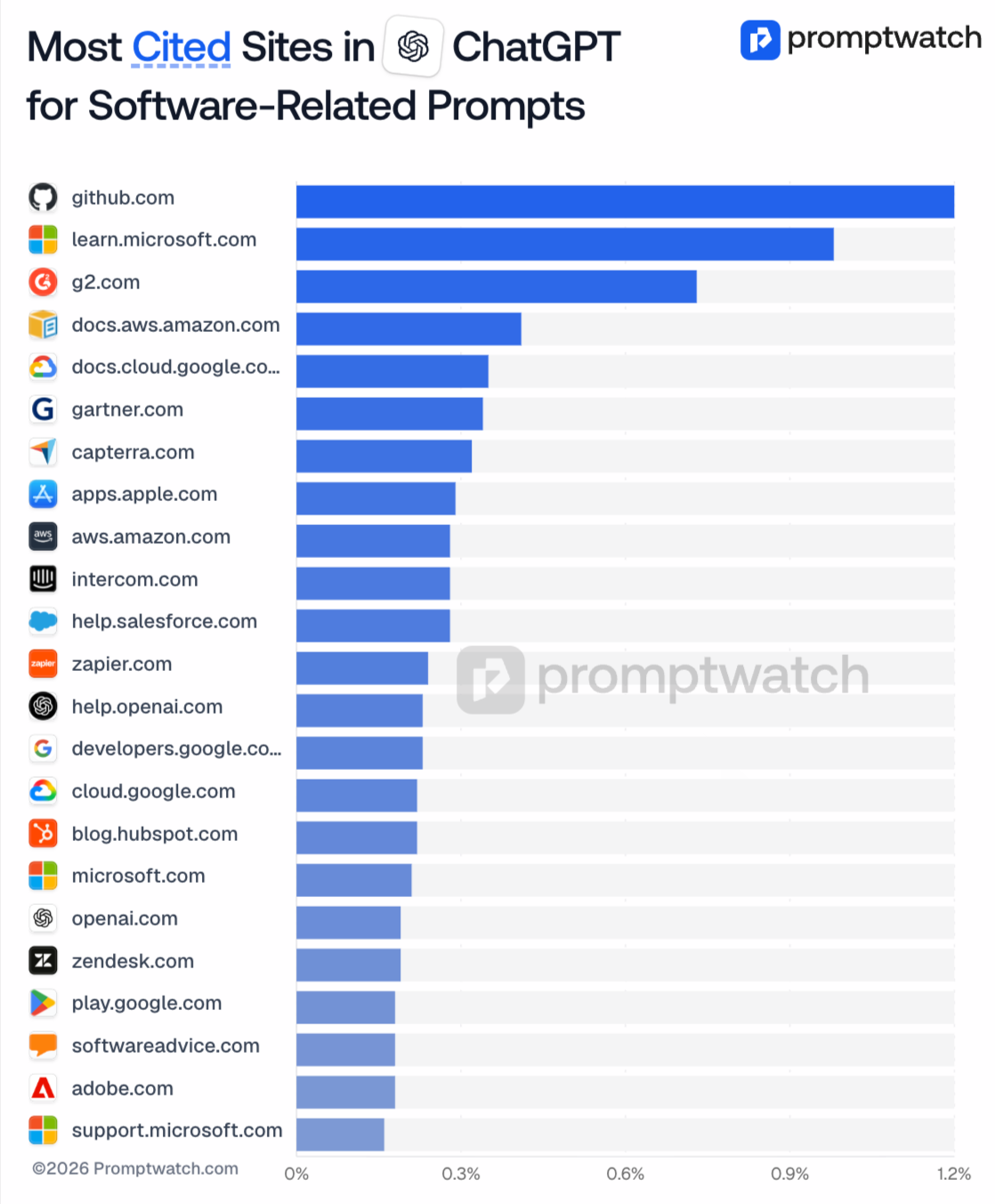
G2 is the most cited review site in ChatGPT answers about software, and review sites as a group earn fewer citations than documentation or vendor sites. That is the core finding of Promptwatch's citation share report for software, which analyzed organic software prompts (comparisons, alternatives, and how-to questions) run through ChatGPT between September 28 and October 4, 2026.
| Domain | Share of ChatGPT software citations |
|---|---|
| GitHub | 1.2% |
| learn.microsoft.com | 0.98% |
| G2 | 0.73% |
| AWS documentation | 0.41% |
| Google Cloud | 0.35% |
| Gartner | 0.34% |
| Capterra | 0.32% |
| Intercom | 0.28% |
| Zapier | 0.24% |
G2, Gartner, Capterra, and Software Advice together earned 1.57% of all software citations. That is more than any single vendor, including Microsoft at 1.35% across three domains. A brand that is absent from those four platforms is missing a source block that outweighs the biggest software company's entire footprint.
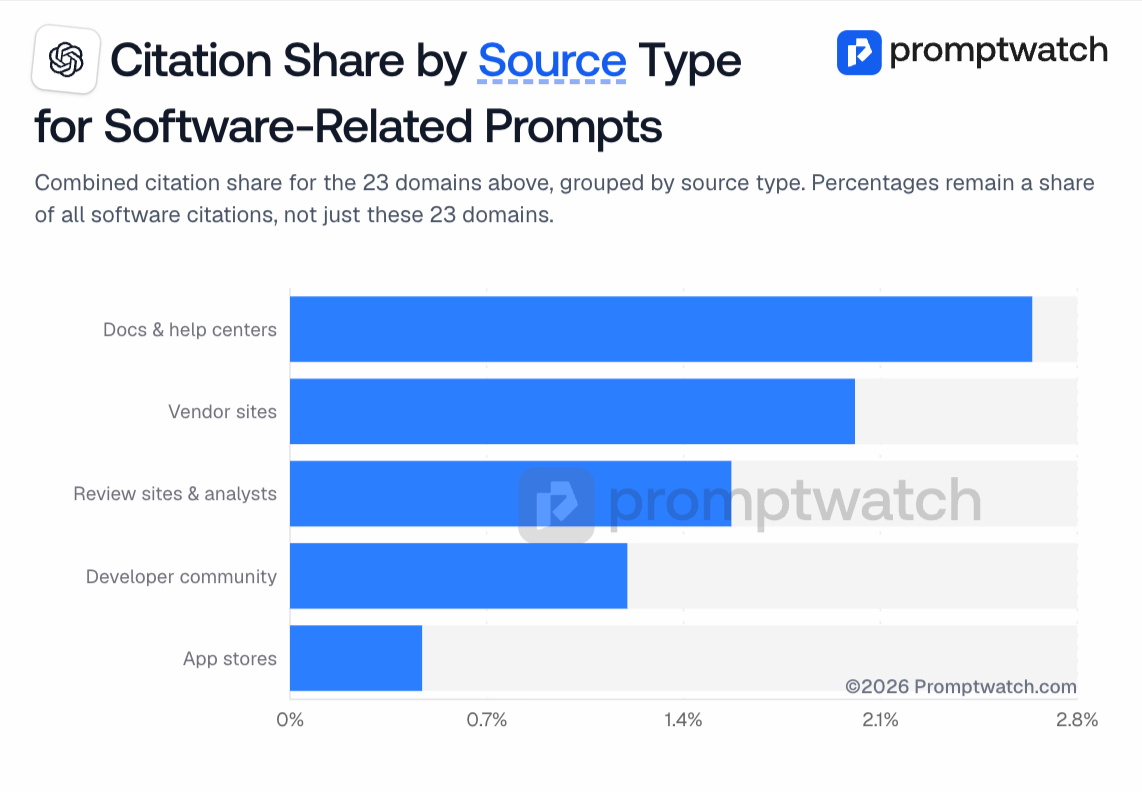
Grouped by source type, the picture changes:
| Source type | Share of ChatGPT software citations |
|---|---|
| Documentation and help centers | 2.64% |
| Vendor sites | 2.01% |
| Review sites and analysts | 1.57% |
| GitHub | 1.2% |
| App stores | 0.47% |
Documentation and vendor sites combined reach 4.65%, about three times the review-site share. Two non-major vendors, Intercom (0.28%) and Zapier (0.24%), made the top domains list through their own content. For most software brands, the pages ChatGPT reads most often are pages the brand controls.
Where review sites matter most for ChatGPT recommendations
Review sites influence three distinct moments in an AI answer, and each one calls for different work.
Inclusion: getting into the candidate pool
On "best X software" and "alternatives to Y" prompts, ChatGPT needs a defensible list of real products in a category. G2 and Capterra category pages provide exactly that: structured, categorized, regularly updated lists of tools. A product filed in the wrong category, or missing from the category entirely, is harder for the model to place.
This is also where review sites face competition from listicles and comparison articles. ChatGPT often pulls its shortlist from editorial "best tools" pages, many of which source their lists from G2 grids. If you want a tactical guide, here's how to get onto the listicles that ChatGPT cites.
Description: the pros and cons ChatGPT repeats
When a user asks "What are the downsides of [tool]?", ChatGPT reads review text and repeats the recurring themes. If dozens of reviewers mention a steep learning curve, that phrase tends to surface in the answer. Review content is effectively a public brief on your product that the model summarizes for buyers.
This makes review quality as important as review count. Reviews that name specific use cases, integrations, team sizes, and outcomes give the model concrete material to match against a buyer's question. Five-word reviews give it nothing to work with.
Evaluation: "[brand] reviews" and head-to-head prompts
Review sites matter most on evaluation prompts. A December 2025 SE Ranking study of 30,000 commercial keywords found that 49% of AI Overviews for explicit review queries cited at least one review platform, compared with 17.1% for "best/top" list queries. Across all queries, 34.5% of AI Overviews cited a review platform.
Promptwatch's fan-out data shows ChatGPT behaving the same way: it searches G2 and Capterra by name when the user's question is about a specific product's reputation. These prompts sit late in the buying journey, which is exactly where a weak or outdated profile costs the most.
Why more reviews don't buy a higher position in ChatGPT
Review volume has a weak relationship with rank because ChatGPT is matching tools to the specific question, and star counts say little about fit. In that March 2026 analysis, OnlyOffice ranked third in one answer with 325 Capterra and 64 G2 reviews, while Slack ranked eighth with tens of thousands. Coda, with 472 G2 reviews, ranked above ClickUp with more than 10,000.
The signals that correlated more strongly in that study were domain authority and a Wikipedia page, both measures of how widely a brand is referenced across the web. That matches what AI models do with sources: they look for agreement across many independent pages.
“It's no longer only about you shouting 'I'm the best' on your own website. It's about the entire internet reaching a consensus that you are the best.”
Position inside an answer is what drives a brand's visibility score in Promptwatch: a sole recommendation scores 100, first in a ranked list 90 to 94, and fourth or later 25 to 49. Being listed on G2 can get a brand into the answer. Moving from fourth to first takes consistent third-party corroboration, strong owned content, and descriptions that match the buyer's exact use case.
How Google AI Overviews, AI Mode, and Gemini treat review sites
Each AI platform leans on review sites differently, so a G2 strategy built for one engine won't look the same on another. Promptwatch tracked the domains each engine cited when answering this article's question between September 22 and October 22, 2026:
- ChatGPT cited learn.g2.com 13 times, more than any other domain, followed by help.openai.com (9). It cited G2's own research and editorial content far more than G2 profile pages.
- Google AI Mode cited g2.com 3 times and capterra.com twice, alongside Reddit (5).
- Google AI Overviews cited g2.com, capterra.com, and gartner.com twice each, with LinkedIn the most cited source (5).
- Gemini cited reddit.com 9 times, with only one G2 link (learn.g2.com).
- Microsoft Copilot cited marketing blogs and AEO agencies, with no review-site citations.
This is one prompt over 30 days, so treat it as directional. The pattern is consistent with the broader data, though. Google's AI surfaces cite review profile pages directly. ChatGPT cites review sites most when it searches for them by name, and otherwise favors docs, vendor sites, and research. Gemini leans heavily on Reddit for opinion questions.
Reddit's role has also been volatile. Promptwatch measured that ChatGPT references to Reddit plummeted over eighty percent in August 2026, the same month review-site sub-queries started appearing in the fan-out data above. Brands that rely on a single community or review source for AI visibility are exposed to shifts like this.
How to use G2 and Capterra to get recommended by ChatGPT
Treat review sites as one part of a source portfolio. These steps cover the review-site work and the owned content that review sites can't replace.
- Claim the right categories on G2 and Capterra. Your product should sit in every category a buyer would ask ChatGPT about, with a description that uses the same words buyers use in prompts.
Promptwatch's prompt tracking shows the real category prompts where competitors appear and you don't, so you know which categories to claim first. - Keep a steady flow of recent, detailed reviews. Ask customers to mention their use case, team size, integrations, and the result they got. A profile with no reviews in the last year reads as stagnant to buyers and to models looking for fresh signals.
Promptwatch's Citations Analysis shows which review pages ChatGPT actually links for each prompt, so you can see whether a refreshed profile starts getting cited. - Fix the complaints that keep recurring. If reviews repeatedly mention the same weakness, ChatGPT will repeat it. Respond publicly, ship the fix, and ask recent customers to review the updated product.
Promptwatch scores sentiment per response, from 1 to 100, so you can watch whether the AI's description of your product improves over the following weeks. - Publish crawlable docs, pricing, and integration pages. Documentation and help centers are the largest citation group in ChatGPT's software answers, at 2.64%. Clear pages for pricing, integrations, and use cases give the model a verified source it can quote directly.
Promptwatch's Content Gap Analysis re-runs ChatGPT's own fan-out queries against your indexed site and flags the sub-questions none of your pages answer. - Earn placement in comparisons and listicles. Editorial "best tools" pages build the shortlists ChatGPT copies from. Pitch reviewers with documented differentiators and keep your listing facts current.
Promptwatch's Off-site Mentions categorizes third-party mentions by type (review, comparison, blog, news, community), so you can see which ones the AI cites. - Make sure AI crawlers can reach your pages. A perfect G2 profile won't help if your own docs return a 403 to OAI-SearchBot. Check your server or CDN logs for blocked AI crawlers.
Promptwatch's AI crawler logs record every hit from GPTBot, OAI-SearchBot, ClaudeBot, and PerplexityBot with the page requested and the status code.
How to measure whether review sites are changing your AI recommendations
Measure review-site impact prompt by prompt, separated by intent, because the effect differs by intent. Review sites should move evaluation prompts ("[brand] reviews," "X vs Y") faster than category prompts ("best CRM for startups"), and a single blended score hides that difference.
Set up the measurement in four steps:
- Split your prompts into three sets: organic category prompts, competitor comparisons, and brand-specific review prompts.
- Track three things per prompt: whether you are mentioned, where you rank in the answer, and which domains are cited.
- Compare direct and indirect citations: citations from your own site (direct) against citations from G2, Capterra, Reddit, and listicles that mention you (indirect).
- Watch your review prompts after a profile refresh: if G2 starts appearing in their sources, the work is landing.
Give changes time. Promptwatch's research shows citation relevance holds for roughly 8 to 14 weeks before a refresh helps, and day-to-day scores fluctuate as models re-crawl. Judge review-site work on the trend across several weeks. For a broader view of how brands earn AI brand citations beyond review sites, the same measurement setup applies.
“Promptwatch stands out for its powerful features, especially its earned media tracking for off-site mentions, the 'Actions' feature, and its well-documented API integrations. It overall helps us take the right actions to improve our visibility in AI Search engines.”
FAQ
Do G2 and Capterra reviews directly affect ChatGPT rankings?
They have a weak effect on position. A March 2026 industry analysis found near-zero correlation between review score and where a tool ranked in ChatGPT, and weak correlation for review count. Reviews mainly help a product get included and shape how ChatGPT describes it.
Which review site does ChatGPT cite most for software?
G2. In Promptwatch's October 2026 software citation report, G2 earned 0.73% of all ChatGPT software citations, followed by Gartner at 0.34% and Capterra at 0.32%. Together with Software Advice, review sites and analysts earned 1.57%.
How many reviews do I need on G2 to get recommended by ChatGPT?
No public study has found a threshold. Tools with a few hundred reviews regularly outrank tools with tens of thousands in ChatGPT answers. A complete profile in the right categories, with recent reviews that describe real use cases, matters more than a target number.
Are review sites more important for Google AI Overviews than for ChatGPT?
Google's AI surfaces cite review profile pages more directly. A December 2025 SE Ranking study found 34.5% of AI Overviews for commercial software queries cited at least one review platform. ChatGPT cites review sites mostly when the prompt is about a specific product's reputation.
What earns more ChatGPT citations than review sites for software brands?
Documentation and help centers. In Promptwatch's October 2026 data, docs and help centers earned 2.64% of ChatGPT software citations and vendor sites 2.01%, together about three times the 1.57% share for review sites and analysts.


