


TL;DR: Best AIclicks Alternatives
Promptwatch is best for teams that need execution backed by crawler-level evidence, every AI model available at $95 with no tier gating, MCP and API on the entry plan, and server-side crawler logs AIclicks doesn't offer. Writesonic bundles GEO into a full content suite. AthenaHQ joins AI visibility to revenue via GA4 and Shopify. Qwairy covers 10+ engines with no per-engine surcharge.
Quick Comparison Table
| Tool | Best For | AI Engines on the Base Plan | Starting Price |
|---|---|---|---|
| AIclicks | Small teams and agencies that also want done-for-you services | 3 of 11 on Starter; 4 on Pro; 6 on Business; all models Enterprise-only | $59/mo |
| Promptwatch | Teams that need execution plus crawler-level proof | All 11 models available on every paid plan; 4 tracked per project at a time | $95/mo |
| Peec AI | Clean, fast monitoring for teams that already have an execution layer | 3 of 6 — Claude and DeepSeek are Enterprise-only | $95/mo |
| Profound | Enterprises that need real AI search demand data | 1 (ChatGPT); 3 on Growth at $399 | $99/mo, billed annually |
| Writesonic | Teams that want GEO bundled with a full content suite | 10+, but only from the GEO tier | $79/mo; GEO from ~$199/mo |
| AthenaHQ | Teams that need AI visibility joined to revenue | 8 on every tier | $295/mo (credit-based) |
| Qwairy | Broad engine coverage without per-engine surcharges | 10+ | ~€59–79/mo (credit-based) |
| Otterly.ai | Solo operators and small teams on a tight budget | 4; Gemini, AI Mode and Claude are add-ons | ~$29/mo |
Why Look for AIclicks Alternatives?
AIclicks is a genuinely good product, built by a Lithuanian team for their own agency clients and then productised. It serves 1,000+ brands and 400+ agencies, holds a 4.9/5 on G2, queries AI platforms through their real user interfaces rather than APIs (the right call, since API responses and what a user sees frequently diverge), refreshes daily on every tier, and its Recommendations tab turns visibility data into ranked, concrete actions, which is more than many trackers manage.
Four reasons teams still look elsewhere come up repeatedly.
- Which models you can reach is capped by tier. AIclicks markets 10+ platforms, and the catalogue is broad: ChatGPT, Gemini, Perplexity, Google AI Overviews, Google AI Mode, Claude, Copilot, Grok, DeepSeek, Meta and Mistral. But Starter at $59 lets you choose 3, Pro at $189 gives you 4, Business at $499 gives you 6, and all models is Enterprise-only. Reaching six engines costs $440/month more than the entry plan, and the prompts you gain along the way (30 to 300) are bundled into the same jump, so you can't buy coverage without buying volume.
- The integration wall sits at $189. On Starter, the only integration is CMS. GA4 traffic attribution, one of the headline differentiators, plus API and MCP access all begin on Pro. If you planned to pipe AI visibility data into your own reporting, the $59 plan can't do it, and the real entry price for a connected setup is $189.
- There's no server-side crawler log analysis. GA4 attribution tells you a human landed on your site after using ChatGPT. It cannot tell you whether GPTBot, ClaudeBot or PerplexityBot ever fetched the page. That's the difference between measuring the outcome and diagnosing the cause, and when a page isn't being cited, the crawl question is usually the first one worth asking.
- Short runway, and the vendor is also an agency. The tracker offers a 3-day trial and no free tier, a tight window to see a visibility score move at all. And the managed-services layer starts around $1,699/month. For teams who want done-for-you execution, that's a feature; for teams who want a neutral measurement tool, a vendor that also sells the remediation is an awkward fit.
One smaller gotcha worth checking before you buy: Starter is limited to a single country, and the plan card lists one website while the comparison table on the same page says three. Confirm which applies to your account.
How We Evaluated These Alternatives
We didn't assemble this list by skimming landing pages. Every tool was assessed against one question: does it help a team change how AI models talk about their brand, or only observe it?
Four criteria:
- AI engine access on the plan you'd actually buy. Not the marketing page's catalogue, but which models you can reach without an upgrade, and whether coverage is gated by tier at all. This remains the single biggest gotcha in the category.
- Real monthly cost, including the integration wall. Per-engine add-ons, per-domain multipliers, credit burn, annual-billing requirements, and which tier unlocks API access. Per-domain pricing is the most commonly missed cost for agencies; credit models are the most commonly missed cost for everyone else.
- Execution, not just recommendation. A prioritised task list is useful. Content that reaches your CMS under an approval gate is a different level of useful. We scored where each tool stops.
- Evidence underneath the recommendation. Real-UI scraping shows you what users see. Crawler logs, prompt volume data and content gap scoring show you why a page is or isn't cited. Tools that only surface the answer text are working from half the picture.
Pricing and feature coverage verified August 2026 against each vendor's public pricing page, supplemented by third-party review analysis. We evaluated AI search visibility specifically, not traditional SEO capability. Pricing in this category changes frequently; confirm before you buy.
The 7 Best AIclicks Alternatives
Ranked by overall fit for teams that want to improve AI visibility rather than only measure it. Each solves a different problem, so the right answer depends on which part of the job you can't currently staff.
1. Promptwatch: Best Overall AIclicks Alternative
The clearest way to compare these two is tier by tier, because they're close enough in shape that the differences are specific rather than philosophical.
At $59, AIclicks gives you 30 prompts, a choice of three engines, 4,650 monthly responses, and CMS as your only integration. At $95, Promptwatch gives you 50 prompts, 6,000 responses, MCP and API access on day one, Agent Chat, plus access to every model in the catalogue, including Claude, Grok, DeepSeek and Meta, with four tracked per project at a time. Where AIclicks gates which engines you can reach behind higher tiers, Promptwatch includes them all on the entry plan and caps only how many run concurrently. At $189, AIclicks reaches API, MCP and GA4 with 150 prompts. At $245, Promptwatch matches the 150 prompts and adds the layer AIclicks doesn't have at any price: server-side crawler logs, 25 million entries, plus a branded knowledge base and content gap analysis.
Key features
- All 11 AI surfaces on every paid plan (ChatGPT, Claude, Gemini, Google AI Overviews, Google AI Mode, Perplexity, Grok, DeepSeek, Meta Llama, OpenCode and Claude Code), with four tracked per project at a time, freely chosen and changeable, and prompt tracking refreshed daily. No model is reserved for a higher tier.
- Real-UI scraping, so visibility reflects what users see rather than an API approximation
- Prompt suggestions from Google Search Console, a seed query or a specific page, plus prompt volumes, prompt difficulty and query fan-out analysis
- AI crawler log analysis through direct CDN integrations (Akamai, AWS CloudFront, Cloudflare, Fastly, Google Cloud CDN, Netlify and Vercel). This is how you see the elapsed time between a bot fetching a page and an engine quoting it
- Visitor analytics and conversion tracking for AI-referred human traffic, kept separate from crawler activity, so you see both what AI can read and what actually converts
- Content gap analysis that scores how well your existing pages answer the prompts your buyers are asking, plus offsite mention tracking across Reddit, YouTube and third-party sources that shape AI recommendations
- Content Agents that write against measured gaps and publish directly to Webflow or Framer (any other CMS is a manual export), moving through review and approval states you control, with budget caps
- Actions and Agent Chat. Actions turns visibility data into a prioritised list of next steps, each assignable to a team member as owner; Agent Chat lets you ask about performance and act on the answer without leaving the conversation
- MCP server and API access on every plan, including Essential
- State and city-level prompt targeting on every plan, including Essential, plus Shopping Insights from Professional and Ads Radar on Business
More than 1,780 brands and agencies run on Promptwatch, including Center Parcs, SIX Group and Landytech, and it holds a 4.7/5 rating on G2.
Pros
- Every model available at $95 (Claude, Grok, DeepSeek and Meta included) where AIclicks makes you climb to $499 for six engines and reserves the full set for Enterprise
- MCP and API on the entry plan, where AIclicks reserves both for the $189 tier
- State and city-level targeting on every plan, where AIclicks Starter is limited to a single country
- Crawler logs answer the question GA4 attribution can't: whether AI bots reached the page at all
- Prompt volumes, difficulty scoring and GSC-derived suggestions, so your prompt set isn't limited to what you already thought to track
- Content ships under an approval gate with budget caps, which matters when software has write access to your live site
- White-label and multi-client workflows are first-class for agencies, and 7 days of trial rather than 3
Cons
- AIclicks is cheaper at every comparable tier ($59 vs $95, $189 vs $245, $499 vs $579) and ships more AI-generated articles per month at each one
- Only four models run per project at a time; a team that wants to watch six engines simultaneously in one project would need AIclicks Business, which allows that for $80 less
- Microsoft Copilot and Mistral aren't in the Promptwatch catalogue, and both are in AIclicks'
- Crawler logs start at $245, so the entry plan doesn't include the feature that most differentiates the product
- Seats are metered (1, 2 and 5 by tier), where AIclicks includes unlimited users
Verdict
- Best for: Teams who hit AIclicks' tiered engine gating or its $189 integration wall, and anyone who needs to know whether AI bots are actually fetching their pages.
- Why it wins: Comparable prompt volumes at each tier, but with every model included from the first plan, MCP and API from the first plan, and the crawler-log layer underneath the citation data, the diagnostic AIclicks doesn't sell at any price.
2. Peec AI
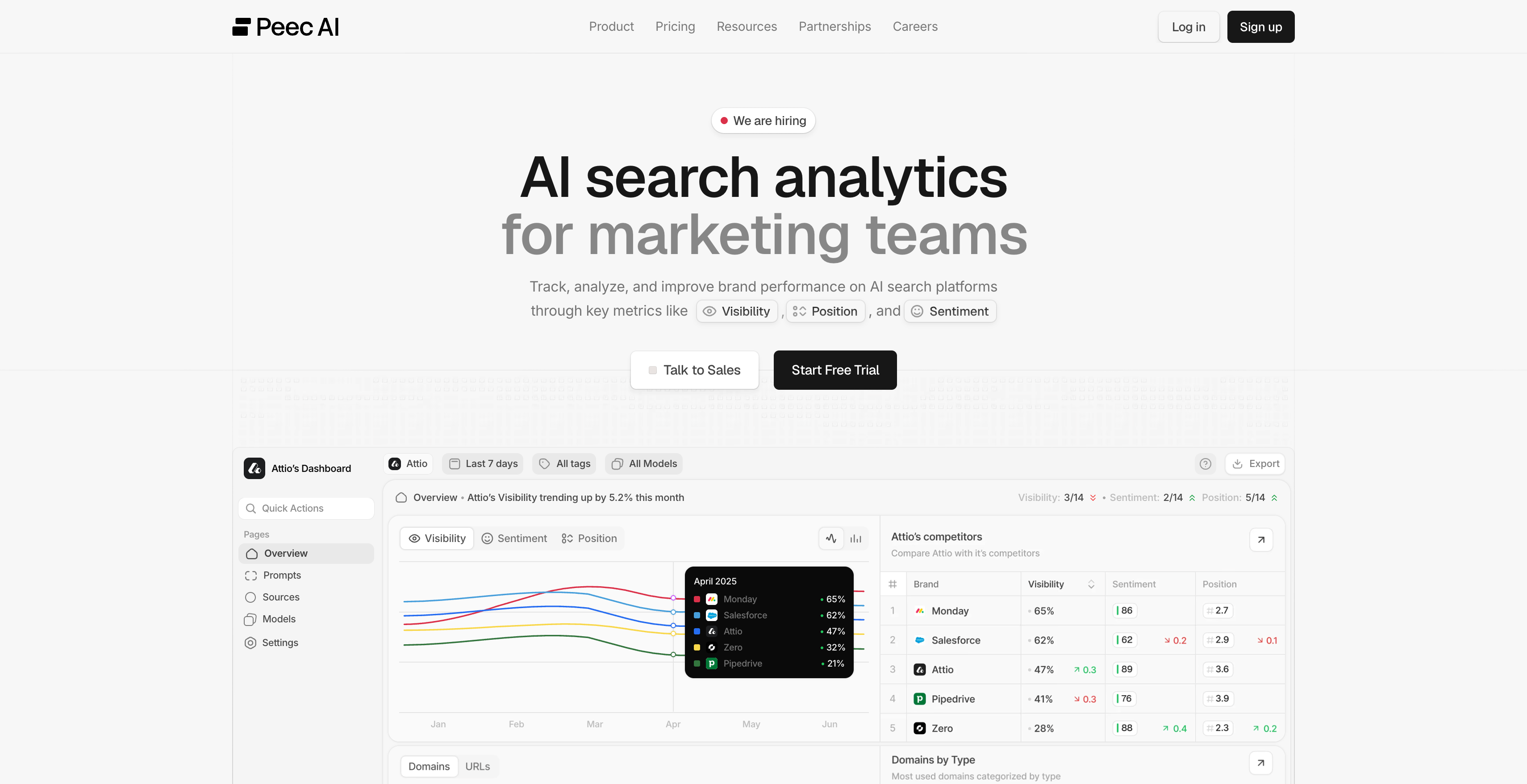
Peec is the Berlin-based counterpoint: less execution, more polish. It raised $29M, crossed $10M ARR roughly 16 months after launch, and serves 2,000+ teams including Hugo Boss, n8n, TUI and ElevenLabs, with a 4.9/5 on G2. Setup takes minutes and every plan includes unlimited seats, the single thing it does better than almost everyone here.
Key features
- Three engines from six on every self-serve tier, with a clean, fast dashboard
- Unlimited users on all plans, including the $95 Starter
- Actions module that turns source data into a prioritised task list
- Multi-country tracking from the $245 Pro plan
Pros
- Unlimited seats is genuinely rare, and for a large in-house team it can outweigh everything else
- Among the fastest onboarding in the category
- Consistently high reviewer satisfaction on interface and reliability
Cons
- Every self-serve tier caps you at three engines; extra models cost $35 to $165/month depending on plan
- Claude, DeepSeek, Qwen and Mistral are Enterprise-only, and Grok isn't offered at all
- No content generation, no CMS publishing, no crawler logs, and API is Enterprise-only
Verdict: If you're leaving AIclicks because you want a cleaner monitoring layer and have a big team, Peec is the swap. If you're leaving because you want more engines, note that Peec's cap is tighter than the one you're escaping.
See our full comparison of how Promptwatch compares to Peec AI.
3. Profound
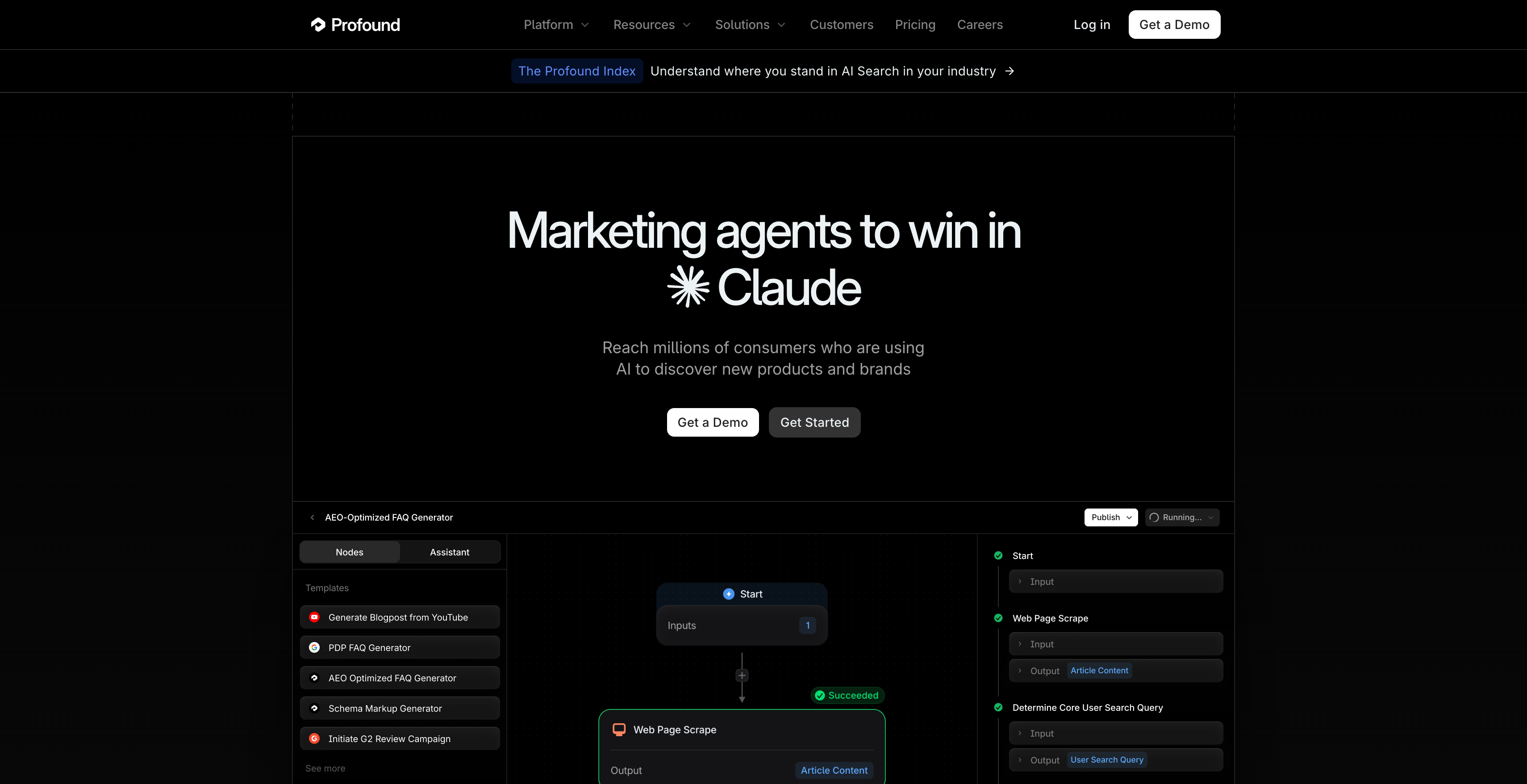
Profound is the most funded and most enterprise-validated platform in the category, with roughly $155M raised at a $1B valuation and customers including Ramp, MongoDB, Figma and Walmart. Its Prompt Volumes panel data, showing what people actually ask AI, with demographic cuts, is the thing genuinely no one else has.
Key features
- Prompt Volumes panel data drawn from opted-in consumers
- Agents for content generation, plus MCP and Shopping insights
- Agent analytics covering how AI systems crawl and interpret your site
- SOC 2 and enterprise governance
Pros
- The prompt demand dataset is a real competitive moat, not a feature claim
- Deepest analytics in the category at the top tier
- Enterprise security posture that most startups in this space can't match
Cons
- Starter at $99/month covers ChatGPT only; the functional entry point is Growth at $399 for three engines, and full ten-engine coverage is Enterprise-led
- Both public plans require annual billing
- Reviewers report a steep learning curve and no white-label reporting
Verdict: If your problem is that AIclicks' data isn't deep enough and budget isn't the constraint, Profound is the upgrade. The Promptwatch vs Profound breakdown covers where the two diverge. If your problem was the tiered engine gating, note that Profound's Growth plan tops out at three.
4. Writesonic
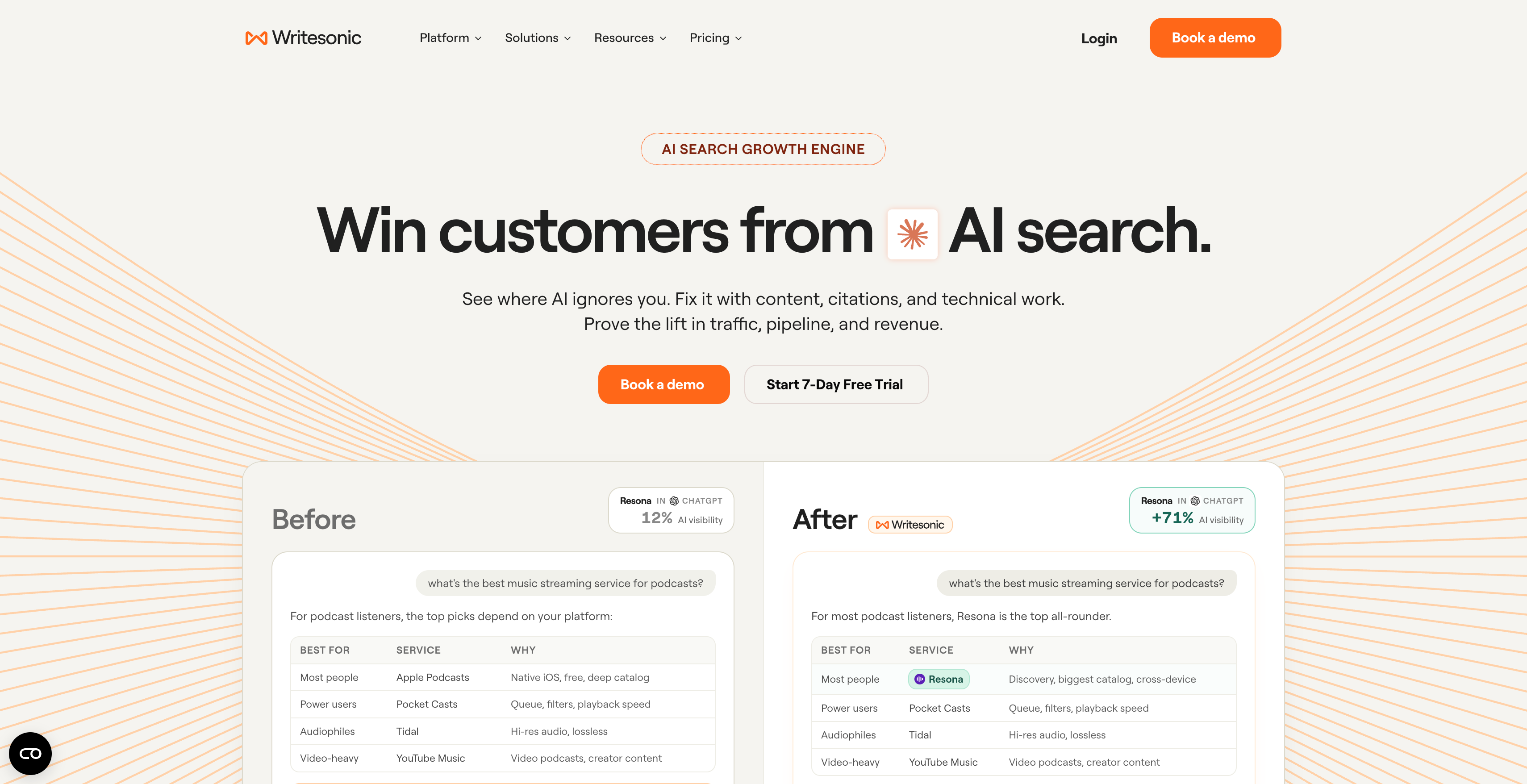
Writesonic started as an AI writing tool in 2020 and pivoted hard into AI search visibility. It's the closest structural match to AIclicks on this list (both sell tracking and content production in one subscription), but Writesonic's content side is considerably deeper, drawing on a claimed 120M+ AI conversation dataset to surface real user prompts.
Key features
- 10+ platforms tracked including Claude, Copilot, AI Mode, Meta AI and DeepSeek
- AI Visibility Action Center prioritising fixes by impact
- Article writer, site audits and agentic page rewrites in the same dashboard
- Cloudflare-based AI bot tracking, catching 404s and 500s from GPTBot, ClaudeBot and PerplexityBot
Pros
- The all-in-one workflow is real: find a gap and fill it without switching tools
- Broad platform coverage once you're on the GEO tier
- Bot-level crawl auditing, which most content suites skip entirely
Cons
- GEO features don't exist on the entry plan. The practical starting point is roughly $199/month annually, closer to $249 monthly, so the $79 headline is a content plan, not a visibility one
- Add-ons stack: extra seats around $50/user/month, extra articles around $100 per 20
- No white-label reporting on the standard tiers, which rules it out for most agency setups; reviewers also report tracking depth is shallower than dedicated visibility tools
Verdict: If you liked AIclicks' bundle but want a stronger content engine and a bigger prompt dataset, Writesonic is the trade. Price the GEO tier, not the homepage number.
5. AthenaHQ
AthenaHQ solves the attribution problem more thoroughly than GA4 alone. All eight engines, including Claude and Grok, are on every plan with no add-ons, and revenue attribution runs through GA4 and Shopify, which means AI visibility sits next to conversion data instead of in a separate dashboard nobody opens. It holds a 4.9/5 on G2.
Key features
- Eight AI engines on every tier with no per-model surcharge
- Action Center that turns findings into assignable, trackable tasks
- Ask Athena copilot and GA4 / Shopify revenue attribution
- Credit-based metering: 1 credit = 1 AI response
Pros
- Full engine coverage at the entry tier, without the tier climb AIclicks requires
- The attribution join makes the CFO conversation much easier
- Unlimited seats and a genuinely action-oriented workflow
Cons
- $295/month entry, five times AIclicks Starter, and the credit model makes real spend hard to predict
- Self-Serve is single-country, so multi-market teams land on Enterprise immediately
- No MCP server, and API, BI integrations and the ACE Citation Engine are Enterprise-only
Verdict: If the engine gating and thin attribution are both blockers, AthenaHQ fixes both, at a much higher entry price and with credit math to manage.
6. Qwairy
Qwairy attacks the metering problem head-on: 10+ engines including ChatGPT, Claude, Perplexity, Gemini, Copilot, Grok, AI Overviews, AI Mode, Mistral and DeepSeek, with no per-provider surcharge and no feature gates reserved for enterprise plans. It's used by 2,000+ brands.
Key features
- 10+ AI models tracked, monitoring both API and UI responses where relevant
- Five-module workflow: Visibility → Insights → Strategy → Technical → Analytics
- Action Center with impact scores and effort estimates
- Content Studio briefs in 45+ languages, plus log analysis and agency audits
Pros
- Broad included engine list at this price point, with no tier climb to reach models
- Action Center prioritisation is usable, not a list of generic tips
- Strong multilingual coverage for European and international brands
Cons
- Credit-based pricing makes monthly cost hard to forecast, and reviewers report credits draining fast once you add engines
- No prompt volumes or prompt difficulty data
- Content Studio produces briefs, not published pages
Verdict: If your only complaint about AIclicks is that you're paying $499 to reach six engines, Qwairy is a direct swap, provided you can live with credit math instead of a flat fee.
7. Otterly.ai
At roughly $29/month, Otterly undercuts even AIclicks' $59 Starter. It carries Gartner Cool Vendor recognition for AI in Marketing (2025), monitoring across 50+ countries and unlimited team members on every tier, including the cheapest one.
Key features
- Four core engines on Lite: ChatGPT, Google AI Overviews, Perplexity and Copilot
- GEO audit covering on-page factors, plus AI prompt research
- 50+ country monitoring and unlimited seats on every plan
- API, MCP server and Looker Studio connector from Standard ($189)
Pros
- Lowest real paid entry point in the category, and it's a working plan rather than a teaser
- Unlimited seats at $29 is unusual, and 50+ countries beats AIclicks Starter's single-country limit
- MCP and API arrive at $189, the same price point where AIclicks reaches them
Cons
- Lite caps you at 15 prompts, half of AIclicks Starter, and unused prompts don't roll over
- Gemini, Google AI Mode and Claude are paid add-ons ranging from roughly $9 to $149/month
- Monitoring only: no content generation, no CMS publishing, no crawler logs
Verdict: If budget is the binding constraint and you need a baseline rather than a program, Otterly is the honest recommendation. Price the engine add-ons before you compare it to anything.
How to Switch From AIclicks to Promptwatch Without Losing Your Baseline
Export your prompt list and competitor set before you cancel. What moves is the prompt list, not the history. There's no connector between platforms. Export your prompts from AIclicks as a spreadsheet and keep a column headed prompt; topic, type and intent columns are optional but worth carrying over if you have them. In Promptwatch, paste the list or upload the file when adding prompts, up to 1,000 at a time. Document your competitor set at the same time, since that gets rebuilt manually too.
One AIclicks-specific note: if you've been splitting a single prompt allowance across several projects, map that split before you migrate. Promptwatch meters projects separately (1 on Essential, 2 on Professional, 5 on Business), so a setup running three client brands off one Pro allowance needs the Business plan to reproduce cleanly.
FAQ
Why do people look for AIclicks alternatives?
Four reasons come up repeatedly: which models you can reach is capped by tier despite a 10+ platform catalogue, and reaching six costs $499; API, MCP and GA4 attribution are all locked behind the $189 Pro tier, so the $59 plan can't export data; there's no server-side crawler log analysis, only GA4 traffic attribution after the fact; and the 3-day trial gives you very little time to evaluate before billing starts.
Is Promptwatch a good AIclicks alternative?
Yes, particularly if you hit either the engine gating or the integration wall. Promptwatch Essential is $95 for 50 prompts with every model in the catalogue available (Claude, Grok, DeepSeek and Meta included, four tracked per project at a time), and MCP plus API access included, where AIclicks reserves both for $189. From $245 it adds server-side crawler logs, content gap analysis and content agents that publish to Webflow or Framer. The honest trade-off is price: AIclicks is cheaper at every tier and ships more AI-generated articles per month.
How much do AIclicks alternatives cost?
Roughly $29/month at the bottom (Otterly Lite) to $1,000/month or more at the top once you add engines, domains or credits. Most self-serve tools land between $95 and $295/month for meaningful multi-engine coverage. Budget $100 to $250/month for a real program, and check whether pricing is per domain, per prompt, per engine or per credit before comparing headline numbers.


