


TL;DR
- Most brands should start with ChatGPT, Google AI Overviews and Google AI Mode, because they reach the largest audiences, then fill the remaining slots based on where their buyers actually ask questions.
- Google's AI surfaces and the Gemini app are separate products with different citation behavior, so track them separately.
- Your business model changes the list: e-commerce brands need ChatGPT's shopping results, developer tools need coding agents like Claude Code, and local businesses need Google's AI surfaces measured city by city.
- Validate your choice with your own data: AI crawler activity and AI-referred visits show which assistants actually read and send traffic to your site.
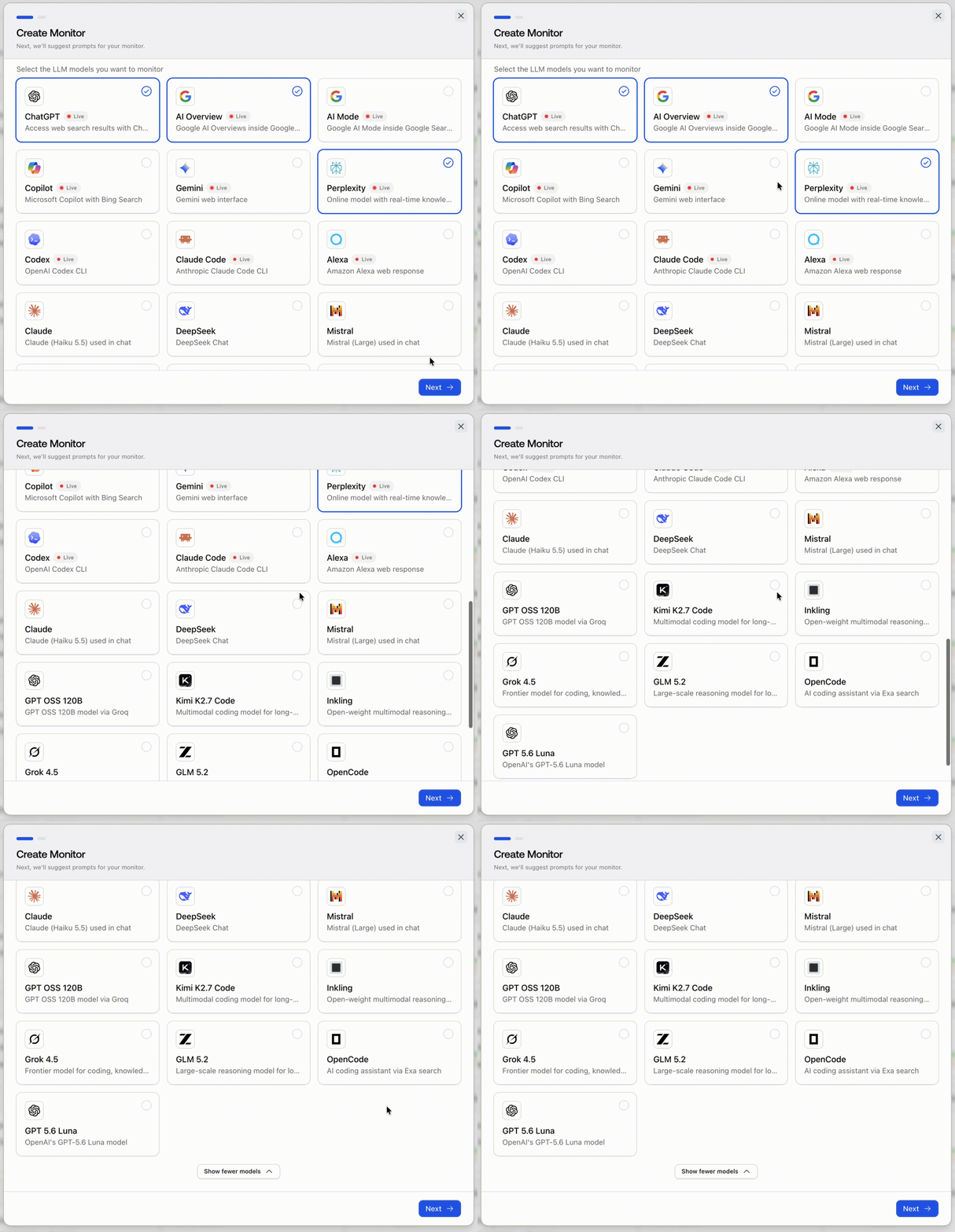
- Promptwatch tracks 12 AI platforms from their real user interfaces, and every Brands plan lets you pick 4 per project from the full list, so you can start focused and swap engines as your data changes.
The AI assistants worth tracking are the ones your buyers use to make decisions in your category. For most brands in 2026 that means ChatGPT and Google's AI surfaces first, with Perplexity, Claude, Gemini, Grok or a coding agent added based on audience, market and business model. Tracking every engine equally spreads your attention thin; tracking only ChatGPT misses the answers your buyers see in Google Search.
This guide gives you a five-question framework for picking assistants, a profile of each major engine, and recommended starting sets for SaaS, e-commerce, local, developer-tool and multi-market brands. If you're still deciding what to measure inside those engines, start with how to track brand mentions in AI.
Why it matters which AI assistants you track
Each AI assistant builds its answers from a different index and different sources, so the same question can recommend different brands depending on where it's asked. A brand that leads in ChatGPT can be missing from Perplexity, and a brand cited in Google AI Overviews can get few visible links in the Gemini app.
"The amazing thing about AI is that it amplifies the mistakes. In the past, your UK website may not have been as good as your Dutch website, and you could get away with it. But because AI pulls from so many sources, and you have little control over where it pulls from, it became a serious issue." Iain Davenport, Director of Business Solutions at Monks
The practical consequence: one blended "AI visibility" number hides the engine where you're losing. Picking the right assistants, and reporting on each one separately, is what makes the data actionable.
How big is each AI assistant in 2026?
Audience size is the first filter, and the gap between the top engines and the rest is wide.
| Assistant | Reported reach | Source |
|---|---|---|
| Google AI Overviews | 2.5 billion monthly users | Google I/O, May 19, 2026 |
| Gemini app | More than 1 billion monthly users | Google, August 11, 2026 |
| Google AI Mode | More than 1 billion monthly users | Google I/O, May 19, 2026 |
| ChatGPT | More than 900 million weekly active users | OpenAI, February 27, 2026 |
Web traffic tells a similar story for standalone assistants. Similarweb data for May 2026, reported by Momentic in August 2026, put ChatGPT at 53.9% of worldwide web visits among the seven largest assistants, followed by Gemini (27.9%), Claude (9.2%), DeepSeek (4.1%), Grok (2.4%), Perplexity (1.3%) and Microsoft Copilot (1.3%). In the US, Claude's share was higher at 13.4%, and its visits grew 855% year over year.
Two caveats keep these numbers honest. Google's figures cover features built into Search, so a "user" includes anyone who saw an AI Overview, and web-visit shares leave out native apps and assistants embedded in other products (Copilot inside Microsoft 365, Meta AI inside Meta's apps). Use reach to set the baseline, then let the next four questions decide the rest.
A five-question framework for choosing AI assistants to track
Run your category through these five questions. Each one either confirms an engine or adds one.
1. Where do your buyers ask questions?
Start with the audience, then check it against data. A B2B software buyer researching tools behaves differently from a shopper comparing running shoes or a developer choosing an SDK. Claude's 13.4% share of US web visits, against 9.2% worldwide, shows how much the mix shifts from one market to the next.
Ask your sales team which assistants prospects mention, and check which AI sources already send visits in your analytics. Promptwatch's Visitor Analytics separates AI-referred human visits by source, so you can see which engines send real buyers.
2. Does the assistant cite sources, and how many?
Citation behavior decides what you can measure and what you can influence. Perplexity and ChatGPT Search cite many sources per answer, and Google AI Overviews and AI Mode are citation-heavy by design, so all four reward content and off-site work you can trace to specific pages.
The standalone Gemini app is different: it synthesizes answers with few or no visible source links. That is Gemini's own behavior, so for Gemini, lead with brand mentions and visibility score over citation counts. If you're unsure what that score measures, see what is AI visibility score.
3. Which markets and languages do you sell in?
AI answers change by country, language and city. "Best streaming service" returns different brands in the US and Germany, and "best dentist near me" changes from one city to the next. An assistant's market share also varies by country, so a list built on US numbers can be wrong for your European or APAC markets.
Pick assistants per market, then track each market in its own language. Promptwatch's guide on how to monitor brand visibility in regional AI search engines across different countries covers the setup.
4. What does your business model need?
Some business models depend on a specific AI surface:
- E-commerce: ChatGPT shows product recommendations and shopping cards, which need product-level tracking on top of brand-level visibility.
- Developer tools, APIs and SDKs: coding agents like Claude Code and OpenCode choose libraries and services while they write code, often without a human asking for a recommendation.
- Local and multi-location businesses: Google AI Overviews and AI Mode answer "near me" questions, and the answer changes by city.
- Regulated industries: brands in healthcare, finance and legal need the engines where a wrong answer creates real risk, usually ChatGPT and Google's AI surfaces first.
5. Where are your competitors already winning?
Run your core prompts across every engine you're considering once, then compare. An engine where competitors appear and you don't is a priority, because that's the gap costing you recommendations. An engine where no brand in your category appears can wait.
Which AI assistants should you track? Engine by engine
Here's what each major assistant means for brand visibility tracking, in rough order of priority for most brands.
ChatGPT
ChatGPT is the default first engine for almost every brand: it has the largest standalone audience and cites multiple sources per answer when it searches the web. It also runs shopping results with product cards and has started showing ads, so e-commerce and paid teams have extra surfaces to watch. For product-level tracking, see ChatGPT monitoring for product pages.
Google AI Overviews
AI Overviews appear above regular Google results for a large share of searches, which makes them the widest-reaching AI surface. They cite sources heavily, so they're one of the best engines for linking content work to results. If organic search already drives your pipeline, this is a must-track. Promptwatch's guide on how to track AI Overviews citations covers the page-level view.
Google AI Mode
AI Mode is Google's conversational search experience, with longer answers and follow-up questions. It draws on Google's index like AI Overviews, but answers differ, so track the two separately. Brands with local intent or complex purchase decisions should treat AI Mode as a core engine.
Gemini
The Gemini app is a separate product from Google's Search features, with its own large audience. Because it shows few citations, measure it on mentions, placement and sentiment. Track it when your audience uses Google Workspace or Android heavily, or when Gemini comes up in sales conversations.
Perplexity
Perplexity has a small share of total traffic but cites many sources per answer and attracts research-heavy users. It's worth tracking for B2B, finance and technical categories where buyers dig into sources before deciding.
Claude
Claude's audience is smaller than ChatGPT's and Gemini's but growing fast, and its share is notably higher in the US than worldwide. Track it for B2B software, professional services and any category where your buyers do research inside their work tools.
Claude Code and OpenCode (coding agents)
Coding agents recommend and install tools as part of writing code. For developer tools, APIs, SDKs and infrastructure products, they're often more important than general chat assistants. See how to track your brand's visibility in Claude Code for what that measurement looks like.
Grok, DeepSeek and Meta Llama
These engines matter in specific situations. Grok is tied to X, so it's relevant where your audience is active on that platform. DeepSeek has a large audience outside the US. Meta's models power Meta AI inside Facebook, Instagram and WhatsApp. Add them when your audience data points there.
Microsoft Copilot
Copilot's standalone web share is small, but it's built into Windows, Edge and Microsoft 365, where web traffic data can't see it. It draws on Bing's index, so strong Bing visibility helps. Track it when your buyers work inside Microsoft 365, as many enterprise B2B audiences do.
Recommended starting sets by business type
Most teams can start with four engines. That matches how Promptwatch's Brands plans work: each project tracks 4 of the 12 supported platforms, chosen by you and changeable later.
| Business type | Start with these 4 | Add next |
|---|---|---|
| B2B SaaS | ChatGPT, Google AI Overviews, Perplexity, Claude | Google AI Mode, Gemini, Microsoft Copilot |
| E-commerce and retail | ChatGPT, Google AI Overviews, Google AI Mode, Gemini | Perplexity |
| Local and multi-location | Google AI Overviews, Google AI Mode, ChatGPT, Gemini | Perplexity |
| Developer tools, APIs, SDKs | Claude Code, ChatGPT, Claude, OpenCode | Perplexity, Google AI Overviews |
| Finance, healthcare, legal | ChatGPT, Google AI Overviews, Google AI Mode, Perplexity | Gemini, Claude |
| Multi-market brands | ChatGPT and Google AI Overviews in every market, plus the two strongest local engines per market | DeepSeek or Grok where local data supports it |
Treat this table as a starting hypothesis. The next section shows how to check it against your own data within the first month.
"There's only one way to eat an elephant: one bite at a time. We had to do small sprints and align on one thing we wanted to test before building a whole strategy." Emma Gammons, Director of Global External Comms at Shutterstock
How to check you're tracking the right AI assistants
Your first engine list is a guess. Three data sources tell you whether it was a good one.
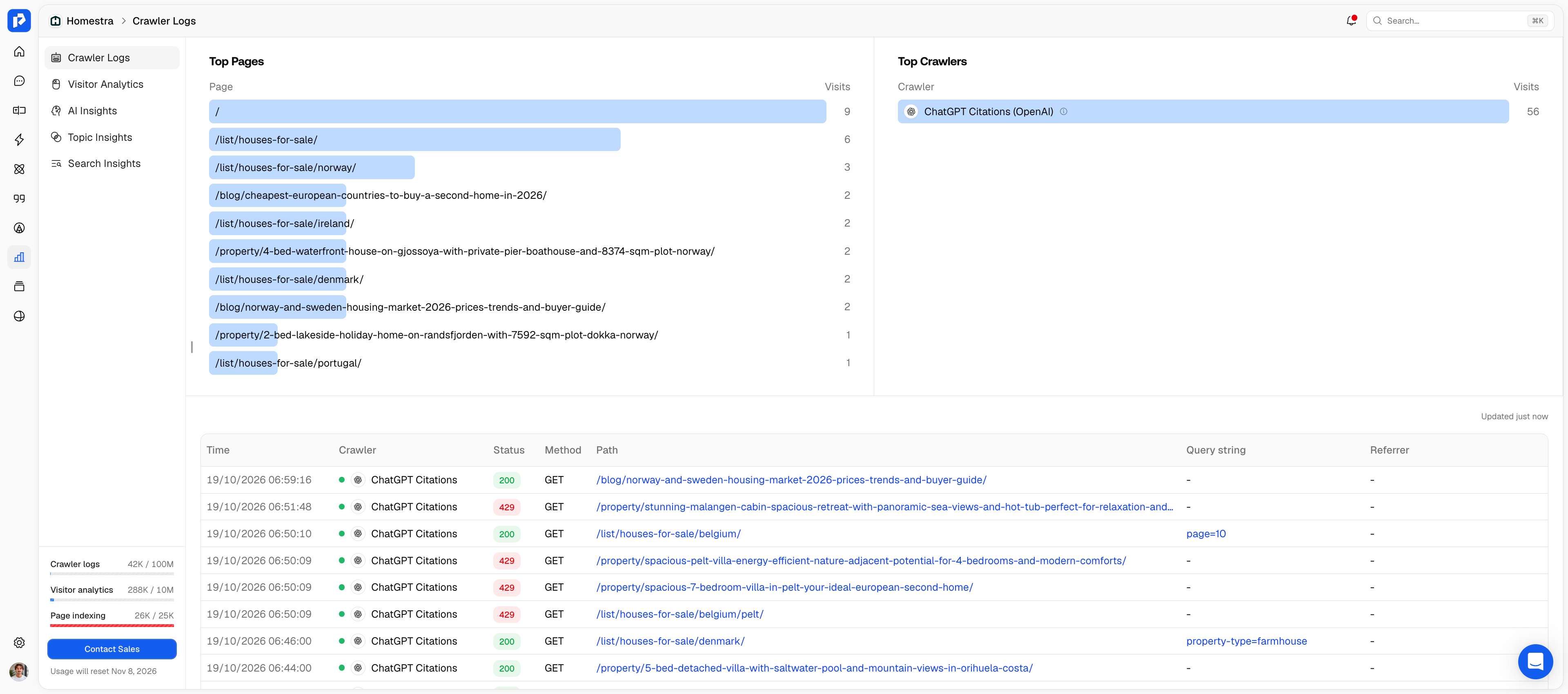
- AI crawler activity. If an assistant's bots never fetch your pages, that engine has little of your content to work with. AI crawler logs show which AI bots request which pages and whether they get a 200 or a 403. The mix of assistants crawling the web is shifting: across Promptwatch's connected logs, OpenAI's share of IP-verified AI crawler requests fell from 94.8% in the week of June 8 to 14 to 79.8% in the week of August 31 to September 6, 2026 (AI crawler traffic report).
- AI-referred visits. Visitor Analytics shows which assistants send people to your site and whether they convert. An engine that sends converting visits earns a permanent slot.
- Competitor gaps per engine. After four weeks of daily data, compare your visibility score per engine against competitors. Keep the engines where the gap is closable, and swap out the ones where nobody in your category appears.
Re-run the check every quarter. Assistant usage shifts quickly: Claude's worldwide web visits grew 855% in a year.
How Promptwatch handles assistant selection
Promptwatch tracks 12 AI platforms: ChatGPT, Perplexity, Google AI Overviews, Google AI Mode, Claude, Gemini, Microsoft Copilot, Meta Llama, DeepSeek, Grok, OpenCode and Claude Code. Answers are collected from each engine's real user interface, so results reflect what a user in your chosen country, language and city actually sees, including citation order and localization (the AI search monitoring API comparison explains why that matters).
On Brands plans, every plan from Essential up gives access to all 12 platforms, and each project tracks 4 at a time. Agency plans track all 12 at once. Every engine's results come from the same tracked prompts, so you can compare visibility, citations and sentiment engine by engine and see where to focus. If you haven't built that prompt list yet, start with how to choose prompts to track.
FAQ
Which AI assistant should I track first?
ChatGPT, for almost every brand. It has the largest standalone audience, cites sources when it searches the web, and covers shopping results for e-commerce. Google AI Overviews is a close second for any brand that relies on organic search.
Should I track Google AI Overviews and Gemini separately?
Yes. AI Overviews and AI Mode appear inside Google Search and cite sources heavily, while the Gemini app is a separate product that shows few citations. Tracking them as one engine mixes two different audiences and two different answer styles.
How many AI assistants should I track?
Four is a practical starting point for most brands: enough to cover the main engines without spreading attention thin. Agencies and multi-market brands often track more, and Promptwatch's Agency plans track all 12 supported platforms at once.
Is Perplexity worth tracking with a small market share?
For research-heavy categories, yes. Perplexity cites many sources per answer and attracts users who compare options carefully, which makes it useful for B2B, finance and technical products even though its share of total traffic is small.
Do I need to track coding agents like Claude Code?
Only if you sell to developers. For APIs, SDKs, developer tools and infrastructure, coding agents choose and install products while writing code, which can matter more than chat assistant visibility.
How often should I review which assistants I track?
Every quarter. Assistant usage changes fast, so check crawler activity, AI-referred visits and competitor gaps per engine, then swap out engines that aren't earning their slot.


