

TL;DR
- To track AI visibility for ecommerce, you need three layers of data on the same prompts: brand mentions and citations in written answers, product cards in AI shopping results, and AI crawler activity on your product pages.
- Product-level tracking only works when the product ID in your catalog matches the ID the AI platform uses, such as a Shopify product ID or Amazon ASIN.
- Promptwatch covers all three layers in one place: it stores every product card from tracked ChatGPT and Amazon Alexa responses with price, merchant, rating, review count and carousel position, and matches cards to your catalog by exact product ID. Shopping Insights is included from the Business plan ($579/month).
The best tool to track AI visibility for ecommerce shows three things on the same set of prompts, such as "best shoes to run a marathon":
- Brand visibility: whether AI names your brand in the written answer, where it ranks, and how it is described.
- Product placement: whether your shoes appear in AI shopping results, at what position, at what price, and through which merchant.
- Crawler access: whether AI crawlers can reach the product pages for those shoes.
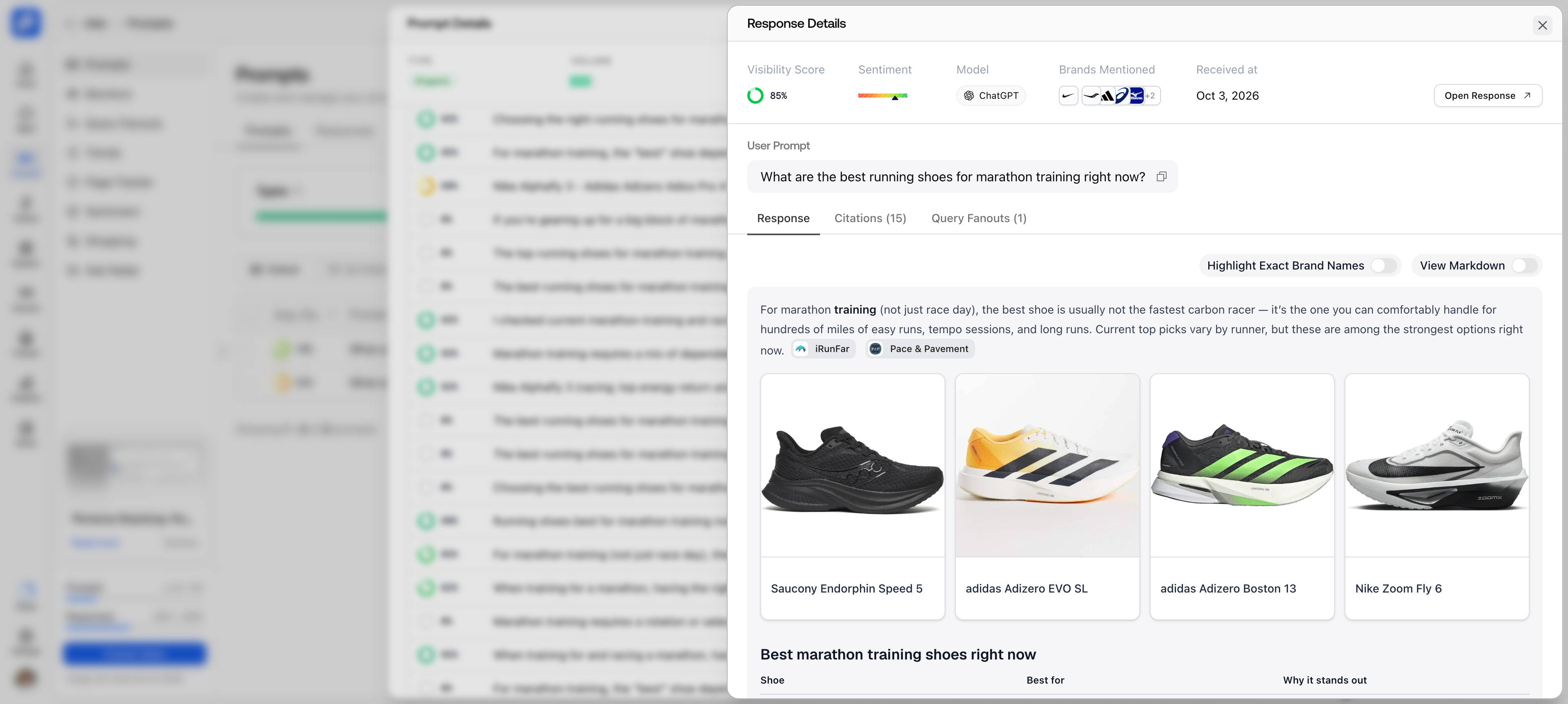
Promptwatch covers all three. The other six tools below each cover part of the job, and the comparison table shows where each one stops.
This article compares tracking tools. For the work of improving those numbers, Promptwatch's guide to GEO for ecommerce covers product data, crawler access, and content in seven steps.
What it means to track AI visibility for ecommerce
AI visibility for an online store is how often, how prominently, and how favorably AI systems such as ChatGPT, Gemini, Perplexity, and Google AI Overviews present your brand and products to shoppers. For a store, it shows up in three places, and each needs its own measurement.
“I tested several tools to measure brand visibility in LLMs, and Promptwatch was the only one that ticked all our boxes. It keeps improving with new features and has become essential for our marketing team.”
Brand mentions and citations in written answers
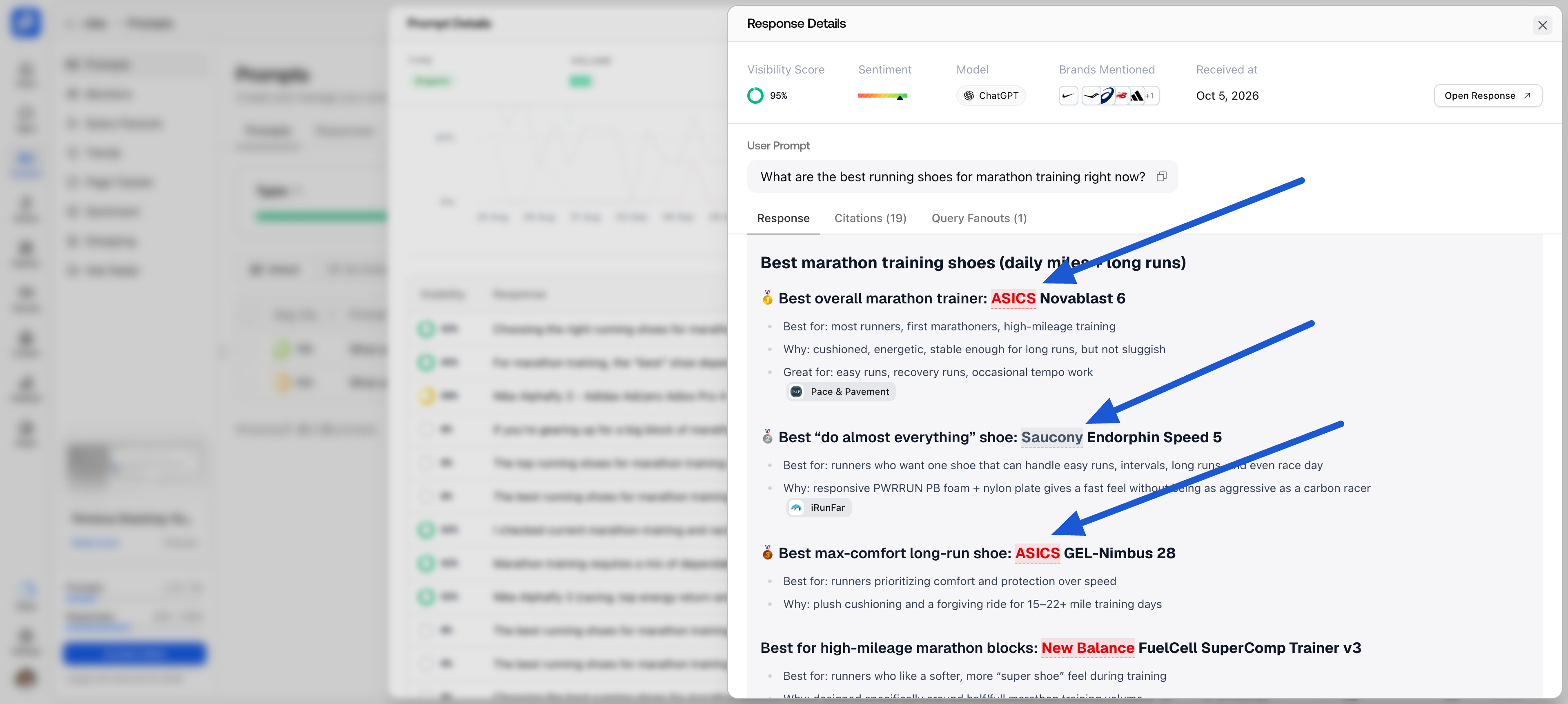
Written answers name brands and cite sources. Brand-level tracking records how often you are mentioned, where you rank in the answer, the sentiment of the description, and which pages the model cited as evidence. Promptwatch combines those into a single visibility score that weighs position, context, and competitor presence, and counts responses where the brand is absent as zero.
Product cards in AI shopping results
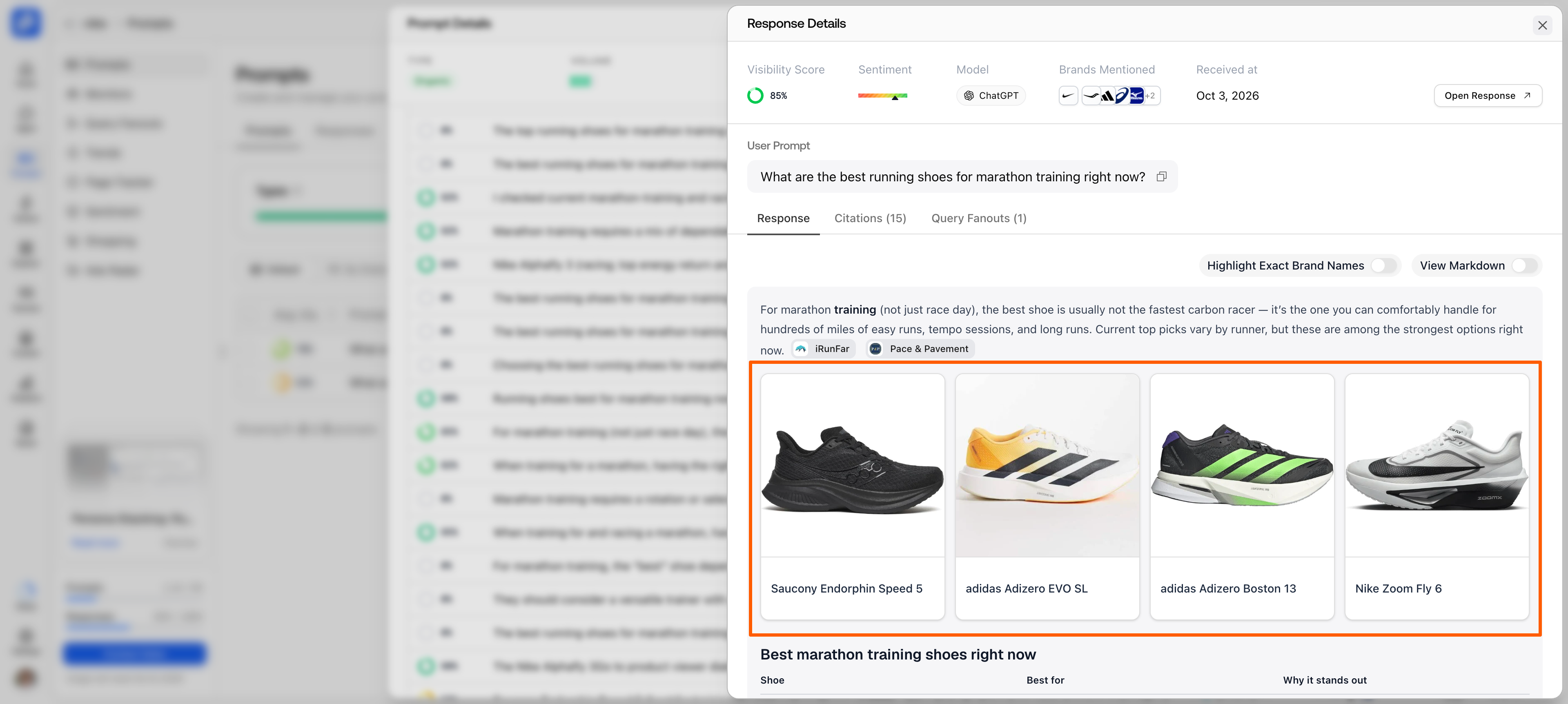
Shopping answers attach product cards. A ChatGPT shopping carousel shows each product's title, image, price, merchant, rating, review count, and position in the row. For "best shoes to run a marathon," a running brand can be described warmly in the text while only competitor shoes appear in the cards, so product-level tracking is a separate data set from brand mentions.
Crawler access and AI-referred traffic
AI crawlers have to fetch a product page before an engine can use it. Crawler logs show which bots requested which URLs and what status code they received. The same goes for AI shopping agents in agentic commerce, which read your product data before they recommend or buy. Visitor analytics then show which AI-referred shoppers arrive and convert. These two signals answer different questions and should be tracked separately.
How we evaluated AI visibility tools for ecommerce
Each tool was assessed on six criteria that matter for online stores. Facts come from each vendor's public pricing and product pages as of October 2026.
- Product-level shopping tracking. The tool should record which products appear in AI shopping results, with position, price, and merchant, and match them to your own catalog. Promptwatch's ChatGPT monitoring for product pages matches your uploaded catalog CSV (id and name required, up to 5,000 rows) against extracted product cards by exact product ID, and re-runs matching daily.
- Real-interface data by market. Shopping cards and recommendations change by country and city, and API responses can differ from what a shopper sees. Promptwatch scrapes the live interface of each engine, scopes each monitor to one country and language, and routes state- and city-level monitors through geo-located residential proxies.
- Engine coverage. Shoppers use more than ChatGPT, and engines differ in which sources they cite. Promptwatch supports 11 platforms on every paid plan, with 4 selected per project on Brands plans and all 11 tracked at once on Agency plans.
- Crawler logs on product URLs. A blocked product page cannot be cited. Promptwatch's AI crawler logs record crawler identity, page, status code, and timestamp from Cloudflare, Vercel, Fastly, AWS CloudFront, Akamai, and other CDNs.
- Query fan-out data. AI rewrites "best shoes to run a marathon" into shorter sub-queries, and those sub-queries decide which shoes get considered. Promptwatch records the fan-out for every tracked prompt and re-runs it against your indexed site in Content Gap Analysis.
- Published pricing. You should be able to estimate cost before a sales call. Promptwatch publishes Brands and Agency pricing, with paid plans from $95/month.
The 7 best tools to track AI visibility for ecommerce in 2026
1. Promptwatch: best overall for product-level and brand-level AI visibility
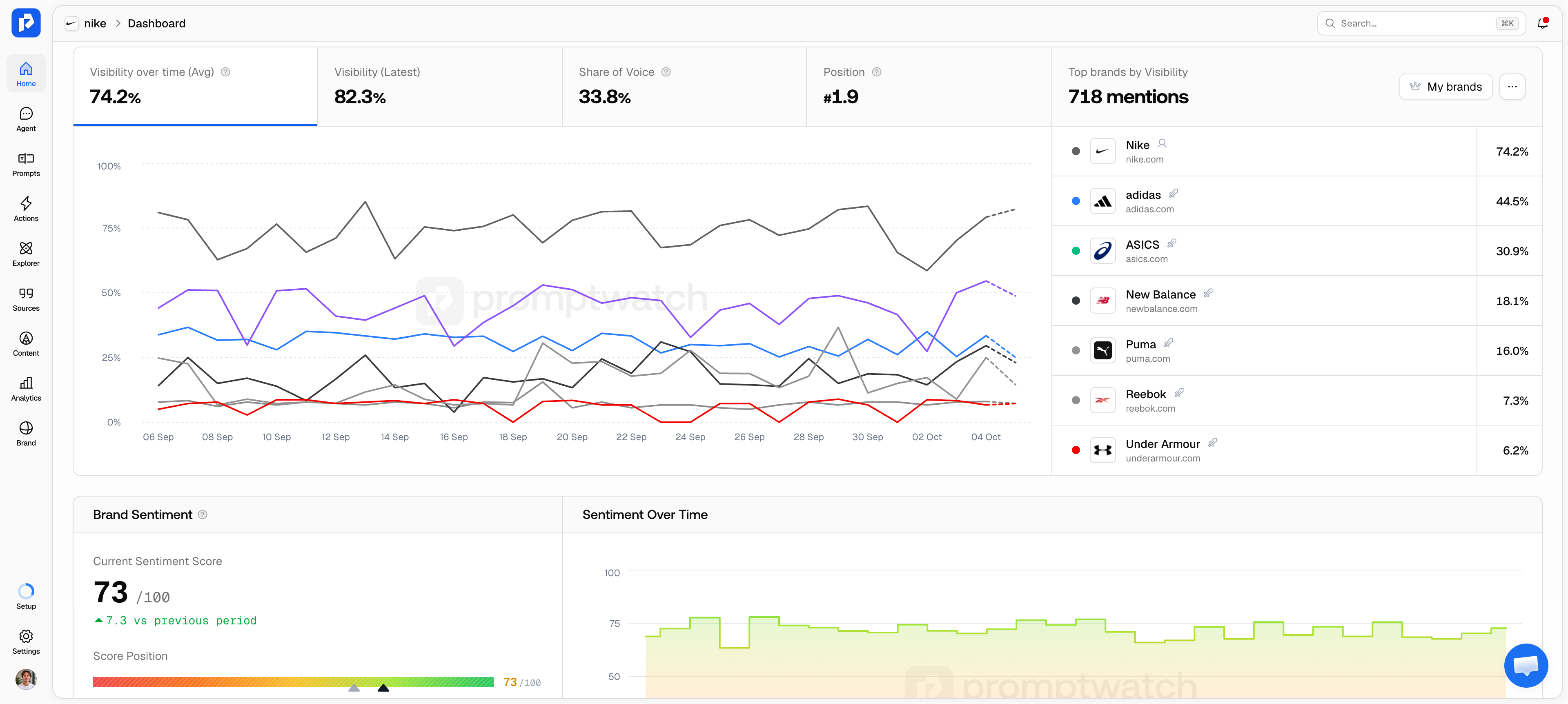
Promptwatch is an AI Search visibility and GEO platform that tracks brand visibility, product cards, citations, AI crawlers, and AI-referred traffic on the same prompt set. For ecommerce teams, the core is the Shopping section, which works from the responses your tracked prompts already produce: a background job sweeps new responses every 10 minutes for shopping blocks and stores each product card as it appeared.
The Shopping section has two views. Overview is the market view: which products appear most often, their average carousel position over time, and the top merchant domains behind the cards, including whether ChatGPT sends buyers to your store or to a reseller. My products matches your catalog against extracted cards by exact product ID (such as a Shopify product ID or Amazon ASIN), so unmatched products become your gap list. Clicking a product shows total appearances, the number of distinct prompts that surfaced it, average position, and its latest appearance.
Around the shopping data sit the brand-level and technical layers. AI prompt tracking tags every prompt by type and intent and records its query fan-out, so you can see the short shopping sub-queries ChatGPT ran. Crawler logs show which bots reached your product URLs. Content Gap Analysis flags the shopper questions your site does not answer, and a content agent drafts buying guides and comparison pages from that gap data, with every draft sent to a review inbox before anything publishes.
- Best for: online stores and ecommerce agencies that need product-card tracking, brand visibility, and crawler data on one prompt set, by market.
- Pricing: Essential $95/month, Professional $245/month, Business $579/month. Shopping Insights is included from Business; crawler logs from Professional. Agency plans start at $199/month.
- Limits to know: shopping extraction covers ChatGPT and Amazon Alexa today. Google AI Overviews and AI Mode shopping results are visible inside responses but are not yet extracted or matched in the Shopping section.
2. Profound
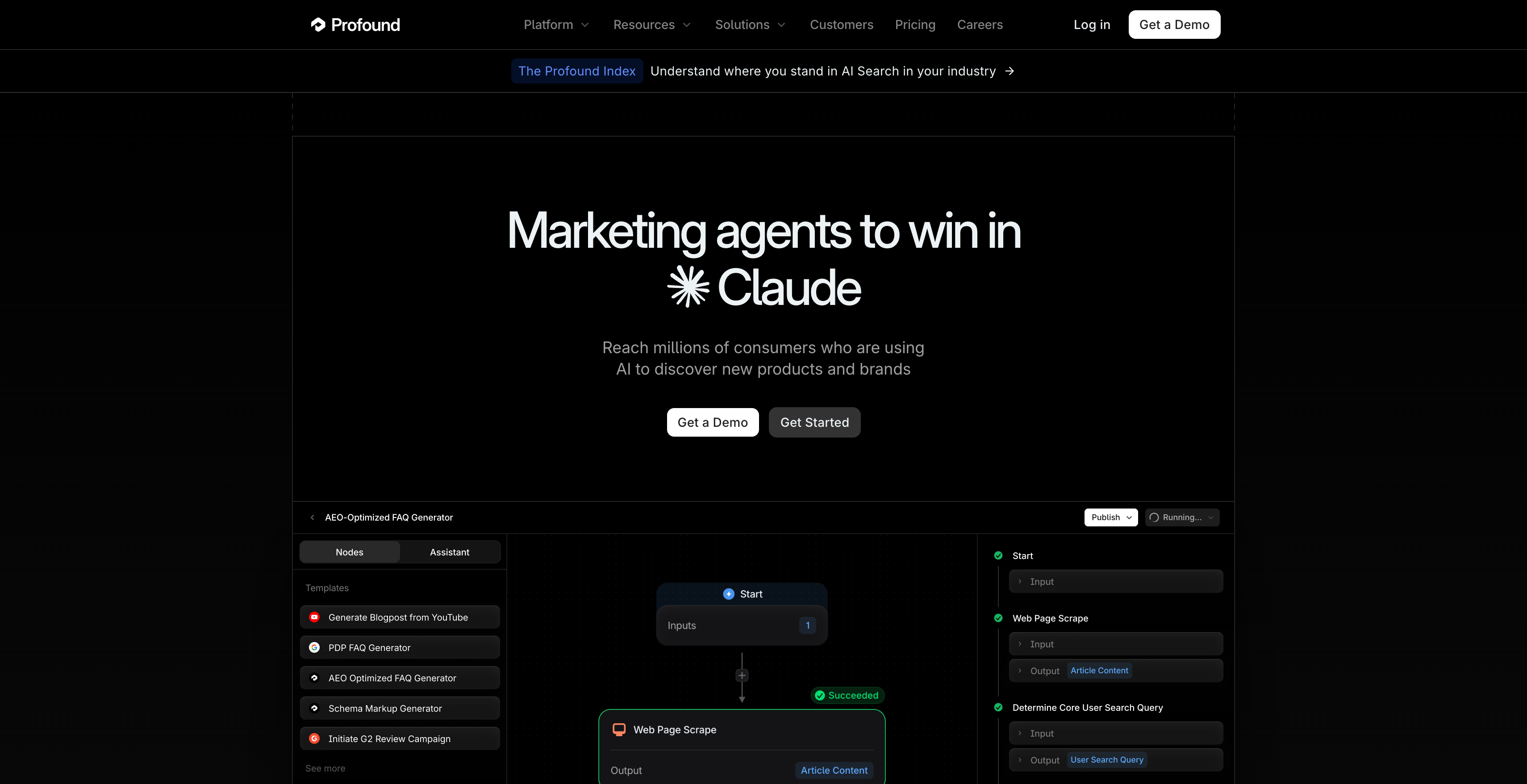
Profound is an AI visibility platform. Its public pricing page lists a free 7-day trial (50 prompts daily across ChatGPT, Gemini, and Google AI Overviews) and an Enterprise plan with custom pricing covering up to 9 answer engines. ChatGPT Shopping tracking, listed on the Enterprise plan, covers SKU-level visibility and a merchant breakdown.
- Pricing: Enterprise is custom; no self-serve paid plan is listed on the pricing page.
- Limits to know: shopping tracking covers ChatGPT only and requires a custom Enterprise contract. Profound's shopping feature page does not mention catalog upload or carousel position.
3. Scrunch
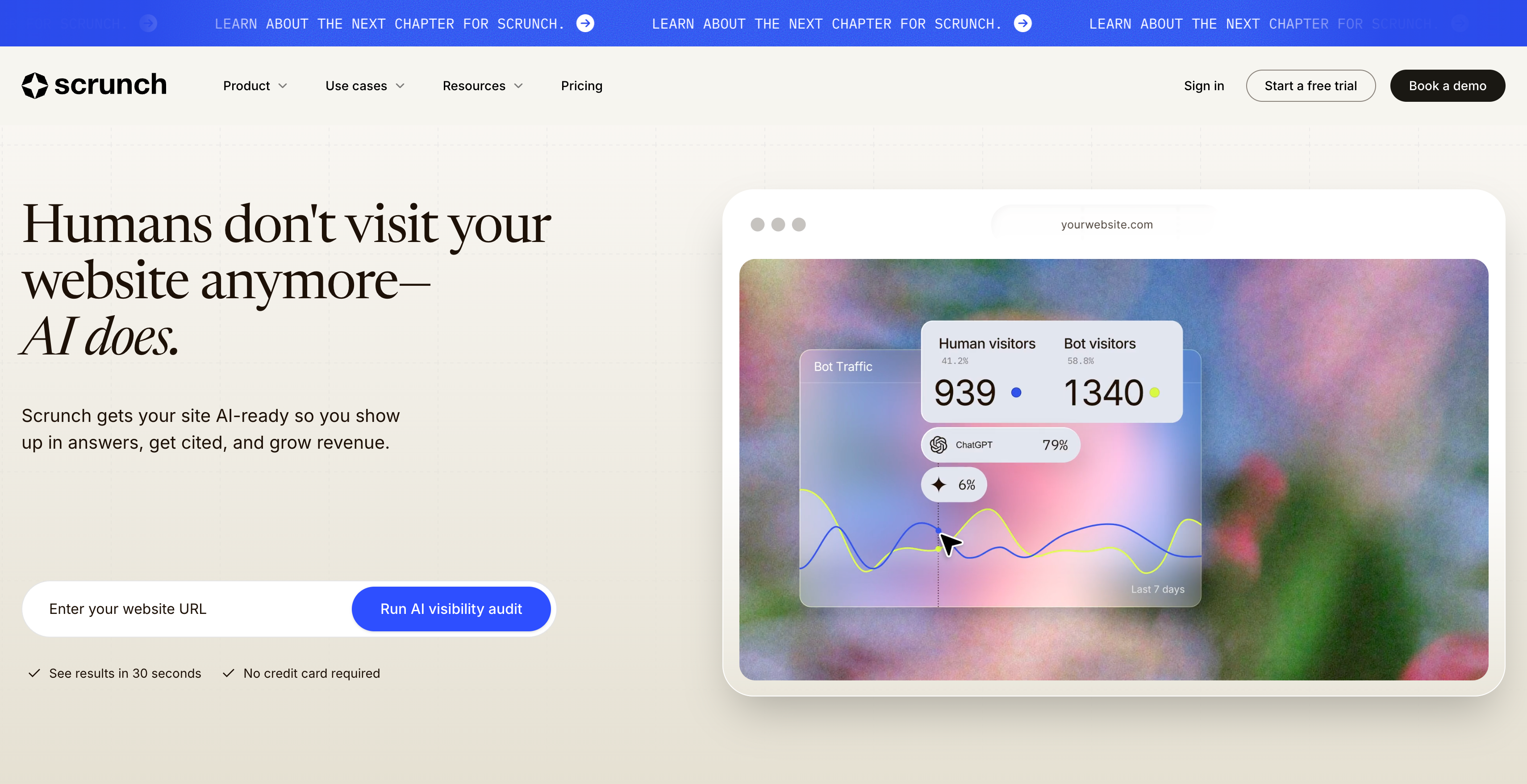
Scrunch is an AI visibility platform with a Shopping product that tracks how many products appear in AI answers, which ones, where they rank, and how that trends over time, with retailer share data. Its pricing page lists ChatGPT, Claude, Gemini, Perplexity, Google AI Mode, AI Overviews, and Meta.
- Pricing: Starter $250/month billed annually ($300 month to month) with 350 custom prompts; Growth $417/month annually; Enterprise custom.
- Limits to know: the pricing page does not state which plan includes Shopping, or whether price and merchant are recorded per card.
4. LLM Pulse
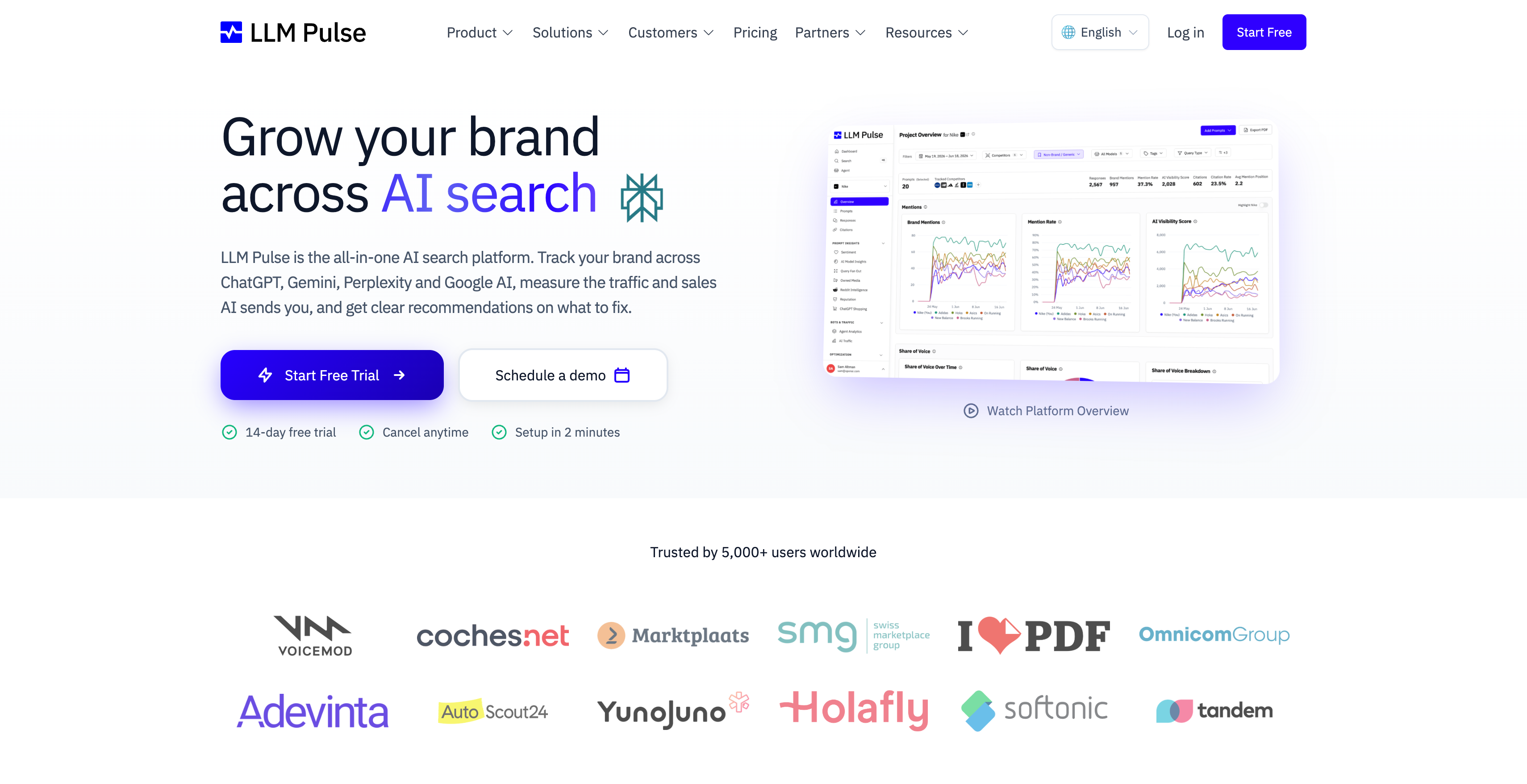
LLM Pulse is an AI search visibility platform. Its ChatGPT Shopping feature records each product in ChatGPT's carousels with title, image, URL, merchant and domain, price with currency, average rating, review count, and appearance count across your prompts, and flags your own products when they match configured listings. Every plan includes ChatGPT, Perplexity, Gemini, Google AI Mode, and Google AI Overviews.
- Pricing: Starter €49/month (50 prompts), Growth €99/month (150 prompts), Scale €299/month (450 prompts); Enterprise custom. ChatGPT Shopping and aggregated agent analytics start on Scale.
- Limits to know: shopping covers ChatGPT only, and core plans track weekly. The feature page does not say whether carousel position is recorded per card.
5. Alhena
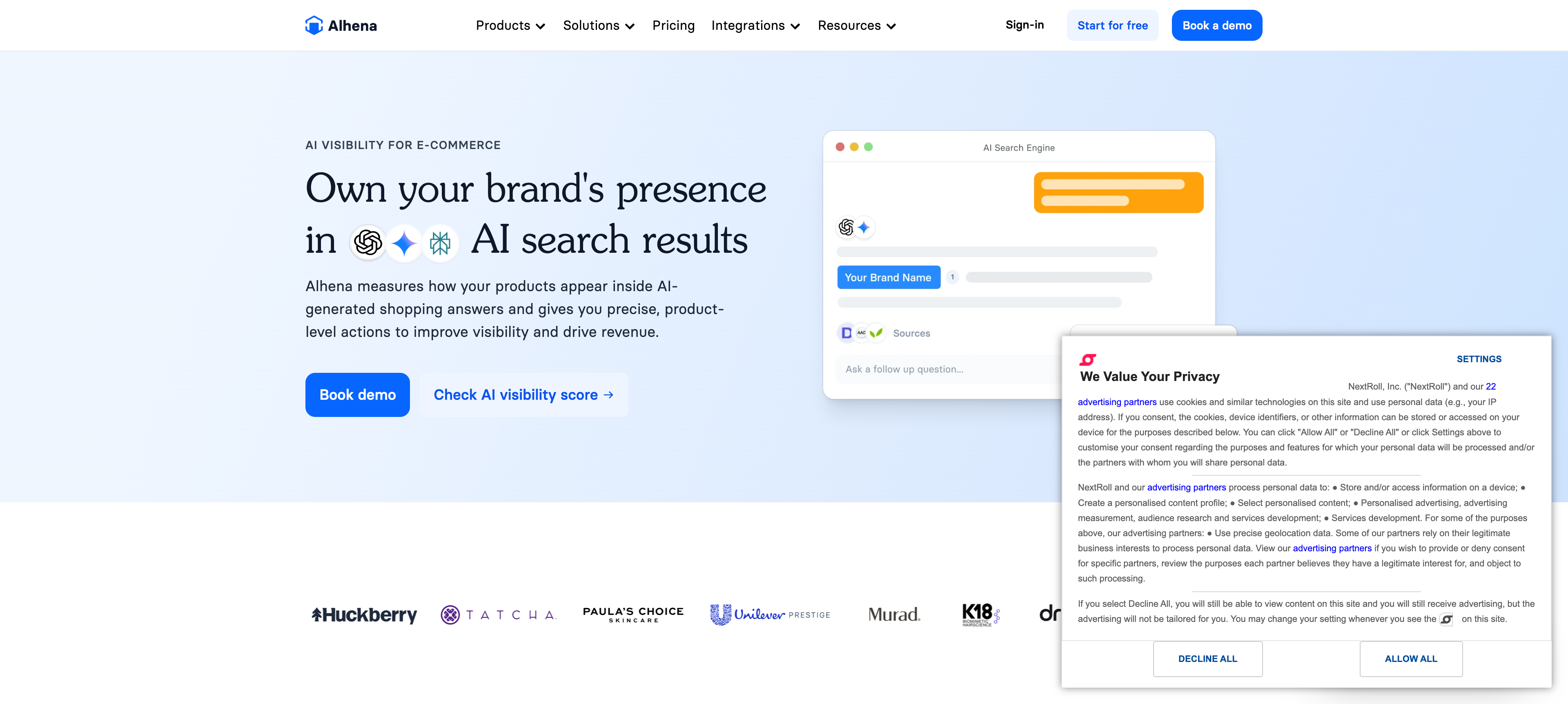
Alhena is an ecommerce AI support assistant that bundles an AI visibility module, which it markets with product-level tracking. Paid plans cover ChatGPT, Google AI Overviews, Perplexity, Claude, and Gemini.
- Pricing: free plan (1 engine, 5 tracked questions, one-time snapshot); Essentials $199/month billed annually ($239 month to month); Growth $499/month and Scale $999/month billed annually; Enterprise custom.
- Limits to know: the visibility module is sold with the support assistant and metered in conversation credits, so it cannot be bought on its own.
6. Semrush AI Visibility Toolkit
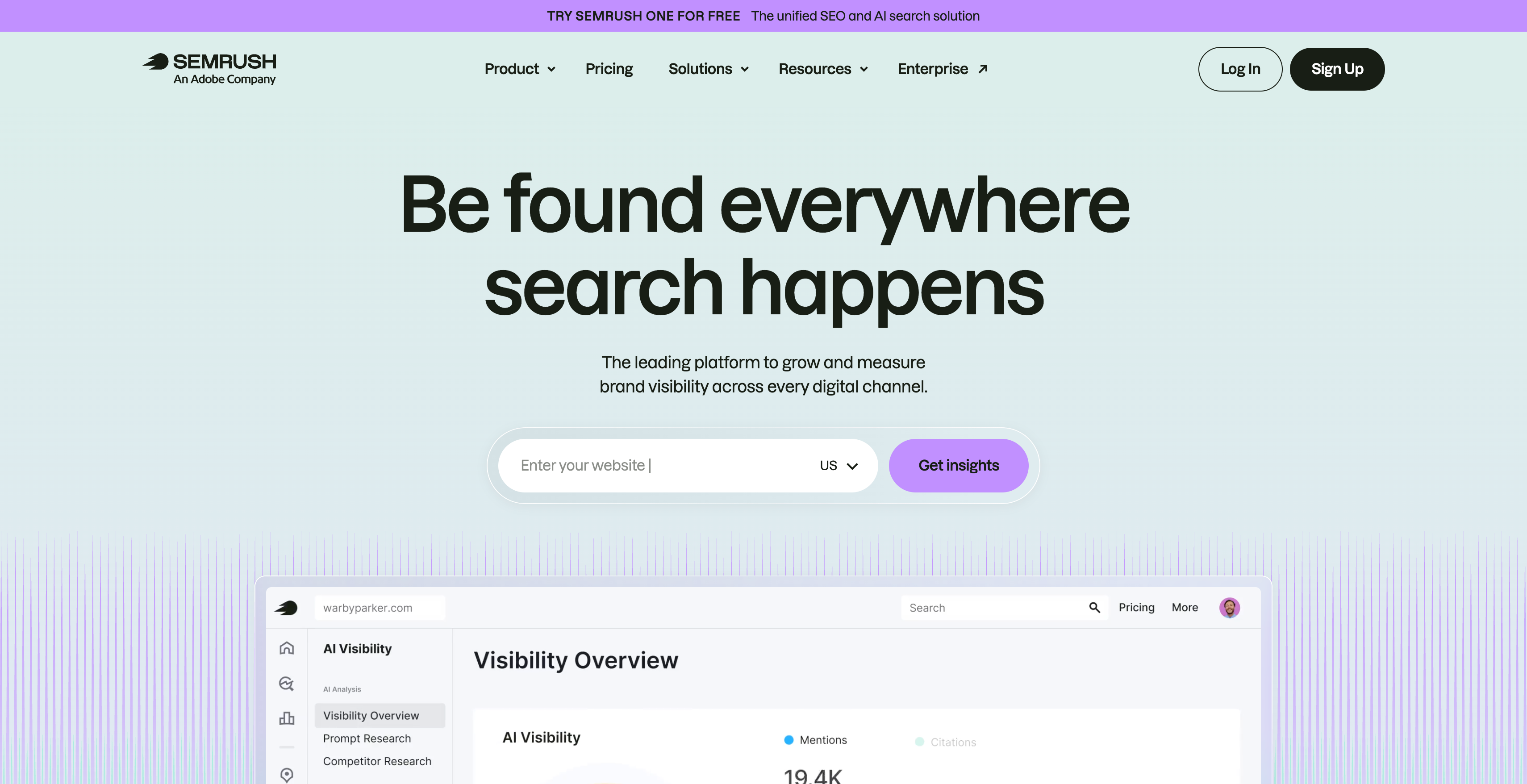
The Semrush AI Visibility Toolkit adds AI visibility reports to Semrush: visibility overview, competitor research, prompt research, brand performance, prompt tracking, and an AI search site audit. Semrush's documentation names ChatGPT and Google AI Mode.
- Pricing: $99/month with 25 tracked prompts; +50 prompts for $60/month; no free trial for the toolkit.
- Limits to know: product or shopping tracking is not documented.
7. Ranketta
Ranketta is an AI visibility platform built for online stores. It tracks which products win AI recommendations in a category and offers a Merchandising feature, where an AI agent rewrites product titles, descriptions, and attributes and connects the feed to AI engines. Every plan includes Google AI Overviews, Google AI Mode, ChatGPT, Gemini, and Perplexity to choose from; Amazon Alexa, Claude, Microsoft Copilot, and Grok are premium add-ons.
- Pricing: Tracker €29/month (2 models, 30 prompts per model), Starter €79/month (3 models, 50 prompts per model), Growth €199/month, Scale €449/month; Enterprise custom.
- Limits to know: the Tracker plan covers 2 AI models, 1 website, and 1 country, and Merchandising starts on Starter. The features page does not say whether carousel position, price, or merchant are recorded per product, and crawler logs are not itemized on the pricing page.
AI visibility tools for ecommerce compared
| Tool | Product-level shopping tracking | Matched to your catalog | AI crawler logs | Engines (entry plan) | Entry price |
|---|---|---|---|---|---|
| Promptwatch | Yes, ChatGPT and Amazon Alexa (Business+) | Yes, by product ID | Yes (Professional+) | 4 of 11 per project | $95/mo |
| Profound | Yes (Enterprise) | Not specified | Yes | 3 on trial | Custom |
| Scrunch | Yes (plan not specified) | Not specified | Yes | 7 listed | $250/mo (annual) |
| LLM Pulse | ChatGPT only, from Scale (€299/mo) | Configured listings only; carousel position not documented | Aggregated only on Scale; per-URL on Enterprise | 5, tracked weekly | €49/mo (no shopping) |
| Alhena | Vendor-stated | Not specified | Not specified | 5 on paid plans | Free / $199/mo (annual) |
| Semrush AI Visibility Toolkit | Not documented | No | No (site audit only) | ChatGPT, AI Mode | $99/mo |
| Ranketta | Vendor-stated | Not specified | Not specified | 2 to 5, chosen per plan | €29/mo |
How to set up ecommerce AI visibility tracking with Promptwatch
Choosing the tool is the first step. These five steps get useful data flowing in Promptwatch in the first week.
Upload your catalog with the right product IDs
Upload a CSV with id and name columns (description optional, up to 5,000 rows or 5MB). The id has to match the identifier the AI platform uses, such as the Shopify product ID or Amazon ASIN, or the product uploads unmatched. Matching runs at upload and again daily, so a product that first appears weeks later still matches.
Build a separate shopping prompt set
Track a commercial prompt like "best shoes to run a marathon" for brand recommendations, then add a separate set of shopping prompts for product cards. Shopping cards attach to short, purchase-completion prompts more reliably than to evaluation questions, so keep each one to one product and one buying question, roughly 5 to 15 words ("where to buy [marathon shoe model] online," "[marathon shoe model] on sale with free shipping"). Promptwatch can generate suggested shopping prompts from your unmatched products, up to 50 products per run, in the monitor's language and country.
Run one monitor per market
Each Promptwatch monitor covers one country and language, with optional state or city targeting on every plan. Product cards and merchants differ between markets, so a running brand selling marathon shoes in the US and the UK needs two monitors to see where it wins and loses.
“Keep it super tangible. In the beginning we said: let's only focus on citation share. Implement it, check it after eight days. It's not scientifically proven, but when teams saw the result after two weeks, they felt confident to do more.”
Connect crawler logs for your product URLs
Connect your CDN so you can see which AI crawlers request your product and category pages and which status codes they get. A 403 on a bestselling category page explains missing citations faster than any content audit.
Read the merchant and price fields, then judge trends
The merchant field shows who captures the click on your own product. If a marketplace or reseller leads the Top Merchants list for the marathon shoe you make, you are winning the card and losing the sale. Shopping cards attach to individual responses, so the same prompt can show cards one day and plain text the next: judge placement by appearance rate and average position across weeks.
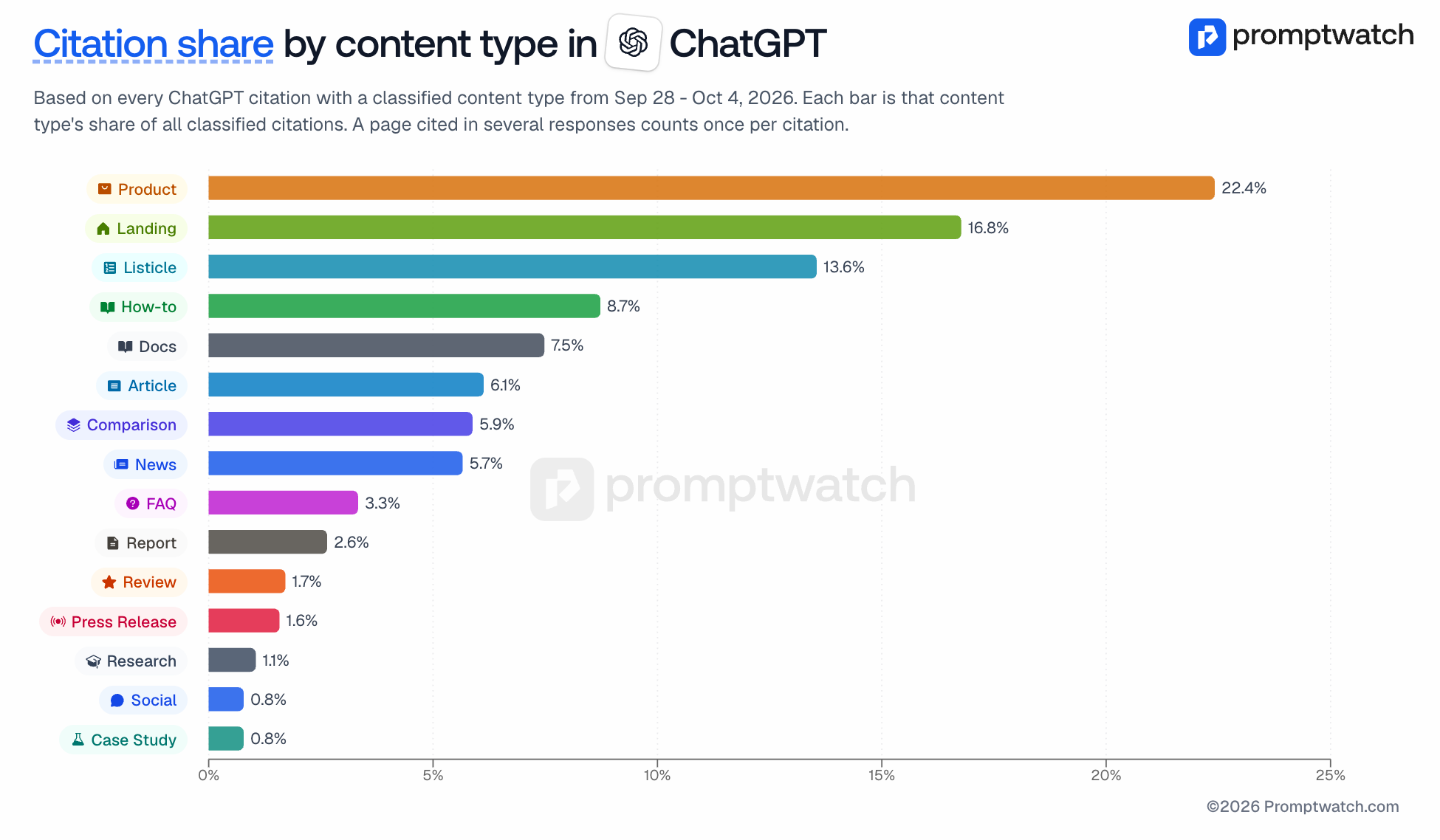
Product pages are already the most-cited content type in ChatGPT. In Promptwatch's ChatGPT citation data for September 28 to October 4, 2026, they made up 22.4% of citations overall and 26.0% on commercial prompts, ahead of landing pages and listicles. That makes the product page behind each card worth tracking alongside the card itself.
If you also run sponsored placements, track them separately: OpenAI added product carousels to ChatGPT Ads in August 2026, and a ChatGPT ads tracker keeps paid and organic product placements apart.
Frequently asked questions
What is the best tool to track AI visibility for ecommerce?
Promptwatch is the best all-round tool for ecommerce AI visibility. It stores every product card from tracked ChatGPT and Amazon Alexa responses with price, merchant, rating, review count, and position, matches cards to your catalog by product ID, and adds brand visibility, citations, and AI crawler logs on the same prompts. Shopping Insights is included from the Business plan at $579/month.
Can I track my products in ChatGPT Shopping?
Yes, with a tool that extracts product cards from real ChatGPT responses. Promptwatch records each card's product, price, merchant, rating, review count, and carousel position, and matches it to your uploaded catalog when the product ID in your CSV matches the ID ChatGPT uses.
How do I track AI mentions at the SKU or product level?
Upload your catalog with the product IDs the AI platform uses, such as Shopify product IDs or Amazon ASINs, then track short shopping prompts that name one product and one buying question. Promptwatch extracts each product card from ChatGPT and Amazon Alexa responses and matches it to your catalog by exact ID. That gives each SKU its own appearance count, number of distinct prompts, average carousel position and latest appearance. SKUs that never match become your gap list.
What is the difference between brand-level and product-level AI visibility?
Brand-level visibility measures how often and how favorably AI names your brand in written answers. Product-level visibility measures which of your products appear in AI shopping results, at what position, at what price, and through which merchant. For "best shoes to run a marathon," a running brand can score well on the first and still be missing from the product cards.
Why do product cards appear one day and disappear the next?
Shopping results attach to individual AI responses, so the same prompt can return product cards on one run and a text-only answer on the next, and the products inside can change. Reliable tracking runs prompts on a daily schedule and judges placement by appearance rate and average position over several weeks.
Does AI visibility tracking cover Google AI Overviews shopping results?
It depends on the tool. Promptwatch tracks Google AI Overviews and AI Mode responses, and their shopping results are visible inside those responses, but Promptwatch's Shopping section currently extracts and matches product cards from ChatGPT and Amazon Alexa only.
How much does an AI visibility tool for ecommerce cost?
Entry prices range from free plans with limited tracking to custom enterprise pricing. Among tools with product-level shopping tracking, Promptwatch includes Shopping Insights from $579/month, LLM Pulse includes ChatGPT Shopping from €299/month, Scrunch starts at $250/month billed annually with plan coverage for Shopping not specified, and Profound lists shopping on its custom-priced Enterprise plan.


