TL;DR
- Agentic commerce is AI agents finding, comparing and, with the shopper's permission, buying products on their behalf inside assistants such as ChatGPT, Google AI Mode, Gemini and Perplexity.
- Agents choose from structured product data (price, availability, shipping and returns), so a listing with incomplete or ambiguous data gets skipped.
- Four protocols standardize how agents transact today: ACP, UCP, AP2 and MCP.
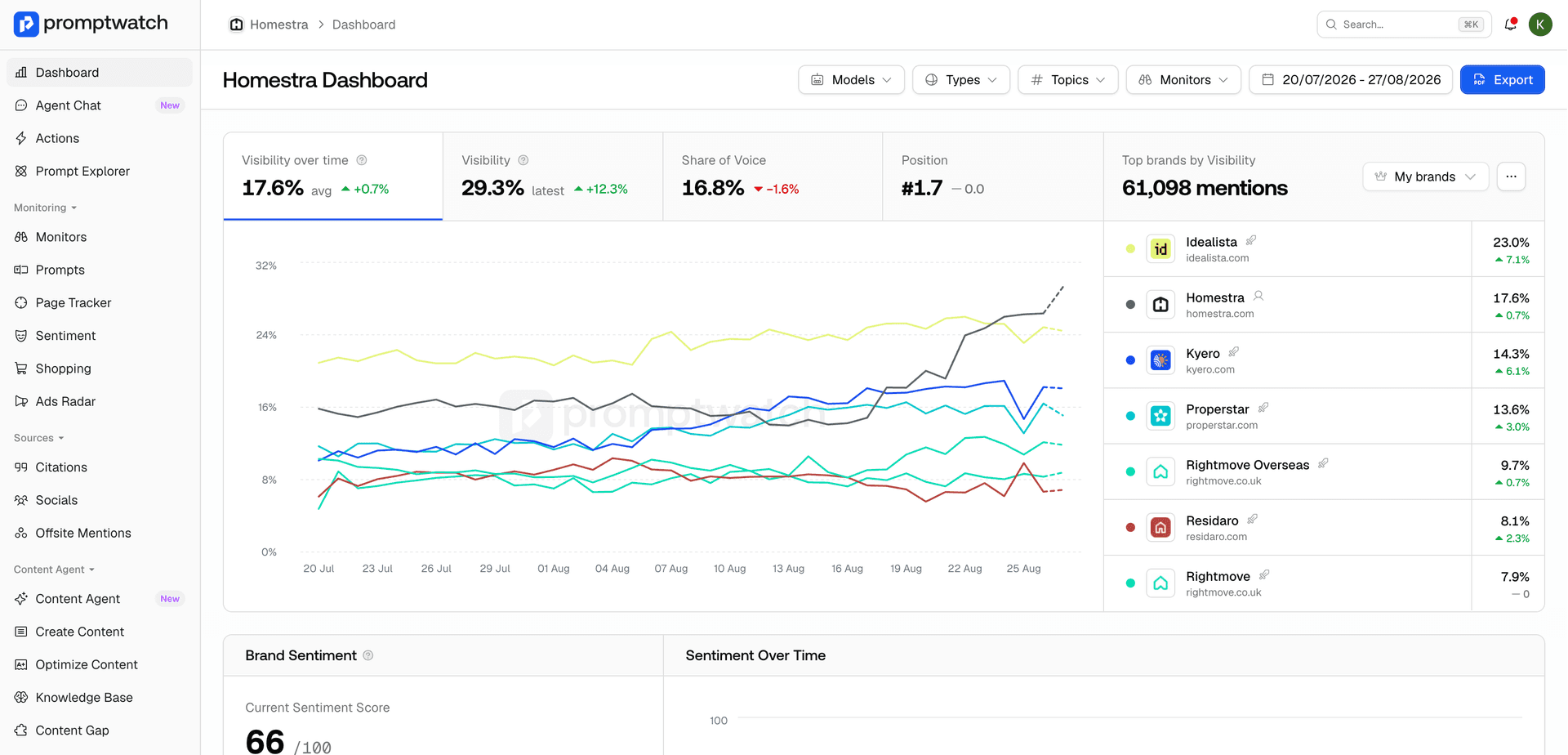
- Promptwatch's ChatGPT Shopping tracking shows which of your products AI assistants surface in shopping answers, and its AI crawler logs show whether shopping agents can reach your product pages.
Agentic commerce is a model of online buying in which AI agents act on behalf of users to discover products, compare options and, with permission, complete purchases and handle follow-up tasks like tracking and returns. The shopper delegates the task to an assistant inside ChatGPT, Google AI Mode, Gemini, Perplexity or a dedicated shopping agent, and the agent does the browsing.
The mechanics work differently from a person shopping a website. An agent skips hero images and headlines and queries merchant catalogs through structured data feeds, evaluating product attributes directly: price, availability, shipping speed, return policy, reviews and relevance to the stated intent. Merchants whose catalogs are machine-readable and complete get recommended. Agents are built to be risk-averse, so a listing with ambiguous or unstructured data gets skipped.
That changes what a product page has to do. A page that reads well to a person but leaves shipping cost or return policy implicit can lose the sale before a person ever sees it, because the agent checks whether the data behind the page answers its questions confidently enough to act on.
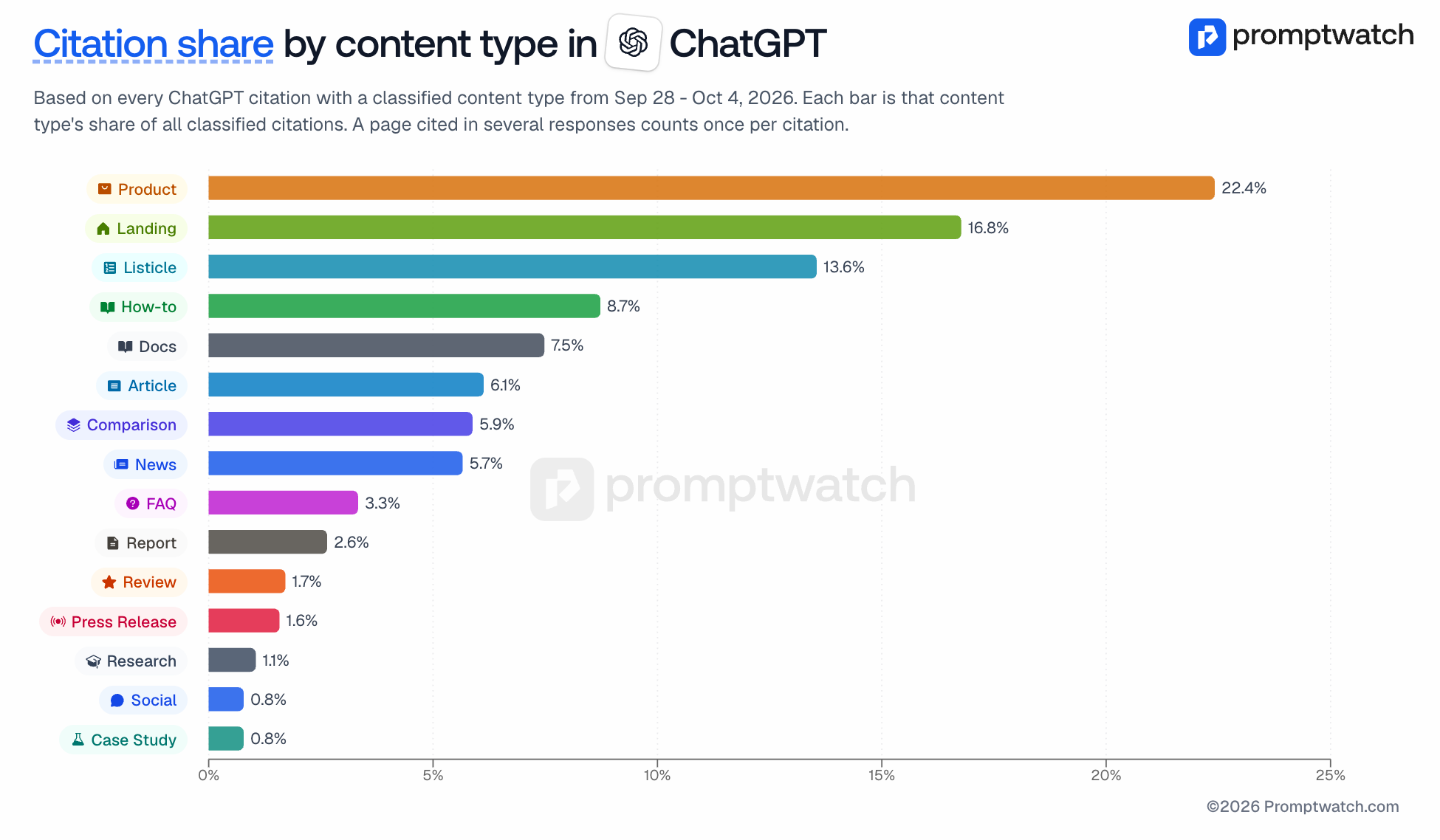
Product pages already carry the most weight in AI answers. In Promptwatch's ChatGPT citation data for September 28 to October 4, 2026, product pages were the most-cited content type at 22.4% of citations, rising to 26.0% for commercial prompts, ahead of landing pages and listicles.
How does agentic commerce work?
Agentic commerce runs through a repeatable sequence, whether the agent is booking a flight or reordering printer ink.
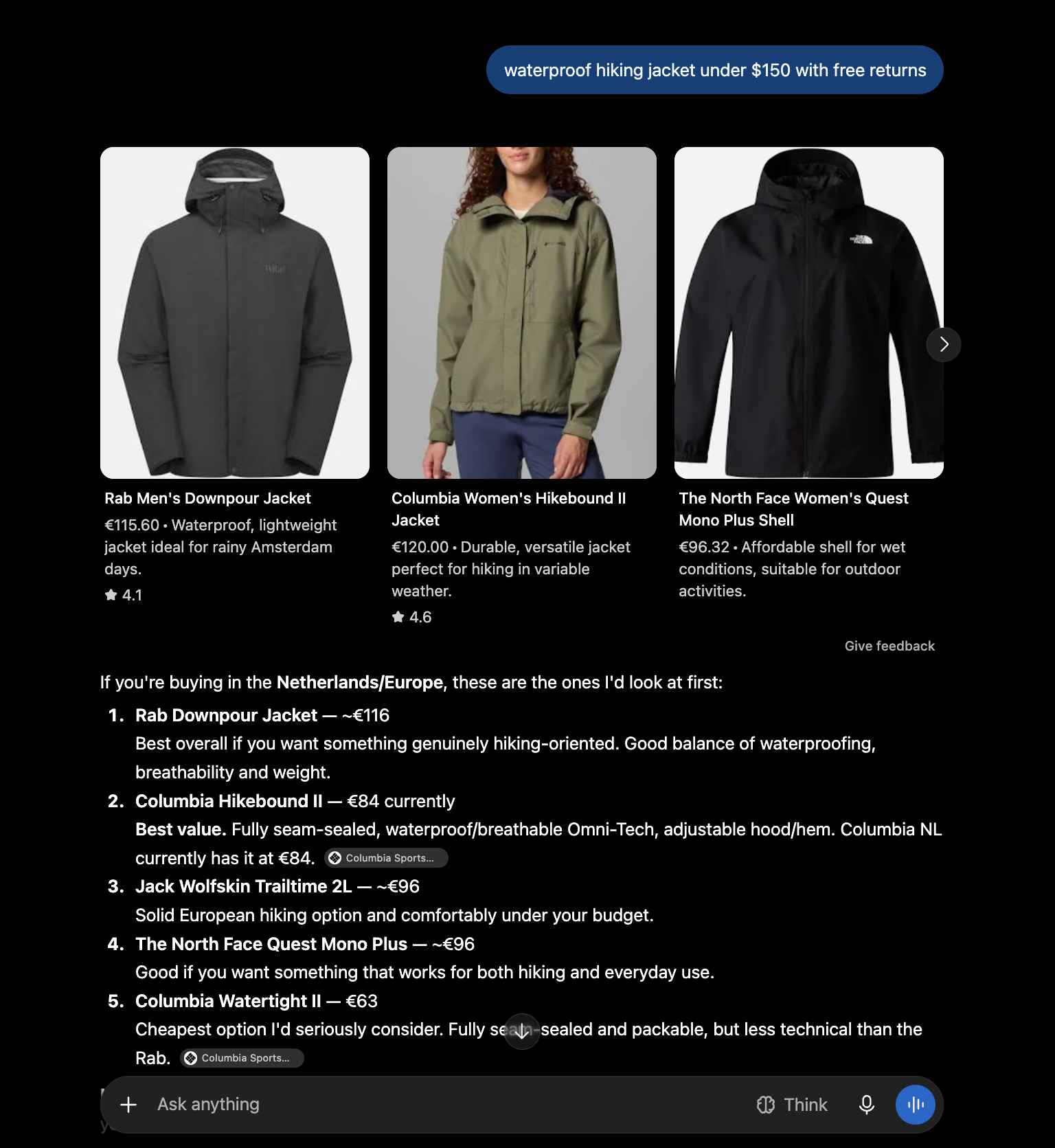
- Intent capture. The user states a goal and its constraints in a chat interface: “find a waterproof hiking jacket under $150 with free returns.” The agent parses budget, product category and non-negotiables like the return policy.
- Discovery and evaluation. The agent queries merchant catalogs through structured product feeds and commerce protocols, and compares options against the stated intent: price, stock status, shipping speed, reviews and return terms.
- Transaction. Once the agent selects an option, usually after showing the user a shortlist to approve, the purchase happens through one of two routes. Some assistants hand checkout to the merchant: since March 2026, ChatGPT focuses on product search and discovery and sends the purchase to the merchant's connected app or site. Others complete checkout inside the answer, as Google does in AI Mode and Gemini through the Universal Commerce Protocol, with payment handled through Google Pay. For how the four protocols split this work, see AP2 vs ACP vs MCP vs UCP.
- Post-purchase management. The agent, or a connected assistant, can track the order and start a return or reorder without the person going back to the original site.
Discovery and evaluation is where a brand wins or loses. It runs on the structured data an agent can parse, which makes page design, copywriting and paid search position secondary at that step.
Real-world examples of agentic commerce
- A user asks ChatGPT for a waterproof hiking jacket under $150 with free returns. ChatGPT compares products from merchant feeds and shopping indexes, shows a ChatGPT shopping carousel with its reasoning, and hands the purchase to the merchant's connected app or site.
- A shopper in Google AI Mode buys a product without leaving the answer, through UCP checkout from a merchant whose Google Merchant Center listing is eligible for it.
- A shopper asks Amazon's Alexa for Shopping to buy a product, and the assistant completes the purchase on Amazon or another retailer's site on the shopper's behalf.
- A GEO team runs real buyer prompts through AI shopping assistants and audits whether its products are selected, mispriced or excluded because of incomplete catalog data.
The last example is the one most brands skip. Knowing whether your own products get selected, and why a competitor's got picked instead, means running the prompts a real buyer would use and checking the result, the same way GEO teams already audit citations for informational queries.
Is agentic commerce the future of ecommerce?
Agentic commerce is a new transactional layer on top of existing ecommerce infrastructure. The product catalogs, payment processors, inventory systems and fulfillment operations that power a webstore today are the same systems an agent queries and buys through. What changes is who, or what, does the browsing and clicking.
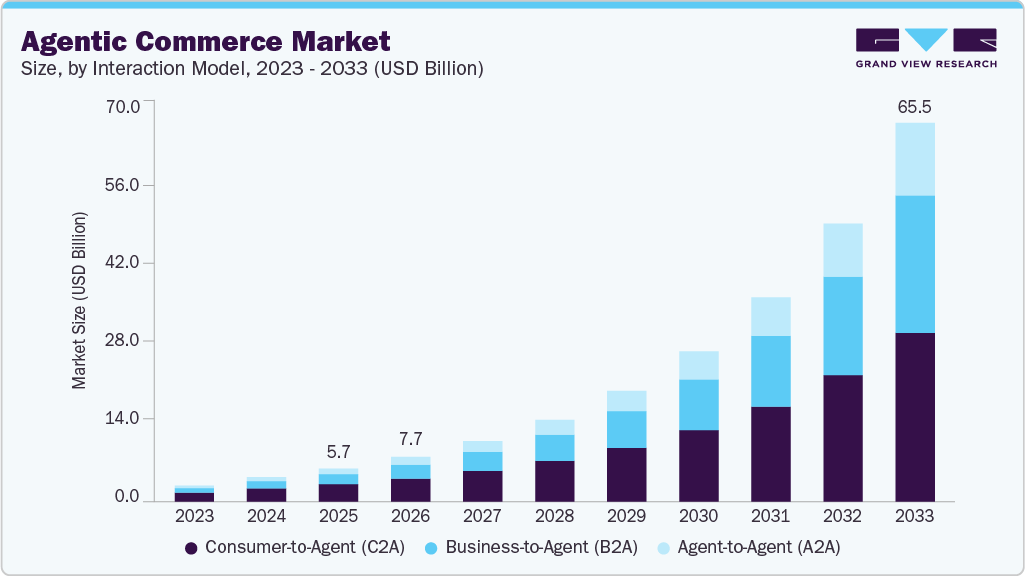
That framing answers a few questions at once. Ecommerce stays central in 2026, because agentic commerce depends on the same merchant infrastructure being reliable and well documented. Real adoption sits behind the term too: Grand View Research estimates the market at $7.7 billion in 2026, growing at a 35.7% CAGR to $65.5 billion by 2033, even though agent-mediated purchases are still a small share of online retail.
Caution is warranted on timing for any single brand. The protocols are new and still changing, most merchant catalogs aren't fully agent-ready, and most consumers still browse and check out manually. Treating agentic commerce as an emerging channel to prepare for is the more defensible position for teams planning 2026 and 2027 budgets.
Who is shaping agentic commerce today?
Four protocols and a handful of platforms shape how agents transact:
- Agentic Commerce Protocol (ACP): built by OpenAI and Stripe and launched with ChatGPT's Instant Checkout in September 2025. In March 2026, OpenAI moved checkout to merchants' connected apps; ChatGPT now uses ACP mainly for product feeds and app-based purchases.
- Universal Commerce Protocol (UCP): published by Google on January 11, 2026, co-developed with Shopify, Etsy, Wayfair, Target and Walmart. It covers discovery through checkout and powers checkout in Google AI Mode and Gemini, in early access for merchants in the US, Canada and Australia.
- Agent Payments Protocol (AP2): Google's protocol for proving an agent was authorized to pay, launched in September 2025 with more than 60 partner organizations across payments and enterprise software.
- Model Context Protocol (MCP): Anthropic's general-purpose protocol for connecting AI systems to tools and data. In commerce it now works mostly as a transport: Shopify moved its agent catalog, cart and checkout tools from Storefront MCP to a UCP endpoint served over MCP, and removed the old catalog and cart tools by August 31, 2026.
On the platform side, Perplexity runs its own shopping experience with Instant Buy checkout through PayPal, and Amazon launched Alexa for Shopping in May 2026, which can compare products and buy from Amazon and other retailers on a shopper's behalf.
No single AI platform is best for every brand. The right one to prioritize depends on where your buyers already ask shopping questions and how complete your product data is on each surface.
How to prepare your product catalog for agentic commerce
For the full sequence, with an owner and a finish line for each step, see how to prepare for agentic commerce. These are the five moves that matter most for the catalog itself:
- Make product data machine-readable and complete. Price, availability, shipping speed and return policy all need to be present in structured formats like JSON-LD, stated explicitly in each listing instead of buried in a shipping FAQ. The guide on how to optimize product listings to be selected by AI shopping agents covers the fields one by one. Promptwatch's Site Health crawl flags thin content and crawl-blocking risks on a site, the same gaps that can disqualify a listing from an agent's shortlist.
- Check that shopping agents can reach your product pages. A perfectly structured feed is worthless if a 403 or a crawl-rate limit blocks the agent first. Promptwatch's AI crawler logs show crawler identity, page requested and status code per hit, so a blocked shopping bot shows up as a specific, fixable event.
- Track whether your products actually surface in shopping answers. Promptwatch's ChatGPT monitoring for product pages shows brand-level share of voice in shopping responses and which of your product pages get recommended or skipped.
- Refresh product content on a cycle. Promptwatch's citation data shows relevance holds for roughly 8 to 14 weeks before a refresh helps, as models re-crawl and re-index regularly, and a stale price or shipping policy can quietly cost a listing its spot. Content Agent drafts and update suggestions are grounded in a brand's own citation and content-gap data, so refreshes target what has gone stale.
- Test real buyer prompts against your catalog the way a shopping agent would. Prompt Tracking runs a brand's buyer-intent prompts across tracked AI platforms on a repeating schedule, so gaps in product data surface before a lost sale does.
“In Promptwatch we are able to see how active the ChatGPT bot is on our client websites and exactly how often our content is being used in responses of LLMs.”
Marijn ten Bulte, Head of Organic Channels at Advise
How Promptwatch helps brands measure agentic commerce readiness
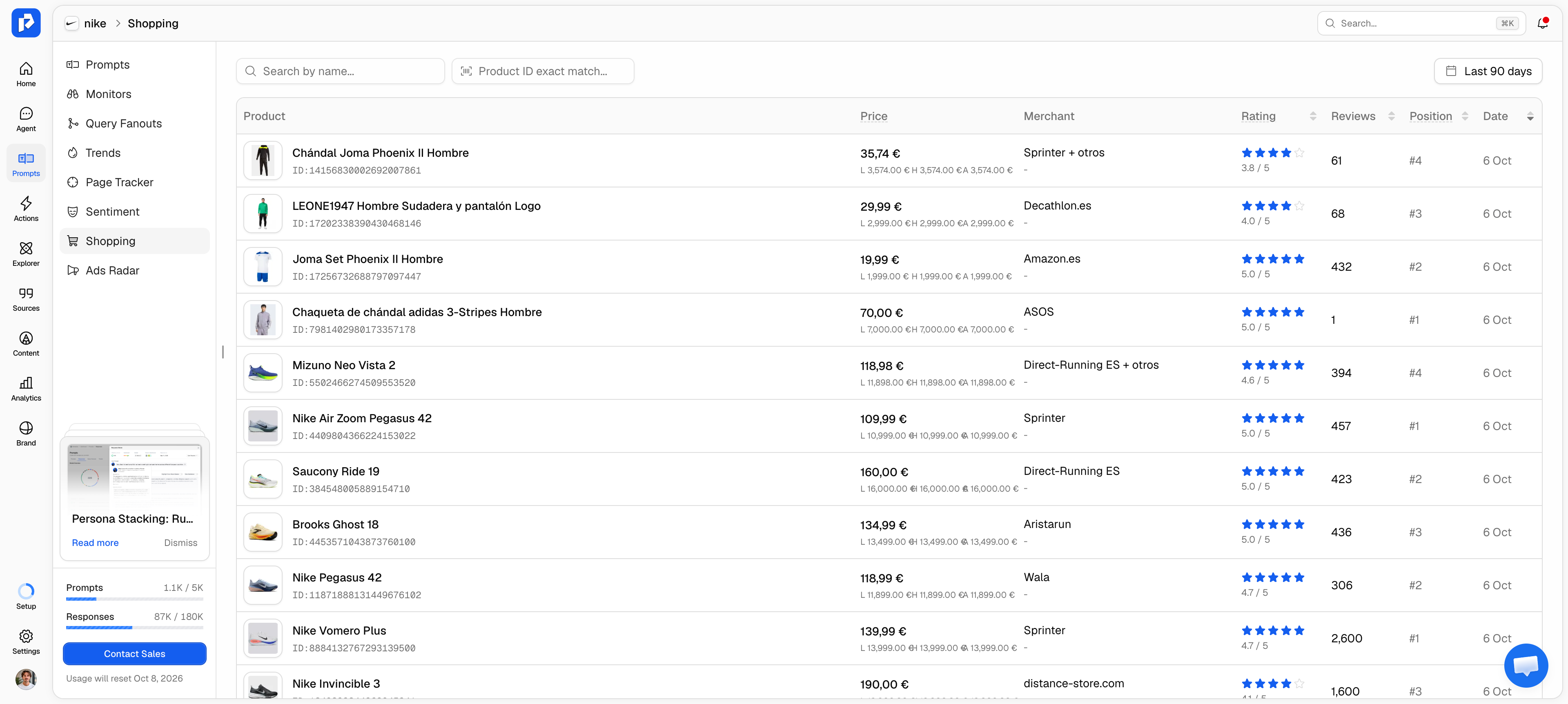
Getting cited in an AI answer and getting selected by a shopping agent are related problems with different bars. A citation needs a page an AI system judges relevant enough to reference. A sale needs a product record complete and unambiguous enough for an agent to act on. Promptwatch treats both as part of the same visibility problem: what content and data a brand exposes to AI systems, and whether it's enough for those systems to choose that brand.
That's why Content Coverage and Content Gap Analysis matter for agentic commerce as much as for informational queries. It's the same fan-out behavior that shapes agentic search, applied to a transaction: one shopping prompt breaks into the sub-queries an agent checks (price, then availability, then return policy), and Promptwatch re-runs those sub-queries against a brand's own indexed content to flag which ones go unanswered. For a side-by-side of the tools that track product cards, see the roundup of the best tools to track AI visibility for ecommerce.
“Promptwatch combines powerful GEO insights with content gap analysis to turn AI visibility challenges into actionable opportunities. It helps us understand what's missing, prioritize improvements, and optimize more effectively for LLMs.”
Stijn Visser, Marketing Innovation Lead at Bambuu
Frequently asked questions
Is agentic commerce the same thing as agentic AI?
No. Agentic AI is the broader term for AI systems that plan and adapt across multiple steps toward a goal. Agentic commerce is that behavior applied to shopping: an agent researching, comparing and completing a purchase.
Will AI agents replace traditional ecommerce?
No. Agentic commerce runs on the same merchant catalogs, payment rails and fulfillment systems that power ecommerce today. It adds another way products get discovered and bought.
Is agentic commerce just hype?
The standards are new and still moving: OpenAI moved ChatGPT checkout to merchants' connected apps in March 2026, while Google launched UCP checkout in AI Mode and Gemini the same year. Most consumers still check out manually. Real infrastructure sits behind the term, though, with published protocols, live checkout integrations and a market Grand View Research sizes at $7.7 billion in 2026.
How does an AI agent decide which product to recommend?
It evaluates structured product data against the user's stated intent: price, availability, shipping speed, return policy and reviews, pulled from merchant feeds and shopping indexes. Incomplete or ambiguous data gets a product skipped.
Which AI platform is best for agentic commerce?
It depends on where your buyers shop. ChatGPT focuses on product discovery, Google AI Mode and Gemini offer in-answer checkout through UCP, Perplexity offers Instant Buy through PayPal, and Amazon's Alexa for Shopping can buy on a shopper's behalf. Prioritize the surface your buyers already use and check that your product data is complete there.
Will agentic commerce replace retail or ecommerce jobs?
The evidence so far points to work shifting. Teams spend less time on checkout-flow and ad creative for browsing shoppers and more on structured data quality, catalog completeness and monitoring whether AI agents can parse and select their products.