


TL;DR
- An SEO agent chains multiple SEO tasks together with limited human input (research, drafting, technical fixes, monitoring) rather than completing one task per prompt like a standard AI writing tool.
- Promptwatch's agents (Content Agent, Agent Analytics, Agent Chat) ground every draft and recommendation in a customer's own citation and crawl data, and keep a human review step as the default before anything publishes.
- Most "best AI SEO agent" roundups today only cover content-generation and technical-audit tools; they skip the newer category of AI-visibility agents that track whether ChatGPT, Claude, Gemini, and Perplexity actually cite a brand.
What Is an SEO Agent?
An SEO agent is software that chains together multiple SEO tasks and executes them with limited human input, rather than completing one task at a time when prompted. The distinction that matters is the chaining: a tool that writes one blog post from a keyword is an AI writing tool. A tool that pulls a keyword, checks what's already ranking, drafts a brief, writes the piece, flags technical issues on the page, and reports back on results is acting as an agent.
Most SEO agents on the market today are built around content and technical workflows: keyword research, content briefs, on-page audits, meta tag fixes, internal linking, sometimes direct CMS publishing. That's a real and useful category. It's also an incomplete one. AI Search (ChatGPT, Perplexity, Google AI Overviews, Gemini) now decides whether a brand gets named or cited in an answer, and that decision runs on a different mechanism than traditional ranking. An agent that only optimizes for search engine crawlers and ignores what AI models are actually retrieving and citing is solving last decade's problem.
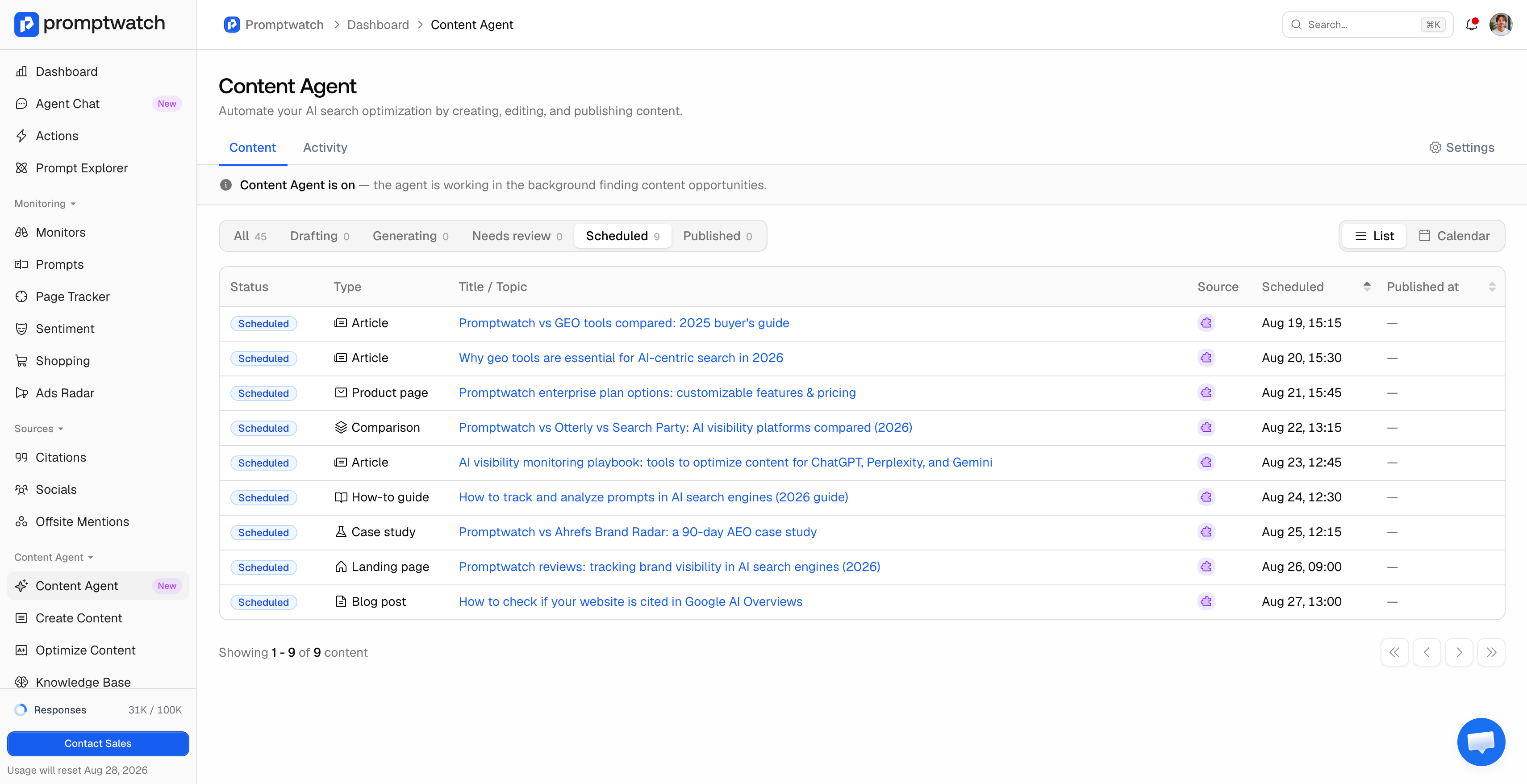
Promptwatch's own product vocabulary treats "agent" the same way: Content Agent drafts AI-optimized pages, Agent Analytics tracks crawler behavior, Agent Chat answers questions and takes action inside a conversation, and Agentic AI Search Optimization runs the whole loop as a managed service. Each is grounded in a customer's own citation and crawl data rather than a generic prompt a distinction covered in more detail below.
How SEO Agents Actually Work
Agentic SEO tools generally move through a version of the same loop:
- Research. The agent pulls keyword or prompt data — search volume, AI prompt volume, competitor gaps to decide what to target next.
- Coverage check. It compares that target against what the site already publishes, to see whether an existing page already answers it or whether there's a real gap.
- Draft or fix. It generates a content brief or full draft, or flags a technical issue (a missing meta tag, a blocked crawl path, thin content).
- Review. A human or, in opt-in configurations, an automated quality gate approves the output before it goes live.
- Monitor. The agent tracks what happened after publication: did rankings move, did AI models start citing the page, did crawlers even reach it.
This is close to how Promptwatch's own Content Coverage methodology works: Query Fan-Out breaks a tracked prompt into the sub-questions an AI model actually asks internally, a semantic search checks whether the site's indexed content can answer each one, and gap detection turns the unanswered ones into a content brief. The mechanism matters more than the label an agent that can't explain why it's recommending a specific page or fix is asking for trust it hasn't earned.
The Three Types of SEO Agents in the Market Today
- Content-generation agents draft briefs and articles from keyword or prompt data, often with CMS publishing built in. This is the most crowded segment and the one most current "best AI SEO agents" roundups focus on almost exclusively.
- Technical-audit agents crawl a site for speed issues, broken links, schema gaps, and crawlability problems, and generate fixes or tickets.
- AI-visibility agents the newest and least covered category, closer to LLM visibility tools than to a content drafter track whether AI models mention and cite a brand at all, show which pages get retrieved, and connect that back to actual site traffic. This is where agentic SEO diverges most sharply from its pre-AI-search predecessor: content and technical fixes only matter if a model can find, trust, and choose to cite the page in the first place.
Most published comparisons of AI SEO agents cover only the first two categories, reviewing published feature lists rather than testing outcomes, and treating "GEO" as a settled term without defining it for readers who haven't encountered it. A genuinely useful SEO agent operates across all three, otherwise a team optimizing content and technical health has no idea whether any of it is moving AI visibility.
Why Content and Technical Fixes Alone Aren't Enough Anymore
Three mechanics explain the gap.
- Content in AI search decays quietly. Based on Promptwatch's own analysis, citation relevance holds for roughly 8–14 weeks before a refresh helps. Models re-crawl and re-index regularly, so a page can lose citations with nothing broken, no ranking drop, no 404, no traffic cliff a standard SEO dashboard would catch. An SEO agent that only checks technical health will miss this entirely, because nothing is technically wrong.
- Real interfaces and API responses aren't the same thing. Many tools measure AI visibility by querying model APIs directly. Promptwatch instead scrapes the live, geo-located, locale-matched interface of each platform what a real user in that market actually sees, including citations and localized ordering an API call wouldn't return. An SEO agent grounded in API responses is reporting on something users never encounter.
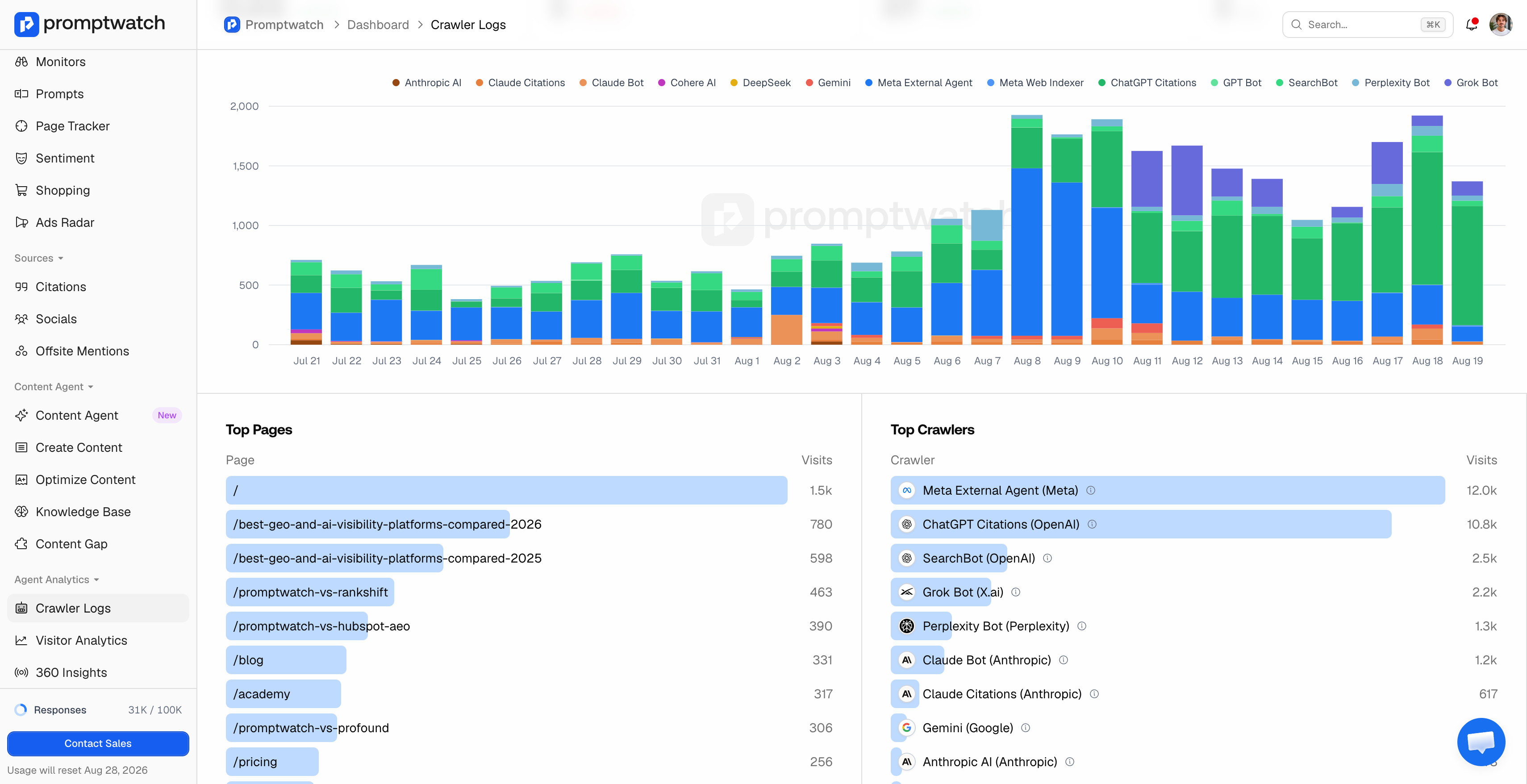
- Crawlers are not visitors. AI crawler logs show what a model can see when it requests a page. Visitor analytics show what's actually converting from AI-referred traffic. An agent that conflates the two, treating a bot hit as equivalent to a human visit produces reporting that looks complete and tells a team nothing about revenue.
None of this replaces content and technical optimization. It's the layer most SEO agent comparisons skip, because it requires crawler-log infrastructure and live-interface data collection that content-generation tools typically don't build.
What a Full-Stack SEO Agent Should Actually Do
A complete SEO agent needs four working parts, each grounded in the site's own data rather than generic instructions.
- Prompt tracking that monitors what a brand's audience actually asks AI models not just search-engine keywords tagged by intent (branded, informational, commercial, transactional) so a team can see where visibility is strong or missing at each funnel stage.
- Content generation grounded in a private knowledge base. A model given only a generic prompt produces generic prose. Promptwatch's Content Agent instead retrieves a customer's actual citation data, content gaps, and proprietary research before drafting, so the output reflects specifics a competitor's agent working from public information alone can't reproduce.
- Crawler-to-citation visibility. Logging which bots hit which pages, and tying that back to which of those pages actually got cited, closes the loop between "AI can technically reach this content" and "AI chose to use it."
- Action items with an owner, not just a dashboard. A daily agent that surfaces prioritized, plain-language recommendations and lets a team assign each one to a specific person turns monitoring into a workflow instead of a report nobody acts on.
"Promptwatch stands out for its powerful features, especially its earned media tracking for off-site mentions, the 'Actions' feature, and its well-documented API integrations. It overall helps us take the right actions to improve our visibility in AI Search engines." Rutger van der Lee, Founder of NXT Pharma
Should an SEO Agent Be Allowed to Publish on Its Own?
This is the question that comes up in almost every conversation about AI content automation, and it deserves a direct answer rather than a hedge: it depends on the review step the agent is built around, not on how "autonomous" its marketing copy claims to be.
Some SEO agents market themselves as fully autonomous without specifying what that actually means in practice whether a human ever sees a draft before it reaches a live CMS. Promptwatch's default is the opposite: every Content Agent draft goes to a review inbox, and nothing publishes until a person approves, edits, or sends it back. Publishing is a separate, explicit step from drafting. An optional hands-off mode exists for teams that want it pieces that pass an automated quality check publish on a schedule the customer sets, with allowed days and blackout dates but it's opt-in, not the default.
This matters because "will AI-generated content sound generic?" is close to a universal question the moment content automation comes up. The honest answer is that generic inputs produce generic output regardless of the tool. An agent grounded in a brand's actual citation data, content gaps, and voice guidelines writes something more specific than a competitor could reproduce from public information alone but that grounding, not the word "autonomous," is what actually determines quality.
How to Choose an SEO Agent
A few questions separate a genuinely useful agent from a well-marketed content drafter:
- Does it show its reasoning, not just its output? An agent that recommends a fix should explain why which prompt is unanswered, which page is losing citations, which crawler got a 403. A recommendation without a visible cause is a guess with better formatting. Promptwatch's Action Items surface this by default: every item comes with plain-language reasoning, a GEO impact estimate, and a severity badge, not just a task title.
- Does it cover AI visibility, not just search-engine ranking? If the tool only reports Google position, it's answering a narrower question than most buyers now need answered. Ask specifically whether it tracks citations and mentions across models like ChatGPT, Claude, Gemini, and Perplexity, not just Google's AI Overviews panel, which several tools in this category treat as a stand-in for full LLM visibility. Promptwatch tracks all 11 major AI platforms, available to select from on every plan including the entry tier.
- Does it separate crawler activity from human traffic? If a dashboard reports "AI traffic" as a single number, ask whether that blends bot requests with actual visitor sessions a distinction with a real revenue difference. Promptwatch tracks these separately by design: Agent Analytics shows what AI can see, Visitor Analytics shows what's actually converting, and the two are never blended into one figure.
- Can you see the data it's grounded in? An agent that generates content or recommendations should let you inspect the source material, the citation data, the content gap, the knowledge base passage, behind each output, not just the output itself. Promptwatch's Content Agent drafts are traceable back to the customer's own Knowledge Base, so a team can see exactly which citation or gap a recommendation came from.
- What's the actual review step? Ask directly whether drafts publish automatically by default, and if there's a hands-off mode, what quality gate and schedule controls exist before you'd turn it on. Promptwatch's default sends every draft to a review inbox — nothing publishes without approval — with an opt-in, schedule-bounded hands-off mode for teams that want it.
Frequently Asked Questions
What's the difference between an SEO agent and an AI writing tool?
An AI writing tool generates content from a single prompt. An SEO agent chains multiple tasks together research, drafting, technical fixes, monitoring with limited human input between steps.
Do SEO agents replace an SEO team?
No tool reviewed in this space claims full replacement, and the honest framing is closer to a force multiplier: agents handle repetitive research, drafting, and monitoring tasks, while strategy, brand voice, and final review stay with the team. Promptwatch's default workflow keeps a human in the review loop before anything publishes.
Can an SEO agent track visibility in ChatGPT and other AI models, or just Google?
Depends on the tool. Many agents marketed for "SEO" only extend traditional keyword tracking into Google's AI Overviews. Full LLM visibility — ChatGPT, Claude, Gemini, Perplexity — requires a platform built for that specifically, since AI models don't rank pages the way search engines do; they synthesize answers from whichever sources they judge most relevant to a given prompt.
How does Promptwatch's Content Agent decide what to write?
It maps existing pages against tracked AI responses to see which prompts are already answered and which aren't, then generates briefs for the gaps that are actually costing citations grounded in the customer's own knowledge base rather than a generic prompt.
Will content from an SEO agent get cited by AI the same way human-written content does?
Google's own guidance is that AI-generated content is acceptable as long as it demonstrates genuine expertise and trust signals with human oversight the concern is not how content is produced, but whether it provides real value. Content grounded in a brand's own data and reviewed before publishing has a much stronger case for citation than content generated from a generic instruction.


