


TL;DR
- Coding agent visibility is how often an AI coding agent like Claude Code or Codex recommends, installs, or builds around your product when a developer asks it to plan or build something. It extends AI visibility tracking to technical users who are actively choosing their stack.
- Promptwatch now tracks Claude Code and Codex on every plan, with the same visibility, mention, sentiment, and competitor metrics it uses for ChatGPT, Gemini, and Perplexity.
When a developer asks Claude Code to "set up the backend for my SaaS app", the agent picks a database, writes the install command, and builds around it. That moment is one of the highest-intent signals a software company can observe: someone is choosing their stack right now. Many teams already practice AI model mention monitoring across the LLMs. Tracking coding agents adds the view from users who are actively building.
What is coding agent visibility?
Coding agent visibility is how often an AI coding agent recommends, installs, or builds on your product when a user asks it to plan or build software. The main coding agents today are Claude Code (Anthropic) and Codex (OpenAI). Both run inside a developer's terminal or editor and act on the codebase directly.
You track it the same way as visibility in any other AI model: the same prompts approach, the same metrics, the same competitor benchmarks. What coding agents add is a specific audience and moment. The people using them are developers and technical teams, and they are usually planning a build or brainstorming which technology to use, so their prompts are technical and high-intent.
In practice, coding agent visibility answers four questions:
- Is your product in the plan? When the agent outlines an architecture, does your tool appear?
- Is it the default? Is it the first choice, an alternative, or a passing mention?
- Does the agent build instead of buy? Coding agents often write a custom solution instead of recommending any vendor.
- How does the agent describe you? Is your product framed as the standard option, or as legacy or overkill?
What coding agent tracking adds to your AI visibility data
For software companies, coding agents add three layers of insight on top of existing AI visibility tracking: users who are actively building, technical buyers asking technical questions, and recommendations that turn directly into installed code.
The recommendation becomes the install
When Codex writes npm install with your package into a project, your product becomes a dependency of that project. Replacing a dependency later costs the developer time, so the tool an agent picks on day one tends to stay.
This makes the recommendation self-reinforcing. Code built around your SDK produces tutorials, GitHub repositories, and forum threads that use your SDK, and those become sources future agents learn from.
Planning prompts carry purchase-level intent
Developers ask a coding agent to plan a system when they are about to build it. A prompt like "build me a photo-upload feature with resizing and a CDN" comes from someone who is shipping that feature now. These are planning and brainstorming prompts, and the tool that gets picked is the one that gets used.
In Promptwatch's Intent Types, most coding agent prompts map to Transactional, the highest-intent stage, even when no brand is named.
Technical users ask technical questions
The people giving instructions to Claude Code and Codex are engineers, technical founders, and platform teams. Their prompts go deeper into the stack:
- which SDK handles retries
- which database supports branching
- which provider has the fastest API.
Tracking those prompts shows how AI represents your product on the details technical buyers care about.
Technical buyers are the path upmarket
At larger companies, these same technical users choose the stack and sign off on vendor evaluations. Being the default in their coding agent gets you in front of technical decision-makers without a sales call.
What research shows about how Claude Code and Codex pick tools
Two public studies give the best view so far of how coding agents choose tools: Amplifying's What Claude Code Actually Chooses (February 2026) and Armature's study of which tools Claude Code, Codex, and Cursor choose (September 3, 2026). Both point to the same conclusion: each coding agent has its own preferences, so each one is worth measuring.
Agents often build instead of buy
Amplifying ran 2,430 open-ended prompts through Claude Code in February 2026, across 20 tool categories and three Claude models, without naming any tool in the prompts. In 12 of the 20 categories, the most common "pick" was a custom-built solution rather than any third-party product.
Armature's September 3, 2026 study found the same pattern across agents. Claude Code built in-house solutions in 19% of sessions, nearly twice as often as Codex and Cursor (10%). For a SaaS company, this means your real competitor in a coding agent is often the agent writing 200 lines of code instead of calling your API.
A few defaults win almost everything
When agents do pick a vendor, a handful of tools dominate. In the Amplifying study, GitHub Actions took 93.8% of CI/CD picks, Stripe 91.4% of payments picks, shadcn/ui 90.1% of UI component picks, and Vercel 100% of JavaScript deployment picks. Armature measured a 90% win rate for Stripe in payments and 66% for Neon in databases.
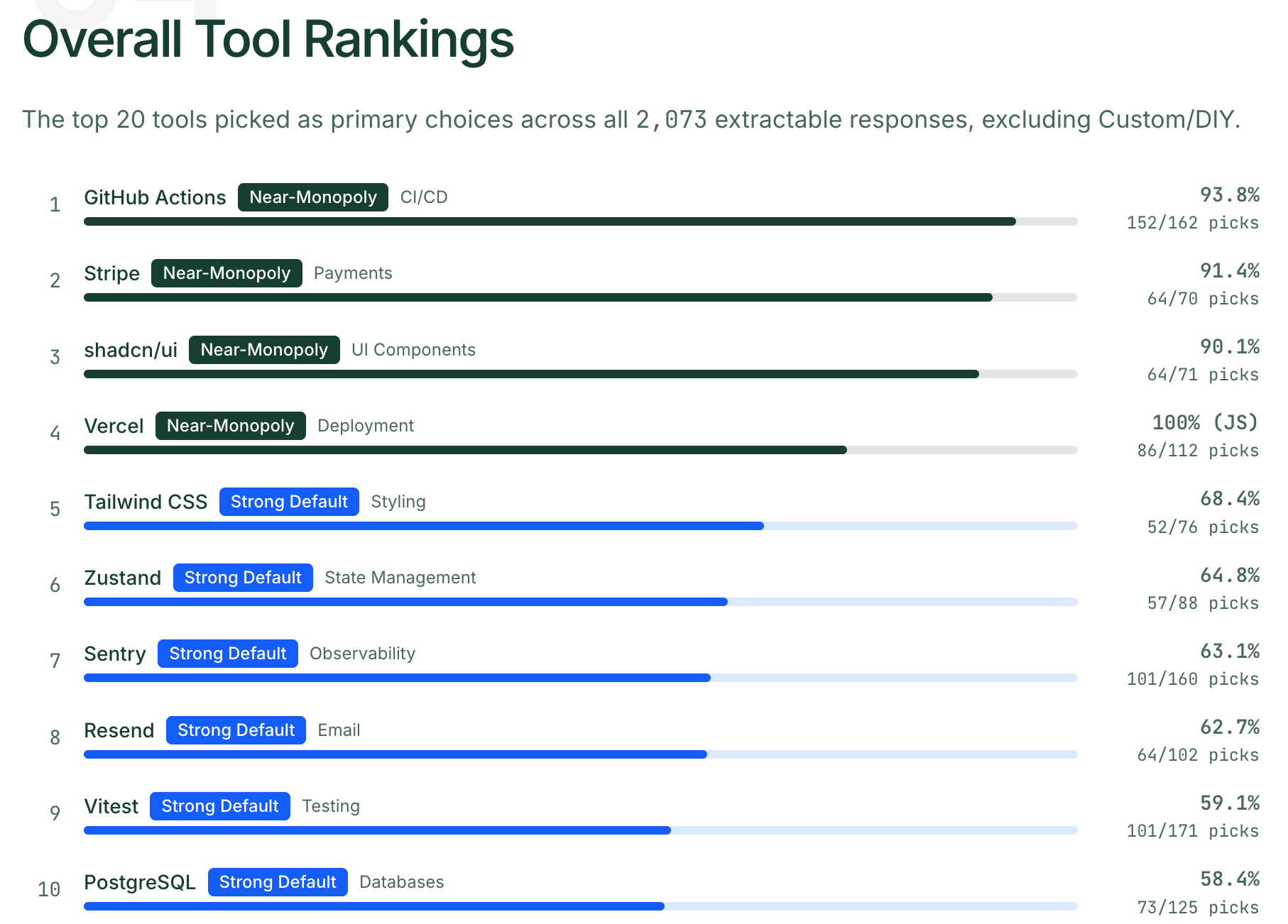
These are near-monopolies, and they're won at the model level. If your category already has a default like this, the job is to become the named alternative for specific use cases.
Mentions and selections are two different metrics
Armature separated tools an agent mentioned from tools it actually selected. PayPal was mentioned 139 times and never selected. LangChain was mentioned 194 times and chosen 4 times.
This is the coding agent version of a point Promptwatch makes about chat visibility: a high mention count with a low Visibility Score means the brand is present but not recommended. In coding agents, the gap between being mentioned and being installed is even wider.
Claude Code and Codex often disagree
In Armature's sessions, Claude Code, Codex, and Cursor chose the same tool in only 42% of cases. Their research habits differ too: Codex used web search in 94% of sessions, often with site-specific operators, while Claude Code searched the web in about 30% of sessions overall and around 80% in newer sectors.
That difference has a practical consequence. Codex's picks are more likely to reflect what's live on the web today, including your docs and recent comparisons. Claude Code's picks lean more on what the model already knows, so they shift more slowly. Tracking only one agent leaves you blind to the other.
Which prompts should SaaS companies track in coding agents?
Coding agent prompts are usually phrased as tasks, often name the stack, and ask the agent to make a choice. Before you choose prompts to track, map them to the decision the agent is actually making.
| Prompt category | What the agent decides | Example prompt |
|---|---|---|
| Framework and stack | Which framework the project starts on | "Create a new website with a backend and a static frontend." |
| Packages and SDKs | Which library gets installed | "Add rate limiting to my Node API." |
| Databases and infrastructure | Where data lives and what the app runs on | "Set up a Postgres database and deploy this app." |
| APIs and data sources | Which external service gets called | "Build a feature that pulls company data from an API with good docs." |
| AI models and routing | Which model provider or gateway is used | "I want to use several LLMs without separate subscriptions. Set it up." |
| MCP servers | Which MCP server the agent connects to | "Connect my agent to an expense management tool that has an MCP server." |
| Head-to-head choices | Which named option wins | "Should I use Next.js or Gatsby for this project? Pick one and scaffold it." |
The MCP row deserves extra attention. As more companies ship MCP servers, "which tool has an MCP server for X?" becomes a discovery question agents answer directly. If you've built an MCP server, you want coding agents to find it, recommend it, and connect to it.
Segment these prompts the same way you would for any model. Organic prompts (no brand named) show whether you're the default. Competitor Comparison prompts show how you do in a direct choice. Branded prompts are mostly a sanity check.
For coding agents, this applies twice over: a developer who types your brand name already knows you.
How to track Claude Code and Codex in Promptwatch
Claude Code and Codex work like any other model in Promptwatch. You add them to a project, run your prompts on a schedule, and read the results next to ChatGPT, Gemini, Claude, and Perplexity. Both are available on every Promptwatch plan.
1. Add Claude Code and Codex to your project
On Brands plans, each project actively tracks 4 models at a time, picked from the full list. For a dev-tool company, a sensible setup pairs Claude Code and Codex with ChatGPT and one more chat assistant, so you can compare what developers hear in chat with what agents actually build. Agency plans track all models at once.
2. Build a coding agent prompt set
Start from the seven categories above and write prompts as tasks, the way developers phrase instructions to an agent. Promptwatch's AI prompt tracking lets you tag each prompt by type and intent, import prompts in bulk, and generate suggestions from your Google Search Console queries or from competitor gaps.
Tag coding agent prompts clearly or give them their own monitor, so you can report on this high-intent, technical segment by itself.
3. Read the right metrics
Promptwatch scores every response with the same formula it uses for every model: Position + Context − Competitors. Responses where you're not mentioned count as zero. This is why your AI visibility score in coding agents can be much lower than your mention count suggests, which is exactly the mentioned-vs-chosen gap the research describes.
The metrics to watch per agent:
- Visibility Score: whether you're the default, an alternative, or buried.
- Share of voice against competitors: the competitor heatmap shows which tools the agent picks instead of you, prompt by prompt.
- Sentiment: how the agent describes you ("the standard choice" versus "heavier than you need").
- Model-by-model comparison: where Claude Code and Codex disagree about you, and how both compare to chat assistants.
4. Track the trend over weeks
Agent outputs vary from run to run, just like chat answers. Promptwatch runs monitors daily by default, so judge coding agent visibility on weekly and monthly trends.
What influences whether a coding agent recommends your tool
Only the model labs know exactly how Claude Code or Codex weighs its options. The research and Promptwatch's own data do show which levers you can actually control.
Consensus across the web
Agents pick tools the internet already agrees on. Stripe's 90%+ win rate in payments reflects years of tutorials, Stack Overflow answers, GitHub repositories, and comparison posts that all point the same way.
"It's no longer only about you shouting 'I'm the best' on your own website. It's about the entire internet reaching a consensus that you are the best."
For dev tools, that consensus lives in places marketing teams often ignore: GitHub READMEs, package registry pages (npm, PyPI), example repositories, framework integration guides, and developer forum threads.
Documentation agents can retrieve and use
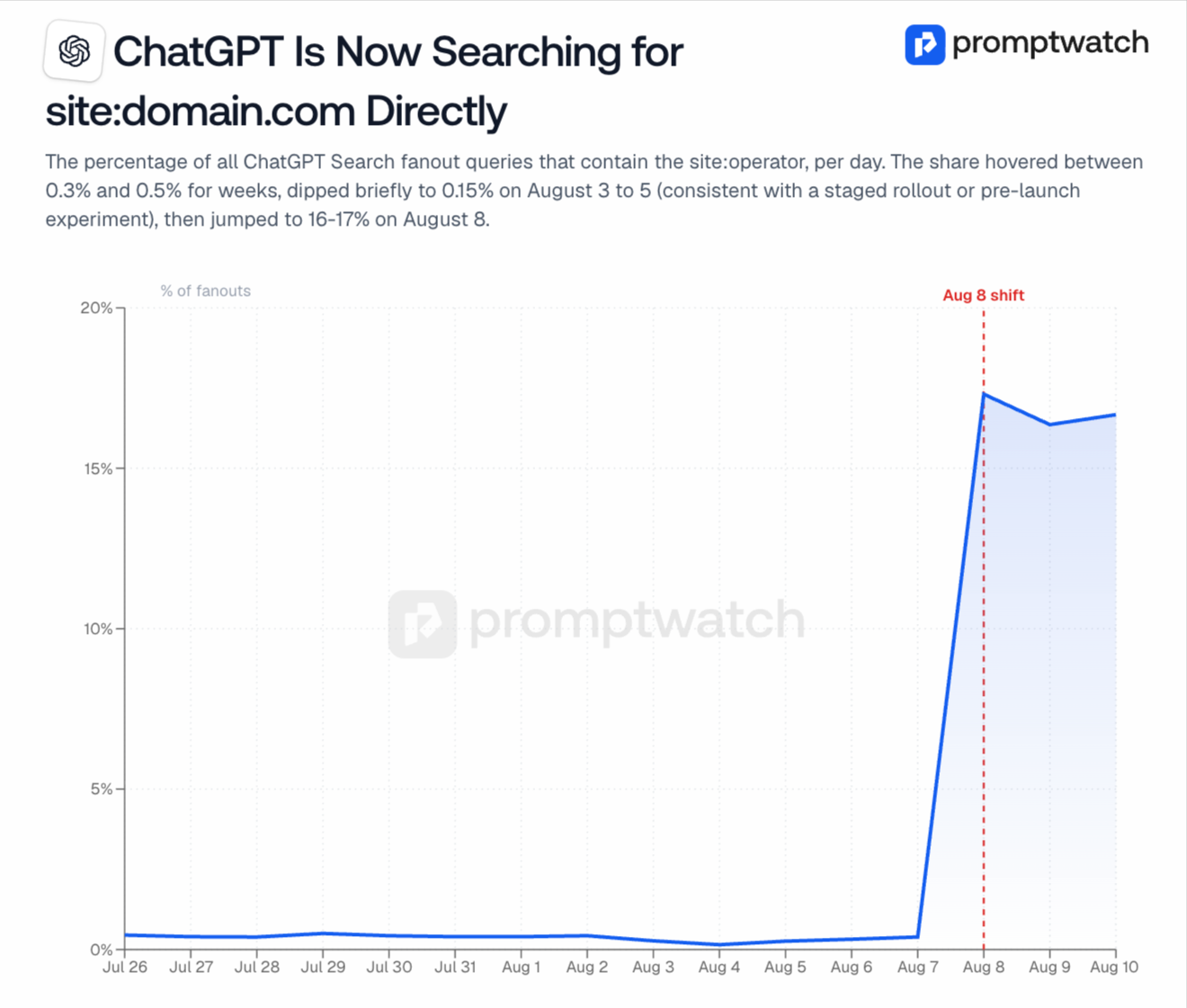
Codex searched the web in 94% of Armature's sessions, often with site-specific operators. Promptwatch sees the same behavior in ChatGPT Search: on August 8, 2026, the share of fan-out queries using the site: operator jumped from about 0.4% to about 17% overnight. An agent that runs site:yourdocs.com needs pages that answer "how do I install and authenticate this?" in a few clean, self-contained paragraphs.
Format matters less than retrievability. Promptwatch's data shows markdown files make up just 0.05% of all AI search citations, because markdown mainly serves agents reading your docs directly. Serve clean, parseable docs to agents, and judge them by whether agents can find and use them.
The same logic applies to llms.txt. Promptwatch's published position is that llms.txt has no measurable impact on AI search visibility yet. Treat it as a small convenience for agents.
Crawl access to the pages that matter
An agent can only recommend pages it can fetch. Promptwatch's AI crawler logs show which AI bots request which pages, with status codes, so you can see whether your docs, pricing, and quickstart pages return a 200 or are quietly blocked. Crawler activity shows what AI can see, so read it alongside your visibility data to connect access with recommendations.
This is part of a broader shift toward agentic web optimization: preparing your site for AI agents that take actions on a user's behalf.
Frequently asked questions
Can I measure how often Claude Code mentions my brand?
Yes. Promptwatch tracks Claude Code as a model, so you can run your prompts through it and measure mentions, Visibility Score, sentiment, and share of voice against competitors. Results show next to other AI models, so you can compare what Claude Code recommends with what ChatGPT or Claude chat recommends.
Can I track whether Codex recommends my product over the market leader?
Yes. Add Codex to a project, write Competitor Comparison and organic prompts for your category, and the competitor heatmap shows which tool Codex picks, prompt by prompt. Visibility Score then weighs whether you're the default, an alternative, or buried.
Which Promptwatch plans include Claude Code and Codex tracking?
Every plan. On Brands plans, each project tracks 4 models at a time chosen from the full list, so you pick Claude Code and Codex alongside the chat assistants that matter to you. Agency plans track all models at once.
Is coding agent visibility the same as GEO?
Yes, it's part of GEO. GEO covers how AI systems choose which brands to name and cite, and coding agent visibility applies the same tracking to Claude Code and Codex. It adds insight into technical users who are actively building, and whose choices turn into installed packages, API calls, and MCP connections.
Why do Claude Code and Codex recommend different tools?
They're built on different models, trained differently, and research differently. In a September 2026 study by Armature, Claude Code, Codex, and Cursor picked the same tool in only 42% of cases, and Codex used web search in 94% of sessions compared with about 30% for Claude Code. Each agent needs its own tracking.
Which companies benefit most from tracking coding agents?
Any company whose product gets chosen during a build: SaaS platforms with APIs, developer tools, databases, hosting and infrastructure providers, AI model providers and gateways, open-source packages, and companies that ship MCP servers. If a developer can install you, an agent can recommend you.


