


TL;DR
- GEO (generative engine optimization) and SEO aren't competing strategies. SEO gets you ranked on a results page; GEO gets you cited inside an AI-generated answer. Most teams need both, not one instead of the other.
- This isn't a fringe concern anymore: roughly 58% of Google searches now show an AI Overview (as of May 2026), and ChatGPT alone processes over 2.5 billion queries a day.
- The real mechanical difference isn't vibes, it's query fan-out: Google's AI Mode and AI Overviews break one question into several parallel sub-queries before synthesizing an answer. That's a retrieval pattern a traditional search engine doesn't use.
- GEO also isn't one thing to optimize for. ChatGPT, Perplexity, Claude, and Google's AI features run on different search backends and don't cite the same sources for the same query.
- If you're already doing solid SEO (structured content, real authority, technical crawlability), you're closer to "GEO-ready" than most GEO content implies. The gap is narrower, and more specific, than the hype suggests.
"GEO vs. SEO" gets framed as a rivalry more often than it should. In reality, they're answering two different questions. SEO is still about whether your page shows up in a ranked list of links on Google or Bing. GEO is about whether your brand gets mentioned, cited, or recommended inside the answer an AI system generates: a different outcome, with a different mechanism behind it, and a different way of measuring whether it's working. Below is what genuinely changes between the two, what doesn't, and an honest answer to the question a lot of marketers are quietly asking: is this actually a new discipline, or just SEO wearing a new name?
What is GEO, and how is it different from SEO?
SEO gets your content ranked on a results page. GEO gets your content cited, mentioned, or recommended inside an AI-generated answer. Neither replaces the other. They optimize for different outputs, and increasingly, for different platforms entirely.
If you've also seen this called "GEO optimization" or "GEO marketing," that's not a different discipline. It's the same practice, just phrased for a technical audience versus a marketing or strategy one. For the full definition and where the term actually came from, see what generative engine optimization is and how it works.
SEO vs. GEO at a glance
The cleanest way to hold the two side by side comes down to three questions:
- Target goal: SEO earns a high position in a list of links. GEO earns a spot inside the answer itself, often with no link at all.
- Input focus: SEO is built around keywords. GEO is built around natural-language prompts, semantic context, and full intent.
- Authority signals: SEO leans on domain authority and backlinks. GEO leans on entity recognition, brand mentions across third-party forums and reviews, and direct factual accuracy.
| SEO | GEO | |
|---|---|---|
| Optimizes for | Ranking position on a results page | Being cited, mentioned, or recommended inside an AI-generated answer |
| Primary surface | Google/Bing SERPs | ChatGPT, Gemini/AI Overviews, Claude, Perplexity |
| How the engine works | Indexes pages, ranks them against a query using a fixed set of signals | Retrieves passages from many sources, then synthesizes a single answer, sometimes with a citation and sometimes without one |
| Query format it responds to | Short, keyword-based | Longer, conversational, often multi-part |
| What moves the needle | Backlinks, on-page relevance, technical crawlability, site speed | Content structure, factual specificity, entity recognition, brand mentions across the web |
| Content style | Keyword-optimized pages, metadata, long-form guides | Q&A blocks, short summaries, lists, and definitions written to be lifted as-is |
| Output format | Text-based results, almost always | Can return a mix of formats in one answer (summarized text, tables, code, step-by-step lists), depending on the prompt |
| Content delivery | User clicks through to your page | The answer may fully satisfy the user without a click at all |
| Success metric | Rankings, organic clicks, CTR | Citation rate, share of voice, brand mentions |
| How stable results are | Same query tends to return a similar ranked list over time | Same prompt can return a different answer within minutes, since it's generated fresh each time |
Is GEO actually a new discipline, or just SEO with new vocabulary?
This is a fair question, and it deserves a straight answer instead of a dodge: several AI platforms don't run their own, fully independent ranking algorithm. Some sit on top of an existing search index rather than building one from scratch. If your mental model of GEO is "a totally new science replacing SEO overnight," that's not quite right, and pretending otherwise wouldn't hold up to five minutes of scrutiny.
Here's the more accurate version. GEO doesn't throw out SEO's fundamentals. Authority, structure, and relevance still matter in both. What's genuinely new is the retrieval mechanism behind how an answer gets built, and the output format it gets delivered in: a synthesized answer instead of a ranked list. That changes what "winning" looks like, even when the underlying quality bar is similar. A page can be excellent by every SEO standard and still never get pulled into an AI answer, for reasons that have nothing to do with its quality and everything to do with how that specific system retrieves and cites information. The next section gets into exactly why.
It's also worth sizing this honestly rather than treating it as hype. As of May 2026, roughly 58% of Google searches now surface an AI Overview, up sharply from a year earlier (Forbes). ChatGPT alone handles more than 2.5 billion queries a day (DemandSage), and Google's AI Mode has already passed a billion monthly active users. Whatever you call the discipline, that's not a rounding error in your traffic anymore.
The risk runs in both directions, though. Treating GEO as a totally separate function that needs its own team, its own budget, and its own tactics built from zero is just as inaccurate as insisting nothing has changed at all. The realistic position sits in the middle, and the rest of this page is built around that middle ground.
How the underlying technology actually differs
If there's one concrete, verifiable answer to "what's actually different here," it's this: the systems generating AI answers don't retrieve information the way a search engine ranks pages.
Query fan-out: how AI engines actually decide what to retrieve
When a question needs more than a simple lookup, Google's AI Mode and AI Overviews don't just run your query once. They break it into several related sub-queries, run them in parallel behind the scenes, and stitch the results into a single answer. The person asking never sees the individual sub-queries happen (Aleyda Solis, on Google's own description of the mechanism). That's a genuinely different retrieval pattern than "one query, one ranked list of ten blue links."
It has a direct practical consequence. A page that only targets the head term (say, "best CRM software") can miss every sub-query an AI system actually fans out to: pricing, integrations, security, onboarding time. A competitor who covers those specific angles can get cited multiple times inside the same answer, while a head-term-only page gets cited zero times, on the exact same topic. That's not a ranking problem. It's a coverage problem, and it's invisible if you're only looking at traditional keyword rankings.
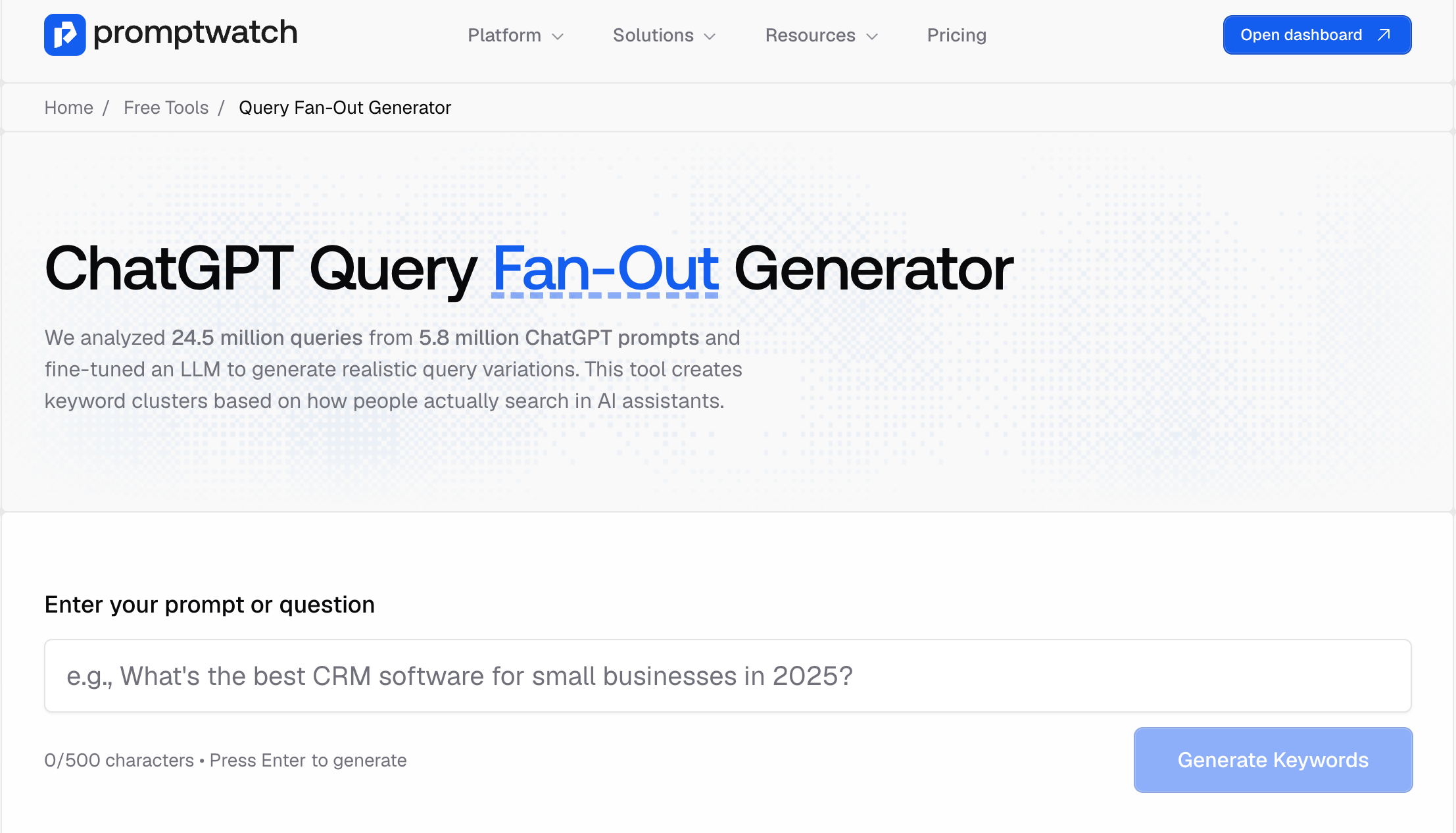
Rather than guess at what an AI system might fan a prompt out into, you can see it directly. Our free ChatGPT Query Fan-Out Generator shows the actual sub-queries a given prompt breaks into, so you can check your content's coverage before you publish instead of finding the gap after the fact.
Which search backend each AI platform actually runs on
This is also the answer to something that trips people up constantly: why does the same question get a different answer, with different sources, depending on which AI tool you ask? Because they're not all running on the same infrastructure.
| Platform | Search backend | What that means for visibility |
|---|---|---|
| ChatGPT | Runs primarily on Bing's index via its own crawlers | If you're not indexed in Bing, ChatGPT's web search has nothing to retrieve, regardless of your Google ranking |
| Google AI Overviews / AI Mode | Google's own index, retrieved via query fan-out | Standard technical SEO and crawlability still apply directly, since it's built on Google's existing index |
| Perplexity | Its own crawler and index (PerplexityBot), built independently rather than borrowed from another engine | Blocking PerplexityBot in robots.txt makes you invisible on the platform outright, separate from any other engine's rules |
| Claude | Uses Brave Search as its web search backend when it searches at all | Claude leans more on trained knowledge than live retrieval for many queries, so consistent, authoritative presence over time matters as much as any single page |
(Backend mapping per Hitit Medya's breakdown of which search engine each AI assistant uses, corroborated on the Claude/Brave pairing specifically by Profound's analysis of Claude's web search behavior.)
This is also the real explanation behind something you'll notice the moment you test the same prompt across tools: you'll get different sources, sometimes wildly different ones, for what looks like an identical question. That's not inconsistency for its own sake. It's four different retrieval systems making four independent decisions.
Knowing which crawlers are actually reaching your site in the first place is a prerequisite for any of this working. This rundown of the AI crawlers currently active is worth checking against your own logs, and Agent Analytics shows you, in real time, which of these are actually visiting your site, rather than assuming based on the table above.
Where GEO and SEO genuinely overlap
Before getting into where the two pull apart, it's worth being direct about how much they share, because a lot of GEO content implies you're starting from nothing. You're probably not.
- Structured content (clear headers, lists, FAQs) helps both a crawler and a generative model parse a page.
- Topical authority and content clusters lift visibility in both search results and AI answers. A scattered, one-off page underperforms in both, for the same underlying reason.
- Technical crawlability is a prerequisite for both. An AI system can't cite what it can't read, the same way a search engine can't rank what it can't index.
- Original data and cited statistics earn backlinks in SEO and earn citations in GEO: the same underlying behavior, rewarded differently by each system.
If you're already doing this well, structuring a page so both a crawler and a model can use it is less of a rebuild than you'd expect and more of a targeted addition.
Where GEO and SEO genuinely diverge
Content strategy: keywords vs. prompts
SEO content is built around short, typed phrases. Content that's actually going to hold up as the answer to a longer, conversational question needs something different. Subheadings phrased as real questions ("What is...", "How does...") tend to match how people actually prompt AI tools, rather than how they'd type into a search bar. It's also worth knowing that prompt volume behaves differently than keyword volume: they're measuring two different pools of language, not the same demand viewed through a different lens.
Output format: ranked links vs. a single synthesized answer
A search engine hands the user a menu of options and lets them choose. A generative engine makes that choice for them and delivers one answer. That's why a page can rank #1 on Google and never get cited by an AI system for the exact same question, and why the reverse (a page that's barely visible on Google but gets cited regularly in AI answers) happens just as often. If you want a model to attribute a specific claim to you by name instead of restating it in its own words, there's a real, practical lever for that, and it's more specific than "write better content."
Off-site signals carry more weight in GEO
AI models weigh third-party corroboration (what other sources say about a brand) more heavily than a page's own claims about itself. Most comparisons stop at a vague nod to "reviews and social proof." It's worth being more specific than that: this is most visible on Reddit right now, where threads get cited directly and frequently in AI answers, entity recognition across review platforms and forums matters more than any single backlink, and how consistently a brand is described across the web feeds directly into whether a model treats it as a trustworthy source worth citing at all.
Measurement: rankings and clicks vs. citations and share of voice
The metrics themselves change too, and not just in name. SEO's numbers (rankings, clicks, CTR) tell you whether people found you and clicked through. GEO's numbers have to answer a different question, since a citation can happen with zero clicks attached to it. That's different enough to deserve its own section below, rather than a single line here.
How to shift your strategy from SEO-only to SEO + GEO
If you already run SEO, the honest starting point isn't "here's everything you need to build from scratch." It's narrower than that.
Keep doing: technical SEO, site structure, backlink building, and keyword research for navigational and transactional intent. None of it becomes obsolete.
Add: conversational subheadings phrased as real questions, FAQ sections with short factual answers, and statistics specific enough to be quoted in isolation, out of context, and still make sense.
Check, don't assume: confirm you're actually crawlable by the backends in the table above: Bing's index, Perplexity's own crawler, Google's index. A page can be fully optimized by every SEO standard and still be invisible to one of these for a purely technical reason that has nothing to do with content quality.
Stop assuming: that ranking #1 on Google guarantees AI visibility, or that "optimizing for AI" as one category covers ChatGPT, Perplexity, and Claude at once. It doesn't. See the backend table again if that's not landing yet.
Once you actually know where the gaps are, Content Agents can close them without starting the whole process over from a blank page. And if you're checking whether a specific gap even exists, it's worth reading about what it looks like when a brand is technically fine on Google and still never shows up in AI answers. It's a more specific failure mode than "bad SEO," and it needs a different diagnosis.
How to measure whether your GEO efforts are working
| Metric | What it tells you | SEO equivalent |
|---|---|---|
| Visibility score | Combined signal across mentions and citations, benchmarked over time | Overall organic visibility |
| Share of voice | How often you show up vs. named competitors, on the same prompts | Competitive rank tracking |
| Citation rate | % of tracked responses where you're cited as a source, not just mentioned | Featured snippet capture rate |
| Sentiment | Whether the tone of AI mentions is favorable, not just present | Brand sentiment / review score |
Getting any of these numbers starts with knowing which prompts to actually watch in the first place, rather than guessing based on your existing keyword list. From there, monitoring mentions as they happen turns this into something you can act on the same week, instead of finding out in a quarterly report that you've been invisible for three months.
Common GEO vs. SEO mistakes
- Treating GEO as a full replacement for SEO instead of an addition to it. The fundamentals underneath both are more similar than the hype suggests.
- Optimizing for "AI" as one category, when ChatGPT, Perplexity, Claude, and Google's AI features run on genuinely different backends, as the table above shows.
- Assuming a #1 Google ranking guarantees AI visibility. The two are correlated, not identical, and treating them as the same metric will misread your actual performance.
- Ignoring off-site presence (Reddit, press, review sites) because it doesn't show up in a traditional backlink audit.
- Having no way to measure any of it, so no way to tell whether the strategy shift is actually working or just adding effort without a result.
Platform-specific quirks compound all of this. ChatGPT specifically has its own behavior worth knowing. Treating it identically to Perplexity or Claude is its own version of the "one category" mistake above.
Frequently Asked Questions
Is GEO replacing SEO?
No. SEO still governs whether you show up in Google's traditional results, and AI features like Google's AI Overviews are still built directly on top of Google's own index. GEO adds a second, separate target (being cited inside a generated answer) on top of that, not instead of it.
What does "GEO in SEO" mean?
It usually refers to treating generative-answer visibility as one part of a broader SEO strategy, rather than a separate department. The overlap section above (structure, authority, crawlability) is exactly what that looks like in practice.
Is "GEO marketing" different from GEO?
No. "GEO marketing" is generally the phrase marketers use when talking about the discipline in a strategy or planning context, rather than the more technical "generative engine optimization." Same practice, different audience for the term.
Do ChatGPT, Perplexity, and Claude use Google's rankings?
No, not directly. As the backend table above shows, they run on different infrastructure (Bing's index, Perplexity's own crawler, and Brave Search, respectively), which is exactly why the same prompt can return different sources depending on which one you ask.
How long does it take to see GEO results?
Often faster than SEO, since AI answers regenerate on every query rather than waiting for a re-crawl. It's also less stable, though, since the same prompt can return a different answer within minutes. Track the trend over weeks, not any single response.


