


TL;DR: Best Rankscale Alternative
Promptwatch is best for teams that want fixed, predictable pricing and execution in one platform: all 11 AI platforms with 4 freely chosen per project, no engine-weighted credit math, plus crawler logs and a Content Agent that publishes to your CMS.
Why Look for Rankscale Alternatives?
Four reasons teams look elsewhere come up repeatedly in independent reviews.
- Credit-weighted pricing is genuinely hard to forecast. A ChatGPT or Gemini query runs roughly 0.25 credits, while a Claude query can run up to eight times that rate. A team that leans on Claude or DeepSeek burns through the monthly credit pool far faster than the headline "120 credits for $20" figure implies, so the real cost depends on which engines you actually use, not just how many prompts you track.
- It surfaces data but doesn't act on it. There's no content generation, content-gap-to-draft workflow, or CMS publishing. Rankscale shows what's happening; closing the gap is still manual work with a separate tool.
- No server-side crawler log product. Rankscale can't show whether an AI bot actually requested a page, separate from whether that page eventually got cited, and direct GA4 traffic attribution is still in beta.
- Its own published details are reported inconsistently across sources. Independent reviews disagree on which tier unlocks REST API access, some cite the $99/mo Pro tier, others cite a tier priced closer to $385/mo, and on how long the free trial runs, 7 days in some accounts, 30 in others. Confirm both directly before committing.
How We Evaluated These Alternatives
Every tool was measured against one question: does it make AI visibility spend predictable and actionable, or does it leave both the cost and the next step unclear?
- Pricing predictability. Flat, published allowances versus engine-weighted credits that can multiply cost depending on model mix.
- Content execution. Whether a citation gap turns into a published page, or the tool stops at a report.
- Crawler-to-citation evidence. Real server-side logs showing whether AI bots reached a page, not just whether it was later cited.
- Consistency of published information. Whether the vendor's own pricing and feature pages agree with independent reviews, or require confirmation before you can budget with confidence.
Pricing and feature coverage verified August 2026 against each vendor's public pricing page, supplemented by third-party review analysis. Several tools in this category, including Rankscale itself, have inconsistently reported details across sources, so confirm current numbers before you buy.
The 7 Best Rankscale Alternatives
Ranked by overall fit for teams that want predictable spend and a path to execution, not just the widest engine list at the lowest headline price.
1. Promptwatch: Best Overall Rankscale Alternative
Rankscale's $20/month entry price tracks more engines than any tool in this comparison, but the credit-weighted billing means the real cost depends heavily on which engines get queried, a Claude-heavy tracking plan can burn through the monthly pool several times faster than a ChatGPT-only one. Promptwatch's $95/month Essential plan uses fixed prompt allowances instead: 4 of 11 platforms freely chosen, with no engine costing more to query than another.
Key features
- 11 AI platforms available on every plan, including the $95 entry tier, ChatGPT, Perplexity, Google AI Overviews, Google AI Mode, Claude, Gemini, Meta Llama, DeepSeek, Grok, OpenCode, and Claude Code, all live today, with 4 tracked per project at a time.
- Real UI scraping, so visibility reflects what a user actually sees.
- AI crawler log analysis through direct CDN integrations (Akamai, AWS CloudFront, Cloudflare, Fastly, Google Cloud CDN, Netlify and Vercel), a product category Rankscale doesn't offer.
- Visitor analytics and conversion tracking for AI-referred human traffic, kept separate from crawler activity, where Rankscale's GA4 attribution is still in beta.
- Content Agent that drafts content grounded in citation and content-gap data and publishes to Webflow or Framer under a review gate.
- Actions and Agent Chat: Actions turns visibility data into prioritized next steps, each assignable to a team member as owner, and Agent Chat lets you ask about performance and act on the answer in one conversation.
- State and city-level prompt targeting on every plan, including Essential.
- Fixed, published pricing with no engine-weighting or credit math.
- API and MCP access included on every paid plan.
More than 1,780 brands and agencies run on Promptwatch, including Center Parcs, SIX Group, and Landytech, and it holds a 4.7/5 rating on G2.
Promptwatch has: fixed prompt allowances rather than engine-weighted credits, so a Claude query doesn't cost multiples of a ChatGPT query; a Content Agent that drafts and publishes to your CMS; AI crawler log analysis; and one consistently published price and feature set.
Rankscale doesn't: flat, unweighted usage, its credit model can charge up to eight times more per query depending on the engine; a content-generation or publishing product, by its own positioning it surfaces data but won't rewrite the page; a crawler-log product or confirmed GA4 traffic attribution, which is still in beta; or full agreement between sources on its own tier structure, which plan unlocks REST API and how long the free trial runs are both reported inconsistently.
Pros
- Fixed pricing with no engine-weighting, so the monthly bill doesn't shift based on which platforms you actually track
- A Content Agent and crawler log analysis close two gaps Rankscale's own reviewers point out directly
- One consistently published price and feature set, rather than details that vary by source
Cons
- Rankscale tracks more engines (17+) at a lower entry price; Promptwatch's 4-of-11 concurrency limit means fewer platforms run at once per project
- Rankscale's daily onboarding calls and Looker Studio connector are more hands-on than what ships at Promptwatch's entry tier
- Mistral, which Rankscale tracks, isn't in the Promptwatch catalogue, and neither is Microsoft Copilot
- Crawler logs start on Professional ($245/mo), not on the $95 Essential plan
Verdict
- Best for: Teams that got burned by unpredictable credit spend on Rankscale, or that need content execution and crawler evidence it doesn't provide.
- Why it wins: Predictable pricing, a content-execution layer, and crawler logs, three things Rankscale's own reviewers consistently flag as missing.
2. AIclicks
AIclicks pairs AI visibility tracking with an actual content-execution layer, live MCP server, documented REST API, and direct CMS publishing to WordPress, Webflow, Shopify, and Framer, plus an optional managed-service layer for teams that want help turning visibility into action. Engine access rises with the plan rather than being freely chosen: 3 platforms on Starter, 4 on Pro, 6 on Business, with full coverage Enterprise-only.
Key features
- Starter at roughly $59/month (30 prompts, 3 platforms); Pro at $189/month (150 prompts, 4 platforms); Business at $499/month (300+ prompts, 6 platforms); custom Enterprise for full coverage. One AIclicks-published source cites $39/month for what appears to be the same entry tier, so confirm the live number directly.
- Live MCP server and a documented REST API for domains, prompts, mentions, citations, and rankings.
- Direct CMS publishing claimed for WordPress, Webflow, Shopify, and Framer, though a G2 reviewer separately describes content-creation capabilities as still being built, so confirm exactly what's live today versus in progress.
- Daily refresh on every tier, and free standalone tools (a GEO audit and an AI citation tracker) with no card required.
Promptwatch has: all 11 platforms with 4 freely chosen per project at every tier, rather than a count that only rises by paying for a higher plan; a single, confirmed content-execution workflow instead of conflicting accounts of whether CMS publishing is live; and a 7-day free trial versus AIclicks' 3-day window.
AIclicks doesn't: freely chosen engine selection, coverage rises from 3 to 4 to 6 platforms only by upgrading; consistent agreement across its own marketing and independent reviews on whether direct CMS publishing is fully live today; or one published entry price, sources cite both $39/month and $59/month for what appears to be the same Starter tier.
Pros
- A genuine content-execution layer (MCP, API, CMS publishing) that most budget-tier competitors, including Rankscale, don't offer at all
- Optional managed service for teams that want execution help rather than another dashboard to operate themselves
- Self-serve entry tier with daily refresh and no sales call required to start
Cons
- Engine coverage is tier-gated (3 to 4 to 6) rather than freely chosen, and full coverage is Enterprise-only
- Only a 3-day free trial, and its own sources disagree on the entry price ($39 versus $59/month)
Verdict: A reasonable pick for teams that specifically want tracking plus a path to managed execution and can live with tier-gated engine access.
See our roundup of the best AIclicks alternatives.
3. Otterly.ai
At roughly $29/month, Otterly is the cheapest credible entry point in the category, with published, flat pricing rather than credit metering.
Key features
- Four core engines on Lite: ChatGPT, Google AI Overviews, Perplexity, and Copilot.
- Unlimited seats on every tier, including the cheapest one.
- API, MCP server, and Looker Studio connector from Standard ($189/month).
Promptwatch has: all 11 platforms selectable at the entry price with no per-engine add-on; API and MCP included on the entry plan; AI crawler log analysis; and a Content Agent that publishes to Webflow or Framer.
Otterly.ai doesn't: engine coverage beyond 4 core engines without paying $9 to $149/mo per add-on for Gemini, AI Mode, or Claude; API or MCP access before the $189/mo Standard tier; any crawler-log product; or content generation and CMS publishing at any tier.
Pros
- Lowest real, published entry price among dedicated AI visibility tools
- Unlimited seats at $29/month is unusual at this price point
- Flat, predictable pricing with no engine-weighting
Cons
- Lite caps at 15 prompts with no rollover, and Gemini, AI Mode, and Claude are paid add-ons
- Monitoring only: no content generation, no CMS publishing, no crawler logs
Verdict: The honest downgrade if budget is the binding constraint and content execution isn't the priority yet.
See our otterly alternative comparison.
4. LLM Pulse
LLM Pulse offers a transparent, published euro pricing ladder, a useful contrast to Rankscale's engine-weighted credit model.
Key features
- Starter at 49 euro/month (50 prompts), Growth at 99 euro/month (150 prompts), Scale at 299 euro/month (450 prompts, unlocks REST API).
- Five standard models included on entry tiers.
- MCP server included on every plan.
Promptwatch has: REST API on the entry-level paid plan; AI crawler log analysis; and a Content Agent that publishes directly to your CMS.
LLM Pulse doesn't: raw API access below its 299 euro Scale tier; any published crawler-log product; or a confirmed direct-to-CMS publishing step.
Pros
- Fixed, published pricing with no credit math or engine-weighting
- MCP ships on every plan, including Starter
- White-label arrives at Growth, well below where most competitors place it
Cons
- Raw REST API access is reserved for the 299 euro Scale tier
- No crawler-log product, and CMS publishing isn't documented beyond generating a brief
Verdict: A strong budget swap for teams that specifically want flat, predictable pricing without Rankscale's credit-weighting.
5. Trakkr
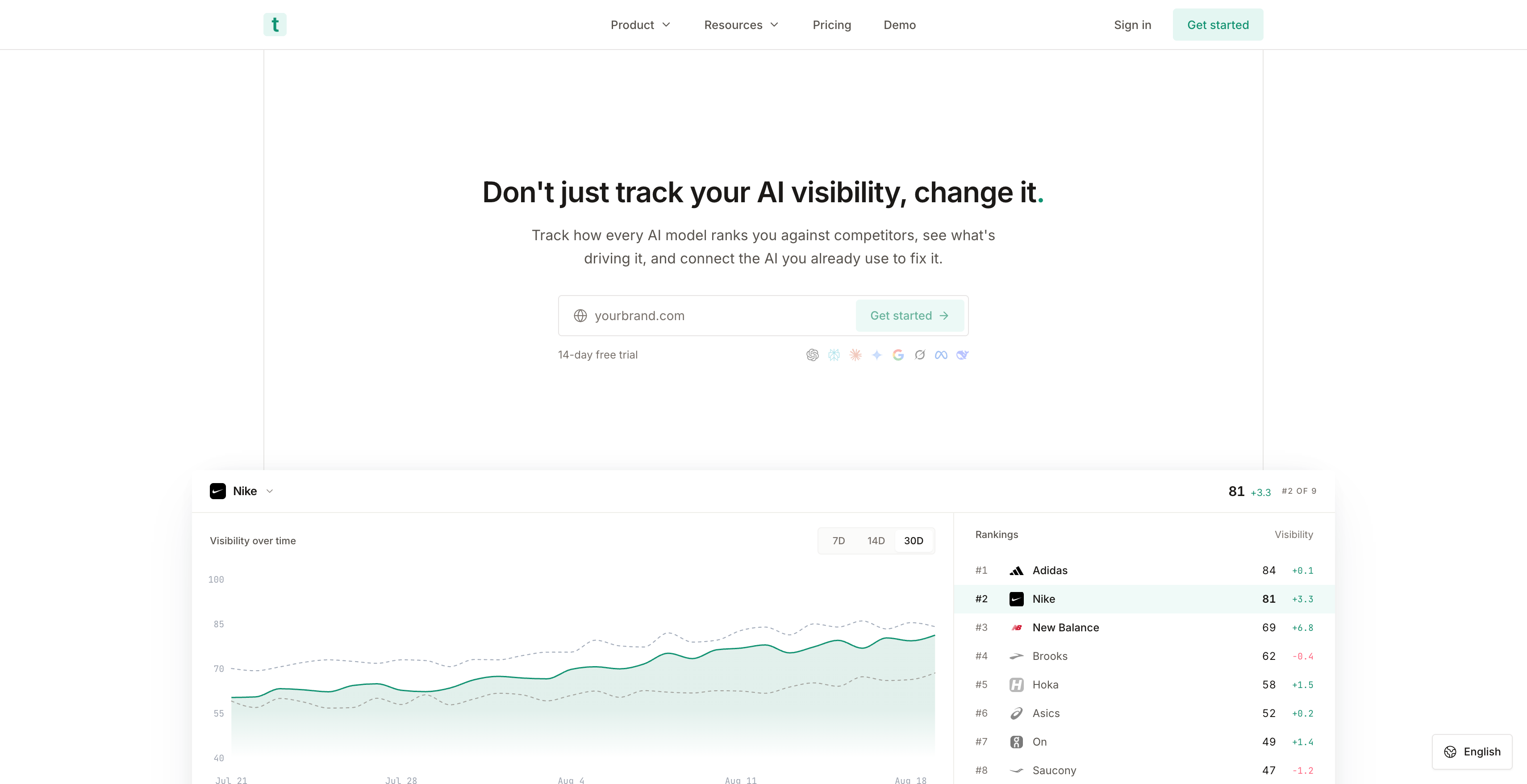
Trakkr takes the direct opposite approach to Rankscale's engine-weighted credits: one flat fee covers all 8 major models, full stop.
Key features
- 8 AI models on every paid plan, with no per-model add-on.
- Reddit intelligence and a stated "actions, not dashboards" philosophy.
- Full white-label agency support.
Promptwatch has: a Content Agent that drafts and publishes directly to Webflow or Framer; content gap analysis against your own indexed site; Reddit and YouTube citation feeds together; and one consistent published price.
Trakkr doesn't: any published claim of content generation or publishing; a YouTube citation feed to sit alongside Reddit; or agreement between its own pricing pages, one cites a $49 Starter plan, its official pricing page lists Growth at $100 as the entry tier.
Pros
- No add-on or credit math, the $100 Growth price covers the full 8-model roster
- Reddit intelligence ships without an Enterprise gate
- Agency white-label is included rather than upsold
Cons
- Its own marketing pages disagree on the entry price, confirm before you budget
- No published crawler-log or content-publishing product
Verdict: A strong swap for teams that want flat, predictable engine coverage without Rankscale's per-query weighting, provided a monitoring-only tool fits the job.
6. AthenaHQ
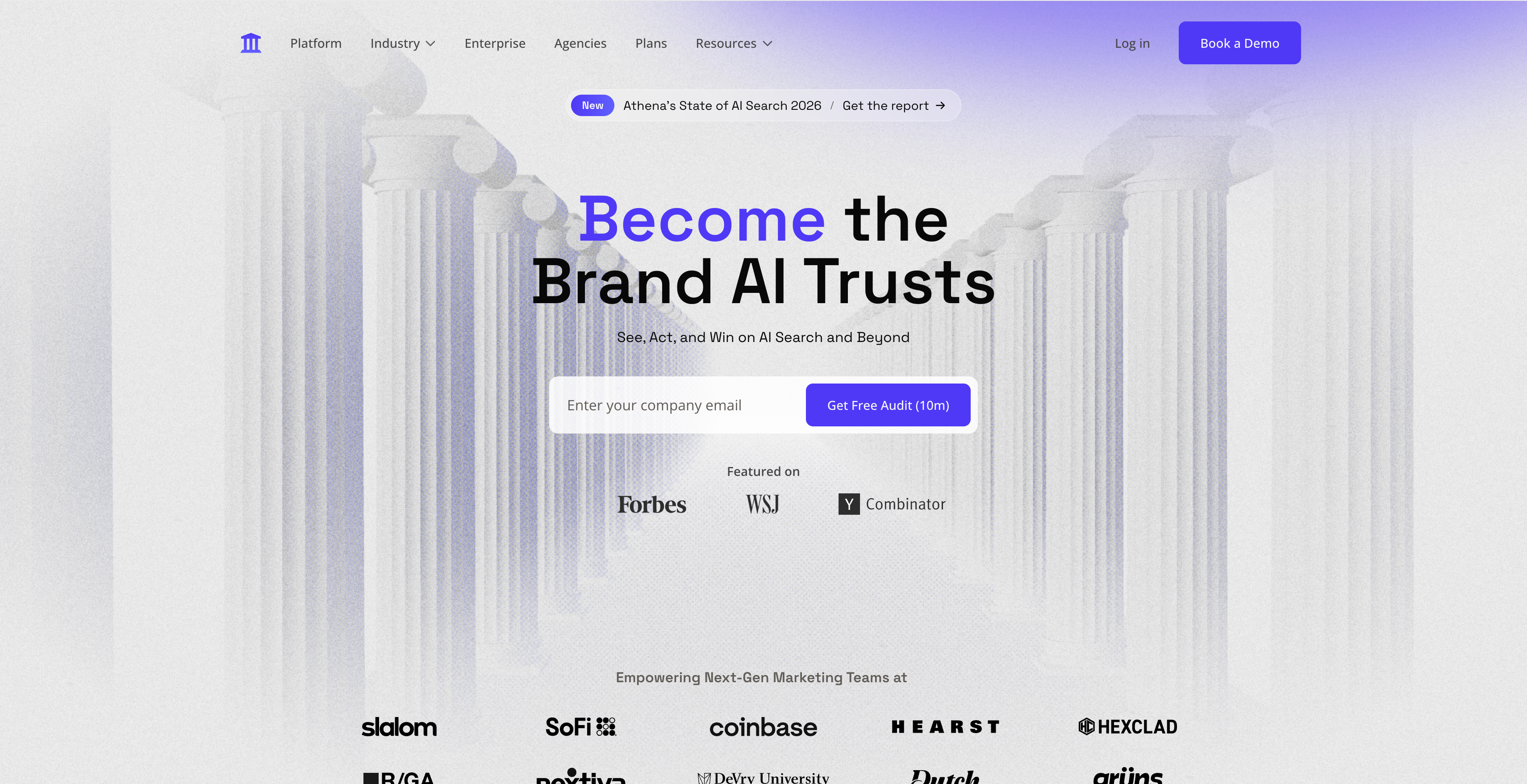
AthenaHQ ties AI visibility directly to revenue attribution, a layer none of the budget-tier trackers in this comparison offer.
Key features
- Self-Serve at $295/mo, all 8 major engines including Claude and Grok, no add-ons.
- Revenue attribution through GA4 and Shopify.
- Credit-based metering, unlimited seats.
Promptwatch has: an MCP server; REST API on a self-serve plan; state and city-level prompt targeting on every plan; and fixed, predictable monthly pricing.
AthenaHQ doesn't: an MCP server at any published tier; API or BI integrations below Enterprise; multi-country tracking below Enterprise, Self-Serve is single-country; or flat pricing, Self-Serve is credit-metered.
Pros
- All 8 engines included at the entry tier, no add-on math required
- GA4 and Shopify attribution makes the revenue conversation with finance easier
- Unlimited seats
Cons
- $295/mo entry and credit-based billing make real spend harder to predict than a flat plan
- No MCP server, and Self-Serve is single-country with API access Enterprise-only
Verdict: The move for teams that need to prove AI visibility's revenue impact, well past what a budget engine-tracker like Rankscale was designed to show.
See our AthenaHQ alternative comparison.
7. Searchable
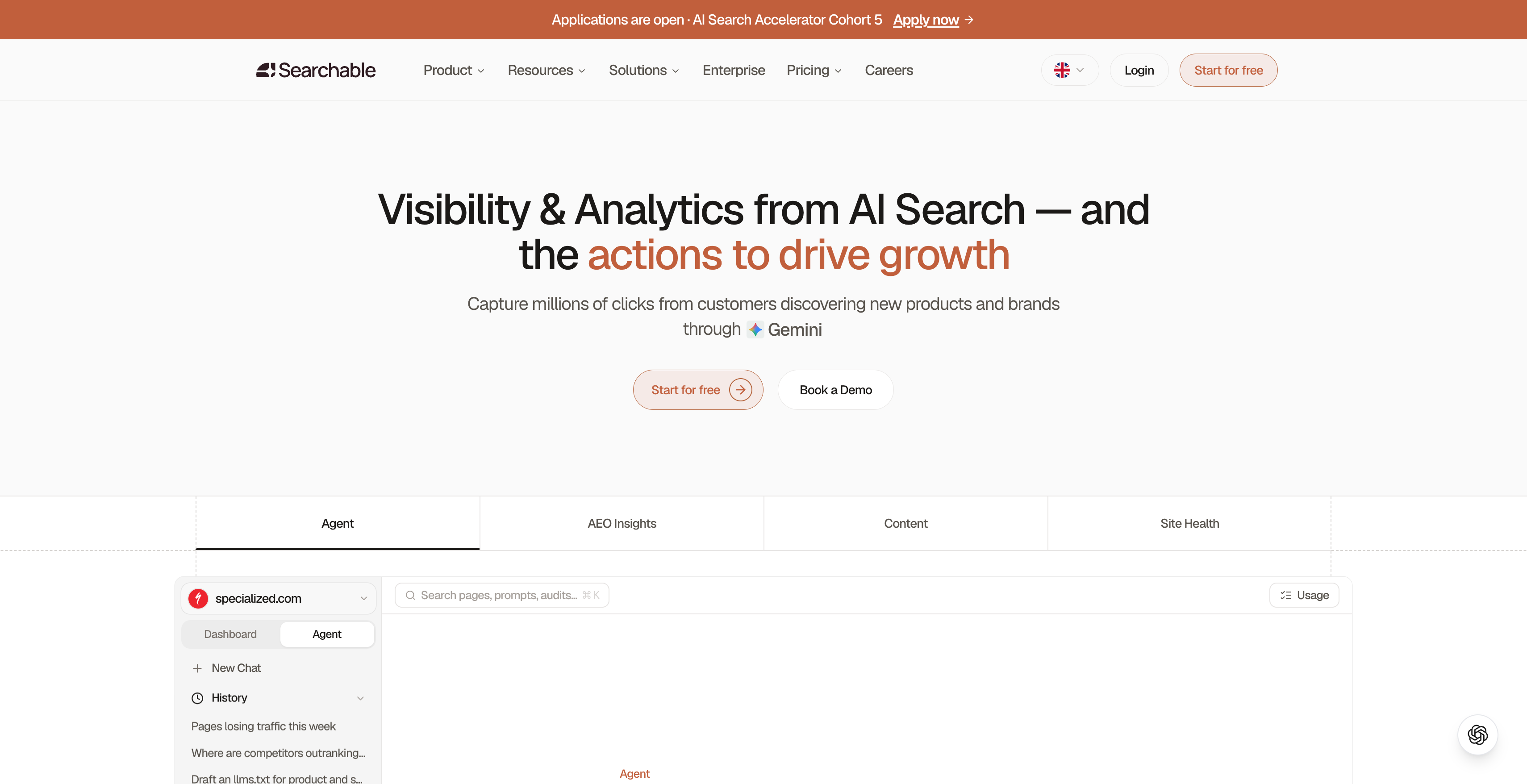
Searchable pairs AI visibility tracking with content generation and technical site audits in one product, closing the execution gap Rankscale's reviewers point to directly.
Key features
- $125/mo entry tier: 100 prompts across ChatGPT, Google AI Overviews, and Perplexity, plus 20 articles a month and 200 site audits.
- Mid tier: 500 prompts, 80 articles a month, white-label reports.
- Custom Enterprise tier for Claude, Copilot, Grok, and DeepSeek.
Promptwatch has: all 11 platforms selectable at the entry price; AI crawler log analysis; and REST API plus MCP on a self-serve plan.
Searchable doesn't: more than 3 engines below its custom Enterprise tier; a published crawler-log product; or self-serve API access.
Pros
- Content generation and technical site audits ship in the same product as visibility tracking
- Transparent published pricing at every tier
- Daily prompt runs across available models
Cons
- Claude and other major models require the custom Enterprise tier
- No crawler-log product, and REST API is Enterprise-only
Verdict: A reasonable pick for teams that want tracking and content generation bundled and don't need Claude below Enterprise.
How to Switch From Rankscale to Promptwatch Without Losing Your Baseline
Recalculate your real spend before you compare plans. Rankscale's credit-weighted pricing means the number on its pricing page isn't the number that maps cleanly onto a flat-rate tool like Promptwatch. Pull your last two or three months of actual credit usage and break it down by engine, since a Claude- or DeepSeek-heavy tracking plan has been costing several times more per query than a ChatGPT-only one would. That gives an honest comparison point against Promptwatch's fixed $95/month for 4 freely chosen engines. Export your tracked prompt list as a spreadsheet, keeping the prompt text and any engine tags. In Promptwatch, paste the list or upload the file when adding prompts, up to 1,000 at a time, and rebuild the competitor set manually since that doesn't carry over.
FAQ
Why do people look for Rankscale alternatives?
Four reasons come up repeatedly: credit-weighted pricing makes monthly cost hard to forecast, since a Claude query can cost up to eight times a ChatGPT query; there's no content generation or CMS publishing, the tool surfaces data but doesn't act on it; there's no server-side crawler log product; and independent sources disagree on Rankscale's own tier structure and trial length, which is worth confirming directly before signing up.
Is Promptwatch a good Rankscale alternative?
Yes, particularly for teams that want predictable monthly spend and a path from citation gap to published content. Promptwatch's $95/mo Essential plan uses fixed prompt allowances with no engine-weighting, and adds a Content Agent and crawler log analysis that Rankscale doesn't offer. The trade-off is that Rankscale tracks more engines (17+) at a lower entry price, if raw engine breadth on a tight budget is the priority, that's a real point in its favor.
Does Rankscale's credit model really cost more for some engines?
Yes, based on independent reporting. A ChatGPT or Gemini query runs roughly 0.25 credits, while a Claude query can run up to eight times that rate. A team that queries premium models frequently will burn through the monthly credit pool much faster than the headline credit count suggests, so budget based on your actual engine mix, not the advertised number alone.


