


TL;DR
- Agentic search optimization (ASO) is a distinct discipline from GEO. GEO gets your brand cited in an AI-generated answer; ASO determines what happens when an agent follows that citation to actually complete a task, like booking, comparing, or buying.
- Agentic search runs in three practical stages: retrieval (the agent finds and shortlists options), evaluation (it cross-checks claims against outside sources), and action (it executes a booking, purchase, or workflow). Each stage has a different failure mode.
- Sites succeed or fail at the technical layer most retailers never audit: whether an AI agent can actually crawl, parse, and act on a page, not just whether a human finds it appealing.
- Crawler activity shows what agents can reach; it doesn't show whether they act on it. Promptwatch's Agent Analytics and ChatGPT Shopping tracking separate those two signals rather than blending them into one vague "AI traffic" number.
Agentic Search Optimization Isn't the Same Discipline as GEO
Generative Engine Optimization (GEO) is about getting a brand named, described favorably, and cited inside an AI-generated answer. Agentic search optimization is a step further down the funnel: it's what determines whether an autonomous AI agent, one that researches, compares, and increasingly acts on a user's behalf, can actually use your site to complete the task it was given.
The distinction matters because the two disciplines fail differently. Getting cited by ChatGPT or Perplexity only requires enough parsing to summarize or quote a crawled snapshot of a page, a comparatively low bar. Agentic search asks more: can a live agent that follows that citation actually execute against the current version of the page, extract structured data it can trust, or complete a checkout flow, without hitting a bot block, a JavaScript-rendered element it can't run, or a form with no machine-accessible path through it. A page can clear the first bar easily and still fail the second one entirely. Getting cited and getting used are different outcomes, and most sites are only measuring the first one. If you want the broader background on how agentic systems evaluate and act on content generally, see our guide to what is agentic search.
It's also worth separating agentic search optimization from agentic SEO, a related but different idea. Agentic SEO describes AI agents doing the optimization work itself, planning, executing, and iterating SEO tasks with less manual input. Agentic search optimization, by contrast, describes preparing your site to be found and used by AI agents acting on someone else's behalf. One is about agents as a labor source; the other is about agents as an audience.
The Three Stages of Agentic Search
Agentic search runs through a sequence, and each stage has its own failure mode worth understanding separately.
- Retrieval. The agent searches the web and builds a shortlist of candidates against whatever criteria the user (or its own system prompt) gave it. This stage looks a lot like traditional AI search: the agent needs to be able to find and parse your content in the first place, which depends on the same crawlability fundamentals GEO already requires.
- Evaluation. The agent cross-references what your site claims against third-party sources: reviews, comparison sites, forums, review platforms like G2 or Capterra. A brand can pass retrieval and still get dropped here if outside sources contradict or don't corroborate the on-site claim. This is the stage most sites have no visibility into at all, since it happens entirely outside their own analytics.
- Action. The agent executes the task: a booking, a purchase, a form submission, a workflow completion, through whatever machine-accessible interface the site exposes. A site with no structured way for an agent to complete an action effectively fails at the finish line, regardless of how well it performed in the first two stages.
The Technical Layer Most Sites Haven't Audited
Underneath those three stages sits a technical checklist that has nothing to do with how appealing a page looks to a human visitor. An AI agent needs to be able to reach a page (crawlability), parse what's on it in a structured way (accessibility of the underlying data), understand it without ambiguity (readability, both for humans and machine parsers), and, where relevant, actually execute a transaction against it (executability). Sites that pass a human-usability audit routinely fail one or more of these, because nobody has checked whether an agent, not a person, can complete the same task.
Practical levers that show up across most credible frameworks in this space:
- Solidify the SEO foundation. Site speed, clean HTML, and clear entity signals aren't optional groundwork here, they're a prerequisite an agent needs before it can do anything else with your page.
- Build third-party trust. Since the evaluation stage checks your claims against outside sources, reviews and mentions on independent platforms carry weight an on-site claim alone can't.
- Front-load direct answers. Structured data (schema markup) and concise, front-loaded answers reduce the parsing work an agent has to do, and reduce the chance it misreads or skips your content.
- Write for machine readability. Short paragraphs and explicit statements of what a product or service is actually for help an agent make a confident match, rather than guessing from vague marketing language.
If you want the fuller technical checklist for making a site legible to autonomous crawlers specifically, our guide on agentic web optimization covers that layer in more depth.
Measuring Agentic Search Performance
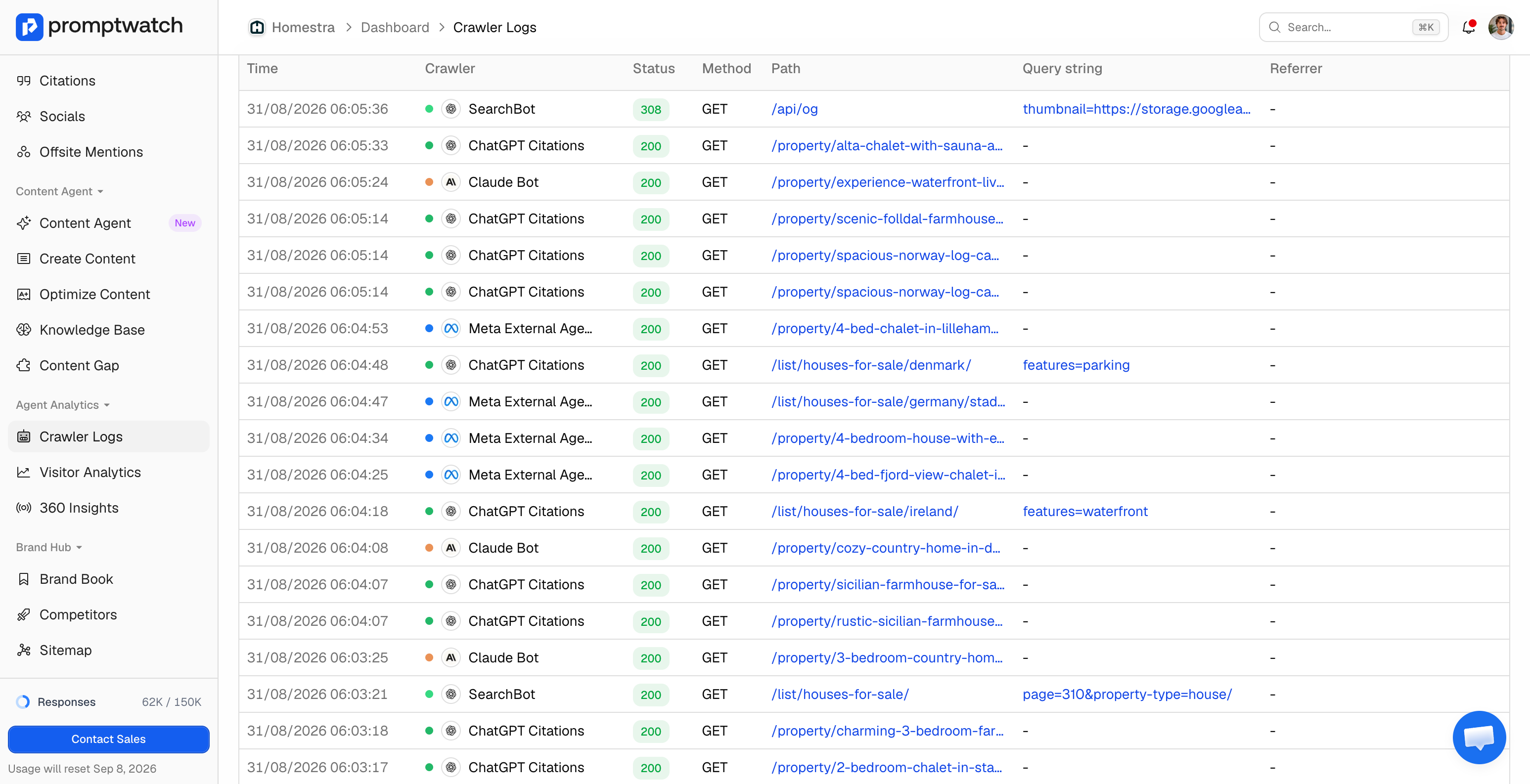
Most of the frameworks circulating right now stop at the checklist. The harder problem is measuring whether any of it is working, and that requires separating two signals that get blended together constantly: crawler activity and actual agent behavior.
Crawler activity, a bot requesting a page, shows what an agent can see. It says nothing about whether the agent used what it found, cited it, or acted on it. Promptwatch's AI crawler logs track the crawl-to-citation path specifically so this distinction doesn't get lost: which crawler (GPTBot, ClaudeBot, PerplexityBot) requested which page, what status code it got back, and whether that activity actually preceded a citation, rather than just counting hits.
"In Promptwatch we are able to see how active the ChatGPT bot is on our client websites and exactly how often our content is being used in responses of LLMs." Marijn ten Bulte, Head of Organic Channels, Advise
The action stage is the hardest of the three to instrument, since most of it happens inside a closed agent workflow you can't directly observe. The clearest current window into it is agentic commerce: when a shopping agent inside ChatGPT recommends or completes a purchase involving your product.
Promptwatch's chatgpt monitoring for product pages tracks how often specific products get recommended in ChatGPT's shopping surface, which is the closest thing available today to observing the action stage directly rather than inferring it from crawl data alone.
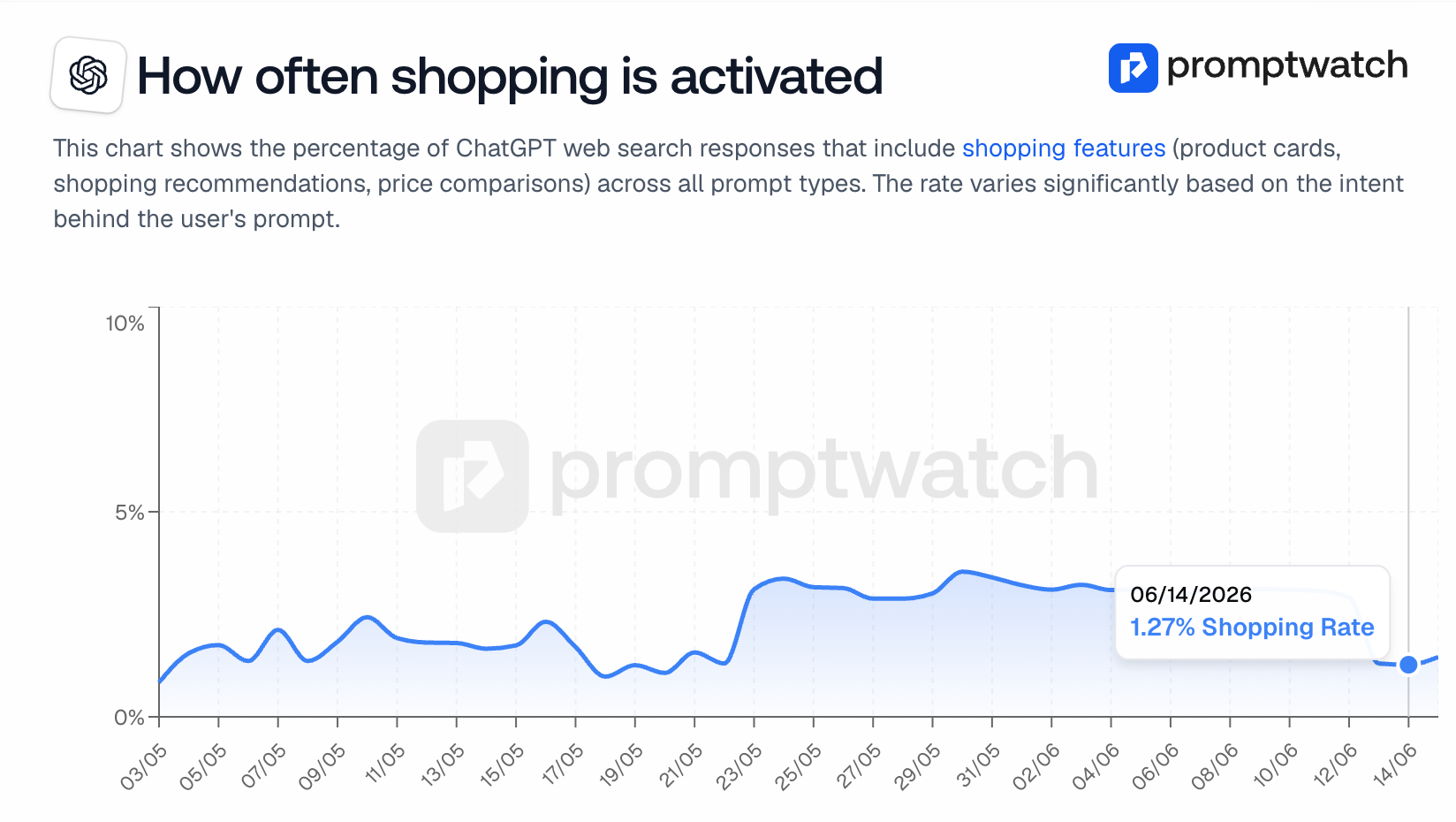
That window is narrower than it looks, though. Promptwatch's own tracking of ChatGPT shopping trigger rates puts the current baseline at a low single-digit percentage of ChatGPT's web-search responses overall, with the real activity concentrated in commercial and transactional queries rather than distributed evenly across prompt types. The baseline itself isn't stable either, Promptwatch has observed it jump sharply within a single day before settling back down weeks later, evidence that OpenAI is actively controlling the dial on when the feature surfaces rather than letting it scale organically. For now, the action stage is real but still a narrow, deliberately-gated surface, not yet the default outcome of a well-optimized site.
None of this measurement work is the same job as building an seo agent to automate the fixes. An SEO agent can act on what the data shows, publishing content, adjusting structured data, flagging technical issues, but it still needs the underlying retrieval, evaluation, and action data to know what to fix in the first place.
Why This Is Worth Treating as Its Own Workstream
It's tempting to fold agentic search optimization into an existing GEO or technical SEO program and call it covered. The risk in doing that is treating "the agent found us" and "the agent used us" as the same outcome, when they're measurably not. A brand can have strong crawler activity and a healthy visibility score in AI-generated answers while still losing every agent-driven transaction to a competitor whose site the agent could actually complete a booking or purchase on.
"Promptwatch pulls all your competitors and gives you an analysis of those prompt-versus-your competitors. There are a lot of tools out there, but this one is easier to see what matters and take action." Michael Cole, CMO, Everflow
FAQ
What is agentic searching?
Agentic search is when an autonomous AI agent researches, evaluates, and can act on a user's behalf, rather than just returning an answer. It runs through the three stages covered above, retrieval, evaluation, and action, and it's a subset of the broader AI search category: not everything AI-shaped (like a standard chat response) involves an agent that plans, evaluates, and acts.
What is the agentic version of SEO?
People usually mean one of two different things by this. Agentic SEO uses AI agents to do the optimization work itself, planning, executing, and iterating SEO tasks with less manual input. Agentic search optimization, the subject of this article, is the opposite direction: preparing your site to be found and used by AI agents acting on someone else's behalf, not using agents as labor.
Is ChatGPT agentic?
It depends on the surface. A standard ChatGPT response is AI-shaped discovery, not inherently agentic. But specific ChatGPT surfaces, its shopping features in particular, do involve an agent researching, evaluating, and recommending or completing an action, which is why tracking ChatGPT's shopping trigger rate is one of the few current windows into observing agentic behavior directly.
Can ChatGPT do SEO?
This is really the "agentic SEO" question, using AI agents to plan, execute, and iterate SEO tasks with less manual input, which is a different discipline from agentic search optimization. Whatever tool or model does that work still needs the underlying retrieval, evaluation, and action data to know what to fix; good SEO execution and good agentic search measurement are separate jobs.
Is SEO dead now with AI?
No. The technical prerequisites for agentic search, crawlability, clean structure, structured data, overlap heavily with standard SEO fundamentals, so agentic search optimization builds on solid SEO rather than replacing it. What's changed is that ranking well in Google no longer guarantees an AI agent will find, trust, or act on your page.


