What is citation rank?
Citation rank is the position of a citation within an answer’s list of sources, counted from 1. If ChatGPT answers with five sources and your page is the second one, that citation has rank 2. Your brand’s citation rank is the average rank of all citations pointing at your own domain, subdomains included. Rank matters because source order is not random. The sources an AI model lists first are typically the ones it leaned on hardest, and they get the clicks: a source card at the top of a Perplexity answer is visible, the eighth footnote is not. Being cited at rank 1 or 2 means your content is a primary source for the answer. Being cited at rank 9 means you made the bibliography.How the rank is computed
Every citation Promptwatch records stores its position among that answer’s sources. From there:- Rank starts at 1. The first source in the answer is rank 1, the second is rank 2, and lower numbers are better throughout the product.
- Only your own domain counts toward your citation rank. The metric follows your project website’s domain and its subdomains, so a citation of “docs.yourbrand.com” counts alongside “yourbrand.com”. See domains and subdomains for where else subdomains count.
- Ranks are averaged per day. Every citation with a position counts equally that day, so a busy day weighs more in a period average than a quiet one. The monitor card shows the latest day’s average and a sparkline of the daily series.
- Citations without position data are excluded from the average. Some responses return sources without a usable order; those citations still count as citations, they just don’t move the rank.
Citation rank vs. position in answer
The two are easy to confuse and measure different things:- Position in answer: where your brand appears in the answer’s text, among the brands discussed.
- Citation rank: where your page appears in the answer’s source list.
What moves it
Rank improves when models treat your pages as the authority for the question rather than supporting material:- Direct answers rank higher. A page that answers the prompt’s question head-on (“How much does X cost?” answered with actual numbers) tends to be cited before a page that mentions the topic in passing.
- Freshness helps. Models re-rank sources as they re-crawl. Updated pages with current data displace stale ones, including yours.
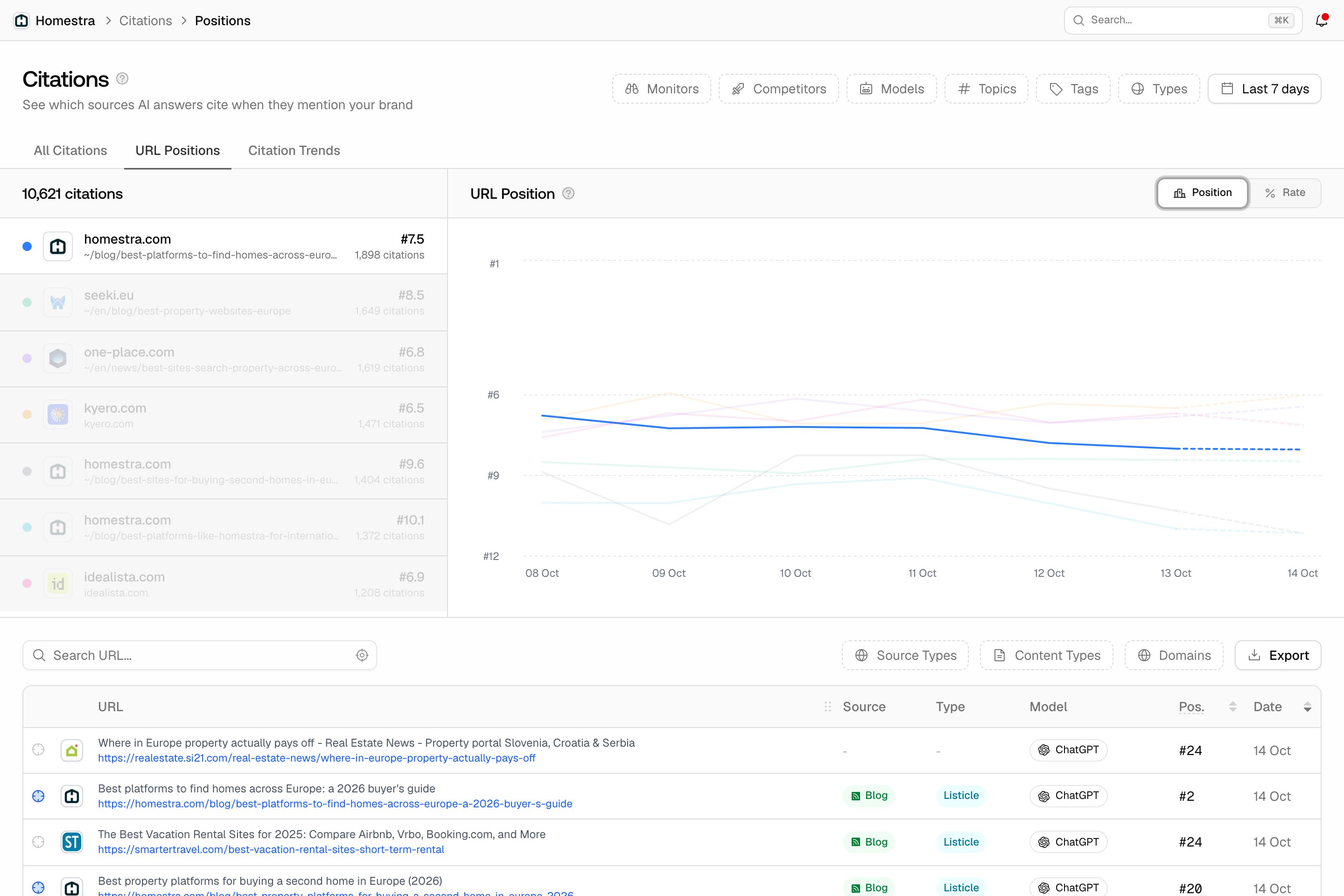
- Competition for the slot is per-prompt. Your average can fall because a strong new page entered the source lists for one high-volume prompt. The URL Positions view shows which pages hold the top slots.
Where to find it
Each monitor card on the Monitors page shows your current citation rank at a glance. For the underlying detail, open Sources in the left rail, then Citations, and switch to the URL Positions tab: it charts average position over time for the most-cited URLs, with a toggle between Position (where the URL ranks) and Rate (what share of responses cite it). This view covers all domains, not just yours, so you can watch which specific competitor pages hold the top source slots you want.