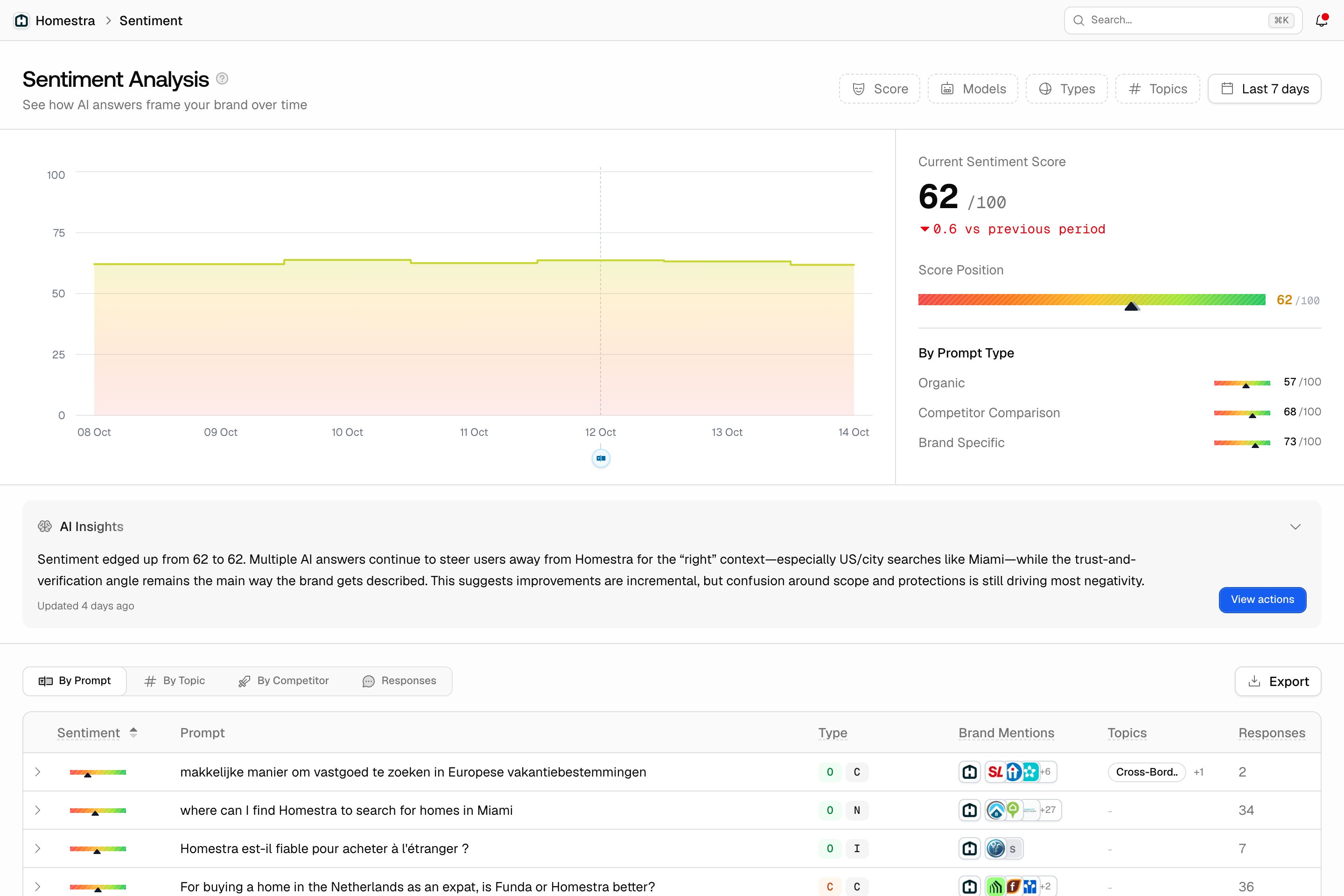
What is the sentiment score?
The sentiment score measures how positively or negatively AI models talk about your brand in their answers, on a 100-point scale. Around 50 is neutral, higher is more favorable, lower is more critical. A higher score means AI answers describe your brand more favorably across your tracked prompts. Sentiment is deliberately separate from visibility. Visibility measures how prominently you appear; sentiment measures the tone once you do. An answer built entirely around problems with your product can score near the top on visibility and near the bottom on sentiment, and that combination is exactly what you want to catch.How a response gets scored
When Promptwatch analyzes a response, it scores the tone of every brand the answer discusses, yours and your competitors’, using all passages about that brand:- Positive: recommendations, praise, or favorable comparisons push the score up. “The best in class” lands near the top of the scale.
- Neutral: factual mentions without a clear judgment sit around 50. “BrandX provides the listed features” is a 50, not a compliment.
- Negative: criticism, unfavorable comparisons, or caveats pull it down. “Works but has important limitations” lands in the low 40s; “avoid it, it is unreliable” lands near the bottom.
- Every statement counts, weighted by strength. Explicit recommendations, warnings, and direct comparisons weigh more than vague implications. Mixed coverage (“solid choice, but support can be slow”) balances out to the middle rather than taking the last sentence.
- Prominence never leaks in. Being first in a list, being repeated, or dominating the answer does not move sentiment. That is the visibility score’s job.
- Thin mentions get no score. If your brand only appears as a bare name in a list, with no evaluative context, the response records no sentiment rather than a fake neutral. Averages only include responses where a stance was actually determinable.
How the number you see is calculated
Each response that mentions your brand carries one sentiment score. Charts average those scores per day, and the headline Sentiment Score shows the most recent daily average from the last 30 days, so it stays meaningful even when your selected date range has quiet days. Unlike the visibility score, responses that don’t mention you are not counted as zero: sentiment describes how you are discussed, not whether you are.What moves it
Sentiment follows what the models read about you. The levers, roughly in order of impact:- Third-party coverage: reviews, comparison articles, Reddit threads, and support complaints are where models pick up caveats like “their API is limited”. Fixing the perception usually means fixing or answering the source, not your own homepage.
- Real product weaknesses that got documented: models repeat specific criticism (“setup takes time”, “support is slow”) long after you fix the issue. Publish updated content that addresses the criticism directly, so newer crawls carry the correction.
- Comparison framing: in head-to-head answers, sentiment often comes from how you compare, so a competitor’s strong launch can lower your relative framing without anything changing on your side.
Where to find it
Open Prompts in the left rail, then Sentiment. The page shows the score over time, a weekly AI-written summary of what changed, and the underlying responses, filterable by score range, AI model, prompt type, topics, and date range. The same score also appears on your dashboard and on each response, so you can always trace an average back to the exact answers behind it. For a tour of the page itself, see Sentiment tracking.