A monitor accumulates history: every response it collects feeds your visibility charts. That makes the three maintenance actions very different in weight. Editing changes how the monitor runs from now on, pausing stops it while keeping the data, and deleting erases everything it ever collected. For creating monitors in the first place, see adding a new monitor.

Editing a monitor

Open Monitors in the sidebar, click the monitor, and open its Settings tab. You can change:
  • Monitor Name: cosmetic only, so rename freely.
  • Persona and Persona stacking: which persona is used when generating prompts, and whether the persona prompt is injected around each tracked prompt at run time, so the same prompt can be asked from your buyer’s perspective.
  • Language and Country: the locale your prompts run in, so answers reflect the market you’re tracking. Country-level tracking is plan-gated, as are the optional State (US only) and City fields.
  • Tracking frequency: how often the monitor checks the models for new responses. The field only appears when custom frequency is enabled for your organization (arranged through sales, not a standard plan feature); options are Daily, Every 2 days, Weekly, and Monthly, plus a default that inherits your organization’s cadence. See data freshness.
  • Models: which AI models every prompt in the monitor runs against, so adding a model widens coverage for every prompt at once. See choosing your models.
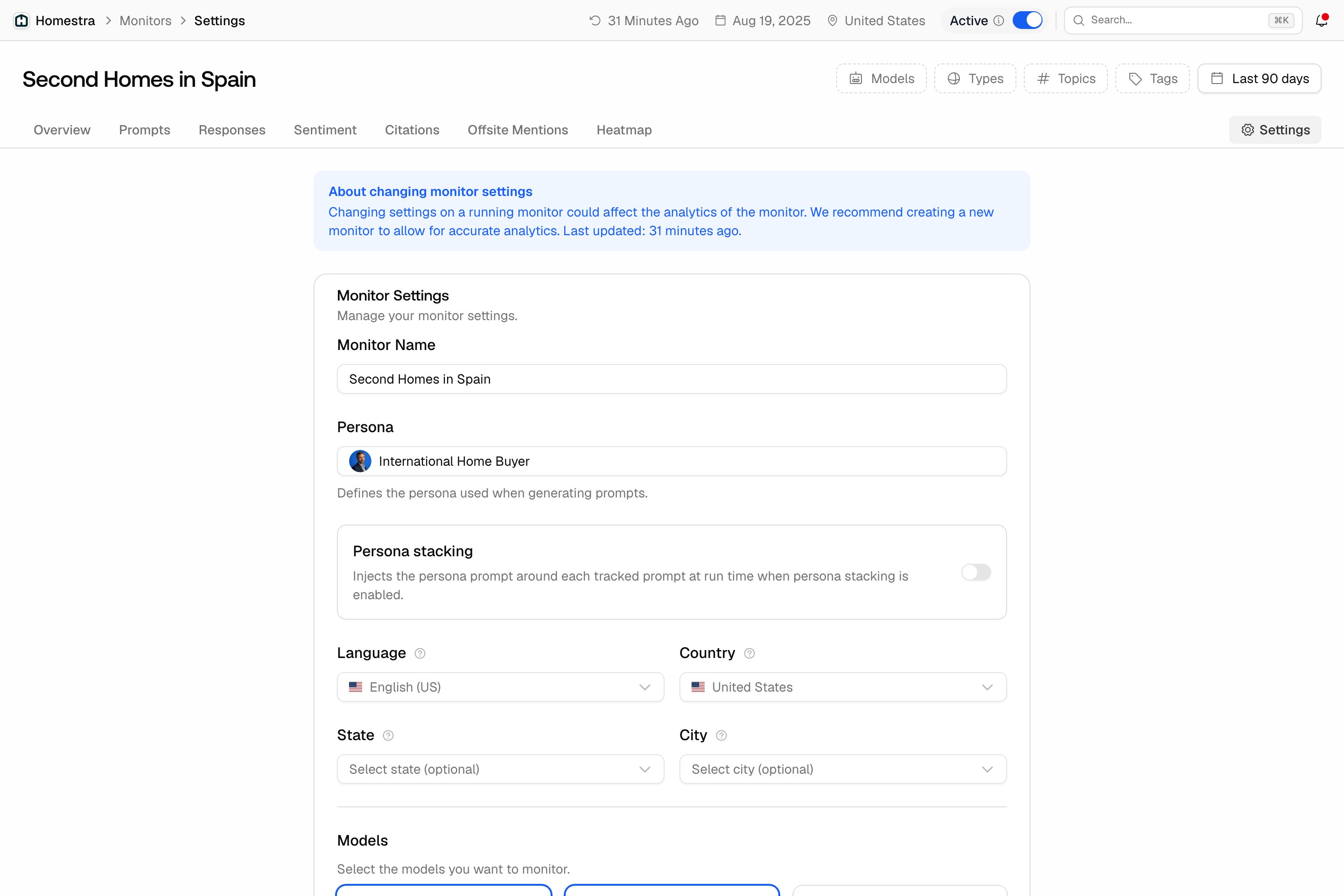
The Settings tab of a Promptwatch monitor, showing the settings form with the warning that changing settings on a running monitor could affect its analytics. Click Save changes to apply. If you add models to an active monitor, the new models are scheduled immediately, so responses start arriving without waiting for the next regular run. One caution before editing a running monitor: the settings page opens with a warning that changing settings could affect the monitor’s analytics. The reason is your time series: if you switch a monitor’s country or persona mid-flight, the chart mixes responses from two different setups and the trend stops meaning one thing. For a change that big, use Copy to new monitor at the bottom of the settings form instead. It opens the create dialog pre-filled with the current monitor’s location, models, and frequency, named “(Copy)” after the original (the persona is not copied), so the old series stays clean and the new setup starts its own.

Pausing a monitor

Every monitor page shows a pill in the top-right corner reading Active or Inactive, with a toggle next to it. Switch the toggle off to pause the monitor:
  • Tracking stops: the monitor no longer runs its prompts against the models.
  • Its data leaves your dashboard: responses from an inactive monitor are excluded from your visibility analytics while it’s paused. Nothing is deleted; the history comes back the moment you reactivate.
  • Its prompts stop counting against your plan: the active prompt quota only counts prompts inside active monitors, so pausing frees room for prompts elsewhere.
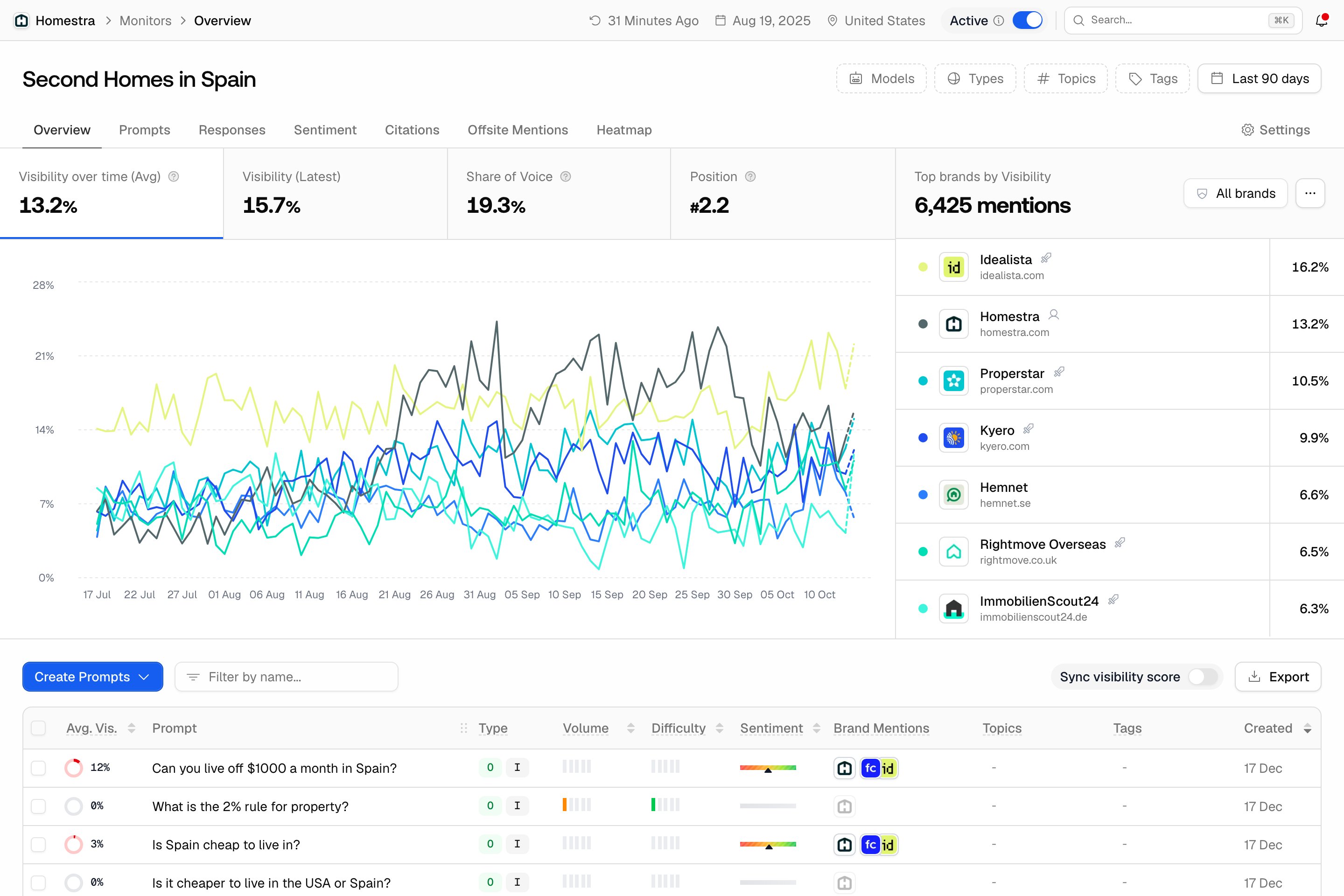
A Promptwatch monitor page with the Active pill and its toggle in the top-right corner of the header. An inactive monitor shows a banner (“This monitor is inactive.”) with an Activate button, and you can also flip the header toggle back on. Reactivating re-checks your plan’s active prompt limit, because the monitor’s prompts start counting again: if they no longer fit, you’ll be prompted to upgrade or free up prompts first. On reactivation the monitor schedules a fresh run right away rather than waiting for the next cycle. Pausing is the right tool for seasonal campaigns, markets you’re deprioritizing, or temporarily freeing quota. If you’ll never need the data again, delete instead.

Deleting a monitor

Deletion lives at the bottom of the Settings tab, in the Delete Monitor card:
  1. Open the monitor and go to Settings.
  2. Scroll to the Delete Monitor card and click Delete monitor.
  3. Type the monitor’s name to confirm, then click Yes, delete monitor.
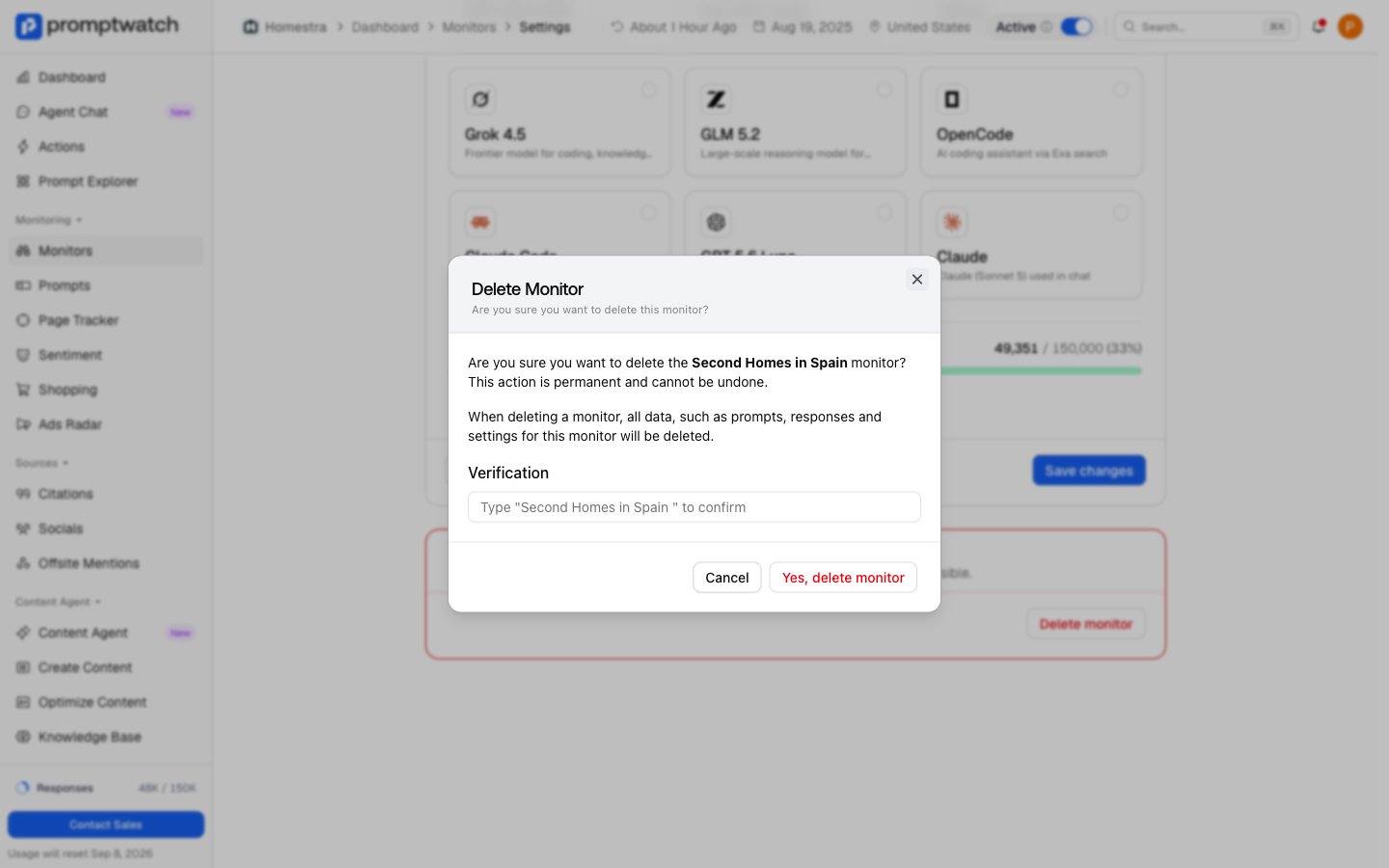
The Delete Monitor confirmation dialog in Promptwatch, asking you to type the monitor's name before it can be deleted. The typed confirmation is there because the action is heavy: all data for the monitor, including its prompts, responses, and settings, is deleted, and it cannot be undone. If some of the prompts are still worth tracking, move them to another monitor before deleting.

After you’re done

An edited monitor keeps collecting under its new settings, immediately for added models, from the next run for the rest. A paused monitor holds its history until you flip it back on. A deleted monitor disappears from the monitors list and from every chart. For managing what’s inside a monitor, prompt by prompt, see working with prompts.