

Catch a block before it costs you visibility
Bot-protection rules block AI crawlers silently: human traffic looks normal while a provider gets 403s for weeks, and your citations on that platform quietly decay.- Open Crawler Logs weekly. The comparison cards cover the ChatGPT, Claude, Perplexity, and Mistral citation bots; scan the crawl trend or Top Crawlers for the other bots. A crawler down sharply against the previous period is your trigger.

- Filter by that crawler plus status codes 403 and 500. Concentrated 403s mean a firewall or bot-fight rule; check your CDN’s security settings against the bot’s published identity.
- After fixing, watch the trend with the 24-hour preset, minute-level granularity shows the crawler returning the same day rather than making you wait a week.
Validate a site migration
After a URL restructure, AI crawlers keep requesting the old paths they have indexed.- In the Top Pages tab, sort by error rate right after the migration. Old paths returning 404 rise to the top.
- Redirect every 404’d path that used to earn crawls; the crawler is telling you it still values that content.
- Over the following weeks, check the Top Pages tab for the new URLs with a range starting at the migration; First Crawled there is the first request in the selected range.
Measure whether new content gets picked up
You published a cluster of pages and want to know if AI models noticed.- Make sure the sitemap includes the new URLs, sitemap updates are a common crawl-spike trigger.
- Filter Crawler Logs by the new section’s path. On the Top Pages tab, set the range to start at publish and read First Crawled: that’s the first request in the selected range, so a range from publish day gives you discovery time per page.
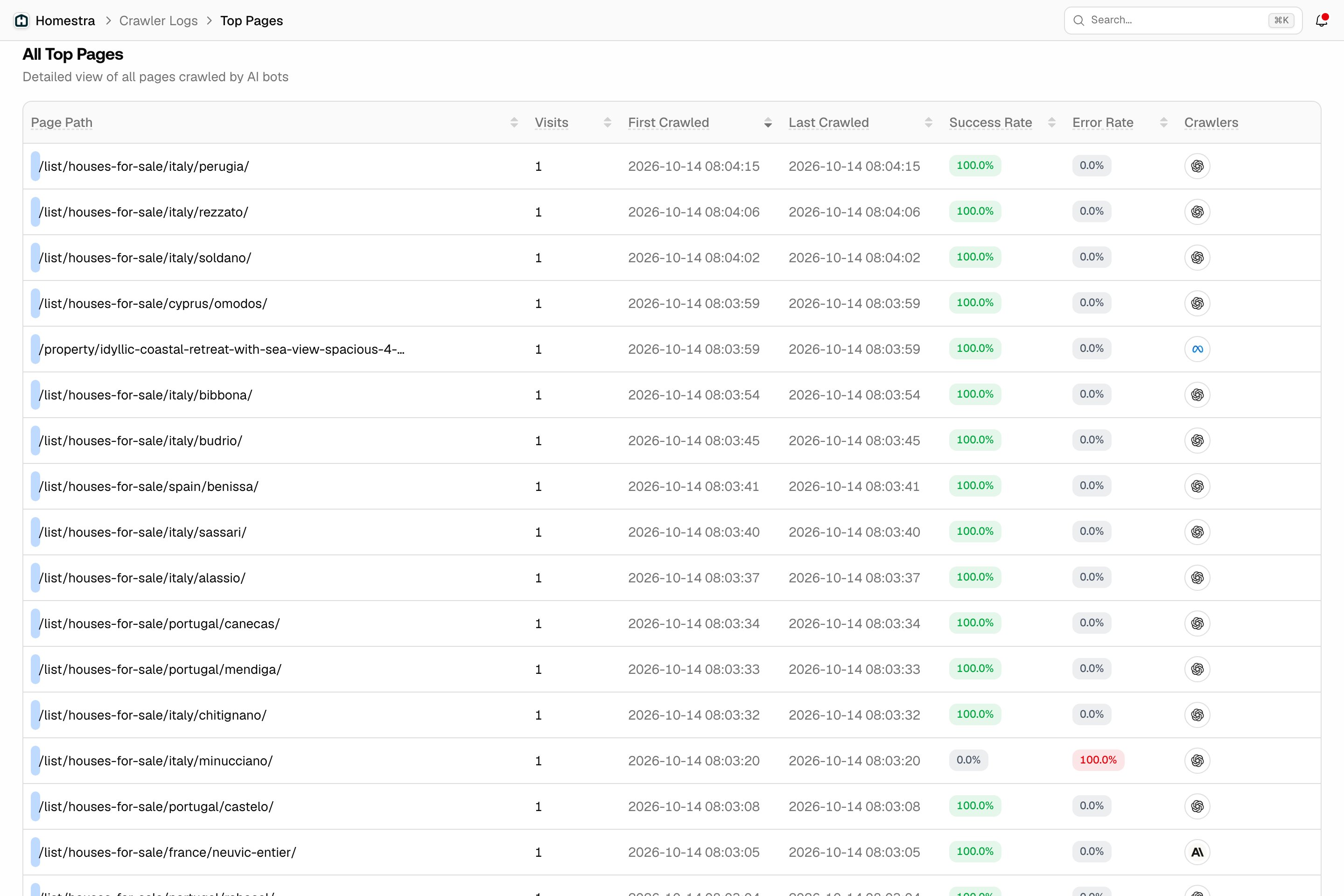
- Add the pages to the Page Tracker so crawls, citations, and clicks for the cluster sit in one view as they develop.
Compare providers and spot the missing one
- Set Last 90 days and read Top Crawlers for the highest-volume bots. It’s a top-10 list, so use the crawler filter or the crawl trend to check a specific low-volume provider.
- If a provider’s search or citation bots never appear, they either can’t reach you or haven’t found you. Check robots.txt for an accidental block of its user-agent tokens (Crawlability lists the bot types), then check your CDN rules. Training-only bots like GPTBot are a separate question.
- Cross-reference with your visibility per model: weak visibility on a model whose bots never crawl you is an access problem before it’s a content problem.
See which AI platforms send humans, not just bots
Crawl volume is attention from machines; the business case needs humans.- In visitor analytics, read top sources and referrer stats: visits per AI platform.
- Compare against crawl share. A provider that crawls heavily but refers few visitors either cites you poorly or cites pages that don’t invite clicks; check those pages’ positioning in actual responses.
- Compare landing pages against your cited pages to find citations that never convert to traffic.